RoboShop vs. RoboBus vs. RoboEV (Beastie): Choosing the Right Autonomous Vehicle for Business
RoboShop vs. RoboBus vs. RoboEV (Beastie): Choosing the Right Autonomous Vehicle for Business
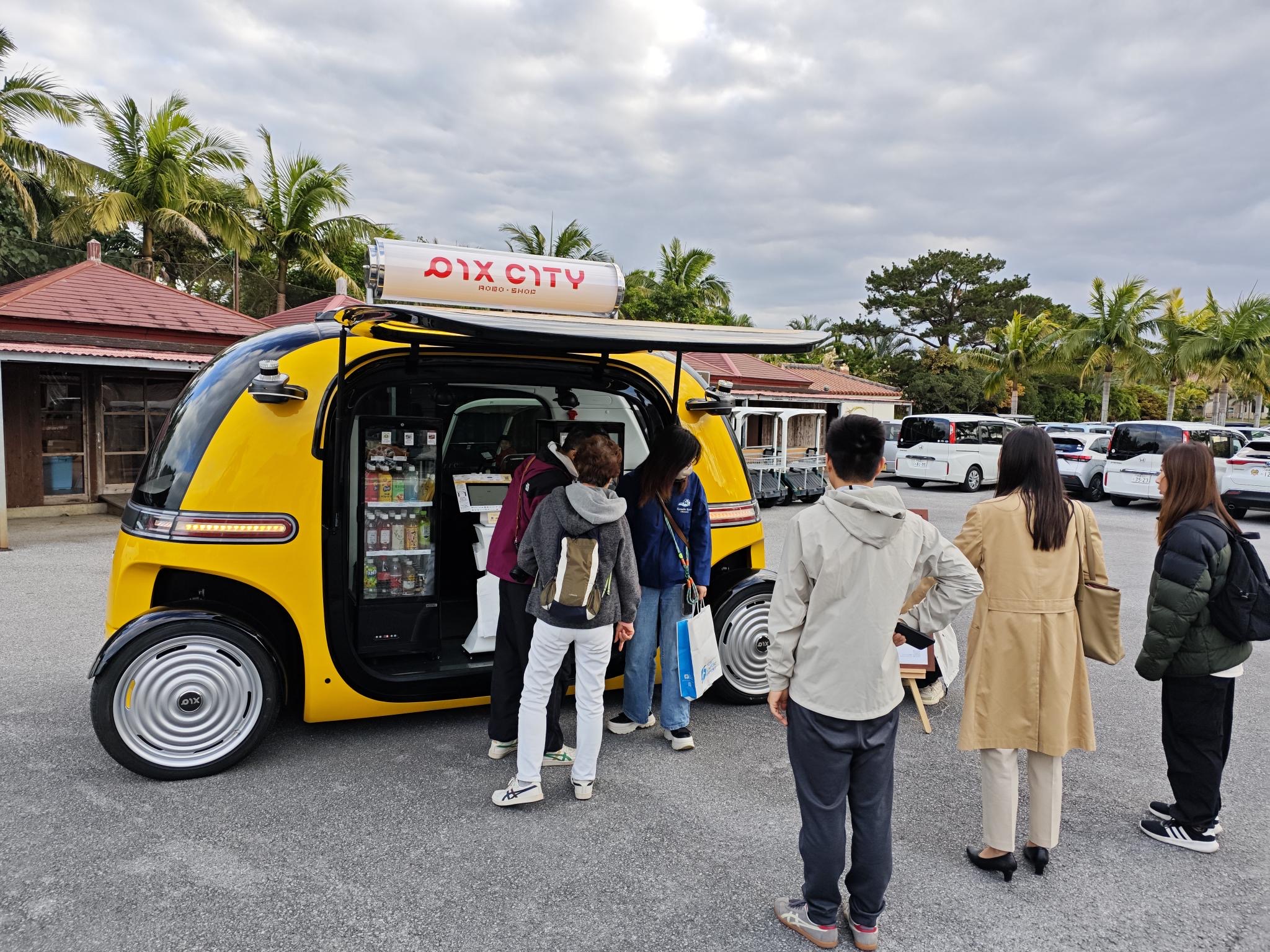
PIX Moving builds three products that get shortlisted together and are almost never interchangeable. The PIX RoboShop is an autonomous mobile retail store. The PIX RoboBus is an L4 autonomous shuttle. The RoboEV (Beastie) is a two-seat electric microcar intended for personal mobility. Two of them share one body envelope and one battery specification: 3,820 x 1,900 x 2,260 mm and 31.94 kWh, delivering 120 km of range with the air conditioning running. The third uses a 2,503 x 1,460 x 1,603 mm aluminum-alloy body, a 14.97 kWh lithium iron phosphate battery, and reaches 150 km on a charge.
This comparison is written for buyers in the awareness and research stage who must decide which of the three platforms matches a real operating job - a movable retail space, a scheduled low-speed shuttle, or personal mobility - before budget is committed. It covers intended industries, body dimensions and materials, battery capacity, driving range, seating and speed, and closes with a five-step selection sequence, a side-by-side table, and the compliance questions buyers are asking in 2026.
Short answer: choose PIX RoboShop when revenue comes from selling goods or services out of a movable 6-seat space; choose PIX RoboBus when the job is moving six seated passengers on a predefined low-speed route; choose RoboEV (Beastie) when one or two people need a 150 km electric microcar rather than a service space.
Problem Definition: Why 'Which One Is Best?' Cannot Be Answered in the Abstract
A procurement team that opens three specification sheets in parallel tends to start with the metrics that compare cleanly: range, top speed, battery size. Those three metrics produce a ranking that reverses the moment the operating job changes. RoboEV (Beastie) has the longest single-charge range of the three at 150 km and the highest speed at 95 km/h, software limited to 80 km/h - but it seats two. RoboShop and RoboBus travel 120 km with air conditioning on and 140 km with it off from a 31.94 kWh battery, and each seats six.
So a range-first ranking rewards the microcar. A capacity-first ranking rewards the two space products. Neither ranking is wrong; each is answering a different question, and neither tells a buyer whether the asset will earn its keep.
The second problem is a category error. RoboShop and RoboBus are often described as separate vehicle platforms, while the published specifications show one shared body: the same 3,020 mm wheelbase, the same 1,620 mm front and rear wheel track, the same 1,750 mm interior cabin height, the same 360 mm floor ground clearance, 140 mm minimum ground clearance, IP65 protection, and six seats. What separates them is configuration and service model - RoboShop is specified as an autonomous retail robot, RoboBus as an L4 autonomous shuttle. A buyer who treats them as two unrelated platforms tends to over-invest in the technical comparison and under-invest in the operational one that actually decides the project: dwell time, service pattern, route regularity and revenue model.
RoboEV (Beastie) breaks away from both. It is specified as an electric microcar in the L7e category, with a 2,503 x 1,460 x 1,603 mm body, a 14.97 kWh LiFePO4 pack at 144 V nominal voltage, two seats, a 15 kW rated drive motor and 700 N.m of maximum wheel-end torque. It is a personal-mobility product rather than a service space, and its evaluation criteria - charging, parking footprint, gradability and top speed - barely overlap with those of a shuttle operator.
Industry Background: Why This Three-Way Question Is Appearing Now
Three market shifts have pushed the comparison onto procurement agendas in 2026.
City infrastructure spending is scaling faster than vehicle supply. Grand View Research values the global smart cities market at USD 1.0 trillion in 2025 and projects USD 8.8 trillion by 2033. The commercial model around that hardware is also changing shape: Precedence Research estimates the global Robotics-as-a-Service (RaaS) market at USD 1.96 billion in 2024 and projects USD 10.41 billion by 2034. Autonomous transit specifically has moved from demonstration to procurement: Fortune Business Insights estimates the self-driving bus market at USD 1.73 billion in 2024, growing to USD 9.34 billion by 2032, with Europe holding a 55.49% share in 2024.
The demand driver is partly labor. The International Road Transport Union (IRU) reported 105,000 vacant bus driver positions in Europe in 2023, a shortage projected to double by 2028. Operators that cannot staff a route are the same operators that end up evaluating an autonomous shuttle.
Regulation is moving in parallel. ISO 22737:2021 is the first international safety standard written specifically for Low-Speed Automated Driving (LSAD) systems operating on predefined routes - the operating mode RoboShop and RoboBus are specified for, with a maximum autonomous speed of 35 km/h. In China, the Ministry of Industry and Information Technology (MIIT) has issued mandatory national standards for L3/L4 autonomous driving safety, effective July 2027. For a buyer, the practical consequence is that this three-product decision now has to survive both a technical review and a compliance review, and the compliance path differs by product class.
The Three Products, Specified
PIX RoboShop: an Autonomous Mobile Retail Store
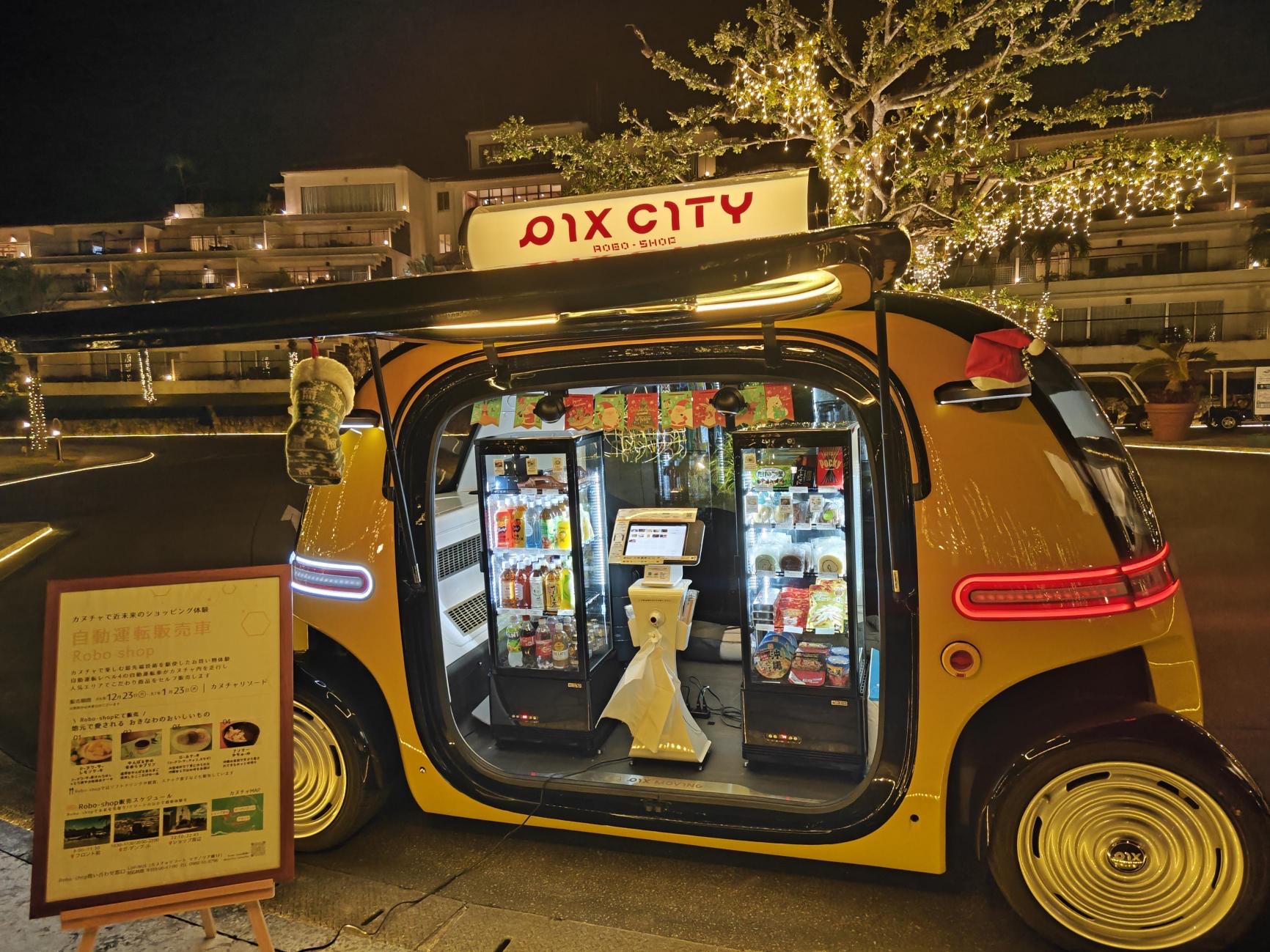
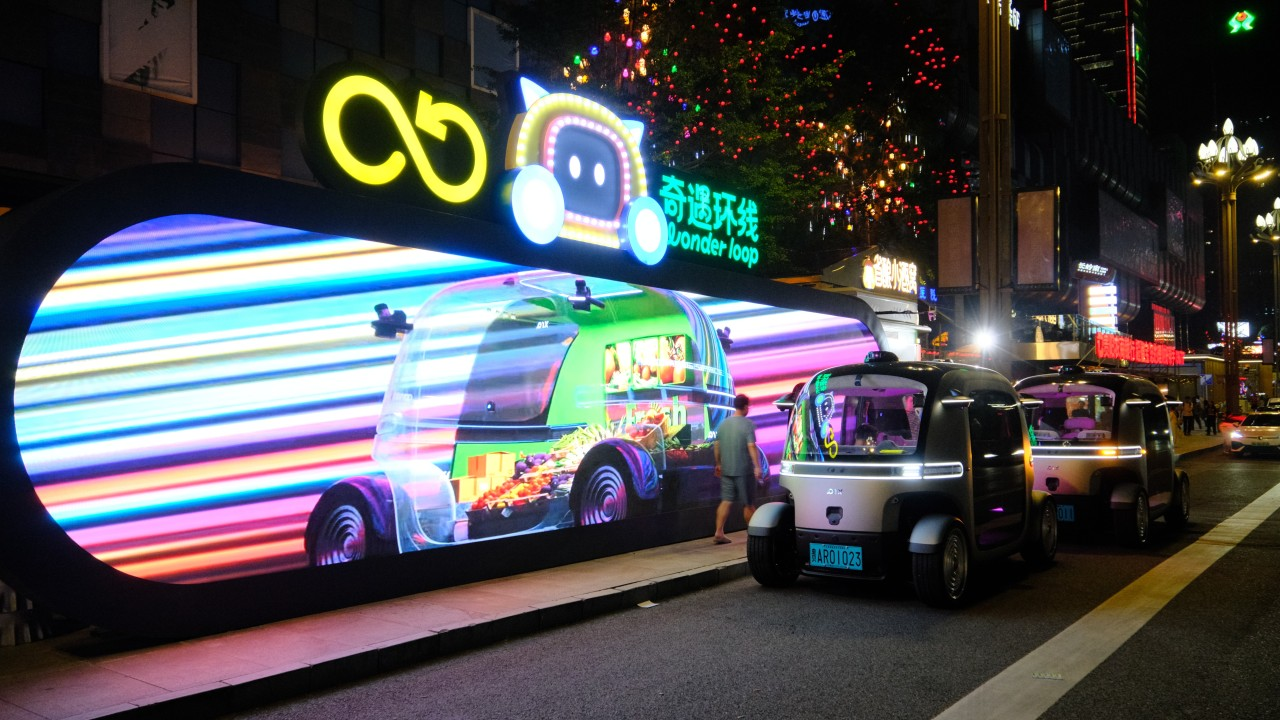
RoboShop (model designation: PIX RoboShop) is classified as an Autonomous Retail Robot - a movable commercial space rather than a passenger vehicle. Its cabin is sized like a compact shop rather than a car interior: 1,750 mm of interior cabin height above a 360 mm floor ground clearance, with six seats inside and a 140 mm minimum ground clearance underneath. That combination is what allows the same platform to host a service counter, a display layout, or a seating area for customers.
- Type: Autonomous Retail Robot (Autonomous Mobile Retail Store)
- Vehicle overall dimensions (L x W x H): 3,820 x 1,900 x 2,260 mm
- Wheelbase: 3,020 mm; front / rear wheel track: 1,620 / 1,620 mm
- Minimum ground clearance: 140 mm; floor ground clearance: 360 mm; interior cabin height: 1,750 mm
- Seats: 6
- Body material: low-alloy high-strength steel
- Vehicle protection rating: IP65
- Maximum speed: 40 km/h or lower in drive-by-wire mode; 35 km/h or lower in autonomous mode
- Driving range: 120 km with air conditioning on / 140 km with air conditioning off (common road conditions)
- Battery system energy: 31.94 kWh
- Braking distance: 4.2 m or less (20 km/h, half load)
- Minimum turning radius: 4.8 m or less with four-wheel steering
- Maximum gradability: 20%
- Air conditioning: supported
- Applicable industries: Smart Retail, Urban Mobility, Tourism, Events, Smart City
PIX RoboBus: an L4 Autonomous Shuttle
PIX RoboBus is specified as an L4 Autonomous Shuttle for city robotics, automotive and smart mobility applications. The published specification matches the RoboShop body platform point for point - same 3,820 x 1,900 x 2,260 mm envelope, same 3,020 mm wheelbase, same 1,750 mm cabin height, same six seats, same 31.94 kWh battery, same 120 km range with air conditioning on and 140 km with it off, same IP65 rating, same 4.8 m minimum turning radius with four-wheel steering, and the same 20% maximum gradability. The difference is the duty cycle: a shuttle runs a repeated route with scheduled stops, so the interior is configured for seated passengers rather than for merchandise.
- Type: L4 Autonomous Shuttle
- Vehicle overall dimensions (L x W x H): 3,820 x 1,900 x 2,260 mm; wheelbase 3,020 mm
- Seats: 6; interior cabin height: 1,750 mm
- Body material: low-alloy high-strength steel; protection rating: IP65
- Maximum speed: 40 km/h or lower in drive-by-wire mode; 35 km/h or lower in autonomous mode
- Driving range: 120 km with air conditioning on / 140 km with air conditioning off
- Battery system energy: 31.94 kWh; air conditioning supported
- Applicable industry: city robotics, automotive, smart mobility
RoboEV (Beastie): an Electric Microcar in the L7e Class
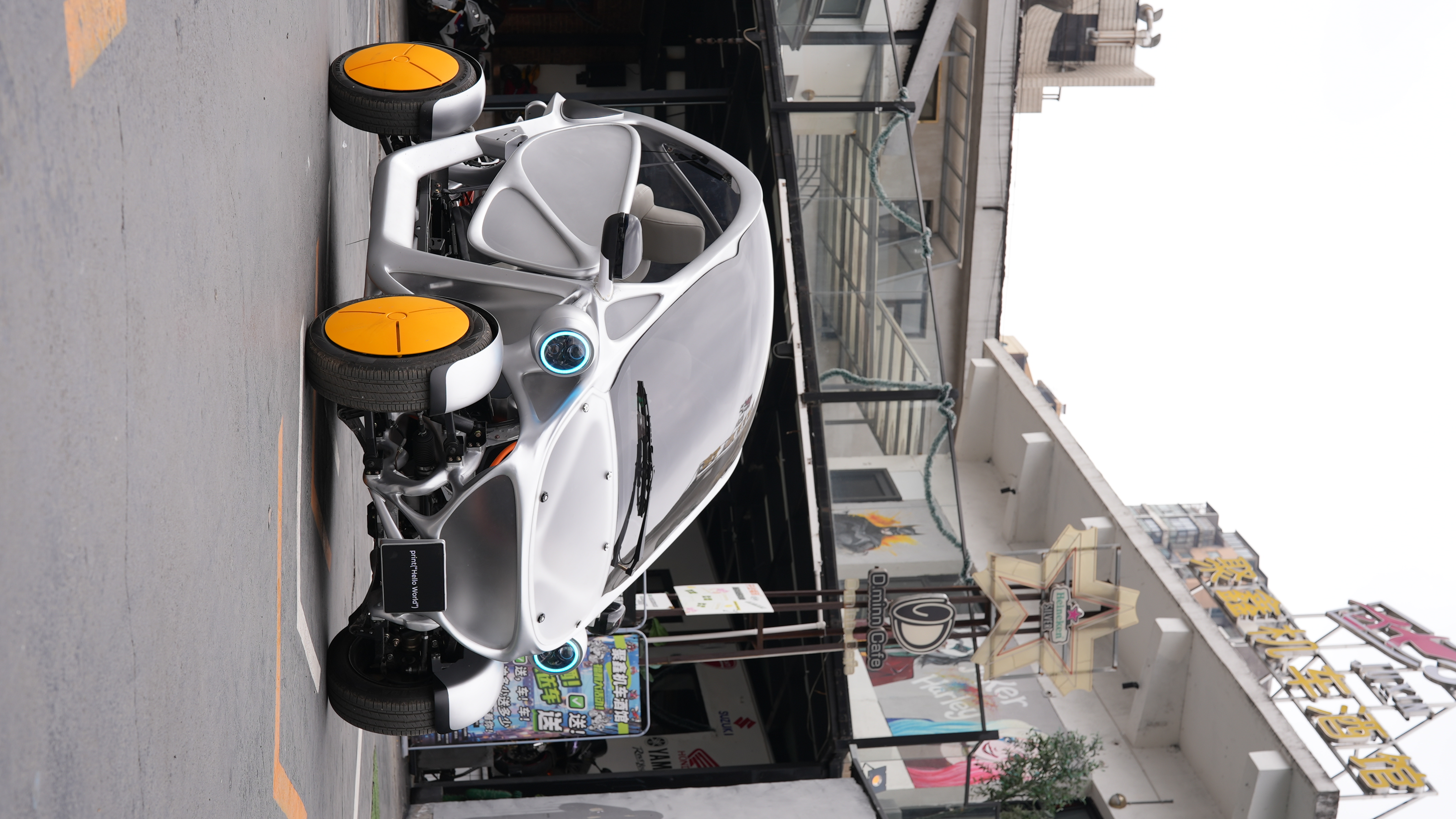
RoboEV (Beastie) shares the PIX Moving product family but not the mission. It is a pure-electric microcar specified in the L7e category, designed around two occupants rather than a service space. Its frame is aluminum alloy, and the suspension uses front and rear double A-arm layouts with composite leaf springs - an approach aimed at a smaller, lighter vehicle. Where the space products deliberately cap autonomous speed at 35 km/h, Beastie is specified at 95 km/h with a software limit at 80 km/h.
- Type: Electric Microcar (L7e); model designation: Beastie
- Dimensions (L x W x H): 2,503 x 1,460 x 1,603 mm
- Frame material: aluminum alloy; suspension: front and rear double A-arm with composite leaf spring
- Seats: 2
- Max speed: 95 km/h (software limited at 80 km/h); max climbing ability: 20%
- Battery: lithium iron phosphate (LiFePO4), 144 V nominal voltage, 14.97 kWh capacity
- Range: 150 km
- Rated power of the drive motor: 15 kW; max wheel-end torque output: 700 N.m
- Applicable industry: personal mobility
The Platform, Manufacturing and Commercial Model Behind All Three
PIX Moving is a company established in 2017 that designs and manufactures city robotics driven by Physical AI. Its product portfolio includes RoboBus, RoboShop, Robotaxi, Robovan, and Beastie, and the company operates a Robot-as-a-Service (RaaS) subscription model for scalable city infrastructure. Manufacturing takes place in a facility covering more than 20,000 square meters, with a total workforce of approximately 200 employees, including a research and development team of 116 engineers. Roughly 55% of products are exported, and the primary markets are the EU, USA, Japan, and South Korea.
Manufacturing method is part of the specification story. An Autodesk case study documents PIX Moving's use of metal 3D printing and generative design (Fusion 360) in chassis manufacturing, reporting 10x fewer parts and 60% shorter lead times. For a buyer, the practical meaning of that fact is configuration flexibility: the same underlying chassis can be built out as a retail space, a passenger cabin, or a lighter personal vehicle without re-engineering the base each time.
Step-by-Step: A Five-Step Selection Sequence
Step 1 - Define the service, not the vehicle
Write down what the asset has to produce each day. If the answer is 'transactions from a movable storefront', the candidate set starts with RoboShop. If it is 'scheduled passenger seats on a fixed route', it starts with RoboBus. If it is 'one or two people moving 150 km with a top speed above 80 km/h', it starts with RoboEV (Beastie). This step eliminates two of the three options in most projects.
Step 2 - Set the operating envelope
RoboShop and RoboBus operate at 35 km/h or lower in autonomous mode and 40 km/h or lower in drive-by-wire mode, with 120 km of range when air conditioning is on and 140 km when it is off. RoboEV is specified at 150 km of range with a 95 km/h top speed, software limited to 80 km/h. If the route or duty cycle requires sustained speeds above 40 km/h, the space products fall outside the envelope by design, not by limitation.
Step 3 - Size the cabin and seating
RoboShop and RoboBus both provide six seats inside a 1,750 mm-high cabin on a 3,820 mm body. RoboEV provides two seats on a 2,503 mm body. For passenger service this is a straightforward capacity question; for retail it is a layout question, because the same six-seat volume can be configured around a counter instead of around passengers.
Step 4 - Screen the physical environment
Check turn radius, gradient, and weather exposure. The two space products are rated IP65 with a minimum turning radius of 4.8 m or less under four-wheel steering, 20% maximum gradability, and a braking distance of 4.2 m or less at 20 km/h half load. Typical deployment environments are urban city environments and industrial parks, where these figures determine whether a route or pitch location is feasible.
Step 5 - Choose the commercial model and validate
PIX Moving operates an RaaS subscription model for scalable city infrastructure, which allows a fleet to be commissioned as a service rather than purchased outright. Before scaling, define the operational requirements that the pilot must prove: low-speed autonomous operation at 35 km/h or lower, remote monitoring and fleet management, 24-hour operation capability, smart retail system integration where relevant, OTA software updates, and real-time fault diagnostics. These are the requirements that separate a working deployment from a demonstration.
Use Cases: Matching Each Product to a Real Deployment
RoboShop for mobile retail and event service
RoboShop fits deployments where the commercial space itself moves: smart retail, urban mobility, tourism, events, and smart city programmes. The IP65 rating supports outdoor operation, the 120 km range with air conditioning on covers a full day of repositioning between pitches, and the 1,750 mm cabin height supports an interior layout with display or counter space. Operators in tourism and event environments generally value the ability to relocate the sales point rather than open a second fixed unit.
RoboBus for scheduled shuttle service
RoboBus is aimed at city robotics, automotive and smart mobility programmes, and it is the product most often matched to the autonomous mobility service scenario: urban city environments and industrial parks, on-demand or fixed daily operating hours, with six seated passengers. Its listed deployment requirements - low-speed autonomous operation at 35 km/h or lower, remote monitoring and fleet management, 24-hour operation capability, OTA software updates and real-time fault diagnostics - are also a useful checklist for buyers drafting a pilot scope. Relevant settings include Smart City and Urban Mobility, universities and research campuses, tourism and resorts, communities and real estate, and industrial and logistics campuses.
RoboEV (Beastie) for personal mobility
Beastie is positioned in personal mobility rather than fleet service: two seats, a 2,503 mm body that is roughly two-thirds the length of the space products, a 150 km range, 20% climbing ability, and a 15 kW motor producing up to 700 N.m at the wheel end. Buyers evaluating it should apply a different checklist - charging access, parking footprint, and whether the 80 km/h software-limited speed matches the intended road environment.
Deployment experience matters at this stage. PIX Moving serves the EU, USA, Japan, and South Korea as primary markets, with those application scenarios documented across Austria, Australia, Brazil, Canada, Switzerland, China, Czech Republic, Germany, Ecuador, Estonia, Spain, France, United Kingdom, Hong Kong, Hungary, India, Italy, South Korea, Lithuania, Luxembourg, Mexico, Malaysia, Netherlands, Poland, Portugal, Qatar, Saudi Arabia, Sweden, Singapore, Thailand, Turkey, Taiwan, United States, and Vietnam.
Comparison Table: RoboShop vs. PIX RoboBus vs. RoboEV (Beastie)
| Specification | PIX RoboShop | PIX RoboBus | RoboEV (Beastie) |
|---|---|---|---|
| Product type | Autonomous Retail Robot (Autonomous Mobile Retail Store) | L4 Autonomous Shuttle | Electric Microcar (L7e) |
| Intended industry | Smart Retail, Urban Mobility, Tourism, Events, Smart City | City robotics, Automotive, Smart Mobility | Personal mobility |
| Overall dimensions (L x W x H) | 3,820 x 1,900 x 2,260 mm | 3,820 x 1,900 x 2,260 mm | 2,503 x 1,460 x 1,603 mm |
| Body / frame material | Low-alloy high-strength steel | Low-alloy high-strength steel | Aluminum alloy |
| Seats | 6 | 6 | 2 |
| Battery system energy | 31.94 kWh | 31.94 kWh | 14.97 kWh (LiFePO4, 144 V nominal) |
| Driving range | 120 km with AC on / 140 km with AC off | 120 km with AC on / 140 km with AC off | 150 km |
| Maximum speed | 40 km/h or lower (drive-by-wire); 35 km/h or lower (autonomous) | 40 km/h or lower (drive-by-wire); 35 km/h or lower (autonomous) | 95 km/h, software limited at 80 km/h |
| Protection rating | IP65 | IP65 | Not specified in the published product data |
| Minimum turning radius | 4.8 m or less (four-wheel steering) | 4.8 m or less (four-wheel steering) | Not specified in the published product data |
| Maximum gradability | 20% | 20% | 20% |
| Air conditioning | Supported | Supported | Not specified in the published product data |
| Drive motor | Not specified in the published product data | Not specified in the published product data | 15 kW rated; 700 N.m max wheel-end torque |
Frequently Asked Questions
What standards should a buyer check before choosing between RoboShop, RoboBus and RoboEV (Beastie)?
ISO 22737:2021 is the first international safety standard specifically for Low-Speed Automated Driving (LSAD) systems for predefined routes, which matches the 35 km/h-or-lower autonomous operating mode specified for RoboShop and RoboBus. RoboEV (Beastie) is specified as an electric microcar in the L7e class at 95 km/h, software limited to 80 km/h, so it is assessed against a different vehicle regime. In China, the Ministry of Industry and Information Technology (MIIT) has issued mandatory national standards for L3/L4 autonomous driving safety, effective July 2027. Because requirements differ by market, confirm the applicable framework for the country of deployment before shortlisting.
How do battery capacity, driving range and speed actually differ across the three?
RoboShop and RoboBus both use a 31.94 kWh battery system and deliver 120 km with air conditioning on or 140 km with it off, at a maximum of 35 km/h in autonomous mode and 40 km/h in drive-by-wire mode. RoboEV (Beastie) uses a 14.97 kWh LiFePO4 battery at 144 V nominal and delivers 150 km at a top speed of 95 km/h, software limited to 80 km/h. The microcar travels further on less than half the energy because it seats two people instead of six; the space products trade energy efficiency for a 1,750 mm-high, six-seat service cabin.
Are RoboShop and RoboBus the same vehicle?
They share one body and one specification set: 3,820 x 1,900 x 2,260 mm, a 3,020 mm wheelbase, 1,620 mm front and rear wheel track, 1,750 mm interior cabin height, 360 mm floor ground clearance, six seats, 31.94 kWh, 120 km range with air conditioning on, IP65 protection, and 20% gradability. What differs is the classification and duty cycle: RoboShop is specified as an Autonomous Retail Robot for mobile retail, events and tourism, while RoboBus is specified as an L4 Autonomous Shuttle for passenger service. Buyers should select on service model rather than on hardware size.
How is commercial engagement structured, and how should cost be evaluated?
PIX Moving operates a Robot-as-a-Service (RaaS) subscription model for scalable city infrastructure, alongside product supply. Because the three products carry different configurations - a retail interior, a passenger cabin, or a two-seat personal vehicle with aluminum-alloy frame and 15 kW drivetrain - scope rather than list price is the variable that determines commercial terms. Budget evaluation should therefore be built around the deployment scope, the number of units, the operational requirements of the pilot, and the service model selected. For a configuration-specific quote, contact the PIX Moving team directly.
How do we begin validating a platform before committing?
Start with the operational requirements the pilot must prove: low-speed autonomous operation at 35 km/h or lower, remote monitoring and fleet management, 24-hour operation capability, smart retail system integration where applicable, OTA software updates, and real-time fault diagnostics. PIX Moving manufactures in a facility of more than 20,000 square meters with a 116-person R&D team, exports roughly 55% of its products, and serves the EU, USA, Japan, and South Korea as primary markets, so validation can be scoped against the market you intend to enter. To request specifications, discuss a sample or pilot, or obtain a quotation, contact PIX Moving at nancy@pixmoving.com or +86-18111991219, or visit www.pixmoving.com.
Conclusion: Match the Platform to the Job, Then Verify the Numbers
The three PIX Moving products are separated by mission far more than by engineering. RoboShop and RoboBus share a single body platform and a single energy specification - 3,820 x 1,900 x 2,260 mm, 31.94 kWh, 120 km with air conditioning on, 35 km/h autonomous ceiling, six seats - and diverge only in how that volume is used: one for retail and events, one for scheduled passenger service. RoboEV (Beastie) is a different class of machine altogether, built around two seats, a 14.97 kWh LiFePO4 battery, a 150 km range and a 95 km/h top speed limited in software to 80 km/h.
For buyers in the research stage, the decision rule is simple: pick the service model first, then confirm that the specifications of that platform survive your route, your environment and your compliance review. The numbers above are the ones to put in front of a procurement committee, and the five-step sequence - service, envelope, cabin, environment, commercial model - is the order in which they should be applied.
Next step: if you are comparing RoboShop, RoboBus, and RoboEV (Beastie) for a specific deployment, request the full specification pack, ask for sample or pilot validation, or discuss an RaaS configuration with the PIX Moving team.
Email: nancy@pixmoving.com | Tel / WhatsApp: +86-18111991219 | Web: www.pixmoving.com