
Thermoforming Plastic Sheet Roll: Printed Sheets Guide

A printed sheet project in Printing & Display Applications uses thermoforming plastic sheet roll as the printing substrate: the sheet is printed in roll or sheet form and then cut, laminated or converted into the finished component. Four requirements decide whether that job runs cleanly — a smooth surface, dimensional stability, a consistent appearance, and ink adhesion that matches the printing process — and the operation itself is specified for a clean, dry indoor environment with controlled temperature and humidity.
This guide is written for the people who have to make that specification hold: converters running screen, UV or digital presses, display printers buying roll stock, and brand owners approving printed retail components. It covers the failure modes that appear before the press does, the four substrate requirements in shop-floor terms, how PET, PP and HIPS rolls differ on the data sheet, the print-to-convert workflow step by step, and the points that belong in a purchase order.
The sheet range behind this guide is PULIXIN's thermoforming plastic sheet roll line, manufactured by Pulixin Packaging Materials (Shanghai) Co., Ltd., a Shanghai-based sheet manufacturer operating 14 co-extrusion lines with an annual output above 40,000 tons.
Why printed sheet projects fail before the press does
Most printed rigid sheet problems are decided before the first impression. They fall into three technical groups, each of which maps to a requirement that can be written into a specification instead of discovered at the end of a run.
Surface defects that print through. Print sits directly on the sheet, so any variation in surface finish shows up in the printed image. A surface that is not uniform leaves the printer compensating with ink laydown or press settings rather than correcting the cause, and the compensation rarely holds across a second batch.
Movement between printing and conversion. A printed sheet is not finished when it leaves the press. It still has to be cut, laminated, creased or folded, and if the sheet does not hold its dimensions, registration at the die or the laminator drifts. The scrap then appears downstream of the operation that caused it, which makes the root cause harder to find.
Ink that does not anchor. Adhesion is a property of the pair — ink system plus sheet surface — not of the sheet alone. Screen, UV and digital processes differ in ink chemistry, deposit thickness and cure, which is why the printing record frames this as "suitable ink adhesion according to printing process" rather than as a single pass-or-fail value.
A fourth failure is commercial rather than technical: roll stock chosen on thickness and price alone, with no agreed surface treatment, colour reference or roll format. That gap typically surfaces as a batch the press cannot repeat, after the artwork has already been approved.
Where printed sheet roll sits in printing and display
The application data places printed sheets under Printing & Display Applications, covering printing and retail display work. The sheet's function is the printing substrate, the project type is printed sheets, and the operation mode is sheet or roll printing followed by cutting, laminating or converting. The supporting equipment named for the application is screen printing equipment, UV printing equipment and digital printing equipment, together with cutting and laminating machines.
That equipment list explains why rigid roll stock is bought instead of finished board. The same substrate has to survive three different ink-deposition methods and then a mechanical conversion step, and each stage inspects the sheet against a different criterion.
Two external reference points help when the material crosses borders. Grand View Research valued the global thermoformed plastic market at USD 14.79 billion in 2023; the figure covers thermoformed plastics broadly rather than printing substrates specifically, so it is context, not a demand forecast for this application. For customs purposes, thermoforming plastic materials fall under HS heading 3920 for non-cellular sheet and 3921 for cellular sheet, per Customs Info / WCO guidance. The distinction matters because a converter importing roll stock and a brand owner importing printed components are not describing the same transaction.
The four substrate requirements in shop-floor terms
Smooth surface
Smoothness protects image quality, and it is also the requirement most often left implicit, because "smooth" is not a number. The practical fix is to name the surface condition on the specification — including any treatment the sheet carries — and to approve a physical reference sample that both the printer and the sheet supplier hold. PET surface treatments listed in the product data include hard coating, silicon coating, corona treatment, laminated film and coating; which one applies follows from the printing process, not from the material alone.
Dimensional stability
Dimensional stability keeps print registration and cut registration in agreement. It begins at manufacturing: PULIXIN's quality control covers thickness tolerance, width accuracy, appearance and mechanical properties, with every batch inspected against those criteria. At the press the check is simpler — measure the printed sheet when it comes off the machine and again after conversion, then compare. If the two measurements disagree, the variables to examine are the sheet, the drying or curing step, and the storage conditions between them.
Consistent appearance
Consistency matters most in multi-panel work: a display assembled from sheets of two batches shows a seam even when each sheet passes on its own. Appearance is partly a material choice — PET is supplied transparent or in customised colours, PP and HIPS in natural, white, black or customised colours, and HIPS additionally in glossy or matte surface — and partly a batch-control question. Specify a colour reference and ask how appearance is verified per batch rather than per order.

Ink adhesion matched to the process
Adhesion is a system property. The three processes named in the application record — screen, UV and digital — place different demands on the sheet surface, so the same roll can behave differently across them. Two controls follow: state the ink system and the printing process on the purchase specification, and validate adhesion on that exact combination using a test that reflects the finished part, including any creasing or cutting the sheet will undergo.
Material options: PET, PP and HIPS sheet roll
All three materials are supplied in roll form with defined thickness, width, colour, surface and structure options — the attributes a printer evaluates when matching a substrate to a press. Printability itself appears in the application records as a stated requirement: the transparent folding box record lists good printability among its special requirements and relates to PET sheet, while the daily consumer goods blister record lists printability when required and relates to PET, PP and HIPS sheet rolls.
PET Thermoforming Plastic Sheet Roll
PET is the sheet named in the printed-sheets application record. The line covers APET, rPET, GAG, PETG, food-grade PET, transparent PET, anti-fog, anti-block, anti-scratch and anti-static ESD variants, with thickness from 0.18 mm to 1.7 mm, width from 250 mm to 1,400 mm, roll weight from 50 kg to 800 kg per roll, transparent or customised colour, and mono-layer or multi-layer structure. The wide width range is the detail that matters in display work, where printed panels are often larger than packaging blanks.
PP Thermoforming Plastic Sheet Roll
PP runs from 0.3 mm to 2 mm in thickness and 300 mm to 900 mm in width, in natural, white, black or customised colour, with mono-layer or multi-layer structure. The line includes normal PP, conductive black PP, antistatic PP, PP/PE and high- or low-temperature-resistant PP. Its thicker gauge ceiling suits printed components where stiffness matters more than clarity.
HIPS Thermoforming Plastic Sheet Roll
HIPS covers 0.24 mm to 2 mm thickness and 300 mm to 900 mm width, in natural, white, black or customised colour, with glossy or matte surface and customised roll size. Variants include normal HIPS, conductive black HIPS, antistatic HIPS, high- and low-temperature-resistant HIPS and light-blocking HIPS. The glossy or matte decision is directly relevant to print appearance: both are legitimate specifications, but a single display programme should not mix them.
Co-extruded and multi-layer structures
All three lines are offered in mono-layer or multi-layer construction, and multi-layer co-extrusion is listed among PULIXIN's customisation options alongside thickness, width, colour, surface finish and roll size. For a printed project the question to settle is which layer faces the press and which faces the product, because that decides whether the printed surface and the functional surface are the same face.
Step-by-step: from artwork to converted printed sheet
- Fix the conversion route first. Decide whether the printed sheet will be cut, laminated or converted — the three options in the record — because the route sets which sheet properties matter after printing.
- Choose the material family. PET where the printed sheet needs clarity, the widest width range or the PET surface-treatment options; PP or HIPS where the project is driven by gauge, stiffness or colour rather than transparency.
- Set the gauge and a tolerance. Thickness is quoted as customised, so the purchase order needs a nominal value plus an agreed tolerance rather than a range alone.
- Name the surface treatment and appearance. Specify colour or transparency and, where the sheet carries one, the surface treatment — hard coated, silicon-coated, corona treatment, laminated film or coating on the PET line — matched to the press.
- Define the roll format. Width, roll weight and roll size are all customisable; PET is quoted at 50 kg to 800 kg per roll. Roll weight affects changeover frequency at the press and handling at the converter.
- Condition the workplace. The application record specifies a clean, dry indoor processing environment with controlled temperature and humidity. Treat room condition as part of the process window, because dimensional stability and ink adhesion are both stated requirements.
- Print on the matched equipment. Screen printing, UV printing or digital printing equipment, per the process chosen and the ink system validated in step four.
- Cut, laminate and convert. Cutting and laminating machines carry out the route fixed in step one. For folding-box work the sequence continues through die cutting, creasing, folding and box assembly.
- Inspect and release. Check print cure and adhesion, sheet flatness, cut registration and appearance against the approved reference before the lot moves to packing.
Working conditions and roll handling
A clean, dry indoor processing environment with controlled temperature and humidity is the stated working condition for printed sheets, and it is the one condition that applies to both the printer and the converter. Two practical consequences follow. First, the pressroom and the storage area should hold the same condition — a sheet that is stable at the press but stored differently between printing and cutting has not been tested under one condition. Second, rolls should stay protected and dry in storage, because surface condition is the first requirement in the specification and the easiest one to lose outside the press.
Neither point requires new equipment. It requires that the condition stated in the application record appears in the job documentation rather than remaining an assumption held by one operator.
Use cases
Printed folding boxes and retail display boxes
Transparent folding box work is the clearest printed-sheet case in the application data, covering transparent folding boxes, cosmetic boxes, gift boxes and retail display boxes. The workflow runs sheet printing, die cutting, creasing, folding and box assembly on a printing machine, die-cutting machine and creasing and folding equipment. The special requirements listed for that application are high transparency, smooth surface, good printability, dimensional stability and suitable folding performance — a combination that shows why the sheet has to be specified as a system rather than as a gauge and a width.

Printed sheets for cutting, laminating and converting
The general printed-sheets case is broader: print in sheet or roll form, then convert. Here the sheet's job ends at a converted component rather than an assembled box, so the critical checks shift toward cut accuracy, laminate compatibility and the flatness of the printed sheet after handling.
Where the printed-sheets record stops
The record does not cover printing followed by thermoforming. That boundary is worth stating plainly, because PET forming temperatures are high enough to matter: South Plastic's thermoforming guide puts PET forming at roughly 130 °C to 160 °C (266 °F to 320 °F). Print applied before forming would pass through that heat cycle, so a print-then-form project needs its own validation of ink, adhesion and registration instead of inheriting the assumptions of this workflow.
Material comparison at a glance
| Attribute | PET | PP | HIPS |
|---|---|---|---|
| Material | PET / APET / rPET | Polypropylene (PP) | Polystyrene (PS) / HIPS |
| Thickness (customised) | 0.18–1.7 mm | 0.3–2 mm | 0.24–2 mm |
| Width (customised) | 250–1,400 mm | 300–900 mm | 300–900 mm |
| Colour | Transparent / customised | Natural / white / black / customised | Natural / white / black / customised |
| Surface | Depends: hard coated, silicon-coated, corona treatment, laminated film, coating | Depends | Glossy / matte |
| Structure | Mono-layer / multi-layer | Mono-layer / multi-layer | Mono-layer / multi-layer |
| Roll size | 50–800 kg/roll, customised | Customised | Customised |
| Forming process | Vacuum / pressure forming | Vacuum / pressure forming | Vacuum / pressure forming |
| Position in the printed-sheets record | Named as the related sheet | Printability documented in the blister record | Printability documented in the blister record |
What to put in the purchase specification
- Material family and grade — APET, rPET, PETG, GAG, food-grade PET, or the PP or HIPS variant.
- Nominal thickness plus tolerance, not a range alone.
- Width, roll weight and roll size.
- Colour or transparency reference agreed against a physical sample.
- Surface treatment, matched to the printing process.
- Structure: mono-layer or multi-layer, and which face is printed.
- Ink system and printing process — screen, UV or digital.
- Conversion route: cut, laminate or convert.
- Packing and labelling requirements.
- MOQ and required delivery window.
- Inspection criteria and any third-party testing requirement.
Quality control, order quantities and delivery
Each batch passes raw material inspection, thickness and width control, appearance inspection, in-process quality control and finished product inspection, with third-party testing available when required. That sequence matters for printed work because two of the four substrate requirements — dimensional stability and consistent appearance — are verified by inspection rather than by a single press test, so the inspection record is the evidence a printer can carry forward between batches.
Order quantities follow the material: standard PET is 5 tons and standard PP or PS is 3 tons, with customised products potentially carrying different MOQ. Delivery generally ranges from 7 to 15 days depending on material, specification, order quantity and customisation. Monthly production capacity is approximately 3,500 tons and may vary with production schedule and product specification, supported by 14 co-extrusion lines in a 20,000 m² production base and exports to more than 55 countries.
Frequently asked questions
Which printing processes can run on thermoforming plastic sheet roll for printed sheets?
The printed-sheets application record names three processes: screen printing, UV printing and digital printing, supported by cutting and laminating machines for the conversion step. The sheet is printed in roll or sheet form and then cut, laminated or converted. Because the processes differ in ink system and cure, adhesion should be validated on the actual press and ink combination.
What must the substrate provide for a printed sheet job?
Four requirements are stated for printed sheets: a smooth surface, dimensional stability, consistent appearance, and suitable ink adhesion according to the printing process. The job also runs in a clean, dry indoor environment with controlled temperature and humidity.
Can PULIXIN supply PET thermoforming plastic sheet roll for food packaging as well as for printed sheets?
Yes. The PULIXIN PET line includes food-grade PET sheet roll alongside APET, rPET, GAG, PETG, transparent, anti-fog, anti-block, anti-scratch and anti-static ESD variants, from 0.18 mm to 1.7 mm thick and 250 mm to 1,400 mm wide in transparent or customised colour. PET is also the sheet named in the printed-sheets application record. Where the printed part contacts food, EU Regulation (EU) No 10/2011 governs plastic materials and articles intended to come into contact with food, so the compliance route is agreed before printing.
What thickness and width can I order across PET, PP and HIPS?
PET: 0.18–1.7 mm thickness and 250–1,400 mm width. PP: 0.3–2 mm thickness and 300–900 mm width. HIPS: 0.24–2 mm thickness and 300–900 mm width. All are quoted as customised, so a purchase order should state a nominal value plus tolerance rather than a range alone.
What are the MOQ and delivery time?
Standard PET is 5 tons and standard PP or PS is 3 tons; customised products may carry different MOQ. Delivery generally ranges from 7 to 15 days depending on material, specification, order quantity and customisation. Monthly production capacity is approximately 3,500 tons and may vary with production schedule and product specification.
How do I request a quotation or a trial roll for a printed sheet project?
Send the material family, nominal thickness and tolerance, width, roll weight, colour or transparency reference, surface treatment, printing process and ink system, conversion route and required quantity to PULIXIN: Carrie, operation01@pulixin.com, +86 13818585204 (also WhatsApp), No.32 Lubin Rd, Luyuan Industrial Zone, Pudong, Shanghai, China.
Turning the four requirements into an order
Printed sheet work is decided by four things that can all be written down: surface, dimensional stability, appearance and ink adhesion. A specification that names material family, nominal gauge and tolerance, width and roll weight, surface treatment, colour reference, ink system and conversion route converts those four requirements into something the sheet supplier and the press operator can both be held to — and it makes a second batch comparable with the first.
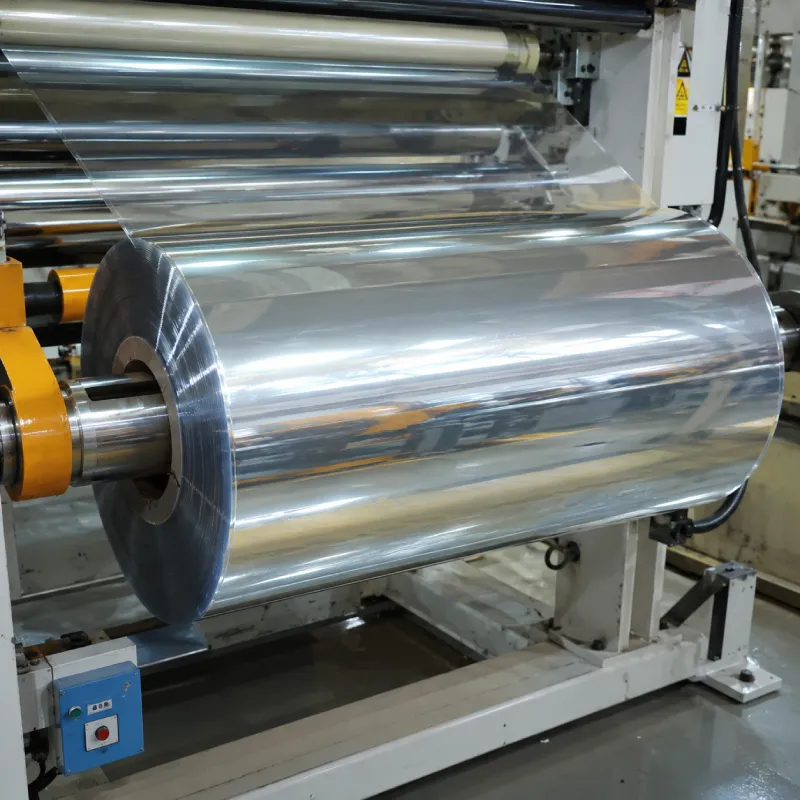
If you are scoping a printed sheet job, start with the sample and the specification rather than the price per ton: PULIXIN's technical team supports material selection, thermoforming application and product specification, and can review the sheet choice against your press, ink system and conversion route. The full range is summarised in the PULIXIN product catalogue (PDF).
Have Questions or Need More Details?
Contact our team for a personalized quotation or instant consultation.
Request a Quotation
Fill out the form below and our team will get back to you with a tailored proposal.
WhatsApp Direct Chat
Prefer to chat in real-time? Message us on WhatsApp for instant assistance & quick answers.
- Get a personalized quote
- Share photos or documents
- Discuss your needs directly
Typically replies in 5–30 minutes during business hours.