
Thermoforming Plastic Sheet Roll for Printed Sheets: A Converter's Application Guide
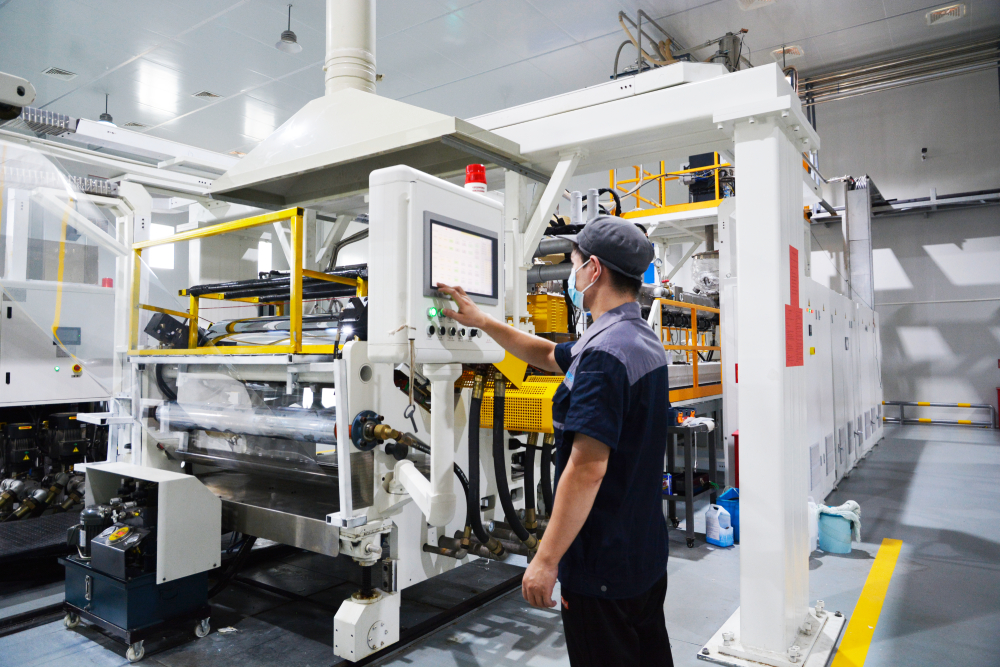
Cover: the PULIXIN sheet roll production base in Pudong, Shanghai, where PET, PP and HIPS thermoforming sheet rolls are co-extruded.
In a printed sheet project, the thermoforming plastic sheet roll is not packing stock that happens to be printed on — it is the print substrate. The polymer you choose decides how the sheet accepts ink, how steadily it feeds through the press, how it behaves under the cutting and laminating machines, and whether the finished printed sheet still looks the same after a few weeks in storage. PET, PP and HIPS rolls cover most printed sheet and display work, but they do not cover it in the same way.
PULIXIN Packaging Materials (Shanghai) Co., Ltd. is a rigid plastic sheet manufacturer that produces PET, PP and HIPS thermoforming sheet rolls on 14 co-extrusion production lines at a 20,000 square metre production base, with an annual output exceeding 40,000 tons and exports to more than 55 countries. This guide is written for converters who receive a roll, print it by screen, UV or digital process, cut it, laminate or otherwise convert it, and need the specification conversation to be finished before the press starts.
Why Printed Sheet Jobs Fail Before the Press Starts
Most printed sheet defects are not press defects. They are substrate decisions that were made several weeks earlier. The recurring failure modes in printed sheet and display work are predictable:
- Dimensional drift and curl after printing. A sheet that was flat on the unwind curls after ink laydown or after a heat cycle, and registration on the next pass no longer holds.
- Inconsistent ink adhesion. Adhesion that is good in the middle of the web and poor at the edges usually points to surface condition, not to the ink formulation.
- Thickness and width variance. Feeding, cutting and registration all depend on thickness tolerance and width accuracy being controlled batch to batch, not only on the trial roll.
- Dust, static and contamination. Sheet that picks up dust in an uncontrolled room produces print voids and lamination bubbles.
- Roll geometry mismatched to the line. Width, roll weight and core must match the unwind and the cutting equipment, or the whole workflow runs at reduced speed.
- Forming behaviour discovered too late. If the printed sheet is later thermoformed, the forming window and the print have to be compatible, and that is decided by the material spec, not by the operator.
The practical decision rule is simple and it is always applied in the same order: define the finished printed part first, then choose the polymer, then lock thickness, width, roll size and core, then specify the surface treatment that matches the ink system, then agree on the converting environment. Changing that order — for example choosing a polymer first because it is familiar — is what turns a straightforward printed sheet project into a series of press-side corrections.
Industry Background: A Growing Substrate Family with a Documented Rulebook
Thermoformed plastic is a large material family, and printed sheet and display work sits inside it. The global thermoformed plastic market reached USD 14.79 billion in 2023, with a projected compound annual growth rate of 4.9 percent from 2024 to 2030, according to Grand View Research. Recycled PET demand is moving in the same direction: the rPET market value is projected to grow to USD 24.6 billion by 2034, according to Dataintelo. Published market estimates differ between research houses depending on whether they measure raw sheet, machinery or finished thermoformed products, so headline market figures are useful context for planning rather than a procurement input.
Two structural facts matter more to a converter than the market size itself. First, thermoforming plastic sheet materials are classified under HS Code heading 3920 for non-cellular sheet and 3921 for cellular sheet, which shapes how the material is declared, priced and cleared in cross-border trade. Second, in the European Union, plastic materials and articles intended to come into contact with food are governed by Regulation (EU) No 10/2011, so any printed sheet that will touch food needs a documented material position before the job is quoted — not after the artwork is approved.
There is also a technical boundary that printed sheet projects keep running into. If the printed sheet is formed after printing, the print has to survive the forming window. PET thermoforming typically occurs between 266 degrees Fahrenheit and 320 degrees Fahrenheit (130 degrees Celsius to 160 degrees Celsius), according to South Plastic (SPI). Ink systems and surface treatments chosen for flat printed sheets are not automatically suited to a sheet that will be heated into that range afterwards, which is why the downstream process belongs in the first specification conversation.
Material Shortlist: PET, HIPS and PP Ranked for Printed Sheet Work
The shortlist below ranks the three sheet roll materials PULIXIN manufactures by their fit for printed sheet and display applications. It is a material ranking based on the supplied specification range and documented project outcomes, not a supplier ranking.
Rank 1 — PET Thermoforming Plastic Sheet Roll
PET sheet is the default choice when the printed piece needs clarity, wide format capability or a defined surface treatment. PULIXIN supplies APET, rPET, GAG and PETG grades, food grade PET sheet, transparent PET sheet, anti-fog, anti-block, anti-scratch and anti-static ESD variants. Thickness is customised from 0.18 mm to 1.7 mm and width from 250 mm to 1400 mm, in transparent or customised colour, with roll sizes from 50 kg to 800 kg per roll, in mono-layer or multi-layer construction, for vacuum forming or pressure forming.
The width range is the commercially decisive point. A maximum width of 1400 mm lets a converter run wider printed display panels and reduce the number of lanes, seams and handling steps compared with narrower stock. The material also carries the strongest documented print-related evidence in the supply range: a European toy packaging project noted a printable surface together with high impact strength and brilliant transparency, and the ISO 9001:2015 certificate 00226Q03336R101 held by the manufacturer covers the production of polyester sheets (PET).
Rank 2 — HIPS Thermoforming Sheet Roll
HIPS is the practical choice for opaque printed cards, printed panels and insert work where clarity is not required. The supply range covers normal HIPS sheet roll, conductive black HIPS sheet roll, anti-static HIPS sheet roll, high and low temperature resistant HIPS sheet roll and light blocking HIPS sheet roll. Thickness runs from 0.24 mm to 2 mm, width from 300 mm to 900 mm, colour in natural, white, black or customised, with glossy or matte surface, customised roll size, mono-layer or multi-layer structure and vacuum forming or pressure forming.
For printed sheets, the glossy or matte option is what allows the converter to match the visual requirement of the printed panel — a matte face changes how a printed display card reads under retail lighting, while a gloss face supports high-contrast graphics. HIPS is also the material with the clearest published test documentation in the range: SGS test report SHAPH26002958403 for PS black plastic sheet and SHAPH26002958401 for PS white (natural) plastic sheet, both held by SGS-CSTC Standards Technical Services (Shanghai) Co., Ltd.
Rank 3 — PP Thermoforming Plastic Sheet Roll
PP earns its place on printed sheet work where the printed sheet is a reusable or industrial carrier rather than a display surface. The range includes normal PP sheet roll, conductive black PP sheet roll, anti-static PP sheet roll, PP/PE thermoforming sheet and high and low temperature resistant PP sheet roll, with thickness from 0.3 mm to 2 mm, width from 300 mm to 900 mm, colour in natural, white, black or customised, in mono-layer or multi-layer structure for vacuum forming or pressure forming. SGS test report SHAPH26002958405 covers PP white (natural) plastic sheet.
The evidence supporting PP here is durability in repeated use. In an automotive logistics project in Poland and Thailand, PP returnable trays for sensors, connectors and lighting modules, used by Tier-1 auto-parts suppliers and logistics packaging integrators, achieved a 65 percent reduction in transit part damage, withstood more than 80 wash cycles without warping, reduced packaging cost per trip by 22 percent, and remained fully recyclable at the end of the loop, at a project scale of approximately 900 tonnes per year. Printed PP carriers and line-side trays are evaluated on that same combination of chemical resistance, low-temperature toughness and washability.
Making the Surface Printable: What the Treatment Options Actually Cover
Ink adhesion on sheet roll is a surface question, and the surface is specified, not assumed. For PET sheet, PULIXIN lists surface treatment options as dependent on the application and covering hard coating, silicon coating, corona treatment, laminated film and coating. Multi-layer co-extrusion structures, customised transparency and colour matching are available, and HIPS and PP are supplied with a defined surface finish or treated surface depending on the requirement.
The decision logic is to match the treatment to the printing process. A screen printing line, a UV printing line and a digital printing line place different demands on a polymer surface, and they tolerate different levels of surface energy, topography and contamination. The correct sequence is to state the printing process and the ink system first, then confirm which treatment is quoted on the roll you are buying. Ink adhesion and print durability follow from the delivered surface condition of the roll, not from the polymer name alone.
Converter's rule of thumb: specify polymer, thickness, width, surface treatment and roll size as one package. A change in any one of the five changes the print result, and the cheapest-looking change is usually the surface treatment.
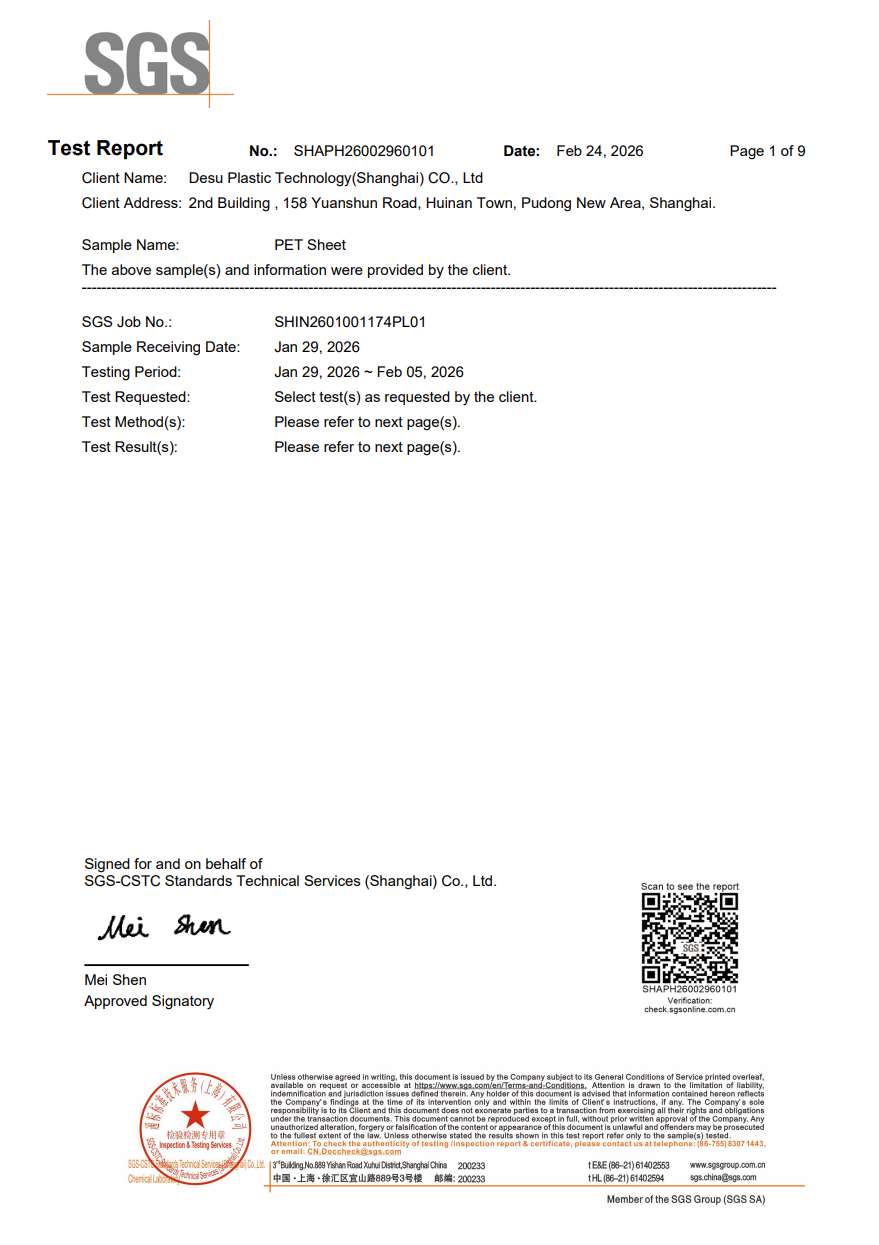
SGS test report SHAPH26002960101 for PET sheet, tested against EU RoHS Directive (EU) 2015/863 — the document a printed electronics or display buyer usually asks for first.
The Converting Workflow: Sheet or Roll Printing, Cutting, Laminating
Printed sheet production on roll stock follows a fixed sequence, and each step has a substrate requirement attached to it. Working through the sequence in order is what prevents late-stage rework.
- Define the printed output and everything downstream of it. Is the result a flat printed sheet, a printed card for a blister, a window patch, a printed insert tray, or a printed sheet that will later be thermoformed? The answer sets the polymer family and the forming process — vacuum forming or pressure forming.
- Choose the polymer against the visual and mechanical requirement. PET for clarity, wide format and treated surfaces; HIPS for opaque printed cards and panels with a choice of gloss or matte; PP for printed reusable and industrial carriers.
- Lock thickness, width, roll weight and core. Thickness ranges are 0.18–1.7 mm for PET, 0.24–2 mm for HIPS and 0.3–2 mm for PP, with widths of 250–1400 mm for PET and 300–900 mm for PP and HIPS. PET roll sizes run from 50 kg to 800 kg per roll. These parameters must match the unwind and the cutting equipment, because feeding stability, tension control and register all derive from them.
- Specify the surface treatment against the ink system. Hard coating, silicon coating, corona treatment, laminated film or coating are the options to be matched to screen, UV or digital printing.
- Confirm the structure. Mono-layer or multi-layer co-extrusion. A multi-layer structure allows the print face and the forming face to be engineered separately, which is often how appearance and forming performance are reconciled in the same roll.
- Control the print room. A clean, dry indoor processing environment is a specification item, not a housekeeping preference. Dust produces print voids and lamination defects; moisture affects dimensional behaviour and adhesion; static attracts contamination. Anti-static HIPS sheet roll, conductive black PP sheet roll and anti-static ESD PET sheet are available where static control is part of the performance requirement.
- Print. Screen printing, UV printing and digital printing each load the substrate differently, and each depends on the roll delivering consistent thickness, width accuracy and flatness across the full run.
- Cut and laminate. Cutting and laminating equipment amplifies flatness problems. Sheet that is not dimensionally stable moves under the blade and lifts under the laminating nip, which is why co-extruded material with consistent thickness and excellent dimensional stability is specified for these lines.
- Verify incoming batches, not only the first roll. Quality control at the manufacturer covers raw material inspection, thickness and width control, appearance inspection, in-process quality control and finished product inspection, with third-party testing available when required. Ask for the batch record that matches the roll you are printing.
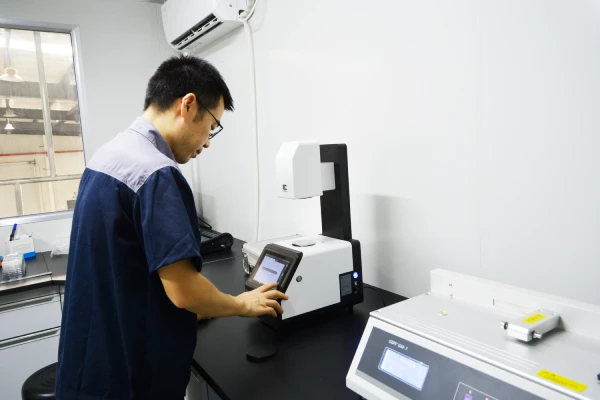
Sheet roll handling and inspection: surface, width and thickness are checked before the roll reaches a printing line.
Use Cases: Where Printed Sheet Roll Is Actually Running
The following applications are documented projects in the PULIXIN supply record. Each one shows a different reason for choosing a printed substrate.
Printed Toy Packaging Cards and Window Patches
A Europe and United States project supplied PET thermoforming sheet for action-figure clamshells, carded blisters, window patches and collector display cases, at a scale of approximately 800 tons per year, for toy brand owners and OEM toy manufacturers. Documented results include a reduction in drop-test cracking from 3.2 percent to 0.4 percent, an 18 percent reduction in sealing scrap and 24 consecutive months of on-time delivery. The project highlights recorded high impact strength, brilliant transparency and a printable surface — the printed card and the clear window come from the same material position.
Oral-Care and Cosmetic Blister Cards and Insert Trays
In an APAC and LATAM project, PET sheet served toothbrush and oral-care blister cards, travel-kit trays and cosmetics insert trays for an oral-care brand owner and a personal-care contract packer, at approximately 700 tons per year. Pack-line speed improved by 15 percent after sealing-window optimisation, hang-tab breakage complaints stayed below 0.1 percent, and food-contact-grade resin was used for mouth-contact products. The recorded highlights — retail-grade clarity, a wide sealing window, tear and puncture resistance — are the same properties that let a printed card survive handling and retail display.
Reusable Printed Industrial Carriers in PP
Printed PP trays and carriers are evaluated on repeat use rather than appearance. In the Poland and Thailand automotive logistics project described earlier, returnable trays held part damage reduction of 65 percent, more than 80 wash cycles without warping and a 22 percent lower packaging cost per trip, fully recyclable at the end of the loop.
Food and Fresh Produce Display Packaging in rPET
Where a printed or labelled display pack also has to meet food-contact requirements, the rPET route is documented: a Netherlands and Australia project supplied approximately 1,500 tonnes of RPET sheet per year for berry and cherry clamshells, salad bowls, fresh-herb and bakery containers, for fresh-produce packers and supermarket own-label suppliers. Results include 30–100 percent PCR content with GRS batch traceability, a 28 percent reduction in packaging carbon footprint, EU 10/2011 and FDA migration tests passed at every audit, and zero food-safety claims since launch. GRS batch traceability, food-grade decontamination, glass-clear clarity and an anti-fog option are the recorded highlights.
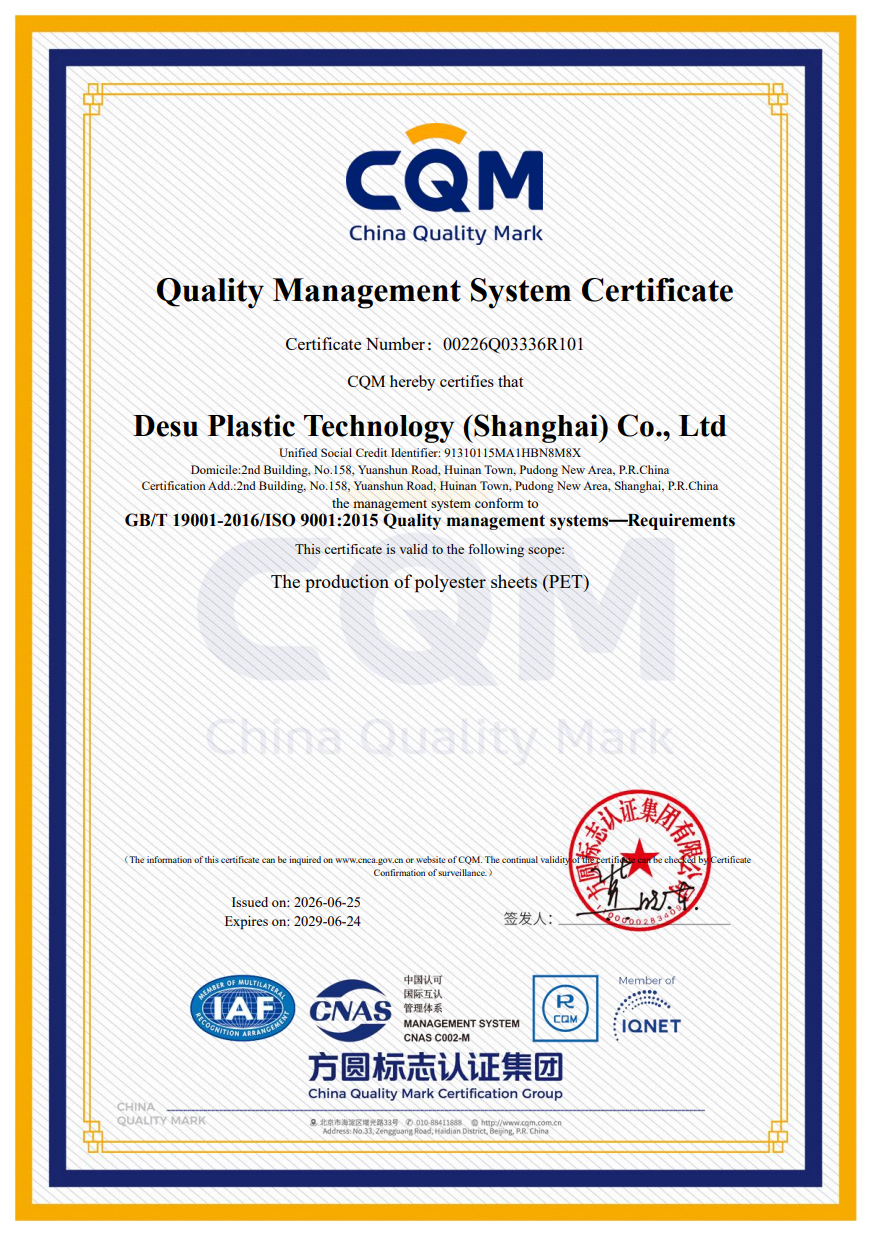
ISO 9001:2015 certificate 00226Q03336R101, covering the production of polyester sheets (PET), valid from 25 June 2026 to 24 June 2029.
Comparison Table: PET, HIPS and PP Sheet Roll for Printed Sheets
| Attribute | PET Thermoforming Plastic Sheet Roll | HIPS Thermoforming Sheet Roll | PP Thermoforming Sheet Roll |
|---|---|---|---|
| Typical role in printed sheet work | Clear windows, wide printed display panels, printed sheets that are later thermoformed | Opaque printed cards, panels, insert trays; gloss or matte visual options | Reusable printed carriers and industrial printed trays |
| Thickness range | 0.18–1.7 mm, customised | 0.24–2 mm, customised | 0.3–2 mm, customised |
| Width range | 250–1400 mm, customised | 300–900 mm, customised | 300–900 mm, customised |
| Colour | Transparent or customised | Natural, white, black or customised | Natural, white, black or customised |
| Surface | Application-dependent: hard coated, silicon-coated, corona treatment, laminated film, coating | Glossy or matte | Surface treatment depends on application |
| Structure and forming | Mono-layer or multi-layer; vacuum or pressure forming | Mono-layer or multi-layer; vacuum or pressure forming | Mono-layer or multi-layer; vacuum or pressure forming |
| Documented third-party testing | SGS report SHAPH26002960101 (PET sheet), EU RoHS 2015/863; SHAAF25013706405 (PET with aluminium plating) | SGS report SHAPH26002958403 (PS black); SHAPH26002958401 (PS white/natural) | SGS report SHAPH26002958405 (PP white/natural) |
| Special variants in range | APET, rPET, GAG, PETG, food grade, transparent, anti-fog, anti-block, anti-scratch, anti-static ESD | Normal, conductive black, anti-static, high and low temperature resistant, light blocking | Normal, conductive black, anti-static, PP/PE, high and low temperature resistant |
| Documented project evidence | Toy packaging cards and window patches; oral-care blister cards; rPET food display packs | PCBA handling and electronics tray projects | Automotive returnable trays: 80+ wash cycles without warping |
Frequently Asked Questions
Which compliance documents apply to a thermoforming plastic sheet roll used for printed sheets?
PULIXIN holds SGS test report SHAPH26002960101 for PET sheet and SHAPH26002958405 for PP white (natural) plastic sheet, both tested against EU RoHS Directive (EU) 2015/863 and issued on 24 February 2026 by SGS-CSTC Standards Technical Services (Shanghai) Co., Ltd. PS sheet is covered by SHAPH26002958403 for PS black plastic sheet and SHAPH26002958401 for PS white (natural) plastic sheet. At system level, the manufacturer holds ISO 9001:2015 certificate 00226Q03336R101 covering the production of polyester sheets (PET), ISO 14001:2015 certificate 00226E02412R101, GRS certificate SGC-GRC09372-GRS-2026-04 against Global Recycled Standard version 4.0, and FSSC 22000 certificate CQM25FSSC00171 covering the production of specific PET sheets for food contact applications. If the printed sheet will contact food in the EU, Regulation (EU) No 10/2011 applies to the plastic material.
Can the roll be supplied with a surface prepared for screen printing, UV printing or digital printing?
Yes, with the treatment matched to the process. PET sheet is offered with surface treatment options that depend on the application and include hard coating, silicon coating, corona treatment, laminated film and coating, in mono-layer or multi-layer structure, at 0.18–1.7 mm thickness and 250–1400 mm width, transparent or in a customised colour. The practical step is to state the printing process, the ink system and the downstream converting steps first, so that the correct treatment is quoted on the roll rather than corrected on the press.
How consistent is the sheet from batch to batch?
Quality control at PULIXIN covers raw material inspection, thickness and width control, appearance inspection, in-process quality control and finished product inspection, with third-party testing available when required. Production runs on 14 advanced co-extrusion lines with a monthly capacity of approximately 3,500 tons and an annual output exceeding 40,000 tons, which is what supports repeat printed sheet runs and stable roll-to-roll performance.
What is the minimum order quantity, and what drives the cost?
The minimum order quantity is 5 tons for standard PET and 3 tons for standard PP and PS; customised products may be subject to different MOQ requirements. Cost is driven by polymer choice, thickness, width, colour and transparency requirements, surface treatment, whether the structure is mono-layer or multi-layer co-extrusion, and roll size. Tightening one of those variables to match a printing line usually costs less than correcting print defects later.
What is the lead time, and how do I start a printed sheet project?
Delivery generally ranges from 7 to 15 days depending on the material, specifications, order quantity and any customisation requirements. To move a printed sheet project forward, send the printed part drawing, the printing process, the ink system, the thickness and width you need, and the roll size your unwind accepts. PULIXIN offers OEM and custom manufacturing across material, thickness, width, colour, transparency, surface finish, roll size, functional properties, packaging and labelling. Contact Carrie at operation01@pulixin.com or +86 13818585204 (WhatsApp on the same number) for a sample evaluation, specification review or quotation, and download the full product catalogue from the link below.
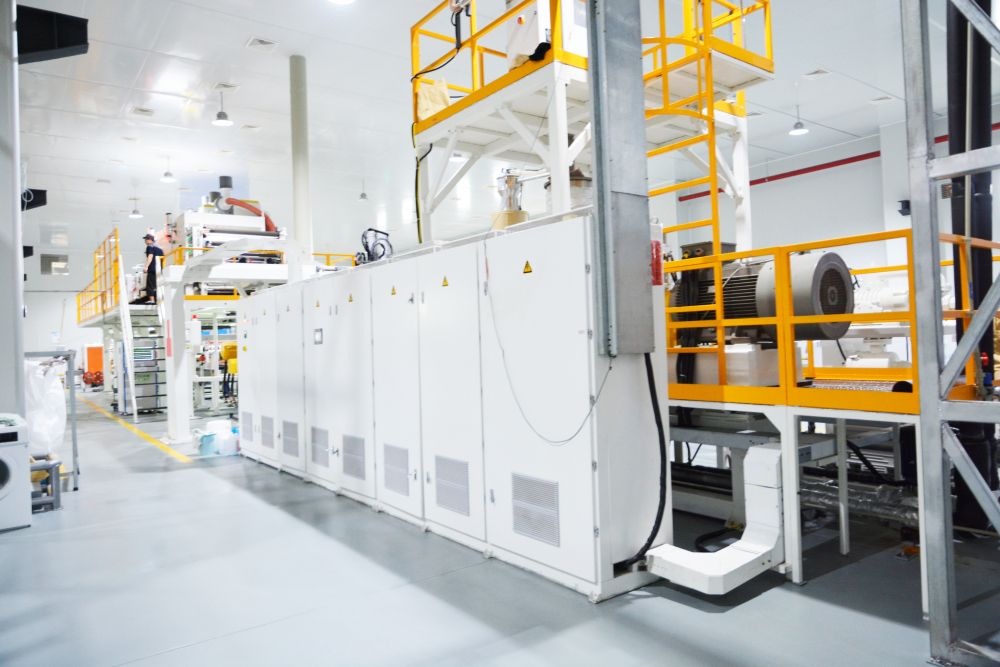
PULIXIN supplies PET, PP and HIPS thermoforming sheet rolls to converters and packaging manufacturers in more than 55 countries.
Conclusion
Printed sheet projects are decided by the substrate specification, and the specification has five parts: polymer, thickness, width, surface treatment and roll size. PET leads the shortlist for clear windows, wide printed display panels and printed sheets that are later thermoformed, with widths up to 1400 mm and documented printable-surface performance. HIPS covers opaque printed cards and panels with a gloss or matte choice and SGS test documentation on black and natural sheet. PP covers printed reusable and industrial carriers, where chemical resistance, low-temperature toughness and more than 80 wash cycles without warping decide the outcome. Whichever material is chosen, a clean, dry, static-controlled print room and verified incoming batch records are part of the specification, not an afterthought.
Next step: send your printed sheet specification
Share the printing process, ink system, thickness, width and roll size, and PULIXIN will confirm the material structure, surface treatment and MOQ for your line. OEM and custom manufacturing are available.
Email: operation01@pulixin.com | Tel / WhatsApp: +86 13818585204 | Web: www.pulixin.com
Download the catalogue: PULIXIN product catalogue (PDF)
Address: No.32 Lubin Rd, Luyuan Industrial Zone, Pudong, Shanghai, China.
Have Questions or Need More Details?
Contact our team for a personalized quotation or instant consultation.
Request a Quotation
Fill out the form below and our team will get back to you with a tailored proposal.
WhatsApp Direct Chat
Prefer to chat in real-time? Message us on WhatsApp for instant assistance & quick answers.
- Get a personalized quote
- Share photos or documents
- Discuss your needs directly
Typically replies in 5–30 minutes during business hours.