
Vetting a Thermoforming Plastic Sheet Roll Supplier for Printing Applications
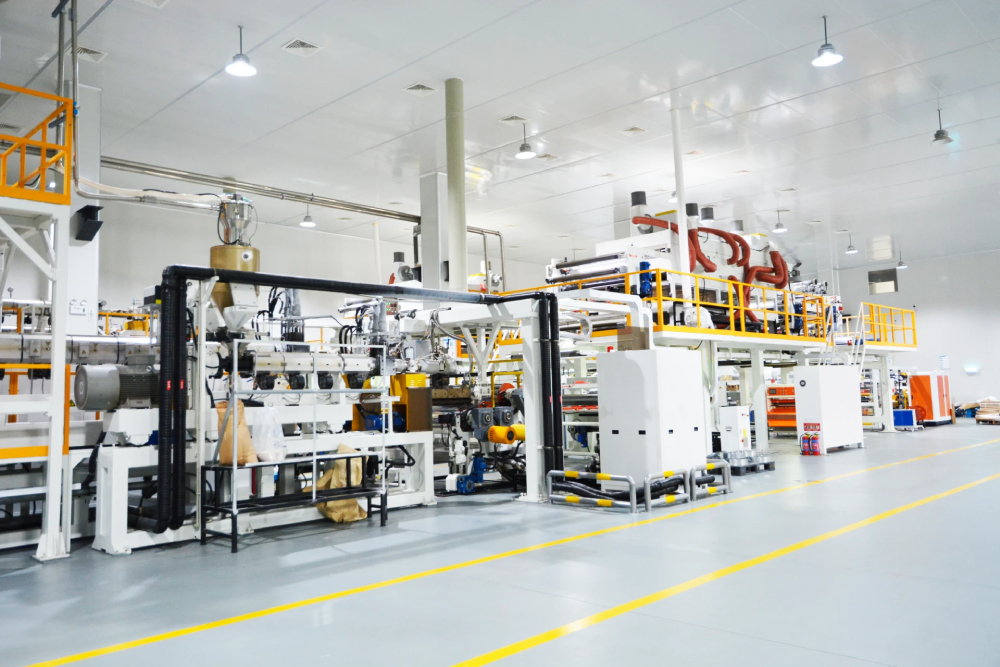
Cover: sheet extrusion and roll handling at the PULIXIN Thermoforming Plastic Sheet production base in Pudong, Shanghai. Image: Pulixin Packaging Materials (Shanghai) Co., Ltd.
Short answer: when a thermoforming plastic sheet roll will be printed, cut, laminated or converted, supplier selection has to be judged on two things that forming-only audits usually miss — a repeatable print surface and dimensional stability that holds registration. Resin grade, nominal thickness and price per kilogram are not enough on their own. The supplier also has to be able to explain, in writing, how its sheet behaves in the steps that come after extrusion: printing, slitting or cutting, lamination, and any forming that follows.
Most sheet suppliers are audited on one skill: how well their material thermoforms. Printing programmes fail for a different set of reasons — a surface that does not accept ink consistently, rolls that will not lie flat on a press or laminator, or thickness drift that pushes repeat length out of tolerance across a long run. Vetting a supplier for a printing application therefore means adding surface, flatness, roll-format and converting checks on top of the usual forming checks.
This article is written for buyers who already know the material families and are now at the point of choosing, and keeping, a supplier. It covers the capability checks to apply, a step-by-step qualification sequence, the material options a sheet producer can realistically confirm, and the commercial terms to settle before the first volume order.
Why a Forming-Qualified Supplier Can Still Fail a Printing Programme
A thermoforming plastic sheet roll can pass every forming test a packaging plant runs and still be unusable in a printing workflow. Forming tests measure how the sheet stretches under heat. Printing and converting steps measure how the sheet behaves before heat is applied at all — as a flat, dimensionally stable substrate travelling through a press, a cutter, a laminator or a coating unit.
The symptoms usually appear at the hand-off point between three parties: the sheet producer, the printer and the packaging converter. Recurring ones include:
- Uneven ink lay or inconsistent adhesion across the web, showing up as mottling or patchy gloss;
- Surface defects such as gels, scratches, drag marks or haze bands that repeat as print marks across the run;
- Sheets or rolls that will not lie flat, causing feeding, tension and registration problems;
- Thickness variation that changes print repeat length, or changes wall distribution later in forming;
- Batch-to-batch differences that force press and forming parameters to be re-set on every delivery.
Sheet curl is a good example of a problem that is often blamed on the wrong party. Documented causes include material structure, residual stress, winding, storage conditions, temperature changes, moisture and handling conditions. The source therefore has to be separated between material, storage and machine factors before anyone adjusts production settings — and a supplier who cannot discuss those variables is unlikely to help a printer solve them.
The practical consequence is simple: a supplier evaluation that stops at resin grade, nominal thickness and price per kilogram is answering the wrong question. For a printed application, the right question is whether the supplier can hold a defined surface and a defined flatness state, batch after batch, and whether they understand what happens to their sheet after it leaves their line.
What the Printed-Packaging Demand Picture Looks Like
Rigid sheet demand keeps being driven by packaging, and printed decoration is one of the main reasons converters specify a particular sheet structure rather than the cheapest one available.
- Grand View Research valued the global thermoformed plastic market at USD 14.79 billion in 2023 and projects a 4.9% CAGR for 2024–2030.
- Recycled PET is a growth story in its own right: Dataintelo projects the rPET market to reach USD 24.6 billion by 2034.
- Market-size estimates for thermoformed plastics differ between research houses, partly because some measure raw sheet materials and others measure finished thermoformed products — worth remembering when a market figure appears in a supplier presentation without a note on what was measured.
Two technical reference points matter more than market size once printing enters the picture:
- PET thermoforming typically runs between 266°F and 320°F (130°C to 160°C), according to South Plastic. Any print applied before forming has to survive that temperature window and the elongation that comes with it.
- For food-contact packaging, EU Regulation (EU) No 10/2011 governs plastic materials and articles intended to come into contact with food. Compliance is assessed against the specific material, test report, application and destination market — not against a general statement that the sheet is food grade.
Shipments also cross borders as goods, which pulls documentation into the supplier conversation: thermoforming plastic materials are classified under HS Code heading 3920 for non-cellular sheet and 3921 for cellular sheet.
The Seven Capability Checks That Matter for Printing
Each check below converts a printing risk into something a buyer can request, inspect or test. They are listed roughly in the order in which they decide the outcome.
1. Surface quality that is specified, not described
A print surface has to be a specification rather than an impression. Ask which appearance defects are inspected for, against which categories and limits, and how the batch record is kept. PULIXIN Thermoforming Plastic Sheet is produced by Pulixin Packaging Materials (Shanghai) Co., Ltd., a rigid plastic sheet manufacturer established in 2009 that supplies PET, PP and HIPS sheet rolls. The company states that every batch undergoes quality control covering thickness tolerance, width accuracy, transparency, mechanical properties and thermoforming performance, and that surface finish is available as a customisation option alongside thickness, width, colour matching and multilayer co-extrusion structures.
For printing, add one question to that list: which surface will be printed, and is the finish on that surface controlled separately from the reverse side? A supplier that can answer that question precisely is already operating at the level a printing programme needs.
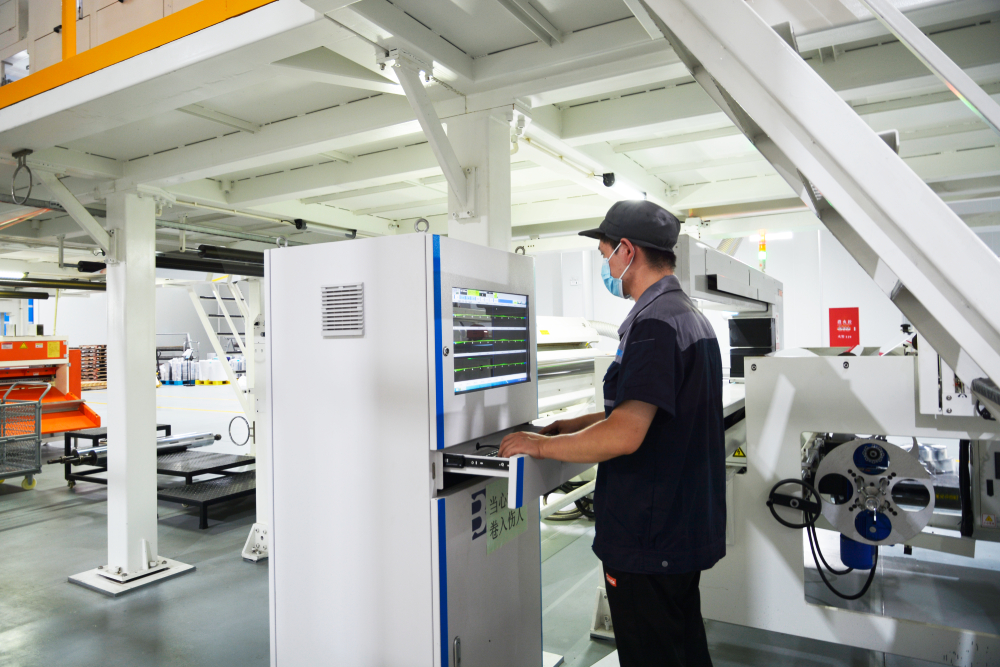
Sheet production area: rigid sheet is produced on co-extrusion lines, with the surface state set before the roll is wound.
2. Thickness and width control that protects registration
Thickness variation affects heating, forming consistency, part weight and final wall distribution — the reasons a converter normally buys on tolerance. In printing, the same variation shows up differently: as drift in repeat length, and as a change in how much material remains for lamination or forming after the printed web is processed.
Width deserves its own confirmation. Roll width should be derived from mould layout, product arrangement and trim allowance against the usable width of the machine, so that edge trim stays under control and registration has room to work. Buyers who order a width because it is a standard stock size often pay for it in trim waste.
3. Lay-flat behaviour and roll format matched to the converting line
Roll dimensions should match the customer’s equipment. Roll width is normally set by mould layout, product arrangement and trim allowance, while roll diameter, roll weight and core size must stay compatible with the unwinding system. The same logic applies to a printing press or laminator, which may have different limits from a thermoformer. For an existing production line, the fastest route to a correct specification is to provide the current roll specification or the equipment limits; for new tooling, sheet width should be calculated first and roll diameter, weight and core size confirmed against the unwinding equipment before production.
4. Material and structure suited to the print route, not only to forming
Material choice is usually the first decision and the one most often made on habit. PET is commonly selected where transparency, stiffness and product visibility are priorities. PP is often preferred for cups, dairy containers and applications needing higher temperature resistance, and its lower density can be an advantage in weight-sensitive work: PP is typically around 0.90–0.91 g/cm³ against roughly 1.33–1.40 g/cm³ for PET, depending on grade and formulation. HIPS is used for opaque or coloured trays, inserts and electronics packaging where impact resistance and practical rigidity matter. rPET provides a route to recycled content, but the actual percentage must be confirmed for each product and order.
Co-extruded, multilayer structures let a functional layer be placed where it is needed rather than compromising the whole sheet. Ask the supplier to state the layer structure explicitly and to confirm which layer will be printed, because that single answer determines whether the print surface and the functional surface can both be optimised.
5. Ink adhesion: what to ask, and what to test
Ink adhesion is a system property. It depends on the sheet surface, any pre-treatment applied, the ink system, the drying or curing conditions, and the time between printing and the next processing step. The sheet supplier’s contribution is one of those variables and it must be a controlled one.
Questions that produce usable answers:
- Is the print surface supplied as extruded, or with a defined surface condition or treatment?
- Who applies any pre-treatment — the sheet producer or the printer?
- How is the prepared surface state verified, and how long does it remain within specification under normal storage?
- What storage and handling conditions are recommended before printing?
- Has the supplier previously supplied sheet that was printed, cut, laminated or converted, and can they describe that route?
Adhesion testing should be agreed with the printer before the trial, and the test method recorded in the trial protocol. If the sheet, ink and press are supplied by three different companies, the trial protocol is the only place where responsibility for adhesion can be assigned clearly.
6. Evidence of converting experience downstream of extrusion
A supplier who only thinks in thermoforming will optimise for the oven. Printing applications follow a different sequence — print, then cut or slit, then laminate, then convert, and frequently form after printing. Ask the supplier to describe what happens to their sheet at each of those steps, and ask whether their customer base includes converters and printers rather than forming plants alone.
This is also where roll consistency earns its money. A converter running a printed web does not want to re-tension, re-register and re-set the press at the start of every delivery; they want the same roll format and the same surface, order after order.
7. Documentation, compliance and long-term supply discipline
Printed packaging is frequently food-contact or consumer-facing, so documentation is part of capability rather than an afterthought. Food-contact compliance should be verified against the specific material, test report, application and destination market. Food-contact and medical packaging requirements address different applications and should not be treated as interchangeable, and general-purpose sheet should not be described as medical grade unless the supporting documentation exists.
Long-term supply rests on change control. Any change of resin, layer structure, production line or surface condition should trigger re-qualification of both the print and the forming process before the next shipment, not after. Capacity is the other half of continuity: PULIXIN reports export experience in more than 55 countries, annual output exceeding 40,000 tons from 14 co-extrusion lines across a 20,000 m² production base, with OEM and customised production within its service scope. That scale matters to a printing programme mainly because it determines whether a single approved specification can be held over a long supply period.
Step-by-Step: How to Vet a Supplier in Seven Steps
- Define the print job and the route first. Write down the sequence — print then form, form then print, print then laminate, or print then cut and convert — together with the ink system and the finishing steps. The route determines which sheet properties become critical.
- Build the sheet specification from the finished part backward. For a new project, start with the application, part dimensions, forming depth, required rigidity, transparency or colour, operating temperature and the printing or thermoforming equipment; a drawing or finished sample is particularly useful. For an existing product, start from the currently proven material and specification and optimise only where necessary.
- Request a documented data package. Material and structure, nominal thickness and tolerance, width, roll dimensions and core size, colour or transparency, surface condition, and the compliance documentation required for the destination market. A quotation request containing only a material name and a target price per kilogram will not produce offers that can be compared.
- Compare against your proven baseline, not against a material name. Two suppliers can both describe their product as 0.5 mm PET sheet and still behave differently on the same line. Compare the actual sheet structure, thickness tolerance, width, roll configuration, colour or transparency, forming behaviour, application requirements and required documentation.
- Run a controlled trial and change one variable at a time. Confirm equivalent specifications and documentation first, then run a controlled production trial before moving to regular volumes. Avoid changing material structure, thickness and process settings simultaneously, because the source of any difference then becomes impossible to identify.
- Verify compliance for the actual use and market. Check food-contact or application-specific documentation against the real application, including which side of the sheet contacts the product and which side carries the print.
- Qualify the commercial and continuity terms. MOQ depends on material, thickness, width, colour and customisation requirements, so confirm it per specification. Delivery terms in use include EXW, FOB and CIF, with others available by agreement. Acceptance criteria typically cover specification verification, thickness and width inspection, appearance inspection and finished-product quality inspection before shipment, with third-party inspection available on request. Payment is normally by T/T, with specific terms depending on order value and mutual agreement.
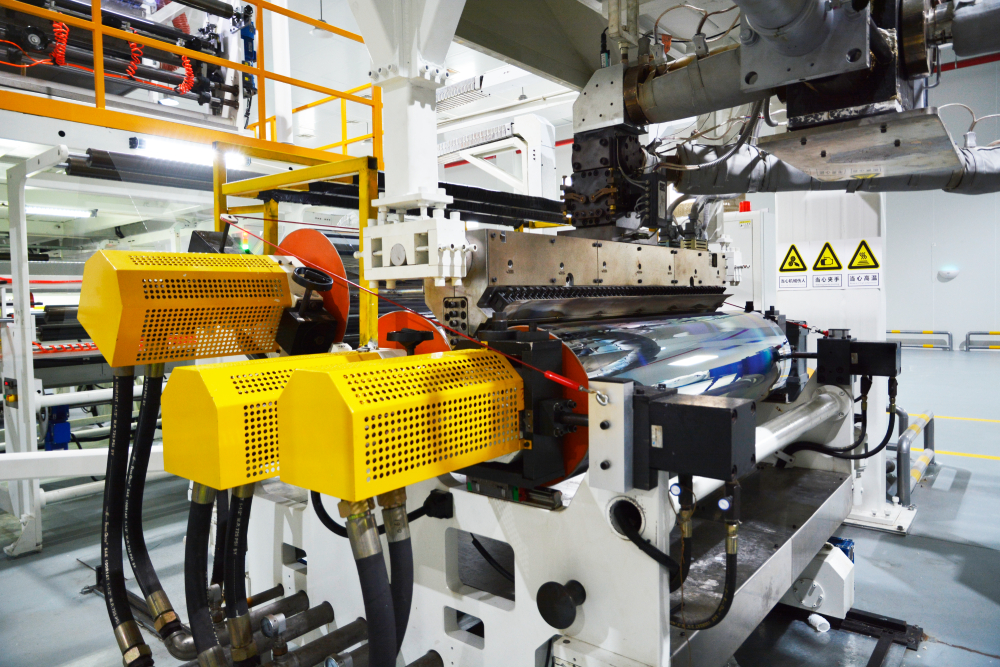
Roll handling: consistent roll format and winding reduce re-setting at the printing and converting stage.
Where Print-Ready Thermoforming Plastic Sheet Rolls Are Actually Used
Printed retail trays and display packs
Retail trays and display packs combine a printed surface with a formed body. Here the sheet must stay flat and dimensionally stable through printing and cutting so that graphics register correctly, and it must still form cleanly afterwards. Thickness consistency supports both halves of that job.
Print-then-form packaging
When decoration is applied to the flat sheet before forming, the ink and any coating have to survive the forming window. PET thermoforming typically runs at 266°F to 320°F (130°C to 160°C), which is why the print and forming trials should be run as one sequence rather than separately. Forming depth, draw ratio and corner radius all affect how the printed image distorts, so the finished-part drawing should be shared with both the sheet supplier and the printer.
Form-then-print and decorated components
Parts formed first and printed or decorated afterwards depend on a consistent formed geometry and a consistent surface. HIPS is a practical choice for coloured or opaque components because it offers good impact resistance, easy forming and flexible colour options, while PET is generally preferred where high transparency is required.
Electronics and technical packaging
Not every electronics package requires anti-static material. The requirement depends on component sensitivity and the customer’s electrostatic-control system: a standard tray mainly provides physical protection and positioning, while an anti-static or ESD tray is designed with specified electrical properties. The required electrical specification should therefore be confirmed before the sheet is selected, especially where a printed label or surface is part of the pack.
Recycled-content programmes
Where recycled content is a programme requirement rather than a marketing line, rPET sheet is the usual route. Recycled content can be customised according to product specification and compliance requirements, and the actual percentage must be confirmed per product or order. Processing conditions may also need adjustment according to recycled content, IV, sheet structure and thermoforming requirements.
Comparison: Material and Structure Options for Printed Sheet
The table below summarises material differences on record in the source material, together with the checks that a printing buyer should add before ordering. The final column is a verification list, not a material specification.
| Material / structure | Difference on record | Typical best fit | Confirm before printing |
|---|---|---|---|
| PET (APET) | Practical balance of transparency, stiffness and cost for high-volume thermoformed packaging. | Food trays, blister packs, clamshells, high-volume packaging. | Whether the print is applied before forming, and the forming window the ink must survive. |
| PETG | Often selected when easier forming or more demanding forming geometry is required. | Complex or deeper thermoformed parts where forming behaviour is the priority. | Whether the deeper draw changes surface stretch in the printed area. |
| PP | Lower density and better suitability where higher temperature resistance is required; PET generally offers higher transparency and stiffness. | Cups, dairy containers, food containers. | Ink system and decoration method agreed with the printer for the chosen grade. |
| HIPS | Good impact resistance, easy thermoforming and flexible colour options. | Opaque trays, electronics packaging, coloured blister inserts. | Colour target and print contrast on an opaque substrate. |
| GPPS | Generally more rigid and transparent but more brittle than HIPS. | Applications where clarity and rigidity matter more than impact resistance. | Handling and cutting behaviour on the converting line. |
| rPET | Incorporates recycled PET content for customers increasing recycled material use in packaging. | Thermoformed packaging, trays, blister packaging with recycled-content requirements. | Recycled-content percentage and documentation per order; possible process adjustment. |
| PET / PE laminated | Combines PET rigidity with a PE sealing layer for applications requiring heat sealing. | Meat trays, fresh food trays and packaging needing compatible heat-sealing performance. | Which layer is printed and which layer is sealed. |
A second table is more useful operationally — a qualification scorecard that a buyer can copy into an RFQ and fill in for each candidate supplier.
| What to verify | Evidence to request | Release rule |
|---|---|---|
| Print-side surface condition | Appearance inspection criteria and batch records | Surface state defined and repeatable between batches |
| Thickness and width | Tolerance and width accuracy data | Variation inside the agreed tolerance for the whole run |
| Roll format | Roll width, diameter, weight, core inner diameter | Compatible with press, laminator and unwinding limits |
| Flatness and feeding behaviour | Storage and handling instructions, trial result | Rolls feed without correction after the agreed stabilisation |
| Material and layer structure | Grade, layer structure, colour or transparency target | Matches the proven baseline or an agreed new specification |
| Compliance documentation | Food-contact or application documentation for the destination market | Documentation covers the actual use and market |
| Trial outcome | Print, cut, laminate and form trial report | Acceptable result across the full sequence, not one step |
| Commercial terms | MOQ per specification, Incoterms, acceptance criteria, payment terms | All terms confirmed in writing before volume release |
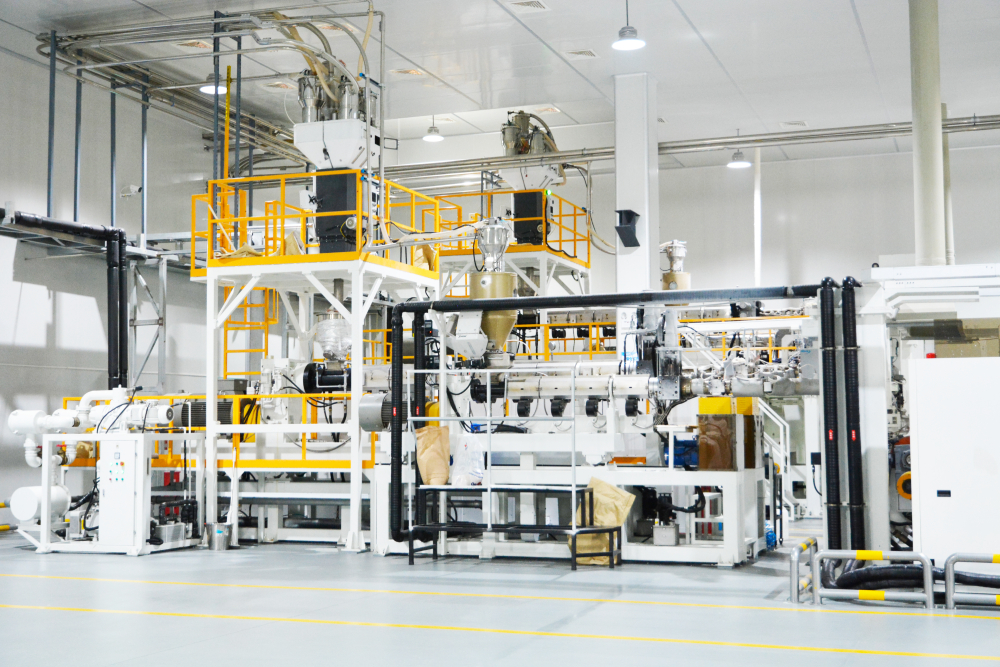
Roll preparation: acceptance inspection before shipment covers specifications, thickness, width and appearance.
FAQ: Vetting a Thermoforming Plastic Sheet Roll Supplier for Printing
1. Does a food-contact declaration automatically cover a printed sheet roll?
No. EU Regulation (EU) No 10/2011 governs plastic materials and articles intended to come into contact with food, and food-contact compliance should be verified against the specific material, test report, application and destination market rather than against a general food-grade statement. For a printed sheet, the buyer should also establish which side contacts the food and confirm that the printed side, the unprinted side and the ink system have each been considered. Food-contact and medical packaging requirements address different applications and are not interchangeable.
2. What should we compare when switching sheet suppliers for a printed application?
Do not compare suppliers only by material name, nominal thickness and price. Compare the actual sheet structure, thickness tolerance, width, roll configuration, colour or transparency, forming behaviour, application requirements and the required compliance documentation. Two suppliers can both describe their product as 0.5 mm PET sheet and still behave differently on the same line. Use the currently proven specification as the comparison baseline, confirm equivalent specifications and documentation first, then run a controlled production trial before moving to regular-volume orders.
3. Is the lowest price per kilogram the lowest cost for a printed packaging programme?
No. Finished-package cost also depends on density, required thickness, forming yield, scrap utilisation, cycle stability and reject rate. A lighter PP sheet and a stiffer PET sheet can reach different total costs for the same part, and material cost itself varies with resin price, specification and order volume. Print waste, re-registration time and rejected printed web add further variables that a price per kilogram does not capture.
4. What should we send a supplier before a trial?
A drawing or finished sample, material preference, sheet thickness, width, finished-part dimensions, forming depth, machine information and performance requirements are particularly useful; a photo alone is usually insufficient. For a new or difficult project, the drawing or sample helps the manufacturer understand forming depth, geometry and performance requirements. For a printing application, add the print method, ink system and finishing steps, and ask the supplier to state the surface condition of the print side in writing.
5. What should a long-term supply agreement cover for a printing programme?
At minimum: MOQ confirmed per specification, since it depends on material, thickness, width, colour and customisation requirements; delivery terms such as EXW, FOB or CIF; acceptance criteria covering specification verification, thickness and width inspection, appearance inspection and finished-product quality inspection before shipment; third-party inspection if required; and payment terms, normally T/T, subject to order value and mutual agreement. For a printing programme, add a change-control clause so that any change in resin, layer structure, surface condition or production line triggers re-qualification before the next shipment. To move from evaluation to execution, a sample roll or trial quantity can be requested from PULIXIN at operation01@pulixin.com.
Conclusion: Qualify the Surface, Then Keep the Specification
Vetting a thermoforming plastic sheet roll supplier for a printing application is not a longer version of a thermoforming audit. It is a different audit with a different pass mark. The supplier has to be able to define the print-side surface, hold thickness and width inside a stated tolerance, deliver rolls in a format that suits the press and the unwinding system, explain what happens to the sheet during cutting, lamination and converting, and support all of it with compliance documentation that matches the destination market.
The qualification sequence matters as much as the questions. Start from the finished part, compare against a proven baseline rather than a material name, run a trial that changes one variable at a time, and settle MOQ, Incoterms, acceptance criteria and payment terms before volume begins. Then protect the result with change control, because the most expensive supplier problem in a printing programme is not a bad first delivery — it is an unannounced change in specification three deliveries later.

Next step: request a sample roll or trial quantity against your proven sheet specification, and ask for the surface condition of the print side in writing.
Email: operation01@pulixin.com | Tel / WhatsApp: +86 13818585204 | Address: No.32 Lubin Rd, Luyuan Industrial Zone, Pudong, Shanghai, China
Website: pulixin.com | Download the PULIXIN product catalogue (PDF)
Have Questions or Need More Details?
Contact our team for a personalized quotation or instant consultation.
Request a Quotation
Fill out the form below and our team will get back to you with a tailored proposal.
WhatsApp Direct Chat
Prefer to chat in real-time? Message us on WhatsApp for instant assistance & quick answers.
- Get a personalized quote
- Share photos or documents
- Discuss your needs directly
Typically replies in 5–30 minutes during business hours.