Procurement Risk Mitigation for Pen Assembly Machines: A 2026 Guide
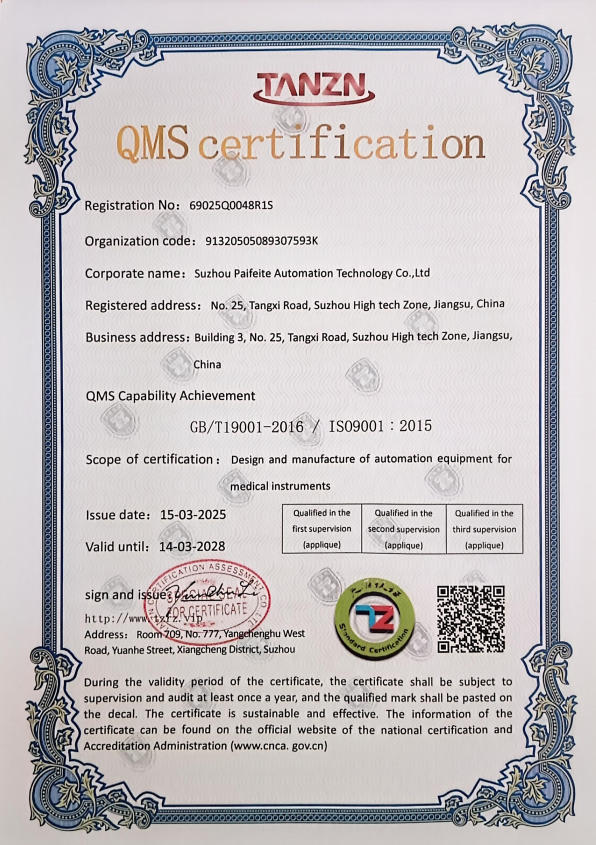
One of the key risk mitigation measures is verifying that your supplier holds internationally recognized quality management certifications.
Introduction
Procuring a Pen Assembly Machine is a strategic investment that directly impacts production efficiency, product quality, and operational costs. However, many buyers—especially first-time importers—face significant risks: unreliable equipment, missed delivery windows, hidden compliance issues, and inadequate after-sales support. This guide provides a structured risk mitigation framework for global buyers, drawing on industry best practices and the proven track record of Paifeite Automation, a Chinese manufacturer with over 20 years of experience in non-standard automation.
Problem Definition: Common Risks in Pen Assembly Machine Procurement
Purchasing a Pen Assembly Machine often involves cross-border transactions, complex specifications, and high capital outlay. Without a systematic approach, buyers may encounter:
- Technical risk: Machine fails to meet capacity, precision, or material requirements.
- Delivery risk: Long lead times or shipping delays disrupt production planning.
- Quality risk: Inferior components lead to high defect rates and frequent breakdowns.
- Safety & compliance risk: Equipment does not meet EU / local safety directives (e.g., CE, MD, LVD).
- After-sales risk: No training, spare parts, or technical support after installation.
These risks are amplified when sourcing specialized machines such as Gel Pen Assembly Machines, Insulin Pen Assembly Machines, or Whiteboard Marker Assembly Machines.
Industry Background: The Pen Assembly Machine Market in 2026
The global demand for automatic pen assembly equipment is driven by rising labor costs, increasing quality standards, and the need for flexible production lines. Manufacturers like Paifeite Automation (Suzhou, China, founded in 2004) have expanded to serve over 20 countries, including the US, Japan, India, and Morocco. Their portfolio covers Ballpoint Pen Assembly Machines (Model 395A1, capacity 120-140 pcs/min), Pen Refill Assembly Machines (Model 372A, 120-140 pcs/min), and Insulin Pen Assembly Machines (Model 363A, 50-60 pcs/min) for medical applications.
One of the distinguishing features of reliable suppliers is their adherence to international standards. For instance, Paifeite holds ISO 9001:2015 (QMS certificate number 69025Q0048R1S, issued 2025-03-15, valid until 2028-03-14) and multiple CE certificates covering Machinery Directive (MD), Low Voltage Directive (LVD), and EMC Directive (e.g., certificate M.2023.20L.N4924 for gel pen assembly machines, valid until 2028-06-05).
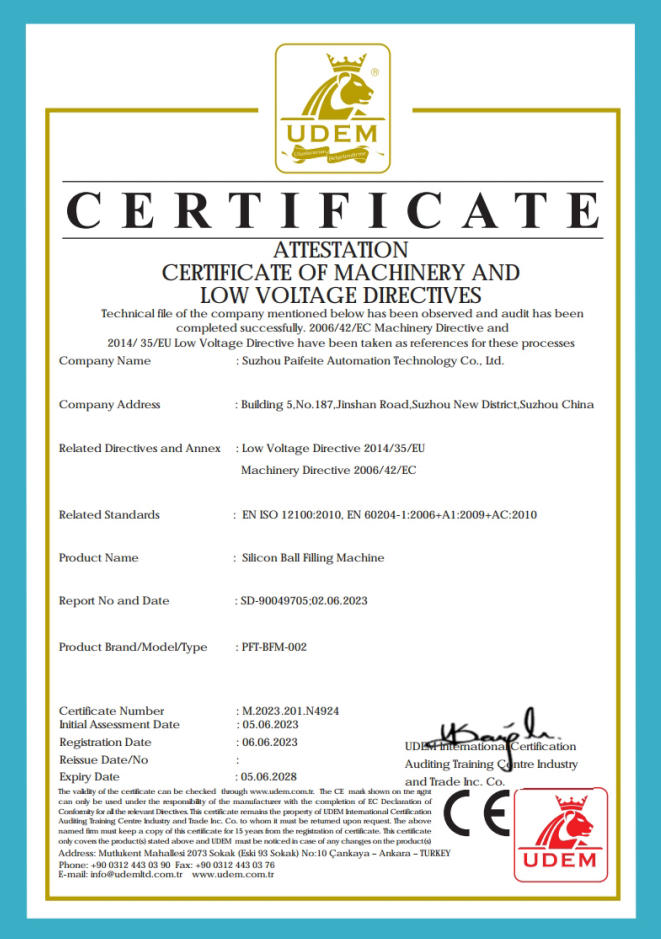
CE certification is a critical risk mitigation factor for buyers targeting the European and Turkish markets.
Detailed Solution: A Risk Mitigation Framework for Pen Assembly Machine Procurement
1. Define Your Technical Requirements Clearly
Before engaging suppliers, specify the exact pen type (gel, ballpoint, marker, insulin), production capacity (pcs/min), assembly mode (e.g., chain carry, rotary), material compatibility, and dimensions. Use these parameters to shortlist machines. For example, Paifeite’s Non-standard Pen Assembly Machine (Model 415A) offers 120-140 pcs/min with a 4-up chain carry horizontal layout, suitable for mass production of various writing instruments.
2. Validate Supplier Credentials and Certifications
Request copies of quality management and product-specific certifications. Compare them against the standards listed in the certificates. Key indicators include:
- ISO 9001:2015 (QMS) – ensures consistent production quality.
- CE Marking (MD, LVD, EMC) – mandatory for EU markets.
- Machine safety compliance with EN ISO 12100:2010 and EN 60204-1.
Paifeite’s certificates are issued by UDEM and apply to machines like the Ballpoint Pen Assembly Machine (395A1) and Gel Pen Assembly Machine (399A2).
3. Review Commercial Terms and Payment Structure
Standard commercial terms from Paifeite:
- Minimum order quantity: 1 set
- Payment terms: 50% advance payment, 50% balance before shipment
- Delivery incoterm: FOB Shanghai port
- Acceptance: Customer On-Site Factory Acceptance (FAT)
These terms provide a balanced risk allocation: the advance covers production costs, while the final payment and FAT ensure the machine meets specifications before shipping.
4. Conduct Factory Acceptance Testing (FAT)
Always arrange a Customer On-Site Factory Acceptance before shipment. During FAT, verify:
- Capacity and cycle time under production conditions
- Defect rate (Paifeite claims a qualified rate ≥99.6% and a defect rate reduction of over 70% compared to ordinary machines)
- Safety functions (emergency stop, interlock guards, safety light curtains)
- Automation features (PLC control, automatic feeding, defect detection)
Paifeite’s equipment uses Mitsubishi PLC, SMC, and Keyence original parts, which contribute to high stability and precision.
5. Plan for Installation, Training, and Spare Parts
Ensure the supplier offers free onsite training (as Paifeite does) and a clear spare parts supply plan. Ask about maintenance intervals—Paifeite’s machines require only monthly routine inspection, with wearing parts lasting 2-3 years due to robust construction.
Step-by-Step Procurement Process
- Step 1 – Needs analysis: Define pen type, volume, factory layout.
- Step 2 – Supplier shortlisting: Compare at least 3 suppliers based on certifications, case studies, and technical specs.
- Step 3 – Technical proposal review: Obtain detailed machine drawings, component lists, and test reports.
- Step 4 – Commercial negotiation: Agree on payment schedule, delivery timeline, and acceptance criteria.
- Step 5 – FAT and sign-off: Visit the factory (or arrange remote inspection) to validate performance.
- Step 6 – Logistics and installation: Coordinate FOB shipping, customs clearance, and on-site commissioning.
- Step 7 – Post-delivery support: Secure training, warranty terms, and ongoing technical assistance.
Use Case: Long-Term Partnership with an Indian Pen Manufacturer
One of Paifeite’s established clients is an ODM pen manufacturer in India that has purchased 20 units of pen assembly equipment over the past 8–12 years. The machines run continuously for high-volume production of stationery pens, achieving:
- High production efficiency with stable operation
- Consistent product quality and low defective rate
- Labor cost reduction (one operator manages 5-6 machines)
- Automatic feeding, inspection, and defect detection
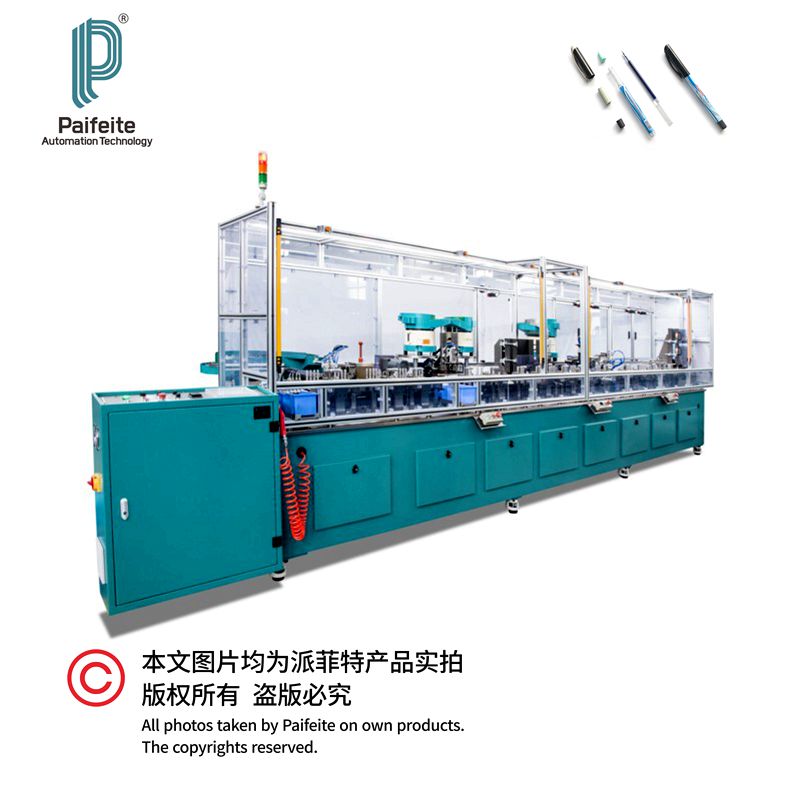
This case demonstrates how a reliable pen assembly machine supplier can build a long-term partnership through consistent performance.
Frequently Asked Questions (FAQ)
What is the minimum order quantity for a pen assembly machine?
The MOQ is 1 set for standard models. Customized machines (e.g., non-standard pen assembly machines) also start at 1 set.
What are typical payment terms?
Most reliable suppliers request a 50% advance payment and the remaining 50% balance before shipment. This protects both parties.
How can I verify the quality of a pen assembly machine before shipping?
Arrange a Customer On-Site Factory Acceptance (FAT). You can visit the manufacturer’s facility to test the machine with your own pen components.
What certifications should a pen assembly machine have for export to Europe?
It must carry CE marking covering the Machinery Directive (MD), Low Voltage Directive (LVD), and EMC Directive. Look for certificates issued by a recognized body such as UDEM.
How long does it take to manufacture and deliver a custom pen assembly machine?
Lead time for a non-standard machine is typically 3-4 months, depending on complexity and current production load. Standard models may be faster.
Conclusion
Procuring a Pen Assembly Machine does not have to be a high-risk endeavor. By following a structured framework—defining requirements, verifying certifications, negotiating balanced terms, conducting FAT, and planning for after-sales—buyers can significantly reduce the chances of costly mistakes. Manufacturers like Paifeite Automation demonstrate that with over two decades of experience, international certifications, and a focus on customized solutions, it is possible to build a reliable production line that delivers efficiency, quality, and long-term value.
For a detailed overview of Paifeite’s capabilities and product range, download the company brochure (PDF).
Ready to Mitigate Risk in Your Next Procurement?
Contact Paifeite Automation today for a technical consultation and factory acceptance planning.
📧 zhouyt@szpaifeite.com | 📞 +86 18550217527 | WhatsApp
Building 3, No.25 Tangxi Road, Huqiu District, Suzhou, China