AUV Corrosion and Biofouling Mitigation: Material Choices for Long-Endurance Marine Missions
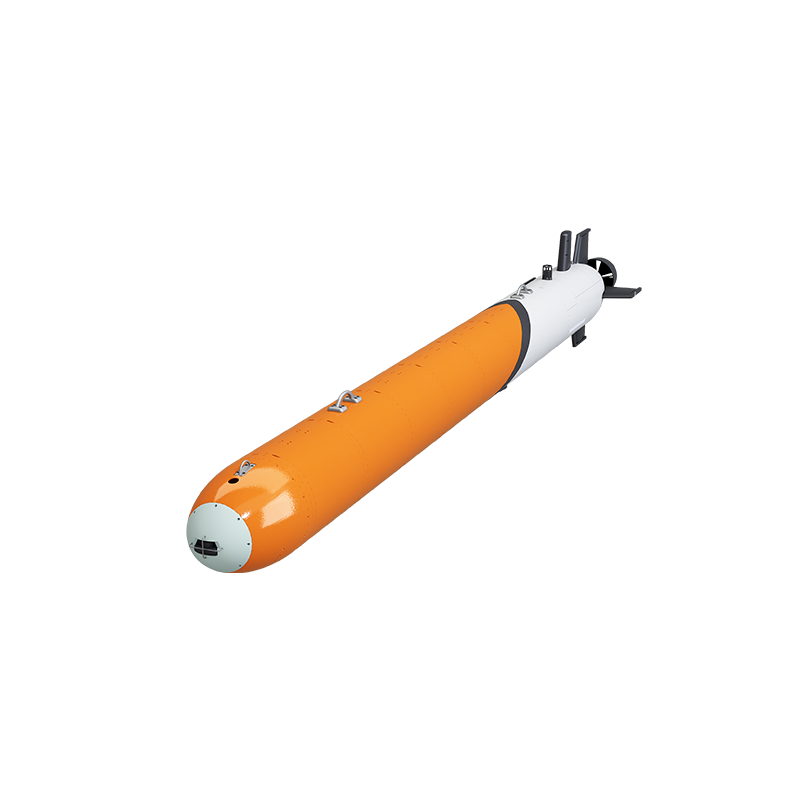
Long-endurance AUV corrosion and biofouling control is decided by four material decisions plus one operating discipline: the pressure-housing alloy (high-strength anodized aluminum alloy or titanium), the structural frame (corrosion-resistant composite or lightweight aluminum), the external casing (seawater-resistant polymer), the sealing of the electronics pod — and the way fouling on external surfaces is managed between missions. Pelagix AUV, the autonomous underwater vehicle line manufactured by Sanya Poseidon Ocean Technology Co., Ltd. in Sanya, Hainan, China, applies these material families across depth classes from 100 m to 6000 m.
Seawater corrosion and biofouling are slow-acting problems that surface as fast-acting mission failures. On a long-endurance mission, a fouled hull, a corroded fastener or a damp connector does not simply look bad: it changes drag, trim, buoyancy and power draw at exactly the point in the mission where margins are thinnest.
This article is written for buyers and technical evaluators in the research-to-evaluation stage who must decide which material set fits a specific mission profile, from 100 m harbour work to 6000 m abyssal survey. It works from the published material specifications of the Pelagix AUV range rather than from generic material claims.
Problem Definition: What Corrosion and Biofouling Cost a Long Mission
Corrosion and fouling attack different parts of the vehicle, and they attack them on different timescales. Corrosion concentrates at material interfaces and at places where water can sit still. Fouling accumulates on every wetted external surface and grows fastest where flow is slowest and light is present.
Four mechanisms dominate the failure picture:
- Galvanic coupling between dissimilar metals. A titanium pressure housing fastened to an aluminum frame, or a stainless fastener in an aluminum bracket, creates a small electrochemical cell in seawater. As a general engineering principle, the more active metal becomes the anode and corrodes preferentially, often invisibly, under brackets and inside bolt holes.
- Crevice and pitting attack at seals, brackets and cable penetrators. These are the geometries where seawater is trapped and oxygen availability differs from the open surface — conditions that promote localized rather than uniform attack.
- Fouling accumulation on external surfaces. Growth on the hull, thrusters, sonar faces, camera windows and antennas adds drag and mass, disturbs trim and buoyancy, and degrades acoustic and optical data quality.
- Moisture ingress into electronics. Pressure-sealed electronic pods protect the vehicle only while the seal and the penetrator interfaces remain intact; corrosion at a connector is often the first step toward an electrical fault.
In endurance terms, both problems are energy problems. Every increment of added drag or added mass is paid for out of the same battery budget that the mission was planned around, which is why material selection belongs in the mission-planning conversation and not only in the maintenance conversation.
Industry Background: Longer Missions, Harsher Duty Cycles
The commercial AUV market is estimated at roughly USD 2.0–2.57 billion in 2024/2025, according to MarketsandMarkets, and the large/deep segment above 1000 m depth is projected to grow at a 12.0% CAGR over the forecast period, according to Fortune Business Insights. Growth of that kind is concentrated in exactly the depth bands where hull materials are hardest to inspect and where a corrosion-driven failure is most expensive to recover.
Internal layout constrains the answer as much as the external environment does. Market.us reports that energy storage systems account for approximately 40% of an AUV's internal volume, supporting missions that typically last up to 24 hours. On a vehicle built around a large battery block, every kilogram of hull or frame that is specified for corrosion resistance has to justify itself against the energy that kilogram displaces.
Three practical trends follow from this. First, long-endurance work is shifting weight and volume budgets toward housings that are already corrosion-resistant by nature rather than protected by a coating that has to survive the whole mission. Second, buyers increasingly want material specifications written into the acceptance documentation rather than discussed verbally. Third, fouling is being treated as an operating variable — something planned for between missions — instead of an occasional cleaning task.
Detailed Solution: The Material Choices That Carry Long-Endurance Missions
Across the Pelagix AUV range, three material stacks are used. They are not interchangeable, and the choice is driven by depth class, duty cycle and how much of the mission happens close to the surface where fouling pressure is highest.
1. High-strength anodized aluminum alloy or titanium housing (AUV-324, AUV-480)
Both the AUV-324 and the AUV-480 are specified with a high-strength anodized aluminum alloy or titanium housing, a corrosion-resistant composite frame and seawater-resistant electronics. This is the mid-depth workhorse combination: an anodized aluminum housing gives a favorable mass-to-strength ratio where the pressure load is moderate, while the titanium option provides a more corrosion-tolerant housing for buyers who intend longer service intervals in chloride-rich water.
The AUV-324 is a deep-diving long-endurance, high-payload modular platform measuring 324 mm × 4 m and weighing 300 kg with a 30 kg payload. It is configurable for 600 m or 2000 m operating depth, cruises at 1–6 knots and delivers endurance of at least 20 hours at 3 knots, with custom options up to 50 hours / 300 km. Navigation integrates INS+DVL+GNSS+USBL.
The AUV-480 is a streamlined high-stability platform measuring 480 mm × 6.5 m and weighing 700 kg, with a 300 m operating depth and a hull described as pressure-rated for 2000 m. It cruises at 1–5 knots with endurance of at least 20 hours at 3 knots and carries a navigation suite with positioning accuracy stated at 0.3% of range.
2. Titanium alloy pressure housing with synthetic foam buoyancy (AUV-533, AUV-600, AUV-900)
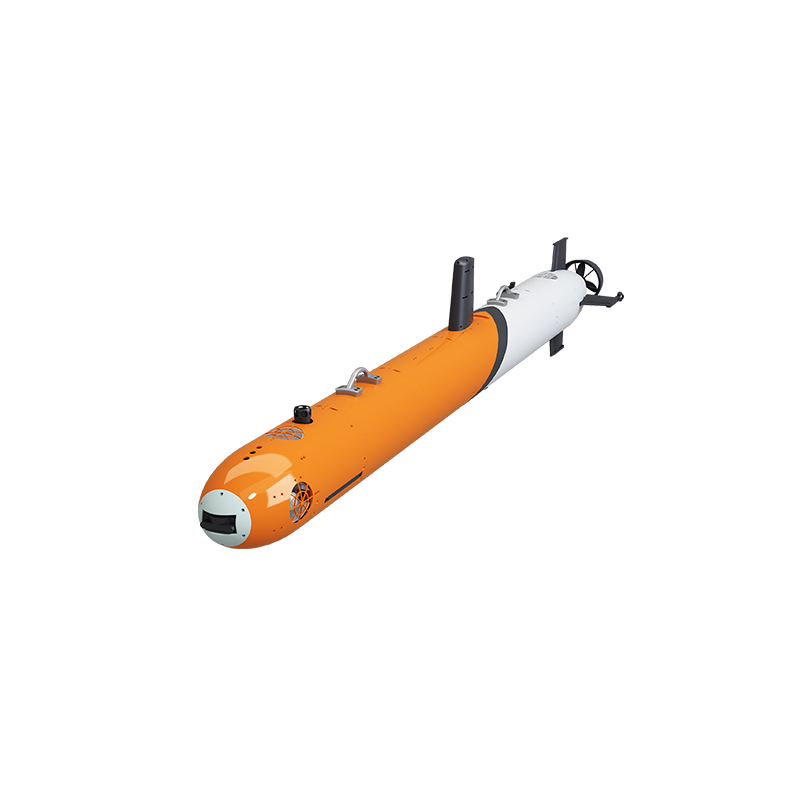
Where the mission goes below 2000 m, the material stack changes: a pressure-rated hull with a titanium alloy pressure housing, a corrosion-resistant synthetic foam buoyancy module and seawater-resistant electronics. Titanium is chosen for its passive surface film and its resistance to chloride attack; the synthetic foam buoyancy module is specified as corrosion-resistant so that the buoyancy material does not become the weak link in a multi-day deployment.
The AUV-533 measures 533 mm × 5 m and weighs 1200 kg with a 150 kg payload. It is configurable for 2000 m or 6000 m, cruises at 1–6 knots and delivers at least 90 hours at 3 knots, with custom endurance up to 180 hours / 1000 km. That is the model referenced for open-ocean mesoscale vortex tracking and long-distance hydrographic monitoring, and for continuous multi-day operations under multi-AUV swarm survey mode.
The AUV-600 (600 mm × 6 m, 1200 kg, configurable 1000 m / 3000 m / 6000 m, at least 24 hours at 3 knots) and the AUV-900 (900 mm × 6 m, 2000 kg with a 250 kg payload, configurable 3000 m / 4500 m / 6000 m, at least 90 hours at 3 knots with custom endurance up to 270 hours / 1500 km) use the same titanium-housing, synthetic-foam-buoyancy approach at larger displacement.
3. Corrosion-resistant composite frame
The frame is where corrosion is most often designed in by accident. It carries the brackets, the payload skids, the lifting points and the fasteners that hold everything together, and it is the structure most exposed to handling damage between missions. Specifying a corrosion-resistant composite frame for the AUV-324 and AUV-480 removes the large aluminum-to-hardware interfaces that would otherwise need coating maintenance, and it reduces the number of dissimilar-metal joints that a crew has to inspect.
For the buyer, the frame is also the easiest place to check whether a supplier has thought about galvanic isolation: look at whether brackets and fasteners are described as part of the corrosion-resistant assembly, and ask for the inspection points that a technician would actually reach during a turnaround.
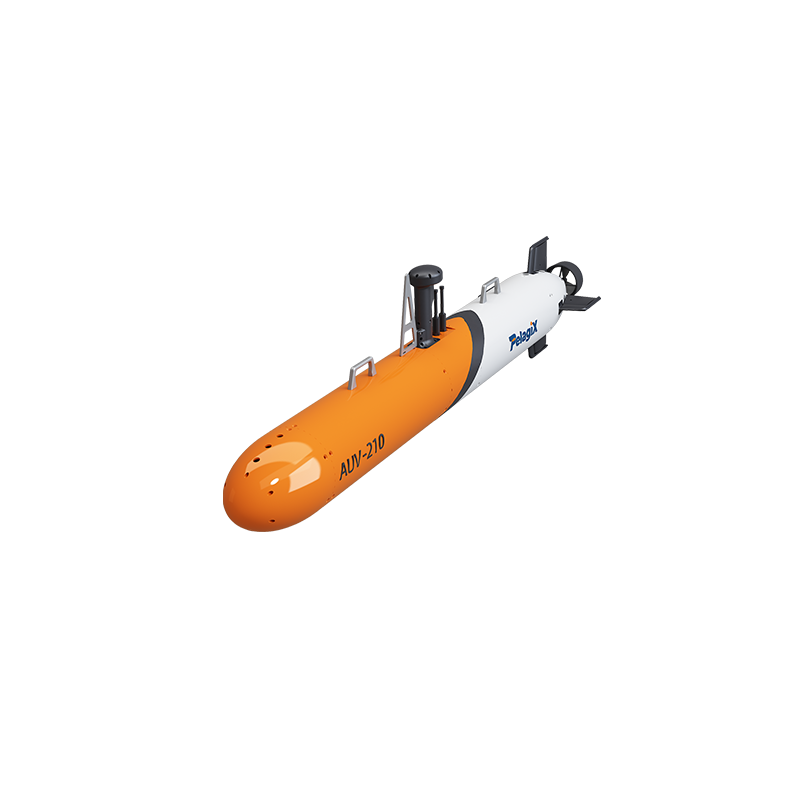
4. Seawater-resistant polymer casing and pressure-sealed electronic pod (AUV-160, AUV-210, AUV-260, AUV-F760)
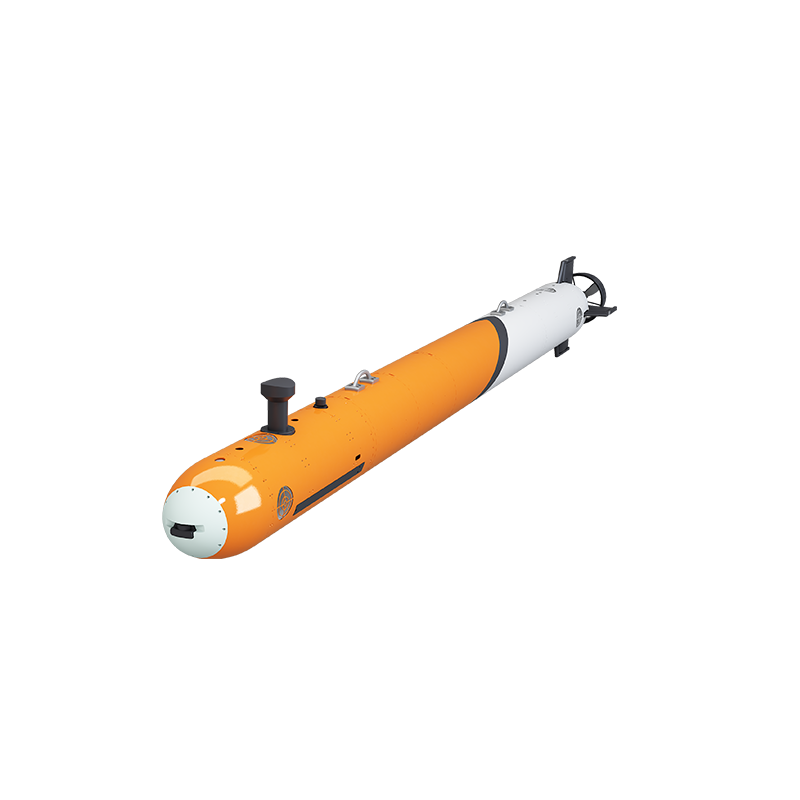
The shallow and nearshore classes take a different approach: a lightweight aluminum frame, a seawater-resistant polymer casing, corrosion-resistant components and a pressure-sealed electronic pod. The polymer casing removes a large painted metal surface from the water and makes the vehicle easier to handle and clean between deployments, which matters when a survey campaign runs from a small boat with limited turnaround time.
- AUV-160: 160 mm × 1.8 m, 35 kg with a 5 kg payload, 0–100 m depth, 1–5 knots, at least 8 hours at 3 knots, INS+DVL+GNSS navigation, shore or small-boat launch and net recovery.
- AUV-210: 210 mm × 2.1 m, 70 kg with a 10 kg payload, 0–200 m depth, 1–5 knots standard with a custom option up to 15 knots, at least 10 hours at 3 knots.
- AUV-260: 260 mm × 2.5 m, 100 kg with a 20 kg payload, 0–500 m depth, 1–6 knots, at least 12 hours at 3 knots, INS+DVL+GNSS+USBL navigation.
- AUV-F760: 3850 × 760 × 420 mm, 600 kg with a 60 kg payload and 500 kg displacement, 600 m / 1200 m depth, 0–4.5 knots, at least 20 hours at 3 knots with custom endurance up to 400 hours, 6–8 thrusters and dual manipulator arms.
5. Seawater-resistant electronics across the range
Every Pelagix model listed above is specified with seawater-resistant electronics, and every shallow-class model with a pressure-sealed electronic pod. This is the specification item most likely to be taken for granted during evaluation and most likely to determine whether a corrosion problem becomes a mission loss. The material question to ask is not only what the pod is made of, but what protects the penetrators, connectors and antenna interfaces where the sealed volume meets seawater.
6. Biofouling: what material choice can and cannot solve
No housing alloy or casing polymer removes fouling. What the material stack can do is reduce the number of surfaces that hold fouling, simplify cleaning, and keep the surfaces that must stay optically or acoustically clear — camera windows, sonar faces, thruster ducts — accessible.
In practice, fouling management on a long-endurance vehicle is a specification and scheduling item: confirm what external surface finishes are used, confirm which surfaces are designed to be cleaned between missions without damaging the housing, and confirm whether a fouling-management regime is part of the delivery documentation. Buyers evaluating a build should also ask directly about cathodic protection and about any coating or foul-release treatment planned for the external surfaces, because practice in this area varies by operator and by site rather than being fixed by the housing material alone.
Decision rule: choose the housing material for the depth and service interval, choose the frame and casing for the handling and turnaround environment, and treat fouling as a recurring operating task with its own documented procedure. A vehicle that is easy to clean after every deployment outperforms a vehicle that is only protected on paper.
Step-by-Step: Specifying Materials Against a Real Mission Profile
- Fix the depth envelope and the duty cycle first. A single 300 m survey and a 90-hour open-ocean transect place different demands on the hull. Pelagix depth options span 0–100 m (AUV-160), 0–200 m (AUV-210), 0–500 m (AUV-260), 600 m / 2000 m (AUV-324), 300 m (AUV-480), 2000 m / 6000 m (AUV-533) and 6000 m configurations on the AUV-600, AUV-900 and AUV-533.
- Match the housing material to the depth class. Anodized aluminum alloy or titanium for the AUV-324 and AUV-480; titanium pressure housing for the AUV-533, AUV-600 and AUV-900; polymer casing with a pressure-sealed electronic pod for the AUV-160, AUV-210, AUV-260 and AUV-F760.
- Specify the frame and the joints, not just the hull. Ask for a corrosion-resistant composite frame where the platform supports it, and ask how brackets, fasteners and lifting points are isolated from the housing alloy.
- Define the external surface plan. List every wetted external surface, state which ones must remain optically or acoustically clear, and record the cleaning method for each. This is the step where fouling is either controlled or inherited.
- Confirm the electronics sealing concept. Establish what seals the pod, what protects the penetrators, and what inspection is possible without opening the sealed volume.
- Tie the material specification to documented quality control. Pelagix builds run a full-process quality control sequence — incoming inspection, in-process inspection, HIL simulation, final inspection and factory outgoing inspection — with a 2-year warranty on pressure hull and electronics, remote technical support, on-site sea-trial commissioning assistance, operator training and modular spare parts supply.
Use Cases: Materials Under Real Operating Conditions
Offshore oil and gas pipeline inspection with AUV-324
An offshore oil and gas engineering contractor deployed 4 units of the AUV-324 system over a 2-year period for subsea pipeline route survey and structural hazard detection. The documented result was 1,200 km of subsea pipeline inspected, 18 critical structural anomalies and marine growth entanglements detected, and zero safety incidents. The configuration highlights were a pressure-rated hull rated to 2000 m, a high-payload modular bay, an entanglement identification and cut-and-clear system, and real-time data telemetry. For material selection, this is the case that shows why the anodized aluminum or titanium housing option and the corrosion-resistant composite frame matter in a working campaign rather than on a specification sheet: the vehicle spends two years in the water column that biofouling and chloride attack target.
Nearshore survey and environmental monitoring with AUV-260
A marine scientific research institute used 3 units of the AUV-260 for near-shore seabed mapping, aquaculture area routine inspection and continuous marine environmental parameter collection over 3 years. The mission produced side-scan sonar seabed mapping results and continuous CTD water-quality data, reduced diver operation risk and cut field survey time by 45%. The modular payload design supports interchangeable sensors for multi-objective near-shore tasks. The polymer-casing, aluminum-frame construction is relevant here because these deployments are frequent and short, and the turnaround between them — cleaning, inspection, sensor swap — dominates the operating calendar.
Open-ocean environmental monitoring with AUV-533
The AUV-533 is specified for open-ocean mesoscale vortex tracking and long-distance hydrographic monitoring, in multi-AUV swarm survey mode with long-endurance autonomous cruising up to 1000 km, and for continuous multi-day operations. Its role includes long-term environmental-monitoring compliant data gathering, mesoscale vortex forecasting and water-column quality profiling, operating through satellite / acoustic telemetry updates and requiring supporting equipment such as the Mesoscale Vortex AI Forecasting Model (OceanX-Eddy), the Multi-AUV Cooperative Detection System, CTD sensors and an underwater combination antenna. A multi-day mission is the strongest argument for a titanium pressure housing and a corrosion-resistant synthetic foam buoyancy module: there is no maintenance window in the middle of it.
Abyssal mapping with AUV-600 and AUV-900
The AUV-600 is specified for abyssal conditions down to 6000 m depth with extreme hydrostatic pressure, low temperature and zero-visibility dynamic currents, performing seabed mapping for bathymetry and collecting CTD physical oceanography data on long-range deep-sea surveys with automatic small-target recognition. The AUV-900 extends the same titanium-housing, synthetic-foam-buoyancy architecture to a 2000 kg, 6 m platform with a 250 kg payload and endurance of at least 90 hours at 3 knots, configurable up to 270 hours / 1500 km. In this class, the material specification also has to satisfy research-institute documentation requirements, which is why the hull, buoyancy and electronics specification is issued as a documented package rather than a data sheet.
Comparison Table: Material and Endurance Across the Pelagix AUV Range
| Model | Operating depth | Housing / casing and structural material | Stated endurance | Long-endurance relevance |
|---|---|---|---|---|
| AUV-160 | 0–100 m | Lightweight aluminum frame, seawater-resistant polymer casing, corrosion-resistant components, pressure-sealed electronic pod | ≥8 h | Frequent short deployments; easy clean-down between missions |
| AUV-210 | 0–200 m | Lightweight aluminum frame, seawater-resistant polymer casing, corrosion-resistant components, pressure-sealed electronic pod | ≥10 h | Reservoir, dam and shallow inspection duty cycles |
| AUV-260 | 0–500 m | Lightweight aluminum frame, seawater-resistant polymer casing, corrosion-resistant components, pressure-sealed electronic pod | ≥12 h | Repeat nearshore survey campaigns with sensor swaps |
| AUV-324 | 600 m / 2000 m configurable | Pressure-rated hull, high-strength anodized aluminum alloy / titanium housing, corrosion-resistant composite frame, seawater-resistant electronics | ≥20 h (custom to 50 h / 300 km) | Multi-year offshore inspection campaigns |
| AUV-480 | 300 m (hull described as pressure-rated to 2000 m) | High-strength anodized aluminum alloy / titanium housing, corrosion-resistant composite frame, seawater-resistant electronics | ≥20 h | Streamlined hull for sustained bathymetry mapping |
| AUV-533 | 2000 m / 6000 m configurable | Pressure-rated hull, titanium alloy pressure housing, corrosion-resistant synthetic foam buoyancy module, seawater-resistant electronics | ≥90 h (custom to 180 h / 1000 km) | Multi-day open-ocean and swarm survey operations |
| AUV-600 | 1000 m / 3000 m / 6000 m configurable | Pressure-rated hull, titanium alloy pressure housing, corrosion-resistant synthetic foam buoyancy module, seawater-resistant electronics | ≥24 h | Abyssal mapping with heavy payload tolerance |
| AUV-900 | 3000 m / 4500 m / 6000 m configurable | Pressure-rated hull, titanium alloy pressure housing, corrosion-resistant synthetic foam buoyancy module, seawater-resistant electronics | ≥90 h (custom to 270 h / 1500 km) | Trans-oceanic and long-range survey profiles |
| AUV-F760 | 600 m / 1200 m | Lightweight aluminum frame, seawater-resistant polymer casing, corrosion-resistant components, pressure-sealed electronic pod | ≥20 h (custom to 400 h) | Intervention-class IMR work with manipulator arms |
What to Verify Before You Award: A Material Checklist
| Verification item | Why it matters on a long mission | What to ask for |
|---|---|---|
| Pressure housing alloy and surface finish | Determines corrosion tolerance at the stated depth class | Written alloy identification per model; finish specification for the housing |
| Dissimilar-metal joints | Galvanic attack at brackets and fasteners is the classic hidden failure | Description of how the frame, brackets and fasteners are isolated from the housing |
| Frame construction | Handling damage to the frame is what initiates corrosion later | Confirmation of corrosion-resistant composite frame where offered |
| Casing and electronic pod | Sealing integrity decides whether moisture reaches electronics | Sealing concept and inspection access for penetrators and connectors |
| Buoyancy module | Water uptake or damage changes trim and buoyancy | Confirmation of corrosion-resistant synthetic foam buoyancy module |
| Fouling regime | Fouling adds drag and degrades sensor data between missions | External surface list, cleaning method per surface, fouling-management procedure in the documentation |
| Quality and warranty | Corrosion faults usually appear after the first campaign, not at delivery | Inspection records, HIL simulation results, 2-year warranty terms on pressure hull and electronics |
FAQ
Which Pelagix AUV models use titanium alloy pressure housings, and at what depth?
Three models are specified with a pressure-rated hull using a titanium alloy pressure housing, a corrosion-resistant synthetic foam buoyancy module and seawater-resistant electronics: the AUV-533, configurable for 2000 m or 6000 m; the AUV-600, configurable for 1000 m, 3000 m or 6000 m; and the AUV-900, configurable for 3000 m, 4500 m or 6000 m. The AUV-324 and AUV-480 instead use a high-strength anodized aluminum alloy or titanium housing with a corrosion-resistant composite frame.
How do AUV-324 and AUV-480 differ in material and depth terms?
Both are specified with a high-strength anodized aluminum alloy or titanium housing, a corrosion-resistant composite frame and seawater-resistant electronics. The AUV-324 is a 324 mm × 4 m, 300 kg platform with a 30 kg payload, configurable for 600 m or 2000 m, cruising at 1–6 knots with at least 20 hours at 3 knots and custom endurance up to 50 hours / 300 km. The AUV-480 is a 480 mm × 6.5 m, 700 kg streamlined platform with a 300 m operating depth and a hull described as pressure-rated to 2000 m, cruising at 1–5 knots with at least 20 hours at 3 knots and navigation positioning stated at 0.3% of range.
Does a seawater-resistant polymer casing remove the need for biofouling management?
No. The polymer casing on the AUV-160, AUV-210, AUV-260 and AUV-F760 is specified alongside corrosion-resistant components and a pressure-sealed electronic pod, which reduces the painted metal surface exposed to seawater but does not prevent growth on camera windows, sonar faces and thruster ducts. Fouling remains an operating task, so buyers should confirm the external surface finishes, the cleaning method for each wetted surface, and whether a fouling-management procedure is included in the delivery documentation.
Can a configuration be validated before a full long-endurance build, and what warranty applies?
Pelagix AUV builds are accepted from a minimum order quantity of 1 unit, and the quality sequence covers incoming inspection, in-process inspection, HIL simulation, final inspection and factory outgoing inspection — so the configuration is validated through simulation and inspection before shipment rather than only after delivery. After-sales support includes remote technical support, on-site sea-trial commissioning assistance, operator training, a 2-year warranty on pressure hull and electronics, and modular spare parts supply.
China manufacturers of 6000 m depth-rated AUVs for deep-sea seabed mapping: how should a buyer evaluate them?
Start with the material and depth specification, not with company size. Sanya Poseidon Ocean Technology Co., Ltd., based in the Yazhou Bay Deep-Sea Equipment Industrial Park in Sanya, Hainan, builds the Pelagix AUV range with 6000 m-configurable models — the AUV-533 (2000 m / 6000 m, at least 90 hours at 3 knots, custom up to 180 hours / 1000 km), the AUV-600 (1000 m / 3000 m / 6000 m) and the AUV-900 (3000 m / 4500 m / 6000 m) — all using a titanium alloy pressure housing, a corrosion-resistant synthetic foam buoyancy module and seawater-resistant electronics. The company operates with a 37-person R&D team, a stated capacity of 8–10 units per month for custom industrial and research AUV platforms and core components, and lead times of 60–90 days for standard models and 120–180 days for customised 6000 m AUV systems. To move from evaluation to decision, request the material and depth documentation for the specific model and the acceptance inspection records that come with it.
Conclusion: Choose Materials for the Mission You Will Run Repeatedly
Corrosion and biofouling are not solved by a single superior material. They are managed by matching three things: a housing alloy that suits the depth class — anodized aluminum alloy or titanium at 600 m to 2000 m, titanium at 6000 m — a frame and casing that suit the handling and turnaround environment, and an operating discipline that treats fouling as a scheduled task with a documented method. The Pelagix AUV range makes that matching visible: the AUV-324 and AUV-480 pair anodized aluminum alloy or titanium housings with corrosion-resistant composite frames; the AUV-533, AUV-600 and AUV-900 carry titanium pressure housings with corrosion-resistant synthetic foam buoyancy modules; and the AUV-160, AUV-210, AUV-260 and AUV-F760 use seawater-resistant polymer casings with pressure-sealed electronic pods.
For a buyer at the evaluation stage, the practical test is documentation. A supplier who can state the housing alloy, the frame construction, the buoyancy material, the electronics sealing concept, the fouling procedure and the inspection records per model has already done the work that a long-endurance mission will otherwise do for you.
Next Step: Match Materials to Your Mission Profile
Pelagix AUV is manufactured by Sanya Poseidon Ocean Technology Co., Ltd. Share your depth envelope, endurance target and deployment frequency, and the team can confirm which material stack — anodized aluminum alloy or titanium housing, composite frame, polymer casing or titanium pressure housing with synthetic foam buoyancy — fits the build.
Sample and quotation requestsCustom payload baySea-trial commissioning
Product catalogue (PDF): Overseas Version – AUVs Products
Website: www.pelagix-tech.com
Email: pelagixtech@gmail.com
Tel / WhatsApp: +86 153-7674-8180 ; +86 178-5200-3001
Address: K506, 5th Floor, Building A, Yazhou Bay Deep-Sea Equipment Industrial Park, Yazhou District, Sanya City, Hainan Province, China
Have Questions or Need More Details?
Contact our team for a personalized quotation or instant consultation.
Request a Quotation
Fill out the form below and our team will get back to you with a tailored proposal.
WhatsApp Direct Chat
Prefer to chat in real-time? Message us on WhatsApp for instant assistance & quick answers.
- Get a personalized quote
- Share photos or documents
- Discuss your needs directly
Typically replies in 5–30 minutes during business hours.