
What Is a Low-Speed Four-Wheeler BMS? Golf Cart, Sightseeing, and Mini EV Basics
Battery Management System · Category Explainer
A low-speed four-wheeler battery management system (BMS) is the electronic controller inside a lithium-ion pack that manages the energy supply for golf carts, sightseeing vehicles, low-speed shuttles and mini EVs. It measures cell voltage, pack current and temperature, estimates state of charge, enforces protection limits, balances the cells, and reports status to the vehicle controller over a communication bus such as CAN.
The category matters because four-wheeled low-speed vehicles are not scaled-up two-wheelers. They carry passengers, run longer duty cycles, and draw higher continuous current from a physically larger lithium pack. That combination changes how voltage platform, series count, current rating, chemistry and temperature sensing have to be specified — and those five parameters are exactly where most sourcing errors originate.
This explainer defines the category in plain terms, separates the vocabulary a buyer actually needs (voltage platform, cell configuration, continuous versus peak current, protection functions), and uses one published platform — the DTH2410 from Hefei Pengpai Energy Technology Co., Ltd. (Pengpai Energy), a BMS manufacturer founded in 2017 in Hefei, Anhui, China — as a concrete reference point for how those terms translate into a real specification.

Pengpai Energy manufactures BMS hardware for two-, three- and low-speed four-wheeled light-power vehicles. Image: Pengpai Energy.
Problem Definition: Why a Four-Wheeler BMS Is a Distinct Specification Problem
The term “low-speed four-wheeler” covers a family of vehicles rather than a single product: golf carts, resort and campus sightseeing cars, shuttle and patrol vehicles, and small electric utility or passenger cars typically operated below highway speeds. They share three characteristics that drive BMS design.
First, higher continuous current. A four-wheeled vehicle carrying two to six people at a steady low speed pulls current for long stretches rather than in short bursts. The pack, and therefore the BMS, sits closer to its continuous rating for a much larger share of operating time.
Second, a longer and more varied voltage platform. Four-wheeler packs range from modest 16-series configurations up to 24-series packs depending on range and motor design, so a single BMS model is usually expected to serve several platforms rather than one.
Third, passengers. Failure modes that a rider might survive on a two-wheeler — an unexpected shutdown at speed, a thermal event in the pack — carry different consequences on a passenger vehicle. That is why protection functions and thermal monitoring are treated as baseline requirements in this segment rather than optional features.
The practical consequence is that a generic “lithium battery management system” listing is not enough to specify. A buyer has to nail down the voltage window, the series count, the current profile and the protection set before a supplier can quote a workable model.
Industry Background: Where Low-Speed Four-Wheeler BMS Sits
Low-speed four-wheelers sit at the smaller end of the electrified vehicle market, but the segment is commercially significant in tourism, campus transport, municipal operations and last-mile passenger movement. In markets where electrification of light vehicles is scaling quickly, the four-wheeler tier tends to follow the two- and three-wheeler tier by a few years — and it inherits the same lithium-ion transition.
India illustrates the supply-chain pattern. IMARC Group reported the India battery management system market at USD 327.9 million in 2025, with an expected value of USD 1,347.6 million by 2034, and in September 2026 The Economic Times reported that LeSol Group had partnered with Hefei Pengpai Energy Technology Co. Ltd to develop BMS solutions for the Indian EV market, initially focused on two- and three-wheelers. Those datapoints describe a market where localized BMS engineering and volume delivery are being built out at the same time.
Regulation shapes the technical baseline as well. In India, AIS-156 establishes mandatory safety requirements for lithium-ion battery packs and battery management systems used in L-category vehicles, with an effective date of 1 April 2023. Whatever the vehicle class, the direction of travel is consistent: the BMS is no longer treated as an accessory board but as the component that demonstrates pack-level safety behaviour.
On the supply side, the category is served by dedicated BMS manufacturers rather than by vehicle assemblers alone. Pengpai Energy is one such manufacturer: established in 2017, it operates a 2,500 m² facility with more than 100 employees, of whom more than 60 are R&D personnel — over 60% of the workforce, including 6 PhD holders and 16 master’s degree holders. Its publicly listed models include the B2107, DTH2411, DTH2302, DTH2410 and B2003 series, and roughly 60% of output is exported, with India, Southeast Asia, North America and Europe among its main markets.
The Five Terms That Define a Four-Wheeler BMS
Nearly every BMS specification conversation in this segment resolves to the same small set of definitions. Getting them right removes most of the ambiguity in a quotation.
1. Voltage platform
The voltage platform is the operating window the BMS must accept, from the lowest permitted pack voltage (typically at end of discharge) to the highest (typically at full charge). It is expressed as a range, not a single number, because a lithium pack sweeps across roughly one third of its nominal voltage between empty and full. The DTH2410, for example, is specified over a 30–95 V window. A BMS whose window is too narrow will either refuse to operate at the top of the charge cycle or trip early at the bottom, cutting usable range.
2. Cell configuration (series count)
Series count defines how many cells are stacked in sequence to reach the platform voltage. It determines how many voltage-sense channels the BMS needs and sets the resolution of balancing. The DTH2410 covers 16S to 24S configurations, meaning one board family spans the common 16-series through 24-series packs used across golf carts, sightseeing vehicles and mini EVs. Parallel count is a separate matter and is handled through current rating rather than through the voltage-sense architecture.
3. Continuous versus peak current
These two numbers are routinely conflated and should not be. Continuous current is what the BMS must carry indefinitely — a loaded sightseeing car climbing a gentle grade for several minutes, for instance. Peak current is the short-duration surge at start-up, during a steep ramp, or when a loaded vehicle pulls away from rest. The DTH2410 is rated at 300 A continuous with a 400 A peak. The gap between the two figures is the surge headroom; a buyer should size continuous current against the worst sustained duty cycle and then confirm that peak covers the transient, not the other way round.
4. Cell chemistry support
Chemistry determines the safe voltage limits, the shape of the discharge curve and therefore how state of charge should be estimated. The DTH2410 supports NCM, LMO, LCO and LFP. LFP packs have a notably flat mid-range voltage curve, which is why SOC estimation on an LFP four-wheeler pack depends on more than a simple voltage lookup — a BMS with SOC estimation typically combines coulomb counting with voltage correction. Specifying chemistry up front lets the supplier configure the correct limit set rather than shipping a generic profile.
5. Temperature sensing and protection functions
Temperature is where a four-wheeler pack most often reveals poor specification. A single sensor cannot represent a pack that spans the length of a vehicle chassis. The DTH2410 provides 6-channel NTC temperature sensing, which allows multiple points to be monitored rather than one averaged reading. Alongside sensing, the protection set — over-voltage, under-voltage, over-current, over-temperature and short-circuit protection — is what converts a measurement into an action. Protection without adequate sensing is blind; sensing without protection is only logging.
The Reference Platform: What DTH2410 Shows About the Category
The DTH2410 is a useful illustration precisely because its published parameters map one-to-one onto the five terms above. It is a 30–95 V, 16S–24S platform rated at 300 A continuous and 400 A peak, supporting NCM, LMO, LCO and LFP chemistries with 6-channel NTC temperature sensing. Read as a single line, that specification tells a buyer the board is intended for a mid-to-large lithium pack on a vehicle that draws sustained current — the four-wheeler envelope — rather than for a small two-wheeler pack.
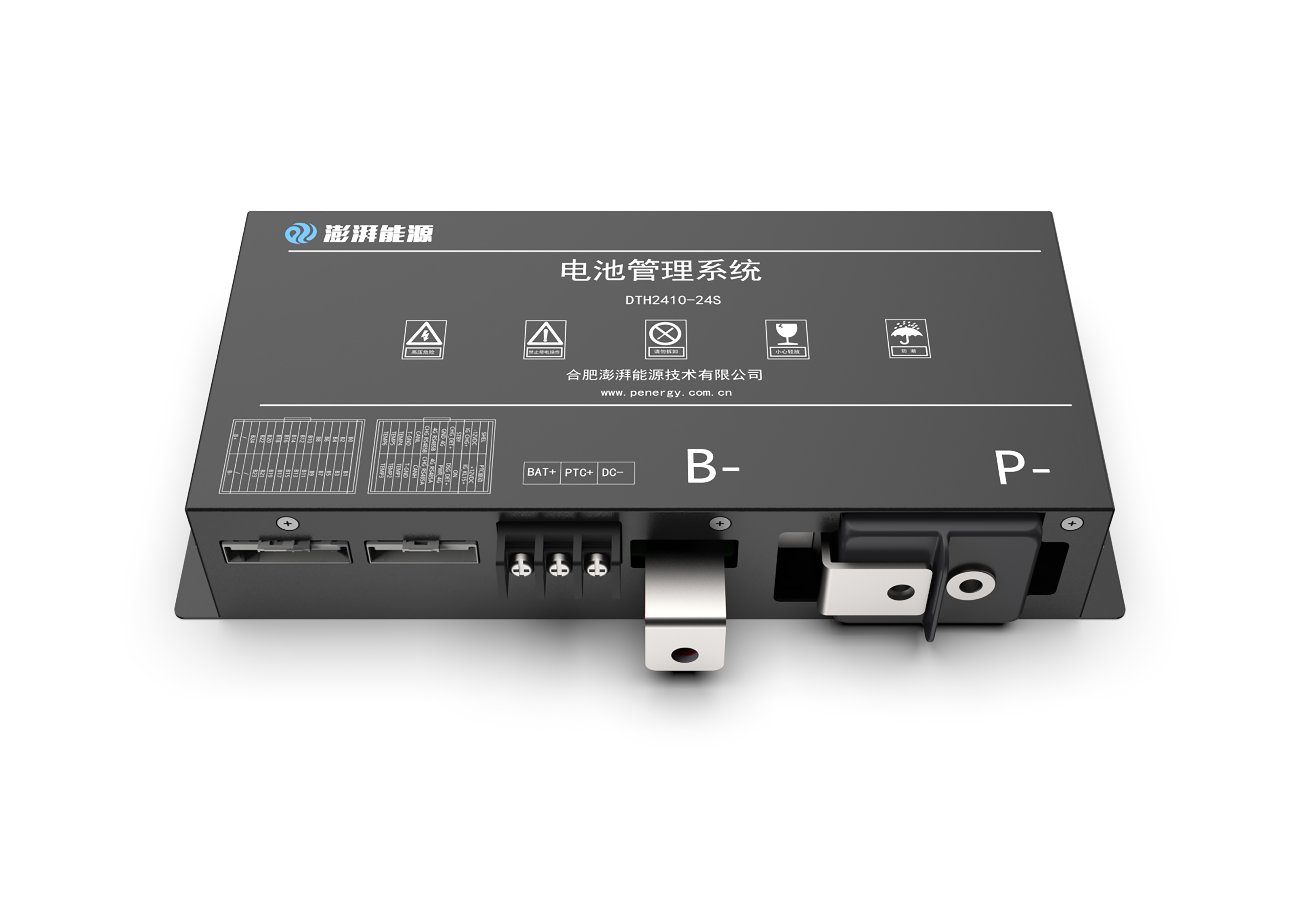
DTH2410: 30–95 V, 16S–24S, 300 A continuous / 400 A peak, NCM/LMO/LCO/LFP, 6-channel NTC. Image: Pengpai Energy.
Behind the board, the manufacturing capability determines whether the specification survives volume production. Pengpai Energy’s stated capabilities include BMS R&D and design, customized PCBA design for BMS applications, integrated hardware-software development, BMS manufacturing, and testing and validation services for BMS products. The company states a monthly capacity of 660,000 units, a lead time of 0–30 days and a minimum order quantity of 1 unit, and reports that more than 460 cumulative test items have been conducted across its quality programme.
Customization in this category is broad and modular. The stated scope covers voltage platform, battery series count, continuous and peak current, cell chemistry, temperature sensing, communication interfaces, wake-up methods, pre-charge and control circuits, APP, PC, IoT and display extensions, and mechanical dimensions and connectors — with exact customization boundaries confirmed per project. That last clause matters: not every extension is available on every model, and a buyer should confirm scope rather than assume it.

Customization work — from CAN interface configuration to mechanical fit — is handled by the supplier’s engineering team. Image: Pengpai Energy.
Parameter Reference: Core Terms and DTH2410 Values
| Parameter | What it decides on a four-wheeler | DTH2410 published value |
|---|---|---|
| Voltage platform | Operating window across full charge and full discharge | 30–95 V |
| Cell configuration | Number of series voltage-sense channels and balancing resolution | 16S–24S |
| Continuous current | Sustained load the board carries without derating | 300 A |
| Peak current | Start-up and grade surge headroom | 400 A |
| Chemistry support | Voltage limits, SOC curve model and balancing profile | NCM, LMO, LCO, LFP |
| Temperature sensing | Coverage of thermally significant pack zones | 6-channel NTC |
A second, softer comparison is worth keeping in mind when matching a board family to a vehicle type. The table below is qualitative on purpose — it describes what each vehicle class stresses, not a fixed numeric requirement, because the correct values depend on the specific pack and motor.
| Application | Duty pattern | BMS parameters that carry the most weight |
|---|---|---|
| Golf cart | Short trips, frequent start-stop, occasional ramp | Peak current headroom, temperature sensing, serviceable connectors |
| Sightseeing / shuttle vehicle | Long low-speed runs with passengers aboard | Continuous current, thermal monitoring, stable SOC estimation |
| Mini EV / campus car | Longer routes with deeper vehicle-controller integration | CAN communication, SOC estimation, complete protection set |
Step-by-Step Breakdown: Specifying a Low-Speed Four-Wheeler BMS
The sequence below reflects the order in which parameters constrain one another. Changing an earlier step invalidates later ones, so it is worth working through in order rather than jumping to a model number.
Step 1 — Fix the voltage platform
Start from the motor and controller voltage, then convert to a charge-to-discharge window. Confirm that the BMS window contains the pack’s full operating range with margin at both ends.
Step 2 — Fix the series count and chemistry together
Series count and chemistry jointly determine the voltage limits. Choose a BMS that explicitly lists the chemistry you intend to use rather than relying on a generic lithium profile. The DTH2410 covers 16S–24S across NCM, LMO, LCO and LFP, which means the chemistry has to be stated at order time.
Step 3 — Size continuous current from the worst duty cycle
Estimate the current drawn during the hardest sustained condition the vehicle will routinely face — a full passenger load on a grade, not a solo flat-road cruise. Select a continuous rating above that figure.
Step 4 — Check the peak rating against transient demand
Peak current covers the surge at pull-away and during ramps. On the DTH2410 the gap from 300 A continuous to 400 A peak is the surge allowance. If the vehicle’s transient demand sits close to the peak figure, the continuous rating is probably undersized for the application.
Step 5 — Plan temperature sensor placement
Decide how many distinct pack zones need monitoring before choosing the channel count. Six NTC channels, as on the DTH2410, allow several zones to be covered; the value of that depends entirely on where the sensors are physically placed in the pack.
Step 6 — Define the communication interface
A CAN bus BMS is the norm where the pack must exchange data with a vehicle controller, charger or display. Confirm the protocol, the wake-up method and the pre-charge and control circuit arrangement, since these determine how the BMS behaves at key-on and key-off. Customization scope at Pengpai Energy explicitly covers communication interfaces, wake-up methods, and pre-charge and control circuits, with boundaries confirmed per project.
Step 7 — Confirm protection functions and documentation
Verify over-voltage, under-voltage, over-current, over-temperature and short-circuit protection are all present, and confirm which certificates accompany the product. Pengpai Energy holds IATF 16949:2016 certification (certificate number IATF00055, issued by ABS Quality Evaluations, Inc., valid 31 May 2025 to 30 May 2028) covering the design and manufacturing of battery management systems, and states that its BMS products comply with CE and FCC, with ISO9001 quality management system certification in place.
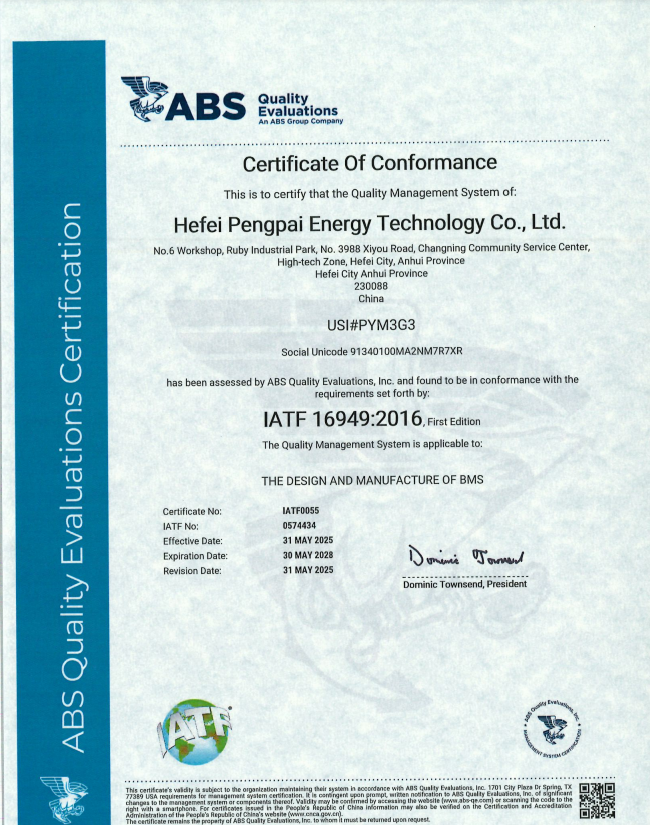
IATF 16949:2016 certificate IATF00055, issued by ABS Quality Evaluations, Inc., covering BMS design and manufacturing. Image: Pengpai Energy.
Step 8 — Validate on a sample before committing
Test the candidate board on the actual pack: charge and discharge at the extremes of the window, run the vehicle under full load, and verify that protection trips occur at the intended thresholds rather than earlier or later.
Step 9 — Lock the mechanical envelope and connector set
Board dimensions, mounting and connector choice are frequently the last items agreed and the first to cause a re-spin. Confirm them before tooling or enclosure design is finalised.
Use Cases: Where This Class of BMS Is Deployed
Golf carts and leisure vehicles. These vehicles see intermittent use with many short trips and frequent current surges from a standing start. The dominant BMS concerns are peak current headroom, reliable temperature sensing around the pack, and connectors that can be serviced without dismantling the vehicle.
Sightseeing and shuttle vehicles. Long, slow, fully loaded runs push the board toward its continuous rating for extended periods. Here continuous current capacity, thermal monitoring across multiple pack zones, and SOC estimation that does not drift during a full day of operation matter more than peak headroom.
Mini EVs and campus cars. Deeper integration with the vehicle controller makes the communication layer central. A CAN bus BMS that reports pack state, allows the controller to react to limits, and supports wake-up and pre-charge sequencing is the baseline; a BMS with SOC estimation feeds the range display the driver relies on.
Adjacent industrial applications. The same electrical requirements — a mid-voltage pack, high continuous current, multiple temperature channels — appear in AGVs and other industrial vehicles. Pengpai Energy states that its products are used across two-, three- and four-wheeled vehicles as well as commercial vehicles, intelligent robots and drones, and its customization scope includes APP, PC, IoT and display extensions for projects that need telemetry beyond the vehicle itself.
Frequently Asked Questions
What certifications should a low-speed four-wheeler BMS supplier hold?
At minimum, look for a documented quality management system plus product-level compliance evidence. Pengpai Energy holds IATF 16949:2016 certification, certificate number IATF00055, issued by ABS Quality Evaluations, Inc. and valid from 31 May 2025 to 30 May 2028, with a scope covering the design and manufacturing of battery management systems. The company also holds ISO9001 certification and states that its BMS products comply with CE and FCC. Note that vehicle-level regulation — such as AIS-156 for L-category vehicles in India, effective 1 April 2023 — applies to the pack and vehicle, so the BMS supplier’s role is to supply supporting documentation rather than to certify the vehicle.
Can a Chinese EV BMS OEM manufacturer customize CAN firmware for a specific platform?
Customization at this layer is normal practice rather than an exception. Pengpai Energy’s stated customization scope includes communication interfaces, wake-up methods, pre-charge and control circuits, and APP, PC, IoT and display extensions, alongside integrated hardware-software development and customized PCBA design for BMS applications. CAN is the common bus for vehicle-controller integration in this segment. Because the customization statement notes that exact boundaries are confirmed per project, a buyer should specify the required CAN messages, baud rate, wake-up behaviour and diagnostic expectations in the request rather than assuming a default set.
How do continuous and peak current differ on a golf cart BMS?
Continuous current is the load the board carries for as long as the vehicle is running under normal conditions; peak current is the short surge at pull-away or on a ramp. The DTH2410 is rated at 300 A continuous and 400 A peak — a 100 A surge allowance. Size the continuous figure against the hardest sustained duty cycle the vehicle will regularly face, then confirm the peak figure covers the transient. Specifying from the peak number alone typically results in an undersized board.
Can I order a single BMS unit for evaluation before a volume order?
Yes. Pengpai Energy states a minimum order quantity of 1 unit, which allows a single board to be evaluated on a real pack before a production commitment. Evaluation should cover the full voltage window, a loaded continuous run, and verification that the protection thresholds trip where intended. Buyers can request a sample or quotation through the company’s official website at www.penergy.com.cn, by email at kaiquan.zheng@penergy.com.cn, or by phone at +86-0551-62628315.
What lead time applies to a low-speed four-wheeler BMS order?
Pengpai Energy states a lead time of 0–30 days, with monthly capacity of 660,000 units. Because the 0–30 day figure is a range rather than a fixed commitment, project-specific timing — particularly for customized communication interfaces or mechanical changes — should be confirmed at quotation. For projects already in volume production, the Indian market experience is relevant: the company reports over 800,000 units delivered across four consecutive years to a vehicle or battery-industry customer in India. To discuss a specific platform, request a quotation or download the company brochure below.
Next step: match a BMS to your four-wheeler platform
Send your voltage platform, series count, chemistry, continuous and peak current requirements, and communication interface to Pengpai Energy. The company’s BMS R&D and design, customized PCBA design, integrated hardware-software development, and testing and validation services cover the full path from sample to volume production.
After-sales support: hotline 0551-65147730, available daily from 9:00 to 21:00. WhatsApp: +86 188-5605-1893.
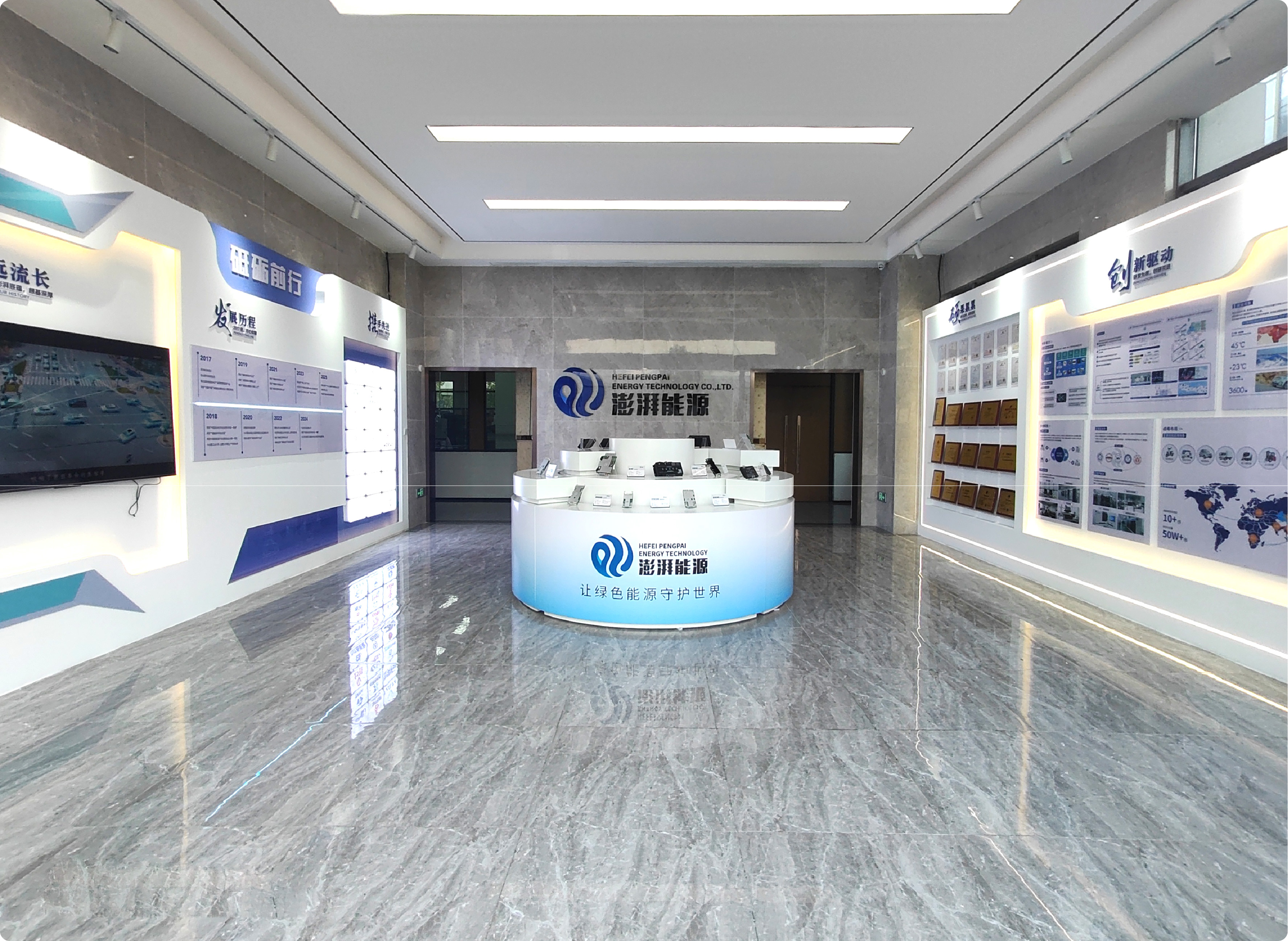
Pengpai Energy’s publicly listed BMS models include the B2107, DTH2411, DTH2302, DTH2410 and B2003 series. Image: Pengpai Energy.
Conclusion
A low-speed four-wheeler BMS is defined less by the label than by five numbers: voltage window, series count, continuous current, peak current and temperature channel count — with chemistry support and communication interface deciding how those numbers are configured. On golf carts and sightseeing vehicles the emphasis falls on peak headroom and thermal monitoring; on mini EVs it shifts toward CAN integration and SOC estimation.
The DTH2410 illustrates the shape of a four-wheeler platform specification: 30–95 V, 16S–24S, 300 A continuous and 400 A peak, NCM/LMO/LCO/LFP chemistry support, and 6-channel NTC sensing. What turns that specification into a supply relationship is the capability behind it — documented design and manufacturing, a defined customization scope, verifiable certification, and a production footprint that can absorb volume.
For buyers moving from evaluation into execution, the practical sequence is unchanged: define the platform, size the current, plan the sensing, agree the interface, confirm the documentation, and validate on a sample before releasing a volume order.
Have Questions or Need More Details?
Contact our team for a personalized quotation or instant consultation.
Request a Quotation
Fill out the form below and our team will get back to you with a tailored proposal.
WhatsApp Direct Chat
Prefer to chat in real-time? Message us on WhatsApp for instant assistance & quick answers.
- Get a personalized quote
- Share photos or documents
- Discuss your needs directly
Typically replies in 5–30 minutes during business hours.