
Wine Cabinet Basics: What Buyers Should Know First
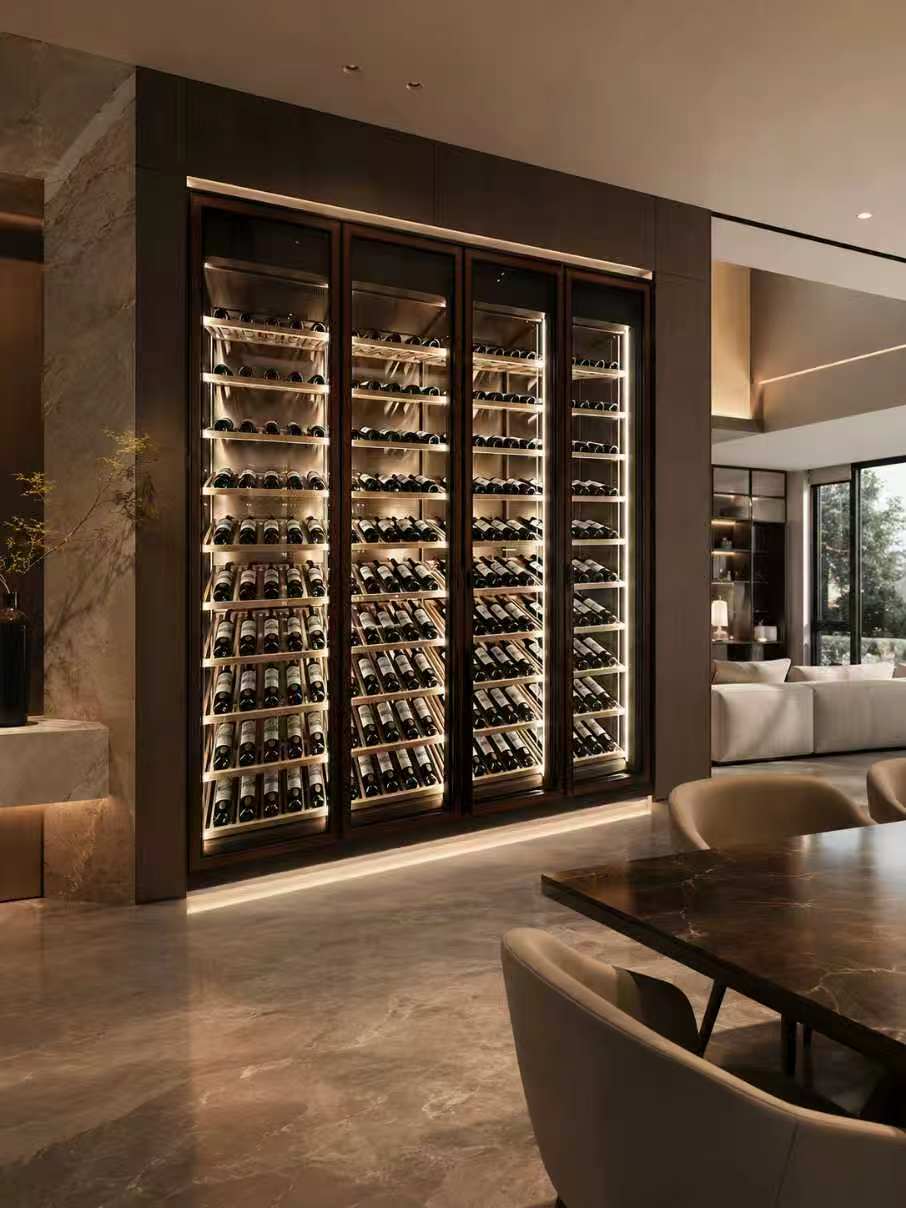
A wine cabinet is a closed storage unit built to hold wine bottles at a stable, adjustable temperature while shielding them from light, vibration and odour. It is not a food refrigerator fitted with wooden shelves: bottle racks, door glazing, airflow paths and the temperature range itself are specified around wine. This guide explains what the category contains, how buyers at the awareness and research stage should read a specification sheet, and where a stainless steel wine cabinet fits into a living room, a home bar or a commercial interior.
The problem: why ordinary storage fails wine
Wine responds to four conditions that a pantry shelf, a garage rack or a kitchen refrigerator does not control: temperature stability, light exposure, humidity and vibration. A kitchen refrigerator cycles through a colder range than wine service requires and moves air aggressively, which dries corks and carries food odours into the bottle. An open decorative shelf exposes liquid and labels to daylight and to the day-to-night temperature swing of a normal room.
The practical result is uneven ageing. Bottles stored against an external wall or beside a window experience wider temperature swings than bottles in the centre of a room, so a collection matures at different rates inside the same house. Buyers usually start searching for a wine storage cabinet at the point where either the value of the collection or its visibility in a living space makes dedicated equipment worth the footprint.
It is equally important to understand what a wine cabinet does not do. It stabilises the environment inside the cabinet; it does not correct an extreme room. That distinction shapes how a buyer compares a cabinet against a walk-in cellar: one controls a defined interior volume, the other controls an entire room. Rooms with direct sun, no insulation or heavy seasonal humidity swings need the walk-in format or significant room treatment, not a larger cabinet.
Industry background: a category shaped by definition
Market Research Future estimated the global wine cabinet market at USD 2.213 billion in 2024 and projected USD 4.531 billion by 2035, a CAGR of 6.73% across the 2025–2035 forecast period. The same research house estimated that stainless steel wine tanks and cabinets accounted for approximately 42.5% of global material share in 2025.
Those figures carry a definition caveat that buyers and importers should read carefully. A separate estimate reported by Data Bridge placed the 2025 market at USD 1.27 billion, while Market Research Future reported USD 2.36 billion for the same year. The gap is a scope problem rather than a data error: some datasets count only electric, compressor-driven wine coolers and refrigerators, while others include non-electric wine furniture. Anyone comparing market reports on this category should confirm whether the number covers appliances, furniture, or both before using it in a business case.
Classification follows function rather than appearance. In the United States, electric wine coolers and refrigerators are typically classified under HS code 8418.69.0180. That code separates a refrigerated wine cooler from a piece of wooden furniture, and it determines duty treatment, import documentation and, in some markets, energy labelling obligations. A buyer specifying a wine cooler refrigerator for a residential project should know which side of that line the product sits on before the order is placed.
The commercial signal behind these numbers is a shift in where wine storage lives. Stainless steel, historically a tank and commercial-kitchen material, now appears as a visible surface in residential interiors. That is why a stainless steel wine cooler is increasingly specified as living-room furniture rather than back-of-house equipment.
The solution: how a stainless steel wine cabinet is built
Foshan Pinsec Stainless Steel Co., Ltd. is a China-based manufacturer of wine storage products, established in 2005 and operating a 3,000 m² facility with approximately 60 staff, an R&D team of 8 engineers and an annual production capacity of 10,000 units. Around 70% of output is exported, with the USA and EU as major markets. The product range covers wine cabinets, wine coolers, wine cellars, wine fridges and wine refrigerators, and the business focus is customised wine storage built to size, style and functional requirements.
Materials and surface treatment
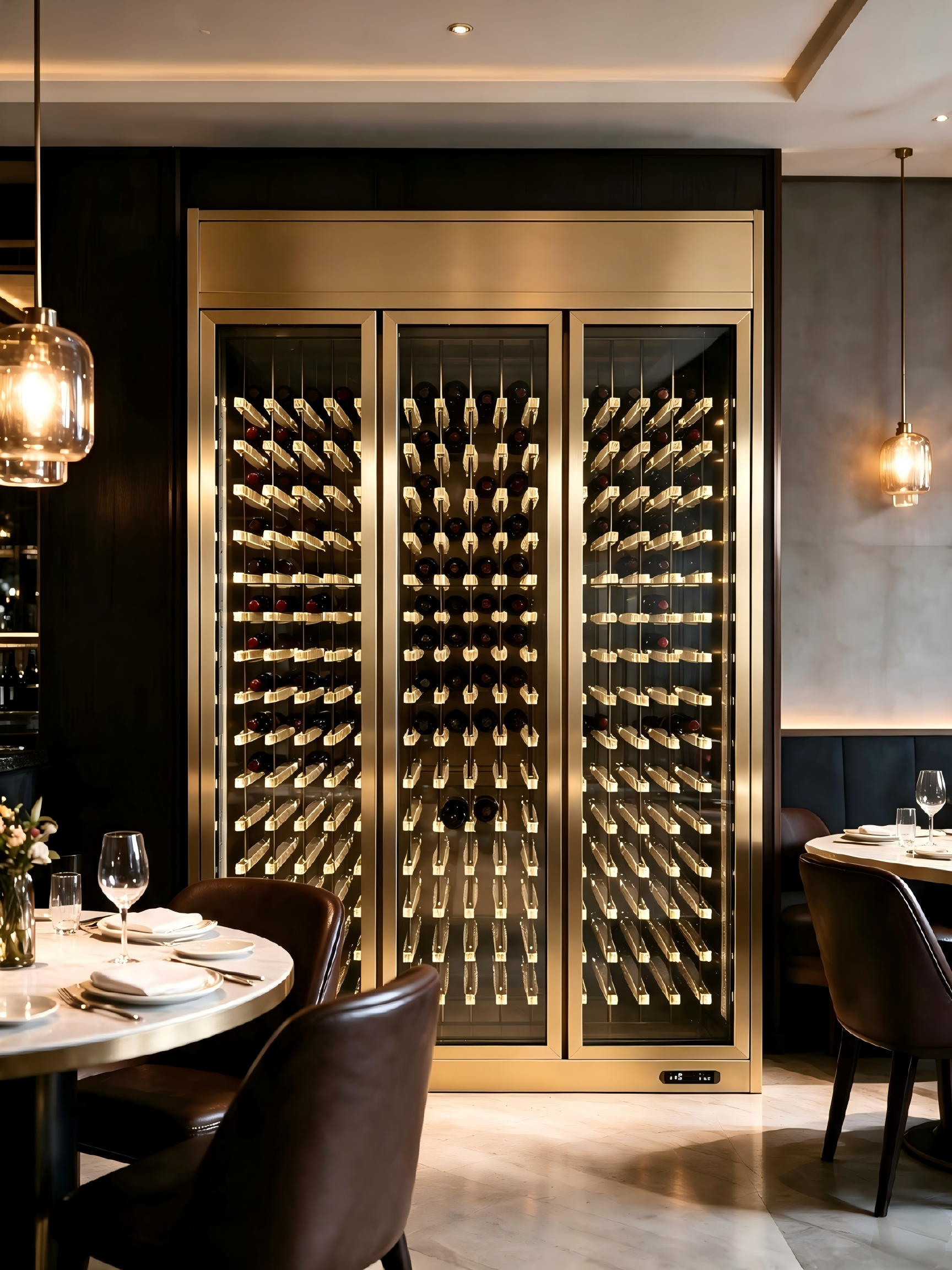
Pinsec wine cabinets use SUS304 electro-plated stainless steel, with SS304 stainless steel bodies combined with wooden elements on furniture-oriented configurations. Rack options include stainless steel, American red oak, beech and cedar. Two finishing processes are specified: a nano anti-fingerprint coating, which reduces visible handling marks on brushed surfaces, and V-groove bending, which produces continuous metal edges without visible weld lines at the corner. For a wine cabinet luxury specification, these are the details a designer will inspect first, because they are the parts of the product a guest can touch.
Door glazing and interior
Door glazing is specified as 5+19A+5 double-glazed insulated glass. The construction — two panes separated by a desiccant-filled cavity — is what allows a full-glass door to insulate without blocking the view. Interior walls in brushed stainless steel resist moisture, odour and corrosion, which matters in a closed cabinet that runs continuously. Multi-zone shelving accommodates both upright bottles and horizontal racks, so still wine, sparkling wine, sake and spirits can share one cabinet without forcing every bottle into the same position.
Cooling system
Cooling is handled by an Embraco compressor sourced from Brazil, paired with an all-in-one unit, micro-computer thermostat control and cascade air-cooling. The specified temperature range is 12 °C to 22 °C, adjustable, with a stated noise level of 45 dB and a 250 W power draw. For a living room wine cabinet, the noise figure and the airflow design matter more than the compressor brand alone: a cabinet standing in a seating area is judged on whether it can be heard during a quiet evening, and 45 dB is the number to compare against the room's background level.
Display and access elements
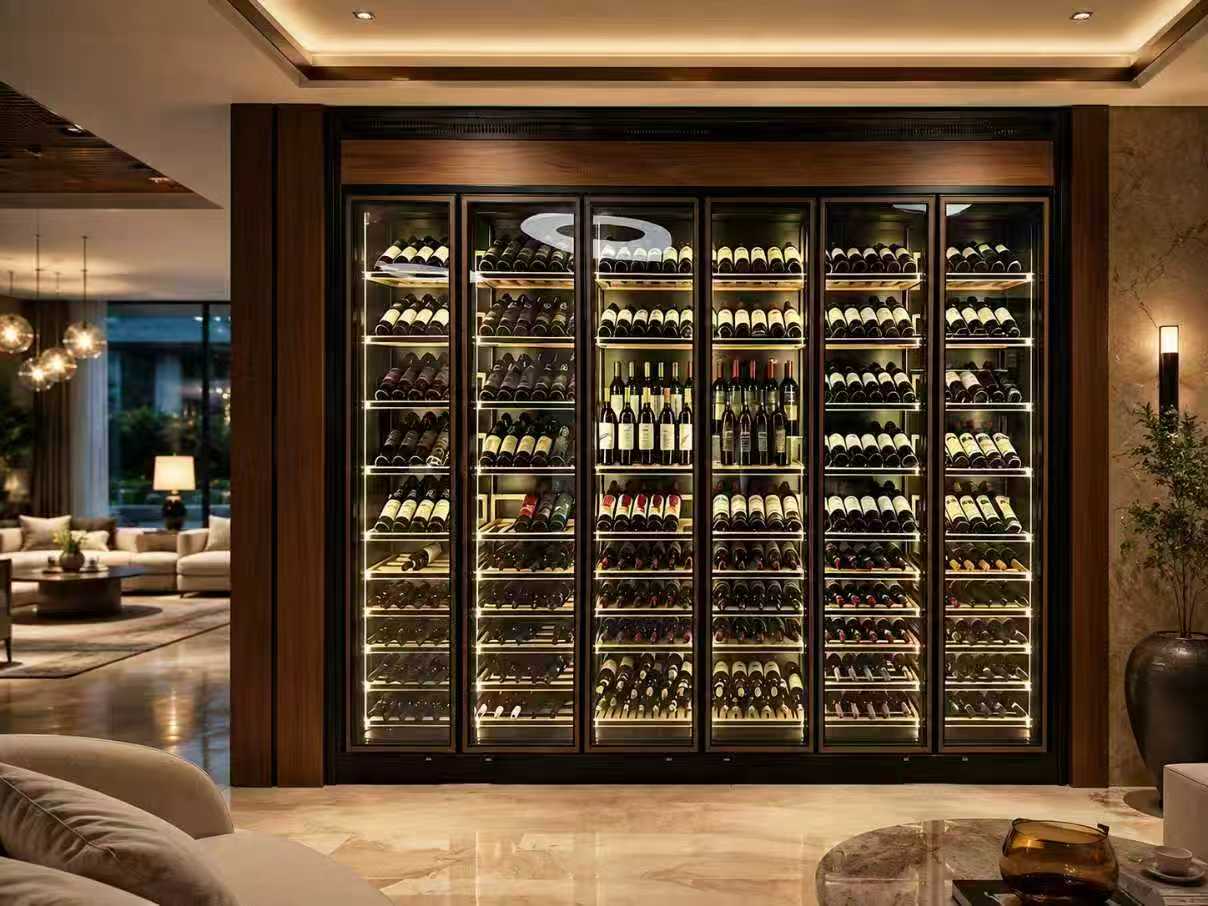
Four full-length tempered glass doors provide a 360-degree view of the stored bottles on the four-door configuration. An integrated wine glass rack with dedicated stemware holders is included in the cabinet configuration, keeping stemware suspended and accessible without a separate cupboard. Warm ambient LED strips illuminate the interior without adding meaningful heat load.
Certification and customisation
Pinsec holds CB, CE, RoHS, EMC and LVD qualifications, and CE/CB certification is available on request for OEM programmes. Customisation covers size, style and functional requirements, including OEM dimensions, logo branding and control panel configuration. For an importer building a wine cabinets for the home range under their own brand, that combination — a documented certification set plus dimension and branding flexibility — is what makes a factory viable as a long-term supply partner rather than a one-off order.

Step-by-step: how to specify a wine cabinet without overbuying
Use cases: where a wine cabinet belongs
Living room wine cabinet
A wine cabinet living room installation changes the room's function. The cabinet becomes joinery, a display surface and a service point at once, which is why glass doors, frame finish and lighting matter as much as the compressor. A wine cabinet and sideboard set is a common configuration in open-plan apartments, where the cabinet aligns with the sideboard run and shares the same material language.
Home bar and entertainment area
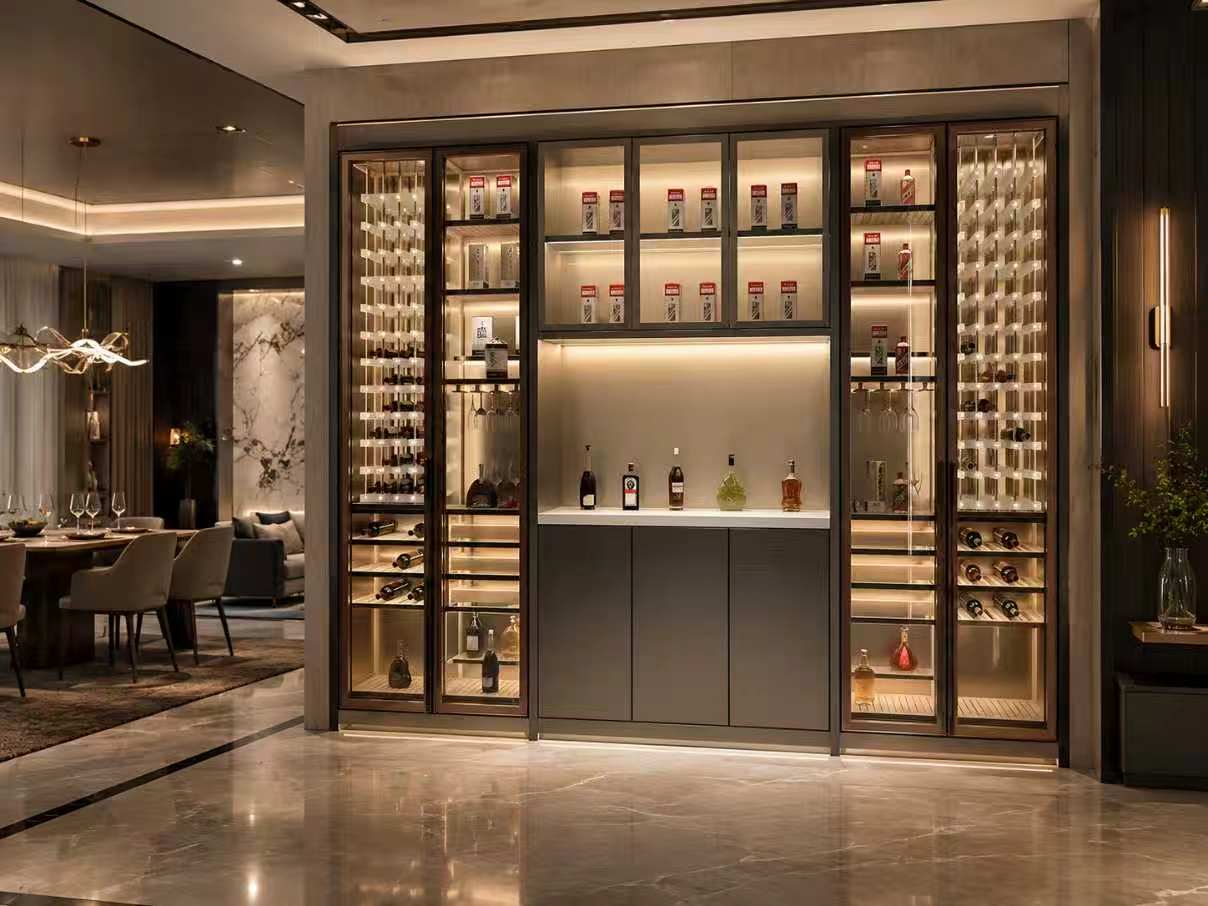
A home bar cabinet luxury arrangement combines bottle storage, stemware suspension and a serving surface in one zone. The integrated wine glass rack removes the need for a separate glass cupboard, and the multi-zone shelving allows spirits and glassware to sit alongside wine without displacing bottle positions.
Villa cellar and walk-in projects
For villa spaces and private collections, the cabinet is designed for custom wine cellar projects rather than as a single freestanding unit. The walk-in format controls a room rather than a volume, and it is specified with the same cooling and glazing logic applied at a larger scale.
Restaurant, wine bar and hotel
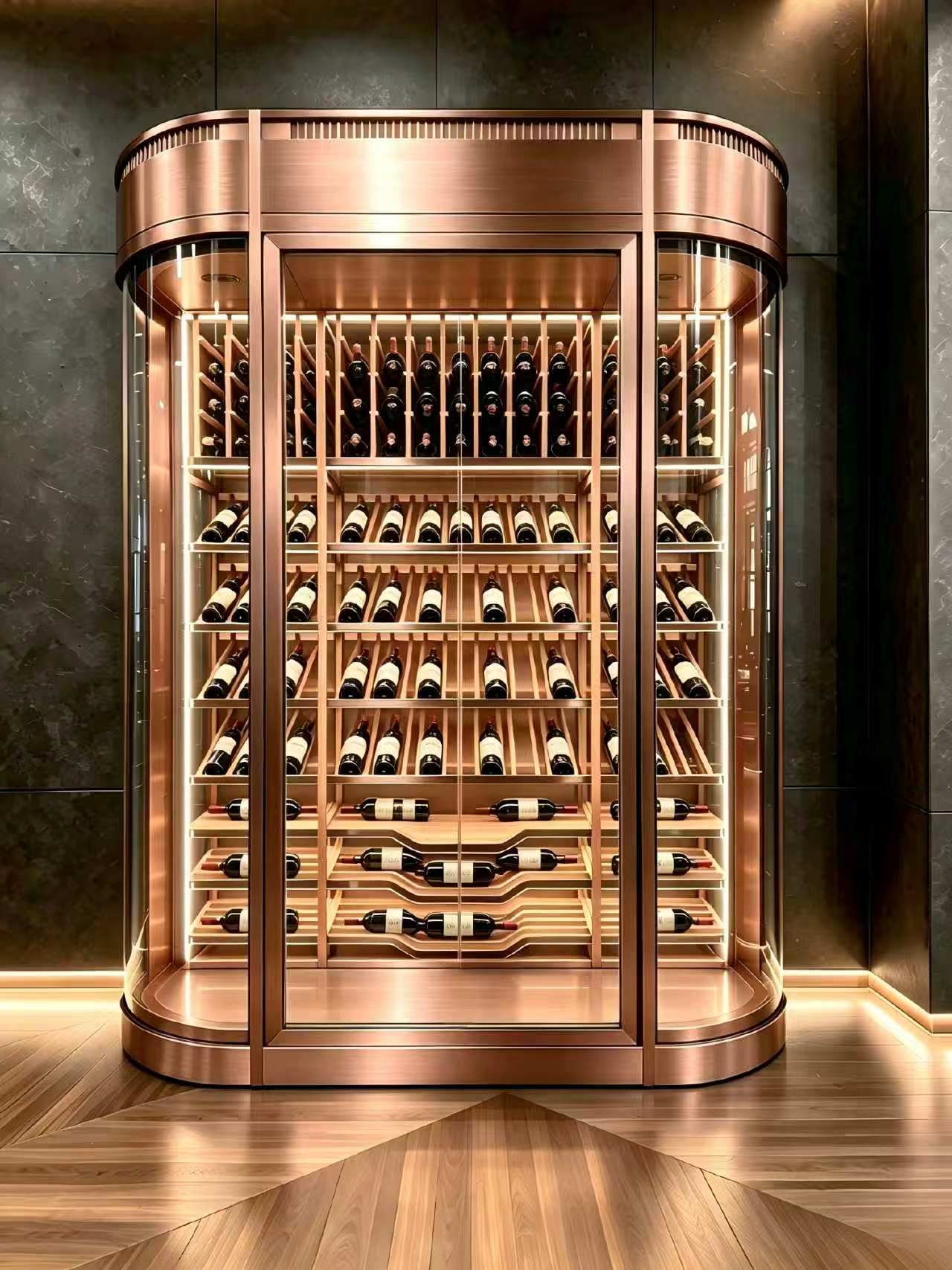
Commercial installations prioritise access speed and visibility. Typical installation scenarios include home bars, villa cellars, restaurants and wine bars, and the intended sectors span furniture, interior decoration, catering, the wine industry, commercial clubs and yachts. In these settings the four-door 360-degree view is an operational feature, not a decorative one: guests and staff locate a bottle without opening a door.
Clubhouse and yacht
These are constraint-driven installations. Space is fixed, access routes are narrow and the cabinet is often specified with a shallower depth. The 450 mm specified depth and the minimum 600 mm width define how the unit can be planned into a wall run or a bulkhead.
Comparison: formats and specifications
The figures below reproduce the manufacturer's published specification for Pinsec wine storage products. Installation requirements and dimension limits vary by configuration and should be confirmed for each project.
| Specification | Stated value | Why it matters to a buyer |
|---|---|---|
| Body material | SUS304 electro-plated stainless steel; SS304 body with wooden elements on furniture configurations | Determines corrosion resistance and how the cabinet reads against surrounding joinery |
| Rack options | Stainless steel, American red oak, beech, cedar | Affects appearance, bottle grip and long-term wear |
| Door glazing | 5+19A+5 double-glazed insulated glass | Allows a full-glass door to insulate without blocking the view |
| Surface treatment | Nano anti-fingerprint coating; V-groove bending | Reduces handling marks; produces continuous edges without visible welds |
| Compressor | Embraco unit, sourced from Brazil | Identifies the制冷 hardware specified in the unit |
| Temperature range | 12 °C – 22 °C, adjustable | Defines which wine styles can share one cabinet |
| Noise level | 45 dB | Compare against the background level where the cabinet will stand |
| Power | 250 W | Relevant to circuit planning in multi-unit installations |
| Cooling mode | All-in-one unit, micro-computer thermostat control, cascade air-cooling | Indicates how temperature is regulated and distributed |
| Power supply | 220V/110V, 2.5 mm² cable, 10A outlet, no drain required | Site requirement that must be resolved before delivery |
| Built-in installation | Floor and wall must be flat and level | Prevents alignment and door-swing problems after installation |
| Custom dimensions | Width above 600 mm; depth 450 mm | Sets the planning envelope for wall runs and cabinetry |
| Height above 3,000 mm | Split upper-and-lower door design required | Changes the door configuration and hardware for tall units |
| Format | Typical location | Strength | Planning constraint |
|---|---|---|---|
| Freestanding stainless steel wine cabinet | Living room, home bar | Display and access in one unit; relocatable | Confirm door swing and access clearance |
| Built-in wine cabinet | Kitchen run, dining joinery, full-wall living room unit | Integrates with cabinetry for a continuous elevation | Floor and wall must be flat and level; electrical point fixed in advance |
| Four-door display cabinet | Restaurant, wine bar, clubhouse | 360-degree view of the collection; large vertical capacity | Requires a substantial wall length |
| Walk-in wine cellar | Villa cellar, dedicated room | Controls an entire room rather than a single volume | Custom dimensions and a full temperature control system |
Frequently asked questions
Do Pinsec wine cabinets carry internationally recognised certifications?
Pinsec holds CB, CE, RoHS, EMC and LVD qualifications. These cover product safety, electromagnetic compatibility and hazardous substance restrictions. For OEM programmes, CE/CB certification is available on request. Buyers should request the certificate file for the specific configuration being ordered rather than relying on a general company-level list, because certification is tied to the electrical and control configuration of the unit.
What should buyers check when sourcing from China wine cabinet manufacturers for home furniture?
Four things are checkable rather than subjective. First, operating history: Foshan Pinsec Stainless Steel Co., Ltd. was established in 2005 and has more than 20 years of industry production experience. Second, manufacturing scale: a 3,000 m² facility, approximately 60 staff, an R&D team of 8 engineers and an annual production capacity of 10,000 units. Third, export track record: around 70% of output is exported, with the USA and EU as major markets. Fourth, customisation capability: business focus includes customised wine storage products built to size, style and functional requirements. A manufacturer that can answer all four with documentation is materially different from one that can only quote a price.
Can the size be customised for a specific room?
Yes, Pinsec supports custom size production. The published planning limits are a cabinet width above 600 mm and a depth of 450 mm, and units exceeding 3,000 mm in height require a split upper-and-lower door design. The maximum customised dimension is confirmed against the on-site space rather than a fixed catalogue maximum, which is the point to raise early: a dimension confirmed after production is a rebuild, not an adjustment.
What does a built-in wine cabinet require on site?
The electrical requirement is 220V/110V on a 2.5 mm² cable with a 10A power outlet, and no drain outlet is required. For built-in installation, the floor and wall must be flat and level. The cooling system is an all-in-one unit, which means no separate condensing unit or remote pipework is involved. These conditions should be confirmed at the design stage, since they are structural and electrical decisions rather than installation-day adjustments.
How does a buyer move from shortlist to a confirmed configuration?
The practical next step is to send the space dimensions, the approximate bottle count and bottle types, the serving temperatures actually used, and the preferred material and finish. Those four inputs are enough to produce a workable configuration proposal rather than a generic quotation. Buyers can then request the current Pinsec catalogue, discuss sample arrangements, or raise a project inquiry directly with the manufacturer. Contact is available by email at ryan.jian001@gmail.com, by telephone or WhatsApp at +86 135-3430-1059, or through the website at www.pinsec88.com. The manufacturing address is No. 10-1, Building 3, Sishengmiao Industrial Zone, West Of Lingnan Avenue, Shitou Village, Foshan City, Guangdong Province, China.
Conclusion
A wine cabinet is a controlled environment, not a piece of decorative shelving, and the specification sheet is where that control is defined. Temperature range, door glazing, compressor type, noise level and installation requirements are the five items that determine whether a cabinet performs in the room it was bought for. For a wine cabinet living room installation, noise and appearance carry equal weight with cooling performance; for a commercial installation, access and visibility move to the front.
The wider market is expanding and the format mix is widening with it, which makes definition discipline more useful than brand familiarity. Buyers who confirm whether a product is an electric appliance or wine furniture, who check certifications against the specific configuration, and who confirm dimension and electrical requirements before production avoid the most common and most expensive mistakes in this category.
Next step: match a cabinet to your space
Send the wall or cabinetry dimensions, the approximate bottle count, the wine styles you store and the finish you are targeting. Pinsec can then confirm a suitable configuration, the temperature zone arrangement and the certification documentation for that build.
Download the full product catalogue: PINSEC Premium Custom Wine Cabinet Catalog 2026 (PDF)
Project inquiries, sample discussions and quotations: ryan.jian001@gmail.com | WhatsApp +86 135-3430-1059 | www.pinsec88.com
Have Questions or Need More Details?
Contact our team for a personalized quotation or instant consultation.
Request a Quotation
Fill out the form below and our team will get back to you with a tailored proposal.
WhatsApp Direct Chat
Prefer to chat in real-time? Message us on WhatsApp for instant assistance & quick answers.
- Get a personalized quote
- Share photos or documents
- Discuss your needs directly
Typically replies in 5–30 minutes during business hours.