
Wine Cabinet Guide: How a Wine Cabinet Works and How to Choose One for the Home
A wine cabinet is temperature-controlled furniture built to hold wine bottles at a stable, adjustable temperature while limiting light and vibration. It differs from a decorative wine rack because it actively manages the storage environment, and it differs from a plain wine fridge in form: a cabinet is finished to live inside the home, with glass doors, interior lighting and shelving arranged for both display and long-term storage.
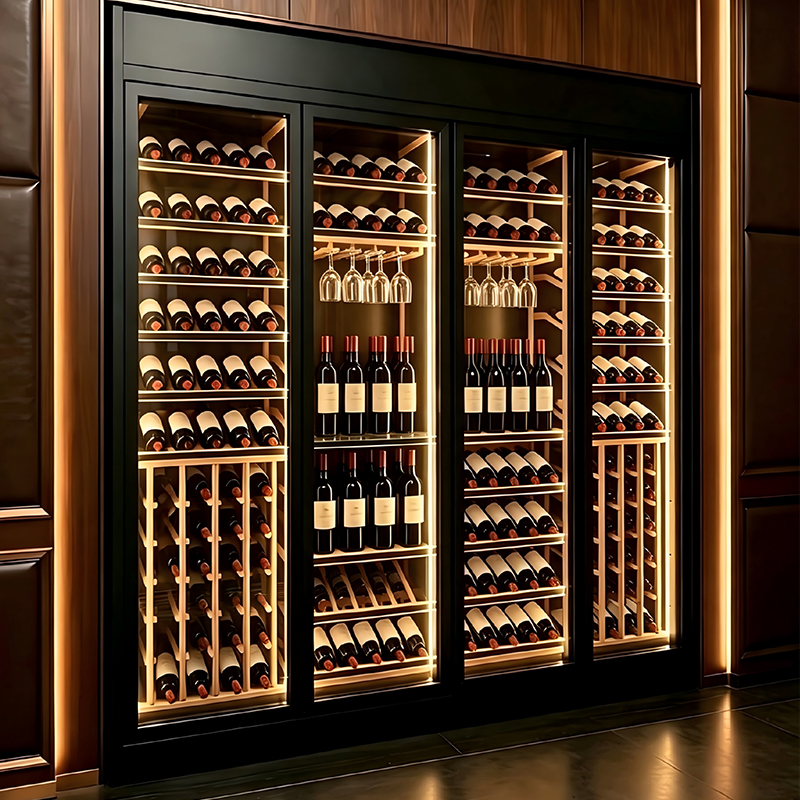
Pinsec luxury stainless steel wine cabinet: a custom configuration with panoramic glass doors and warm ambient LED lighting.
This guide covers the discovery stage of the decision. It is written for homeowners planning a living room, designers specifying for a villa or restaurant, and importers and distributors building a range. It explains what a wine cabinet does, what published industry data says about the category, which specifications decide performance, and how a custom stainless steel wine cabinet is specified step by step.
The storage problem a wine cabinet solves
Wine responds to heat, light, vibration and sudden temperature change. A decorative rack in a bright living room exposes bottles to all four, and the effect is usually invisible until the bottle is opened. This is why the category exists: a wine cabinet replaces an open shelf with a closed, insulated volume that holds a set temperature and controls how light reaches the bottle.
Three practical questions define the problem, and they hold whether the buyer is furnishing a flat or equipping a restaurant.
- Temperature stability. Storage needs a stable set point that can be adjusted for red, white, sparkling wine and sake, rather than ambient room temperature. Pinsec temperature-controlled configurations adjust between 12 °C and 22 °C.
- Space and form. A living room wine cabinet has to work as furniture, so door count, height and depth are dictated by the wall as much as by the bottle count.
- Integration. Built-in cabinets impose site requirements: power supply, level floor and wall, cable size and clearance above the unit. These are far easier to solve at design stage than after installation.
Once those three questions are answered, the choice between a wine cooler, a wine storage cabinet and a walk-in cellar usually becomes obvious.
Industry background: a growing but loosely defined category
Market research published in 2026 by Market Research Future estimated the global wine cabinet market at USD 2.213 billion in 2024, with a projection of USD 4.531 billion by 2035 at a CAGR of 6.73%. The same source estimated that stainless steel wine tanks and cabinets represented approximately 42.5% of global material share in 2025.
A definition caveat: published market values for the same period differ substantially between research houses, largely because some count only electric temperature-controlled cabinets while others include non-electric wine furniture. When comparing reports, check which definition is used before comparing the number.
Two structural signals matter more than the headline figure. First, stainless steel has moved from a purely functional material — the tank and commercial cellar material — into residential furniture, and the finish now carries much of the design intent in a high-end interior. Second, the category is increasingly specified rather than bought off the shelf: buyers expect dimensions, door layout and finish to follow the room.
For importers, classification matters as much as design. In the United States, electric wine coolers and wine refrigerators are typically classified under HS code 8418.69.0180, which affects landed cost and should be confirmed with a customs broker before the first shipment.
Detailed solution: what a Pinsec wine cabinet is built from
Pinsec (Foshan Pinsec Stainless Steel Co., Ltd.) is a China-based manufacturer established in 2005 that specialises in wine cabinets, wine coolers, wine cellars, wine fridges and wine refrigerators. The company exports about 70% of its output, with the USA and EU as its major markets, and its wine cabinet is a custom-built, temperature-controlled stainless steel cabinet rather than a fixed catalogue item.
The specification below is what actually determines how the cabinet behaves once it is installed.
Body, materials and finish
- Main material: SUS304 electro-plated stainless steel, combined with wooden elements in wine cabinet configurations.
- Glass: 5+19A+5 double-glazed insulated glass, specified to limit heat transfer and condensation.
- Craftsmanship: nano anti-fingerprint coating and a V-groove bending process.
- Interior: brushed stainless steel inner walls, specified to resist moisture, odour and corrosion.
- Racking: stainless steel, American red oak, beech or cedar, depending on the configuration.
Cooling and control
- Compressor: Embraco unit, sourced from Brazil.
- Temperature range: 12 °C to 22 °C, adjustable.
- Control: all-in-one cooling unit with micro-computer thermostat control and cascade air-cooling.
- Acoustics and power: 45 dB noise level, 250 W.
Display and access
- Four full-length tempered glass doors, specified to give a 360-degree view of the stored bottles.
- Warm ambient LED strips that illuminate the interior without generating heat, protecting wine from UV exposure.
- Multi-zone shelving for upright bottles and horizontal racks, covering still wine, sparkling wine and spirits.
- An integrated wine glass rack with dedicated stemware holders.
- A dark anodized stainless steel frame for a hotel-grade finish.
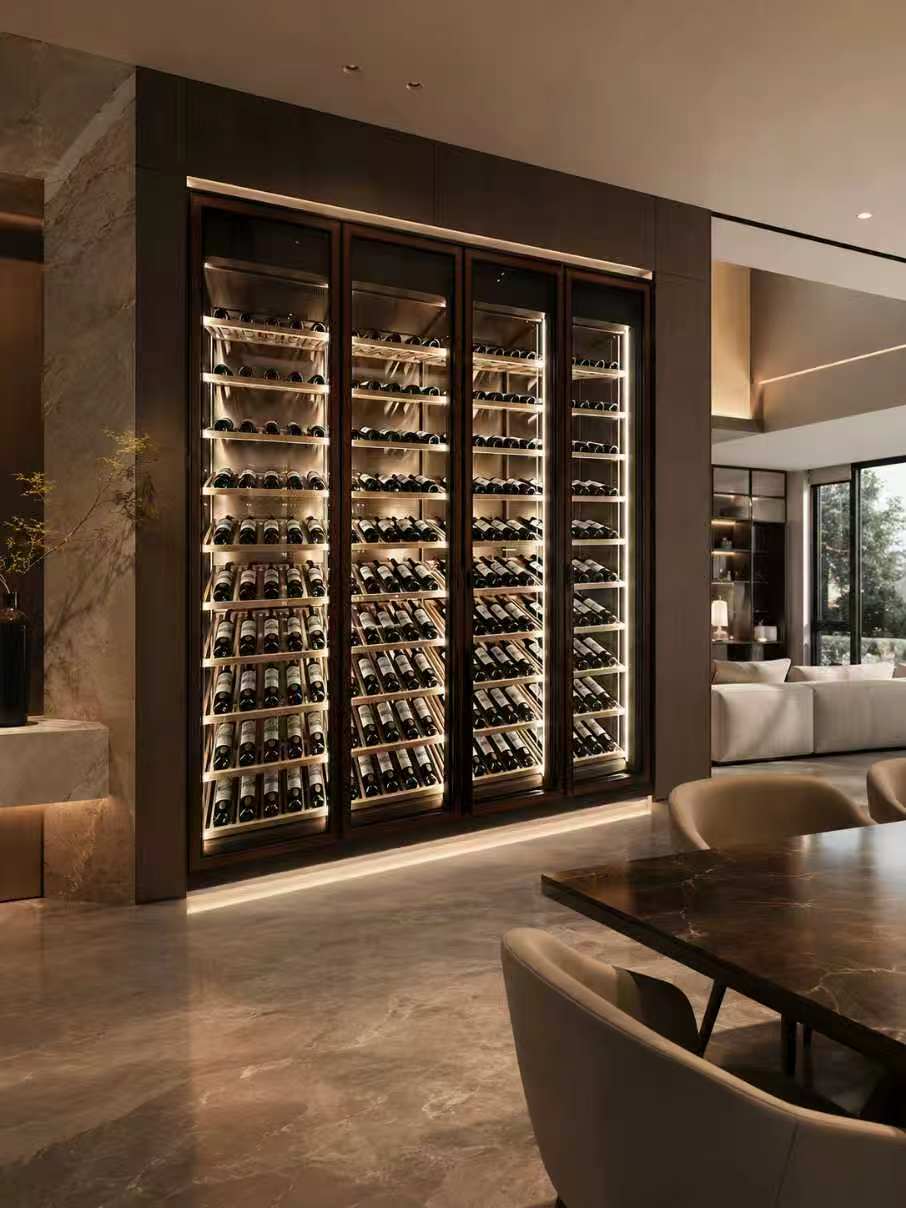
Four-door temperature-controlled wine cabinet: four full-length tempered glass doors give a 360-degree view of the collection.
Site requirements
- Power: 220 V / 110 V, 2.5 mm² cable, 10 A power outlet.
- No drain outlet required.
- For built-in installation, the floor and wall must be flat and level.
- Built-in dimensions: width above 600 mm and depth of 450 mm; units over 3,000 mm in height require a split upper-and-lower door design.
Compliance
Pinsec lists CB, CE, RoHS, EMC and LVD among its certifications, and CE/CB certification is available on request for the wine cabinet configuration. Documentation should be checked against the destination market before ordering, not after.
Step-by-step: how to specify a wine cabinet for a home or project
- Count bottles and bottle types. A mixed collection of still wine, champagne and spirits needs a different shelf mix from a single-type collection. Capacity drives door count and height more than any other input.
- Choose the form factor. A full-height built-in cabinet suits a feature wall; a walk-in wine cellar suits a basement room; a freestanding wine cooler refrigerator suits a kitchen or a compact home bar.
- Confirm the site conditions. Check the 220 V/110 V supply, a 10 A outlet, 2.5 mm² cable and a level floor and wall. No drain is needed, which simplifies retrofits.
- Set the temperature brief. Confirm the target against what will be stored. The adjustable 12 °C to 22 °C band covers service and medium-term storage; the set point, not the range, is what the thermostat holds.
- Select material and finish. Decide between all-stainless and stainless-with-wood, and confirm finish details such as nano anti-fingerprint coating and V-groove bending where visible edges matter.
- Plan glass and lighting. Double-glazed 5+19A+5 glass and heat-free LED strips determine both how the collection reads at night and how much heat reaches the bottles.
- Fix the dimensions with the manufacturer. Custom size production is supported, and the maximum dimension is confirmed against the on-site space rather than a standard table. Allow for the split-door rule above 3,000 mm height.
- Confirm documentation and logistics. Certifications, HS classification and shipping configuration should be settled together, because they affect both compliance and landed cost.
Where wine cabinets are used
Pinsec wine cabinets are specified for living rooms, hotels, restaurants, villas, clubhouses and large flats, operating on constant temperature around the clock for the display and storage of red wine, white wine, champagne and sake.
- Living room. The cabinet works as a display object as well as storage: four glass doors, interior LED lighting and a frame finish that matches the surrounding joinery. This is the most common residential use of a living room wine cabinet.
- Villa and private collection. Larger configurations and walk-in cellars suit villa spaces and private collections, where the cabinet forms part of the architecture rather than standing alone as an appliance.
- Hotel, restaurant and wine bar. Multi-zone shelving and stemware racks support service as well as storage, and the 45 dB noise figure matters in a dining room.
- Clubhouse and yacht. The same stainless steel platform is used in commercial clubs and yacht interiors, where corrosion resistance and finish durability carry more weight than capacity.
- Home bar. A compact configuration under or beside a counter turns a wall into a home bar cabinet, with glasses held in the integrated stemware rack.
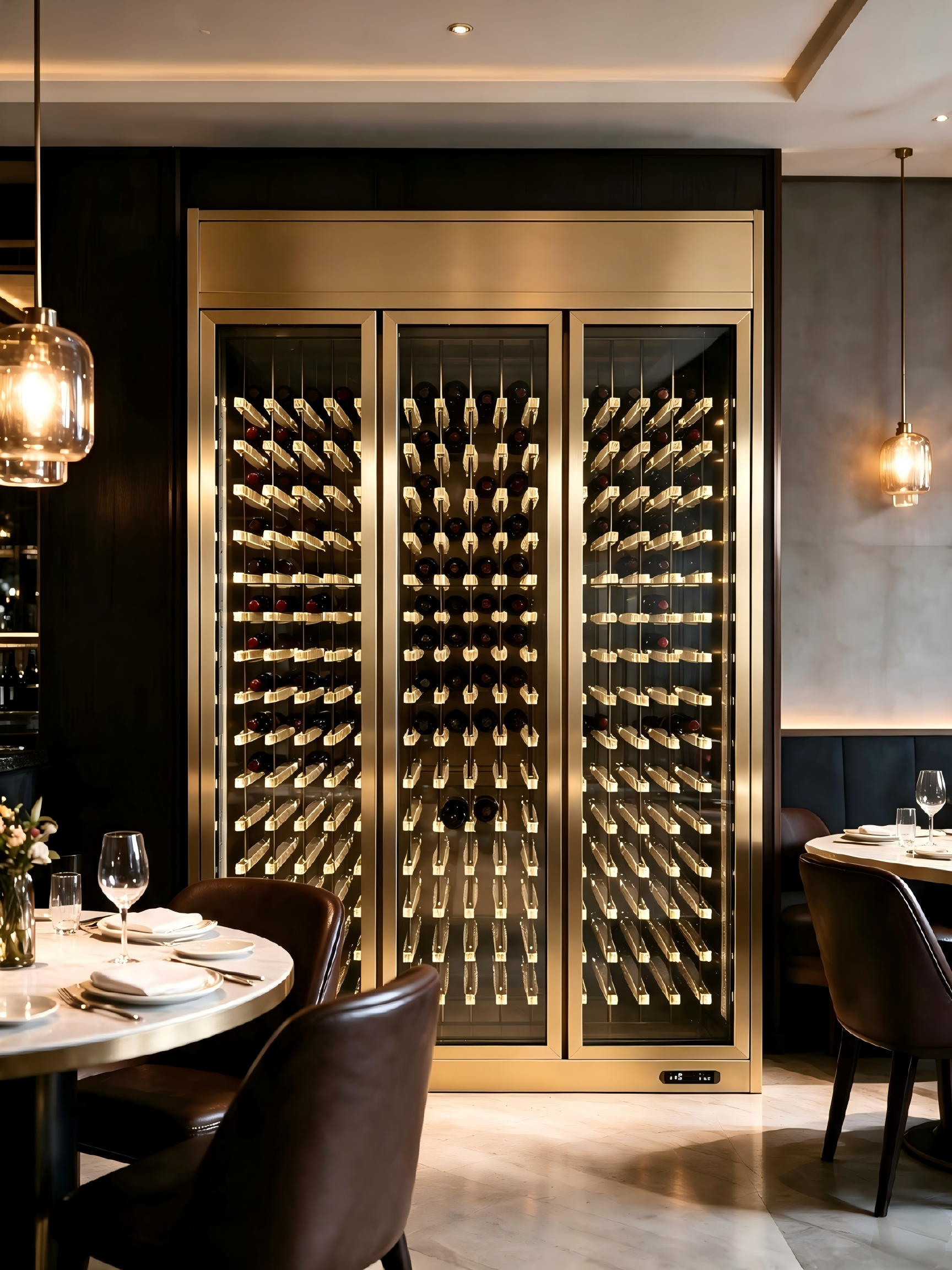
Stainless steel wine cabinet with hidden lighting: warm ambient LED strips illuminate the interior without adding heat.
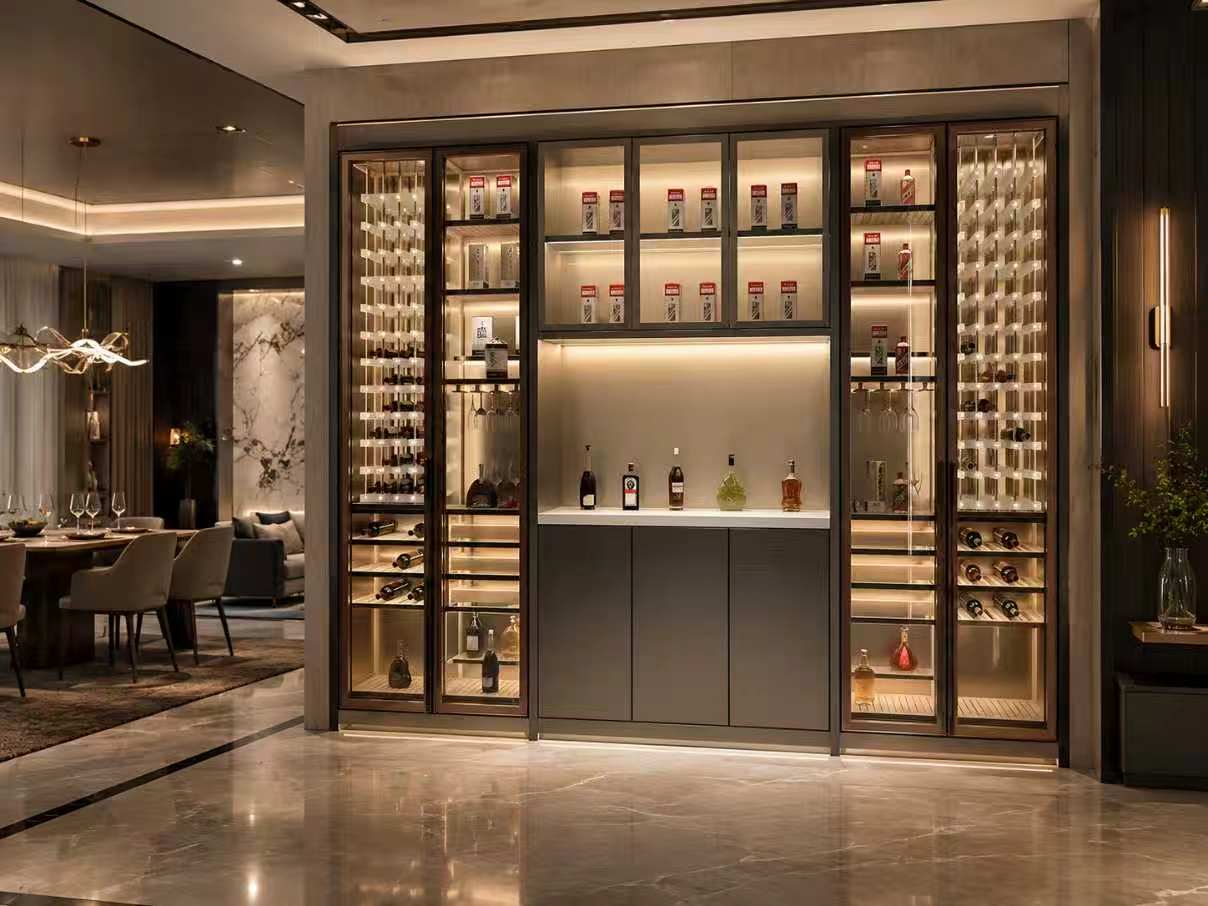
Wine cabinet and sideboard set: a living room configuration where storage and display share one wall.
Comparing common wine cabinet configurations
The table compares configurations on the criteria that change the purchase decision. It uses Pinsec published specifications and does not score or rank one configuration above another, because the right choice depends on the room rather than on the product alone.
| Configuration | Typical placement | Cooling and control | What to confirm before ordering |
|---|---|---|---|
| Two-door temperature-controlled wine cabinet | Living room, large flat, hotel floor | All-in-one cooling unit, micro-computer thermostat, 12–22 °C | Outlet position, level floor and wall, door swing |
| Four-door panoramic glass cabinet | Living room feature wall, restaurant, wine bar | Same temperature-controlled platform, 45 dB, 250 W | Clear height, safe access for cleaning glass, lighting circuit |
| Full-height multi-section cabinet | Villa cellar, tasting room, commercial venue | Cascade air-cooling, constant temperature, continuous operation | Ceiling clearance, split upper-and-lower doors above 3,000 mm, delivery route |
| Walk-in wine cellar | Villa basement, clubhouse | Cascade air-cooling, adjustable 12–22 °C | Room insulation and sealing, 2.5 mm² cable, 10 A outlet, no drain |
| Freestanding wine cooler / wine refrigerator | Kitchen, home bar, apartment | Embraco compressor, micro-computer thermostat control | Ventilation clearance, noise tolerance against the 45 dB figure, bottle capacity |
Figures reflect the Pinsec temperature-controlled platform: 12 °C to 22 °C adjustable, Embraco compressor, 45 dB, 250 W, 5+19A+5 double-glazed insulated glass.
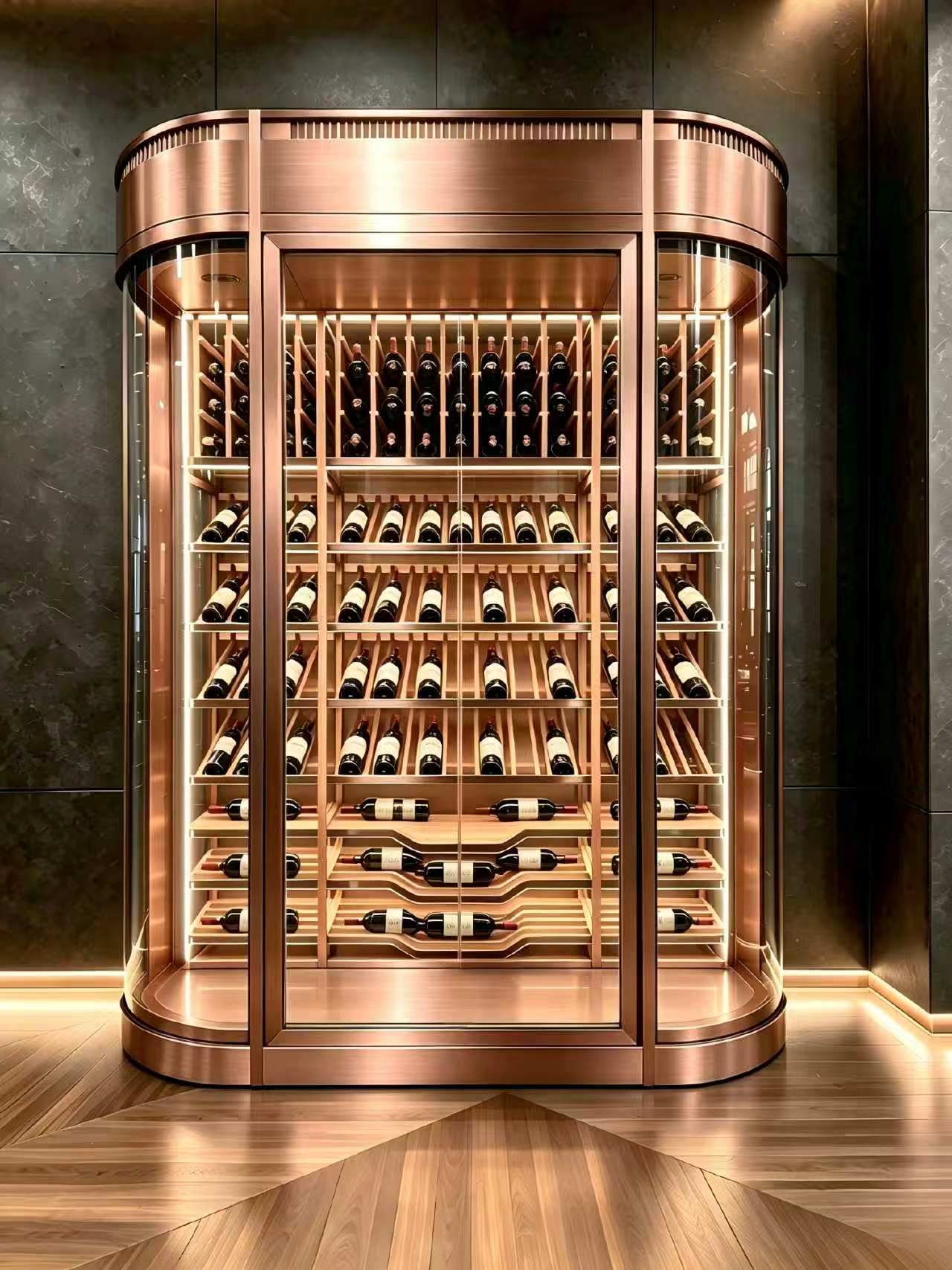
Walk-in wine cellar: the configuration used where bottles are stored by the case rather than displayed by the bottle.
Frequently asked questions
Which certifications and classifications apply to an exported wine cabinet?
Pinsec lists CB, CE, RoHS, EMC and LVD among its certifications, and CE/CB certification is available on request for the wine cabinet configuration. For customs purposes, electric wine coolers and wine refrigerators are typically classified under HS code 8418.69.0180 in the United States, and buyers should confirm the applicable classification with their own customs broker before shipping.
Can a wine cabinet be customised to fit a living room wall?
Yes. Pinsec supports custom size production, and the maximum dimension is confirmed against the on-site space. For built-in configurations, the cabinet requires a width greater than 600 mm and a depth of 450 mm, and the floor and wall must be flat and level. Units over 3,000 mm in height require a split upper-and-lower door design.
How is temperature controlled, and how quiet is the cabinet?
Temperature-controlled Pinsec configurations use an all-in-one cooling unit with micro-computer thermostat control and cascade air-cooling, adjustable between 12 °C and 22 °C. The specification lists an Embraco compressor sourced from Brazil, a noise level of 45 dB and a power draw of 250 W. The cabinet runs on 220 V or 110 V through a 10 A outlet with a 2.5 mm² cable, and no drain outlet is required.
How should buyers compare China wine cabinet manufacturers for home furniture projects?
Compare documented material grade, certification set, custom-size capability, in-house production scale and export experience rather than showroom appearance alone. Foshan Pinsec Stainless Steel Co., Ltd. was established in 2005, operates a 3,000 m² facility with about 60 staff and 8 R&D engineers, produces up to 10,000 units per year, and exports about 70% of its output, mainly to the USA and EU.
How can buyers request a sample, drawing or quotation?
Contact Pinsec directly with the intended space, bottle count and preferred finish, and the team confirms dimensions, configuration and commercial terms for the project. Email ryan.jian001@gmail.com, call or message +86 135-3430-1059 on WhatsApp, or download the Pinsec wine cabinet catalog for the current configuration range.
Conclusion
A wine cabinet is a specification decision before it is a furniture decision. The temperature band, the site requirements, the material grade and the certification set determine whether the cabinet will still be doing its job in ten years, while the door layout and finish determine whether it belongs in the room at all. Buyers who settle the technical points first usually find the aesthetic decision becomes simpler, not harder.
For residential projects, the practical order is: confirm the bottle count, confirm the wall and the power supply, choose the temperature-controlled platform, then choose the finish. For commercial projects, add documentation and landed cost to the same list, because HS classification and certifications affect the total cost as much as the unit specification does.

Pinsec manufacturing facility in Foshan: 3,000 m² of production space with an annual capacity of 10,000 units.
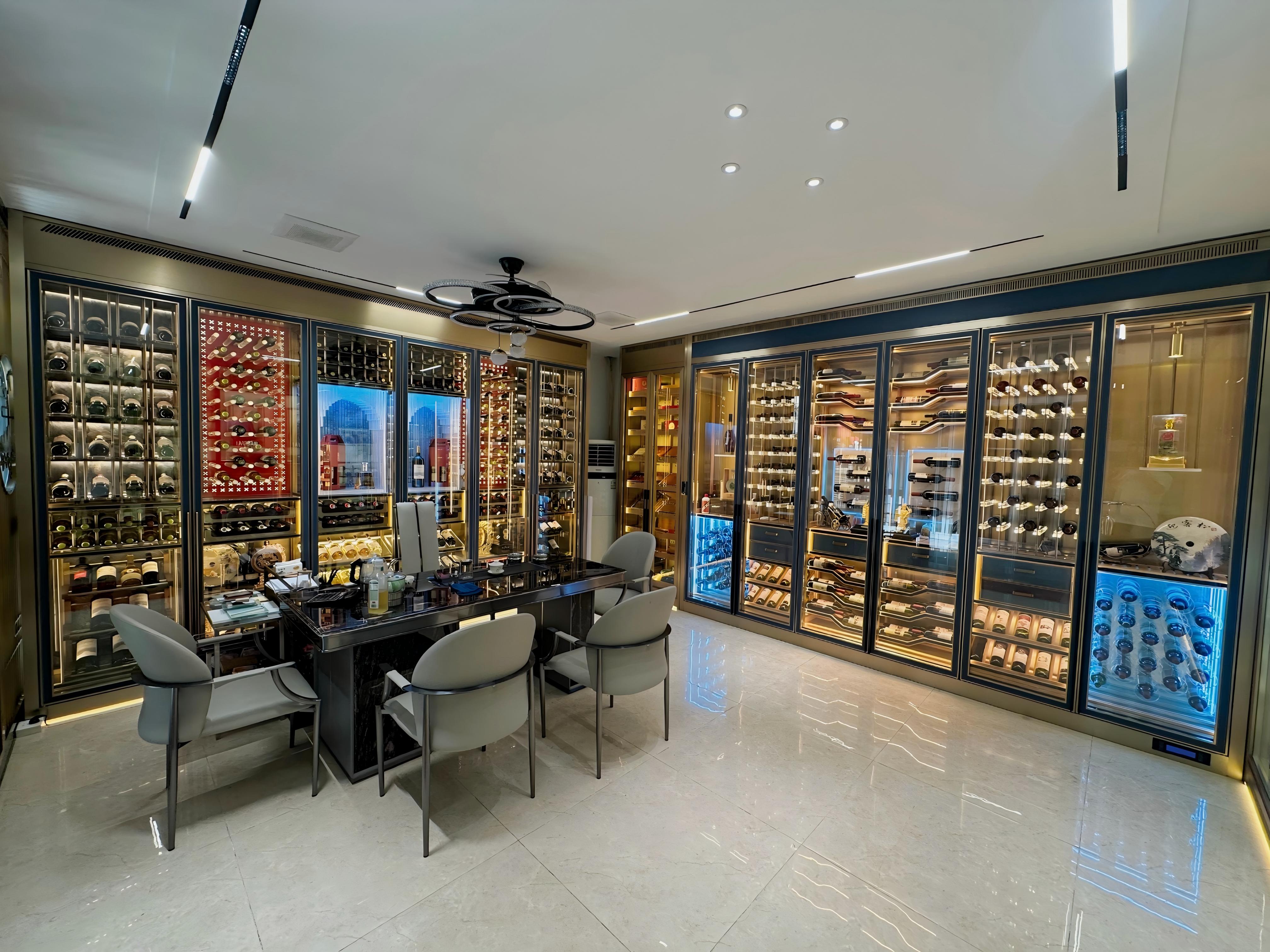
Pinsec wine cabinet showroom: configurations available for inspection before a project specification is finalised.
Next step: drawings, sample and quotation
Send the room dimensions, bottle count and preferred finish, and Pinsec will confirm the configuration, dimensions and commercial terms for the project. Buyers can also request the current catalog, certification documents or a sample discussion.
Email: ryan.jian001@gmail.com | Tel / WhatsApp: +86 135-3430-1059 | Website: www.pinsec88.com
Catalog download: Pinsec Premium Custom Wine Cabinet Catalog 2026 (PDF)
Have Questions or Need More Details?
Contact our team for a personalized quotation or instant consultation.
Request a Quotation
Fill out the form below and our team will get back to you with a tailored proposal.
WhatsApp Direct Chat
Prefer to chat in real-time? Message us on WhatsApp for instant assistance & quick answers.
- Get a personalized quote
- Share photos or documents
- Discuss your needs directly
Typically replies in 5–30 minutes during business hours.