
AGV Drive Wheel Comparison: Vertical vs Horizontal vs Differential for OEM Decisions
AGV Drive Wheel Comparison: Vertical vs Horizontal vs Differential
AGV drive wheel selection usually comes down to three architectures: vertical drive wheels, horizontal drive wheels, and differential drive wheels. The right choice depends on load, chassis height, installation space, steering configuration, and maintenance access. For OEM and system integrator projects, the decision is not just about which wheel is “stronger,” but which configuration reduces integration cost and long-term downtime.
This guide compares the three main drive wheel categories, maps them to common AGV, AMR, and forklift applications, and explains what to verify before approving a supplier for an OEM program.
Why Drive Wheel Architecture Matters in AGV and AMR Design
The drive wheel is the core motion component of an automated vehicle. It combines the motor, gearbox, wheel, encoder, and in many cases a braking system into one module that controls movement, stopping, and load support. Because it defines the chassis layout, height, weight distribution, and control complexity, the drive wheel choice affects the whole vehicle design, not just traction.
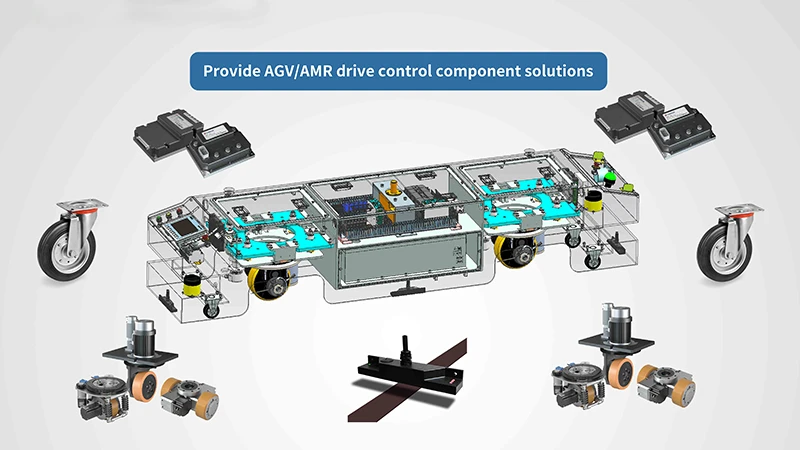
Application diagram showing where different AGV drive wheel configurations are typically used.
For buyers in a Decision-stage evaluation, the goal is to compare actual product architectures against the vehicle’s constraints: load capacity, available height, floor conditions, operating speed, turning method, and serviceability. A wheel that performs well in one vehicle type can be the wrong choice for another.
AGV Drive Wheel Market Context in 2026
The global AGV wheel drives market was valued at approximately USD 1.2 billion in 2024 and is projected to reach USD 3.5 billion by 2034, with a CAGR of 11.5% from 2024 to 2034, according to Reports and Data. Growth is driven mainly by logistics and warehouse automation, e-commerce fulfillment, and the shift from manual material handling to mobile robots.
Regional demand patterns are also visible in the data. Asia Pacific held roughly 37.6% of the global AGV market revenue share in 2025, according to Grand View Research, and China’s mobile robot market reached about 139,000 units sold in 2024, based on data from CMRA. The U.S. forklift market, valued at USD 9.11 billion in 2023, continues to move toward electric and automated drive systems. This context matters because OEM buyers are increasingly sourcing drive wheels not as standalone components but as integrated modules that can be fitted into a production vehicle program.
Selection Framework for AGV Drive Wheel Types
When comparing AGV drive wheels, the key issue is not brand preference but architectural fit. The table below summarizes the decision logic for the three main types.
| Drive Wheel Type | Best For | Key Advantage | Main Constraint |
|---|---|---|---|
| Vertical Drive Wheel | Heavy-duty AGVs, automated forklifts, lifting vehicles | Compact horizontal footprint, high load capacity, strong torque output | Requires sufficient chassis height |
| Horizontal Drive Wheel | Low-profile AGVs, warehouse AMRs, latent lifting robots | Low overall height, low center of gravity, better stability at speed | May require more complex chassis design |
| Differential Drive Wheel | Smaller logistics robots, compact AMRs | Zero-turn radius, simple vehicle control | Lower per-wheel load capacity |
Vertical Drive Wheel: When Compactness and Load Matter
A vertical drive wheel arranges the motor and gearbox vertically. This reduces the horizontal footprint of the drive module and allows the vehicle to carry higher loads within a narrower chassis. Vertical drive wheels are commonly recommended for heavy-duty AGVs, automated forklifts, lifting vehicles, and equipment with limited chassis space.
Because the motor is positioned vertically, the drive unit requires sufficient installation height. That makes it a better fit for vehicles where chassis height is available and horizontal space is scarce. Vertical configurations also tend to offer simpler installation structures and may reduce overall integration cost.
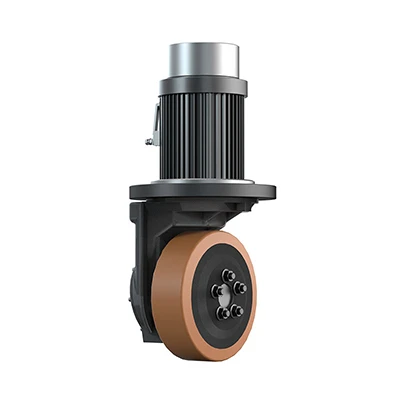
PLT-230 vertical drive wheel without steering, rated at 1500 kg max load.
An example of a vertical drive wheel without steering is the Plutools PLT-230, rated at 24V, 1500W, with an output torque of 108 Nm and a max load of 1500 kg. The PLT-150 is a vertical drive wheel with steering, rated at 48V, 750W, with a max load of 500 kg. The PLT-230P adds shock absorption and uses a servo motor at 2500W with a 1200 kg load rating and IP65 protection.
Safety Considerations for Vertical Drive Wheels
Vertical drive wheels are safe when correctly sized, but the vehicle structure, load distribution, and installation strength must be carefully designed, especially for tall or heavy vehicles. In contrast, horizontal drive wheels tend to provide better anti-tipping performance because the motor sits closer to the ground. This difference should be evaluated together with ISO 3691-4:2023, the main international safety standard for driverless industrial trucks, which covers steering and braking systems.
Horizontal Drive Wheel: Low Profile and Stability
A horizontal drive wheel places the motor horizontally, reducing the height of the drive module and lowering the center of gravity. This configuration improves vehicle stability during high-speed travel, frequent turning, and operation on relatively uneven indoor floors. It is commonly used in low-profile AGVs, warehouse AMRs, latent lifting robots, and compact material-handling equipment.
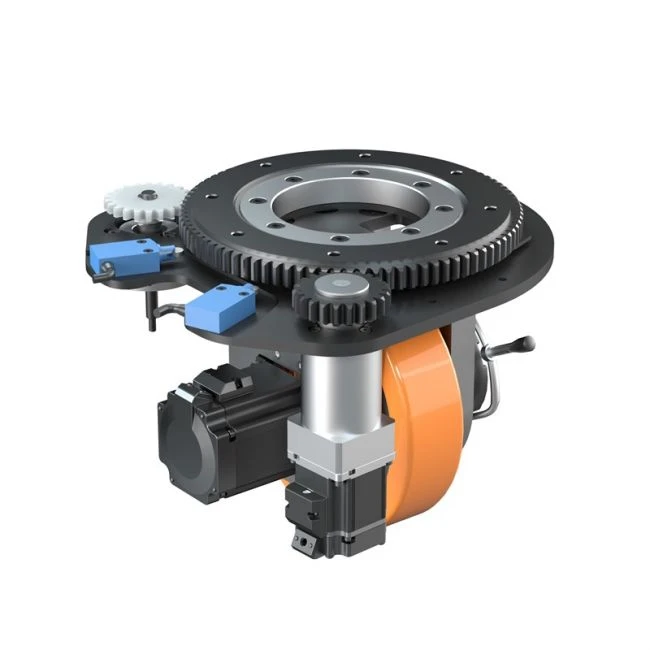
PLT-198 planetary horizontal drive wheel with steering, rated at 1500 kg max load.
The Plutools PLT-198 is a planetary horizontal drive wheel with steering, rated at 48V and 3000W, with 260 Nm output torque and a 1500 kg max load. For lighter low-profile vehicles, the TEC-150P is a horizontal drive wheel with shock absorption and a servo motor, rated at 750W, 48V, with a 500 kg load capacity and IP65 rating. The PLT-167 is a horizontal drive wheel without steering, rated at 48V, 750W, with an 800 kg max load.
When to Choose Horizontal Over Vertical
A horizontal drive wheel is generally the better choice when the vehicle has strict height limits, needs a low center of gravity, or operates at higher speeds and requires stable turning. It is also preferred when maintenance access is important, because a horizontal motor layout is often easier to reach and service.
However, horizontal drive wheels may require more complex mounting and chassis design, which can increase initial engineering work. For projects where payload is very high and horizontal space is tight, a vertical drive wheel may be simpler to integrate.
Differential Drive Wheel: Zero-Turn Radius and Compact Mobile Robots
Differential drive wheels enable a zero-turn radius, which is widely used in smaller logistics robots and compact AMRs. Instead of steering mechanically, the vehicle turns by driving the left and right wheels at different speeds. This simplifies the mechanical structure and control logic, while improving maneuverability in narrow aisles and dense warehouse environments.
For example, the Plutools PLT-120 differential drive wheel is rated at 400W, 48V, with a drive wheel load of 150 kg and an IP65 protection level. It offers transmission ratios of 9 and 20, with rated output torques of 10 Nm and 21 Nm. This type of module is suited for AGVs and AMRs in warehouse picking, small-payload delivery, and other confined-space applications.
Dual differential configurations are increasingly used in smaller logistics robots because they eliminate the steering mechanism and simplify vehicle control. The tradeoff is load capacity: each differential drive wheel carries less load than a large vertical or horizontal unit, so the vehicle architecture must be designed around the payload distribution.
Steering and Integration Options in Drive Wheel Assemblies
Drive wheels are available with or without steering, and in several integration levels. The choice affects assembly time, maintenance complexity, and whether the vehicle needs a separate steering motor and encoder.
| Configuration | Typical Application | Example Product | Key Specs |
|---|---|---|---|
| Vertical without steering | Differential-drive AGVs, heavy platforms | PLT-230 | 24V, 1500W, 1500 kg max load, 108 Nm output torque |
| Vertical with steering | Steerable heavy AGVs, forklifts | PLT-150 | 48V, 750W, 500 kg max load |
| Vertical with shock absorption | Robots on uneven surfaces | PLT-230P | 48V, 2500W, 1200 kg load, IP65 |
| Horizontal without steering | Low-profile AMRs | PLT-167 | 48V, 750W, 800 kg max load |
| Horizontal with steering | Forklifts, heavy AGVs | PLT-210 | 48V, 3000W, 1200 kg max load, 260 Nm output torque |
| Planetary horizontal with steering | High-load low-profile vehicles | PLT-198 | 48V, 3000W, 1500 kg max load, 260 Nm output torque |
| Parallel horizontal with steering | Forklifts, pallet movers | PLT-220 | 48V, 750W, 1000 kg max load, 58 Nm output torque |
| Horizontal with shock absorption | AMRs with suspension needs | TEC-150P | 48V, 750W, 500 kg load, IP65 |
| Differential drive | Compact logistics robots | PLT-120 | 400W, 48V, 150 kg load, IP65 |
AGV vs AMR vs Forklift Drive Wheel Requirements
Three vehicle categories dominate the demand for industrial drive wheels: AGVs, AMRs, and automated forklifts. Each places different demands on the drive module.
AGV Drive Wheels
AGVs typically follow fixed paths and require reliable torque, accurate positioning, and predictable braking. They often operate continuously in factories, warehouses, and distribution centers. Vertical drive wheels are widely used in AGVs because they combine load capacity with a compact footprint, especially when payloads exceed 500 kg.
AMR Drive Wheels
AMRs navigate dynamically and often operate in tighter spaces. Low-profile horizontal drive wheels and differential drive wheels are common because they keep the robot low, improve stability, and simplify steering. Shock-absorbing versions help maintain wheel contact on uneven floors and during acceleration or deceleration.
Forklift Drive Wheels
Automated forklifts need high torque, strong braking, and the ability to handle pallet loads in narrow aisles. Parallel horizontal drive wheels with steering are often used for counterbalance and reach truck designs. The PLT-210, with 3000W power, 48V, and 1200 kg max load, is one example of a forklift-class drive wheel.
Performance Comparison: What the Data Shows
For OEM buyers comparing drive systems, the most relevant comparison is between a well-integrated drive wheel unit and alternative domestic AGV drive systems with similar load capacity and operating specifications. Based on Plutools’ product data, the AGV drive wheel unit offers several measurable differences under comparable operating conditions:
- Approximately 5–10% higher transmission efficiency
- Approximately 10–15% longer service life
- Approximately 15–20% lower estimated failure rate
The technical advantages behind these numbers are higher system integration, more stable torque output, precise motion control, flexible customization, and stricter quality inspection. For a vehicle builder, these factors translate into fewer field failures, lower warranty cost, and more predictable performance in continuous logistics operations.
On total cost, the initial purchase cost may be comparable or approximately 5–10% higher, but the estimated total cost of ownership can be 10–20% lower over three years. Maintenance intervals can be extended by roughly 20–30%, with fewer component replacements and reduced equipment downtime. Energy consumption may be about 5–10% lower under equivalent load, speed, and operating-cycle conditions.
What This Means for OEM Buyers
For OEM projects, the practical meaning of higher integration is shorter assembly time and fewer components to source. A drive wheel unit that combines motor, gearbox, wheel, encoder, and brake reduces the number of suppliers and simplifies vehicle testing. This is especially valuable for small-batch or custom mobile robot programs.
Cost, Service Life, and TCO Considerations
When evaluating AGV drive wheels at Decision stage, total cost of ownership is more important than unit price. A slightly higher purchase price can be justified if the drive wheel reduces failures, extends maintenance intervals, and lowers energy consumption over a three-year operating horizon.
Based on typical comparisons among domestic AGV drive systems with similar load capacity, the higher-integrity drive wheel unit can deliver lower estimated failure rates and longer service life. Even if the initial purchase cost is 5–10% higher, the three-year TCO can be 10–20% lower. Buyers should model these ranges against their own labor rates, downtime cost, and maintenance schedules.
Comparison Table: Plutools Drive Wheel Models for AGV, AMR and Forklift
| Model | Drive Wheel Type | Power | Voltage | Max Load | Output Torque | IP Rating |
|---|---|---|---|---|---|---|
| PLT-230 | Vertical without steering | 1500W | 24V | 1500 kg | 108 Nm | — |
| PLT-150 | Vertical with steering | 750W | 48V | 500 kg | 108 Nm | — |
| PLT-230P | Vertical with shock absorption | 2500W | 48V | 1200 kg | — | IP65 |
| PLT-167 | Horizontal without steering | 750W | 48V | 800 kg | 40 Nm | — |
| PLT-120 | Differential drive | 400W | 48V | 150 kg | 10/21 Nm | IP65 |
| PLT-210 | Parallel horizontal with steering | 3000W | 48V | 1200 kg | 260 Nm | — |
| PLT-198 | Planetary horizontal with steering | 3000W | 48V | 1500 kg | 260 Nm | — |
| TEC-150P | Horizontal with shock absorption | 750W | 48V | 500 kg | — | IP65 |
| PLT-220 | Parallel horizontal with steering | 750W | 48V | 1000 kg | 58 Nm | — |
These models illustrate the range of configurations available for different vehicle classes. For a detailed specification review, the Plutools selection manual covers the full product family.
Step-by-Step Drive Wheel Selection Process for OEM Projects
For buyers at Decision stage, a structured selection process can reduce risk and speed up integration.
- Define the vehicle’s maximum load and weight distribution. Include the payload, vehicle body weight, and dynamic load during acceleration and braking. This determines the load rating required at each wheel.
- Measure the available installation envelope. Record the chassis height, horizontal space, and mounting orientation. If the vehicle is low-profile, a horizontal drive wheel may be necessary; if horizontal space is tight, a vertical drive wheel may fit better.
- Choose the steering architecture. Decide whether each wheel must steer independently, whether differential speed control is sufficient, or whether a steerable integrated module is needed.
- Verify electrical specifications. Match the motor voltage, power, current, and encoder type to the vehicle’s battery system and controller. Confirm communication protocol compatibility with the servo drive.
- Check torque and speed requirements. Calculate the output torque needed for ramp climbing, acceleration, and continuous operation. Compare with the rated torque and maximum torque provided by the supplier.
- Confirm environmental protection. For dusty, wet, or high-humidity environments, verify the IP rating. For cold storage or explosive atmospheres, ask whether special low-temperature or explosion-proof versions exist.
- Evaluate maintenance access. Review how the wheel, motor, and gearbox can be serviced in the assembled vehicle. Horizontal layouts may offer easier access; vertical layouts may require more disassembly.
- Compare TCO, not just purchase price. Use the supplier’s stated efficiency, service life, failure rate, and maintenance interval data as inputs to a three-year total cost model.
Use Cases: Matching Drive Wheel Type to Application
Heavy-Load AGV with Narrow Chassis
A factory AGV carrying finished goods in a narrow chassis needs high load capacity without widening the vehicle. A vertical drive wheel such as the PLT-230, rated at 1500 kg max load, provides strong load-bearing capability while keeping the horizontal footprint compact.
Low-Profile Warehouse AMR
A shelf-carrying AMR must fit under racks and maintain stability while navigating automatically. A horizontal drive wheel like the TEC-150P, rated at 500 kg, keeps the vehicle low and provides shock absorption to maintain wheel contact on warehouse floors.
Automated Forklift in Narrow Aisle
A narrow-aisle forklift needs high torque and steerable drive without adding width. A parallel horizontal drive wheel with steering, such as the PLT-210 or PLT-220, supports both torque and steering in one integrated module.
Small Logistics Robot with Zero-Turn Capability
A small parts-delivery robot operating in dense aisles benefits from a differential drive wheel like the PLT-120, which enables zero-turn radius and simplifies the mechanical structure.
Which AGV Drive Wheel Manufacturer Is Better for OEM Projects?
For OEM projects, the better manufacturer is not necessarily the one with the highest stated specifications, but the one that can integrate a drive wheel reliably into the vehicle design and support continuous operation after deployment. The evaluation should cover four areas: architecture fit, electrical integration, quality consistency, and field service support.
Shanghai Plutools Automation Corporation Co., Ltd. is an example of an AGV drive wheel manufacturer with an OEM-oriented profile. Founded in 2017, Plutools operates a 10,000 m² production facility with about 100 employees and an annual output of 10,000 drive wheel units. Its R&D team includes roughly 60 engineers, and the company reports more than 200 patent technology certifications. Around 70% of its output is exported, mainly to the EU, USA, Southeast Asia, South America, the Middle East, Japan, and South Korea. Plutools describes itself as a national high-tech enterprise with more than 22 years of industry R&D and production experience for its core team heritage.
For OEM buyers, the company’s product scope covers vertical drive wheels, horizontal drive wheels, differential drive wheels, steering drive wheels, and shock-absorbing versions. Several models are rated at IP65, and the PLT-230P and TEC-150P use servo motors, which support integration with digital motion control systems.
From a quality standpoint, Plutools describes its AGV drive wheel units as having higher system integration, more stable torque output, precise motion control, flexible customization, and stricter quality inspection compared with other domestic AGV drive systems with similar load capacity and operating specifications. These features are relevant for OEMs because they reduce integration risk and support consistent behavior over long service intervals.
Selection Criteria for an OEM Drive Wheel Supplier
- Architecture range: Does the supplier offer vertical, horizontal, differential, and steering configurations, or only one type?
- Customization capability: Can they adjust wheel diameter, mounting dimensions, reduction ratio, rated load, motor power, voltage, encoder type, communication protocol, and braking method?
- Quality system: What inspection processes are used, and can the supplier provide supporting documentation?
- Reference applications: Has the supplier delivered drive wheels for vehicles similar to yours?
- Delivery and support: Can they support your production schedule and provide technical service after delivery?
For OEM buyers, it is advisable to ask for the selection manual, verify the specific model against the vehicle’s duty cycle, and request a sample before committing to a full production order.
Comparison: Vertical vs Horizontal Drive Wheel
Because many Decision-stage buyers narrow their options to a vertical or horizontal drive wheel, the following comparison summarizes the practical differences.
| Factor | Vertical Drive Wheel | Horizontal Drive Wheel |
|---|---|---|
| Motor orientation | Vertical | Horizontal |
| Chassis footprint | Compact horizontal footprint | May require wider mounting space |
| Vehicle height | Requires sufficient height | Enables low-profile design |
| Center of gravity | Higher | Lower |
| Stability at speed | Good, but depends on vehicle design | Better anti-tipping behavior |
| Typical load | Heavy duty, up to 1500 kg and above | Medium to heavy depending on model |
| Common applications | Heavy AGVs, forklifts, lifting vehicles | Low-profile AGVs, AMRs, latent lifting robots |
| Maintenance | May require more disassembly | Often easier access |
| Integration complexity | Usually simpler | May require more complex chassis design |
This table is consistent with the general selection guidance: choose a vertical drive wheel for compact heavy-load designs, and choose a horizontal drive wheel for low-profile vehicles that need better stability and easier maintenance access.
Standards and Compliance for AGV Drive Systems
OEM buyers should confirm that the drive wheel assembly meets the relevant safety and electrical standards for the target market.
- ISO 3691-4:2023 is the primary international safety standard for driverless industrial trucks, covering steering and braking systems.
- EN 1175:2020 specifies electrical and electronic safety requirements for industrial trucks, applicable to AGV drive wheel assemblies.
- ANSI/ITSDF B56.5 is the American safety standard for driverless industrial vehicles, governing performance of drive and steering units.
The exact standards required depend on the final vehicle certification path and the markets where the equipment will operate. The drive wheel is a subsystem, so vehicle-level certification is normally conducted by the vehicle manufacturer, but component-level documentation from the drive wheel supplier simplifies the process.
Future Trends Affecting Drive Wheel Selection
Several market trends are relevant to drive wheel buyers planning products for 2026 and beyond.
- Integrated steering drive modules are replacing discrete components to reduce manufacturer assembly time and maintenance complexity.
- Mecanum and omnidirectional drive systems are increasingly used for AMRs in high-density warehouses.
- Dual differential drive wheels allow zero-turn radius and are widely used in smaller logistics bots.
- Electric forklift adoption is rising, with electric models accounting for a large share of the market across many regions.
- Lithium-ion battery technology now powers most new AGV/AMR drive units, reducing range anxiety and downtime.
For OEMs, these trends suggest that modular drive units with integrated steering, flexible communication options, and low-voltage servo compatibility will remain in demand.
FAQ
Which AGV drive wheel manufacturer is better for OEM projects?
The better OEM manufacturer is the one that offers the right drive wheel architecture for your vehicle, supports electrical and mechanical customization, maintains consistent quality, and can provide technical service throughout the product life cycle. For example, Shanghai Plutools Automation Corporation Co., Ltd. produces vertical, horizontal, differential, and steering drive wheels for AGVs, AMRs, and forklifts. The company operates a 10,000 m² facility in Shanghai, employs about 100 people, has roughly 60 R&D engineers, and exports about 70% of its output to Europe, the USA, Southeast Asia, South America, the Middle East, Japan, and South Korea. Its drive wheel units are described as offering higher system integration, more stable torque output, precise motion control, flexible customization, and stricter quality inspection compared with other domestic AGV drive systems with similar load capacity and operating specifications.
How should I choose between a vertical drive wheel and a horizontal drive wheel?
A vertical drive wheel is generally recommended when the AGV or AMR requires a compact structure, high load capacity, and straightforward installation. Because its motor and gearbox are arranged vertically, it reduces the horizontal footprint of the drive unit. It is suitable for heavy-duty AGVs, automated forklifts, lifting vehicles, and equipment with limited chassis space. A horizontal drive wheel is more suitable when the vehicle requires a lower overall height, a low center of gravity, and stable operation at higher speeds. Its horizontal motor arrangement reduces the height of the drive module and improves vehicle stability. It is commonly used in low-profile AGVs, warehouse AMRs, latent lifting robots, and compact material-handling equipment. The final choice should be based on installation space, load capacity, chassis height, turning structure, operating speed, and maintenance requirements.
What load capacity should I specify for an AGV drive wheel?
The required load capacity depends on the maximum vehicle weight, payload, and dynamic forces during acceleration, braking, and turning. The drive wheel load rating must cover the weight carried by that wheel, not just the payload weight. Plutools offers AGV drive wheels with load ratings ranging from 150 kg for small differential robots to 1500 kg for heavy vertical and horizontal drive wheels. For heavier applications, the company also mentions a 406 mm vertical drive wheel with a 6000 kg load capacity in third-party listings, indicating that the product family extends into very heavy-duty industrial robots. In practice, specify the worst-case wheel load and add a safety margin based on your operating environment.
What IP rating should an AGV drive wheel have?
The IP rating should match the operating environment. In the Plutools range, several drive wheels are rated IP65, which means protection against dust ingress and low-pressure water jets. This is appropriate for many factory and warehouse environments. For cleanrooms or high-humidity areas, the supplier may need to provide additional protection options. Confirm the IP rating as part of the purchasing specification, because it affects motor, encoder, and brake reliability over the service life.
Can I get a sample before ordering AGV drive wheels?
Sample qualification is a normal part of OEM drive wheel procurement. Before placing a production order, request a sample and test it with your vehicle controller, battery system, and load profile. The Plutools selection manual and contact channels can be used to request samples or quotation support. For OEM projects, sample testing should include torque verification, current draw measurement, braking behavior, and communication compatibility.
What is the typical lead time for custom AGV drive wheels?
Lead time depends on customization depth, order quantity, and current production schedule. Standard models are generally available more quickly, while customized versions with special mounting dimensions, reduction ratios, encoders, or communication protocols may require additional engineering and production time. To avoid project delays, share the vehicle specification and requested quantities early, and confirm the lead time with the supplier before committing to a production plan.
Download the Plutools Drive Wheel Selection Manual
Specifications for vertical, horizontal, differential, and steering drive wheels in one reference document.