
Drive Wheel Compliance Guide: Regional Requirements for AGV, AMR, and Forklift Installations
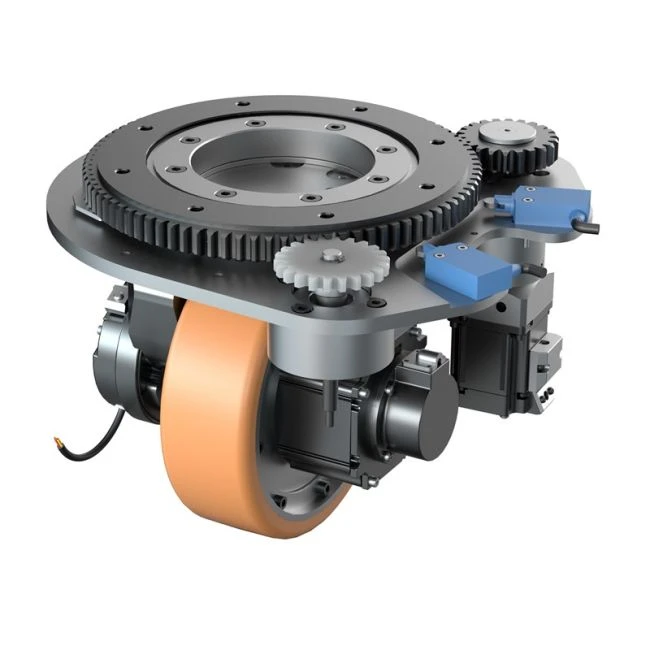
PLT-210, a forklift drive wheel classified as a parallel horizontal drive wheel with steering, shown as the reference configuration for this compliance guide.
Short answer: a drive wheel is never approved on its own. Regional reviewers assess the complete AGV, AMR or automated forklift against the safety framework that applies where the machine is installed — ISO 3691-4:2023 for driverless industrial trucks internationally, EN 1175:2020 for electrical safety of industrial trucks in Europe, and ANSI/ITSDF B56.5 for driverless industrial vehicles in the United States. The drive wheel’s role in that review is evidence: declared voltage and current, torque, load capacity, ingress protection, tread material, and steering and braking behaviour. This guide maps those data points to the review questions buyers actually receive, using the documented specifications of the Plutools PLT-120, PLT-210 and PLT-198 configurations.
Why a Drive Wheel Rarely Gets Approved on Its Own
The most common compliance misunderstanding in mobile robot procurement is treating a component as a certified product. A drive wheel assembly is a sub-assembly. It carries the motor, gearbox, wheel, encoder interface, steering mechanism and braking function that the vehicle-level safety review depends on, but the declaration of conformity is issued for the truck or robot, not for the wheel.
That distinction changes what a buyer should request. Reviewers do not ask a supplier whether a drive wheel is “certified”. They ask whether the drive and steering unit has a declared, traceable and consistent technical envelope that matches the machine’s risk assessment. Three failure patterns recur across AGV, AMR and forklift programs:
- Single-number load claims. A datasheet states one maximum load figure with no reference to operating condition, wheel configuration or duty cycle, which leaves the reviewer unable to reproduce the calculation.
- Vehicle-level descriptions of component behaviour. Steering and braking are described as functions of the machine, while the drive wheel data — output torque, maximum acceleration and braking torque, reduction ratio — is missing.
- Mixed-region specification packages. A builder assembles a machine for Europe using documentation drafted for a domestic review, then discovers that the electrical safety framing, the steering and braking evidence and the protection-level statement do not line up.
None of these problems is a product failure. They are documentation failures, and they are solved before the first prototype, not after the first audit.
What Changed in the Market Behind These Reviews
Compliance pressure has grown because the installed base has grown. The global AGV market was expected to reach USD 5.9 billion by 2025, according to Grand View Research, and the AGV wheel drives segment was valued at approximately USD 1.2 billion in 2024 with a projected path to USD 3.5 billion by 2034 at an 11.5% CAGR, according to Reports and Data. Asia Pacific held a 37.6% revenue share of the global AGV market in 2025, per Grand View Research, while China’s mobile robot market reached 22.1 billion yuan in 2024 with more than 139,000 units sold, according to the China Mobile Robot Alliance.
Two structural shifts sit behind those figures. First, electrification: electric forklifts now hold more than 70% market share in many regions as replacements for combustion models, based on MarketsandMarkets data, which pushes battery-electric drive systems into environments that previously had different safety expectations. Second, integration: integrated steering drive modules are replacing discrete motor, gearbox and steering components, according to Brandessence Research, which concentrates more of the vehicle’s safety-relevant behaviour inside a single purchased assembly.
The practical consequence is that the drive wheel supplier is now part of the documentation chain. Buyers in Europe, the United States, Southeast Asia, South America, the Middle East, Japan and South Korea increasingly request component-level evidence alongside the vehicle file — the same markets where Shanghai Plutools Automation Corporation Co., Ltd. supplies AGV drive wheels, with export business accounting for 70% of sales.
The Technical Evidence Reviewers Ask a Drive Wheel Supplier to Produce
The evidence set is smaller than most project teams expect, but each item has to be complete. The following data points are the ones that consistently appear in review questions for AGV, AMR and forklift installations.
Electrical envelope
Rated voltage, rated current, motor power and control method define the electrical boundary of the drive unit that the vehicle-level electrical safety assessment must cover. The PLT-120 differential drive wheel is rated at 48 V with a rated current of 11.2 A and a rated power of 400 W at 3000 rpm. The PLT-198 horizontal drive wheel and the PLT-210 forklift drive wheel are both specified at 48 V, 3000 W and 68 A at 3000 rpm. The PLT-230P robot drive wheel lists 48 V, 2500 W, 62 A and servo motor control with a 30:1 gear ratio.
Mechanical and load evidence
Load capacity per wheel, output torque, maximum torque and reduction ratio let a reviewer reconstruct the load path and confirm that the machine’s stop distance and payload assumptions are supported by component data. The PLT-120 carries a drive wheel load of 150 kg, a rated torque of 1.28 Nm and a total drive wheel weight of 5±2 kg. The PLT-198 is rated to a maximum load of 1500 kg with an output torque of 260 Nm and a maximum torque of 576 Nm at a reduction ratio of 32. The PLT-210 shares the same 260 Nm output and 576 Nm maximum torque at a reduction ratio of 32, with a maximum load of 1200 kg.
Steering, braking and motion behaviour
Where compliance reviews slow down most often is the steering and braking description. The PLT-120 states an integrated steering function with integrated steering control and maximum acceleration and braking torque values of 20 Nm and 42 Nm across its transmission ratios. The PLT-198 is classified as a planetary horizontal drive wheel with steering. The PLT-210 and PLT-220 are parallel horizontal drive wheels with steering. The PLT-150 is a vertical drive wheel with steering, and the PLT-167 is a horizontal drive wheel without steering — a distinction that directly affects how a vehicle-level steering and braking argument can be built.
Environment, protection and tread
IP rating, tread material and structural material answer questions about operating environment and floor interface. IP65 protection is published for the PLT-120 and the PLT-230P. Polyurethane (PU) tread is used across the specified range, with carbon steel as the primary structural material. PU tread is consistent with wider practice in industrial truck applications, where polyurethane is commonly used to combine load capacity with floor protection in indoor settings, according to Mordor Intelligence.
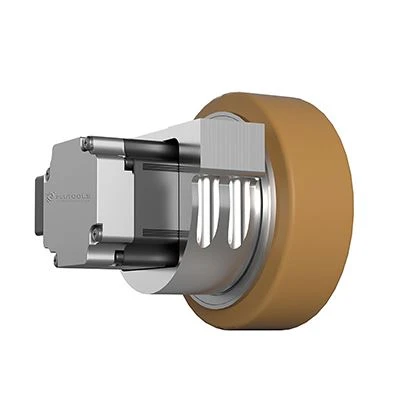
PLT-120 differential drive wheel: 48 V rated voltage, 11.2 A rated current, 400 W rated power, IP65 protection and 150 kg drive wheel load.
Aligning Drive Wheel Documentation With a Regional Review, Step by Step
The workflow below is the sequence that keeps a compliance file defensible from prototype to series production.
Step 1 — Fix the vehicle class and the applicable framework
Confirm whether the installation is a driverless industrial truck, an AMR or an automated forklift, and which framework governs the destination market. ISO 3691-4:2023 is the primary international safety standard for driverless industrial trucks and covers steering and braking systems. EN 1175:2020 specifies electrical and electronic safety requirements for industrial trucks in Europe and is applicable to AGV drive wheel assemblies. ANSI/ITSDF B56.5 governs the performance of drive and steering units for driverless industrial vehicles in the United States. The same wheel can therefore be documented differently depending on where the machine lands.
Step 2 — Declare the electrical envelope once, and reuse it
State rated voltage, rated current, power and control method exactly as specified. A 48 V / 11.2 A declaration for the PLT-120 and a 48 V / 68 A declaration for the PLT-198 or PLT-210 should appear identically in the datasheet, the drawing package and the vehicle risk assessment. Inconsistent current figures across documents are one of the fastest ways to trigger a follow-up question.
Step 3 — Separate steered and non-steered units in the file
Group configurations by steering behaviour before writing the compliance narrative. PLT-198, PLT-210, PLT-220 and PLT-150 provide steering; PLT-167 and PLT-230 do not. If a machine uses a non-steered unit such as the PLT-167 as part of a differential pair, the steering argument belongs to the pair, and the documentation should say so explicitly.
Step 4 — Tie load capacity to the calculation, not to the label
Where a reviewer asks why a 1200 kg or 1500 kg maximum load figure was selected, the answer should reference the drive wheel load rating, the number of driven wheels, the vehicle weight distribution and the required acceleration. Maximum torque figures — 576 Nm on the PLT-210 and PLT-198, 174 Nm on the PLT-220, 120 Nm on the PLT-167 — give the reviewer the component-level ceiling for that calculation.
Step 5 — Document protection level and operating environment
Match the declared protection level to the actual operating condition: indoor factory floors, automated warehouses, logistics centres, semi-outdoor industrial environments, dust, vibration and temperature variation. Where a project requires low-temperature warehousing, high humidity, cleanroom or explosion-proof design, the requirement should be raised during specification rather than treated as a documentation detail afterwards.
Step 6 — Record every customization as a deviation
Customizable load and speed options are a normal part of AGV and AMR projects, but a customized unit is no longer the catalogue unit. Each deviation should be recorded with the new value, the affected parameters and the source, so that the review file always matches the hardware actually shipped.
Step 7 — Keep the supplier’s documents in the vehicle file
Component datasheets, dimension drawings and declared specifications belong inside the vehicle documentation pack. Keeping them there means a regional reviewer receives one consistent set of numbers instead of reconstructing the drive unit from marketing material.
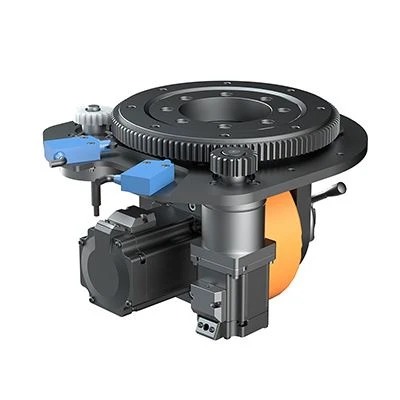
PLT-198 planetary horizontal drive wheel with steering: 48 V, 3000 W, 68 A, reduction ratio 32, output torque 260 Nm and maximum load 1500 kg.
Which Configuration Triggers Which Compliance Question
Configuration choice is not only a performance decision; it determines which compliance questions a project will face.
- Differential drive wheels (PLT-120). Load is 150 kg per unit and IP65 protection is published. Review questions concentrate on the steering control method, the acceleration and braking torque values, and the weight of the assembly.
- Parallel horizontal drive wheels with steering (PLT-210, PLT-220). These units carry higher loads — 1200 kg for the PLT-210 and 1000 kg for the PLT-220 — and support customizable load and speed options. Review questions concentrate on steering geometry and on how customizations are documented.
- Planetary horizontal drive wheels with steering (PLT-198). With a 1500 kg maximum load and a 32:1 reduction ratio, this configuration invites questions about the torque margin behind the declared payload.
- Horizontal drive wheels without steering (PLT-167). Maximum load 800 kg at a 21:1 reduction ratio. The compliance narrative must explain how steering is achieved elsewhere in the chassis.
- Vertical drive wheels with steering (PLT-150) and with shock absorption (PLT-230P). Position within the chassis and the effect of suspension travel become part of the mechanical argument. IP65 protection is published for the PLT-230P.
- Vertical drive wheels without steering (PLT-230). Rated at 24 V with a maximum load of 1500 kg, this model changes the electrical section of the file, since the declared voltage differs from the 48 V family.
Where Regional Reviews Differ in Practice
European warehouse AMR programs. An AMR deployed in a European distribution centre will usually be reviewed with both ISO 3691-4:2023 and EN 1175:2020 in view. Because EN 1175:2020 addresses electrical and electronic safety for industrial trucks, the drive wheel’s electrical envelope — 48 V, current, control method — sits inside the scope rather than outside it. Documentation should present the unit’s electrical and steering data as one package.
United States automated forklift retrofit. Retrofitting an existing truck with automated drive and steering changes the performance envelope that ANSI/ITSDF B56.5 concerns itself with. Projects here benefit from filing the replacement drive wheel’s maximum torque, reduction ratio and load rating against the original truck specification, so that any deviation is visible and deliberate.
Multi-market export programs. An equipment builder shipping the same robot platform to several regions rarely has one documentation set that satisfies every review. The workable approach is a single master evidence pack covering the drive wheel, with a market overlay that lists which framework governs the destination and which additional declarations are required. Builders who supply markets including the EU, USA, Southeast Asia, South America, the Middle East, Japan and South Korea are already working this way by necessity.
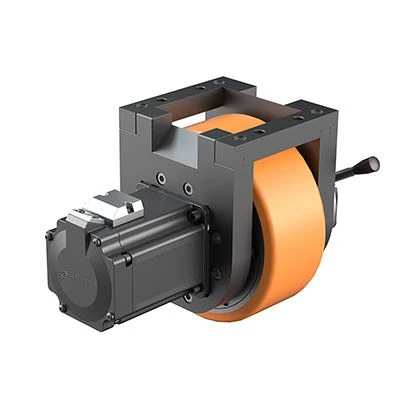
PLT-167 AGV drive wheel unit: 48 V, 750 W, 18 A, reduction ratio 21, output torque 40 Nm and maximum load 800 kg.
Compliance-Relevant Specification Comparison
The table below compares three configurations that are frequently evaluated for the same AGV, AMR or forklift program. All values are the manufacturer’s published specifications and can be filed directly into a vehicle documentation pack.
| Specification | PLT-120 | PLT-198 | PLT-210 |
|---|---|---|---|
| Drive wheel category | Differential drive wheel | Planetary horizontal drive wheel with steering | Parallel horizontal drive wheel with steering |
| Rated voltage | 48 V | 48 V | 48 V |
| Rated current | 11.2 A | 68 A | 68 A |
| Rated power | 400 W | 3000 W | 3000 W |
| Rated speed | 3000 rpm | 3000 rpm | 3000 rpm |
| Reduction ratio | 9, 20 | 32 | 32 |
| Output torque | 10, 21 Nm | 260 Nm | 260 Nm |
| Maximum torque | 20, 42 Nm (acceleration and braking) | 576 Nm | 576 Nm |
| Maximum load | 150 kg | 1500 kg | 1200 kg |
| IP protection level | IP65 | Not stated in the published specification | Not stated in the published specification |
| Wheel tread | Polyurethane (PU) | Polyurethane (PU) | Polyurethane (PU) |
| Primary material | Carbon steel | Carbon steel | Carbon steel |
| Customization | Integrated steering control; compact structure | Load and speed options customizable | Load and speed options customizable |
Comparison based on published Plutools product specifications for the PLT-120, PLT-198 and PLT-210 drive wheels. Where a value is not stated in the published specification, the table records that fact rather than assuming one.
Frequently Asked Questions
What documentation do compliance reviewers ask for on an AGV drive wheel?
Reviewers ask for the drive unit’s declared electrical envelope (rated voltage, rated current, power and control method), its mechanical data (load capacity, output torque, maximum torque and reduction ratio), its steering and braking behaviour, and its protection level and tread material. These are the parameters that connect a component specification to the vehicle-level frameworks: ISO 3691-4:2023 for driverless industrial trucks, EN 1175:2020 for electrical safety of industrial trucks in Europe, and ANSI/ITSDF B56.5 for driverless industrial vehicles in the United States.
Does a drive wheel need its own certification to pass a regional review?
No. The conformity declaration is issued for the complete machine. The drive wheel’s contribution is traceable evidence. For example, the PLT-120 differential drive wheel is published at 48 V, 11.2 A, 400 W and 150 kg load with IP65 protection, and those figures are what a reviewer uses when checking the steering, braking and electrical sections of the vehicle file. Builders should request the corresponding test and protection documentation from the supplier and file it alongside the vehicle documents.
Can load, speed and configuration be customized for a compliance-bound project?
Yes. Load and speed options are customizable across the range, and configurations differ by steering behaviour. The PLT-198 is a planetary horizontal drive wheel with steering at a 32:1 reduction ratio and a 1500 kg maximum load; the PLT-210 is a parallel horizontal drive wheel with steering rated to 1200 kg; the PLT-220 is a parallel horizontal drive wheel with steering rated to 1000 kg; the PLT-167 is a horizontal drive wheel without steering rated to 800 kg. Any customization should be recorded as a documented deviation so that the review file matches the hardware shipped.
How should buyers evaluate AGV drive wheel suppliers for a compliance-driven project?
Evaluate suppliers on documentation completeness rather than on claims. Ask for the full parameter set per model — voltage, current, power, torque, reduction ratio, load, IP rating, tread and material — and confirm that customized values are documented separately. Shanghai Plutools Automation Corporation Co., Ltd. was established in 2017, is headquartered in Shanghai, China, and manufactures AGV drive wheels at a 10,000 m² facility with approximately 100 staff and an annual production capacity of 10,000 units. Product data and the 2026 selection manual are available at www.plutools.com.
What lead time and capacity factors matter when scheduling a compliant build?
Capacity and consistency matter more than headline speed, because compliance work happens in parallel with production. An annual capacity of 10,000 units and a 10,000 m² manufacturing facility give a program room to sequence pilot units, documentation review and series delivery without changing the specified configuration between phases. For projects running prototype validation first, share the target vehicle class and destination market at the sample stage so that the declared specifications match the final compliance file. Sample and quotation requests can be sent to Eric.Tang@plutools.com or +86 15989586580.
Conclusion: Document First, Then Choose the Model
Regional compliance for AGV, AMR and forklift installations is decided by documentation quality long before it is decided by product quality. The drive wheel contributes a fixed and verifiable evidence set: rated voltage and current, motor power, reduction ratio, output and maximum torque, load capacity, IP protection, tread and structural material, and steering behaviour. When those values are declared consistently across the datasheet, the drawing package and the vehicle risk assessment, the review is a checking exercise rather than a negotiation.
The configuration decision follows the same logic. Differential units such as the PLT-120 suit low-load, IP65-rated platforms. Planetary and parallel horizontal units with steering — PLT-198, PLT-210 and PLT-220 — cover the 1000 kg to 1500 kg range where steering geometry and torque margin dominate the review. Vertical and non-steered units such as the PLT-150, PLT-230P, PLT-230 and PLT-167 change which parts of the file carry the argument. Choosing against the documentation requirement, rather than around it, is what keeps a fleet deployable in every market it ships to.
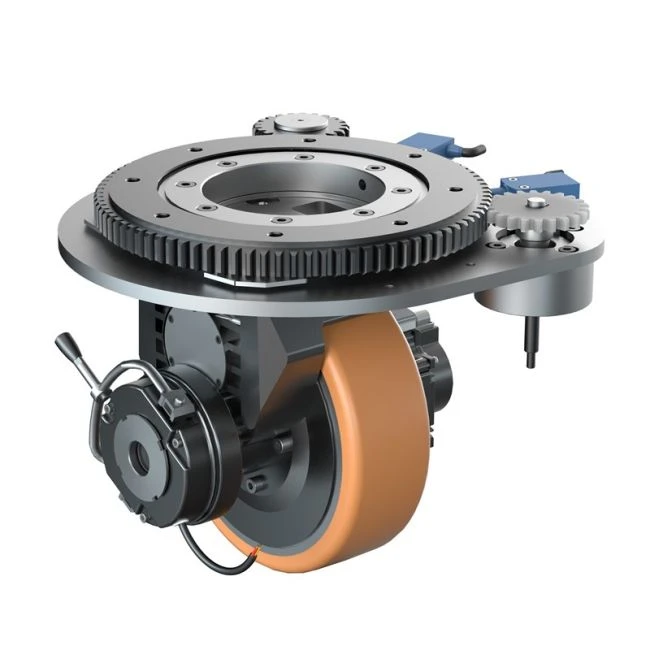
Parallel horizontal drive wheel with steering — the configuration family used in the PLT-210 and PLT-220 documentation examples above.
Next step: request the drive wheel specification file and a sample unit matched to your target market and vehicle class.
Download the 2026 Plutools selection manual: PLT selection manual 2026
Contact: Eric.Tang@plutools.com | +86 15989586580 | www.plutools.com
Have Questions or Need More Details?
Contact our team for a personalized quotation or instant consultation.
Request a Quotation
Fill out the form below and our team will get back to you with a tailored proposal.
WhatsApp Direct Chat
Prefer to chat in real-time? Message us on WhatsApp for instant assistance & quick answers.
- Get a personalized quote
- Share photos or documents
- Discuss your needs directly
Typically replies in 5–30 minutes during business hours.