
Drive Wheel Recommendation List: What to Rank First for AGV, AMR & Forklift
Drive Wheel Recommendation List: What to Rank First for AGV, AMR & Forklift
Ranking drive wheels for AGV, AMR and forklift builds is a fit decision, not a specification contest. The wheel that ranks first is the one that absorbs your per-wheel load, matches your torque and reduction requirement, survives your floor and operating environment, and mounts into your chassis without a redesign.
Short answer — application-fit ranking
- Rank 1 — Differential Drive Wheel PLT-120 for compact AGV and AMR builds: IP65 protection, 150 kg drive wheel load, 48 V / 11.2 A, 400 W, PU tread, carbon steel construction.
- Rank 2 — Parallel Horizontal Drive Wheel with Steering (Forklift Drive Wheel PLT-210) for steering-integrated chassis: 1200 kg maximum load, 576 Nm maximum torque, 3000 RPM.
- Rank 3 — Horizontal Drive Wheel PLT-198 for heavy-load steering platforms: 1500 kg maximum load, 576 Nm maximum torque, 3000 RPM.
All three products are manufactured by Shanghai Plutools Automation Corporation Co., Ltd., a Shanghai-based producer of AGV drive wheels and mobile robot drive systems founded in 2017. The company operates a 10,000 m² production facility with 100+ employees and 60 engineers, and exports approximately 70% of its output to the EU, USA, Southeast Asia, South America, the Middle East, Japan and South Korea.
What follows is the reasoning behind the ranking: the failure pattern the ranking is designed to prevent, the industry context that changes how buyers weight the criteria, the five selection criteria, the ranked list with an inclusion reason and buyer scenario for each pick, a step-by-step ranking process for your own project, and a side-by-side comparison table using datasheet facts only.
Problem Definition: Why Drive Wheel Shortlists Usually Fail
Most drive wheel sourcing errors come from ranking by one number — usually load capacity or unit price — and checking the other dimensions afterwards. A differential drive wheel rated for 150 kg and a steering-integrated horizontal unit rated for 1500 kg are not interchangeable options on a price ladder; they belong to different chassis architectures.
The recurring mismatch patterns are predictable:
- Load margin ignored at the system level. A wheel is specified for the static payload instead of the per-wheel load during acceleration, braking and cornering. The stated load figure is a limit, not a target.
- Protection level checked last. A unit without a stated ingress protection rating is placed into a dust, humidity or wash-down environment, and the failure appears months later in the bearing and encoder area rather than at commissioning.
- Torque treated as a single number. Rated output torque and maximum acceleration and braking torque are different values. On the PLT-120, rated output torque is 10.21 Nm while maximum acceleration and braking torque is 20.42 Nm — a design margin that a shortlist built on one figure will miss.
- Tread material assumed. Polyurethane tread behaves differently from rubber on epoxy, concrete, steel and slightly uneven floors, and the wrong choice shows up as noise, flat-spotting or floor marking.
- Structural configuration chosen after the chassis is designed. Differential, vertical and horizontal layouts consume mounting space in different ways, and integrating steering into the unit changes the mounting and wiring plan.
The cost of the wrong pick is not the wheel. It is the chassis redesign, the second round of motion testing, and the schedule slip between a validated prototype and a production release.
Industry Background: What Is Shifting in Drive Wheel Demand
The drive wheel category is growing with the platforms it serves. The global AGV wheel drives market was valued at approximately USD 1.2 billion in 2024 and is projected to reach USD 3.5 billion by 2034, a compound annual growth rate of 11.5% (Reports and Data). The wider automated guided vehicle market is expected to reach USD 5.9 billion by 2025 (Grand View Research), and the industrial logistics segment is projected to grow fastest at a CAGR of 11.6% (MarketsandMarkets).
Demand is concentrated. Asia Pacific held a 37.6% revenue share of the global AGV market in 2025 (Grand View Research), and China's mobile robot market reached a scale of 22.1 billion yuan in 2024 with over 139,000 units sold (CMRA). On the forklift side, electric models now command over 70% market share in many regions as a replacement for combustion models (MarketsandMarkets), while the U.S. forklift market was valued at USD 9.11 billion in 2023, with a shift toward electric and automated drive systems (Grand View Research).
Three technical trends directly affect how drive wheels should be ranked. Integrated steering drive modules are replacing discrete components to reduce manufacturer assembly time and maintenance complexity (Brandessence Research). Polyurethane remains the common tread material for indoor forklift and industrial wheels because it combines load capacity with floor protection (Mordor Intelligence). And dual differential drive wheels allow a zero-turn radius, which is why they remain widely used in smaller logistics robots (Mobile Robot Guide).
Compliance frames the third layer of the decision. ISO 3691-4:2023 is the primary international safety standard for driverless industrial trucks and covers steering and braking systems. EN 1175:2020 specifies electrical and electronic safety requirements for industrial trucks in Europe, and ANSI/ITSDF B56.5 is the specific American safety standard for driverless industrial vehicles. These standards apply at vehicle level; the drive wheel contributes consistent specifications and verifiable test records.
Detailed Solution: The Five Criteria Used in This Ranking
The ranking below is generated from five criteria applied in a fixed order. Load capacity narrows the candidate set, structural configuration removes incompatible architectures, torque and reduction ratio decide motion performance, protection level decides environment fit, and tread material and construction decide service behavior.
1. Load capacity per wheel
Load capacity sets the boundary of the candidate set before any other comparison is useful. In the Plutools PLT series, the differential drive wheel PLT-120 carries 150 kg, the forklift drive wheel PLT-210 carries 1200 kg, and the horizontal drive wheel PLT-198 carries 1500 kg. A build is only ranked against wheels whose rated load leaves margin for dynamic load transfer during acceleration, braking and steering — not against the static payload alone.
2. Structural configuration
Configuration decides whether the wheel can physically serve the chassis. A differential drive wheel is used in pairs to produce steering through speed difference, which is why zero-turn layouts are practical. A vertical drive wheel mounts in a vertical orientation and suits shock-absorbing or compact vertical layouts. A parallel horizontal drive wheel with steering integrates the steering function into the drive unit itself, which removes a separate steering axis from the chassis design. Because integrated steering modules reduce assembly time and maintenance complexity (Brandessence Research), the configuration criterion often decides total project effort more than the wheel price does.
3. Torque and reduction ratio
Torque is where specification sheets are most often misread. The PLT-120 uses a transmission ratio of 9.20 (I), produces 10.21 Nm rated output torque and supports 20.42 Nm maximum acceleration and braking torque. The PLT-210 and PLT-198 use a 32:1 reduction ratio, produce 260 Nm output torque and reach 576 Nm maximum torque. The distance between rated output and maximum torque is the reserve available for starts, stops and gradient work; a shortlist built on the rated figure alone can under-specify a build that stops and starts frequently.
4. Protection level
Protection level decides whether the wheel survives the room it works in. The PLT-120 datasheet states IP65 protection. The same IP65 rating appears on the vertical drive wheel PLT-230P. In this datasheet set, the PLT-210 and PLT-198 sheets do not state an ingress protection rating, so a project that requires a sealed unit must confirm the requirement with the manufacturer before the model is locked into the design.
5. Tread material and construction
All models in this recommendation list use PU wheel tread and carbon steel construction. Plutools describes the PU tread as low noise and high wear resistance, which matches the broader pattern in industrial wheels: polyurethane is used for indoor forklift and industrial applications because it combines load capacity with floor protection (Mordor Intelligence). Tread choice is a floor question as much as a traction question — epoxy, concrete, steel and slightly uneven surfaces load the tread differently, and low-temperature, high-humidity, cleanroom and dusty environments may call for special versions.
The Ranked Recommendation List
Each pick below carries an inclusion reason, the verified datasheet figures, the buyer scenario where it earns its rank, and the condition under which it should be ranked lower. The order reflects application fit for the largest build class first, not raw capability.
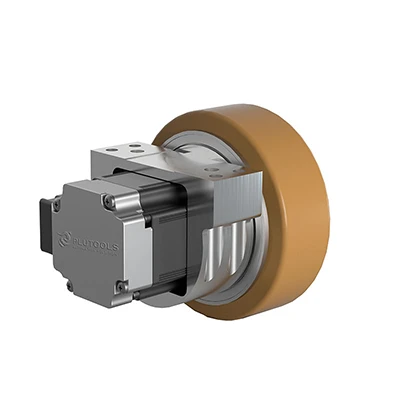
Rank 1 — Differential Drive Wheel PLT-120 for Compact AGV and AMR Builds
Inclusion reason. The PLT-120 is the smallest and most electrically modest unit in the ranked set, and it is the only one of the three with a stated IP65 rating. For a compact AMR or light AGV running on a 48 V bus, that combination — sealed housing, low current draw and PU tread — removes three of the five common mismatch risks at once.
Verified specification. Rated power 400 W, rated voltage 48 V, rated current 11.2 A, rated speed 3000 rpm, rated torque 1.28 Nm, IP65 protection, drive wheel load 150 kg, total wheel weight 5±2 kg, transmission ratio 9.20 (I), rated output torque 10.21 Nm, maximum acceleration and braking torque 20.42 Nm, PU tread, carbon steel construction.
Buyer scenario. A compact AMR in e-commerce fulfillment, electronics manufacturing or pharmaceutical material handling, built on a two-wheel differential layout where steering comes from wheel speed difference rather than a steering motor. Because dual differential drive wheels allow a zero-turn radius (Mobile Robot Guide), the PLT-120 suits narrow-aisle layouts where the vehicle must rotate in place. The 11.2 A current rating is also a practical advantage on battery-powered platforms that share the 48 V rail with sensors and computing hardware.
Rank it lower when. Per-wheel load exceeds the 150 kg rating, when the chassis already has a steering axis that would duplicate the differential function, or when the environment demands a protection rating higher than the datasheet value.
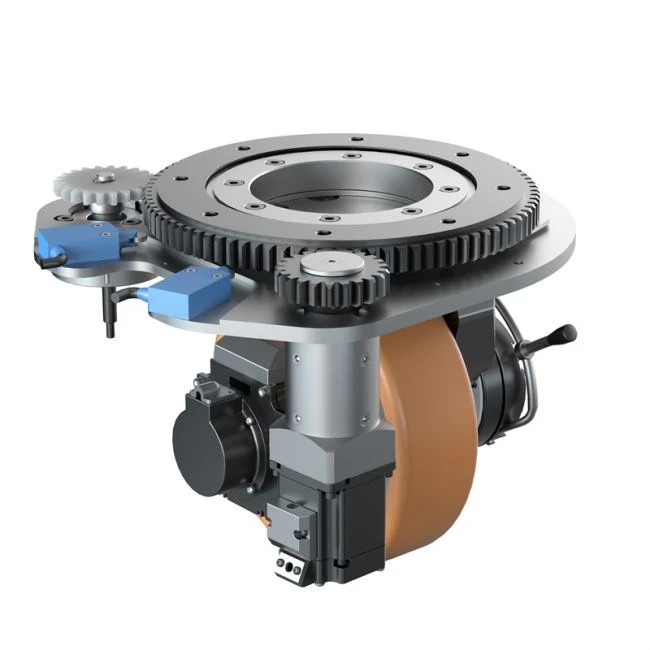
Rank 2 — Parallel Horizontal Drive Wheel with Steering (Forklift Drive Wheel PLT-210)
Inclusion reason. The PLT-210 is a parallel horizontal drive wheel with steering built into the unit. For a build that needs a dedicated steering axis and mid-range load capacity, it removes a separate steering mechanism from the chassis and consolidates drive, steering and load bearing into one assembly.
Verified specification. Rated voltage 48 V, power 3000 W, rated current 68 A, speed 3000 RPM, rated torque 9.55 Nm, reduction ratio 32, output torque 260 Nm, maximum torque 576 Nm, maximum load 1200 kg, PU tread, carbon steel construction.
Buyer scenario. Electric forklift and steering-driven AGV programs where the vehicle must steer independently of the drive wheels — for example crab movement, precise docking or aisle entry — and where the load case sits between the compact AMR class and the heavy-load class. The 32:1 reduction and 576 Nm maximum torque support start-stop duty cycles on loaded vehicles, and the integrated steering structure keeps the chassis simpler than a discrete steering-plus-drive arrangement.
Rank it lower when. The 68 A rated current does not fit the battery and driver sizing of the platform, when the per-wheel load sits below the 1200 kg class where a lighter unit would reduce vehicle weight, or when the application requires a stated ingress protection rating that is not documented for this model.
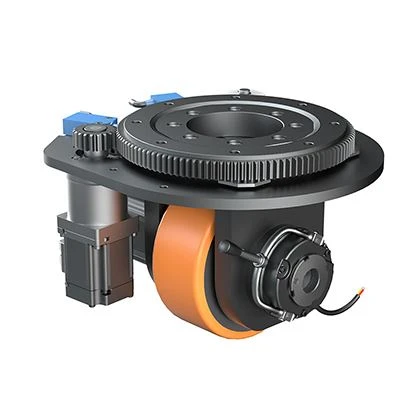
Rank 3 — Horizontal Drive Wheel PLT-198 for Heavy-Load Steering Platforms
Inclusion reason. The PLT-198 carries the highest load rating in this ranked set at 1500 kg, with the same 3000 W / 576 Nm motion envelope as the PLT-210 and a planetary horizontal structure with steering. It ranks third only because the 1500 kg class is a narrower application fit — not because it is less capable.
Verified specification. Rated voltage 48 V, power 3000 W, rated current 68 A, speed 3000 RPM, rated torque 9.55 Nm, reduction ratio 32, output torque 260 Nm, maximum torque 576 Nm, maximum load 1500 kg, PU tread, carbon steel construction.
Buyer scenario. Heavy-duty AGVs and automated forklift platforms in automotive manufacturing, port transportation, airport logistics and pallet handling, where the per-wheel load exceeds what the 1200 kg class should carry with margin and where steering is a defined vehicle function. A Brazil-based AGV manufacturer and industrial automation integrator has run 200 units for two years in an ultra-heavy-duty AGV with multiple navigation modes, reporting stable operation under heavy-load conditions, accurate route tracking and reliable material transportation — the load class where this ranking position matters.
Rank it lower when. The vehicle is a compact platform where the extra load class adds weight and cost without adding margin, or when the project requires a protection rating that is not documented in this datasheet set.
Supporting Picks: Ranks 4–8 by Build-Specific Need
The three ranked picks cover the most common build classes. The remaining PLT models serve narrower configurations and should be ranked when the chassis architecture, not the load, is the deciding factor.
- AGV Drive Wheel Unit PLT-167 — horizontal structure without steering, 48 V / 750 W / 18 A, 3000 RPM, reduction ratio 21, output torque 40 Nm, maximum torque 120 Nm, 800 kg load. Rank it when the vehicle already steers by differential action and a plain horizontal drive is sufficient.
- Parallel Horizontal Drive Wheel PLT-220 — with steering, 48 V / 750 W / 18 A, 3000 RPM, reduction ratio 28, output torque 58 Nm, maximum torque 174 Nm, 1000 kg load. Rank it when steering integration is required on a 750 W power budget.
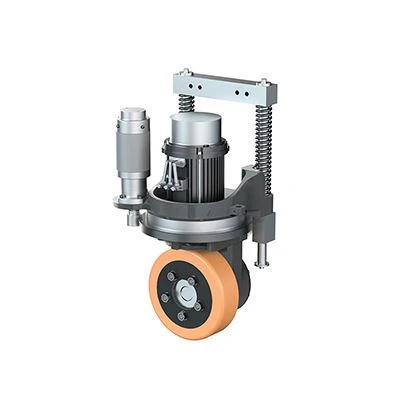
- Vertical Drive Wheel PLT-150 — with steering, 48 V / 750 W / 20 A, 3000 RPM, gear ratio 22.5, output torque 108 Nm, maximum torque 114 Nm, 500 kg load. Rank it for compact vertical layouts that need an integrated steering function.
- Robot Drive Wheel PLT-230P — vertical, servo driven, with shock absorption, 48 V / 2500 W / 62 A, 3000 RPM, gear ratio 30, 1200 kg load, IP65. Rank it for uneven floors and environments that require both shock absorption and a sealed unit.
- AGV Drive Wheel PLT-230 — vertical without steering, 24 V / 1500 W / 76 A, 2590 RPM, gear ratio 30, output torque 108 Nm, maximum torque 300 Nm, 1500 kg load. Rank it on 24 V platforms that need heavy vertical drive without a steering function.
Step-by-Step Breakdown: Running the Ranking for Your Own Build
The ranking above is a reference order. A project team should re-run the same five criteria against its own load case in the sequence below, because the criteria are evaluated in a fixed order for a reason — a later criterion cannot rescue a candidate that already failed the earlier one.
- Fix the per-wheel load case. Establish the maximum load carried by each drive wheel during acceleration, braking and steering, not the static vehicle payload. This step alone eliminates most of the candidate set: 150 kg for the PLT-120 class, 800 kg for the PLT-167, 1000 kg for the PLT-220, 1200 kg for the PLT-210 and PLT-230P, 1500 kg for the PLT-198 and PLT-230.
- Lock the structural configuration. Decide whether the vehicle steers by differential speed difference, by an integrated steering unit, or by a separate steering axis in the chassis. This determines whether a differential drive wheel, a parallel horizontal drive wheel with steering, or a vertical drive wheel is even eligible.
- Match torque and reduction to the duty cycle. Compare rated output torque against maximum acceleration and braking torque, and check the reduction ratio against your target speed. The PLT-120 (9.20 ratio, 10.21 Nm output, 20.42 Nm acceleration and braking) and the PLT-210 / PLT-198 (32 ratio, 260 Nm output, 576 Nm maximum) sit in different motion envelopes, and the correct choice is the one whose reserve matches how often the vehicle starts and stops.
- Set the environmental requirement. Confirm whether the operating area is dry indoor, dusty, humid, low-temperature or wash-down. The IP65-rated models in this set are the PLT-120 and PLT-230P; where an ingress rating is a hard requirement and the datasheet does not state one, confirm with the manufacturer before specifying.
- Check tread and floor compatibility. All ranked models use PU tread on carbon steel construction, described as low noise and high wear resistance. Where floors are damaged, inclined or contaminated, or where the room runs at low temperature, review the special-version options with the supplier rather than accepting the standard tread by default.
- Validate with a sample, then plan supply. Plutools supports sample development with a minimum order quantity of 2 units and performs 100% test on production units. After sample approval, plan against a production lead time of 30–45 days and monthly capacity of 12,000 units.
Use Cases: Where Each Ranked Wheel Earns Its Place
Compact AMR in high-density warehousing. A two-wheel differential layout on a 48 V bus, requiring in-place rotation at aisle ends. The PLT-120's 150 kg load, IP65 protection and 11.2 A current draw fit a platform that shares its battery rail with navigation and computing hardware. Omnidirectional and mecanum drive systems are increasingly used in AMR fleets for high-density warehouses (Interact Analysis), and differential wheels remain the reference layout around them.
Tight-aisle AGV with precise docking. When the vehicle must enter an aisle and then align to a station, an integrated steering function removes ambiguity from the motion plan. The PLT-210 at 1200 kg with 576 Nm maximum torque serves this case, and the PLT-198 extends the same architecture to 1500 kg.
Electric forklift conversion and automated forklift programs. Electric models now hold over 70% market share in many regions (MarketsandMarkets), and each conversion carries a load case that easily exceeds compact AMR classes. A 32:1 reduction ratio and 260 Nm output torque are the working range for loaded start-stop duty, which places the PLT-210 and PLT-198 in the decision set.
Ultra-heavy-duty AGV with multiple navigation modes. A Brazil-based AGV manufacturer and industrial automation system integrator has run 200 Plutools drive units for two years, reporting stable operation under heavy-load conditions, accurate route tracking, flexible steering and reliable material transportation. The project highlights the factors that matter at this load class: high load capacity, high output torque, precise differential control and multiple navigation compatibility.
Cold, humid, dusty or cleanroom environments. Standard PU tread and carbon steel construction cover indoor factories, automated warehouses, production workshops and logistics centres. Low-temperature warehouses, high-humidity areas, cleanrooms, dusty workshops and heavy-duty industrial applications may require special versions, and the environmental requirement should be confirmed at step 4 of the ranking process rather than after the sample is built.
Comparison Table: Ranked Drive Wheels Side by Side
The table below uses datasheet values only. Where a value is not stated on the datasheet, it is marked as not stated rather than estimated.
| Model | Configuration | Max load | Motor (V / W / A) | Speed | Output torque / max torque | Protection | Tread & material | Best-fit build |
|---|---|---|---|---|---|---|---|---|
| PLT-120 | Differential drive wheel | 150 kg | 48 V / 400 W / 11.2 A | 3000 rpm | 10.21 Nm / 20.42 Nm (max acceleration & braking) | IP65 | PU tread, carbon steel | Compact AGV and AMR, tight aisles, 48 V platforms |
| PLT-210 | Parallel horizontal with steering | 1200 kg | 48 V / 3000 W / 68 A | 3000 RPM | 260 Nm / 576 Nm | Not stated | PU tread, carbon steel | Steering-integrated forklift and AGV chassis |
| PLT-198 | Planetary horizontal with steering | 1500 kg | 48 V / 3000 W / 68 A | 3000 RPM | 260 Nm / 576 Nm | Not stated | PU tread, carbon steel | Heavy-load steering platforms, pallet handling |
| PLT-167 | Horizontal, without steering | 800 kg | 48 V / 750 W / 18 A | 3000 RPM | 40 Nm / 120 Nm | Not stated | PU tread, carbon steel | Differential vehicles that need no steering axis |
| PLT-220 | Parallel horizontal with steering | 1000 kg | 48 V / 750 W / 18 A | 3000 RPM | 58 Nm / 174 Nm | Not stated | PU tread, carbon steel | Steering integration on a 750 W budget |
| PLT-230P | Vertical with shock absorption | 1200 kg | 48 V / 2500 W / 62 A | 3000 RPM | Gear ratio 30 (servo) | IP65 | PU tread, carbon steel | Uneven floors, sealing and shock absorption together |
Read the table by row group, not by column. Rows PLT-120 and PLT-230P are the two entries with a stated IP65 rating; rows PLT-210 and PLT-198 share the same 3000 W / 576 Nm motion envelope and differ primarily in load class (1200 kg versus 1500 kg); rows PLT-167 and PLT-220 sit between the compact and heavy classes on a 750 W power budget.
FAQ
Which standards should a drive wheel supplier document for AGV and forklift projects?
ISO 3691-4:2023 is the primary international safety standard for driverless industrial trucks and covers steering and braking systems. EN 1175:2020 specifies electrical and electronic safety requirements for industrial trucks in Europe, and ANSI/ITSDF B56.5 is the specific American standard for driverless industrial vehicles. These standards apply at vehicle level, so the drive wheel contribution is consistent specifications, material and test records, and unit-level testing — Plutools performs 100% test on its drive wheels. Buyers should request the datasheet and test records, and confirm with the vehicle integrator which conformity documentation the finished AGV, AMR or forklift will carry.
Can PLT drive wheels be customized for a specific chassis?
Yes. Plutools customizes load capacity, wheel diameter, motor power, voltage, rated speed, reduction ratio, mounting dimensions, encoder type, brake system, connector, cable length, logo and packaging. Production is organized as OEM, ODM, custom manufacturing and sample development, with production runs from small to large batches, a minimum order quantity of 2 units, a 60-engineer R&D team and more than 200 patent technology certifications.
What drives the cost difference between the ranked drive wheel options?
Cost follows specification class rather than model name. The PLT-120 is a 400 W, 48 V, 11.2 A differential drive wheel with a 150 kg load rating and 10.21 Nm rated output torque. The PLT-210 and PLT-198 are 3000 W, 48 V, 68 A units with 260 Nm output torque, 576 Nm maximum torque, 1200 kg to 1500 kg load ratings, and an integrated steering function. The main commercial variables are motor power, torque class, load class, steering integration, IP65 sealing, connector and cable specification, customization scope and order volume.
How should a buyer validate a ranked drive wheel before series production?
Validate on three levels: datasheet, sample and duty cycle. Plutools supports sample development with a minimum order quantity of 2 units and performs 100% test on production units. Mount the sample on a representative chassis, run the real duty cycle on the target floor, and check acceleration and braking margin against the rated figures — 20.42 Nm maximum acceleration and braking torque on the PLT-120, or 576 Nm maximum torque on the PLT-210 and PLT-198. Confirm IP65 sealing on the PLT-120 after a cleaning cycle, and verify current draw against the 48 V bus.
What lead time and capacity should be planned for a drive wheel order?
Plutools quotes a production lead time of 30–45 days, with monthly capacity of 12,000 units from a 10,000 m² facility and 100% test before shipment. Plan sample approval ahead of that window. The 2026 PLT selection catalogue can be downloaded from the link below, and quotations are issued against the confirmed load, voltage, protection and mounting specification — send your per-wheel load, bus voltage and chassis configuration to start the comparison.
Conclusion: Rank Load and Structure First, Price Last
For most AGV and AMR programs, the drive wheel decision resolves in a fixed order: per-wheel load first, structural configuration second, torque and reduction third, protection level fourth, tread and construction fifth. The PLT-120 ranks first for compact AGV and AMR builds because it satisfies all five at the small end with IP65, 150 kg, 48 V / 11.2 A, PU tread and carbon steel construction. The PLT-210 ranks second for builds that need an integrated parallel horizontal steering unit at 1200 kg and 576 Nm. The PLT-198 ranks third as the 1500 kg extension of the same steering architecture for heavy-load platforms.
A shortlist that starts with these three ranked picks, then narrows by chassis space, current budget and environment, will reach a defensible specification faster than a list built from catalogue pages alone.
Next step: match a ranked drive wheel to your build
Download the 2026 PLT selection catalogue for full dimensions and options: PLT Selection Catalogue 2026 (PDF)
Sample validation starts at a minimum order quantity of 2 units, with production lead time of 30–45 days once the specification is confirmed.
Shanghai Plutools Automation Corporation Co., Ltd.
Website: www.plutools.com
Contact: Eric.Tang | Email: sEric.Tang@plutools.com | Tel: +86 15989586580
WhatsApp: +86 159-8958-6580 | Address: No. 1001, Building A, Shanghai Science Park, Chengbei Road, Jiading District, Shanghai, China

Have Questions or Need More Details?
Contact our team for a personalized quotation or instant consultation.
Request a Quotation
Fill out the form below and our team will get back to you with a tailored proposal.
WhatsApp Direct Chat
Prefer to chat in real-time? Message us on WhatsApp for instant assistance & quick answers.
- Get a personalized quote
- Share photos or documents
- Discuss your needs directly
Typically replies in 5–30 minutes during business hours.