
Drive Wheel Supplier Audit: What to Verify Before the PO
A drive wheel quotation is a commercial offer, not evidence of delivery. Before a purchase order is released, an OEM or AGV/AMR builder needs three things from the supplier: a model and configuration that can be identified without ambiguity, a customization claim expressed in values, units and tolerances, and an acceptance test that both parties have already agreed to run. Everything else — the brochure, the reference list, the capacity slide — is context that either supports those three items or leaves them unresolved.
This guide is written for OEM and AGV/AMR teams in the Evaluation-to-Execution stage, where shortlisting is finished and the remaining risk is delivery. It sets out six checkpoints that can be audited on paper, on a sample and in the contract, using the PLT series drive wheels from Shanghai Plutools Automation Corporation Co., Ltd. (Plutools) as a worked example of what auditable evidence looks like. Plutools is a Shanghai-based manufacturer of AGV drive wheels whose stated production model includes OEM, ODM, custom manufacturing, sample development and production runs from small to large batches.
Delivery assurance means the claim survives the shipment
Delivery assurance is the probability that the unit you receive matches the specification you quoted, at the volume and date you scheduled, repeatedly — and that a defined remedy exists when it does not. It is not the same thing as product quality. A well-made unit delivered against an ambiguous specification still fails the audit, because neither side can prove conformity.
Three failure modes make the difference concrete:
- Identity drift. The quotation names a series, the drawing names a variant, and the invoice names a third string. By the time the units arrive, the mounting pattern or connector is not what the chassis was designed around.
- Adjective-based customization. Custom load and custom speed are capability statements, not specifications. Without values, units and a verification method, the buyer cannot show that the delivered unit meets the intent.
- Undefined acceptance. When acceptance is described only as the supplier's own quality control, the definition of conforming product has effectively been transferred to the supplier, and a dispute becomes a commercial negotiation instead of a measurement.
Each checkpoint below closes one of those gaps before money moves.
Why the audit scope now covers a subsystem, not a wheel
The object being audited has changed. Suppliers increasingly present the drive wheel as an integrated subsystem rather than a bare wheel: maxon describes an integrated wheel drive that combines the wheel, motor, gearhead and brake in one unit, IDEC describes a safety wheel drive that adds a safety encoder and safe motion control, and AMRDriveUnit presents motor, gearbox, drive, encoder and wheel as one integrated unit for OEM programs. Each of those architectures moves more of the vehicle's behaviour inside the component you are qualifying.
Two consequences follow. First, the audit has to cover three interfaces rather than one: mechanical (mounting dimensions, wheel diameter, load path), electrical (supply voltage, connector, cable length) and control or safety (encoder type, brake, any safety function). Second, safety claims need their own evidence. SEER Robotics' published AMR design guidance references ANSI/RIA R15.08 and ISO 3691-4 and states that AMR functional safety is typically implemented at Performance Level d, Category 3 or SIL2; that is a starting point for a risk assessment, not a certificate, and it should be checked against the official standard text rather than accepted from a supplier summary.
Demand context explains why buyers are auditing harder. TrendX Insights projects the global AGV market growing from USD 4.45 billion in 2025 to USD 12.44 billion by 2034 at a 12.1% CAGR (SRC-0001, accessed November 2026). Other research houses publish materially different baselines for the same period, so any planning figure should travel with its source and date attached — the same discipline this audit applies to specification claims.
The four evidence layers an audit should leave behind
A completed audit produces four artefacts, each with a different owner:
- Paper evidence — current datasheet, drawing with revision number, certificate with product scope, capacity and lead-time statement.
- Sample evidence — measured results from a unit built on the production line, not a hand-built demonstrator.
- Process evidence — how the claimed test is run, who signs it, and what record travels with the shipment.
- Contract evidence — the specification annex, acceptance criteria, delivery start event and change-notification clause.
If a claim has no home in one of these four layers, it belongs in a feasibility study, not in a purchase order.
Checkpoint 1 — Model range: from series name to build identity
Start with the part number and work outward. Plutools' CE documentation associates each PLT model with a specific drive wheel category across a series rated from 50 W to 20,000 W. The audit question for each row is not what it is called, but what exactly will be shipped and whether three documents agree on it.

| Model | Documented category | What the audit must pin down |
|---|---|---|
| PLT-120 | Differential Drive Wheel | Confirm both units on a differential chassis share the same drawing revision and parameter table. |
| PLT-150 | Vertical Drive Wheel | Confirm installation height and mounting envelope against the chassis drawing. |
| PLT-167 | AGV Drive Wheel Unit | Confirm which components are inside the unit and which the buyer supplies. |
| PLT-198 | Horizontal Drive Wheel | Confirm mounted height and cable exit direction for a low-profile chassis. |
| PLT-210 | Forklift Drive Wheel | Confirm load and brake declarations against the vehicle's actual duty cycle. |
| PLT-220 | Parallel Horizontal Drive Wheel | Confirm the interface between the unit and the chassis motion system is written down. |
| PLT-230 | AGV Drive Wheel | Confirm the model string is identical on quotation, drawing and invoice. |
| PLT-230P | Robot Drive Wheel | Confirm encoder type, connector and cable length against the control system. |
The audit action is a single sheet — model string, drawing revision, mounting dimensions, connector type, encoder type, brake type, cable length and wheel diameter — signed by the supplier and referenced in the purchase order. Then compare that sheet against three sources: the quotation, the drawing pack and the certificate scope. Any mismatch is a stop point, because it will reappear at incoming inspection when there is no time left to resolve it.
Checkpoint 2 — Customization: replace adjectives with a parameter table
OEM and ODM capability is only useful when it is bounded. Plutools states that its factory offers OEM, ODM, custom manufacturing, sample development and production runs from small to large batches, and that its customization scope covers load capacity, wheel diameter, motor power, voltage, rated speed, reduction ratio, mounting dimensions, encoder type, brake system, connector, cable length, logo and packaging.
That list is a capability statement. The audit converts it into a parameter table with five columns for every item you intend to change: requested value, unit, tolerance, verification method, and effect on lead time or price. Three questions tighten it further:
- Which variables move together? A load-capacity change normally forces a decision on wheel diameter, motor power or reduction ratio. Ask the supplier to state which values it will hold fixed and which it will re-derive, so the change does not silently redesign the mechanical interface.
- Under what condition does the load figure apply? A load rating without speed, gradient and duty condition is not auditable. Request the condition in writing, next to the number.
- Does the change stay inside the certified scope? If a modified unit falls outside the series range named on the certificate, the compliance position changes — and the buyer should learn that before the purchase order, not after.
Checkpoint 3 — Protection, materials and electrical declarations
Declarations are where quotations are thinnest. A declared ingress protection rating, tread compound, frame material or supply voltage is only auditable when four things are stated: the exact value, the part of the unit it applies to, the test or inspection basis, and the model and drawing revision it belongs to. Treat each of the following as a claim to be documented rather than a feature to be assumed:
- Ingress protection. Where a supplier declares IP65, that declaration normally covers an enclosure, not every path into it. Ask which surfaces are covered and which are excluded — shaft seal, connector body, cable gland — and how the seal is confirmed after assembly.
- Tread. PU is a family of compounds, not one material. Ask for the compound or hardness designation, the bonding method and the wear check used at incoming inspection, because tread wear is the failure mode a buyer can least afford to discover in the field.
- Construction. If the structure is described as carbon steel, the coating or finish specification is part of the claim, since it decides corrosion life in humid or washdown environments. A material name without a finish specification is half a specification.
- Electrical. For a 48 V system, the auditable set is rated voltage with tolerance, current draw at rated load, connector rating, cable length and encoder interface — stated per model, not per series.
Fold the answers into one declaration sheet that the supplier signs and that is attached to the purchase order as an annex. A declaration that is not attached to the contract tends to disappear at the first engineering change.
Checkpoint 4 — Certification: read the scope, not the logo
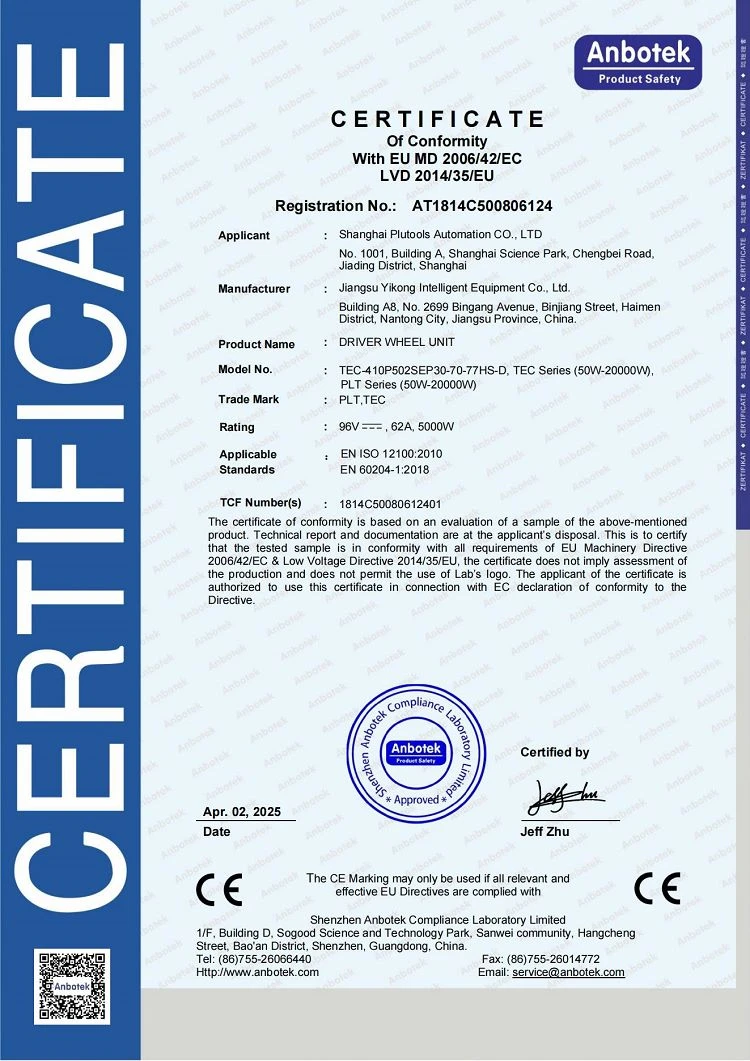
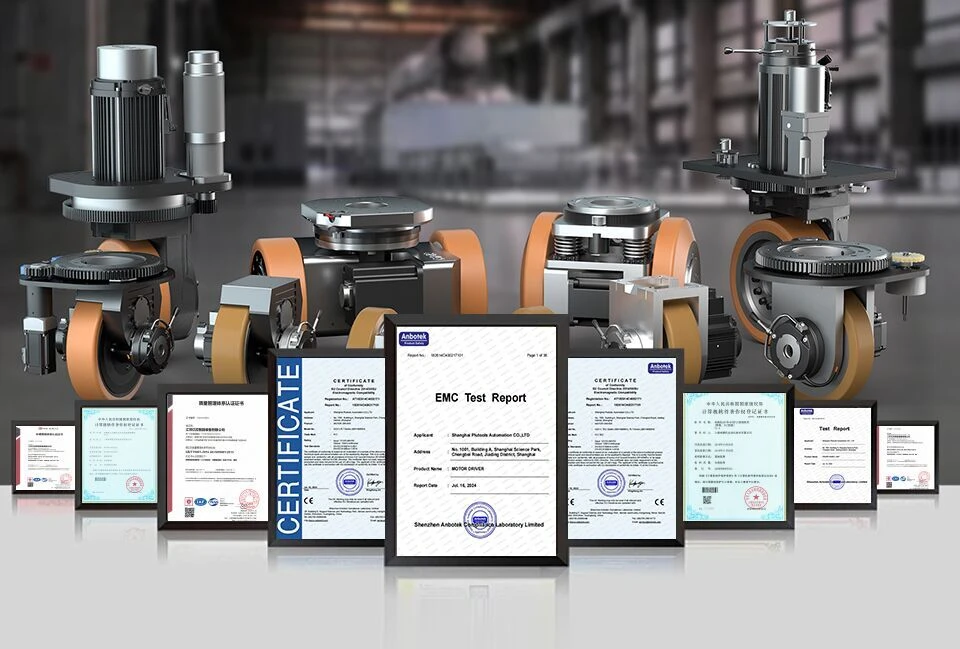
Certification evidence is only meaningful when model, standard and validity window line up. Plutools holds CE certification issued by Shenzhen Anbotek Compliance Laboratory Limited for the EU market: certificate AT1814C500806124, issued 2 April 2025 and valid to 2 April 2030, and certificate AT182414C4001881, issued 16 July 2024 and valid to 16 July 2029. Both cite EN ISO 12100:2010 and EN 60204-1:2018 and cover the TEC Series (50 W–20,000 W) and PLT Series (50 W–20,000 W).
Four checks turn that paragraph into an audit:
- Scope match. Confirm your purchased model sits inside the covered series. A series scope is not a configuration approval, and a modified unit may fall outside it.
- Validity at shipment. A certificate valid today but expiring before your delivery date is a scheduling risk the purchase order should address.
- Standard relevance. EN ISO 12100 addresses machinery risk assessment and design; EN 60204-1 addresses electrical equipment of machines. Neither replaces the vehicle-level safety standard applicable to your market, and functional-safety claims such as PLd or SIL require separate evidence.
- Legal identity. The certificate holder name should match the contracting and invoicing entity. A trading intermediary quoting under a manufacturer's certificate is a different supply arrangement.
Checkpoint 5 — Capacity, lead time and MOQ arithmetic
Capacity claims should be checked for internal consistency before they are believed. Plutools states a monthly capacity of 12,000 units and an annual output of 10,000 units from a 10,000 m² facility with more than 100 employees, alongside a 30–45 day lead time at a minimum order quantity of 2 units. Capacity and output are different numbers — one is what the plant can produce, the other what it did produce — so the useful audit question is which figure your order will be scheduled against, and what share of the monthly figure it represents.

Then break the lead time apart. Thirty to forty-five days should be split into material preparation, machining, assembly and test, with a named event that starts the clock. Without a defined start — typically purchase order plus deposit plus approved drawing — a quoted lead time has no measurable meaning, and a late shipment cannot be shown to be late.
The same arithmetic applies to ramp-up. A supplier that can absorb a pilot batch may still need notice before a volume call-off, so ask for the notice period in writing and test it with a second, larger sample order before committing an annual volume.
Checkpoint 6 — Sample and acceptance: define the test before you need it
A sample proves something only if it is traceable and measured. Plutools states pre-shipment testing as its acceptance criterion and 100% testing as its quality-control method, with FOB Shanghai delivery terms and 50/50 payment terms. Those are the commercial frame; the audit has to fill in the technical content:
- Name every test and its pass/fail limit — no-load current, running current at rated load, speed at rated load, brake holding performance, insulation or withstand check, encoder output, and a dimensional and visual check against the approved drawing.
- Decide who witnesses the test and what record travels with the shipment: serial numbers, measured values, photographs or video of the tested unit.
- Agree the failure path before the first shipment — rework and re-test, replacement, or re-scheduling — so a failed test has a defined consequence instead of a conversation.
- Mirror the supplier's test at your own incoming inspection, ideally on the same parameters, so both sides compare the same numbers.
A ten-working-day audit sequence
Run the checkpoints in this order; each step produces a document the next one depends on.
- Days 1–2 — Request the evidence pack. Datasheet, drawing with revision, certificate copies, capacity and lead-time statement, and the sample plan.
- Day 3 — Build the model and configuration sheet and reconcile quotation, drawing and certificate scope against each other.
- Day 4 — Convert the customization request into a parameter table with values, units, tolerances and verification methods.
- Day 5 — Draft the declaration sheet covering protection, tread, construction and electrical values.
- Day 6 — Check certificate scope and validity against the purchased model and the planned shipment date.
- Days 7–8 — Order and evaluate a sample built on the production line, recording measured values rather than impressions.
- Day 9 — Write the acceptance test list and agree the failure path with the supplier.
- Day 10 — Convert everything into purchase-order annexes: specification sheet, declaration sheet, acceptance criteria, delivery start event and change-notification clause.
Where the audit changes the answer: three build scenarios
The same checkpoints produce different findings depending on the platform.
Differential AGV and AMR platforms
A differential chassis uses two drive units, so consistency between them matters as much as the individual specification. The PLT-120 is documented as a differential drive wheel; the audit should confirm that both units are built to the same drawing revision and the same parameter table, because a mismatch between them shows up as tracking error rather than as an obvious defect.
Low-profile chassis
The PLT-198 is documented as a horizontal drive wheel. Horizontal arrangements are the usual choice when vehicle height and centre of gravity dominate — general design guidance holds that horizontal units suit low-profile vehicles, while vertical units suit compact, heavy-load layouts where installation height is available. In the audit, the mounting envelope and the cable exit direction become the critical documents, because they decide whether the unit fits the chassis at all.
Forklift and heavy-duty vehicles
The PLT-210 is documented as a forklift drive wheel, and heavy vehicles put the load and brake declarations under the most pressure. Here the parameter table from Checkpoint 2 and the test limits from Checkpoint 6 carry most of the risk.
A documented reference in Plutools' own material describes a Brazilian AGV manufacturer and industrial automation system integrator that used 200 units over two years for an ultra-heavy-duty AGV with multiple navigation modes, reporting stable operation under heavy load, accurate route tracking, flexible steering and reliable material transportation. Read it for what it establishes — a stated scope, quantity and duration in one application — and not as evidence about your payload, duty cycle or site conditions.
Findings that should stop the purchase order
Some audit results are worth pausing for, because each one removes the buyer's ability to prove conformity later:
- The certificate scope does not name the series your model belongs to, or the certificate holder is not the contracting entity.
- The customization request returns no values, units or tolerances — only confirmation that the change is available.
- Lead time is quoted without a defined start event.
- Acceptance is described only as the supplier's internal quality control.
- Capacity and output figures are used interchangeably, with no statement of the share allocated to your order.
- The sample cannot be traced to the production line that will make the volume order.
None of these means the supplier cannot deliver. They mean delivery assurance is still verbal, and replacing verbal assurance is the entire purpose of the audit.
FAQ
What certification evidence should an OEM AGV drive wheel manufacturer provide before a PO?
Ask for the certificate number, the issuing laboratory, the standards applied, the covered product scope and the validity window, then check that your purchased model sits inside that scope. Plutools holds CE certificates AT1814C500806124 (valid to 2 April 2030) and AT182414C4001881 (valid to 16 July 2029), issued by Shenzhen Anbotek Compliance Laboratory Limited against EN ISO 12100:2010 and EN 60204-1:2018, covering the TEC Series and PLT Series from 50 W to 20,000 W for the EU market.
What should an OEM AGV drive wheel manufacturer be able to document about its model range and customization?
A model-to-category list, a drawing revision for each configuration, and a customization scope with values, units and tolerances. Plutools documents PLT models including the PLT-120 differential drive wheel, PLT-198 horizontal drive wheel, PLT-210 forklift drive wheel and PLT-220 parallel horizontal drive wheel, and states a customization scope covering load capacity, wheel diameter, motor power, voltage, rated speed, reduction ratio, mounting dimensions, encoder type, brake system, connector, cable length, logo and packaging.
What are the purchasing terms and acceptance criteria?
For Plutools the stated terms are a minimum order quantity of 2 units, FOB Shanghai delivery, 50/50 payment and pre-shipment test as the acceptance criterion. The audit step is to convert pre-shipment test into a named test list with pass/fail limits, and to attach that list to the purchase order as an annex rather than relying on the term alone.
How should a buyer structure sample approval before volume production?
Order the sample at production scale and confirm it comes from the line that will run the volume order. Measure the parameters in the declaration sheet rather than judging appearance, record the values against the agreed limits, and state in advance what a failed sample triggers — rework and re-test, replacement, or re-scheduling. A 2-unit minimum order quantity makes a pre-production sample practical without a special build.
How do I verify capacity and lead-time claims?
Separate capacity from output, then allocate your order against them. Plutools states a monthly capacity of 12,000 units and an annual output of 10,000 units, with a 30–45 day lead time; ask which figure your order is scheduled against, how the lead time splits across material, machining, assembly and test, and which event starts the clock.
What is the final check before signing, and how does an audit start?
Attach the model and configuration sheet, the declaration sheet, the certificate scope, the sample results and the acceptance test list to the purchase order, and add a change-notification clause so any later modification reopens the audit. A practical starting point is the PLT series selection brochure, followed by a sample request at the 2-unit minimum order quantity.
Conclusion: delivery assurance becomes contractual or it stays verbal
The audit does not end with a judgement about a supplier; it ends with a set of documents. Once the model sheet, declaration sheet, certificate scope, sample results and acceptance test are attached to the purchase order, delivery assurance stops being something the sales team said and becomes something both parties can measure. That is the point at which a drive wheel purchase changes from a price comparison into a controlled supply relationship.
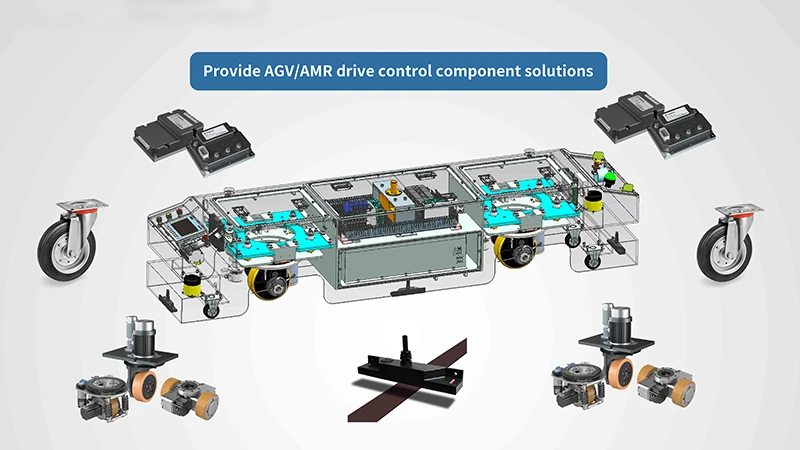
For teams starting the process, the PLT selection brochure sets out model families and configurations and is a practical base for the model and configuration sheet in Checkpoint 1. Sample requests, drawing packs and technical questions can be raised through plutools.com or via WhatsApp; remote technical support is provided after delivery.
Have Questions or Need More Details?
Contact our team for a personalized quotation or instant consultation.
Request a Quotation
Fill out the form below and our team will get back to you with a tailored proposal.
WhatsApp Direct Chat
Prefer to chat in real-time? Message us on WhatsApp for instant assistance & quick answers.
- Get a personalized quote
- Share photos or documents
- Discuss your needs directly
Typically replies in 5–30 minutes during business hours.