
Drive Wheel Torque & Reduction Ratio: A Technical Guide for AGV/AMR Load Matching
Drive Wheel Torque & Reduction Ratio: A Technical Guide for AGV/AMR Load Matching
Drive wheel torque and reduction ratio decide whether an AGV, AMR or automated forklift can actually move its rated load at the speed the route plan assumes. Most mismatches are not discovered in the field — they are designed in during evaluation, because the buyer compared motor power or load ratings instead of the torque-and-speed pair that the gearbox delivers.
This guide works through the published numbers of the Plutools 48 V, 3000 W drive wheel platform: 9.55 Nm rated torque at 3000 RPM, 68 A rated current, a 32:1 reduction, 260 Nm rated output torque and 576 Nm maximum torque, as listed for the PLT-198 Horizontal Drive Wheel and the PLT-210 Forklift Drive Wheel. The same method applies across the range, from the PLT-120 Differential Drive Wheel to the PLT-220 Parallel Horizontal Drive Wheel.
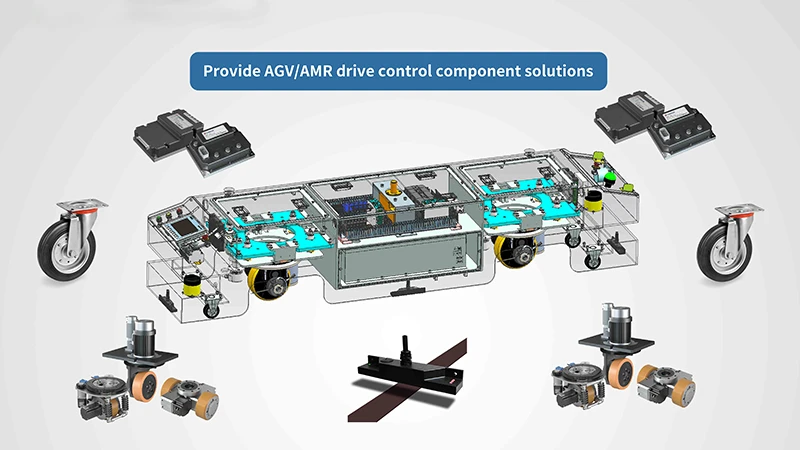
The Problem: Why Drive Wheel Sizing Fails During Evaluation
Three failure patterns repeat across AGV, AMR and forklift programs.
- Undersized output torque. A vehicle that meets its rated load on paper stalls on a ramp, cannot break away from a standstill, or runs hot because the motor is pushed close to its continuous torque limit.
- Oversized drive units. Choosing the largest available drive wheel for safety margin raises unit cost, adds mass the vehicle has to carry, and increases energy consumption per shift — a real constraint on battery-powered mobile robots.
- Wrong ratio. A high reduction ratio multiplies torque but reduces output speed. At 32:1, a 3000 RPM input delivers roughly 93.75 RPM at the output shaft, so travel speed is bounded by the gearbox as much as by the motor.
A load rating on its own does not prove that torque is adequate. The PLT-198 and the PLT-210 share identical electrical and torque figures — 48 V, 3000 W, 68 A, 9.55 Nm rated torque, 32:1 reduction ratio, 260 Nm output torque and 576 Nm maximum torque — yet they are published with different maximum loads of 1500 kg and 1200 kg. The difference comes from mounting style, steering arrangement and vehicle configuration, not from the motor. That is why evaluation has to include wheel diameter, number of driven wheels and duty cycle.
Selection rule: size the torque-speed pair against the duty cycle. Motor power in watts is an input to the calculation, not the answer to it.
Industry Background: What Is Changing Around Drive Wheel Specification
The demand behind these calculations is measurable. Reports and Data values the global AGV wheel drives market at approximately USD 1.2 billion in 2024 and projects USD 3.5 billion by 2034, a CAGR of 11.5% driven largely by logistics and warehouse automation. Grand View Research expects the wider AGV market to reach USD 5.9 billion by 2025, with Asia Pacific holding a 37.6% revenue share. Within that market, MarketsandMarkets identifies industrial logistics as the fastest-growing segment, at a projected CAGR of 11.6%.
Electrification is moving in the same direction. MarketsandMarkets notes that electric forklifts now command over 70% market share in many regions as replacements for combustion models, and Fortune Business Insights observes that lithium-ion battery technology powers the majority of new AGV and AMR drive units — which reduces range anxiety but turns current draw into a specification item rather than an afterthought. Brandessence Research describes a parallel shift toward integrated steering drive modules that replace discrete components, cutting assembly time and maintenance complexity for vehicle builders.
China remains the largest supply base. CMRA (China Mobile Robot Alliance) reports the China mobile robot market at 22.1 billion yuan in 2024, involving more than 139,000 units sold, alongside growing export volumes toward Southeast Asia and Europe.
On the compliance side, three standards shape how drive and steering units are assessed: ISO 3691-4:2023 for driverless industrial trucks, EN 1175:2020 for electrical and electronic safety requirements of industrial trucks in Europe, and ANSI/ITSDF B56.5 for driverless industrial vehicles in the United States. Each of them places direct demands on torque, braking and control behaviour — exactly the behaviour a reduction ratio determines.
The Core Relationship: Rated Torque, Output Torque, Maximum Torque and a 32:1 Reduction
Motor side: power, torque and speed are one equation
At the motor shaft, mechanical power, torque and speed are linked by P = T × ω, where ω is angular speed in radians per second. The Plutools 3000 W platform is internally consistent with this relationship: 9.55 Nm at 3000 RPM (about 314 rad/s) equals approximately 3000 W. If you need more shaft torque at the same power, speed has to fall; if you need more speed, torque has to fall. No configuration increases both without raising power or current.
Gearbox side: what a 32:1 reduction actually changes
The drive wheel gearbox trades speed for torque. With a 32:1 reduction and a 3000 RPM input, output shaft speed is 3000 ÷ 32 ≈ 93.75 RPM. Ideal torque multiplication would be 9.55 Nm × 32 ≈ 306 Nm; the published rated output torque for PLT-198 and PLT-210 is 260 Nm. That gap reflects losses in the gearbox and bearings, and it is the reason selection must use the published output torque figure rather than the arithmetic product.
Travel speed follows from output speed and wheel diameter: speed ≈ (output RPM ÷ 60) × π × D, so at 93.75 RPM the vehicle moves about 4.91 × D metres per second, where D is the wheel diameter in metres. Two consequences matter. First, a larger wheel diameter raises travel speed proportionally. Second, for the same shaft torque, a larger wheel exerts less tractive force at the floor, because torque equals force times radius. Wheel diameter is one of the customizable parameters in the Plutools range, so it should be fixed together with the load target, not chosen afterwards.
Which of the three torque figures binds your design
| Torque figure | Value (PLT-198 / PLT-210) | Measured at | Design use |
|---|---|---|---|
| Motor rated torque | 9.55 Nm | Motor shaft | Motor and current sizing |
| Rated output torque | 260 Nm | Gearbox output, continuous | Continuous traction and duty cycle |
| Maximum torque | 576 Nm | Gearbox output, peak | Acceleration, breakaway, ramp start |
The practical rule is to serve the continuous part of the duty cycle with rated output torque and to reserve maximum torque for acceleration, breakaway and grade climbing — validated against how long and how often that peak occurs. On the PLT-120 Differential Drive Wheel the same logic is published directly as a rated output torque of 10 or 21 Nm and a maximum acceleration and braking torque of 20 or 42 Nm, depending on whether the 9:1 or the 20:1 transmission ratio is selected.
Detailed Solution: Matching the 3000 W / 32:1 Platform to Real Loads
PLT-198: the 1500 kg class planetary horizontal drive wheel
PLT-198 is a planetary Horizontal Drive Wheel with steering: 48 V rated voltage, 3000 W motor power, 68 A rated current, 3000 RPM, 9.55 Nm rated torque, 32 reduction ratio, 260 Nm output torque, 576 Nm maximum torque and a 1500 kg maximum load, built on carbon steel. For an AGV Steering Drive Wheel role, this combination provides both the torque headroom to start a loaded vehicle and enough output speed for normal indoor travel once wheel diameter is fixed.
PLT-210: the forklift-side configuration
PLT-210 is a parallel horizontal drive wheel with steering, published with the same 48 V, 3000 W, 68 A, 3000 RPM, 9.55 Nm, 32:1, 260 Nm and 576 Nm figures, but with a 1200 kg maximum load and a mounting geometry suited to a Forklift Drive Wheel role. Those shared torque values are useful during evaluation: they let a program compare two mounting concepts on one drivetrain instead of changing motor class and mounting concept at the same time.
Construction, protection and the limits that are not published
All of the drive wheels discussed here are built on carbon steel, and polyurethane tread is the common choice for forklift and AGV drive wheel tires because it combines load capacity with floor protection in indoor settings (Mordor Intelligence). Two cautions belong in every evaluation. First, IP ratings are model-specific in this range — IP65 is published for the PLT-120 Differential Drive Wheel and the PLT-230P Robot Drive Wheel — so if washdown, dust or outdoor operation is planned, the protection level should be confirmed for the exact model rather than assumed across the range. Second, not every parameter is published for every model: the PLT-230P lists a 30:1 gear ratio, a 2500 W servo motor, 48 V, 62 A, 1200 kg load and IP65, but no rated or maximum torque figures. Where a figure is missing, request it before the design review instead of estimating it from a neighbouring model.
Step-by-Step Breakdown: Eight Steps to Match Torque, Ratio and Speed to a Load
- Define the moving mass. Add vehicle tare to payload. For forklift duty, also account for load transfer when the mast carries the load away from the drive axle.
- Estimate the required tractive force. Use F = m × a for acceleration, add rolling resistance for the floor and wheel material, and add the grade component m × g × sinθ for ramps. List each element separately so the peak can be timed, not just summed.
- Convert force into wheel torque. T = F × (D ÷ 2), then divide by the number of driven wheels. This is where wheel diameter enters the calculation, and where a Steering Drive Wheel and a dual differential layout behave differently.
- Split continuous from peak demand. The continuous portion must sit within rated output torque (260 Nm on the 3000 W platform); the peak — acceleration, breakaway, ramp start — is checked against maximum torque (576 Nm) with a duty-cycle limit attached.
- Check achievable speed. Output RPM = input RPM ÷ reduction ratio, so 3000 ÷ 32 ≈ 93.75 RPM for a 32:1 unit. Convert it to travel speed with the confirmed wheel diameter and compare it with the route plan. If the plan is not achievable, both ratio and wheel diameter are customizable parameters.
- Check the electrical envelope. The 3000 W platform draws 68 A at 48 V per unit. Multiply by the number of drive and steering units to size battery, controller and cabling, and note that a 24 V platform such as the PLT-230 AGV Drive Wheel draws 76 A in a different voltage class.
- Check the environment. Confirm IP protection, tread material, temperature range, cleaning regime and floor type. These decide whether a standard Electric Drive Wheel is acceptable or a specialized configuration is required.
- Confirm compliance and customization. Match the CE scope to the exact model, then lock the options: encoder type, brake system, connector, cable length, mounting dimensions, logo and packaging. Lead time is 30–45 days and MOQ is 2 units, so the specification should be final before the order rather than during it.
Use Cases: Three Load Profiles and What They Point To
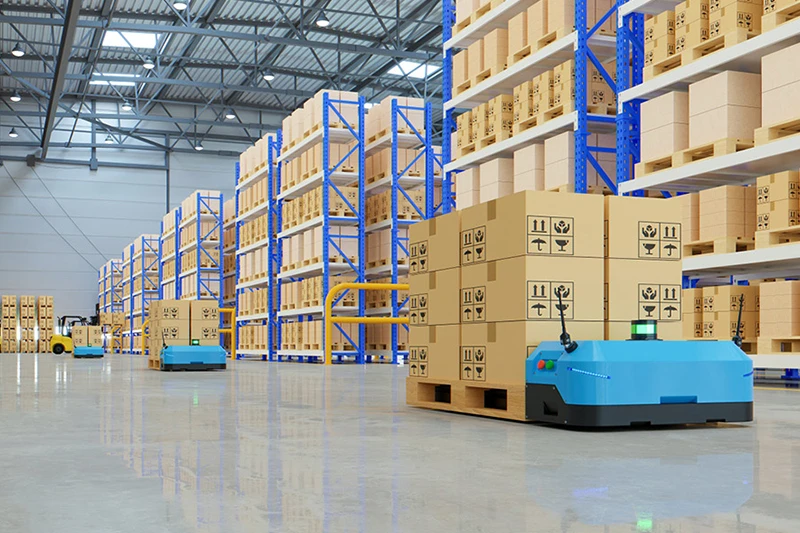
1. Ultra-heavy AGV with multiple navigation modes
A Brazilian AGV manufacturer and industrial automation system integrator built an ultra-heavy-duty AGV with multiple navigation modes, using drive, differential steering and motion control components in a 200-unit program that has run for two years. The reported outcome was stable operation under heavy-load conditions, accurate route tracking, flexible steering and reliable material transportation. Programs of this type are where the 32:1, 260 Nm output torque class earns its place: the torque headroom supports heavy starting loads while the reduction ratio keeps speed predictable along the route.
2. Automated forklift and counterbalance platforms
Forklift conversion projects typically need a Forklift Drive Wheel with steering that can place the driven wheel under a shifting centre of gravity. PLT-210 is specified for that role at a 1200 kg maximum load, while PLT-198 covers 1500 kg in a planetary horizontal layout. The evaluation question is not which load number is higher, but which mounting and steering geometry keeps sufficient normal force over the drive wheel throughout the mast cycle.
3. Light AMR with differential drive
For smaller Mobile Robot Drive Wheel platforms, PLT-120 provides a 400 W, 48 V, 11.2 A differential configuration with 3000 RPM rated speed, 1.28 Nm rated torque, a 9:1 or 20:1 transmission ratio, 10 or 21 Nm rated output torque, 20 or 42 Nm maximum acceleration and braking torque, a 150 kg drive wheel load, a total drive wheel weight of 5 ± 2 kg and IP65 protection. Lower mass and published acceleration and braking torque are the two figures that matter most on a differential AMR: one affects the payload budget, the other affects positioning accuracy.
Comparison Table: Torque, Ratio and Load Across the Plutools Drive Wheel Range
The table below collects the published parameters of eight configurations so that torque, ratio and load can be read together in one view.
| Model | Type | Rated voltage | Motor power | Rated current | Speed | Rated torque | Reduction ratio | Rated output torque | Max torque | Max load |
|---|---|---|---|---|---|---|---|---|---|---|
| PLT-120 | Differential Drive Wheel | 48 V | 400 W | 11.2 A | 3000 RPM | 1.28 Nm | 9 / 20 | 10 / 21 Nm | 20 / 42 Nm | 150 kg |
| PLT-150 | Vertical Drive Wheel with steering | 48 V | 750 W | 20 A | 3000 RPM | 2.4 Nm | 22.5 | 108 Nm | 114 Nm | 500 kg |
| PLT-167 | AGV Drive Wheel Unit, horizontal without steering | 48 V | 750 W | 18 A | 3000 RPM | 2.4 Nm | 21 | 40 Nm | 120 Nm | 800 kg |
| PLT-220 | Parallel Horizontal Drive Wheel with steering | 48 V | 750 W | 18 A | 3000 RPM | 2.4 Nm | 28 | 58 Nm | 174 Nm | 1000 kg |
| PLT-230 | AGV Drive Wheel, vertical without steering | 24 V | 1500 W | 76 A | 2590 RPM | 5.5 Nm | 30 | 108 Nm | 300 Nm | 1500 kg |
| PLT-230P | Robot Drive Wheel, vertical with shock absorption, servo | 48 V | 2500 W | 62 A | 3000 RPM | Not published | 30 | Not published | Not published | 1200 kg (IP65) |
| PLT-198 | Planetary Horizontal Drive Wheel with steering | 48 V | 3000 W | 68 A | 3000 RPM | 9.55 Nm | 32 | 260 Nm | 576 Nm | 1500 kg |
| PLT-210 | Forklift Drive Wheel, parallel horizontal with steering | 48 V | 3000 W | 68 A | 3000 RPM | 9.55 Nm | 32 | 260 Nm | 576 Nm | 1200 kg |
How to read the torque-per-load ratio. Dividing published rated output torque by maximum load gives an indicative figure: about 0.22 Nm/kg for PLT-210 and PLT-150, 0.17 Nm/kg for PLT-198, 0.14 Nm/kg for PLT-120 at the 20:1 ratio, and roughly 0.05–0.07 Nm/kg for PLT-167, PLT-220 and PLT-230. These values are arithmetic derived from published figures, not published specifications, and they are only meaningful when wheel diameter, number of driven wheels and duty cycle are the same across the options being compared.
Read the table as a shortlist rather than a ranking. For the heaviest continuous loads, the 3000 W, 32:1 units — PLT-198 and PLT-210 — carry the greatest torque headroom. For mid-weight vehicles that need steering within a smaller electrical envelope, PLT-220 and PLT-150 sit in the 750 W class. For differential AMRs and small logistics bots, PLT-120 with its 9:1 or 20:1 ratio is the flexible option, while PLT-167 covers the 800 kg horizontal, non-steering case.
Frequently Asked Questions
Which certifications and safety standards apply to a Plutools drive wheel?
CE certification covers the PLT and TEC series (50 W–20000 W). Certificate AT1814C500806124 was issued on 2 April 2025 and is valid to 2 April 2030 by Shenzhen Anbotek Compliance Laboratory Limited for the EU market, citing EN ISO 12100:2010 and EN 60204-1:2018; certificate AT182414C4001881 was issued on 16 July 2024 and is valid to 16 July 2029. Builders integrating drive wheels into driverless industrial trucks also work to ISO 3691-4:2023, and in Europe to EN 1175:2020, while ANSI/ITSDF B56.5 is the corresponding U.S. safety standard for driverless industrial vehicles.
Can the reduction ratio, rated speed and output torque be customized for a specific load?
Yes. Plutools is a factory offering OEM, ODM, custom manufacturing and sample development, and the customizable parameter list includes load capacity, wheel diameter, motor power, voltage, rated speed, reduction ratio, mounting dimensions, encoder type, brake system, connector, cable length, logo and packaging. Published figures such as the 32:1 ratio and 260 Nm output torque on PLT-198 and PLT-210 describe those standard configurations; a different load or speed target should be raised as a customization request with the required torque, speed and duty cycle.
What drives cost when moving to a higher-torque drive wheel?
Cost follows the torque-speed class and the options attached to it: motor power (the 3000 W platform versus the 750 W platform used by PLT-150, PLT-167 and PLT-220), whether steering or shock absorption is included, encoder and brake configuration, and connector and cable specification. MOQ is 2 units, which allows a low-volume build or a pilot vehicle to be quoted without committing to a full production run, and lead time is quoted per configuration.
Can the torque match be validated on a sample before series production?
Yes. Sample development is part of the manufacturing offer, and every unit is 100% tested as part of quality control. A sample allows the buyer to confirm acceleration, braking behaviour, grade capability and floor behaviour with their own wheel diameter and controller settings. One Brazilian AGV manufacturer and industrial automation system integrator validated a 200-unit program for an ultra-heavy-duty AGV with multiple navigation modes; after two years of operation the reported result was stable operation under heavy-load conditions, accurate route tracking and reliable material transportation.
What is the typical lead time and supply capacity?
Lead time is 30–45 days, monthly capacity is 12,000 units, and production runs are handled from small to large batches to keep supply stable. To move from calculation to a confirmed configuration, send the vehicle mass, payload, required travel speed, wheel diameter and duty cycle to the Plutools team and request a quotation or a sample of the matching configuration — PLT-198 or PLT-210 for the 3000 W, 32:1 torque class, or a customized reduction ratio and rated speed.
Conclusion: Three Decisions, One Configuration
Load matching for AGV, AMR and forklift drive wheels comes down to three decisions that have to be made together. The first is the torque figure: use rated output torque for continuous duty and maximum torque for peaks, and never substitute the arithmetic product of rated torque and ratio for the published output torque. The second is the speed trade-off: a 32:1 reduction turns 3000 RPM into about 93.75 RPM at the output shaft, and wheel diameter converts that into travel speed and tractive force. The third is the envelope around the drivetrain — 48 V and 68 A per unit on the 3000 W platform, IP protection where it is published, carbon steel construction, CE scope, and the customizable parameters that adapt load capacity, rated speed and reduction ratio to the actual vehicle.
Teams that handle all three at the specification stage rarely discover a torque problem on the factory floor. Where a published figure is missing, ask for it; where the standard configuration does not fit, specify the customization. Both are cheaper than a redesign after the first vehicle is assembled.
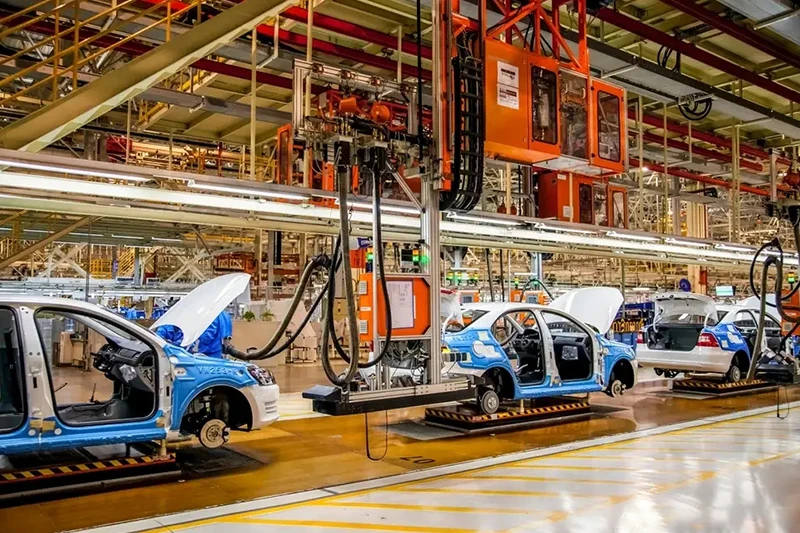
Next Step: From Calculation to a Confirmed Drive Wheel Configuration
Share your vehicle mass, payload, required travel speed, wheel diameter, number of driven wheels and duty cycle. The Plutools engineering team will confirm which configuration matches — PLT-198 or PLT-210 in the 3000 W, 32:1 class, or a customized reduction ratio and rated speed.
Download the selection manual for full parameter tables: PLT Drive Wheel Selection Manual
Contact: Eric.Tang@plutools.com | Tel / WhatsApp: +86 159-8958-6580 | Start a WhatsApp conversation
Shanghai Plutools Automation Corporation Co., Ltd. — www.plutools.com