
Forklift Drive Wheel Overloaded or Hard to Steer? A PLT-198 Scenario
A forklift that demands more torque than its drivetrain can deliver, or that needs noticeably more steering effort inside a narrow aisle, is not a minor inconvenience. In a working material-handling operation, that symptom becomes a throughput loss, a load-support risk, and a maintenance cost. This article follows one realistic scenario — a compact electric forklift operating in narrow-aisle warehousing — and works from the symptom to a verified solution: the PLT-198 horizontal drive wheel from Plutools.
Problem Definition: What “Overloaded” and “Hard to Steer” Actually Mean on a Forklift
“Overloaded” and “hard to steer” are rarely isolated faults. On a forklift drive system they usually appear together, and they share a common root: the drive wheel is being asked to deliver more torque, more grip, or more steering authority than its original specification was designed to provide.
In the scenario described here, a warehouse operator installed a compact electric forklift for narrow-aisle picking. Three symptoms appeared after the first month of operation:
- The truck accelerates acceptably on a straight run, but steering in a tight turn feels heavy — drivers slow down more than expected before turning.
- The drive wheel motor draws high current during load pick-up and rapid direction changes, triggering current-limit warnings on the controller.
- Load support at the rated capacity point feels marginal — the truck handles well when empty but behaves differently with a full pallet.
These symptoms do not necessarily mean the wheel is defective. More often they mean the drive wheel specification is at or beyond the edge of its design envelope. When a forklift’s demand for torque, steering control, or load support rises, the drive wheel becomes the constraint.
Industry Background: Why Drive Wheel Demand Is Rising in Material Handling
The pressure on forklift drive wheels is not accidental. It tracks the broader shift toward more electrified, more automated, and more space-constrained material handling.
Third-party market data points in one direction. According to Reports and Data, the global AGV Wheel Drives market was valued at approximately USD 1.2 billion in 2024 and is projected to reach USD 3.5 billion by 2034, growing at a CAGR of 11.5% from 2024 to 2034, driven by logistics and warehouse automation. Separate industry analysis from MarketsandMarkets indicates that electric forklifts now command over 70% market share in many regions as a replacement for combustion models.
Three trends follow. First, as aisles narrow and picking routes tighten, steering authority becomes a specification rather than an afterthought. Second, integrated steering drive modules are replacing discrete components to reduce manufacturer assembly time and maintenance complexity — a shift identified by Brandessence Research. Third, polyurethane (PU) treads are common on forklift drive wheel tires because they provide higher load capacity and floor protection in indoor settings, per Mordor Intelligence.
The regulatory context has moved in parallel. ISO 3691-4:2023 is the primary international safety standard for driverless industrial trucks, covering steering and braking systems. EN 1175:2020 specifies electrical and electronic safety requirements for industrial trucks, and ANSI/ITSDF B56.5 is the specific American safety standard for driverless industrial vehicles, governing the performance of drive and steering units. For a buyer, these expectations raise the bar on what a drive wheel must demonstrate — not only in normal operation, but inside its torque, steering, and load-support envelope.
Detailed Solution: How the PLT-198 Forklift Drive Wheel Addresses the Scenario
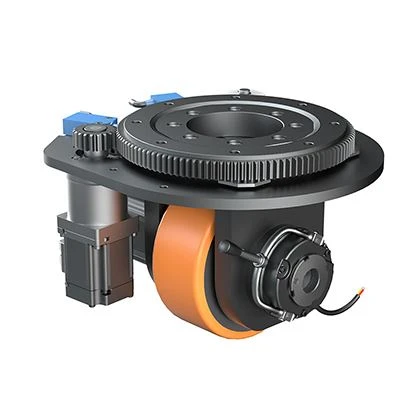
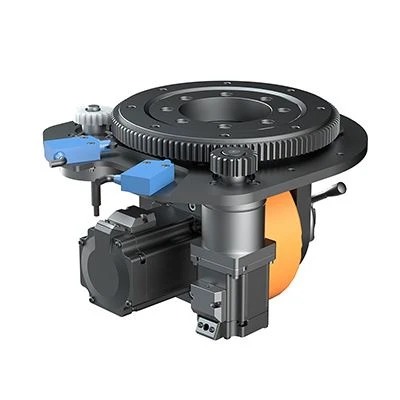
The PLT-198 is a horizontal drive wheel from Plutools, a Shanghai-based manufacturer of AGV, AMR, and forklift drive wheels operating under Shanghai Plutools Automation Corporation Co., Ltd. Its structural configuration is an integrated parallel horizontal structure with steering function, and its PU wheel tread is designed for low noise and high wear resistance.
For the scenario above, the PLT-198 changes three things at once: the torque available at the wheel, the steering configuration built into the wheel, and the load rating the wheel is designed to support. The relevant specifications are below.
The 576 Nm maximum torque and 260 Nm output torque figures are the relevant numbers for the “overloaded” symptom. When a forklift picks up a full pallet, the drive wheel sees a torque spike that a lower-torque unit may not accommodate gracefully. The PLT-198’s 9.55 Nm rated torque, multiplied by its 32:1 reduction ratio, produces the 260 Nm output torque at the wheel. That reduction ratio is also what shapes how the motor is loaded during acceleration and direction changes.
The “hard to steer” symptom is addressed by the integrated parallel horizontal structure with steering function. In this configuration, steering is part of the drive wheel’s structural design rather than a separate assembly. From the vehicle builder’s perspective, that removes a discrete steering component from the integration path and reduces the assembly steps needed at chassis level.
The load-support concern is addressed by the 1,500 kg maximum load rating. For a forklift whose full-pallet weight plus dynamic load transfer stays within that figure, the PLT-198 is rated to the task. Where a project requires less load and less torque, the PLT-220 is an alternative at a 1,000 kg maximum load with different torque and power characteristics — the correct choice depends on the duty cycle, not on catalog position.
Why the PU Tread Matters in This Scenario
The PU wheel tread is not a cosmetic detail. Forklift drive wheel tires commonly use polyurethane to provide higher load capacity and floor protection in indoor settings (Mordor Intelligence). In narrow-aisle warehousing, that combination — traction without floor damage — directly affects the steering symptom: a wheel that grips predictably steers predictably. The PU tread also contributes to the low-noise and high-wear-resistance characteristics listed by Plutools for the PLT-198.
Customization Options That Keep the Wheel Matched to the Task
PLT-198 supports customizable load and speed options. Beyond those two, Plutools offers customization across load capacity, wheel diameter, motor power, voltage, rated speed, reduction ratio, mounting dimensions, encoder type, brake system, connector, cable length, logo, and packaging. For a forklift program where the drive wheel was originally undersized, the correct step is not necessarily a different product family — it may be a configured PLT-198 matched to the actual duty cycle.
Step-by-Step Breakdown: Diagnosing and Resolving the Symptom
The following sequence moves from symptom to verified specification. It is written for a procurement or engineering team evaluating the PLT-198 as a replacement or a new build.
Step 1 — Confirm the Symptom Is Spec-Related, Not a Failure
Check whether steering difficulty, high current draw, or load-support hesitation appears only under specific conditions: a full pallet, a tight turn, a fast direction change. If the symptom is repeatable and condition-dependent, the drive wheel is likely at its design limit rather than failing. This distinction matters before ordering a replacement.
Step 2 — Quantify the Demand at the Wheel
Calculate the torque the vehicle needs at the wheel during pick-up, acceleration, and steering — not only during steady-state travel. Compare the required torque against the PLT-198’s 260 Nm output torque and 576 Nm maximum torque. Compare the actual full-pallet load against the 1,500 kg maximum load rating. Compare the operating speed against the 3000 RPM rated speed.
Step 3 — Check the Electrical Match
The PLT-198 operates at 48 V, draws 68 A rated current, and uses a 3000 W motor. Confirm that the vehicle’s controller, battery, and wiring are rated for that current, and that the current-limit warnings in the original symptom are not the controller protecting against a mismatched drivetrain.
Step 4 — Confirm the Steering Configuration Fits the Chassis
Because the PLT-198 is an integrated parallel horizontal structure with steering function, the chassis must accommodate the mounting dimensions and integration path of that structure. Plutools supports customization of mounting dimensions, encoder type, brake system, connector, and cable length — so the integration can be adjusted rather than forced.
Step 5 — Confirm Compliance for the Destination Market
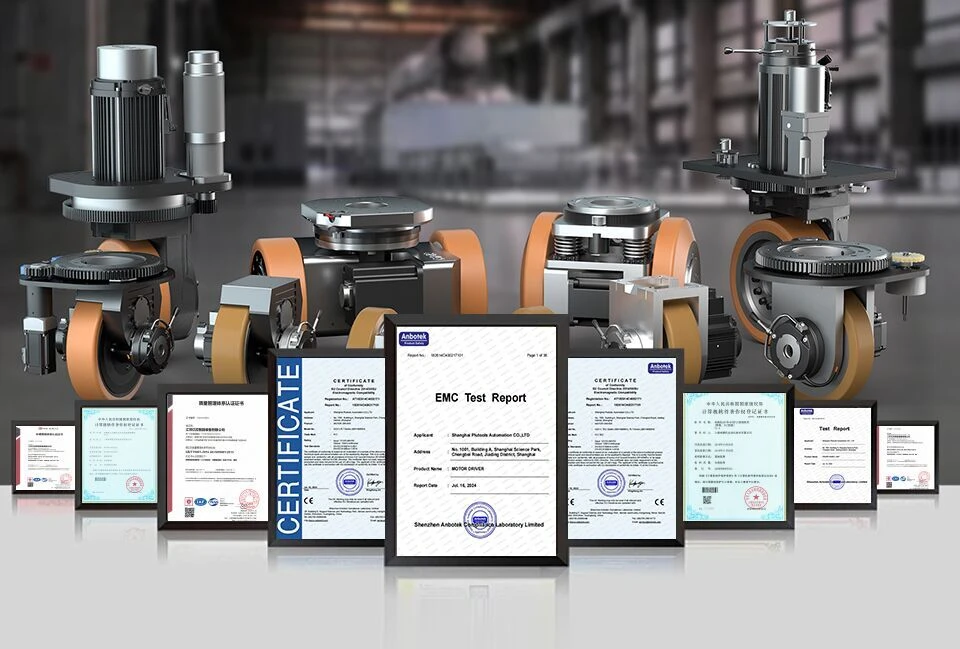
Before finalizing a build, confirm the compliance path for the destination market. The PLT Series is covered by CE certification AT1814C500806124, issued by Shenzhen Anbotek Compliance Laboratory Limited, valid from 2025-04-02 to 2030-04-02, under standards EN ISO 12100:2010 and EN 60204-1:2018. Projects intended for the USA also reference ANSI/ITSDF B56.5 for driverless industrial vehicles, and ISO 3691-4:2023 for driverless industrial trucks internationally.
Step 6 — Validate with a Sample Before Scaling
Plutools offers sample development as part of its factory capabilities, and the minimum order quantity is 2 units. A sample build is the practical way to confirm that the torque and steering behavior observed in the original scenario is resolved under actual working conditions.
Use Cases: Where the PLT-198 Scenario Applies
The scenario above is not unique. The PLT-198 is relevant to any material-handling application where a drive wheel must combine torque, steering, and load support within a compact structure.
Narrow-Aisle Warehousing
In warehouses where turning clearance is limited, steering effort and steering authority become daily operating variables. The integrated steering configuration of the PLT-198, combined with the PU tread, is the relevant combination for this environment.
Automated Forklift and AGV Programs
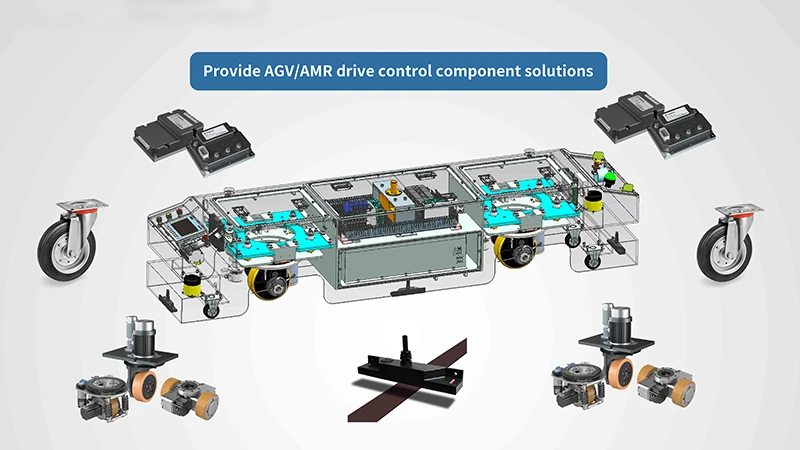
Plutools describes the operating environment for its drive wheels as including indoor factories, automated warehouses, production workshops, logistics centers, and semi-outdoor industrial environments, with typical working conditions of continuous operation, frequent starting and stopping, forward and reverse movement, narrow aisles, heavy loads, dust, vibration, and temperature changes. The PLT-198 fits within that envelope for programs that need a 1,500 kg load-rated drive wheel with integrated steering.
Higher-Torque Material Handling
Where the original symptom is high torque demand during load pick-up, the 576 Nm maximum torque and 260 Nm output torque of the PLT-198 are the relevant specifications. This is the case where the previous drive wheel was rated for travel but not for the torque spikes of load handling.
Where the PLT-198 Is Not the Right Choice
If the required load exceeds 1,500 kg, the PLT-198’s maximum load rating is the ceiling, and the correct response is to evaluate a different configuration within the PLT Series rather than operating beyond the rated load. Where the vehicle does not require integrated steering, a non-steering horizontal drive wheel such as the PLT-167 may be the more appropriate integration.
Comparison Table: PLT-198 Against Related Plutools Configurations
The table below uses only specifications listed for the PLT Series by Plutools. It is not a ranking; it is a configuration reference for the scenario described above.
| Model | Type | Max Load | Output Torque | Max Torque | Reduction Ratio | Steering |
|---|---|---|---|---|---|---|
| PLT-198 | Planetary horizontal drive wheel | 1,500 kg | 260 Nm | 576 Nm | 32 | Integrated |
| PLT-210 | Parallel horizontal drive wheel | 1,200 kg | 260 Nm | 576 Nm | 32 | Integrated |
| PLT-220 | Parallel horizontal drive wheel | 1,000 kg | 58 Nm | 174 Nm | 28 | Integrated |
| PLT-167 | Horizontal drive wheel | 800 kg | 40 Nm | 120 Nm | 21 | None |
Read against the scenario, the table makes the decision logic visible. The PLT-198 and PLT-210 share the same torque characteristics and reduction ratio; the PLT-198 carries a 1,500 kg maximum load, while the PLT-210 carries 1,200 kg. Where the load rating is the constraint, the PLT-198 is the higher-rated choice. Where the torque requirement is lower and the load is smaller, the PLT-220 or PLT-167 may be a better fit — the PLT-167 is the option to consider when steering is handled elsewhere in the chassis.
FAQ: Forklift Drive Wheel Overload and Steering Questions
1. Does the PLT-198 meet CE compliance requirements for EU forklift projects?
Yes, on the compliance path documented for the PLT Series. Plutools holds CE certification AT1814C500806124, issued by Shenzhen Anbotek Compliance Laboratory Limited. The certification is valid from 2025-04-02 to 2030-04-02 and applies the standards EN ISO 12100:2010 and EN 60204-1:2018. The certification scope covers the PLT Series (50W–20000W). For projects intended for other markets, buyers should confirm the applicable local requirements — for example, ANSI/ITSDF B56.5 for driverless industrial vehicles in the USA, and ISO 3691-4:2023 for driverless industrial trucks internationally.
2. Can the PLT-198 handle the torque, load, and steering demands of a narrow-aisle forklift?
It depends on the actual demand. The PLT-198 is rated for a 1,500 kg maximum load, with 260 Nm output torque, 576 Nm maximum torque, 9.55 Nm rated torque, 3000 RPM rated speed, and a 32:1 reduction ratio. It uses an integrated parallel horizontal structure with steering function and a PU wheel tread. If the vehicle’s full-pallet load, required torque at the wheel, and steering configuration fall within those figures, the PLT-198 is specified for the task. If they do not, a different configuration or a customized PLT-198 should be evaluated rather than operating the wheel beyond its rated envelope.
3. What determines the cost of a PLT-198 forklift drive wheel configuration?
Cost is driven by the confirmed specification, not by the model name alone. Plutools offers customization across load capacity, wheel diameter, motor power, voltage, rated speed, reduction ratio, mounting dimensions, encoder type, brake system, connector, cable length, logo, and packaging — each of which changes the configuration. To receive a project-specific quotation, share the target load, torque, speed, and mounting requirements with Plutools so the configuration can be confirmed before pricing.
4. Can we test a PLT-198 sample before placing a production order?
Yes. Plutools offers sample development as part of its factory capabilities, and the minimum order quantity is 2 units. A sample build is the practical way to verify that the torque, steering, and load-support behavior observed in the original scenario is resolved under the actual working conditions before committing to a larger run.
5. What is the production lead time for PLT-198 orders, and how do we start the process?
Production lead time for Plutools drive wheel orders is 30–45 days, with a monthly capacity of 12,000 units and 100% testing as part of quality control. To start, share the vehicle’s operating conditions, load and torque requirements, and steering configuration. For a sample request, a configuration-specific quote, or the full PLT selection guide, contact Plutools through plutools.com or download the PLT selection manual (PDF).
Conclusion: Match the Drive Wheel to the Duty Cycle, Not the Catalog Position
The forklift scenario in this article is a specification problem more often than a product failure. Slow steering, high torque demand, and marginal load support all point to the same question: is the drive wheel matched to the actual duty cycle?
The PLT-198 answers that question for a defined envelope — 1,500 kg maximum load, 260 Nm output torque, 576 Nm maximum torque, 9.55 Nm rated torque, 3000 RPM rated speed, 68 A rated current, 32:1 reduction ratio, integrated parallel horizontal structure with steering, PU tread, and customizable load and speed options. Where the demand fits inside that envelope, the wheel is designed for it. Where the demand sits outside it, the correct answer is a different configuration or a customized build — not an overloaded wheel.
Have a forklift drive wheel that is overloaded or hard to steer?
Share your load, torque, and steering requirements with Plutools. Request a PLT-198 sample, a configuration-specific quote, or the full PLT selection guide.
Visit plutools.com | Download the 2026 PLT selection manual (PDF)
Have Questions or Need More Details?
Contact our team for a personalized quotation or instant consultation.
Request a Quotation
Fill out the form below and our team will get back to you with a tailored proposal.
WhatsApp Direct Chat
Prefer to chat in real-time? Message us on WhatsApp for instant assistance & quick answers.
- Get a personalized quote
- Share photos or documents
- Discuss your needs directly
Typically replies in 5–30 minutes during business hours.