
Top 7 Drive Wheel Configurations for Every AGV, AMR & Forklift Build: A Ranked Recommendation List
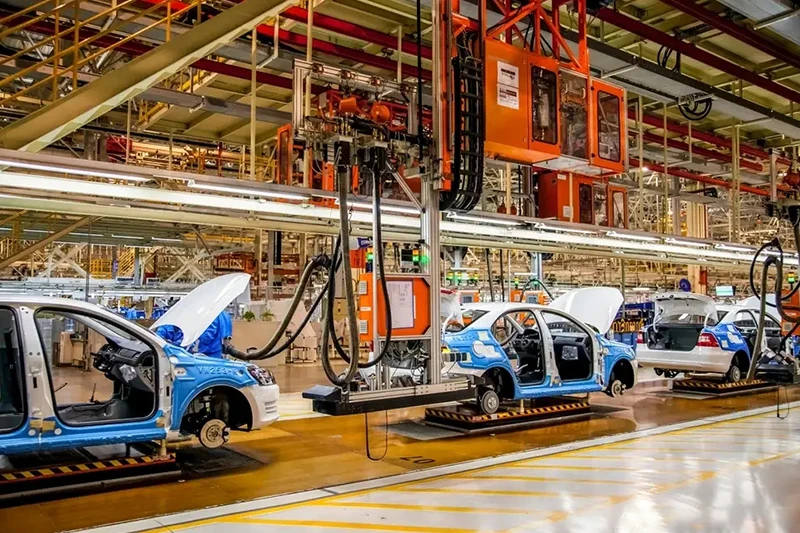
Drive wheel configurations mapped to AGV, AMR and forklift build types. Image: Shanghai Plutools Automation Corporation Co., Ltd.
Top 7 Drive Wheel Configurations for Every AGV, AMR & Forklift Build: A Ranked Recommendation List
Seven drive wheel configurations cover the overwhelming majority of AGV, AMR and forklift builds: horizontal, AGV, forklift, robot, parallel horizontal with steering, vertical, and differential. This ranked list orders them by published maximum rated load, using published maximum torque as the tie-breaker. Every load, torque, voltage, current, speed, reduction ratio and protection figure below comes from Plutools specification data for the configuration named — nothing in the ranking is imported from outside that data set.
Rank position describes payload and torque capability inside this product family. It does not describe quality. The configuration ranked seventh is the smallest unit on the list, yet it is one of only two configurations here that publish an IP65 protection rating for the drive unit, which makes it the right starting point for compact AGV and AMR builds rather than a compromise.
Shanghai Plutools Automation Corporation Co., Ltd. (Plutools) is a Shanghai-based manufacturer of AGV drive wheels, drive wheel assemblies and steering drive modules for AGV, AMR and forklift programs, serving customers in the EU, US, Middle East and Southeast Asia. The configurations below are the seven that build teams most often need to choose between.
Why the Drive Wheel Configuration Decides More Than the Wheel
A drive wheel configuration is a fixed decision that sets several downstream variables at once: the maximum payload the vehicle can carry, the chassis height the vehicle can achieve, how the vehicle steers, how the drive unit is serviced, and how much voltage and current the electrical architecture must supply. Once a configuration is frozen into a chassis drawing, changing it usually means redesigning the mounting plate, the load path and the wiring harness.
The practical problem is that buyers rarely compare configurations. They compare named products, and product names do not reveal the architecture underneath. A 48 V unit rated at 1500 kg maximum load and a 24 V unit rated at the same 1500 kg maximum load behave very differently on the same vehicle, because the voltage determines current draw, cable sizing and battery configuration. Ranking configurations by their published load ceiling, and then publishing the torque, voltage and reduction ratio beside that number, gives a build team a comparison it can actually act on before a supplier is contacted.
Two failure patterns repeat across AGV and AMR programs. The first is selecting a configuration that meets the payload target but not the torque target, so the vehicle cannot accelerate a full load up a ramp or brake it predictably. The second is selecting a configuration whose steering architecture does not match the navigation strategy, which forces an additional steering module into a chassis that was designed for one integrated unit.
What Is Changing in the AGV, AMR and Forklift Drive Market
The commercial context makes configuration choice more consequential each year. The global AGV wheel drives market was valued at approximately USD 1.2 billion in 2024 and is projected to reach USD 3.5 billion by 2034, a CAGR of 11.5% from 2024 to 2034, according to Reports and Data. The wider AGV market is expected to reach USD 5.9 billion by 2025, per Grand View Research, with Asia Pacific holding a 37.6% revenue share in 2025.
Forklift demand is shifting in the same direction. The US forklift market was valued at USD 9.11 billion in 2023 and is moving toward electric and automated drive systems, while electric forklifts now command over 70% market share in many regions as a replacement for combustion models, according to MarketsandMarkets. In China, the mobile robot market reached a scale of 22.1 billion Yuan in 2024, involving over 139,000 units sold, per the China Mobile Robot Alliance. Within the AGV category, the industrial logistics segment is projected to grow fastest at a CAGR of 11.6%, based on MarketsandMarkets data.
Three technology signals matter for configuration planning. Lithium-ion battery technology now powers the majority of new AGV and AMR drive units, which changes how much current headroom a drive configuration must tolerate. Mecanum and omnidirectional drive systems are increasingly used for AMRs in high-density warehouses. And integrated steering drive modules are replacing discrete components to reduce manufacturer assembly time and maintenance complexity.
Vehicle-level safety expectations are converging around named standards rather than general good practice. ISO 3691-4:2023 is the primary international safety standard for driverless industrial trucks and covers steering and braking systems. EN 1175:2020 specifies electrical and electronic safety requirements for industrial trucks and applies to AGV drive wheel assemblies. ANSI/ITSDF B56.5 governs driverless industrial vehicle performance in the United States, including drive and steering units.
The Ranked List: 7 Drive Wheel Configurations by Published Load and Torque
Ordering rule: maximum rated load descending; where two configurations publish the same maximum load, the one with the higher published maximum torque ranks ahead. All specifications below are Plutools figures for the named model.
Rank 1Horizontal Drive Wheel — PLT-198, Planetary Horizontal with Steering
PLT-198 is a planetary horizontal drive wheel with integrated steering. Published specifications: 48 V rated voltage, 3000 W motor power, 68 A rated current, 3000 RPM, 9.55 Nm rated torque, 32:1 reduction ratio, 260 Nm output torque, 576 Nm maximum torque, and 1500 kg maximum load, in carbon steel.
It ranks first because it publishes the highest maximum load on this list and ties for the highest maximum torque at 576 Nm. The planetary horizontal layout positions the motor horizontally, which keeps the drive module low and supports a low centre of gravity, while the integrated steering removes the need for a separate steering actuator in the chassis. That combination makes it the default candidate for heavy-duty steered platforms where payload and turning accuracy must both be high.
Boundary condition: PLT-198 is a 48 V configuration drawing 68 A rated. Builds running a 24 V bus cannot use it without changing the electrical architecture, and the 32:1 reduction ratio favours tractive effort over top speed.
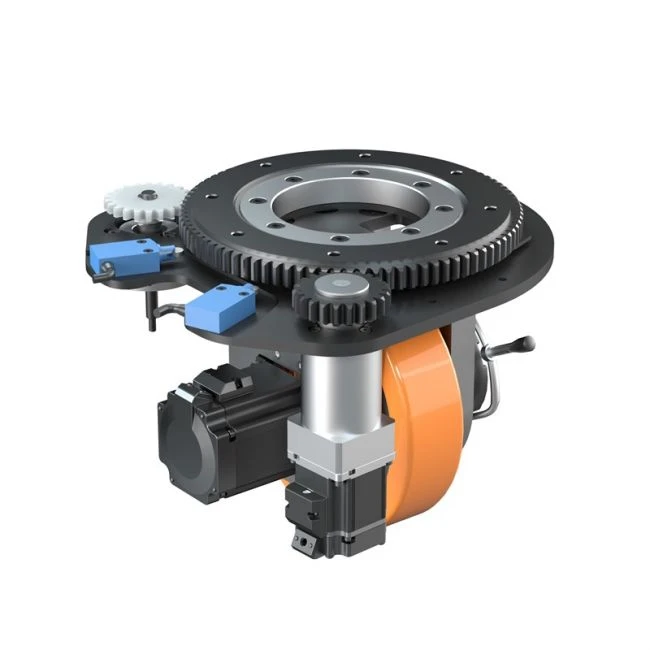
PLT-198 horizontal drive wheel: 48 V, 3000 W, 32:1, 576 Nm maximum torque, 1500 kg maximum load.
Rank 2AGV Drive Wheel — PLT-230, Vertical without Steering
PLT-230 is a vertical drive wheel without steering. Published specifications: 24 V rated voltage, 1500 W motor power, 76 A rated current, 2590 RPM, 5.5 Nm rated torque, 30:1 gear ratio, 108 Nm output torque, 300 Nm maximum torque, and 1500 kg maximum load, in carbon steel.
It ranks second because it matches the 1500 kg maximum load of rank 1 but publishes a lower maximum torque of 300 Nm, which is the stated tie-breaker. Its inclusion reason is architectural rather than numerical: the motor and gearbox are arranged vertically, reducing the horizontal footprint of the drive unit, and the 24 V rating makes it the natural choice for vehicles already built around a 24 V bus. Because steering is not integrated, PLT-230 is normally used in pairs for differential steering or alongside a separate steering arrangement.
Boundary condition: with no integrated steering, PLT-230 shifts the steering function into the vehicle design. Build teams that want a single-unit steer solution should move to rank 1, 3, 5 or 6.
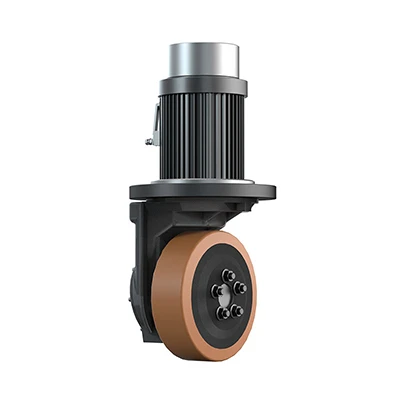
PLT-230 AGV drive wheel: 24 V, 1500 W, 30:1, 300 Nm maximum torque, 1500 kg maximum load.
Rank 3Forklift Drive Wheel — PLT-210, Parallel Horizontal with Steering
PLT-210 is a parallel horizontal drive wheel with steering, specified for forklift and material-handling duty. Published specifications: 48 V rated voltage, 3000 W motor power, 68 A rated current, 3000 RPM, 9.55 Nm rated torque, 32:1 reduction ratio, 260 Nm output torque, 576 Nm maximum torque, and 1200 kg maximum load, in carbon steel.
It ranks third because its 1200 kg maximum load sits below the 1500 kg of ranks 1 and 2, but it publishes the same 576 Nm maximum torque as the top-ranked configuration. That torque-to-load relationship is the inclusion reason: a material-handling vehicle needs high breakaway and braking torque relative to its carried load, not merely a high load ceiling. PLT-210 uses the same parallel-horizontal-with-steering architecture as the parallel horizontal configuration in rank 5, tuned for a heavier duty class.
Tread material is a separate specification, and it is where forklift buyers should ask a direct question. Polyurethane (PU) is commonly used for forklift drive wheel tires because it provides higher load capacity and floor protection in indoor settings, according to Mordor Intelligence. Build teams should confirm the actual tread compound offered for their duty cycle rather than assume it.
Rank 4Robot Drive Wheel — PLT-230P, Vertical with Shock Absorption
PLT-230P is a vertical drive wheel with shock absorption, built around a servo travel motor. Published specifications: motor type servo, 2500 W power, 48 V voltage, 62 A current, 3000 RPM, 30:1 gear ratio, 1200 kg load, and an IP65 rating, in carbon steel.
It ranks fourth because it shares the 1200 kg load of rank 3, and the tie-break falls to rank 3, which publishes a 576 Nm maximum torque figure while PLT-230P publishes no equivalent maximum torque number. PLT-230P earns its place through characteristics no other configuration on the list combines: a servo travel motor, an integrated shock absorption function, and a published IP65 rating. For mobile robots that must maintain ride quality over imperfect floors while surviving dust and water exposure, that combination is the reason to select it.
Rank 5Parallel Horizontal Drive Wheel — PLT-220, with Steering
PLT-220 is a parallel horizontal drive wheel with steering. Published specifications: 48 V rated voltage, 750 W motor power, 18 A rated current, 3000 RPM, 2.4 Nm rated torque, 28:1 reduction ratio, 58 Nm output torque, 174 Nm maximum torque, and 1000 kg maximum load, in carbon steel.
It ranks fifth on the 1000 kg maximum load figure. Its inclusion reason is efficiency rather than capacity: PLT-220 handles a 1000 kg load with a 750 W motor drawing 18 A rated, roughly one quarter of the power and current of the 3000 W configurations above it. For a steered platform that does not need forklift-level torque, that reduces electrical demand and heat load. The parallel horizontal layout keeps the module low, and the integrated steering means one unit covers drive and steer.
Rank 6Vertical Drive Wheel — PLT-150, with Steering
PLT-150 is a vertical drive wheel with steering. Published specifications: 48 V rated voltage, 750 W motor power, 20 A rated current, 3000 RPM, 2.4 Nm rated torque, 22.5:1 gear ratio, 108 Nm output torque, 114 Nm maximum torque, and 500 kg maximum load, in carbon steel.
It ranks sixth at 500 kg maximum load. The inclusion reason is spatial: the vertical arrangement uses chassis height instead of chassis width, so PLT-150 fits vehicles with limited horizontal room around the drive unit but sufficient installation height. It carries steering in the same unit and publishes a 108 Nm output torque, which is the same output torque figure as rank 2 despite drawing far less power.
Rank 7Differential Drive Wheel — PLT-120
PLT-120 is a differential drive wheel built for compact AGV and AMR platforms. Published specifications: 400 W rated power, 48 V rated voltage, 11.2 A rated current, 3000 RPM rated speed, 1.28 Nm rated torque, transmission ratio 9, 20, rated output torque 10, 21 Nm, maximum acceleration and braking torque 20, 42 Nm, IP65 protection level, 150 kg drive wheel load, total drive wheel weight 5±2 kg, in carbon steel.
It ranks seventh on load capacity, and that position is a statement about payload scale rather than capability. PLT-120 is the only configuration on this list that publishes total unit weight (5±2 kg), and it is one of two that publish IP65 protection. Used in left/right pairs, differential drive wheels allow for a zero-turn radius, which is why they are widely used in smaller logistics bots. Its 20, 42 Nm maximum acceleration and braking torque, combined with a 48 V, 11.2 A rated draw, suits battery-constrained platforms where every kilogram and every amp matters.
Step-by-Step: Matching a Drive Wheel Configuration to a Build
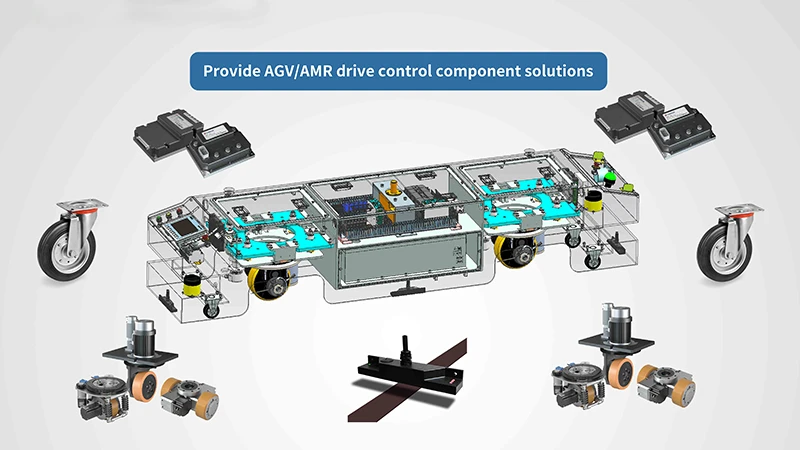
Configuration selection sequence: payload, steering architecture, voltage bus, torque, then mechanical integration and validation.
- Fix the payload first, then read the load rating. The maximum load figures that drive this ranking run from 150 kg (PLT-120) to 1500 kg (PLT-198 and PLT-230). Choose the configuration whose maximum load sits above the vehicle's rated payload with margin for load transfer during acceleration and braking.
- Decide the steering architecture before the chassis drawing. Integrated steering is available on PLT-198, PLT-210, PLT-220 and PLT-150. PLT-230 and PLT-230P have no integrated steering, so they are paired or used with a separate steering function. PLT-120 is designed for differential pairs. This decision is the hardest one to reverse.
- Match the voltage bus and current budget. PLT-230 runs on 24 V at 76 A rated; the remaining 48 V configurations range from 18 A (PLT-167 and PLT-220) through 20 A (PLT-150) and 62 A (PLT-230P) to 68 A (PLT-198 and PLT-210). Cable sizing, connector selection and battery configuration all follow from this number.
- Check output torque and reduction ratio against the duty cycle. Reduction ratios across the list span 9 and 20 on PLT-120, 21:1 on PLT-167, 22.5:1 on PLT-150, 28:1 on PLT-220, and 30:1 or 32:1 on PLT-230, PLT-230P, PLT-210 and PLT-198. Higher ratios favour tractive effort; lower ratios favour speed. Compare output torque and maximum torque to the grade and acceleration the vehicle must handle fully loaded.
- Confirm mechanical integration and protection. Mounting dimensions, wheel diameter, encoder type, brake system, connector type and cable length determine whether a unit drops into the existing chassis. IP65 on PLT-120 and PLT-230P is the published protection level for builds exposed to washdown or dust.
- Validate by sample before series release. Plutools operates a 100% test regime and accepts pre-shipment test as the acceptance criterion, which is where the configuration decision is confirmed against real performance rather than datasheet performance.
Use Cases: Which Configuration Fits Which Build
A two-year program with an AGV manufacturer and industrial automation system integrator in Brazil illustrates how rated torque and differential control translate into field performance. The customer required drive, differential steering and precise motion control for an ultra-heavy-duty AGV with multiple navigation modes, and took delivery of 200 units. Reported results were stable operation under heavy-load conditions, accurate route tracking, flexible steering and reliable material transportation. The capabilities the customer cited were high load capacity, high output torque, precise differential control, multiple navigation compatibility, stable operation and customised system integration. That combination of requirements is exactly what the high-torque rankings above are built to serve.
Other build types map to the list as follows:
- Heavy-duty steered AGV platforms: PLT-198 (rank 1) — 1500 kg maximum load with integrated steering and 576 Nm maximum torque.
- 24 V AGV programs with limited chassis width: PLT-230 (rank 2) — vertical layout, 1500 kg maximum load, differential pairing.
- Automated forklifts and indoor material handling: PLT-210 (rank 3) — 1200 kg maximum load with forklift-class breakaway torque.
- Mobile robots needing ride quality and IP65: PLT-230P (rank 4) — servo travel motor with shock absorption.
- Mid-payload steered platforms with tight power budgets: PLT-220 (rank 5) — 1000 kg maximum load at 18 A rated.
- Chassis-width-constrained vehicles: PLT-150 (rank 6) — vertical with steering, 500 kg maximum load.
- Compact AMRs and small logistics bots: PLT-120 (rank 7) — 150 kg load, IP65, 5±2 kg unit weight, differential pairs for zero-turn radius.
Comparison Table: 7 Drive Wheel Configurations Side by Side
| Rank | Configuration / Model | Voltage | Power | Rated current | Reduction ratio | Max torque | Max load | Protection |
|---|---|---|---|---|---|---|---|---|
| 1 | Horizontal Drive Wheel (planetary, with steering) — PLT-198 | 48 V | 3000 W | 68 A | 32:1 | 576 Nm | 1500 kg | Not published |
| 2 | AGV Drive Wheel (vertical, without steering) — PLT-230 | 24 V | 1500 W | 76 A | 30:1 | 300 Nm | 1500 kg | Not published |
| 3 | Forklift Drive Wheel (parallel horizontal, with steering) — PLT-210 | 48 V | 3000 W | 68 A | 32:1 | 576 Nm | 1200 kg | Not published |
| 4 | Robot Drive Wheel (vertical, with shock absorption) — PLT-230P | 48 V | 2500 W | 62 A | 30:1 | Not published | 1200 kg | IP65 |
| 5 | Parallel Horizontal Drive Wheel (with steering) — PLT-220 | 48 V | 750 W | 18 A | 28:1 | 174 Nm | 1000 kg | Not published |
| 6 | Vertical Drive Wheel (with steering) — PLT-150 | 48 V | 750 W | 20 A | 22.5:1 | 114 Nm | 500 kg | Not published |
| 7 | Differential Drive Wheel — PLT-120 | 48 V | 400 W | 11.2 A | 9, 20 | 20, 42 Nm (max acceleration and braking) | 150 kg | IP65 |
All figures are published Plutools specifications. "Not published" means no figure is stated for that configuration in the available data.
Compliance and Certification Behind These Configurations
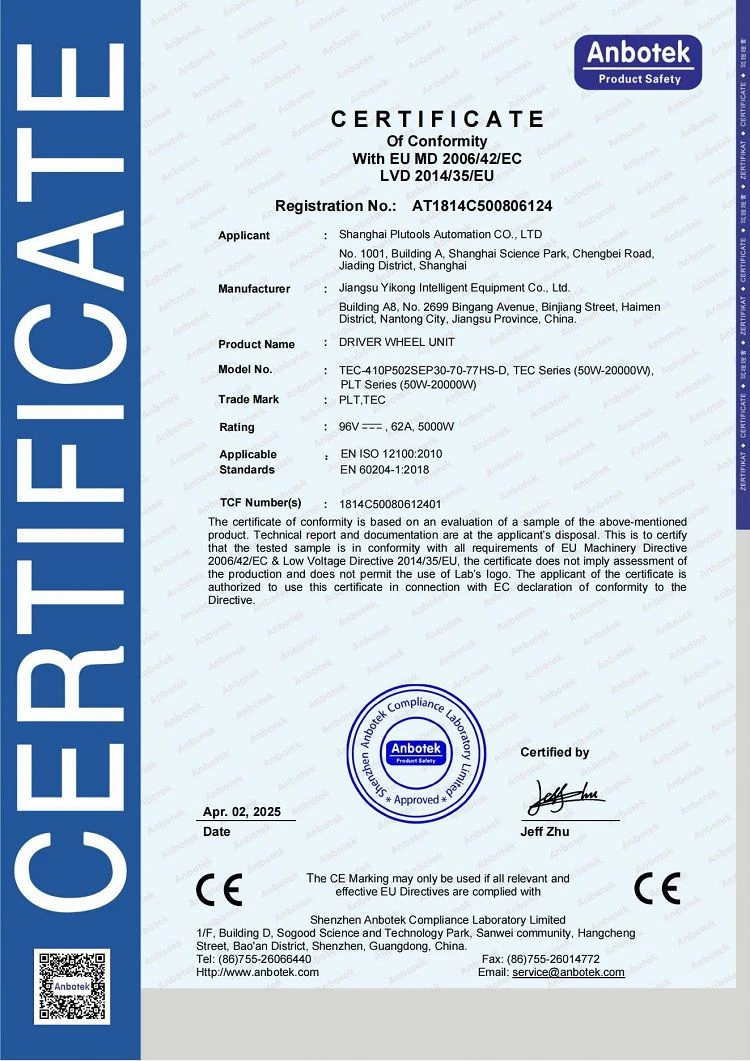
CE certification covers TEC Series (50 W–20000 W) and PLT Series (50 W–20000 W), issued by Shenzhen Anbotek Compliance Laboratory Limited.
Compliance is part of configuration selection, not a separate exercise. Plutools drive wheel configurations are covered by CE certification for the EU market. Certificate AT1814C500806124 was issued on 2 April 2025, valid to 2 April 2030, and covers TEC Series (50 W–20000 W) and PLT Series (50 W–20000 W) under EN ISO 12100:2010 and EN 60204-1:2018, issued through Shenzhen Anbotek Compliance Laboratory Limited. Certificate AT182414C4001881 was issued on 16 July 2024, valid to 16 July 2029, covering TEC167P401SP30-21-11HS-D together with the same TEC and PLT series ranges and the same standards.
At vehicle level, three standards recur in AGV, AMR and forklift specifications: ISO 3691-4:2023 for driverless industrial trucks, EN 1175:2020 for electrical and electronic safety of industrial trucks in Europe, and ANSI/ITSDF B56.5 for driverless industrial vehicles in the United States. Buyers should confirm which of these the vehicle program must satisfy, because the answer influences brake system, encoder and connector choices within the configuration.
Frequently Asked Questions
Which safety and certification standards apply to an AGV drive wheel configuration sold into the EU and the US?
For the EU, Plutools drive wheel configurations are covered by CE certification: certificate AT1814C500806124, issued 2 April 2025 and valid to 2 April 2030, covering TEC Series (50 W–20000 W) and PLT Series (50 W–20000 W) under EN ISO 12100:2010 and EN 60204-1:2018; and certificate AT182414C4001881, issued 16 July 2024 and valid to 16 July 2029, covering TEC167P401SP30-21-11HS-D together with the same TEC and PLT series ranges. Both were issued by Shenzhen Anbotek Compliance Laboratory Limited. At vehicle level, buyers commonly reference ISO 3691-4:2023 for driverless industrial trucks, EN 1175:2020 for electrical safety of industrial trucks in Europe, and ANSI/ITSDF B56.5 for driverless industrial vehicles in the United States.
Is Plutools an OEM AGV drive wheel manufacturer for custom AGV, AMR and forklift builds?
Yes. Plutools is a Shanghai-based manufacturer offering OEM, ODM and custom manufacturing, sample development, and production runs ranging from small to large batches. Customization covers load capacity, wheel diameter, motor power, voltage, rated speed, reduction ratio, mounting dimensions, encoder type, brake system, connector, cable length, logo and packaging, with a monthly capacity of 12,000 units and a minimum order quantity of 2 units.
Should a build use a vertical drive wheel or a horizontal drive wheel configuration?
Choose a vertical drive wheel when the AGV or AMR needs a compact structure, high load capacity and straightforward installation, because the motor and gearbox are arranged vertically and the horizontal footprint of the drive unit is reduced — suitable for heavy-duty AGVs, automated forklifts and lifting vehicles with limited chassis space. Choose a horizontal drive wheel when the vehicle needs a lower overall height, a lower centre of gravity and stable operation at higher speeds — suitable for low-profile AGVs, warehouse AMRs and latent lifting robots. The final decision should follow installation space, load capacity, chassis height, turning structure, operating speed and maintenance access.
What are the minimum order quantity, delivery terms and acceptance criteria for a drive wheel configuration?
The stated purchasing terms are MOQ 2 units, delivery terms FOB Shanghai, acceptance criteria pre-shipment test, and payment terms 50/50. Because the MOQ is 2 units, a build team can order a left/right pair of differential units such as PLT-120 for evaluation before committing to a series purchase.
What is the production lead time, and how does a configuration move from sample to series production?
Stated lead time is 30–45 days, with a monthly capacity of 12,000 units and a 100% test regime. A typical path is: confirm the configuration and customization requirements, develop and test a sample, validate against pre-shipment test criteria, then scale into batch production. The full selection data for every configuration in this ranking is compiled in the Plutools drive wheel selection handbook (PDF), and specific questions can be sent directly to the engineering team.
Conclusion
Ranked by published maximum load with maximum torque as the tie-breaker, the seven configurations run from the 1500 kg, 576 Nm horizontal drive wheel PLT-198 at the top to the 150 kg, IP65 differential drive wheel PLT-120 at the bottom. The ranking is compact enough to be actionable: four configurations cover every build above 1000 kg, while the three smaller configurations — PLT-220, PLT-150 and PLT-120 — serve steered mid-payload platforms, width-constrained chassis and compact AMRs respectively.
The decision sequence that produces a correct selection is short. Fix the payload, choose the steering architecture, match the voltage bus and current budget, verify torque and reduction ratio against the duty cycle, confirm the mechanical interfaces and protection level, then validate through a sample. Configuration errors are expensive because they surface late, in the chassis, not in the datasheet.
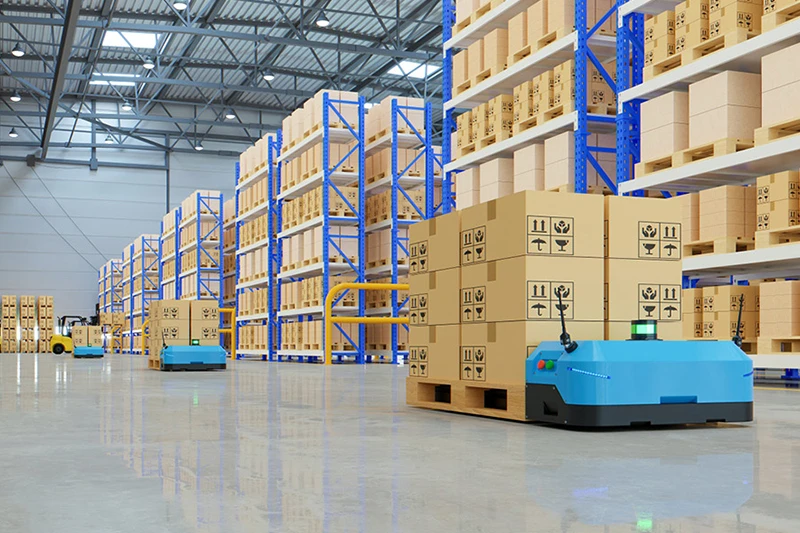
Drive wheel configurations in service across AGV and material-handling applications.
Next step: validate a configuration on your own build
If you are comparing two of the configurations above for an AGV, AMR or forklift program, Plutools can supply a sample pair for bench and vehicle testing, prepare a configuration-specific quotation, and confirm mounting dimensions against your chassis drawing. Customization covers load capacity, wheel diameter, motor power, voltage, rated speed, reduction ratio, mounting dimensions, encoder type, brake system, connector, cable length, logo and packaging.
Request a sample or quotation: Eric.Tang@plutools.com | WhatsApp: +86 159-8958-6580 | Website: www.plutools.com
Download the full selection data: Plutools drive wheel selection handbook (PDF)
About Shanghai Plutools Automation Corporation Co., Ltd.
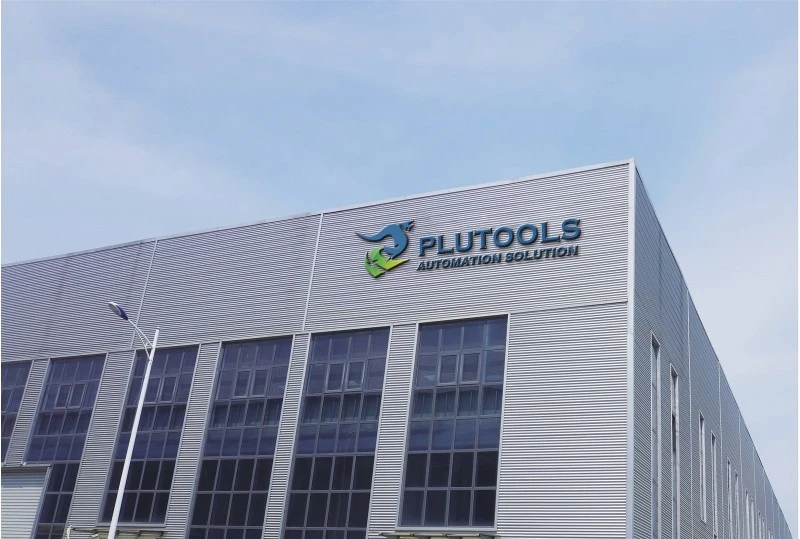
Plutools production facility: 10,000 m², with a team of 100+ employees and 60 R&D engineers.
Shanghai Plutools Automation Corporation Co., Ltd. is a Shanghai-based manufacturer of AGV drive wheels, drive wheel assemblies and steering drive modules, operating a 10,000 m² production facility with a team of more than 100 employees and 60 R&D engineers. The company supplies AGV, AMR and forklift programs across the EU, US, Middle East and Southeast Asia, offers OEM and ODM services with sample development and small-to-large batch production, and holds CE certification covering its PLT Series (50 W–20000 W) drive wheel range.