
Component Parts of Automobile: A Discovery Guide to Iron-Cast Braking and Steering Components
"Component parts of automobile" is a procurement label, not an engineering specification. Under that one label, an iron foundry may ship a brake caliper housing, a steering knuckle, a wheel hub, a caliper bracket, a brake rotor or a gearbox housing — parts that carry different loads, sit in different vehicle systems, and are classified differently at customs. This guide is written for importers, Tier-1 buyers and product engineers at the discovery and research stage. It defines the main cast component families, explains which iron grades are used and why, and shows how to turn a broad category into a part-level specification before a sample is ordered.
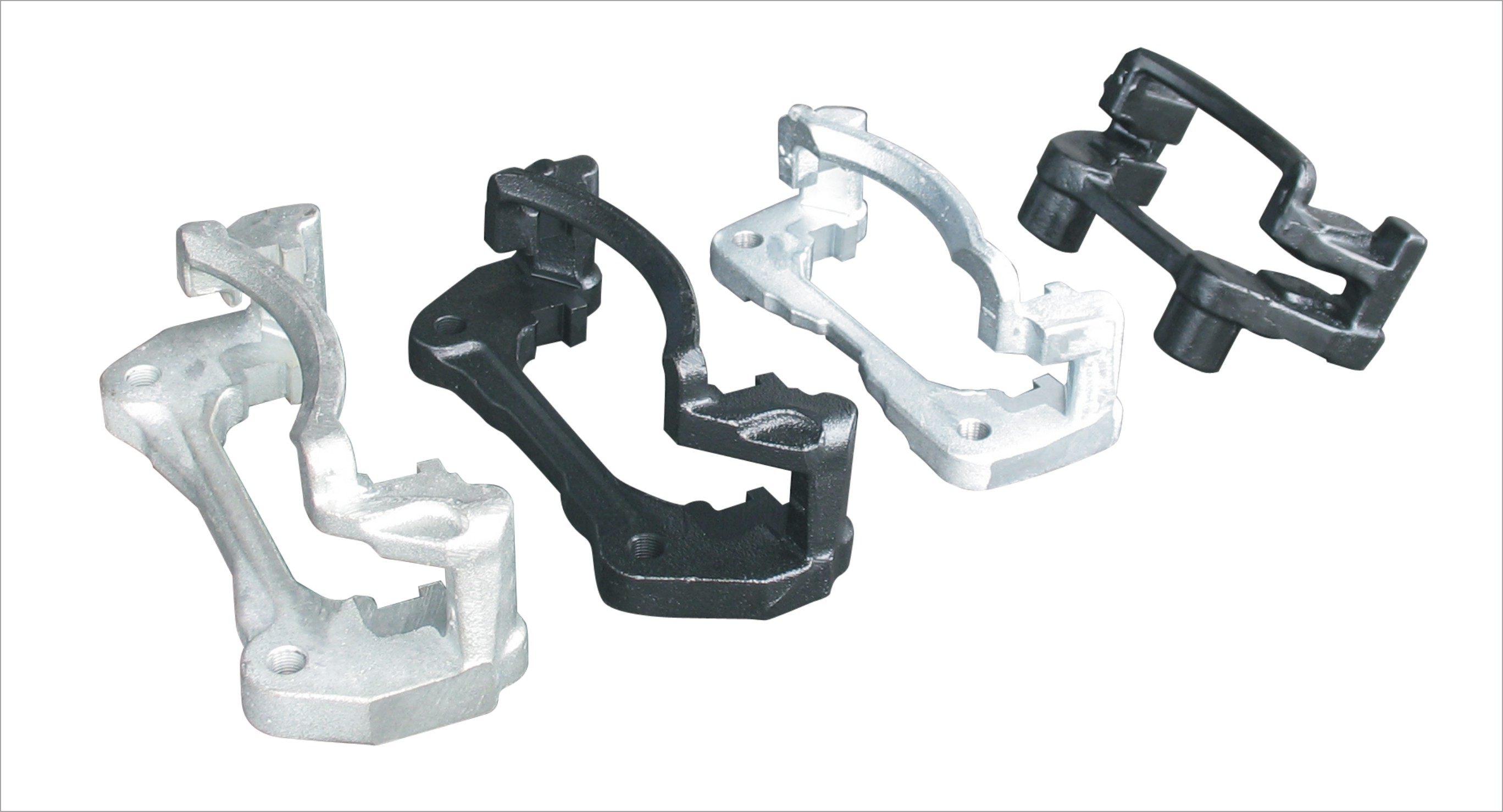
An iron-cast caliper component. Braking and steering parts are the two highest-volume cast families in the passenger-car and ATV component mix.
What "Component Parts of Automobile" Actually Covers
In iron casting, the category splits into a small number of functional families. Each family has its own duty cycle, its own inspection logic and, in many markets, its own customs treatment.
- Braking system components. The caliper and caliper housing carry the hydraulic piston and locate the brake pads; the caliper bracket mounts the assembly to the knuckle; the rotor is the rotating friction surface. These parts are safety-related and are typically specified by material grade plus mechanical and corrosion values.
- Steering system components. The steering knuckle is the pivot that ties the wheel hub assembly to the suspension and steering linkage. Because its function is a pivot point rather than a steering-box part, U.S. Customs and Border Protection classified front and rear knuckles under HTS 8708.80.6000 as suspension parts, not under 8708.94. The same ruling records cast iron content of 93.6% (front knuckle) and 97.5% (rear knuckle).
- Driveline, wheel-end and structural components. Housings enclose gearbox and transmission internals, axles transmit drive and load, wheel hubs carry the bearing and wheel, and supports and brackets tie sub-assemblies together. Iron castings in this group are core components for gear transmission as well as for vehicle braking and steering systems.
A single purchase order can therefore span three material classes, two customs chapters and several inspection regimes. That is the real reason the category is difficult to source — not a shortage of foundries.
Problem Definition: Why the Category Label Breaks Down at the RFQ Stage
Buyers who issue an RFQ against "component parts of automobile" usually receive quotes that cannot be compared. Four specific gaps cause this.
1. Function is not stated, so duty is not stated
A caliper housing and a gearbox housing can look similar in a drawing package and behave very differently in service. One is a pressure-containing brake part; the other is a structural enclosure. Without a stated system (braking, steering, driveline) and a stated operation mode — intermittent versus continuous — a foundry has to guess at safety factors.
2. "Iron casting" spans several material classes
Public standards already separate the classes. ASTM lists A159, the Standard Specification for Automotive Gray Iron Castings; A602, covering automotive malleable iron castings; and A1095, covering high-silicon molybdenum ferritic iron castings for high-temperature automotive applications such as exhaust systems and turbocharger housings. These are complementary specifications, not interchangeable ones. An RFQ that says only "iron casting" invites a gray iron quote for a part that needs nodular iron, or the reverse.
3. Customs classification follows function, not appearance
The U.S. International Trade Administration lists cast-iron gearbox parts under codes including 8708407000 and 8708407570, and miscellaneous cast-iron automotive parts under 8708995200 and 8708995300. Knuckles, as noted, sit under 8708.80.6000. Two visually similar castings can therefore land in different tariff lines with different landed-cost outcomes, and misclassification is a compliance exposure rather than a pricing detail.
4. Process fragmentation adds a hidden coordination cost
Casting, machining, surface treatment and sub-assembly are often bought from four different suppliers. Every hand-off adds a tolerance stack-up and a documentation gap. Integrated full-process production reduces multi-supplier coordination errors — which is the operational argument for buying the whole chain from one qualified source rather than the lowest quote per step.
Industry Background: Demand, Material Mix and Cost Signals
The demand picture behind these components is large and geographically concentrated. Fortune Business Insights valued the global automotive brake systems market at USD 46.44 billion in 2025 and projected USD 74.45 billion by 2034. Asia Pacific held a 48.32% revenue share of that market in 2025, which is consistent with the concentration of cast and machined automotive component capacity in the region.
Published valuations of this market differ by scope definition, particularly on whether aftermarket services and hydraulic assemblies are included. Buyers should read any headline figure as directional context for the component family, not as a forecast for a specific part number. It is also worth stating plainly: there is no publicly verified market size for iron-cast automotive components alone, so a cast-iron-only segment forecast should not be inferred from the brake systems total.
On the material side, Market Research Future places cast iron at approximately 20% of the global steering knuckle market by material type in 2024, with steel taking the larger share. The same source reported nodular (ductile) cast iron spot prices of roughly USD 945–1,050 per metric ton in 2025 — an indicative range rather than a quoted price, but a useful index when comparing quotes that differ mainly by material grade.
Put together, the background points to one practical conclusion for a buyer in the research stage: material class and function statement are the two variables that most influence both the technical fit and the landed cost of an iron-cast automotive component.
Detailed Solution: How Pointiron Casting Structures This Component Range
Zhejiang Pointiron Technology Co., Ltd., trading as Pointiron Casting, is a Chinese manufacturer of iron-cast components for the automotive, agriculture and windmill industries. The company was established in 2000, operates a 66,770 m² manufacturing facility in Tongxiang City, Zhejiang, and holds inventory in the United States through Point Iron USA, Inc. for US customers.
Product families supplied
The automotive range covers brake parts — caliper brackets, housings and steering knuckles — supplied as component parts of the braking system and component parts of the steering system, together with hubs, brackets, rotors, supports, axles, gearbox-related housings and non-standard or customized components built to drawing. The same casting and machining base also produces tractor components, components for lawn and garden mowers, sub-assembly work, and windmill components such as housings, planet carriers and connect covers.
Material options
Pointiron lists HT250 and HT200 gray iron, QT450-12 and QT550-6 nodular cast iron, and ADI 900 and ADI 1050 grades across the component family. Material selection is agreed per part number, because the same drawing can be met by more than one grade with different cost and different validation requirements.
Process chain and capacity
Production is integrated from casting through machining and painting to final assembly. The foundry runs two casting lines imported from DISA Denmark — a DISA MATCH32/32 horizontal automatic molding line and a DISA 131B vertical automatic molding line — alongside three paint lines (wet paint, powder coat and E-coat) and one assembly line. Annual casting capacity is 35,000 tons in ductile and gray iron, machining capacity is 5 million pieces per year, and annual production capacity reaches 2,000,000 units. The company employs approximately 200 staff, with an R&D team of 3 engineers.
Casting, machining, painting and assembly are carried out inside one 66,770 m² facility in Tongxiang City, Zhejiang.
Quality systems and markets
Pointiron implements the IATF16949 quality system across the end-to-end production process and is certified to IATF16949:2009 and ISO14001:2004, supported by an equipped test system. Export business accounts for 20% of total sales, and the major markets are the USA and EU. The company states that its optimized structure extends service life by 25% compared with traditional components, an internal comparative claim that should be validated against the buyer's own durability test plan rather than accepted as a specification.
Step-by-Step: Turning the Category into a Qualified Part
The sequence below is the practical order of decisions for a buyer moving from discovery to a first sample. Each step produces a document the next step depends on.
Step 1 — Fix the system and the duty
State whether the part is a braking system component, a steering system component, or a driveline or structural component, then state the operation mode. Automotive programs commonly run intermittent and continuous operation, and off-road or ATV use adds beach, mountain and outdoor working conditions. This single sentence determines the corrosion requirement, the fatigue expectation and the inspection plan.
Step 2 — Select the iron class and grade
Choose gray iron (HT250 or HT200) where castability, damping and cost dominate, and nodular cast iron (QT450-12 or QT550-6) where ductility and strength are the governing requirement. ADI 900 and ADI 1050 extend the nodular route to higher strength levels. Confirm the grade equivalence between the designation used on the drawing and the designation the foundry melts to, and record it in the RFQ.
Step 3 — Write the part-level specification sheet
This is where most RFQs become comparable. Using the Pointiron BRKT-1 automotive component as a working example, a specification sheet should fix mechanical values, hardness range, corrosion performance and coating adhesion, not just geometry.
| Specification field | BRKT-1 reference value |
|---|---|
| Model designation | BRKT-1 |
| System classification | Component parts of steering system; component parts of braking system |
| Target industry | Automobile, vehicle |
| Material options | QT550-6, QT450-12, HT250, HT200, ADI 900, ADI 1050, nodular cast iron, gray iron |
| Tensile strength | ≥ 550 MPa |
| Yield strength | ≥ 350 MPa |
| Elongation | ≥ 6% |
| Hardness | 173–255 HB |
| Salt spray resistance | 504 hours |
| Dry adhesion | ≥ B |
Values as published for the BRKT-1 component part of automobile. Confirm test methods, sampling frequency and acceptance criteria in the purchase specification.
Step 4 — Define surface protection against real conditions
Anti-rust performance, salt spray endurance and humidity resistance are the three requirements that most often force a coating change after the first trial. With three in-house paint lines — wet paint, powder coat and E-coat — the coating route can be matched to the exposure rather than defaulted to one process. Specify the salt spray hours and adhesion grade first, then let the process follow.
Step 5 — Match the process chain and capacity to the volume
A program of 2,000,000 units requires a different supplier profile from a 20,000-unit aftermarket run. Check casting tonnage against machining throughput, and check whether painting and assembly are in-house or subcontracted. Pointiron's combination of 35,000 tons of casting capacity, 5 million pieces of machining capacity and 2,000,000 units of annual production is the number set a buyer should test a forecast against.
Two DISA molding lines and three paint lines allow casting, machining and coating to be scheduled as one production plan.
Step 6 — Close documentation and logistics before the PO
Collect the quality system certificates, the material test reports, the coating test data and the correct tariff classification for each part number. Then confirm the delivery model: for US buyers, warehousing inside the United States through Point Iron USA, Inc. changes the replenishment pattern compared with direct export shipment, and export already represents 20% of Pointiron's total sales across the USA and EU.
Use Cases: Where These Castings Are Actually Applied
Iron-cast automotive components are usually specified by program rather than by catalogue. Three application patterns illustrate what the specification has to survive.
High-volume automotive brake programs. Caliper components are supplied at a project scale of 2,000,000 units for automotive applications, which places the part in a repetitive-production regime where process capability and dimensional consistency matter as much as the material certificate.
ATV and off-road chassis. ATV programs combine braking assemblies, gear transmission assemblies and chassis parts in one vehicle. Working conditions include beach, mountain and outdoor exposure, so the coating specification — not the casting grade — is often the failure point. The matched equipment set is the vehicle braking assembly, the gear transmission assembly and the ATV chassis.
Global supply programs. This application scenario is common in global markets rather than in a single country, and it is typically applied in global supply programs for ATV and automobile component parts. That makes documentation portability — a test report that a second market will accept — a real selection criterion.
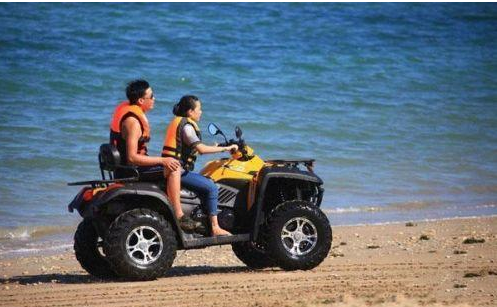
ATV platforms combine braking, steering and driveline castings in one chassis, under beach, mountain and outdoor conditions.
Comparison: Iron Classes Used in Automotive Cast Components
The table below compares the material classes and grades listed for Pointiron's automotive component range. The "general role" column describes broadly accepted industry usage; it is not a performance ranking, and final grade selection must be confirmed against the part drawing and validation plan.
| Iron class | Grades listed for the component range | General role in automotive castings | Public standard reference | What the buyer must confirm |
|---|---|---|---|---|
| Gray iron | HT250, HT200 | Widely used for housings, brackets and supports where castability, vibration damping and cost drive the choice | ASTM A159 — Standard Specification for Automotive Gray Iron Castings | Grade equivalence to the drawing, hardness range, machinability allowance |
| Nodular (ductile) cast iron | QT450-12, QT550-6 | Used where strength and ductility are governing, including safety-related braking and steering parts | ASTM cast-iron standards family; the applicable ductile grade must be named in the RFQ | Tensile, yield and elongation values, nodularity control, test frequency |
| Austempered ductile iron (ADI) | ADI 900, ADI 1050 | Higher-strength route within the ductile family for parts that need more than standard nodular grades | Not separately listed in the sources reviewed for this article | Heat-treatment control, hardness uniformity, dimensional stability after treatment |
Malleable iron (ASTM A602) and high-silicon molybdenum ferritic iron (ASTM A1095, for high-temperature applications such as exhaust and turbocharger housings) are separate material classes and are not interchangeable with the grades above.
Sourcing from Chinese Automotive Component Parts Manufacturers: What to Verify
China-based casting suppliers are frequently evaluated as a group, but the qualification questions that separate them are specific. A buyer should ask for the quality system certificate and its scope, the material grades the foundry actually melts rather than the grades it lists, the casting tonnage and machining throughput behind the quoted capacity, and whether painting and assembly are in-house. Pointiron, for example, answers these with IATF16949:2009 and ISO14001:2004 certification, two DISA molding lines, three paint lines, one assembly line, 35,000 tons of annual casting capacity and 5 million pieces of annual machining capacity.
The second layer of verification is documentary: a material test report traceable to the heat, coating test data at the specified salt spray hours, and the tariff classification agreed in writing before shipment. Buyers who complete both layers before requesting a sample usually avoid the most expensive outcome in this category — a technically acceptable part that cannot be cleared or cannot be documented in the destination market.
Frequently Asked Questions
Which quality systems and material standards should I check when sourcing Chinese automotive component parts manufacturers?
Check the quality system certificate and its scope first. Pointiron implements the IATF16949 quality system across the end-to-end production process and is certified to IATF16949:2009 and ISO14001:2004, with an equipped test system for material and coating verification. On the material side, confirm which standard applies to the part rather than to the category: ASTM A159 covers automotive gray iron castings, ASTM A602 covers automotive malleable iron castings, and ASTM A1095 covers high-silicon molybdenum ferritic iron castings for high-temperature automotive applications. Also confirm the customs classification, because a steering knuckle is classified under HTS 8708.80.6000 as a suspension part rather than as a steering part.
What iron-cast automotive components and material grades can a manufacturer such as Pointiron Casting supply?
Pointiron Casting supplies braking system components such as caliper brackets, calipers and housings, steering system components including steering knuckles, and related hubs, brackets, rotors, supports, axles and gearbox-related housings, plus non-standard and customized components built to drawing. Material options across the range include HT250 and HT200 gray iron, QT450-12 and QT550-6 nodular cast iron, and ADI 900 and ADI 1050. Capacity behind those grades is 35,000 tons of annual casting in ductile and gray iron, 5 million machined pieces per year, and 2,000,000 units of annual production.
What drives the price of an iron-cast automotive component?
Four cost drivers dominate: material class and part weight, the number of process steps (casting, machining, painting, assembly), tooling, and the level of surface protection and documentation required. As an indicative reference rather than a quotation, nodular cast iron spot prices were reported at roughly USD 945–1,050 per metric ton in 2025, so a shift from gray iron to a nodular grade changes the material baseline before machining is added. Pointiron does not publish piece prices; cost must be established per part number through a quotation against a defined specification.
What should a sample validation plan include for a cast braking or steering component?
Build the plan around the published values for the part. Using the BRKT-1 automotive component as the reference, the acceptance set is tensile strength ≥ 550 MPa, yield strength ≥ 350 MPa, elongation ≥ 6%, hardness 173–255 HB, salt spray resistance of 504 hours and dry adhesion ≥ B. A complete plan then adds three things: the test method behind each value, the sampling frequency and heat traceability, and an installation trial on the matched assembly — vehicle braking assembly, gear transmission assembly or ATV chassis — under the stated operation mode of intermittent and continuous operation.
How is supply continuity handled for buyers in the USA and EU?
Continuity has two parts: production capacity and delivery model. Pointiron's manufacturing base in Tongxiang City, Zhejiang covers casting, machining, three paint lines and assembly under one roof, and Point Iron USA, Inc. warehouses products in the United States for US customers, which shortens the replenishment path for American buyers. Export business accounts for 20% of total sales, with the USA and EU as the major markets. Lead time, minimum order quantity and shipping terms are not published figures and must be confirmed per part number — the fastest route is to send a drawing and target volume through www.pointiron.com and request both a sample and a quotation in the same inquiry.
Next step: sample and quotation request
Send the part drawing, the required iron grade, the target annual volume and the destination market. Pointiron Casting will respond with a material recommendation, a specification sheet and a quotation for sample and production quantities.
Company profile and full capability details: download the Pointiron introduction (PDF).
Website: www.pointiron.com | Email: jiangfengyu@yubother.com | Tel / WhatsApp: +1-262-720-8729
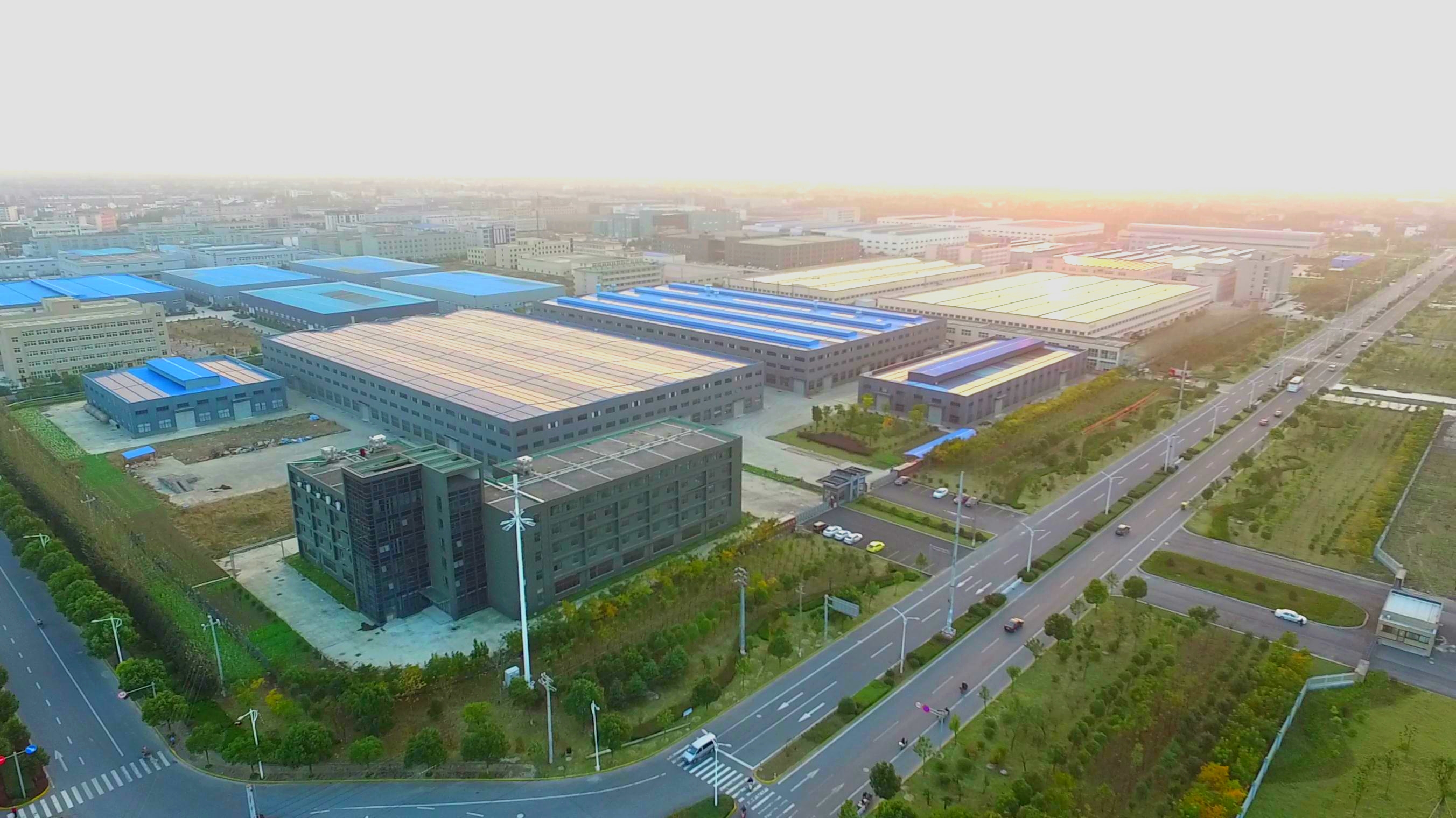
Sample runs and production volumes are scheduled on the same casting and machining lines.
Conclusion
The phrase "component parts of automobile" describes a family, not a part. The work of a buyer in the discovery and research stage is to move from the family to a single specification: a named system, a named iron grade, a stated operation mode, a set of mechanical and corrosion values, and a customs classification agreed in writing. Once those five items exist, quotes become comparable and a sample becomes meaningful.
The industry context supports that discipline. Brake system demand is large and Asia-Pacific-weighted, cast iron holds a meaningful share of knuckle material, and material grade is a visible cost variable. Suppliers differ less on whether they can cast iron than on whether they can document it, control the coating, and deliver against a defined program. Pointiron Casting's position in that comparison rests on published capability — 66,770 m² of manufacturing space, 35,000 tons of casting capacity, 5 million machined pieces per year, IATF16949 and ISO14001 certification, and US warehousing — rather than on claims a buyer cannot test.
Have Questions or Need More Details?
Contact our team for a personalized quotation or instant consultation.
Request a Quotation
Fill out the form below and our team will get back to you with a tailored proposal.
WhatsApp Direct Chat
Prefer to chat in real-time? Message us on WhatsApp for instant assistance & quick answers.
- Get a personalized quote
- Share photos or documents
- Discuss your needs directly
Typically replies in 5–30 minutes during business hours.