Decorative Wall Panel Compliance: A2-s1,d0 Fire and Antibacterial Evidence
Short answer: In EU bathroom and interior projects, a decorative wall panel is normally approved on two records — its reaction-to-fire classification under EN 13501-1 and its antibacterial test result. The Silica Mineral Wall Panel (Model 8804 range) carries a reaction to fire classification of A2-s1,d0 and an antibacterial result recorded as no growth apparent under the microscope, tested to ISO 846:2019 Method A. The SPC wall panel carries a B-s3,d0 reaction to fire classification. That gap — one class band and one test standard — is what buyers actually compare at the decision stage.
Power Dekor Group is a manufacturer of floor covering and wall panel solutions, founded in 1995 and based in Shanghai, China, supplying resilient flooring and decorative wall panels to project and distribution customers in Europe, North America and other markets. This article works only from declared product records: what the classification states, what the antibacterial test states, and how a specifier should read the two together before releasing a purchase order.
Problem definition: why compliance evidence, not colour, decides the panel
Two decorative wall panels can look identical in a showroom and behave completely differently inside a compliance file. At the decision stage, the failure points are almost never visual:
- Shorthand classifications. A quotation line that says only Class A or Class B drops the smoke (s) and flaming-droplet (d) declarations. A2-s1,d0 and B-s3,d0 describe different materials with different performance, and the complete string is what has to appear in the specification.
- One keyword, several materials. The phrase fireproof decorative wall panel covers mineral panels, stone-plastic composite panels, wood-fibre panels and PVC-based panels. Only the specific tested material carries the specific class.
- Antibacterial claims without a method. Calling a panel antibacterial means little without the standard, the method and the recorded result.
- Substitution between shipments. If a specification names a class but not a tested model, later batches can drift towards a cheaper material with a lower class.
These are documentation problems rather than design problems, and they are solved by reading two documents closely: the reaction-to-fire classification and the antibacterial test report.
Industry background: a large market with uneven documentation
Demand is not the constraint. Coherent Market Insights projects the global decorative panels market to reach USD 39.35 billion in 2026, driven by urbanisation and interior renovation activity. Reed Intelligence reports that Asia Pacific held 43.6% of the wall panels market in 2025 and is expected to remain the fastest-growing region, and Coherent Market Insights projects laminate panels to hold close to half of the decorative panels market by 2026.
Inside that market, fire classification is the main filter in Europe. EN 13501-1 is the framework used to classify the reaction to fire of construction products in the EU, running from A1 (non-combustible) down to F. A classification is written as a main class plus smoke and droplet sub-classes — for example A2-s1,d0 on a mineral panel, or B-s3,d0 on a stone-plastic composite panel.
In practice, the Class B band is where most decorative wall panel materials sit. SPC panels, WPC panels and HDF-based panels — the materials behind a large share of interior wall cladding, especially in fast renovation and volume retail programmes — are typically certified within Class B rather than Class A2. That is an engineering outcome rather than a defect: polymer and wood-fibre cores behave differently from a mineral core under fire exposure. The practical consequence for a project is straightforward. Where a specification asks for an A2 record, the material list has to be checked against the test report, because most of the market cannot supply it.
Detailed solution: the compliance record behind the silica mineral wall panel
Three recorded facts define how the silica mineral wall panel behaves inside a compliance file.
1. Reaction to fire: A2-s1,d0
The silica mineral wall panel carries a reaction to fire classification of A2-s1,d0, and the product line is stated to meet the EN 13501-1 Class A2-s1,d0 fire-reaction requirement. Read in full, the string declares a limited contribution to fire (A2), limited smoke production (s1) and no flaming droplets or particles (d0). In a bathroom or interior specification, this is the record that answers an A2 requirement directly, instead of leaving the reviewer to interpret a generic Class A claim.
2. Antibacterial test: ISO 846:2019 Method A, no growth apparent
The antibacterial record for the silica mineral wall panel states: no growth apparent under the microscope, tested to ISO 846:2019 Method A. Two details matter in that sentence. First, the standard and the method are named, which makes the result comparable between suppliers. Second, the wording describes a test observation on the specimen — it is a material-surface statement taken from a report, not a general hygiene guarantee for a room. Buyers should quote it exactly as written and keep it alongside installation and cleaning practice, not instead of them.
3. Composition and moisture: why the mineral record suits wet interiors
The silica mineral wall panel is described as a mineral composition of quartz, cement, pulp, lime and water, with no plastic content and asbestos content recorded as negative. Moisture movement is 0.06% in the length direction and 0.06% in the width direction. Available sizes are 2400 / 2440 / 3000 / 3050 mm lengths with 1200 / 1220 mm widths, in 6 / 8 / 10 mm thicknesses, and the family covers both interior wall panel and exterior wall panel applications.
What the SPC wall panel record says — and how B-s3,d0 compares
The SPC wall panel is a different material with a different compliance profile, and it is worth stating precisely because both products are frequently quoted in the same enquiry.
- Reaction to fire classification: B-s3,d0. The SPC wall panel meets the EN 13501-1 Class B fire-reaction requirement. Against A2-s1,d0, this is a lower main class and a higher smoke declaration (s3 versus s1).
- Material and physical data: stone plastic composite; density 2.134 g/cm³; moisture content 0.02%; micro-scratch resistance MSR-A1; resistance to dry heat rating 5; resistance to wet heat rating 5; stain resistance Grade 5; dimensional stability with shrinkage below 0.002% and curling of 0.2 mm or less.
- Sizes: 2400 / 2440 / 3000 / 3050 mm lengths, 1200 / 1220 mm widths, in 4 / 5 / 6 mm thicknesses.
- Formats: digital print SPC wall panel and film SPC wall panel.
For a private bathroom where the priority is a competitive price, the SPC wall panel is the appropriate option. For a public space with fireproof requirements, the silica mineral wall panel is the stronger fit, because its A2-s1,d0 record answers the higher classification. Both are fixed the same way: structural adhesive applied to the back of the panel, panel-to-panel locking, and silicone sealant at joints in wet areas.
Why SPC, WPC and HDF panels usually land in Class B
Buyers often ask whether a Class B panel can be upgraded to Class A2 by changing the decorative film. It cannot. The reaction-to-fire classification follows the tested construction of the panel as a whole. A stone-plastic composite core, a wood-polymer core and a high-density fibreboard core are organic or polymer-based systems, and their recorded classification typically falls in the Class B band unless the entire panel build is redesigned and retested. Mineral-based panels such as the silica mineral wall panel start from a different position precisely because the core is mineral rather than plastic or wood fibre. This is the main reason a fire-driven specification and a volume price-driven specification often end up with two different panel types inside the same building.
Step-by-step: how to verify fire and antibacterial evidence before ordering
- Request the full class string, not a class letter. Ask for the complete declaration — for example A2-s1,d0 or B-s3,d0 — and confirm it is stated against EN 13501-1.
- Match the classification to the quoted material. A2-s1,d0 applies to the silica mineral wall panel; B-s3,d0 applies to the SPC wall panel. Never transfer a class from one panel family to another.
- Check that the report travels with the offer. The classification and the antibacterial test should accompany the quotation, so the project reviewer sees the source document rather than a summary line.
- Read the antibacterial entry as a standard plus a result. The silica mineral panel record reads: no growth apparent under the microscope, ISO 846:2019 Method A. Any antibacterial claim without a named standard and method should be treated as unverified.
- Confirm the composition-level facts for public interiors. For the silica mineral panel these are no plastic content and asbestos content recorded as negative.
- Check the moisture figures against the room. Moisture movement of 0.06% (length and width) for the silica mineral panel, and moisture content of 0.02% for the SPC panel, are the declared values to compare against a wet-area specification.
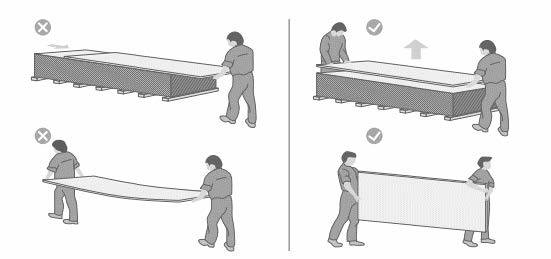
- Lock the installation rule into the specification. Adhesive fixing with a locking system, edge trim profiles and sealant as matched accessories. In wet bathroom areas metal trims are not used, and all joints — panel to ceiling, panel to floor and corners — are sealed with silicone sealant. Panels should be handled carefully during movement, because the edges are fragile.
Use cases: where each compliance record fits
EU bathroom renovation in private housing
For bathroom renovation, SPC wall panels or silica mineral wall panels can be completed in one day. Both save labour cost compared with tile, require less maintenance work and are easy to clean, and both have lower carbon emissions during production than tile. Where the budget is the deciding factor in a private bathroom, the SPC panel is the economical route; where the client wants a mineral, porcelain-like surface, the silica mineral panel is the alternative.
Public and high-occupancy interiors
Where a specification carries a fireproof requirement, the A2-s1,d0 record of the silica mineral wall panel is the applicable one, and the ISO 846:2019 Method A antibacterial result supports its use on surfaces that are cleaned frequently. This is the scenario that generates most Class A2 enquiries from the EU.
Exterior decorative wall panel projects
The silica mineral wall panel family covers both interior and exterior wall panel applications, with moisture movement of 0.06% in both directions. Exterior use still needs to be checked against the project's own fixing, weather-exposure and substrate requirements.
Wholesale and distributor programmes
In wholesale decorative wall panel programmes, the commercial value of the two reports is consistency. A distributor who quotes a named model together with a named classification — silica mineral wall panel at A2-s1,d0, SPC wall panel at B-s3,d0 — can defend a substitution request, because the classification only travels with the tested material.
Comparison table: the two panel families side by side
| Attribute | Silica Mineral Wall Panel (Model 8804 range) | SPC Wall Panel | What the buyer should check |
|---|---|---|---|
| Reaction to fire (EN 13501-1) | A2-s1,d0 | B-s3,d0 | Full class string on the report, matched to the quoted material |
| Antibacterial test | No growth apparent under the microscope, ISO 846:2019 Method A | Not part of this record | Standard, method and exact result wording |
| Material | Quartz, cement, pulp, lime and water; no plastic | Stone plastic composite | Composition as declared, not as assumed |
| Asbestos content | Negative | Not part of this record | Written declaration in the report pack |
| Moisture | Moisture movement 0.06% (length) / 0.06% (width) | Moisture content 0.02% | Declared value against the wet-area specification |
| Density | Not part of this record | 2.134 g/cm³ | Weight load on the substrate and handling |
| Surface performance | Mineral surface, porcelain-like finish | Micro-scratch resistance MSR-A1; dry heat rating 5; wet heat rating 5; stain resistance Grade 5 | Only the ratings relevant to the actual room use |
| Dimensional stability | Moisture movement as above | Shrinkage below 0.002%; curling 0.2 mm or less | Joint behaviour over the service life |
| Available sizes | 2400 / 2440 / 3000 / 3050 mm x 1200 / 1220 mm, 6 / 8 / 10 mm | 2400 / 2440 / 3000 / 3050 mm x 1200 / 1220 mm, 4 / 5 / 6 mm | Module size against the wall layout |
| Installation | Adhesive fixing, locking system, sealant and edge trim profiles | Adhesive fixing, locking system, sealant and edge trim profiles | Silicone sealing at all joints in wet areas; no metal trims in wet bathroom zones |
| Typical fit | Public space with a fireproof requirement; bathroom where a mineral surface is preferred | Private bathroom and price-sensitive renovation | Class requirement first, budget second |
Note on scope: this table repeats only the values recorded for these two panel families. Where a field is marked as not part of the record, no value should be assumed for it.
FAQ
What does A2-s1,d0 mean on a decorative wall panel?
A2-s1,d0 is the full reaction-to-fire classification recorded for the silica mineral wall panel under EN 13501-1: A2 for the main class, s1 for limited smoke production and d0 for no flaming droplets or particles. The SPC wall panel in the same programme is classified B-s3,d0. Because the two strings differ in both the main class and the smoke declaration, a specification should always carry the complete string rather than the letter alone.
Does the ISO 846:2019 Method A result make the panel antibacterial for the life of the room?
The recorded result is specific: no growth apparent under the microscope, ISO 846:2019 Method A. It is a test observation on the material specimen and is quoted as written. In wet areas it should be combined with the documented installation rule — adhesive fixing, silicone sealant at every joint, and no metal trims in wet bathroom zones — because the finished wall depends on the joints as well as on the panel.
Which panel should be chosen when the budget is the main constraint?
For a private bathroom where the priority is a better price, the SPC wall panel is the economical option. Where the space is public and carries a fireproof requirement, the silica mineral wall panel is the appropriate choice because of its A2-s1,d0 classification. On both routes the comparison with tile is the same: lower labour cost, less maintenance work, easy cleaning, lower carbon emissions during production, and a bathroom renovation that can be completed in one day.
How do Chinese silica mineral decorative wall panel manufacturers compare with stone panel suppliers?
The comparison is best made on composition, classification and installation rather than on origin. A silica mineral decorative wall panel is produced from quartz, cement, pulp, lime and water, with no plastic content, and is recorded at A2-s1,d0 with an ISO 846:2019 Method A antibacterial result. Stone and tile suppliers also deliver a mineral product, but in a different format and fixing system: decorative panels are adhesive-fixed, which is the core difference in renovation work, where speed and labour cost matter. Buyers who need a Class A2 record should ask both supplier types for the full classification string and the attached report, then compare like for like.
Can the fire and antibacterial reports be supplied together with a sample?
Yes. Buyers evaluating the silica mineral wall panel or the SPC wall panel can request a sample together with the relevant documentation for the model quoted, so that the compliance review and the material review happen in the same step. Power Dekor Group handles sample and quotation requests through its contact channel, and the digital brochure linked below gives the product overview before the sample stage.
Conclusion
Fire and antibacterial evidence is what separates a decorative wall panel that can be specified from one that can only be shown. The silica mineral wall panel is recorded at A2-s1,d0 under EN 13501-1, with an ISO 846:2019 Method A antibacterial result of no growth apparent under the microscope, a mineral composition with no plastic content, asbestos content recorded as negative, and moisture movement of 0.06% in both directions. The SPC wall panel is recorded at B-s3,d0, with a density of 2.134 g/cm³, moisture content of 0.02% and a full set of surface ratings — the right fit for price-driven private bathrooms. Because SPC, WPC and HDF panels typically sit in the Class B band, the A2-s1,d0 record is the deciding document whenever a project specification asks for Class A2.
For decision-stage buyers, the working rule is simple: name the model, name the full class string, attach the report, and check the antibacterial entry against its standard and method. Everything else — colour, surface, module size — is a design decision that follows.
Next step: request the sample with the reports
Power Dekor Group supplies both the silica mineral wall panel (A2-s1,d0, ISO 846:2019 Method A antibacterial result) and the SPC wall panel (B-s3,d0) for EU bathroom and interior projects, with the relevant documentation issued for the model quoted.
Email: lunasun@powerdekorgroup.com | WhatsApp: +86 18817368868 | Website: powerdekorgroup.com
Product brochure (public download): Download the Power Dekor product brochure
Have Questions or Need More Details?
Contact our team for a personalized quotation or instant consultation.
Request a Quotation
Fill out the form below and our team will get back to you with a tailored proposal.
WhatsApp Direct Chat
Prefer to chat in real-time? Message us on WhatsApp for instant assistance & quick answers.
- Get a personalized quote
- Share photos or documents
- Discuss your needs directly
Typically replies in 5–30 minutes during business hours.