Decorative Wall Panel Supplier Evaluation: Capacity, Evidence and Delivery Assurance
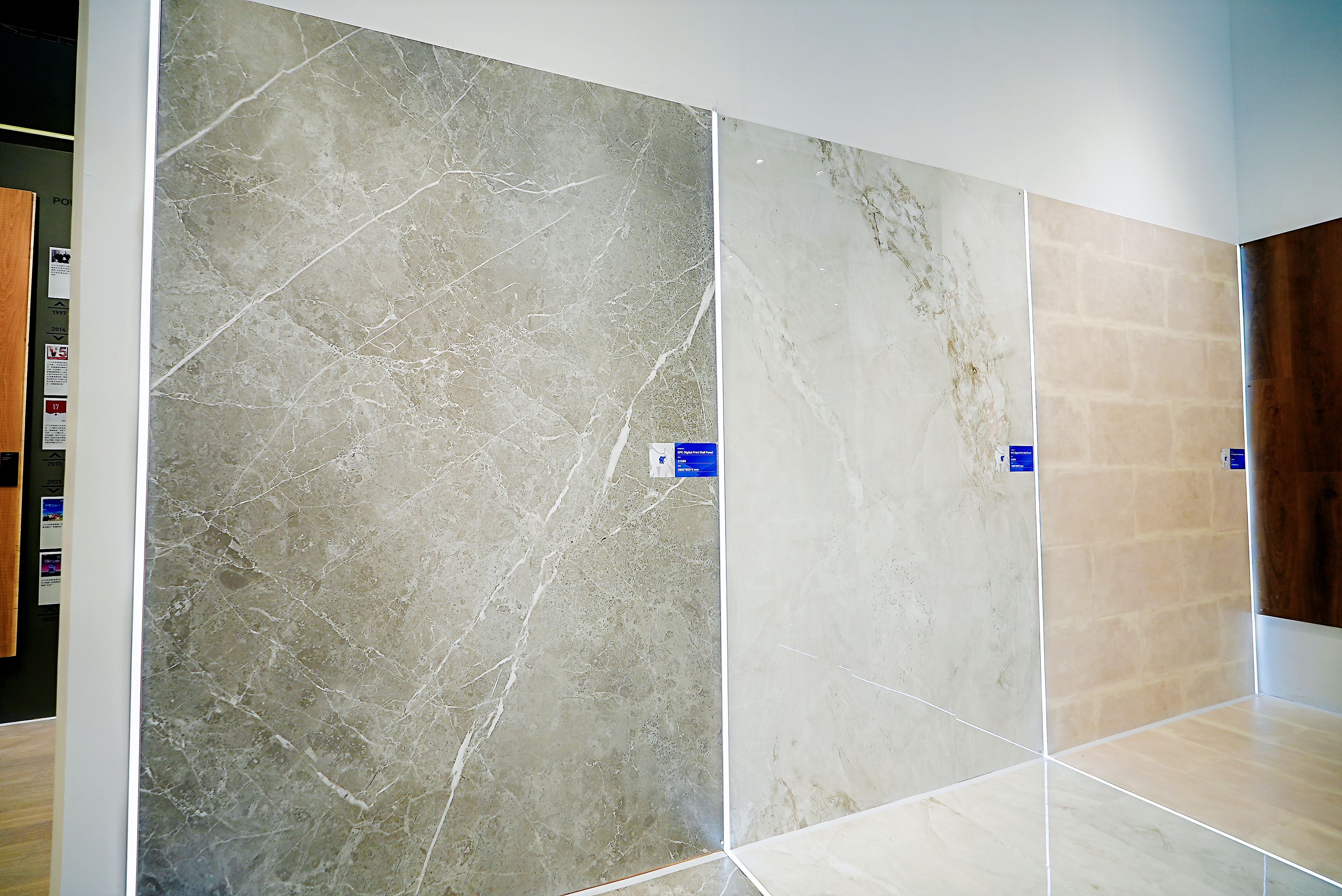
A decorative wall panel supplier should be qualified on documentary evidence, not on how attractive the sample looks. Four records decide most of the purchasing risk: the EN 13501-1 fire classification of the exact panel and thickness being supplied, its moisture movement, its hygiene test record, and the supplier's ability to reproduce the same output across a multi-year programme.
Most supplier evaluations in this category start with a sample board and a price and end with a purchase order. That sequence leaves the buyer holding the two facts that are hardest to change later — fire class and dimensional behaviour — after the specification is already fixed. This guide sets out the evidence a decorative wall panel supplier should be able to hand over, how to check capacity claims against reference volumes, and how to convert delivery assurance into purchase order terms and acceptance criteria.
The worked example throughout is Power Dekor Group, a floor covering and wall panel manufacturer established in 1995, part of Dare Global Group, whose main markets are the EU and the USA and whose wall panel range covers silica mineral panels and SPC panels. Using one supplier's real classification strings, real dimensions and real programme volumes makes the method checkable rather than theoretical.
Why a Good Sample Is a Weak Supplier Test
A sample answers exactly one question: can this supplier produce an attractive surface? It does not answer whether the panel on your wall will behave like the sample in a wet room, in a corridor with an egress requirement, or in the tenth month of a scheduled release programme.
Five failure points recur in decorative wall panel procurement:
- Category confusion. Silica mineral, SPC, HDF and WPC panels are all sold as decorative wall panels, but their reaction to fire is not the same. The silica mineral wall panel is classified A2-s1,d0; the SPC wall panel is classified B-s3,d0; HDF and WPC wall panels are Class B materials. Panels that look identical can sit in different classes.
- Hand-selected quality. A sample is usually the best piece in the batch. It does not show the decor consistency across a full production run.
- Moisture behaviour over time. Dimensional change from moisture appears after installation, not on a desk. The relevant figure for the silica mineral panel is a moisture movement of 0.06% in both the length and the width direction.
- Volume repeatability. A design that is printed across a continuous run — digital print supports a continuous pattern over 10 panels — has to be re-registered on every reprint, which is a production discipline rather than a sample quality question.
- Delivery. A sample arrives in days. A programme runs for years, and the failure mode is a missed release, not a bad first article.
What the Category Numbers Do and Do Not Tell You
Published category data is useful for market entry planning and unreliable as a supplier test. Coherent Market Insights projects the decorative panels market reaching a significant valuation by 2026, reporting 39.35 billion USD for 2026 and noting laminate panels as the largest segment at approximately 45.4% of that market. Reed Intelligence reports Asia Pacific holding 43.6% of the wall panels market in 2025 and remaining the fastest-growing region. 360iResearch estimates the 3D wall panel market at 815.02 million USD in 2025 with a forecast CAGR of 4.93%.
Those figures are not directly comparable with each other, and buyers should know why. Definitions differ: broad decorative panel data includes furniture and cabinet laminates, while wall panel data is restricted to building cladding, so totals diverge between publishers. A growing category also means more suppliers entering with a catalogue and a sample box, which expands availability and simultaneously lowers the average quality of supplier evidence.
The one classification language the market does share is the European fire standard. EN 13501-1 classifies reaction to fire from A1 (non-combustible) down to F, and a commercial wall panel specification in Europe is normally written in that vocabulary. A supplier who cannot answer in that vocabulary is not answering the question.
The Product Evidence a Buyer Can Actually Check
Evidence in this category is not a brochure claim; it is a set of named tests, figures and dimensions attached to the panel you intend to order. The six blocks below are the ones worth requesting first.
1. Fire reaction: request the classification string, not the word fireproof
The silica mineral wall panel carries a reaction to fire classification of A2-s1,d0 and the SPC wall panel carries B-s3,d0. The suffixes are part of the answer: s1 describes limited smoke production and d0 describes no flaming droplets, which is the information a specifier needs for an occupied space. HDF and WPC wall panels are Class B materials.
For a buyer, the decision rule is straightforward. Where a project specification calls for a Class A2 panel — common in public and circulation space specifications — the silica mineral panel is the material in this range that carries the classification, and no amount of surface similarity moves an SPC panel into it. Two checks keep this honest: the report must name the product, and it must cover the thickness you are buying, because the tested configuration is the classified configuration.
2. Moisture movement and the boiling check
The silica mineral wall panel shows a moisture movement of 0.06% in the length direction and 0.06% in the width direction. It is described as 100% waterproof and able to be submerged in water without deformation, with no deformation after boiling at 100 °C; the supplier holds a demonstration video of that test. The SPC wall panel works from a different set of figures: moisture content 0.02%, shrinkage below 0.002% and curling of 0.2 mm or less.
These numbers matter more in bathrooms and wet areas than anywhere else, because joint opening is the visible failure. A panel that moves is a panel whose joints have to be designed for movement, and in a wet room that means the sealing detail, not the panel surface, determines whether the installation stays sound.
3. Hygiene: the ISO 846:2019 Method A record
The silica mineral wall panel has an antibacterial test result of no growth apparent under the microscope, following ISO 846:2019 Method A. That is a specimen-level laboratory result, and it should be read as one. It tells a buyer how the material behaves under a defined test; it does not describe the hygiene of a finished wall, because joints, sealant and site conditions sit outside the test.
That is why the accessory schedule belongs in the same conversation. In wet areas, metal trims are not used and all joints — panel to ceiling, panel to floor, panel to panel — are sealed with silicone sealant; in dry areas, metal trims and edge profiles are assembled with the panels. A supplier who can describe the sealing detail has usually done the installation work behind the test.
4. Size and thickness envelope
The silica mineral wall panel is available in 2400, 2440, 3000 and 3050 mm lengths and 1200 or 1220 mm widths at 6, 8 or 10 mm thickness. The SPC wall panel is available in the same 2400, 2440, 3000 and 3050 mm lengths and 1200 or 1220 mm widths, at 4, 5 or 6 mm thickness.
Size selection is a specification decision with procurement consequences. Longer panels reduce the number of horizontal joints an installer has to seal, which matters most in wet rooms where joints are the vulnerable line. Wider panels reduce vertical joint count on large wall areas. Thickness changes weight, handling and edge detailing, so it must be fixed at specification stage — and confirmed against the fire report — rather than adjusted at delivery. On weight, the densities differ substantially: the silica mineral panel is 1050 kg/m³ and the SPC panel measures 2.134 g/cm³, which affects both substrate load and freight weight per square metre.
5. Surface method changes what can be repeated
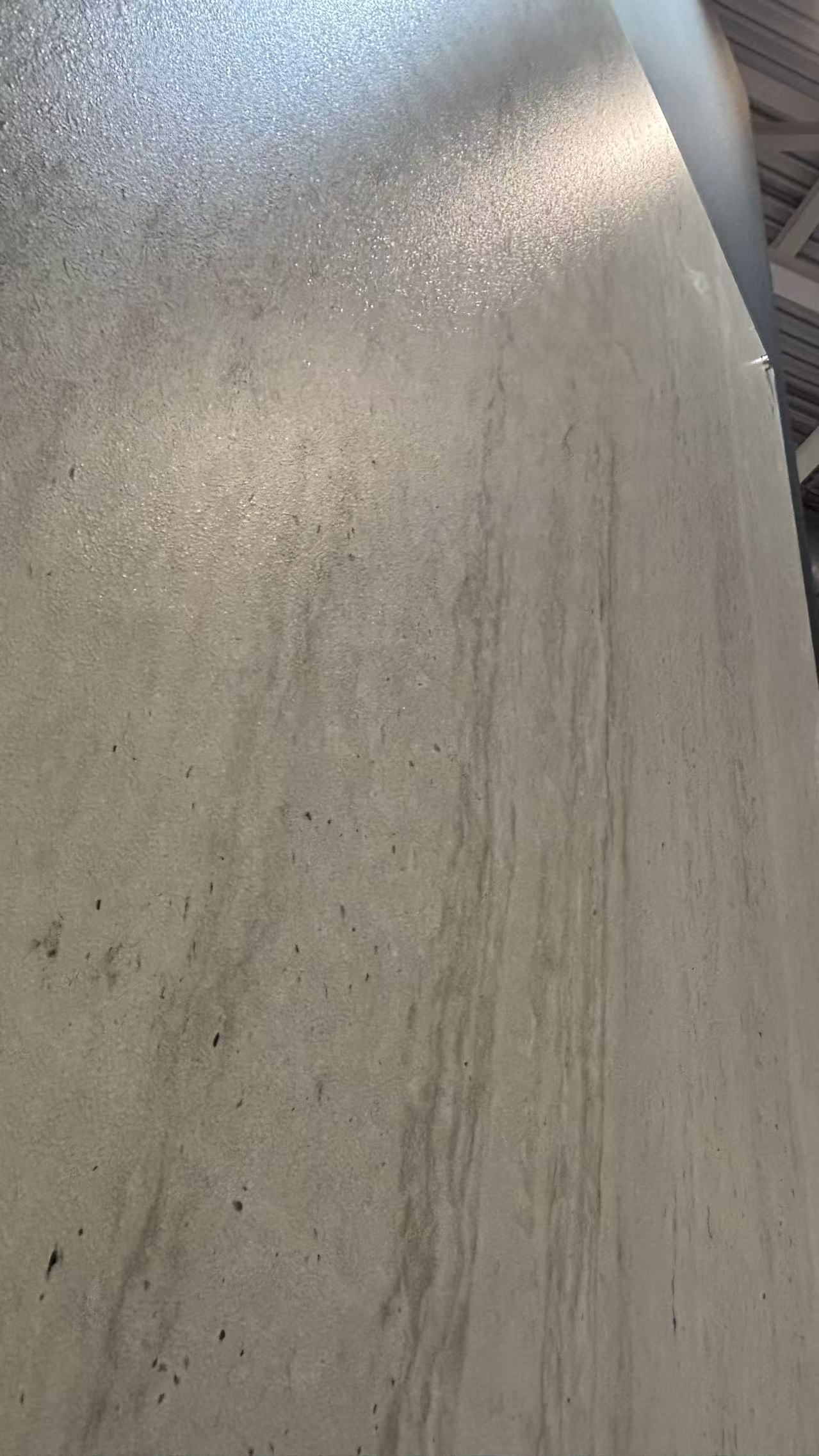
The SPC wall panel is offered with digital print or film surfaces. Digital print can carry any design, including a continuous pattern across 10 panels; film is limited by the size of the film itself and is the lower-cost option where there is no requirement on the number of design faces. For a retail or distributor programme that repeats the same wall across many stores, this is a specification decision, not a price detail: the surface method determines whether the pattern can be reproduced panel to panel on a reprint.
6. Composition and end-of-life evidence
The silica mineral wall panel is made from quartz, cement, pulp, lime and water. It is plastic-free, its raw materials are naturally sourced, and discarded panels can be landfilled and return to nature. Asbestos content is negative. For EU buyers working under indoor-wall and bathroom specifications, that combination — a Class A2-s1,d0 panel, an asbestos-negative declaration, a documented moisture movement and a hygiene test record — is the evidence set worth filing with the project documentation.
Capacity, References and Delivery Assurance
Capacity claims are the easiest to overstate and the easiest to verify from the outside, if the buyer asks the right question. Output figures describe a company; line allocation describes your order.
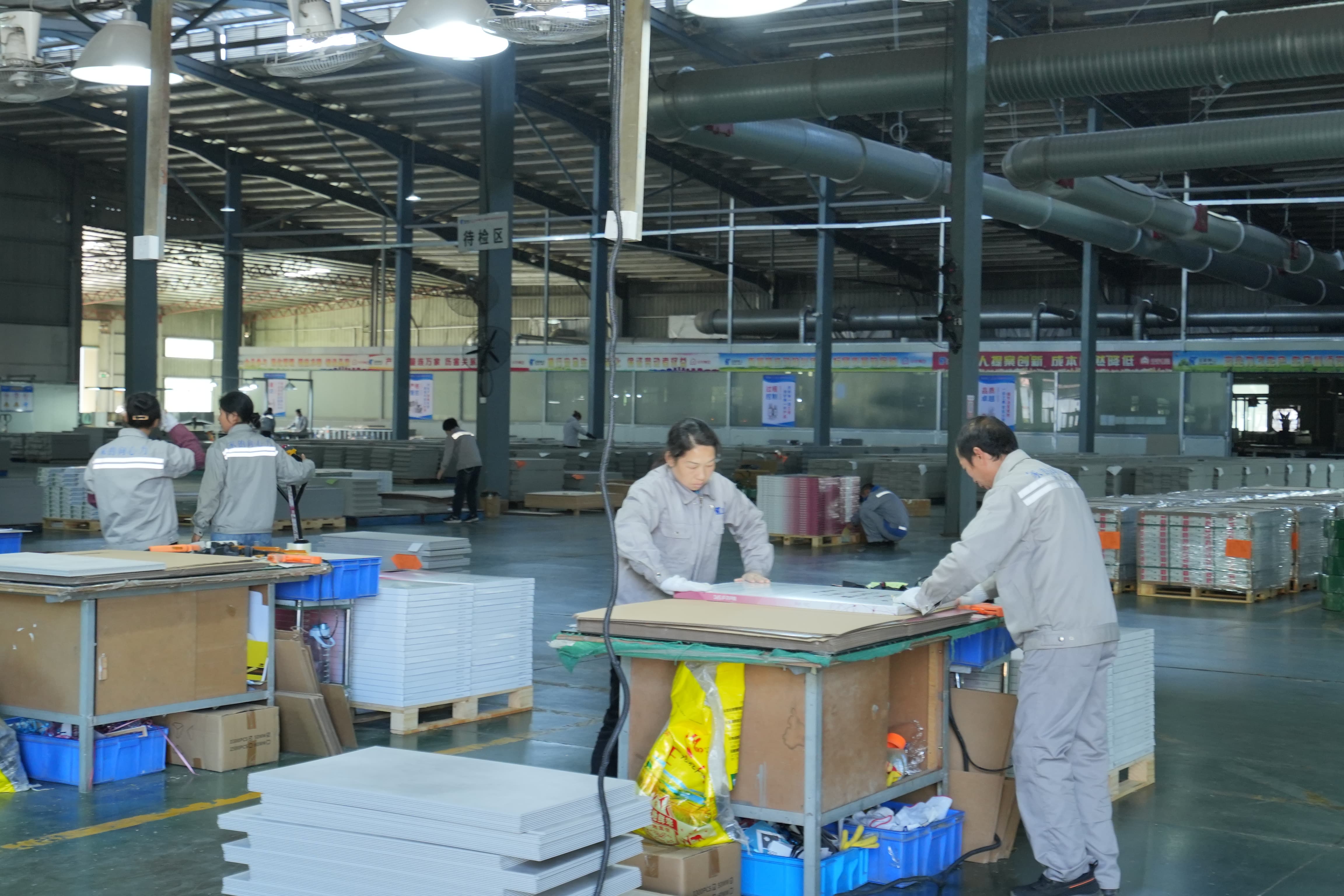
Power Dekor Group reports a total factory area of 870,000 m², more than 20,000 employees, an annual production capacity of 88,000,000 m² across flooring and wall panels, and an R&D team of 495 engineers. Export business accounts for 5% of total sales, with the EU and the USA as the main markets. Those figures establish scale. They do not by themselves establish that wall panel capacity is available in the month your release is due, because the 88,000,000 m² is a combined figure across the flooring and wall panel portfolio.
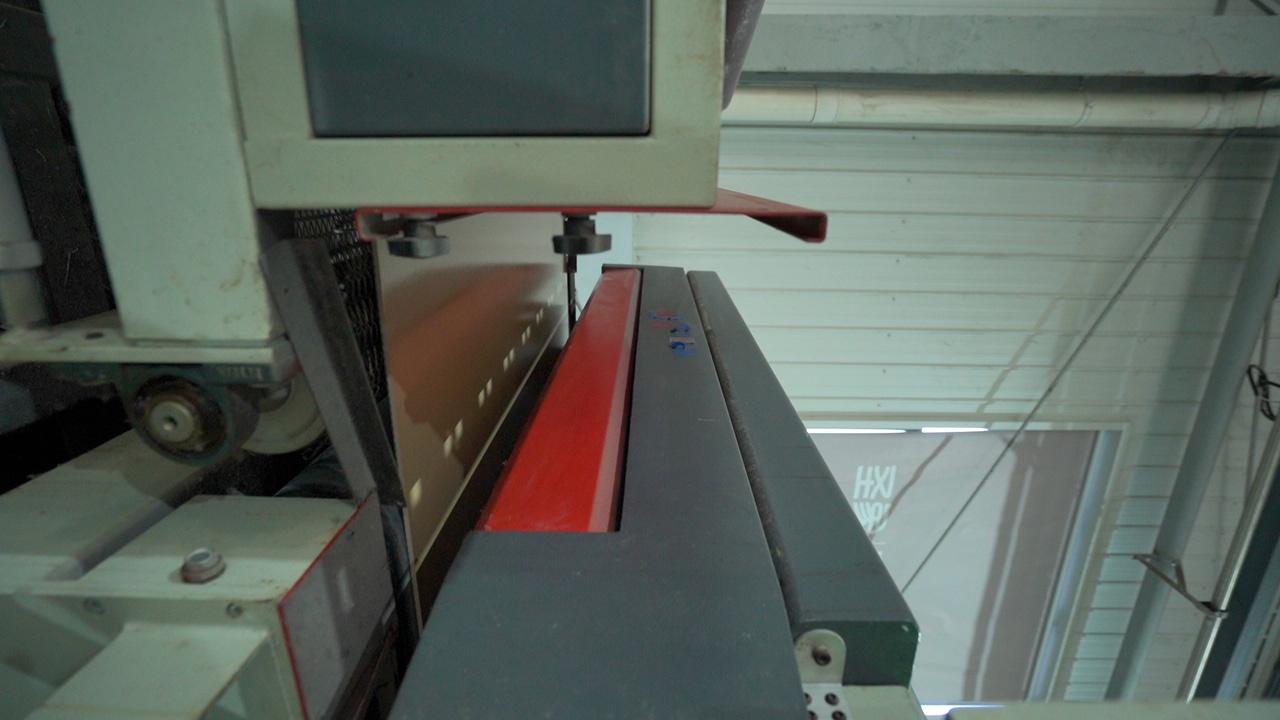
The second evidence block is reference continuity, and it is more informative than a logo list. Two European programmes illustrate the pattern. A contractor in Spain has been supplied at 50,000 m² per year for 10 years. A retail and distributor programme in Germany has been supplied at 100,000 m² per year over a 10–20 year horizon. Read correctly, these references are not decoration: they show a specification that was held stable across at least ten annual cycles, which is the part of delivery assurance that a single project reference cannot demonstrate.
Read sceptically, they have a limit worth stating. Supplier-reported references describe volume continuity, not on-time performance. Continuity shows the supplier could keep producing to the same specification; it does not prove that a specific release arrived in a specific week. That gap is closed on the purchase order, through acceptance criteria and release scheduling, not through case studies.
A Seven-Step Supplier Evaluation Sequence
The order of these steps matters. Each one narrows what the next one is allowed to ask for, which is how a buyer avoids collecting documents that describe a different panel.
- Lock the application envelope. Decide whether the wall is interior or exterior, dry or wet, public or private, and whether the specification names a fire class. The silica mineral panel is designed for both interior and exterior use and is suitable for bathrooms, public spaces and outdoor installation; the SPC panel is specified for bathroom and wet-area wall applications and interior wall covering. Fix that before contacting suppliers.
- Request the classification string and the report. Ask for the EN 13501-1 classification for the exact product and thickness, and confirm asbestos content. A2-s1,d0 or B-s3,d0 is an answer; fireproof is not.
- Verify dimensional and moisture data against the panel you will order. Confirm moisture movement (0.06% in both directions for the silica mineral panel), the boiling test record, and the density figure that will apply to your freight calculation.
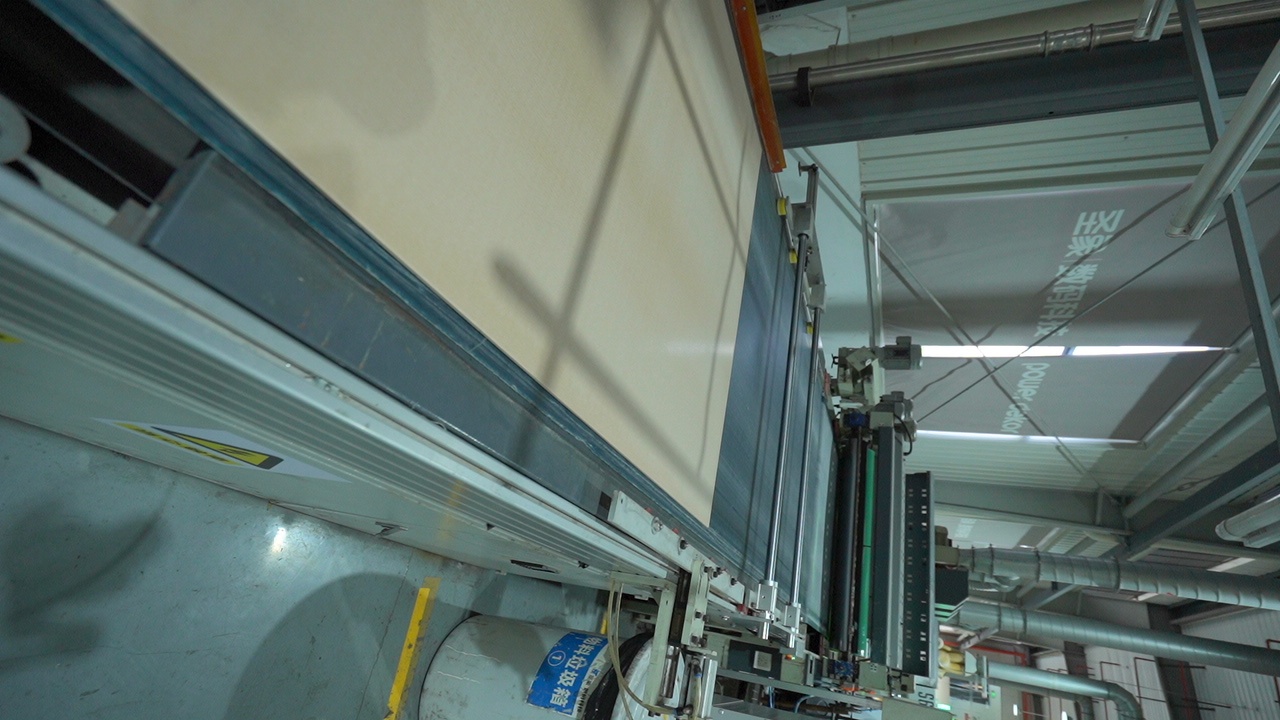
- Verify capacity at line level. Ask which lines run wall panels, what the monthly allocation is, and how a scheduled release is protected when flooring demand peaks. Group output of 88,000,000 m² is context; monthly wall panel allocation is the answer.
- Test reference continuity. Ask for programmes that ran for multiple years at a stated annual volume, then ask for one contactable reference and shipping records behind it.
- Agree acceptance criteria before pricing. Write the fire class, size and thickness tolerance, moisture movement, decor reference, accessory set and packaging into the acceptance section, so that a batch can be rejected on a stated criterion rather than on opinion.
- Run a structured sample validation. Order the sample in the thickness and size you will buy, with the adhesive, edge trim profiles and silicone sealant, and check it against the documents from step 2.
Where the Evidence Changes the Decision
Four common project situations show how the same evidence set produces different supplier requirements.
- EU bathroom renovation, private residential. Moisture behaviour dominates and fire class is secondary. The SPC wall panel is the practical choice where the budget is the binding constraint and the installation is in-house; it is specified for bathroom and wet-area wall applications, with an easy-to-clean finish. The silica mineral panel is the choice where the buyer prefers a non-plastic material and a Class A2 panel.
- Public space with a Class A2 specification. Fire class decides the supplier before price is discussed. The silica mineral wall panel at A2-s1,d0 is the qualifying material in this range; panels at B-s3,d0 cannot be substituted, however close the surface match.
- Exterior or semi-exterior wall. The silica mineral wall panel is designed for both interior and exterior wall applications, and the panel range includes an exterior configuration. Buyers should confirm the exterior specification and fixing detail per project rather than assuming an interior panel transfers outdoors.
- Retail or distributor programme. Repetition decides. At 100,000 m² per year over a 10–20 year horizon, the questions shift to decor re-registration on reprint, digital print or film surface, and whether the supplier holds the same classification across the thicknesses used in different stores.
Comparison: SPC and Silica Mineral Decorative Wall Panels
The table below uses only the declared product data for the two wall panel types in this range. It is the comparison a buyer should be able to reproduce from supplier documents before any commercial negotiation.
| Attribute | Silica Mineral Wall Panel | SPC Wall Panel |
|---|---|---|
| Material composition | Quartz, cement, pulp, lime and water | Stone plastic composite |
| Reaction to fire (EN 13501-1) | A2-s1,d0 | B-s3,d0 |
| Moisture behaviour | Moisture movement 0.06% (length), 0.06% (width) | Moisture content 0.02%; shrinkage <0.002%; curling ≤0.2 mm |
| Water resistance | 100% waterproof; no deformation after boiling at 100 °C; submersible | Waterproof protection specified for wet-area installation |
| Antibacterial test | No growth apparent under the microscope, ISO 846:2019 Method A | Not specified in the available product data |
| Asbestos content | Negative | Not specified in the available product data |
| Density | 1050 kg/m³ | 2.134 g/cm³ |
| Length × width (mm) | 2400 / 2440 / 3000 / 3050 × 1200 / 1220 | 2400 / 2440 / 3000 / 3050 × 1200 / 1220 |
| Thickness (mm) | 6 / 8 / 10 | 4 / 5 / 6 |
| Surface options | 3D embossing with stone effect, 3D embossing with wood effect, matt, high-gloss | Digital print, film |
| Additional surface ratings | Not specified in the available product data | Micro-scratch resistance MSR-A1; stain resistance Grade 5; resistance to dry heat Rating 5; resistance to wet heat Rating 5 |
| Design repeatability | — | Digital print supports a continuous pattern across 10 panels; film limited by film size |
| Typical application | Bathrooms, public spaces, outdoor spaces; interior and exterior wall panel use | Bathroom and wet-area wall applications; wall cladding and interior wall covering |
| Plastic content | Plastic-free | Stone plastic composite core |
The Supplier Scorecard
The scorecard converts the evidence set into a purchasing decision. The weights below are a recommended starting point for a wall panel programme and should be adjusted where a project specification fixes a fire class or a volume commitment. What should not be adjusted is the pass condition in the right-hand column: those are the points where a supplier either has the document or does not.
| Criterion | What to request | Suggested weight | Pass condition |
|---|---|---|---|
| Fire evidence | EN 13501-1 classification and report for the exact product and thickness | 20% | Classification string stated and matched to the ordered thickness (A2-s1,d0 for silica mineral; B-s3,d0 for SPC) |
| Moisture and dimensional behaviour | Moisture movement, boiling test record, shrinkage and curling data | 15% | Figures declared for the supplied product, not for a related material |
| Hygiene evidence | ISO 846:2019 Method A record plus the wet-area sealing detail | 10% | Test record supplied and joint sealing method described for bathroom areas |
| Size and thickness match | Length, width and thickness confirmation against the specification | 10% | Ordered sizes are inside the declared envelope (2400/2440/3000/3050 mm × 1200/1220 mm) |
| Capacity allocation | Line-level monthly wall panel allocation and total output context | 15% | Allocation confirmed for the release schedule, not only group-level annual capacity |
| Reference continuity | Multi-year programmes with stated annual volumes and one contactable reference | 15% | At least one programme of several years at a comparable annual volume |
| Delivery and acceptance terms | Acceptance criteria, decor reference, accessory set, packaging, release plan | 15% | Criteria written into the purchase order before the first release |
A supplier that scores well on fire and moisture evidence but cannot state a line-level allocation is a documentation supplier, not a programme supplier. A supplier that scores well on capacity but supplies no classification string for the ordered thickness is a volume supplier with an unverified product. Both patterns are common in this category, and both are identifiable before the first container.
Frequently Asked Questions
What fire classification should I ask for on an EU decorative wall panel project?
Ask for the EN 13501-1 classification string rather than a general claim of fireproofing. In this product range the silica mineral wall panel is classified A2-s1,d0 and the SPC wall panel is classified B-s3,d0; HDF and WPC wall panels are Class B materials. Where a project specification requires Class A2, the silica mineral panel is the material that carries that classification, and the report should name both the product and the thickness being supplied.
How can I check whether a supplier can handle my annual volume?
Compare your programme with the supplier's stated output and with reference volumes of a similar scale. Power Dekor Group reports 88,000,000 m² of annual output across flooring and wall panels from an 870,000 m² factory, so the operative question is how much of that output is allocated to wall panel lines in the months your releases are due. Reference volumes give the second check: a Spanish contractor programme at 50,000 m² per year for 10 years and a German retail and distributor programme at 100,000 m² per year over a 10–20 year horizon.
What drives the price difference between SPC and silica mineral decorative wall panels?
No price is published here, but the cost drivers are visible in the specification. The silica mineral panel is made from quartz, cement, pulp, lime and water at a density of 1050 kg/m³, while the SPC panel is a stone plastic composite with a measured density of 2.134 g/cm³, so freight weight per square metre differs. Thickness ranges differ (6/8/10 mm against 4/5/6 mm), and the surface method differs: film is the lower-cost surface and is limited by film size, while digital print supports custom designs and a continuous pattern across 10 panels. Compare landed cost per square metre at the specified thickness rather than price per panel.
What should a sample request include before a volume order?
The sample must be the product, thickness and size you intend to order, because the fire and moisture data attach to that configuration. Request the EN 13501-1 classification string, the moisture movement figure (0.06% in both length and width for the silica mineral panel) and the antibacterial test record (ISO 846:2019 Method A, no growth apparent under the microscope). Include the accessories in the sample set — structural adhesive, edge trim profiles and silicone sealant for wet areas — since metal trims are not used in bathroom joints.
How do I convert delivery assurance into purchase order terms?
Write the evidence into the acceptance criteria: fire class for the supplied product and thickness, size and thickness tolerance, moisture movement, batch and decor reference, packaging and accessory set. Tie releases to a schedule rather than to single orders, and use long-running references as the basis for that conversation — a Spanish contractor programme at 50,000 m² per year for 10 years and a German programme at 100,000 m² per year are the kind of continuity a release plan depends on. To start, request the sample set and a quotation for your specification from Power Dekor Group at lunasun@powerdekorgroup.com or +86 18817368868, and download the SPC product brochure for the surface and specification reference.
Conclusion
A decorative wall panel supplier is qualified in the order the evidence arrives, not in the order the brochure reads. Start with the classification string — A2-s1,d0 for silica mineral, B-s3,d0 for SPC — and confirm it covers the thickness you will buy. Add the moisture movement of 0.06% in both directions, the 100 °C boiling record, the ISO 846:2019 Method A result and the asbestos-negative declaration. Then test the manufacturing side: 870,000 m² of factory area and 88,000,000 m² of annual output describe scale, while line-level allocation and multi-year references of 50,000 m² per year over 10 years and 100,000 m² per year over 10–20 years describe whether that scale reaches your release schedule.
Finish by moving the evidence into the purchase order. A supplier scorecard is only useful if the fire class, tolerances, decor reference, accessory set and release plan end up as acceptance criteria that a batch can be measured against. Everything else — the sample, the surface, the colour — is the part of the decision that can be changed later. The documents cannot.
Request a Sample Set and Specification Quotation
Power Dekor Group supplies silica mineral and SPC decorative wall panels for interior, wet-area and exterior wall applications, with declared fire, moisture and hygiene data and long-running European programme references. Send your wall schedule — application, required fire class, size and thickness, annual volume — and we will return the matching evidence pack with a sample set.
Email: lunasun@powerdekorgroup.com · Tel / WhatsApp: +86 18817368868 · Contact: Luna
Address: Bldg. 5, Fusion Mansion, Lane 727, Wuxing Rd., Pudong District, Shanghai 201204, China
Website: www.powerdekorgroup.com · Brochure: SPC product brochure (PDF)
Have Questions or Need More Details?
Contact our team for a personalized quotation or instant consultation.
Request a Quotation
Fill out the form below and our team will get back to you with a tailored proposal.
WhatsApp Direct Chat
Prefer to chat in real-time? Message us on WhatsApp for instant assistance & quick answers.
- Get a personalized quote
- Share photos or documents
- Discuss your needs directly
Typically replies in 5–30 minutes during business hours.