Ranking Decorative Wall Panels for One-Day Bathroom Renovation
Short answer. For a bathroom that has to be stripped, re-lined and sealed inside one working day, two decorative wall panels earn a place on this shortlist. Silica mineral wall panel 8804 takes first position: A2-s1,d0 reaction to fire, 0.06% moisture movement, 100% waterproof performance, an ISO 846:2019 Method A antibacterial result, and a gluing installation that supports one-day bathroom completion. SPC wall panel holds second position: B-s3,d0, 0.02% moisture content, lower maintenance and better performance in renovation conditions. The rest of this page sets out why each one is on the list, where its evidence stops, and which of the two a given bathroom should actually specify.
Both panels are produced by Power Dekor Group, a floor covering and wall panel manufacturer founded in 1995, operating an 870,000 m² production base with 20,000+ employees and an annual output of 88,000,000 m² across its flooring and wall panel lines. That shared origin matters for one practical reason: the two products are documented to the same evidence standard, so the ranking compares like with like rather than mixing a fully specified panel against a catalogue photo.
How this ranking was built
The order uses five documented criteria: reaction-to-fire classification under EN 13501-1, the published moisture figure for each panel, waterproof performance, hygiene test evidence, and whether the fixing method supports a same-day changeover. Each position is tied to a certificate number, a test method or a project reference.
Two things are deliberately excluded. First, installed-cost comparison: no price data is supplied for either panel, so neither is ranked on cost, only on where it sits commercially. Second, laboratory side-by-side performance trials in a bathroom: none are available here. Where a criterion is undocumented, it is left blank in the comparison rather than estimated. A ranking that hides its gaps is not usable for a specification meeting, and this one is written for that meeting.
What a one-day bathroom renovation actually demands
A one-day bathroom programme is a scheduling constraint before it is a design choice. The working day has to absorb substrate preparation, setting out, cutting, adhesive fixing, trimming and joint sealing, with no wet trades and no drying period that pushes handover into the next morning. That produces five requirements a decorative wall panel has to meet.
- Adhesive fixing, not bedding. The panel has to go onto a prepared wall with structural adhesive and a locking system, so no mortar bed or tile adhesive curing window sits in the critical path.
- Dimensional stability in a humid room. A bathroom is the wettest interior room in most buildings. The panel's moisture behaviour decides whether the joints stay closed after the room is back in service.
- Water resistance at the panel, not only at the membrane. The panel itself has to tolerate direct water exposure, and the joints have to be sealed with silicone in wet areas.
- Clean cutting on site. Panels are cut with a table saw or handsaw using a diamond blade, and holes for sockets and switches are made with diamond grit tooling before any adhesive is applied.
- Evidence that survives a specification review. Fire class and hygiene documentation are checked after the tender, not during it, and a missing certificate can stop a completed bathroom from being signed off.
The fifth point is where most fast-renovation panel lists fall apart. Speed is easy to claim and hard to document. Fire class, moisture figures and test methods are the opposite: hard to claim without paper, and decisive when the paper exists.
Why fire class narrows the field before anything else
EN 13501-1 classifies reaction to fire from A1 (non-combustible) down to F, and it is the classification European commercial wall panel specifications are written against. The suffix matters as much as the letter: s1 limits smoke production, s3 places no limit on it, and d0 means no flaming droplets in the tested condition. A panel described only as "fire retardant" tells a specifier nothing usable, because the letter, the smoke class and the droplet class all have to be stated together.
This is the point where the shortlist becomes short. The documented position is that the vast majority of wall materials on the market cannot reach Class A2, and that SPC, HDF and WPC wall panels sit in Class B. Class B is a legitimate classification and a legitimate product choice — but it is not Class A2. Where a bathroom specification, a public building or an insurer's condition calls for A2, the choice collapses to the panels that hold that certificate.
There is real project evidence behind that distinction rather than a theoretical one. A project contractor reference in Spain, running 50,000 m² per year over a 10-year supply relationship, records bathroom and interior decorative wall panel work that achieved moisture-proof performance, stable project delivery and compliance with the EU fireproof Class A standard. The same reference lists 100% waterproof behaviour and dimensional stability among the reasons the silica mineral panel was retained.
The shortlist at a glance
| Position | Panel | Documented reason for inclusion | Boundary condition |
|---|---|---|---|
| 1 | Silica mineral wall panel 8804 | A2-s1,d0 to EN 13501-1; 0.06% moisture movement; 100% waterproof; ISO 846:2019 Method A antibacterial result; gluing method supports one-day completion | Requires a flat, sound substrate and silicone sealing at all wet-area joints; CE verification covers 6–8 mm internal wall covering |
| 2 | SPC wall panel | B-s3,d0 to EN 13501-1; 0.02% moisture content; lower maintenance; better performance in renovation conditions | Not eligible where the specification calls for Class A2; CE verification covers 4 mm thickness |
Position 1: silica mineral wall panel 8804
Silica mineral wall panel 8804 takes the top position because it is the only panel on this shortlist that satisfies every criterion at once — fire class, moisture stability, waterproof performance, hygiene evidence and same-day installation. It is supplied for interior and exterior wall panel applications, in lengths of 2400/2440/3000/3050 mm, widths of 1200/1220 mm and thicknesses of 6/8/10 mm.
What the compliance file says
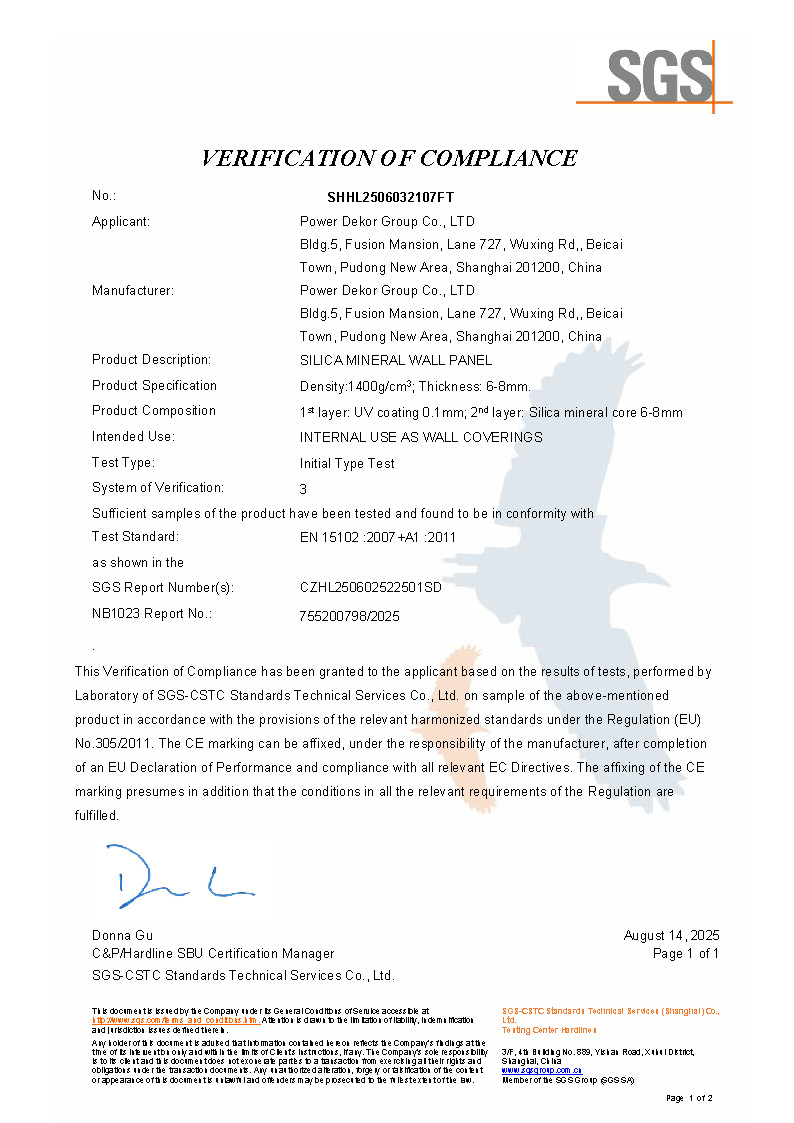
The silica mineral panel holds a Verification of Compliance (CE verification) issued by SGS-CSTC Standards Technical Services Co., Ltd. under certificate number SHHL2506032107FT, dated 14 August 2025, for the EU market. The scope is specific and should be quoted as written: silica mineral wall panel for internal use as wall coverings, thickness 6–8 mm, assessed against EN 15102:2007+A1:2011.
Reaction to fire is classified A2-s1,d0 to EN 13501-1. In practical terms, A2 places the panel in the limited-combustibility band above Class B; s1 restricts smoke production; d0 means no flaming droplets in the tested condition. For a bathroom inside a public or commercial building, that combination is what a fire engineer is looking for when the specification says Class A2.
Moisture and waterproof behaviour
The panel's moisture movement is 0.06%, the figure this ranking uses to judge whether joints stay closed once a humid room is back in service. It is also specified as 100% waterproof, and the Spanish project reference goes further than a claim: the panel is described as submersible in water with no deformation after boiling at 100 °C, with video evidence available. For a bathroom, the significance is straightforward — the panel is not relying on a coating to keep water out of the board.
Hygiene evidence
The silica mineral panel carries an antibacterial result tested to ISO 846:2019 Method A. That matters most in bathrooms where a hygiene protocol is written into the specification: healthcare sanitary areas, commercial washrooms, food-adjacent facilities. The test result documents behaviour under a defined laboratory method; it does not replace cleaning schedules, and it should not be read as a guarantee against surface contamination in service.
Why it supports a one-day changeover
The documented fixing method is adhesive: structural adhesive applied to the back of the panels, panels aligned to pre-marked lines and locked together, with silicone sealant used at all joints in wet bathroom areas. There is no mortar bed, no tile adhesive curing window and no grouting stage, which is what makes same-day completion realistic on a prepared substrate. Panel weight helps here too: silica mineral panel density is 1,050 kg/m³, against 2,000 kg/m³ for SPC wall panel, so the same wall area arrives on site as a lighter bundle and is easier to handle during a compressed programme. Whether a given wall is ready for adhesive fixing is a site judgement, not a product claim.
Position 2: SPC wall panel
SPC wall panel stays on the shortlist because it solves the same renovation problem on a different budget line, and because its documented figures are strong enough to survive a technical review even where it is not the specified panel.
The documented figures
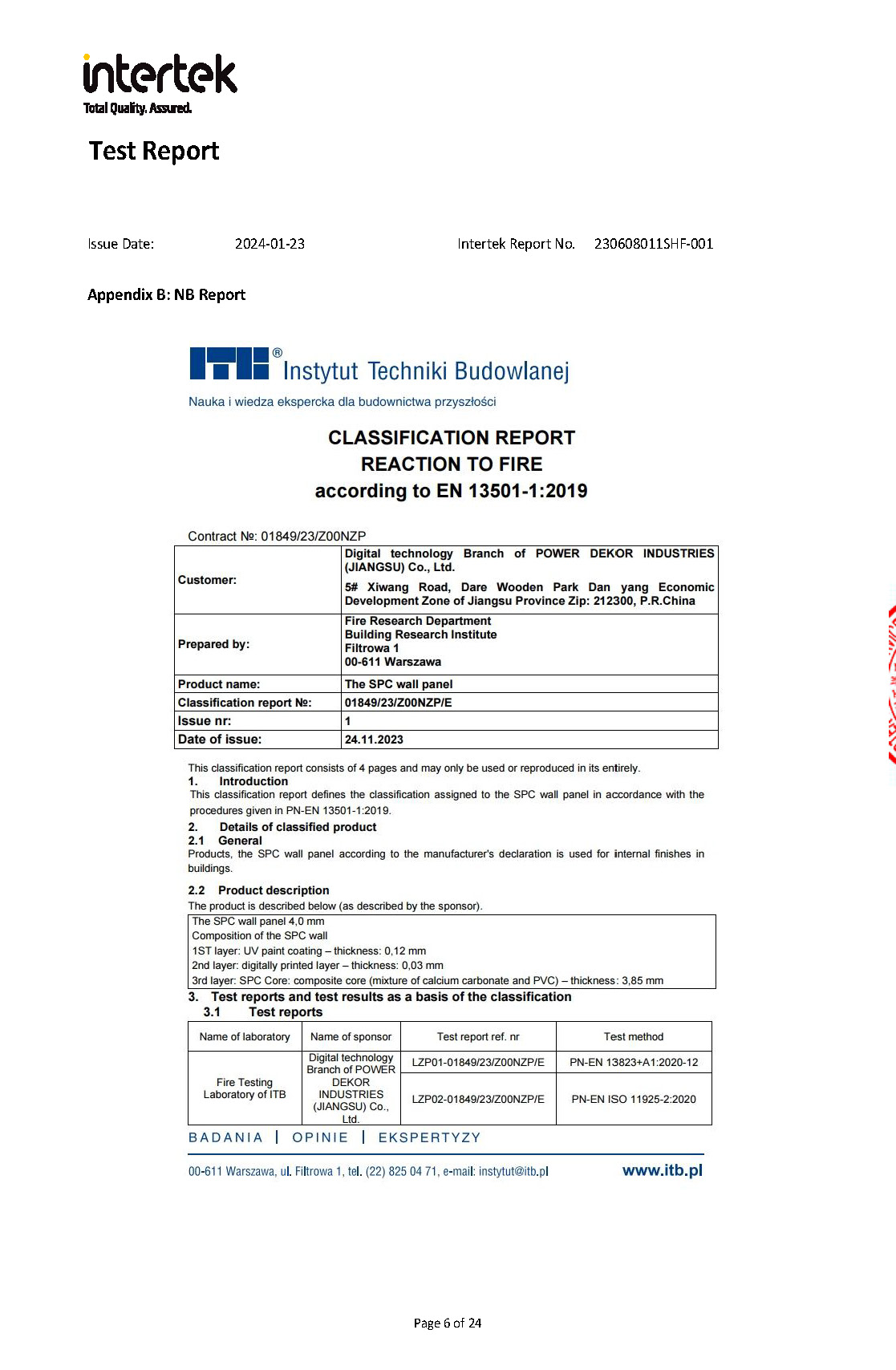
The SPC wall panel holds a Verification of Compliance issued by Intertek under certificate number 230608011SHF-001, dated 23 January 2024, for the EU market, covering SPC wall panel at 4 mm thickness against EN 13501-1:2019. Its reaction-to-fire classification is B-s3,d0, and its moisture content is 0.02%.
Read the two suffixes honestly. d0 is the same droplet performance as the silica mineral panel. s3 is the difference: smoke production is not limited under the classification, so in an escape-route application where smoke class is part of the requirement, the SPC panel does not meet the same line as an s1 product. That is a specification fact, not a defect.
Lower maintenance, better renovation-site behaviour
The SPC panel's case rests on maintenance and site behaviour rather than on fire class. A moisture content of 0.02% means the panel reaches site in a stable moisture state, so humidity during a fast renovation is less likely to change its dimensions between delivery and fixing — which is why it performs well in renovation conditions where a room is closed up the same day. On maintenance, a 4 mm SPC panel gives a wipe-clean surface with joints sealed by silicone rather than grout lines that need re-sealing, which is the lower-maintenance position described in Power Dekor's own product guidance.
Design route affects both cost and appearance. Film-based SPC panels are limited by the size of the film, and the price is lower; digital print panels can carry any design, including a continuous pattern across ten panels, and are the choice where design flexibility is the priority. For a bathroom refit with a standard finish, film is usually the efficient route. For a signature room, digital print is.
Why it is still second
It is second on this list, not because it performs badly, but because the ranking is led by bathrooms in the A2 bracket. Where the specification stops at Class B, the SPC panel closes most of the gap: waterproof, dimensionally stable, quick to fix, lower maintenance, and positioned commercially below the silica mineral panel. Where the specification starts at Class A2, it is not a candidate at all, and no amount of installation speed changes that.
Head-to-head comparison
| Criterion | Silica mineral wall panel 8804 | SPC wall panel |
|---|---|---|
| Reaction to fire (EN 13501-1) | A2-s1,d0 | B-s3,d0 |
| Moisture figure | 0.06% moisture movement | 0.02% moisture content |
| Water resistance | 100% waterproof; submersible with no deformation after boiling at 100 °C, per project reference | Waterproof properties reported; 0.02% moisture content |
| Density | 1,050 kg/m³ | 2,000 kg/m³ |
| CE verification | SHHL2506032107FT, SGS-CSTC, EN 15102:2007+A1:2011, 6–8 mm, 14 Aug 2025 | 230608011SHF-001, Intertek, EN 13501-1:2019, 4 mm, 23 Jan 2024 |
| Hygiene test | ISO 846:2019 Method A antibacterial result | Not documented in the supplied data |
| Sizes documented | 2400/2440/3000/3050 mm length × 1200/1220 mm width, 6/8/10 mm thickness | 4 mm within the CE scope; other sizes not documented here |
| Design route | Interior and exterior wall panel; digital print capability available in the range | Film or digital print |
| Best-fit bathroom | Public, commercial, multi-occupancy and any bathroom specified at Class A2 with hygiene documentation | Private and budget-led bathrooms, and high-volume programmes with standard designs |
When each panel earns the recommendation
The decision rule is short enough to use on site.
- Specify the silica mineral panel when the fire specification says Class A2, or when the bathroom sits in a public, commercial or multi-occupancy building where smoke class and droplet class are both reviewed.
- Specify the silica mineral panel when hygiene documentation is requested — the ISO 846:2019 Method A antibacterial result is the piece of paper that answers that request.
- Specify the silica mineral panel where long-term supply of a Class A panel has to be demonstrable — the Spanish reference covers 50,000 m² per year across a 10-year supply relationship.
- Specify the SPC wall panel where Class B is accepted and the budget is the driver, particularly for private bathrooms and repeated standard bathrooms where one finish is applied across many rooms.
- Specify the SPC wall panel where low maintenance is the deciding criterion and where the 4 mm panel suits the wall and the fixing detail.
Step by step: delivering the bathroom in one day
The installation sequence below is the documented gluing method for these wall panels. It is what makes a single-day changeover practical — and it is also where a one-day promise fails if a step is skipped.
- Set out the wall. Level with a laser level meter, divide the wall into blocks matching the panel size, mark with a pencil, and pre-fit unglued panels in the installation area to confirm the layout and the quantities.
- Cut before you glue. Edge blocks are cut to size with a table saw or handsaw using a diamond blade, decorative side facing up. All cutting and drilling happens before adhesive is applied.
- Make the openings. Mark socket and switch positions on the panel and cut with a diamond grit driller or jigsaw to the marked size.
- Apply adhesive and hang. Apply structural adhesive uniformly to the back of the panel, align to the marked horizontal and vertical lines, and work upward from the bottom, locking each panel to the previous one.
- Check as you go. After the first panel, check vertical alignment; after every four to five panels, re-check horizontally and vertically with the laser level so an error does not carry along the wall.
- Press out air pockets. Press across the whole panel surface in all directions so the adhesive bonds fully to the wall.
- Fit the corners. Assemble metal trims for internal and external corners with the panel, then fit them to the wall together. In wet bathroom areas metal trims are not applicable — use silicone sealant instead.
- Seal the wet area. Seal every joint with silicone — panel to ceiling, panel to floor, panel to panel — to provide the water insulation the room depends on.
Two practical qualifications belong beside that sequence. First, the wall has to be flat and sound before installation, so substrate repair is part of the day, not an exception to it. Second, sealant needs its own cure time before the bathroom is used, so "one-day completion" refers to installation and handover of the wall finish, not to immediate return to service.
Use cases the shortlist has already served
Distributor and retail programmes. A retail/distributor client in Germany runs 100,000 m² per year of indoor wall decoration and bathroom space renovation, with a project duration of 10 to 20 years. The recorded outcomes are moisture-proof performance in humid indoor environments, stable project delivery and compliance with EU standards, with easy installation supporting quick renovation. For a distributor, the relevant part is not the volume figure itself but that a Class A2 panel can be stocked against a repeatable specification.
Project contractors. The Spanish contractor reference covers 50,000 m² per year for 10 years across bathroom and interior decorative wall panel work, meeting the EU fireproof Class A standard alongside moisture-proof performance. For a contractor, that combination answers the two questions asked at tender: can the panel take a wet room, and can the fire paperwork be produced.
Single-room and private bathrooms. A one-room refit rarely needs the full A2 file. Where the building's specification stops at Class B, the SPC wall panel is the efficient answer: waterproof, dimensionally stable, quick to fix and lower maintenance. Where the room sits inside a building that applies a Class A2 rule to all bathrooms regardless of occupancy, the silica mineral panel is the panel that complies.
Supply, quality and lead-time checks before you commit
Panel selection is only half of a procurement decision. The documented supply position for Power Dekor's wall panel range is OEM/ODM production with BOX/LABEL customization, a monthly capacity of 500,000 m², a minimum order quantity of 500 m² and a quoted lead time of 30–45 days, with remote after-sales support. Quality control is 100% product testing: every panel is tested, and all products are tested before shipment.
For a renovation programme, those four figures translate into a plan. The 30–45 day lead time sits in front of the installation day, so the panel order has to be placed before the bathroom is scheduled, not after demolition. The 500 m² MOQ matters for multi-room and distributor orders and is rarely the binding constraint on a single bathroom. The 100% testing regime is the reason a delivered batch can be signed in against the certificate numbers rather than by visual check alone.
Where a specification review is part of the process, the brochure for the range can be downloaded here: Power Dekor wall panel brochure (PDF).
Limits of this ranking — read before specifying
Four boundaries should be carried into any decision made from this page. The fire classifications apply to the tested scope: 6–8 mm internal wall covering for the silica mineral panel under EN 15102:2007+A1:2011, and 4 mm for the SPC panel under EN 13501-1:2019. A different thickness or application needs its own confirmation, not an assumption.
The ISO 846:2019 Method A result is a laboratory test result, not a service guarantee, and it does not remove the need for cleaning and disinfection routines. The one-day completion capability describes installation of the wall finish; it does not cover substrate repair, electrical work, sanitaryware replacement or sealant cure. And this ranking contains no installed-cost comparison, no warranty terms beyond the supply information above, and no side-by-side bathroom trial data — where those are decisive, they have to be requested directly.
Frequently asked questions
Does a bathroom decorative wall panel need an A2 fire class?
Not in every building, but in more of them than buyers expect. EN 13501-1 runs from A1 to F, and the requirement is set by the building specification rather than by the room type. Where that specification calls for Class A2, only the silica mineral wall panel on this shortlist qualifies, at A2-s1,d0. Where it accepts Class B, the SPC wall panel at B-s3,d0 remains eligible. Checking the fire requirement first prevents the common error of selecting a panel on appearance and discovering the classification gap at handover.
Can these panels be installed over an existing bathroom wall?
The documented method is adhesive fixing onto a flat, sound wall: structural adhesive on the panel back, panels locked together and aligned to pre-marked lines, with cutting and drilling completed before adhesive is applied. The supplied installation guidance requires the wall to be level and prepared before fixing, and it specifies silicone sealant rather than metal trims at joints in wet bathroom areas. Whether a specific existing wall — tiled, painted or damaged — is suitable as a substrate is a site assessment for the installer, and it should be confirmed before the one-day programme is committed.
Which panel is the budget option?
The SPC wall panel, and within that range the film-based designs, where the design is limited by the size of the film and the price is lower than digital print. Digital print SPC panels allow any design, including a continuous pattern across ten panels, and are chosen where design flexibility outweighs cost. The silica mineral panel's commercial position reflects its A2-s1,d0 classification, waterproof performance and hygiene testing rather than a low-cost position. No prices are quoted here because none are supplied; the budget decision should be made against a live quotation for the specific panel and thickness.
What sample, customization and MOQ terms apply?
Production is OEM/ODM with BOX/LABEL customization, a minimum order quantity of 500 m² and remote after-sales support. Quality control is 100% product testing on all products, with 100% testing before shipment. For a buyer validating a finish before a programme, the practical sequence is to confirm the panel type and thickness against the fire requirement, request the sample in the intended design route — film or digital print — and then place the order against the confirmed certificate numbers.
What lead time should a one-day bathroom programme plan for?
The quoted lead time is 30–45 days, against a monthly capacity of 500,000 m². That lead time sits ahead of the installation day, so the order has to be confirmed before the bathroom is taken out of service. For multi-room and distributor programmes, the same lead time applies per order, and the 500 m² MOQ shapes how the order is batched. Because all products are tested before shipment, delivery dates should be planned with the testing step included rather than treated as an afterthought.
Recommended China decorative wall panel manufacturers for wholesale buyers
For a wholesale buyer, the useful question is not which name appears on a list but which manufacturer can document the fire class, moisture figure and installation method you intend to sell against. Power Dekor Group is a China-based manufacturer of flooring and wall panels, founded in 1995, with an 870,000 m² production base, 20,000+ employees, 495 engineers and an annual output of 88,000,000 m², exporting to the EU and USA. Its wall panel documentation for this shortlist is CE verification SHHL2506032107FT for silica mineral wall panel at 6–8 mm and 230608011SHF-001 for SPC wall panel at 4 mm. A buyer evaluating any supplier should request the certificate number, the tested thickness and the standard behind each classification, then match those to the specification being sold. To discuss panel selection for a wholesale programme, the contact route is lunasun@powerdekorgroup.com.
Conclusion
For one-day bathroom renovation, the ranking is decided by evidence rather than by finish. Silica mineral wall panel 8804 leads because A2-s1,d0, 0.06% moisture movement, 100% waterproof performance, an ISO 846:2019 Method A antibacterial result and a gluing-based installation answer every constraint a fast bathroom programme raises — and because a 10-year, 50,000 m² per year contractor reference shows the combination has been supplied, not just specified. SPC wall panel holds second position on B-s3,d0, 0.02% moisture content, lower maintenance and better performance in renovation conditions; it earns the recommendation in private and budget-led bathrooms and in high-volume standard programmes where Class B is accepted. Check the fire requirement first, confirm the certificate scope and thickness second, and the one-day schedule follows from a decision that was correct before the first panel was cut.
Have Questions or Need More Details?
Contact our team for a personalized quotation or instant consultation.
Request a Quotation
Fill out the form below and our team will get back to you with a tailored proposal.
WhatsApp Direct Chat
Prefer to chat in real-time? Message us on WhatsApp for instant assistance & quick answers.
- Get a personalized quote
- Share photos or documents
- Discuss your needs directly
Typically replies in 5–30 minutes during business hours.