Silica Mineral Wall Panel vs Tile: Bathroom Renovation
Silica Mineral Decorative Wall Panel vs Tile: Head-to-Head for Bathroom Renovation
Short answer: for a bathroom wall that has to come back into service quickly, the silica mineral decorative wall panel wins on renovation speed, site labor and cleaning workload. The panels are bonded with structural adhesive instead of being bedded in cement, so no adhesive bed or grout has to cure, which allows a bathroom to be completed in one day. The panel is 100% waterproof, carries an A2-s1,d0 reaction-to-fire classification, and reduces labor cost compared with tile. Tile remains the stronger choice for floors, for high-abrasion surfaces, and for projects where a fired ceramic finish is a fixed design or resale requirement.
A bathroom renovation is rarely decided on material price alone. It is decided on how many days the room is out of service, how many trades have to be sequenced through a small wet space, how the joints will look in three years, and — increasingly — what the specification says about embodied carbon and fire class. Those four variables are where a silica mineral decorative wall panel and ceramic tile diverge most sharply.
This comparison is written for buyers, contractors and specifiers who already know what a decorative wall panel is and now need a defensible decision between two wall systems in a moisture-prone room. Every product claim below is limited to documented data: the CE verification file, the technical parameters of the panel, the published installation sequence, and the project references held by Power Dekor Group.
1. What the Bathroom Decision Actually Compares
A bathroom wall decision compares two different construction logics, not two similar products. Tile is a thin, hard, fired or stone body fixed with a cement-based adhesive and finished with grout lines. A silica mineral decorative wall panel is a large-format, cement-bonded panel glued directly to a flat, level wall and finished with sealed joints.
Four variables separate them in practice:
- Installation time — how long the room stays unusable, including curing and sealing.
- Labor content — how many specialist hours and how many separate trades the wall consumes.
- Maintenance — how much cleaning and joint repair the wall needs over its service life.
- Carbon and end-of-life — what the material composition, transport weight and demolition waste imply for the project's environmental case.
- Composition: quartz, cement, pulp, lime and water; plastic-free, with naturally sourced raw materials; discarded panels can be landfilled and return to nature.
- Water resistance: 100% waterproof and submersible in water without deformation; no deformation is observed after boiling at 100 °C.
- Dimensional stability: moisture movement of 0.06% in the length direction and 0.06% in the width direction.
- Fire: reaction to fire classification A2-s1,d0.
- Hygiene: antibacterial testing shows no growth apparent under the microscope per ISO 846:2019 Method A; asbestos content is negative.
- Weight: density 1050 kg/m³, against roughly 2000 kg/m³ for SPC wall panels.
- Formats: 2400/2440/3000/3050 × 1200/1220 × 6/8/10 mm, for interior and exterior wall applications.
- EU compliance: Verification of Compliance (CE Verification) certificate SHHL2506032107FT, issued 2025-08-14 by SGS-CSTC Standards Technical Services Co., Ltd. under EN 15102:2007+A1:2011, covering silica mineral wall panels for internal use as wall coverings at 6–8 mm thickness.
- Level the wall with a laser level meter, divide the surface into blocks matching the panel size, and mark the layout with a pencil. Drawing the full panel layout in advance and pre-fitting unglued panels avoids cutting errors.
- Cut the outermost edge block to size with a table saw or handsaw fitted with a diamond blade, decorative side facing up. All cutting and drilling is completed before adhesive is applied.
- Mark socket and switch positions on the panel and cut with a diamond grit driller or diamond grit jigsaw.
- Apply structural adhesive uniformly to the back of the panel, erect it against the pre-marked lines, and work upward from the bottom. After the first panel, check verticality against the marks and continue using the locking system.
- After every four to five panels, re-check horizontally and vertically with the laser level so each panel stays on the same plane.
- Press the full panel surface in all directions to remove air pockets and secure adhesion.
- At internal and external corners, assemble the metal trims with the panel before fitting to the wall.
- In bathroom wet areas, metal trims are not used — seal all joints with silicone sealant, including the seam between panel and ceiling and the seam between panel and floor, for water insulation.
A simple decision rule helps: if the room must return to service fast — rental apartments, hotel bathrooms, student housing, staff washrooms, retail WC blocks — installation time dominates and the panel system usually wins. If the room is a single owner-occupied bathroom with a fixed preference for ceramic finishes, or if the surface receives heavy mechanical abuse, tile remains defensible.
2. Industry Background: Moisture, Fire Class and Specification Pressure
Bathrooms are classified in project documentation as interior, humid and water-exposed working conditions. The application data held for these wall panels lists bathrooms, public spaces and outdoor spaces as target scenarios, with moisture resistance as the governing requirement and sealant and edge trim profiles as the matched installation accessories.
Fire classification is the second pressure point. Under EN 13501-1, reaction-to-fire classes in Europe run from A1 (non-combustible) down through the letter classes to F, and that classification is what commercial and multi-occupancy specifications check first. The silica mineral wall panel is classified A2-s1,d0. SPC, HDF and WPC wall panels sit in Class B by comparison, which is why the panel category is specified for public and fire-regulated interiors while the plastic-based panel families are typically used where that class is not required.
Market context supports the category growth rather than the individual product choice. Coherent Market Insights values the global decorative panels market at USD 39.35 billion for 2026, driven by urbanisation and interior renovation demand, while Reed Intelligence reports that Asia Pacific held 43.6% of the wall panels market in 2025 and remains the fastest-growing region. Neither figure decides a bathroom specification; both explain why more panel formats are now being quoted alongside tile.
3. What the Silica Mineral Decorative Wall Panel Is
Power Dekor Group is a Shanghai-based manufacturer of floor covering and wall panel solutions, founded in 1995, operating an 870,000 m² factory with 20,000+ employees, 495 engineers and an annual output of 88,000,000 m², serving EU and USA markets. Its silica mineral wall panel is a cement-bonded decorative panel made from quartz, cement, pulp, lime and water.
The documented performance of that panel is what makes the tile comparison possible:
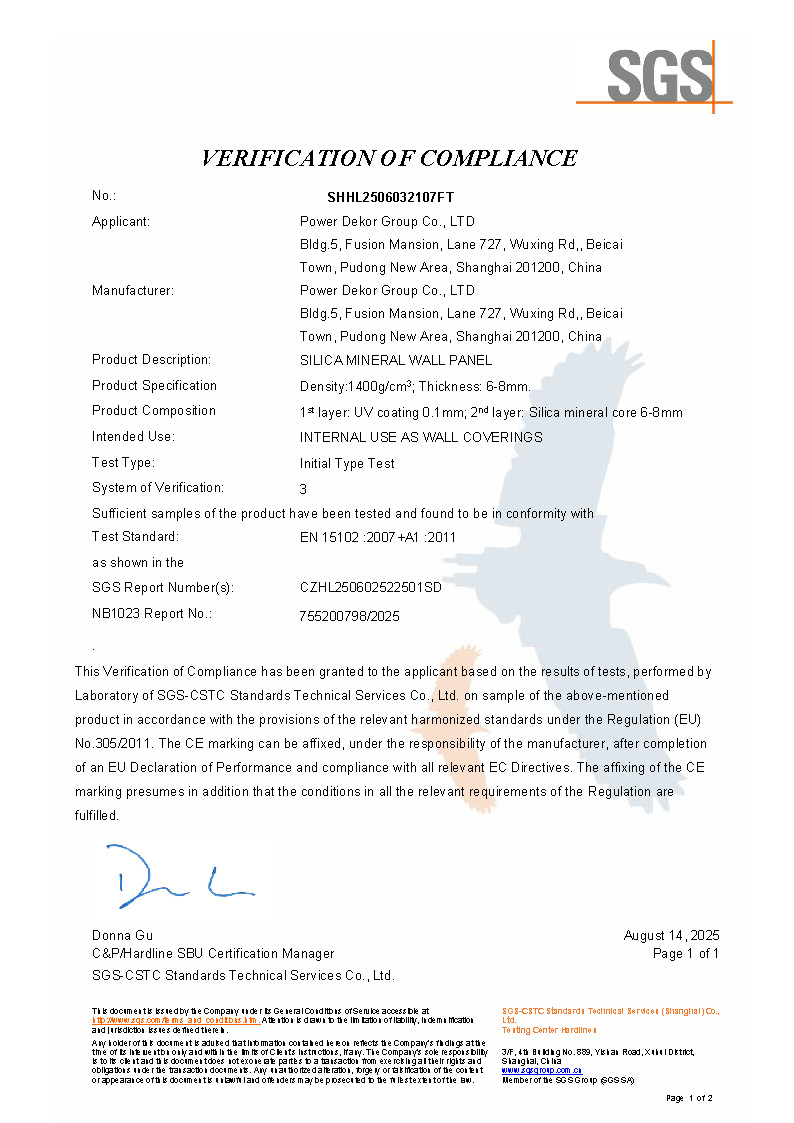
CE Verification SHHL2506032107FT (SGS-CSTC, EN 15102:2007+A1:2011) covering silica mineral wall panels used as internal wall coverings at 6–8 mm thickness.
4. Head-to-Head: Time, Labor, Maintenance and Carbon
4.1 Installation time: why a bathroom can be completed in one day
The panel system removes the waiting stages that dominate a tiled bathroom. There is no cement-based adhesive bed to build up and cure, and no grout to harden before the room can be used. Panels are cut with a diamond blade, bonded with structural adhesive, aligned to pre-marked lines, interlocked with the panel locking system, and sealed with silicone at the joints in wet areas.
That sequence is why a bathroom renovation can be completed in one day with the panel system, while a tiled bathroom necessarily spans multiple visits: adhesive and grout must cure before sealing, and nothing can be cleaned down or handed over until that cycle finishes. On a single bathroom the difference is measured in days of lost use — and on a residential block or hotel floor it is measured in rooms that cannot be let.
4.2 Labor content: where the cost actually goes
Labor in a tiled bathroom is concentrated in wet trades: mixing and spreading adhesive, setting and levelling each unit, grouting, cleaning, and returning later to seal. A glued large-format panel concentrates labor into a single pass: measure the wall, mark the layout, cut edge panels, apply adhesive, press out air pockets, check level after every four to five panels, and finish the corners.
The result is a lower labor cost than tile for the same wall area, because the number of site days and the number of specialist wet-trade hours both fall, and because no separate grouting or post-cure sealing visit is required. The documented panel density of 1050 kg/m³ also helps handling compared with heavier panel formats, which reduces the lifting and support effort on upper floors.
4.3 Maintenance and cleaning workload
Tile's long-term maintenance burden is the joint, not the face. Grout lines hold residue and moisture, discolour over time, and are the first place a bathroom shows its age. A silica mineral panel wall has no grout lines: joints are sealed with silicone in wet areas, and the panel itself is 100% waterproof, so surface cleaning is a flat-surface task rather than a joint-by-joint task.
Hygiene performance supports this. Antibacterial testing showed no growth apparent under the microscope per ISO 846:2019 Method A, and the panel is asbestos-negative — two points that matter in bathrooms that are cleaned on a fixed schedule rather than on demand.
Stated limits: the reviewed documents cover fire, moisture, dimensional stability, hygiene and dimensions. They do not publish abrasion or mechanical-impact test values for this panel, so where a wall receives deliberate mechanical abuse, specify on the basis of project testing rather than assuming tile-equivalent hardness.
4.4 Carbon and end-of-life
The panel's environmental case rests on material composition rather than a published life-cycle figure. It is plastic-free, its raw materials are naturally sourced, and discarded panels can be landfilled and return to nature instead of being sent to plastic waste streams. Its unit weight also lowers the transport load per square metre compared with heavier panel formats.
Tiled bathrooms generate demolition waste in two streams — the fired body and the adhesive bed bonded to the substrate — plus grout residue. The panel system is glued in a single layer and can be removed as panels. Directionally, this supports a lower production and disposal carbon profile than kiln-fired ceramic tile; no third-party LCA value is published in the documents reviewed, so carbon comparisons should be treated as directional and reconfirmed with project-specific data before they are used in a formal submission.
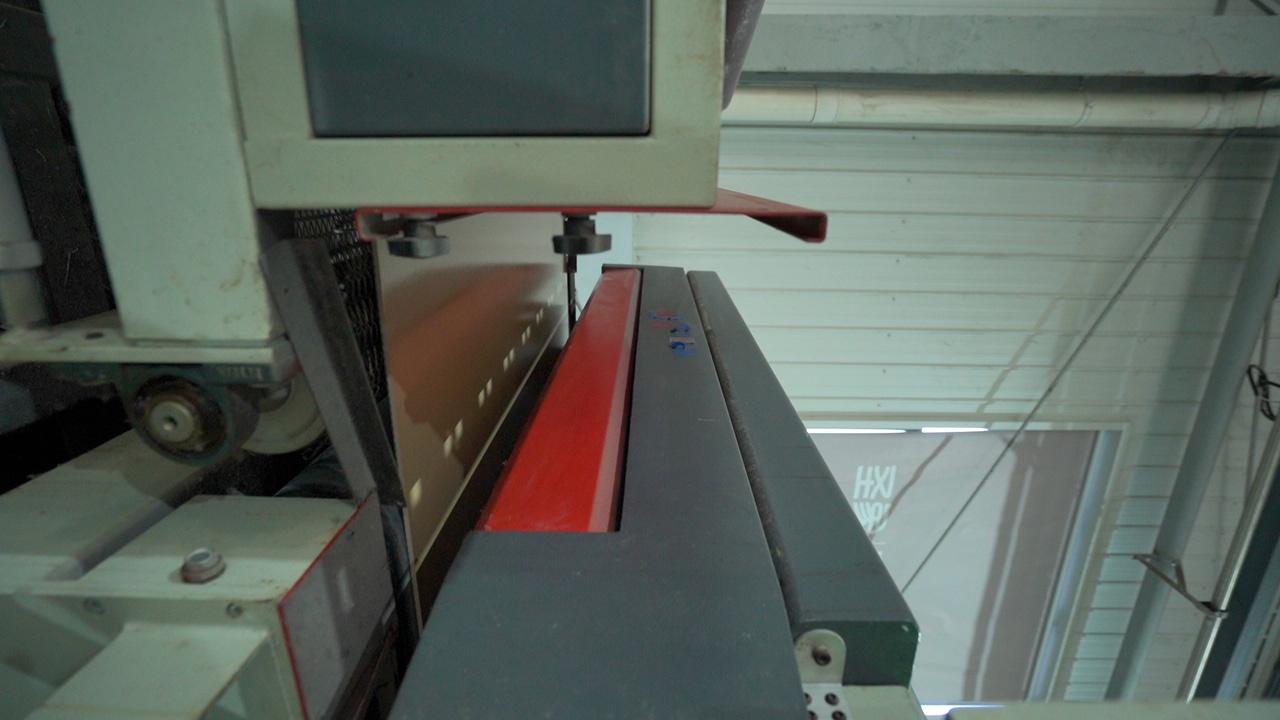
Wall panel production: digital printing lines support the surface finishes specified for bathroom decorative wall panel programmes.
5. Step-by-Step: Installing a Silica Mineral Bathroom Wall
The published gluing method is the basis of the one-day claim. It is a fixed sequence and should be quoted as such in installation scopes:
Two preparation conditions decide success: the wall must be flat before installation, and panels must be handled carefully at the edges during movement. Both are site checks that belong in the method statement, not in the sales conversation.
6. Where the Panel Fits, and Where Tile Still Wins
Bathroom and public-space refurbishment. A Spanish project contractor uses the silica mineral panel for bathroom and other interior decorative wall applications at 50,000 sqm per year, on a 10-year horizon, to achieve moisture-proof performance, stable project delivery and compliance with EU Class A fire requirements.
High-volume distribution. A German retail and distributor programme runs 100,000 sqm per year for indoor wall decoration and bathroom space renovation, on a 10–20 year horizon, for moisture-proof performance, stable delivery and EU standard compliance — with the panel's suitability for humid interiors and quick installation named as the operating highlights.
Public space and exterior. The same panel is specified for public spaces and outdoor wall applications, where the A2-s1,d0 classification and the plastic-free composition carry more weight than fast turnaround.
Where tile holds its ground. Tile remains the default for bathroom floors and for walls that take hard mechanical wear, and it remains the expected finish in markets where a ceramic wall is part of resale value. Where budget is the only constraint and fire class is not specified, an SPC wall panel is the cheaper plastic-based option — it is classified B-s3,d0, holds CE verification 230608011SHF-001 under EN 13501-1:2019 at 4 mm thickness, and is documented with Grade 5 stain resistance, Rating 5 wet and dry heat resistance and MSR-A1 micro-scratch resistance.
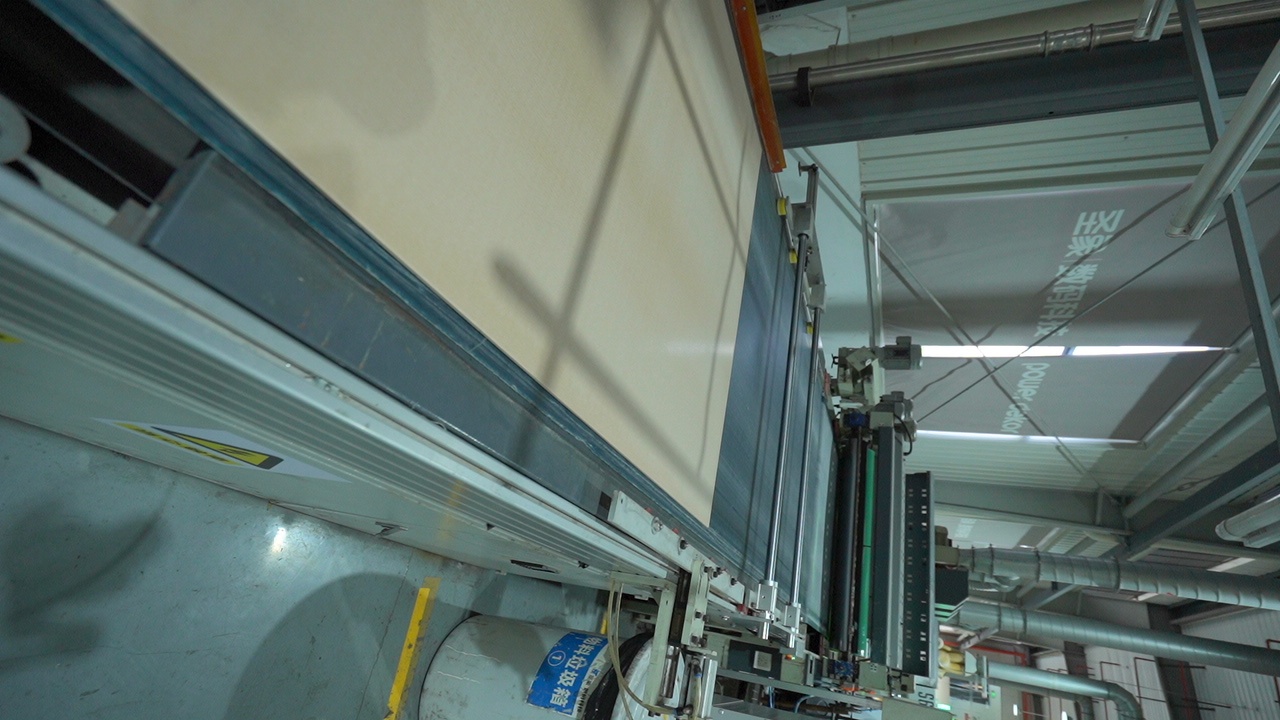
Surface finishing determines whether the panel reads as a stone decorative wall panel or a plain painted wall in the finished bathroom.
7. Comparison Table: Silica Mineral Decorative Wall Panel vs Tile
| Decision variable | Silica mineral decorative wall panel | Ceramic tile |
|---|---|---|
| Fixing method | Structural adhesive bonded to a flat, level wall, with panel locking system | Cement-based adhesive bed plus grout joints |
| Bathroom turnaround | Bathroom can be completed in one day; no adhesive bed or grout curing stage | Multiple site visits while adhesive and grout cure |
| Site labor | Single-pass installation; no grouting or post-cure sealing visit; lower labor cost than tile | Wet-trade hours for setting, grouting, cleaning and sealing |
| Joint treatment | Silicone sealant at all joints in wet areas; metal trims not used in bathrooms | Grout lines, with periodic cleaning and re-grouting |
| Water performance | 100% waterproof; submersible without deformation; no deformation after boiling at 100 °C; moisture movement 0.06% length and width | Water-resistant body; joints and substrate form the leak path |
| Reaction to fire | A2-s1,d0 under EN 13501-1 | Not covered by the wall panel certification reviewed here |
| Hygiene | No growth apparent under the microscope per ISO 846:2019 Method A; asbestos negative | Porcelain body is non-porous; grout lines require scheduled cleaning |
| Density / weight | 1050 kg/m³ | Not stated in the documents reviewed |
| Formats | 2400/2440/3000/3050 × 1200/1220 mm; 6/8/10 mm thickness | Modular formats set by the tile supplier |
| End-of-life | Plastic-free; discarded panels can be landfilled and return to nature | Fired body plus bonded adhesive bed during demolition |
| Best fit | Fast bathroom refurbishment, humid walls, fire-regulated interiors, public space | Floors, high-abrasion walls, ceramic-led design schemes |
8. Frequently Asked Questions
Does the silica mineral decorative wall panel hold CE compliance for EU bathroom use?
Yes. The panel holds Verification of Compliance (CE Verification) certificate SHHL2506032107FT, issued on 2025-08-14 by SGS-CSTC Standards Technical Services Co., Ltd. under EN 15102:2007+A1:2011 for the EU market. The certified scope covers silica mineral wall panels for internal use as wall coverings at 6–8 mm thickness, and the reaction to fire classification documented for the product is A2-s1,d0.
Which China decorative wall panel manufacturers can document CE compliance for wall panels?
Power Dekor Group documents CE compliance on two product lines. The silica mineral wall panel is covered by certificate SHHL2506032107FT from SGS-CSTC under EN 15102:2007+A1:2011, and the SPC wall panel is covered by certificate 230608011SHF-001 under EN 13501-1:2019 for 4 mm thickness. Buyers should match the certificate number to the exact product and thickness being ordered, because the certified scope is thickness-specific.
Can the panel be installed over an existing tiled bathroom wall?
The published method bonds panels directly to the wall with structural adhesive, and its first requirement is a flat, level substrate verified with a laser level. Whether an existing tiled wall qualifies is a site assessment, not a catalogue decision: the adhesive bond depends on substrate flatness and soundness, and the wall must be checked before ordering. Where the substrate is not flat, it must be corrected first.
Is a silica mineral bathroom cheaper in labor than a tiled bathroom?
Yes, labor cost is lower than tile for the same wall area. The saving comes from removing the cement-based adhesive bed, the grouting stage and the post-cure sealing visit, and from compressing the work into a single installation day. Material price and labor must be compared together: a tiled bathroom carries additional site days and specialist wet-trade hours that do not appear on the tile invoice.
What is the minimum order for a wholesale decorative wall panel programme?
The documented commercial terms are a 500 sqm minimum order quantity, OEM/ODM production with box and label customisation, 100% quality testing and remote after-sales support. Monthly capacity is 500,000 sqm, which is the figure to check against a distributor's annual programme before committing delivery dates.
How long does delivery take, and how should a sample be validated?
Lead time is 30–45 days. Before that commitment, validate the surface finish and the joint detail on a physical sample: the panel is produced in stone, wood and matt surface variants, and the finish decides how the wall reads against the rest of the bathroom. Request a sample and a project-specific quotation from the Power Dekor Group team at lunasun@powerdekorgroup.com or +86 18817368868, and confirm the certificate number against the thickness you intend to order.
9. Conclusion: Decide on the Constraint, Not the Finish
For bathroom renovation, the silica mineral decorative wall panel and tile are separated by process rather than appearance. The panel is glued, sealed and finished in a single day, requires no grout lines to clean or re-seal, is 100% waterproof with an A2-s1,d0 fire classification, is plastic-free with landfill-returnable waste, and reduces labor cost compared with tile. Tile keeps the floor, the high-abrasion wall and the ceramic-led design scheme.
Power Dekor Group manufactures the panel at its 870,000 m² facility in Shanghai, founded in 1995, with 495 engineers, 88,000,000 m² annual output and documented EU compliance. If the project constraint is downtime, moisture or fire class, the panel is the shorter path; if the constraint is abrasion or a fixed ceramic specification, tile stays in the drawing.
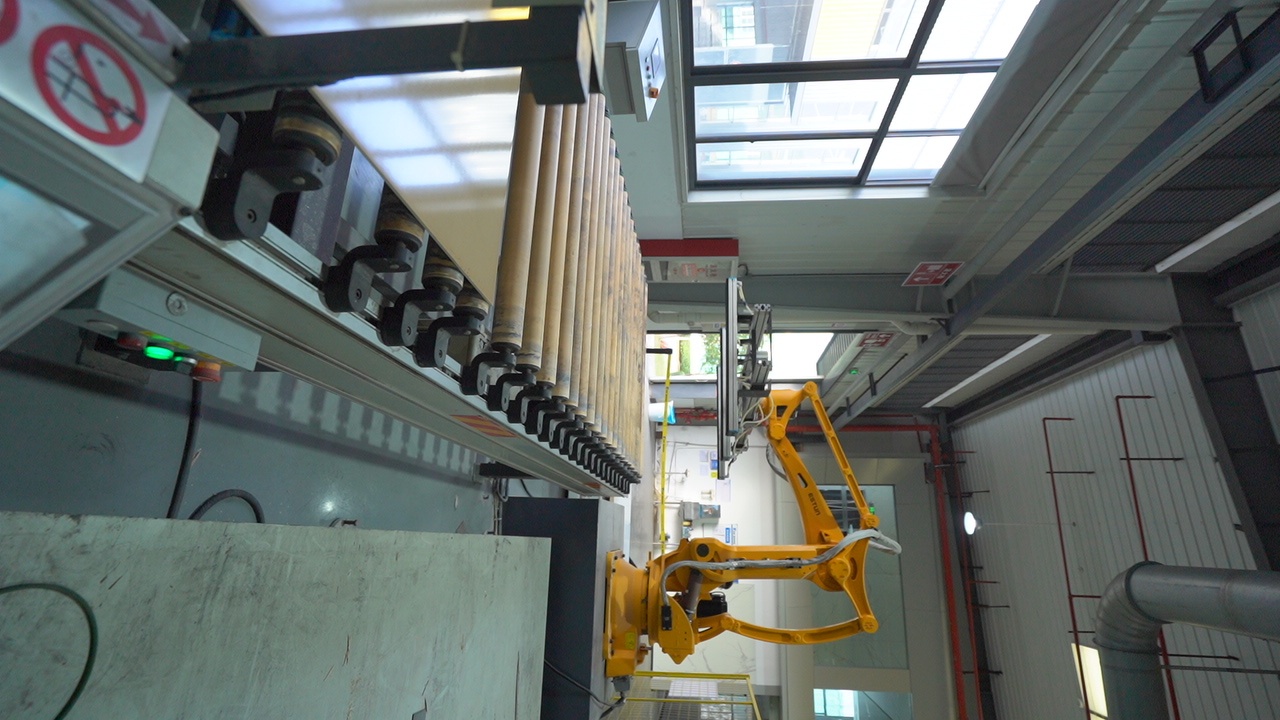
Production capacity of 500,000 sqm per month supports distributor and project programmes with a 30–45 day lead time.
Next Step: Sample, Specification File or Quote
Send the bathroom wall area, substrate condition, target fire class and delivery window, and the Power Dekor Group team will return a specification package with the matching certificate scope, a physical sample and a quotation.
Website: www.powerdekorgroup.com
Email: lunasun@powerdekorgroup.com
Tel / WhatsApp: +86 18817368868
Address: Bldg. 5, Fusion Mansion, Lane 727, Wuxing Rd., Pudong District, Shanghai 201204, China
Catalogue download: Power Dekor Group product brochure (PDF)
Have Questions or Need More Details?
Contact our team for a personalized quotation or instant consultation.
Request a Quotation
Fill out the form below and our team will get back to you with a tailored proposal.
WhatsApp Direct Chat
Prefer to chat in real-time? Message us on WhatsApp for instant assistance & quick answers.
- Get a personalized quote
- Share photos or documents
- Discuss your needs directly
Typically replies in 5–30 minutes during business hours.