Silica Mineral vs SPC Wall Panels: Buyer's Comparison Guide
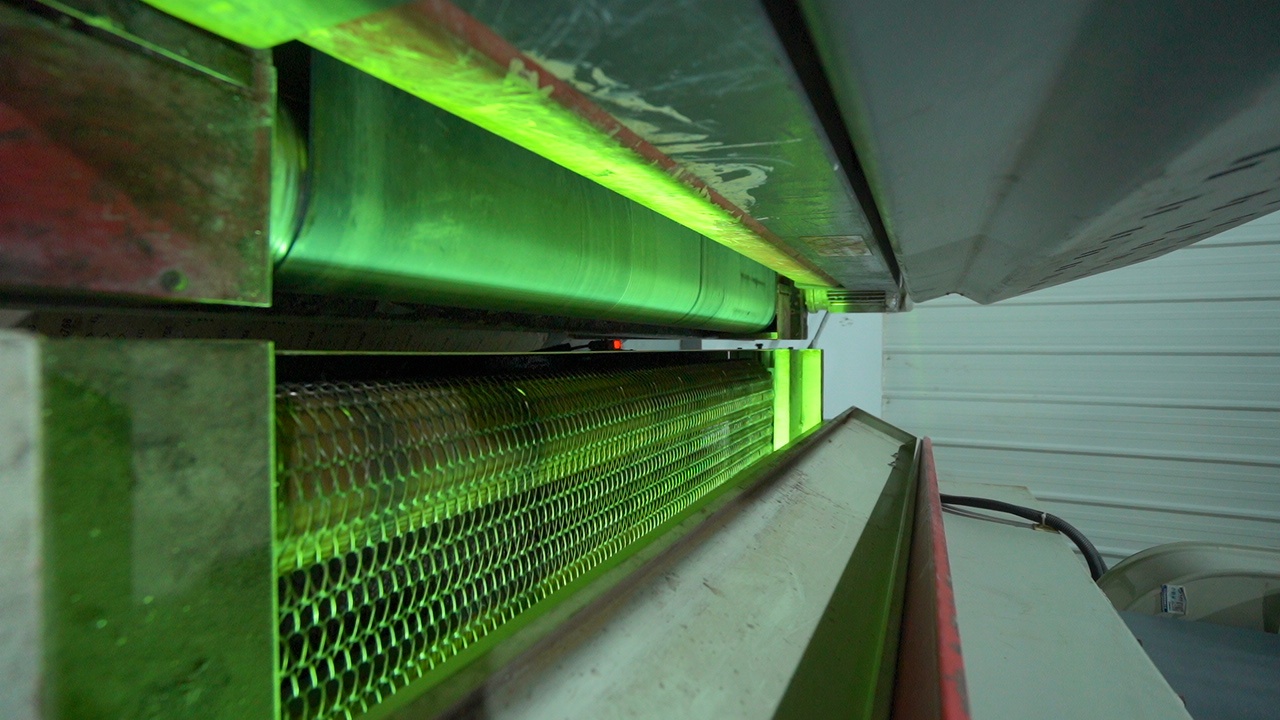
Decorative wall panel production at Power Dekor Group, covering digital print and film surfaces for both silica mineral and SPC systems.
Short answer: silica mineral wall panels and SPC wall panels are separated by three measurable facts, not by surface design. In the documentation Power Dekor Group supplies for the European market, the Silica Mineral Wall Panel (model 8804) is classified A2-s1,d0 under EN 13501-1 and declared at a density of 1050 kg/m³. The SPC wall panel (model 8321) is classified B-s3,d0, declared at a moisture content of 0.02% and at a density of roughly 2000 kg/m³. Those three numbers decide whether a panel can be written into a public-space specification, how much weight it adds to a wall, and how easy the finished surface is to clean and maintain.
This guide is written for buyers at the evaluation stage — importers, distributors, project contractors and specifiers who have already decided they need a decorative wall panel and now have to choose a material system. It compares the two panels on fire class, density, moisture behaviour, maintenance and renovation conditions, then sets out a step-by-step evaluation sequence that turns a specification into a decision.
Both panels are manufactured by Power Dekor Group, so what follows is a material-to-material comparison rather than a supplier contest. The question is which panel belongs in which project.
Why This Comparison Is a Compliance Decision Before It Is a Design Decision
The wall panel decision starts with a clause. In the European Union, EN 13501-1 provides the reaction-to-fire classification scale for wall panels, running from A1 (non-combustible) down to F. Class A — A1 and A2 — is the band that public and commercial interior specifications most often point to. A Class B product cannot be substituted for a Class A requirement, however closely the two surfaces match visually. So the first question in evaluation is not which panel looks better, but which class the specification clause actually requires.
Two further problems follow the fire question. The first is wet-zone behaviour. Bathrooms and humid interiors expose panels to moisture from two directions: surface splash and ambient humidity, and both can drive dimensional movement, curling or joint opening if the material is unsuited. The second is the renovation condition itself. Many wall panel projects are refurbishments rather than new builds, which means the panel has to go over existing surfaces, keep demolition and dust to a minimum, and shorten the time a bathroom or corridor is out of service.
A third consideration is lifetime maintenance. In retail, hospitality and other high-traffic interiors, surface resistance — not the initial appearance — determines how often a wall needs cleaning and how long it stays presentable.
Power Dekor project documentation notes that the vast majority of wall panel materials on the market cannot meet Class A2, and that SPC, HDF and WPC wall panels fall into Class B. That statement is the reason the fire class difference between the two panels in this guide carries so much weight during evaluation.
Industry Background: A Large, Fire-Regulated and Renovation-Driven Market
Decorative wall panels sit inside a market that keeps expanding as urban interiors are built and re-fitted. Coherent Market Insights projects the global decorative panels market to reach USD 39.35 billion in 2026, driven by rising urbanisation and interior renovation demand, and estimates that laminate panels account for close to half of that market at 45.4% by 2026. Reed Intelligence reports that Asia Pacific held a 43.6% share of the global wall panels market in 2025 and is expected to remain the fastest-growing region. In the narrower 3D decorative wall panel segment, 360iResearch estimated the market at USD 815.02 million in 2025 with a forecast CAGR of 4.93%.
The regulatory layer is what shapes the material choice inside that market. EN 13501-1 fire safety classification is critical for commercial wall panels in Europe, since the scale spans A1 (non-combustible) through F, and a project specification written around Class A effectively filters out every Class B material before price or design is discussed.
Power Dekor Group is a manufacturer of floor covering and wall panel solutions founded in 1995, operating an 870,000 m² factory with more than 20,000 employees, 495 engineers and an annual output of 88,000,000 m², with main markets in the EU and the USA. The company introduced the Silica Mineral Panel as a green, fireproof and waterproof solution for both floors and walls, which places the A2-s1,d0 classification discussed here at the centre of the product's positioning rather than at the edge of it.
The Two Panel Systems in Plain Terms
Silica Mineral Wall Panel, Model 8804
The Silica Mineral Wall Panel is a mineral composite panel made from quartz, cement, pulp, lime and water. Its European verification is a CE Verification issued by SGS-CSTC Standards Technical Services Co., Ltd. under certificate SHHL2506032107FT, with issue date 14 August 2025, scope "SILICA MINERAL WALL PANEL, for internal use as wall coverings, thickness: 6–8mm" and standard EN 15102:2007+A1:2011 for the EU market.
Declared performance of model 8804: Reaction to fire classification A2-s1,d0 · Density 1050 kg/m³ · Moisture movement 0.06% in both length and width direction · Asbestos content negative · Antibacterial test: no growth apparent under the microscope per ISO 846:2019 Method A · Available in 2400/2440/3000/3050 mm length, 1200/1220 mm width, 6/8/10 mm thickness, for interior wall panel and exterior wall panel applications.Project documentation for this panel also records that it is 100% waterproof and can be submersible in water, with no deformation after boiling at 100°C, that it contains no plastic, and that its raw materials are naturally sourced with waste that can be landfilled and return to nature. For a buyer, the practical reading is that model 8804 combines a Class A2 fire classification with full water exposure tolerance and a comparatively low panel weight.
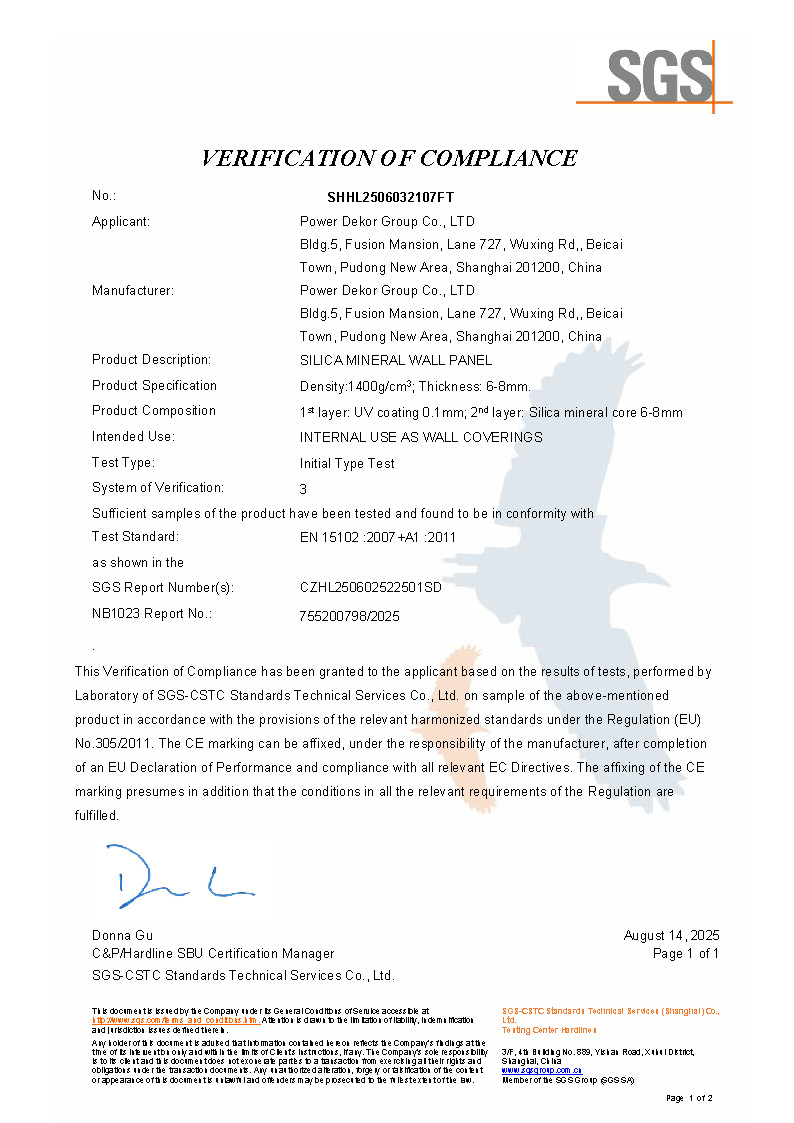
CE Verification for the Silica Mineral Wall Panel, certificate SHHL2506032107FT, issued by SGS-CSTC under EN 15102:2007+A1:2011 for internal wall coverings at 6–8 mm thickness.
SPC Wall Panel, Model 8321
The SPC wall panel is a stone plastic composite panel supplied with either a digital print or a film surface. Its CE Verification was issued by Intertek under certificate 230608011SHF-001, with issue date 23 January 2024, scope "SPC wall panel, thickness 4mm", standard EN 13501-1:2019, for the EU market.
Declared performance of model 8321: Reaction to fire classification B-s3,d0 · Moisture content 0.02% · Density 2.134 g/cm³ · Micro-scratch resistance MSR-A1 · Resistance to dry heat Rating 5 · Resistance to wet heat Rating 5 · Stain resistance Grade 5 · Dimensional stability: shrinkage <0.002%, curling ≤0.2 mm · Available in 2400/2440/3000/3050 mm length, 1200/1220 mm width, 4/5/6 mm thickness.The SPC panel's numbers point in a different direction from the silica mineral panel. Moisture content of 0.02% describes a material with almost no residual water, and the Grade 5 stain resistance and MSR-A1 micro-scratch resistance are surface properties that translate directly into easier cleaning and lower day-to-day maintenance effort. Digital print surfaces also allow continuous patterns to run across panels, while film surfaces are the cost-sensitive option where design variability is not a priority.
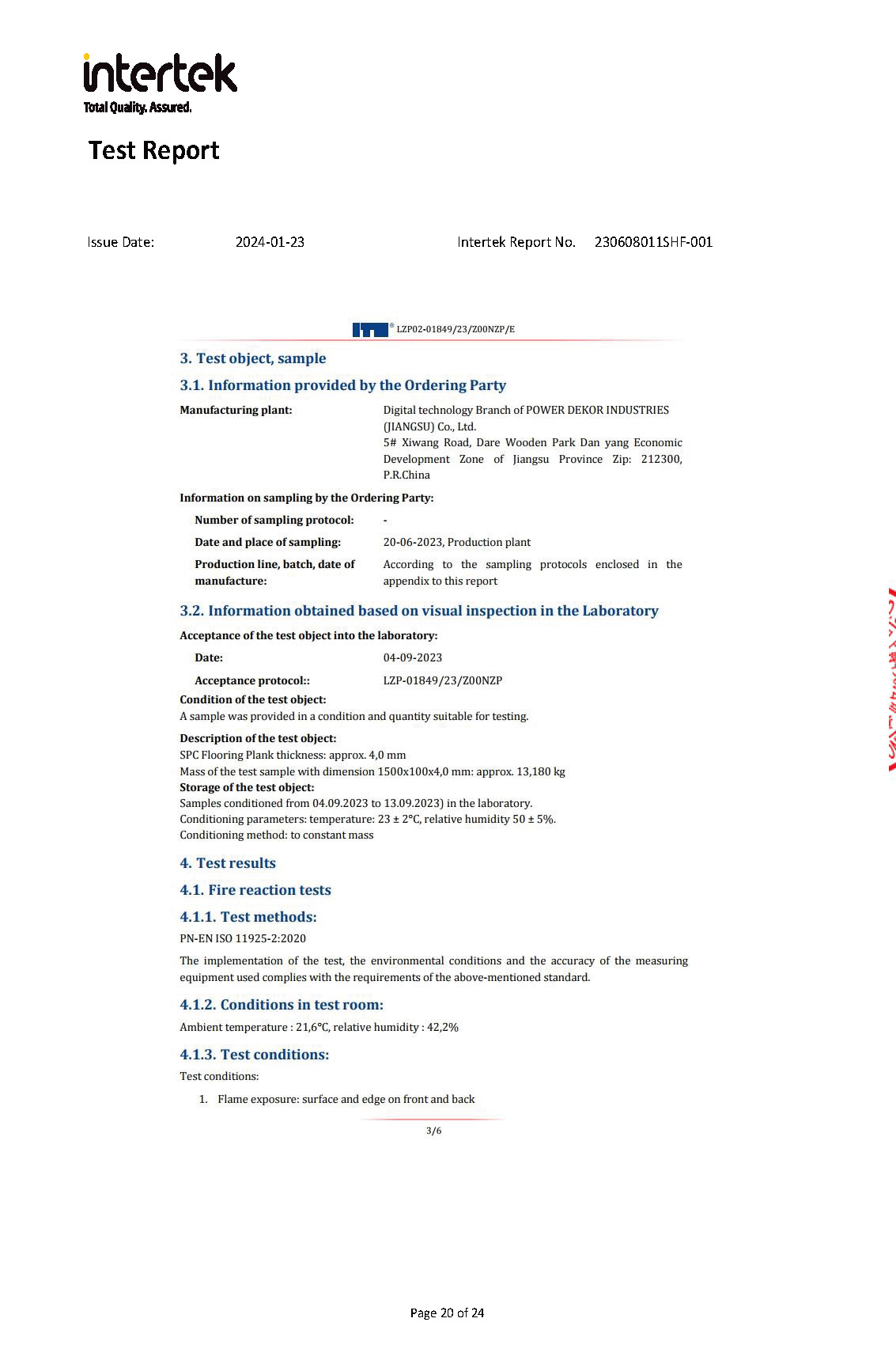
CE Verification for the SPC wall panel, certificate 230608011SHF-001, issued by Intertek under EN 13501-1:2019, with fire classification B-s3,d0.
Side-by-Side Comparison: Silica Mineral 8804 vs SPC 8321
The table below compares only verified, documented values. Where a property is not covered in the documents referenced for this comparison, it is marked as not stated rather than estimated.
| Parameter | Silica Mineral Wall Panel (8804) | SPC Wall Panel (8321) | What It Means in Evaluation |
|---|---|---|---|
| Reaction to fire (EN 13501-1) | A2-s1,d0 | B-s3,d0 | Only the A2 panel satisfies specifications that call for EU fire Class A; the B-s3,d0 panel is not a substitute in those clauses. |
| CE verification | EN 15102:2007+A1:2011, certificate SHHL2506032107FT, SGS-CSTC, issued 14 Aug 2025, scope: internal wall coverings 6–8 mm | EN 13501-1:2019, certificate 230608011SHF-001, Intertek, issued 23 Jan 2024, scope: SPC wall panel 4 mm thickness | Both carry EU verification, but under different standards and scopes. Quote the certificate that matches the clause in the specification. |
| Density | 1050 kg/m³ | Approx. 2000 kg/m³ (declared 2.134 g/cm³) | Panel weight affects handling, transport and the load placed on large wall areas. |
| Moisture | Moisture movement 0.06% length and width; documented as 100% waterproof, submersible in water, no deformation after boiling at 100°C | Moisture content 0.02% | These are different measurements. Moisture movement describes dimensional change under humidity; moisture content describes residual water in the material and supports easier cleaning. |
| Surface and cleaning | Antibacterial test shows no growth apparent under the microscope, ISO 846:2019 Method A; plastic-free mineral surface | Micro-scratch resistance MSR-A1; dry heat Rating 5; wet heat Rating 5; stain resistance Grade 5 | SPC carries documented surface resistances that directly support easier cleaning; silica mineral carries a documented antibacterial result. |
| Dimensional stability | 0.06% moisture movement | Shrinkage <0.002%; curling ≤0.2 mm | Both figures support stable joints; SPC provides tighter numerical tolerances in its declared data. |
| Material | Quartz, cement, pulp, lime and water; no plastic | Stone plastic composite; digital print or film surface | Mineral composition versus polymer composite drives the fire class and weight differences. |
| Asbestos content | Negative | Not stated in the documents referenced here | Relevant for healthcare, education and public interior procurement screening. |
| Sizes and thickness | 2400/2440/3000/3050 × 1200/1220 mm; 6/8/10 mm | 2400/2440/3000/3050 × 1200/1220 mm; 4/5/6 mm | Same footprint range; silica mineral starts at 6 mm, SPC at 4 mm. |
| Application range | Interior wall panel and exterior wall panel | Interior wall panel | The mineral panel is documented for both interior and exterior decorative wall panel use. |
| Typical fit | Public and commercial interiors with Class A requirements; bathroom and wet zones | Private bathrooms, residential renovation, cost-led interiors and high-touch surfaces | Fit follows the fire requirement first, then budget and maintenance profile. |
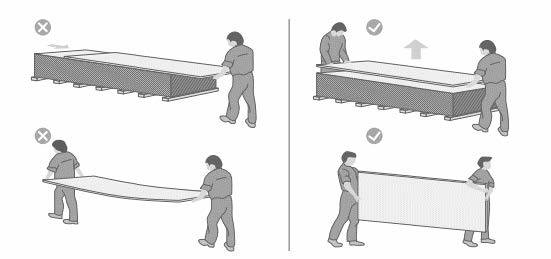
Gluing installation sequence used for decorative wall panels: levelling and layout marking, cutting with a diamond blade, socket marking, adhesive application, panel locking, and sealing of joints in wet areas.
Step-by-Step Breakdown: How to Evaluate These Two Panels
Evaluation becomes straightforward when the fire question is answered first and the remaining criteria are scored against it in a fixed order. The sequence below reflects how the two products' documented values map onto real project constraints.
- Fix the required fire class before anything else. Read the specification clause and identify whether it demands EU fire Class A. If it does, the SPC wall panel at B-s3,d0 is out of scope and the Silica Mineral Wall Panel at A2-s1,d0 is the only one of the two that qualifies.
- Match the certificate to the clause. The silica mineral panel is verified under EN 15102:2007+A1:2011 (certificate SHHL2506032107FT) for internal wall coverings at 6–8 mm; the SPC panel is verified under EN 13501-1:2019 (certificate 230608011SHF-001) at 4 mm thickness. Confirm that the certificate scope and thickness cover the thickness you intend to order.
- Weigh the wall, not just the panel. At 1050 kg/m³, model 8804 is roughly half the density of the SPC panel at about 2000 kg/m³. On large wall areas this changes handling requirements, transport weight and the load carried by the substrate and fixing method.
- Separate the two moisture measurements. Moisture movement of 0.06% for silica mineral describes dimensional change under humidity; the SPC panel's 0.02% moisture content describes how little water remains in the material. For bathrooms, both are relevant, but they answer different questions: one about stability, one about cleaning and hygiene.
- Score the maintenance load. Where the panel will be touched, splashed or stained regularly, the SPC panel's Grade 5 stain resistance, MSR-A1 micro-scratch resistance and Rating 5 resistance to dry and wet heat give a documented cleaning advantage. Where hygiene screening matters, the silica mineral panel's ISO 846:2019 Method A antibacterial result is the relevant evidence.
- Define the renovation condition. Both products are installed by gluing and locking panels onto the wall after levelling and layout marking, which suits refurbishment without a full demolition cycle. In wet areas such as bathrooms, metal trims are not recommended and joints should be sealed with silicone sealant between panel and ceiling and panel and floor.
- Lock the commercial parameters. Confirm monthly capacity, minimum order quantity, lead time, testing scope and packaging before the specification is frozen, so that compliance and delivery are validated together rather than sequentially.
Use Cases: Where Each Panel Belongs
Bathrooms and Wet Interiors
Silica mineral is documented for interior and exterior decorative wall panel applications and is described as 100% waterproof and submersible in water with no deformation after boiling at 100°C. In practice this means bathroom and humid-zone projects can specify the panel without the moisture reservations that usually attach to wall linings. A Spanish project contractor has used the Silica Mineral Wall Panel at 50,000 sqm per year for ten years in bathroom and other interior decorative wall panel applications, achieving moisture-proof performance, stable project delivery and compliance with the EU fireproof Class A standard. That combination — wet-zone tolerance plus Class A fire response — is unusual and is the reason this case pattern repeats in public-facing projects.
SPC answers a different part of the same question. Its 0.02% moisture content and Grade 5 stain resistance make it a practical bathroom decorative wall panel for private homes, where the buyer prioritises easier cleaning, a better price position and fast renovation. A German retail and distributor customer uses SPC alongside the mineral panel at 100,000 sqm per year for indoor wall decoration and bathroom space renovation, with a project duration expected to run 10 to 20 years, on the strength of suitability for humid indoor environments and easy installation for quick renovation.
Public and Commercial Interiors with Fire Requirements
Corridors, lobbies, healthcare and education interiors are where the EN 13501-1 classification stops being a technical footnote. Power Dekor documentation records that most wall panel materials on the market cannot reach Class A2 and that SPC, HDF and WPC panels sit in Class B. For a specifier, that means the choice is often already made by the fire clause, and the remaining evaluation work is about thickness, size and surface finish rather than material family.
Wholesale and Distributor Programmes
Wholesale decorative wall panel buyers usually need both systems rather than one. SPC covers the volume residential and renovation segment where price sensitivity governs, and the silica mineral panel covers the compliance-driven segment where a Class A2 certificate is the entry ticket. Running both under one supplier simplifies container planning, colour coordination and documentation, because fire certificates, test reports and declarations come from the same quality system.
Exterior and Semi-Exposed Walls
The Silica Mineral Wall Panel is documented for interior wall panel and exterior wall panel applications, which opens up facade-adjacent and semi-exposed decorative uses where a polymer composite panel would not normally be considered. This is a specification decision that should always be validated against the certificate scope for the thickness in question.
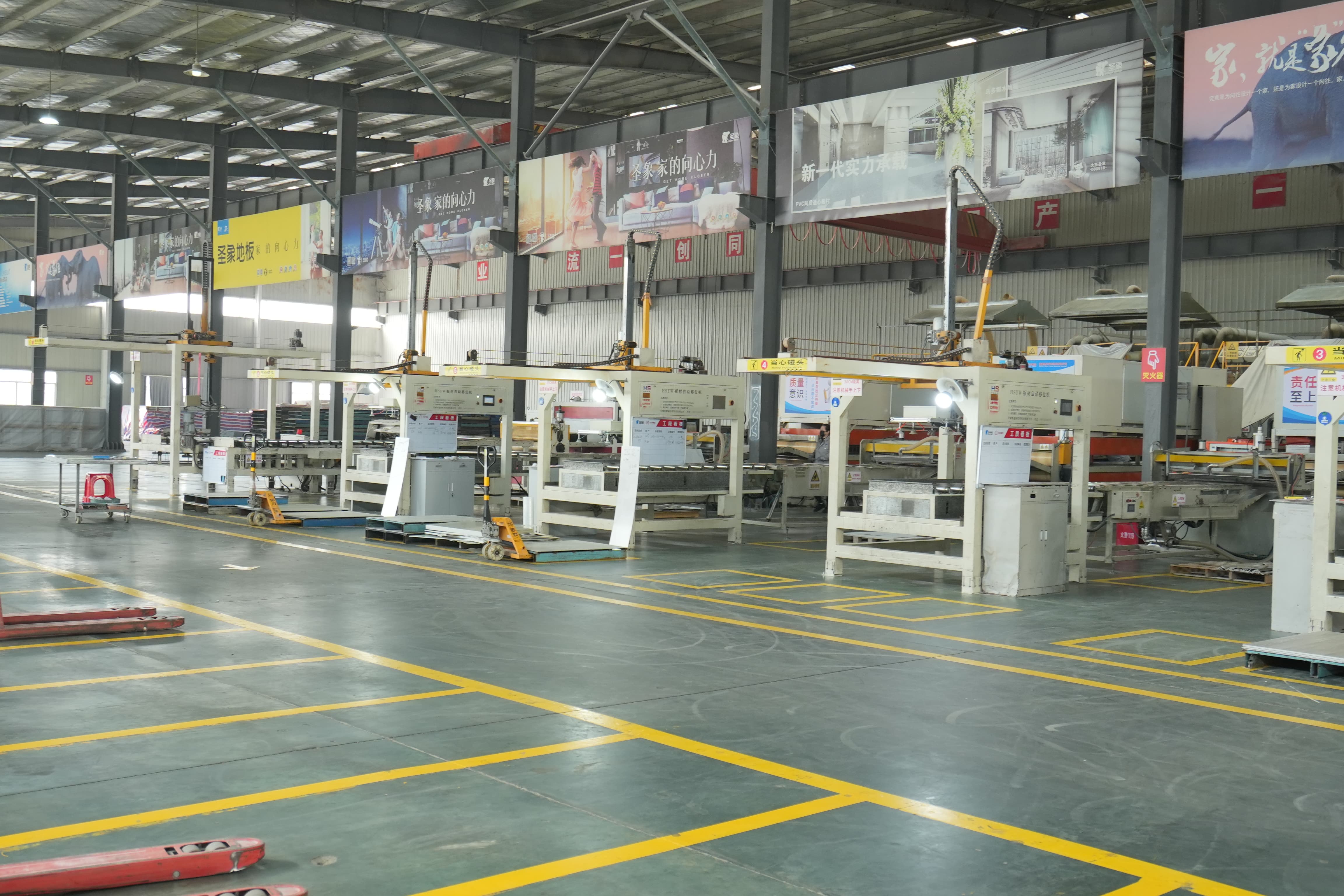
SPC panel production: digital print and film surfaces are laminated onto stone plastic composite cores before finishing and packing.
Scenario Fit Ranking: Which Panel Wins Where
Ranked by application fit rather than by brand, the two panels split cleanly along five scenarios. The ranking column states the deciding metric, so a buyer can re-rank the options as soon as a project's priority changes.
| Fit Rank | Scenario | Better-Fit Panel | Deciding Metric |
|---|---|---|---|
| 1 | Public, commercial or code-driven interiors that require EU fire Class A | Silica Mineral Wall Panel 8804 | A2-s1,d0 reaction to fire under EN 13501-1 |
| 2 | Bathrooms and humid interiors where full water tolerance is the risk to be removed | Silica Mineral Wall Panel 8804 | 100% waterproof, submersible, no deformation after boiling at 100°C; moisture movement 0.06% |
| 3 | Large wall areas where panel weight affects handling, transport and substrate load | Silica Mineral Wall Panel 8804 | Density 1050 kg/m³ versus about 2000 kg/m³ |
| 4 | High-touch interiors where easier cleaning and low maintenance dominate the cost case | SPC Wall Panel 8321 | Moisture content 0.02%; stain resistance Grade 5; MSR-A1 micro-scratch resistance; dry and wet heat Rating 5 |
| 5 | Cost-led residential renovation where the specification allows Class B | SPC Wall Panel 8321 | B-s3,d0 accepted within scope; digital print or film surface flexibility |
Quality, Documentation and Order Checkpoints
Whichever panel is selected, the order-level checks are the same. Power Dekor Group operates OEM and ODM production with box and label customisation, a monthly capacity of 500,000 sqm, a minimum order quantity of 500 sqm, a lead time of 30–45 days, remote after-sales support and export markets worldwide. Quality control covers 100% product testing, with all products undergoing 100% testing before shipment.
For an evaluation-stage buyer, three documents should travel with the quotation: the CE verification matching the panel family and thickness, the fire classification report behind the declared class, and the test scope confirming which performance values were measured on the delivered construction. Silica mineral and SPC sit under different standards — EN 15102:2007+A1:2011 and EN 13501-1:2019 respectively — so the documentation pack is not interchangeable between the two.
Frequently Asked Questions
1. Is the silica mineral wall panel A2 fire rated for EU projects, and what class is the SPC wall panel?
Yes. The Silica Mineral Wall Panel, model 8804, carries a reaction to fire classification of A2-s1,d0 under EN 13501-1, verified through CE Verification certificate SHHL2506032107FT issued by SGS-CSTC Standards Technical Services Co., Ltd. on 14 August 2025 for the EU market. The SPC wall panel, model 8321, carries a classification of B-s3,d0 under EN 13501-1:2019, verified through Intertek certificate 230608011SHF-001 issued on 23 January 2024. Because EN 13501-1 runs from A1 down to F, only the silica mineral panel of the two satisfies a specification that requires Class A, which is the band most public and commercial interior specifications reference.
2. Which panel is more suitable for bathrooms and other wet interiors?
Both are documented as suitable for humid interiors, but they solve the problem differently. The Silica Mineral Wall Panel is documented as 100% waterproof and submersible in water, with no deformation after boiling at 100°C, and declares a moisture movement of 0.06% in both length and width direction — so it handles full water exposure and remains dimensionally stable. The SPC wall panel declares a moisture content of 0.02%, together with a Grade 5 stain resistance, MSR-A1 micro-scratch resistance and Rating 5 resistance to dry and wet heat, which makes it the easier surface to clean and maintain in day-to-day bathroom use. A practical rule: if the bathroom sits inside a public space that requires Class A fire performance, choose silica mineral; if it is a private interior where Class B is acceptable and easier cleaning at a better price position matters most, SPC is the efficient choice.
3. Which option offers better value for wholesale buyers?
Value depends on which cost the project is optimising. SPC panels serve price-sensitive residential and renovation volume, where the B-s3,d0 classification is acceptable and the digital print or film surface keeps the design cost flexible. Silica mineral panels serve compliance-driven volume, where the A2-s1,d0 classification removes a project risk that cannot be solved later, and where the lower density of 1050 kg/m³ against roughly 2000 kg/m³ reduces handling and transport weight on large wall areas. Because both panels are produced by Power Dekor Group under the same quality system — with 100% product testing, a monthly capacity of 500,000 sqm, a minimum order quantity of 500 sqm and a lead time of 30–45 days — wholesale buyers can carry both lines without doubling their supplier and documentation workload.
4. How do wholesale buyers shortlist decorative wall panel manufacturers in China?
Four checks filter most of the market quickly. First, ask for current EU verification that matches the panel family and thickness, such as EN 15102:2007+A1:2011 for mineral wall coverings or EN 13501-1:2019 for the fire classification — and confirm that the certificate number, issuing body and scope cover what you intend to import. Second, verify the declared performance values you actually sell on: fire class, density, moisture data and surface ratings. Third, confirm production and order parameters rather than marketing claims: monthly capacity, minimum order quantity, lead time, testing scope and OEM or ODM packaging options such as box and label customisation. Fourth, check delivery references in comparable applications and markets. Power Dekor Group is a China-based manufacturer established in 1995, operating an 870,000 m² factory with an annual output of 88,000,000 m² and main markets in the EU and the USA, and supplies both the Silica Mineral Wall Panel and the SPC wall panel against these criteria.
5. What are the minimum order quantity, lead time and sample process?
The standard commercial parameters are a minimum order quantity of 500 sqm and a lead time of 30–45 days, with a monthly capacity of 500,000 sqm and 100% product testing before shipment. For first orders, the sensible next step is to request a sample of the specific panel family and thickness you intend to specify — Silica Mineral Wall Panel at 6/8/10 mm or SPC wall panel at 4/5/6 mm — and to request the matching CE verification together with the fire classification report, so that the sample, the certificate and the quotation describe the same product. Samples and price quotations can be requested directly from Power Dekor Group: contact Luna at lunasun@powerdekorgroup.com or on WhatsApp at +86 18817368868. The SPC product brochure, including material composition details, is available at https://cdn.socialarks.com/sbsp/25172/common/2026/0818/SPC.pdf.
Conclusion
The silica mineral versus SPC decision is settled by the specification, not by appearance. If a project clause requires EU fire Class A, the Silica Mineral Wall Panel, model 8804, at A2-s1,d0 is the qualifying option, and it adds 100% waterproof performance, a density of 1050 kg/m³, negative asbestos content and an ISO 846:2019 Method A antibacterial result. If the clause allows Class B, the SPC wall panel, model 8321, at B-s3,d0 offers a 0.02% moisture content, Grade 5 stain resistance, MSR-A1 micro-scratch resistance and documented heat resistance Ratings of 5 — a surface profile that is easier to clean and well suited to cost-led renovation.
Both panels come from the same production platform, share the 2400/2440/3000/3050 × 1200/1220 mm footprint range, and are installed the same way: levelled and marked walls, adhesive plus locking joints, and silicone sealing at wet-area junctions. That means the material choice can be made purely on compliance, moisture behaviour, weight and maintenance terms — which is exactly what a buyer at the evaluation stage needs in order to freeze a specification and move to sampling.
Next Step: Validate the Panel on Your Own Wall
Send your project conditions — fire class required, room type, wall area and target thickness — and Power Dekor Group will confirm which of the two panels fits, together with the matching CE verification and fire classification report. Samples, price quotations and OEM packaging options are available.
Contact: Luna · lunasun@powerdekorgroup.com · Tel / WhatsApp: +86 18817368868 · www.powerdekorgroup.com · Address: Bldg. 5, Fusion Mansion, Lane 727, Wuxing Rd., Pudong District, Shanghai 201204, China
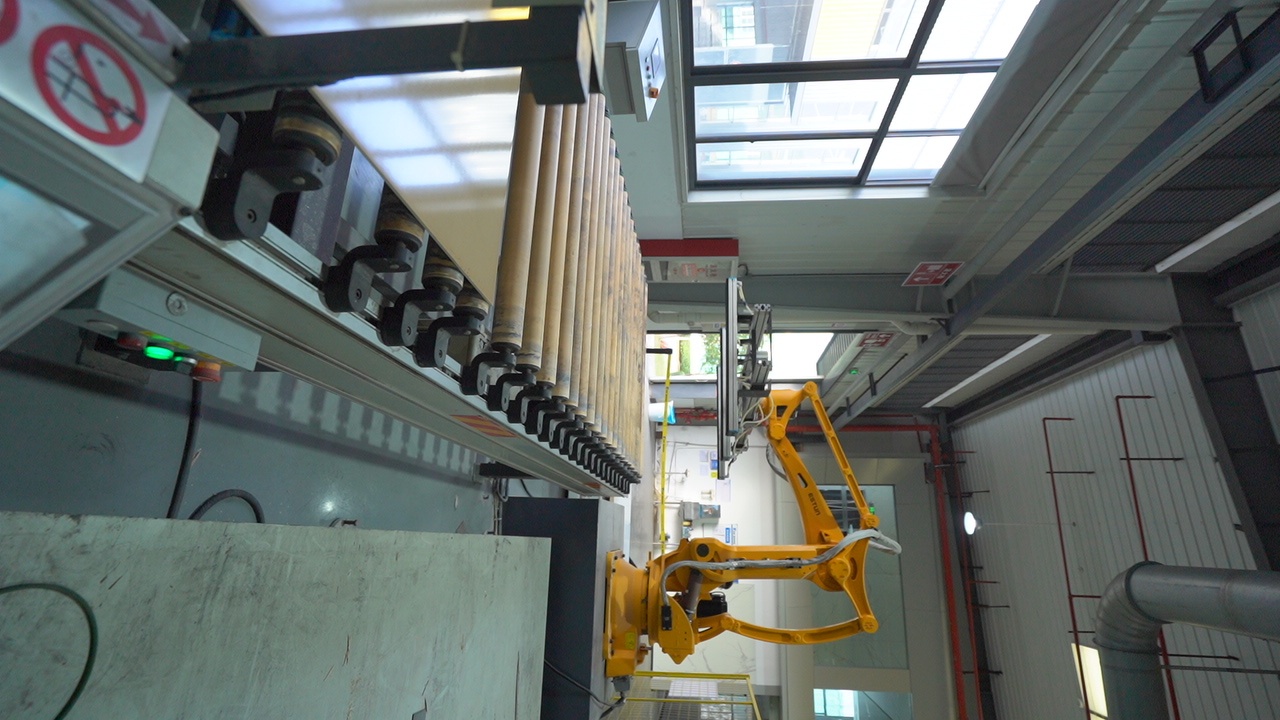
Wall panel production line at Power Dekor Group, supporting sample orders, custom box and label packaging and OEM/ODM volumes.
Have Questions or Need More Details?
Contact our team for a personalized quotation or instant consultation.
Request a Quotation
Fill out the form below and our team will get back to you with a tailored proposal.
WhatsApp Direct Chat
Prefer to chat in real-time? Message us on WhatsApp for instant assistance & quick answers.
- Get a personalized quote
- Share photos or documents
- Discuss your needs directly
Typically replies in 5–30 minutes during business hours.