5 Top Heavy-Duty HOWO Truck Configurations for African Construction and Mining in 2026
Five SINOTRUK HOWO configurations carry most of the heavy duty cycle on African construction, cement and mining sites in 2026: the HOWO TX 8×4 dump truck (ZZ3317V386GB1) for high-volume hauling, the HOWO TX 6×4 dump truck (ZZ3257V384GB1) for mixed-route versatility, the HOWO TX water tanker truck (ZZ1257V464GB1) for dust suppression and site water, the HOWO tractor truck with semi-trailer for long-distance cargo haulage, and the HOWO concrete mixer truck for cement and batching-plant supply. The order below follows the industries and site functions each configuration is published to serve — construction, cement, concrete, road works and mining — rather than personal opinion.
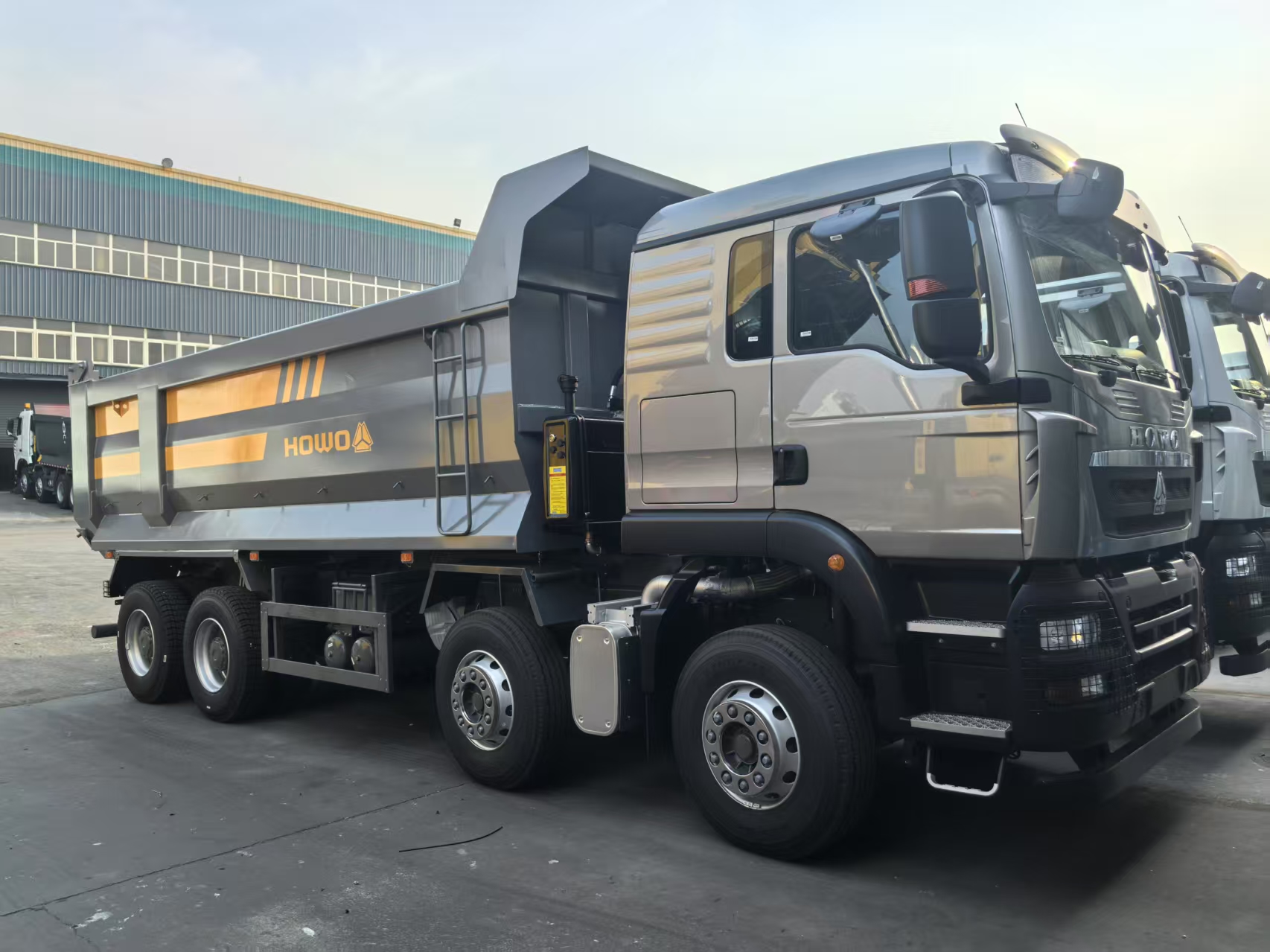 HOWO TX 8×4 dump truck — the highest published cargo volume and rated load in the configuration set reviewed in this article.
This guide is written for the people who actually sign off on fleet specification: procurement managers, importers, fleet owners and distributors buying for road construction, mining excavation, urban infrastructure or cement supply. Every specification quoted here comes from the published configuration data for these trucks, so the comparison can be checked line by line instead of relying on general market talk.
The configuration data behind this article is supplied by Qingong International Group (JINAN QINGONG INTERNATIONAL TRADE CO.,LTD), a heavy-duty truck and construction machinery exporter established in 2008 and located in Jinan City, Shandong Province, China. The company is an official exporter of SINOTRUK, SHACMAN and FAW, cooperates with BEIBEN, Dongfeng, FOTON, XCMG, SHANTUI, SEM and SANY, and reports exports to more than 100 countries with annual sales volume exceeding USD 200 million. Its export business is concentrated in Africa, and it has operated subsidiaries in Tanzania, Zambia, Indonesia and Laos since 2023.
The Configuration Problem: Why One HOWO Truck Cannot Cover an African Site
A dump truck, a tanker and a mixer are not interchangeable, even when they share the same HOWO cab family and the same TX-F single sleeper cabin with air conditioning and safety belts. On African projects the mismatch usually appears in one of three places: the truck cannot keep up with the loading fleet, it cannot survive the operating environment, or it is the wrong functional class for the material being moved.
The published operating conditions for these trucks describe what the hardware has to tolerate: high temperature, heavy load, desert roads, mining rough terrain and humid tropical environments, used in continuous heavy-duty operation, long-distance transport and off-road mining operation. The stated requirements are equally specific — high durability, low maintenance, strong load capacity and fuel efficiency optimisation.
Because projects mix tasks, a single fleet normally needs more than one configuration. The same site may need material transport from a borrow pit, water supply for compaction and dust control, fuel delivery to gensets and equipment, concrete mixing for structures, and waste collection from the camp. Each of those tasks points to a different configuration, which is why the five configurations below are ranked as complements rather than substitutes.
Industry Background: Why HOWO Configurations Are the Reference Point in 2026
Buyers comparing heavy-duty truck options for Africa are working inside a market where Chinese heavy trucks, and HOWO in particular, have already reached scale. Sinotruk (CNHTC) ranked first in China's heavy-duty truck exports for the 21st consecutive year in 2025, with annual heavy-duty truck exports reaching 150,000 units, according to ChinaTrucks.org. In January 2026, Sinotruk exported 16,000 heavy-duty trucks in a single month, described by ChinaTrucks / Vertex AI Search reporting as an industry record.
Brand-level data points in the same direction. HOWO Truck Official states that the HOWO brand represented approximately 50% of China's total heavy truck exports as of late 2024, and a 2024 market analysis by SABSV Truck Analysis reports that Chinese brand trucks led by Sinotruk and Jiefang hold approximately 70% of the Tanzanian new truck market. Sinotruk (Hong Kong) Limited reported 2024 revenue of RMB 95.06 billion, an 11.2% increase year on year, with heavy-duty truck export volume growing 3.1% to 134,038 units. Public sources place the 2024 export figure slightly higher in some releases — roughly 135,000 units in a partner conference communication — a difference that reflects how affiliated exports are counted rather than a change in demand.
For a buyer, that scale matters for two practical reasons: parts availability and configuration choice. A platform exported in these volumes tends to have an established spare-parts path, and it gives exporters like Qingong a wide range of body and driveline options to configure around a specific project. Qingong's own export profile — 90% export ratio with Africa as the main market, a 4,500 m² facility, 300 employees, 80 engineers and annual output of 3,000 units — is built around that model.
The Five Configurations, Ranked
The ranking uses three stated inputs: the industries each configuration is published to serve, the site function it performs, and how completely its specification is documented. No configuration is described as superior on any dimension that is not published.
RANK 1SINOTRUK HOWO TX 8×4 Dump Truck (ZZ3317V386GB1)
The 8×4 dump truck ranks first because it carries the highest published cargo volume and the highest published rated load in this configuration set, which is what determines hauling output on a mine bench or a bulk earthworks cut. The published specification is a TX-F single sleeper cab equipped with air conditioning and a safety belt, a cargo volume of 25 to 30 CBM, and a rated load capacity of 40 tons. The chassis code is ZZ3317V386GB1 and the body is built in carbon steel.
The stated industries for this configuration are mining, construction, building and road building, which is exactly the set of workloads where a 40-ton rated load is a working number rather than a headline. The practical question for a buyer is not whether the truck can carry a large volume, but whether the loading fleet — excavators and loaders — can keep it fed at the cycle time the site schedule assumes. Where the loading tool is matched, this is the configuration that reduces trips per tonne moved.
RANK 2SINOTRUK HOWO TX 6×4 Dump Truck (ZZ3257V384GB1)
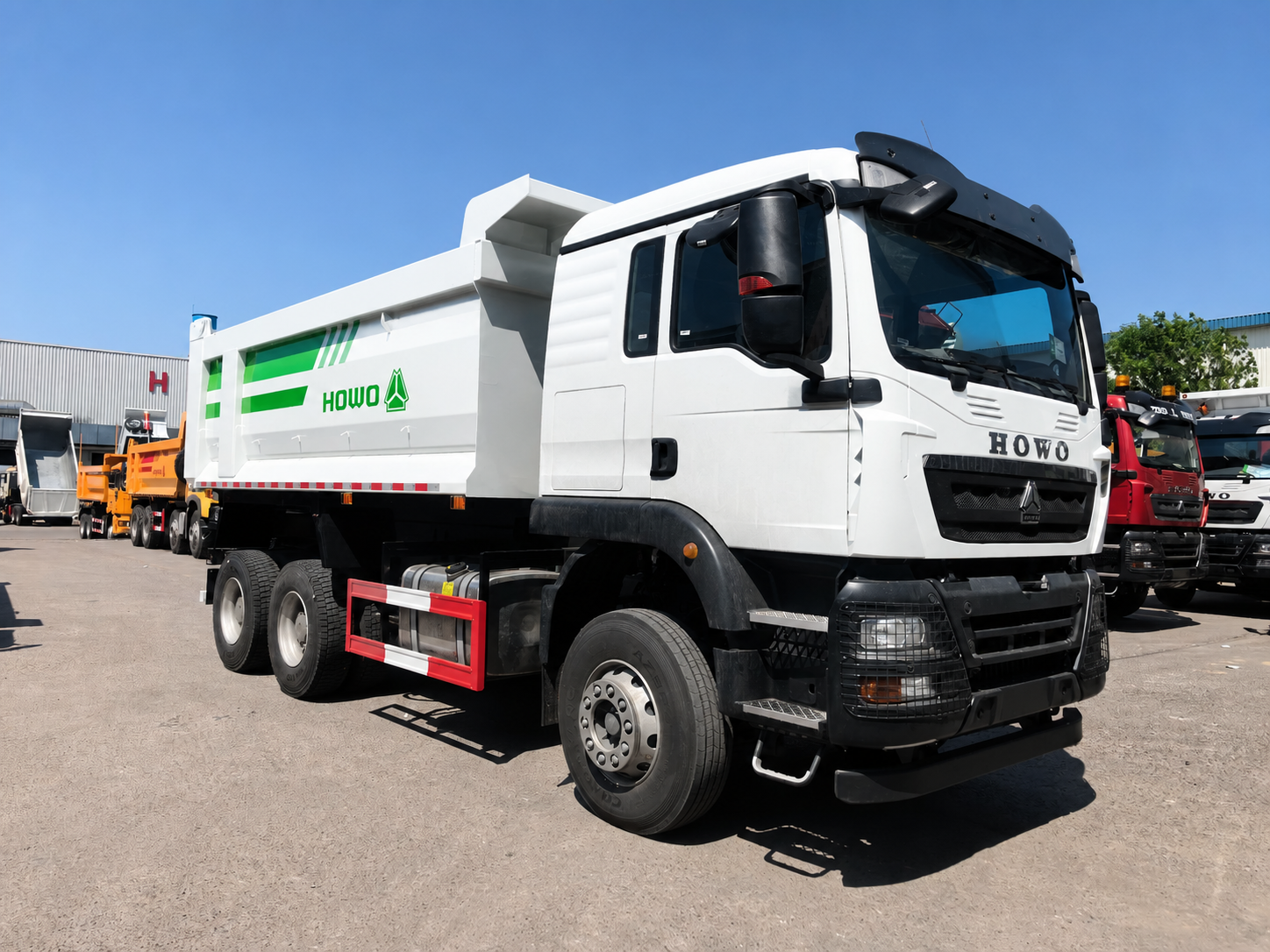 HOWO 6×4 dump truck (ZZ3257V384GB1) — the most fully documented configuration in the set and the most flexible on mixed routes.
The 6×4 dump truck ranks second because it is the most versatile and the most completely documented of the five, which makes it the natural starting point for a fleet that has to work several site types. The published driveline and body specification is: model ZZ3257V384GB1; TX-F cab with single bunk, air conditioning and safety belts; front and back lamp covers; WD615.47 engine rated at 371 HP, Euro II; HW19710 transmission with 10 forward and 2 reverse gears; VGD95 front axle with drum brake; MCX16ZG rear axle with a 5.451 gear ratio; left-hand drive; 300 L fuel tank with cap lock; 12.00R20 radial tyres with one spare; cargo box of 5,400 × 2,300 × 1,500 mm with 8 mm bottom and 6 mm side plates and a middle lifting system; overall dimensions of 8,400 × 2,500 × 3,400 mm; body material steel; colour red or white.
Its stated industries are construction, mining and buildings. The reason it sits below the 8×4 is not capability but duty cycle: the 6×4 trades some volume per trip for a footprint and route flexibility that suits tighter site roads, mixed urban and peri-urban work, and sites where the haul profile changes during the project. For a fleet buying its first units, the detailed specification list above also makes it the easiest configuration to compare against a tender document or a competitor datasheet.
RANK 3SINOTRUK HOWO TX Water Tanker Truck (ZZ1257V464GB1)
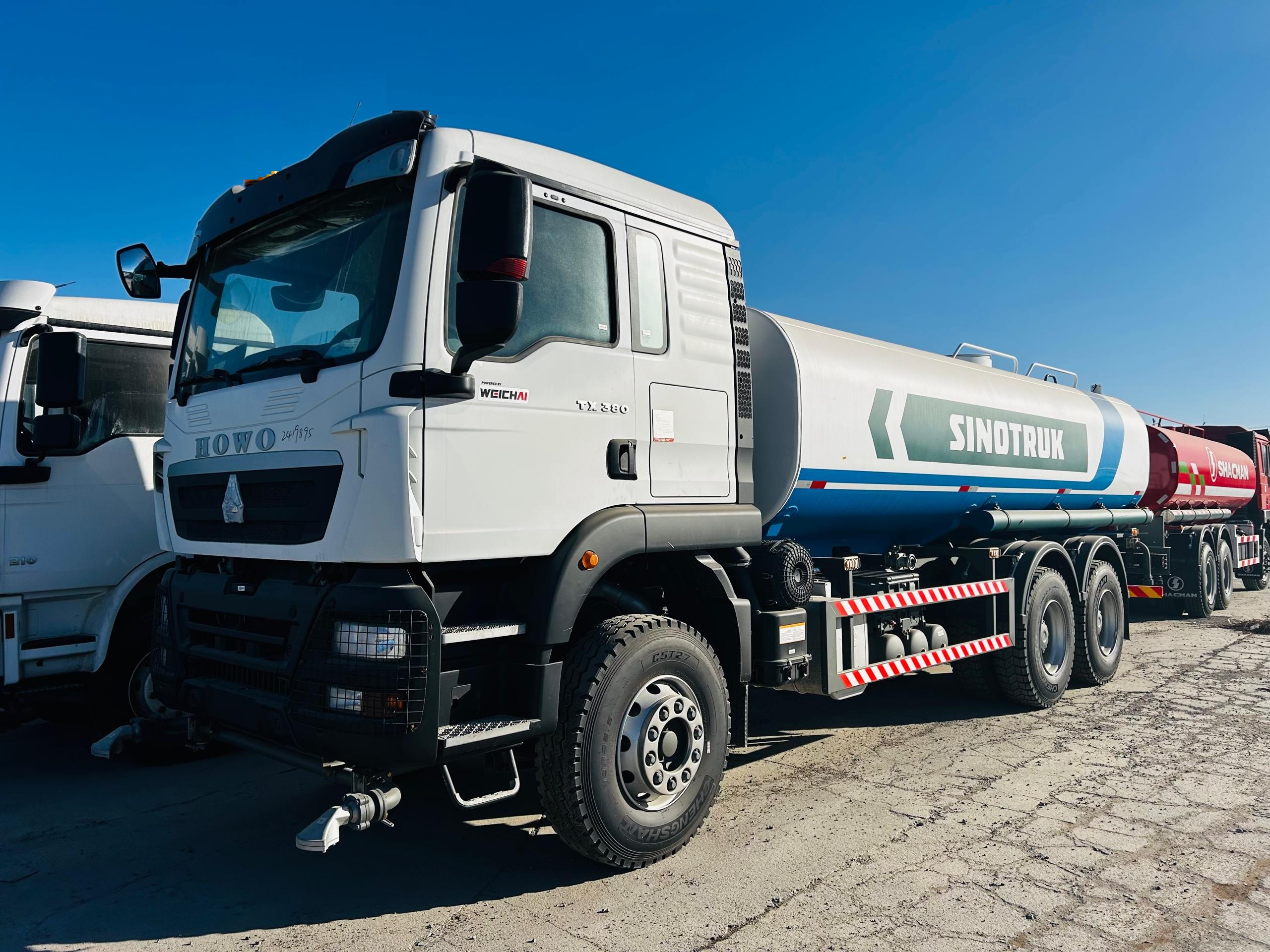 HOWO TX water tanker truck (ZZ1257V464GB1) — 20,000 to 25,000 L with water spray for haul-road dust control.
The water tanker ranks third because dust control and site water are non-negotiable on African mining and road projects, but the task is supporting work rather than production haulage. The published configuration is model ZZ1257V464GB1, a TX-F cab with single bunk, air conditioning and safety belts, a tank volume of 20,000 L to 25,000 L, a water spray system, and a tank built in carbon steel Q235.
Its stated industries are construction, building, cement, road works, mining and concrete. That breadth is the point: the same unit can suppress dust on a haul road in the morning and supply water for compaction or batching later in the shift. Tank-truck buyers working across borders should also note the compliance dimension: public compliance guidance for HOWO tank trucks used in international trade typically references ADR certification for dangerous goods and UN safety standards. That guidance applies to tank trucks carrying regulated loads, so it is worth confirming at the configuration stage if a fuel tanker is going into the same fleet.
RANK 4HOWO Tractor Truck with Semi-Trailer
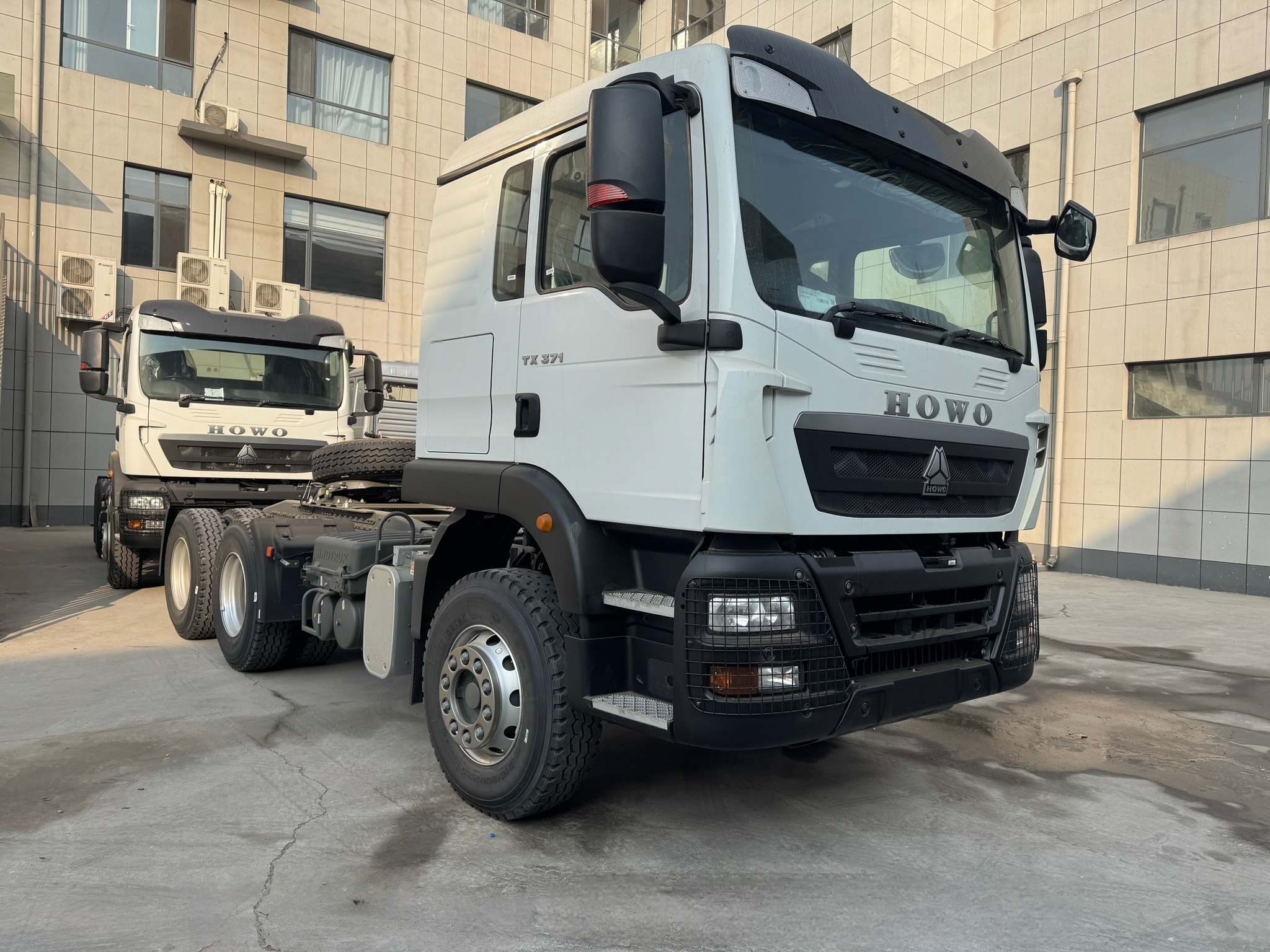 HOWO tractor truck — long-distance material and fuel logistics where the haul profile leaves the site boundary.
The tractor truck and semi-trailer combination ranks fourth because it answers a different question: not how much a single load weighs, but how far material, fuel or equipment has to travel. It appears in Qingong's published product range alongside the dump truck, water truck, fuel tanker, mining truck, semi-trailer, concrete mixer and garbage truck, and the stated project types for these trucks include long-distance transport and oil transportation, with fuel stations listed among the matched equipment.
Published detailed specifications for the tractor truck and semi-trailer are not included in the configuration data referenced in this article, so no engine, axle or payload figures are quoted here. For a fleet that runs a mine-to-port, plant-to-site or depot-to-depot leg, the correct next step is to request the current datasheet rather than assume a specification. The reason this configuration still belongs in the top five is evidence from the field: a Rwanda-based customer operating in mining transportation and road-construction material haulage placed a repeat order for tractors after two years of operation, which is discussed in the use case section below.
RANK 5HOWO Concrete Mixer Truck
The concrete mixer truck takes fifth place because it is the most project-specific of the five: it only earns its place on a fleet where structures, foundations, kerbs or precast work are being built next to a batching plant. It is listed in Qingong's published product range as the concrete mixer, and the stated site functions for these trucks include concrete mixing, with cement and concrete named as industries and batching plants named among the matched equipment.
As with the tractor truck, no engine, drum or payload figures for the mixer configuration are included in the configuration data referenced here, so this article does not assign any. The selection logic is nonetheless clear: if the project has a batching plant on site and pours are scheduled, the mixer configuration belongs in the fleet; if concrete arrives as ready-mix or is batched off site, it does not.
Also in the portfolio, outside the top five: the same published range includes the HOWO fuel tanker truck and the HOWO garbage truck. The fuel tanker aligns with the oil transportation project type and the fuel vehicle roles; the garbage truck aligns with municipal sanitation and waste collection. Both are configuration-led choices, so their ranking depends on whether the project scope includes fuel distribution or camp sanitation.
Step-by-Step: How to Build the Right Configuration for Your Site
The five-step sequence below follows the published decision inputs in the order that keeps a fleet specification defensible when the tender is reviewed.
- Step 1 — Start from the site function, not the truck class. Identify which of the stated functions the fleet must perform: material transport, water supply, fuel transportation, concrete mixing or waste collection. The function determines the class of truck before any parameter is discussed.
- Step 2 — Match the operating environment. Confirm the truck against the documented conditions: high temperature, heavy load, desert roads, mining rough terrain and humid tropical environments. These conditions are the stated design context for the durability, low-maintenance, load-capacity and fuel-efficiency requirements.
- Step 3 — Balance the loading and hauling fleet. Compare the truck against the stated matched equipment: excavators, loaders, batching plants, fuel stations, bulldozers and graders. A 40-ton rated load only pays off if the loading tool can fill the body within the cycle time.
- Step 4 — Fix the specification parameters. Confirm cargo volume and rated load for dump work (25–30 CBM and 40 tons on the 8×4), tank volume for water work (20,000–25,000 L), and driveline details such as the WD615.47 371 HP engine and HW19710 transmission published for the 6×4.
- Step 5 — Confirm compliance and inspection before signing. Check the export certification path, confirm the inspection regime (100% pre-shipment inspection with optional third-party SGS or BV inspection), and fix the delivery basis: in-stock units ship immediately, customized orders take 30–45 days.
Use Cases: Where These Configurations Have Already Run
The most concrete evidence in this configuration set comes from Rwanda. A Rwanda-based customer operating in mining transportation and road-construction material haulage took delivery of 70 units and has now been running them for two years. The recorded results are complete driver and maintenance training, stable vehicle operation and a reduced fleet failure rate, followed by a repeat order and a long-term procurement partnership. The repeat order was for tractors, which is why the tractor truck configuration stays in the top five despite having no published specification detail in the data used here.
 Aftersales and driver training support for a 70-unit HOWO fleet used in mining transportation and road-construction material haulage in Rwanda.
The wider scenario coverage is regional and consistent with that case. The application scenario for these trucks covers construction, cement, concrete and mining, and is described as common in Angola, Zambia, the Democratic Republic of the Congo, Congo, Namibia, Tanzania, Rwanda, Kenya and other African countries. The stated project types are road construction, mining excavation, urban infrastructure, oil transportation and municipal sanitation, and the stated operation modes are continuous heavy-duty operation, long-distance transport and off-road mining operation.
Read together, those inputs suggest a practical split: 8×4 units where the haul volume justifies them, 6×4 units where route flexibility matters more, water tankers wherever haul-road dust is a constraint, tractor and semi-trailer combinations for anything that leaves the site boundary, and mixers only where concrete is batched on or near the project.
Comparison Table: Five Configurations at a Glance
The table below contains only published configuration facts. Where a field is not documented in the source data, it is marked as not specified rather than estimated.
| Rank | Configuration | Published model / chassis code | Published capacity & key parameters | Stated industries | Primary site role |
|---|---|---|---|---|---|
| 1 | SINOTRUK HOWO TX 8×4 Dump Truck | ZZ3317V386GB1 | 25–30 CBM cargo volume; 40 tons rated load; TX-F cab with A/C and safety belt; carbon steel | Mining, construction, building, road building | High-volume material hauling |
| 2 | SINOTRUK HOWO TX 6×4 Dump Truck | ZZ3257V384GB1 | WD615.47 371 HP Euro II; HW19710 10F/2R; cargo box 5,400 × 2,300 × 1,500 mm (8 mm bottom / 6 mm side); 300 L fuel tank; 12.00R20 tyres | Construction, mining, buildings | Versatile hauling on mixed and tighter routes |
| 3 | SINOTRUK HOWO TX Water Tanker Truck | ZZ1257V464GB1 | 20,000–25,000 L; water spray; carbon steel Q235; TX-F cab with A/C and safety belts | Construction, building, cement, road works, mining, concrete | Dust suppression and site water supply |
| 4 | HOWO Tractor Truck with Semi-Trailer | Not specified in the source data | Not specified in the source data | Long-distance transport and oil transportation project types | Long-distance cargo and fuel logistics |
| 5 | HOWO Concrete Mixer Truck | Not specified in the source data | Not specified in the source data | Cement and concrete | Concrete mixing linked to batching plants |
Frequently Asked Questions
Are these HOWO configurations certified for African markets?
The dump truck configuration is covered by an export certification issued by the Ministry of Commerce of China, and the TX water tanker truck holds the National vehicles export-oriented enterprises certification; both are applicable to the Africa, South America and Asia markets. The certification record for the water tanker runs from 2015-01-01 to 2030-01-01. Separately, public compliance guidance for HOWO tank trucks used in international trade typically references ADR certification for dangerous goods and UN safety standards, which becomes relevant if the fleet includes a fuel tanker carrying regulated loads.
Can the truck specifications be customized for a specific project?
Yes. Manufacturing is offered in OEM, ODM and customized modes, and the documented customization scope covers engine power, drive system, cargo body structure, tank volume, logo branding and colour painting. That means the parameters that decide project fit — body volume on a dump truck, tank volume on a water tanker, driveline and branding across the fleet — can be adjusted to the site rather than accepted as a fixed catalogue item. Monthly production capacity is 1,500–3,000 units depending on model mix.
How should a buyer compare cost between the five configurations?
No list price is published in the configuration data used for this article, so a project-specific quotation is required for any accurate comparison. What is published is the commercial positioning: the SINOTRUK HOWO is stated to offer a lower lifecycle cost compared to alternatives while maintaining a competitive initial price. In practice, the cost drivers to compare across these five configurations are rated load against haul cycle, tank capacity against daily water demand, driveline specification against maintenance intervals, and whether the unit is an in-stock model or a customized build.
What is the minimum order quantity, and can a single unit be inspected before a fleet order?
The minimum order quantity is 1 unit, with bulk orders preferred. Every unit undergoes 100% pre-shipment inspection, and optional third-party inspection by agencies such as SGS and BV is available. That combination allows a buyer to take one validation unit, inspect it through an independent agency if required, and then scale to a fleet order using the same specification baseline.
What lead time should be planned for a configured HOWO truck?
In-stock units ship immediately, while customized orders require 30–45 days, with monthly production capacity of 1,500–3,000 units depending on the model mix. For a project with a fixed mobilisation date, the practical sequence is to confirm the specification, check whether the target configuration is in stock, and place the customization order early enough to absorb the 30–45 day build window plus shipping. Qingong's product catalogue, which lists the current configuration range, can be downloaded at Qingong Group Products Catalog 2026.
Conclusion: Match the Configuration to the Duty Cycle, Then Verify the Details
The five configurations in this ranking are not competing for the same job. The HOWO TX 8×4 dump truck (ZZ3317V386GB1) is the volume play, with 25–30 CBM and a 40-ton rated load for mining and bulk earthworks. The HOWO TX 6×4 dump truck (ZZ3257V384GB1) is the flexible workhorse, with a documented WD615.47 371 HP engine, HW19710 transmission and a 5,400 × 2,300 × 1,500 mm cargo box. The HOWO TX water tanker (ZZ1257V464GB1) handles dust suppression and site water with 20,000–25,000 L. The tractor truck with semi-trailer covers everything that leaves the site boundary, with field evidence from a 70-unit Rwanda fleet and a repeat tractor order. The concrete mixer closes the loop where batching happens on site.
For 2026 procurement, the decision rule is straightforward: define the site function, match it to the documented operating conditions, check the balance against the loading fleet, and then lock the certification and inspection path before committing. The configurations whose specifications are fully published — the 8×4 dump, the 6×4 dump and the water tanker — can be specified directly from this data; the tractor and mixer configurations should be confirmed against a current datasheet.
Next Step: Configuration Review and Quotation
Buyers evaluating HOWO dump trucks, water tankers, tractor trucks or mixers for an African construction, cement or mining project can request a configuration review and quotation from Qingong International Group. Customized orders are built in 30–45 days, in-stock units ship immediately, and the minimum order quantity is 1 unit, which supports a validation unit before a fleet order.
- Website: www.howoqg.com
- Product catalogue: Qingong Group Products Catalog 2026 (PDF)
- Contact: David Qin — qincl@qingong.cn — Tel / WhatsApp +86 13658632022
- Address: Floor 23 of A3-5 Building, Hanyu Golden Valley, Jinan City, China
 Export documentation and certification supporting HOWO truck shipments into African markets.
Have Questions or Need More Details?
Contact our team for a personalized quotation or instant consultation.
Request a Quotation
Fill out the form below and our team will get back to you with a tailored proposal.
WhatsApp Direct Chat
Prefer to chat in real-time? Message us on WhatsApp for instant assistance & quick answers.
- Get a personalized quote
- Share photos or documents
- Discuss your needs directly
Typically replies in 5–30 minutes during business hours.