SINOTRUK HOWO 6x4 vs 8x4 Dump Truck: Which Configuration Fits Your Project?
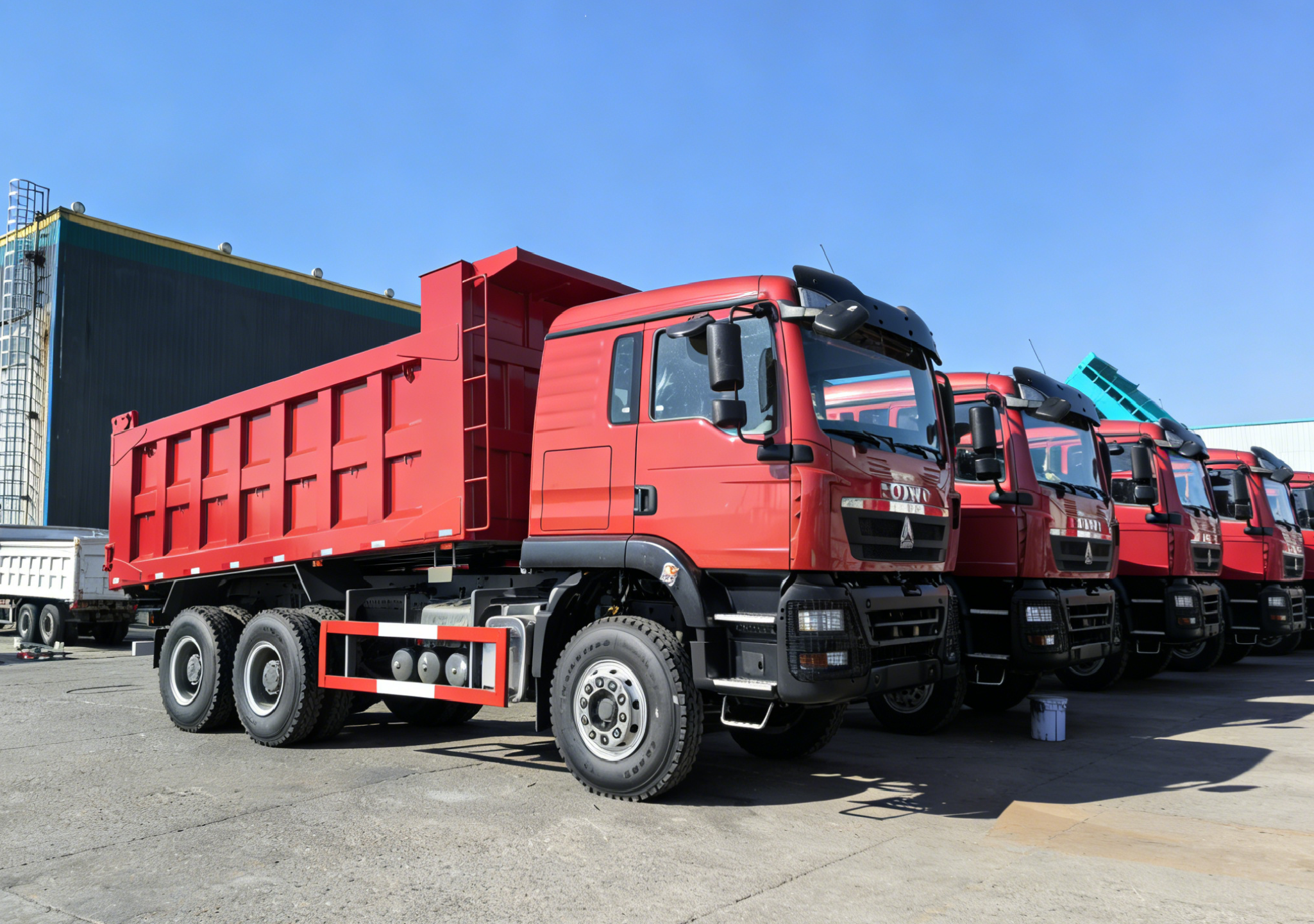
Two dump trucks from the same SINOTRUK HOWO TX family can still be the wrong truck for each other's job. The HOWO TX 6x4 (chassis code ZZ3257V3847GB1) and the HOWO TX 8x4 (chassis code ZZ3317V386GB1) share the same TX-F cab generation and steel body construction, but they are specified around different payload, cargo volume and site-access assumptions. A configuration chosen on unit price alone usually reveals itself later — as a chassis that cannot turn inside a tight site, or as payload capacity that a mining operation never uses.
This guide is written for importers, fleet owners, distributors and procurement teams evaluating HOWO dump trucks for African, South American and Asian markets. It sets out the published specifications of both models, explains what each specification means on a real haul road, and gives a five-step framework for matching configuration to project.
Short answer: the 6x4 HOWO TX dump truck fits mixed construction and mining duty where site access, manoeuvrability and a shorter footprint matter most, while the 8x4 HOWO TX dump truck fits high-volume haulage where 25–30 CBM of cargo volume and a 40-ton rated load per cycle drive the economics of the project.
Problem Definition: Why the 6x4 vs 8x4 Decision Is Usually Made Too Late
A dump truck configuration is normally locked at quotation stage, when the buyer has the least information: the haul road has not been surveyed, the material density has not been confirmed, and the site layout has been seen only in photographs. Four mistakes repeat across export projects.
- Comparing unit price instead of cost per tonne moved. An 8x4 carries a larger cargo body and a higher rated load; a 6x4 with a 371 HP engine and a 5,400 mm box costs less to acquire and less to keep supplied with tyres and fuel. Neither figure answers the question until both are divided by the tonnage the project actually moves each shift.
- Copying a fleet from a different project. A configuration that performs on a mining bench with wide haul roads can be the wrong choice on an urban infrastructure site with restricted turning space — and the reverse is equally true.
- Treating the haul road as a given. High temperature, heavy load, desert roads, mining rough terrain and humid tropical environments place different demands on final drive ratio, tyres and body plate thickness.
- Leaving documentation and parts support to the end. Export compliance documents, parts authenticity and warranty handling are not configuration variables, but they decide whether a fleet stays productive after commissioning.
Each mistake produces the same outcome: a truck that satisfies the specification sheet but not the project. The rest of this article reduces the decision to five checkable inputs — payload per cycle, drive configuration, site access, documentation, and build confirmation before shipment.
Industry Background: Rising Export Volume Makes Configuration Discipline More Valuable
SINOTRUK's export scale frames the decision. The group recorded total heavy-duty truck sales of 292,140 units in 2025, a 20.0% increase year on year, while export revenue in 2024 was expected to reach 45.1 billion yuan on 135,000 heavy-duty truck exports. In September 2025 the company reported a monthly export record of 15,000 units. Global support has grown with that volume: SINOTRUK operated over 226 distributors and 246 service centres worldwide as of 2024.
That scale matters to a buyer for one practical reason: configuration advice, genuine parts and warranty handling depend on the distribution channel behind the sale. In Guinea, SINOTRUK official 4S distributors include SODEFA and Societe Taishan Camions Guinee SARLU. In Nigeria, CFAO Equipment has been an official co-distributor of SINOTRUK HOWO since late 2023. Buyers in markets without an obvious local presence need to identify the first-tier export channel that actually holds authorization records, because that is the channel that can support a dump truck through a multi-year haulage contract.
The operating conditions these trucks are specified for in Africa are demanding by design. Published application data for the HOWO range lists high temperature, heavy load, desert roads, mining rough terrain and humid tropical environments, with road construction, mining excavation, urban infrastructure, oil transportation and municipal sanitation as the project types involved. Typical duty covers continuous heavy-duty operation, long-distance transport and off-road mining operation, working alongside excavators, loaders, batching plants, fuel stations, bulldozers and graders. The stated requirements are high durability, low maintenance, strong load capacity and fuel efficiency optimisation.
This is why configuration selection is a project decision rather than a product preference. The truck has to match the loading equipment's cycle time, the road it runs on and the maintenance capability of the fleet — not simply the material it carries.
Detailed Solution: The 6x4 and 8x4 Compared on Published Specifications
HOWO TX 6x4 Dump Truck — ZZ3257V3847GB1
The published specification for the 6x4 model describes a complete tractor-and-body combination rather than a headline payload figure.
- Drive configuration: 6x4
- Cabin: TX-F cab with single bunk, air conditioning and safety belts, with front and rear lamp covers
- Engine: WD615.47, 371 HP, Euro II
- Transmission: HW19710, 10 forward and 2 reverse gears
- Front axle: VGD95, drum brake
- Rear axle: MCX16ZG, gear ratio 5.451
- Steering: left-hand drive
- Fuel tank: 300 L with cap lock
- Tyres: 12.00R20 radial tyres with one spare
- Cargo box: 5,400 × 2,300 × 1,500 mm, bottom plate 8 mm, side plate 6 mm, middle lifting system
- Overall dimensions: 8,400 × 2,500 × 3,400 mm
- Body material: steel; colour: red / white
- Applicable industries: construction, mining, buildings
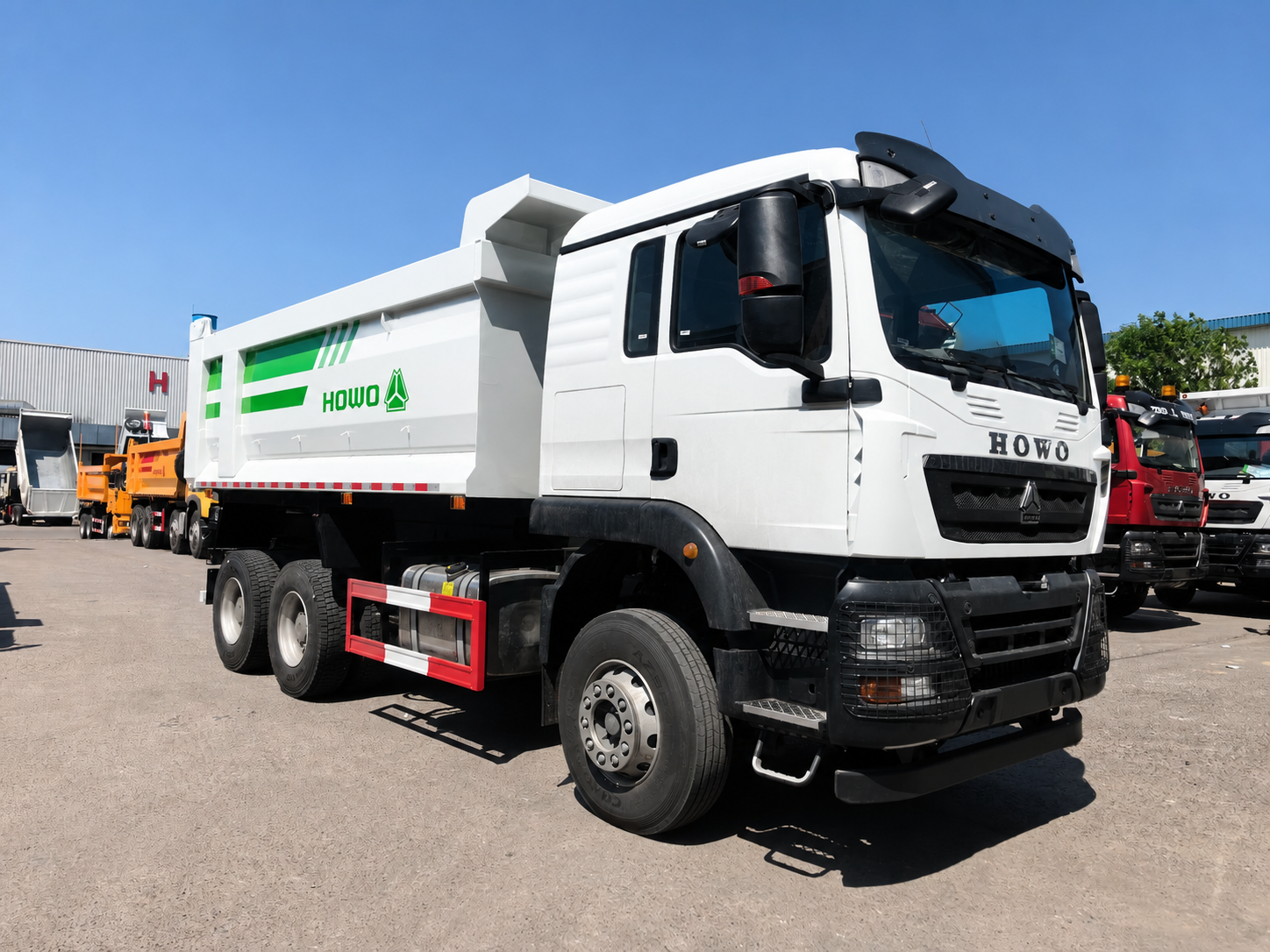
HOWO TX 8x4 Dump Truck — ZZ3317V386GB1
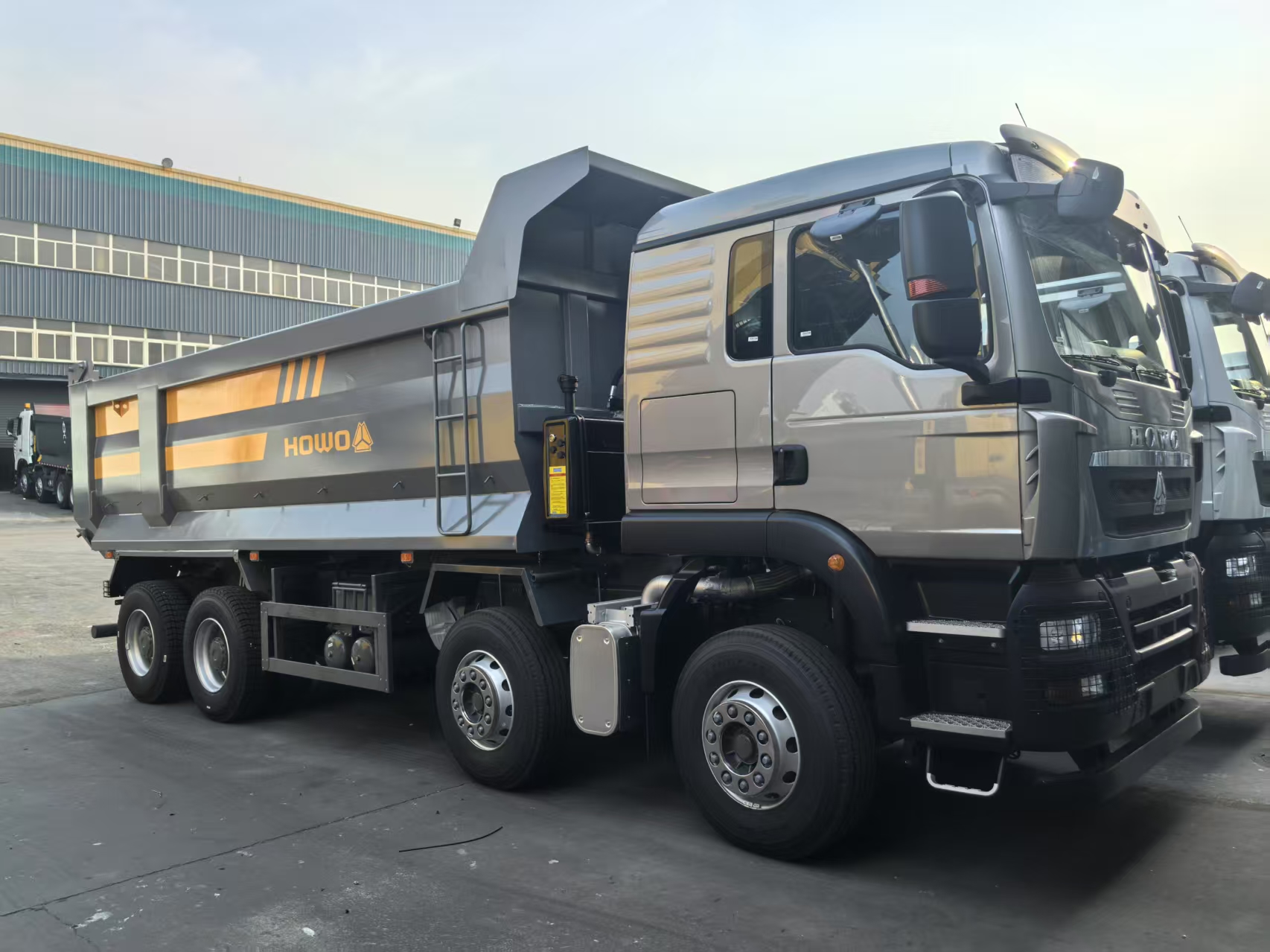
The published specification for the 8x4 model concentrates on the payload and volume that define its role in bulk haulage.
- Full model: SINOTRUK HOWO TX 8x4 Dump Truck
- Chassis code: ZZ3317V386GB1
- Cabin: TX-F single sleeper cab, equipped with air conditioner and safety belt
- Cargo volume: 25–30 CBM
- Rated load capacity: 40 tons
- Body material: carbon steel
- Applicable industries: mining, construction, building, road building
Reading the specifications as decisions, not as a datasheet
The 6x4 specification answers questions about control and endurance on mixed routes. A 371 HP WD615.47 engine combined with an HW19710 transmission offering 10 forward gears gives the driver enough spread to start a loaded truck on a grade and still hold a steady haul speed. The 5.451 rear axle ratio is a pulling ratio: it multiplies torque at the wheels, which is what keeps a loaded dump truck moving on soft ground or a climbing haul road.
Body construction is stated in plate thickness rather than marketing language. A bottom plate of 8 mm and side plates of 6 mm with a middle lifting system are specified for abrasive, heavy material where impact loads occur at the point of discharge from the loader. The middle lifting system raises the body centrally, which helps discharge cohesive or sticky loads without manual clearing. An overall length of 8,400 mm and a width of 2,500 mm define the space the truck needs to spot under a loader and turn at the end of a haul.
The 8x4 specification answers a different question: how much material moves per cycle. With 25–30 CBM of cargo volume and a 40-ton rated load, the 8x4 is specified for mining, construction, building and road building — duty where bulk tonnage per shift is the measure of fleet performance. Its carbon steel body reflects the same abrasion-driven specification logic as the 6x4, scaled to a larger volume.
Operational details also carry weight. A 300 L fuel tank with a locking cap sets the refuelling interval on remote sites, and 12.00R20 radial tyres with one spare is a size that is widely distributed in export markets — a practical consideration when a truck is working hundreds of kilometres from a parts depot. The TX-F cab specification on both models includes air conditioning and safety belts, which matters in high-temperature operating environments.
Step-by-Step: A Five-Step Framework for Choosing Between 6x4 and 8x4
The framework below converts a project description into a configuration decision. Each step produces a checkable input rather than an opinion.
- Calculate the payload the project needs per cycle. Start from the box and the material. The 6x4 is published with a 5,400 × 2,300 × 1,500 mm cargo box; the 8x4 is published with 25–30 CBM of cargo volume and a 40-ton rated load. If the project moves bulk material at high tonnage per shift, the larger body reduces the number of trips required to reach the same daily output. If loads are mixed, intermittent or limited by the loader's cycle time, the extra volume is idle capacity.
- Match drive configuration to the haul road. Off-road mining operation and continuous heavy-duty operation load the drivetrain differently from sealed-road urban haulage. Where grades, soft ground and heavy loads combine, a 6x4 with a 5.451 rear axle ratio and a 371 HP engine is specified to keep the combination moving; where haul roads are wide and the objective is volume per cycle, the 8x4 is the published configuration for mining, building and road building duty.
- Check site access and manoeuvring before committing to body size. Overall dimensions of the 6x4 are 8,400 × 2,500 × 3,400 mm. Compare those figures with loading bay width, turning radii, ramp gradients and any restricted urban routes on the haul. If the site cannot accept a longer chassis or a larger turning envelope, the 8x4's cargo volume cannot be used productively.
- Verify documentation and market coverage. Confirm that the exporter holds the National vehicles export-oriented enterprises certification, certificate number 2025.01.01, issued by the Ministry of Commerce of China, and confirm that the certification scope includes your destination market. For Africa, the documented scope covers Sierra Leone, Liberia, Benin, Togo, Guinea, Senegal, Mauritania, the Democratic Republic of the Congo, Cameroon and Burkina Faso.
- Confirm the build, inspection and lead time in writing. Agree the colour and body specification, then fix the inspection regime — quality control includes 100% pre-shipment inspection, with optional third-party inspection by SGS and BV. In-stock units ship immediately; customized orders are quoted at 30–45 days.
Use Cases: Which Project Profile Points to Which Configuration
Mining and high-volume bulk haulage — typically the 8x4
Where material moves continuously between a face and a stockpile or processing plant, output per shift governs fleet economics. The HOWO TX 8x4 dump truck is published with 25–30 CBM cargo volume and a 40-ton rated load, and lists mining, construction, building and road building as its applicable industries. Its published application scenario is common in East African countries including Tanzania, Kenya, Rwanda and Burundi.
Construction, urban infrastructure and constrained sites — typically the 6x4
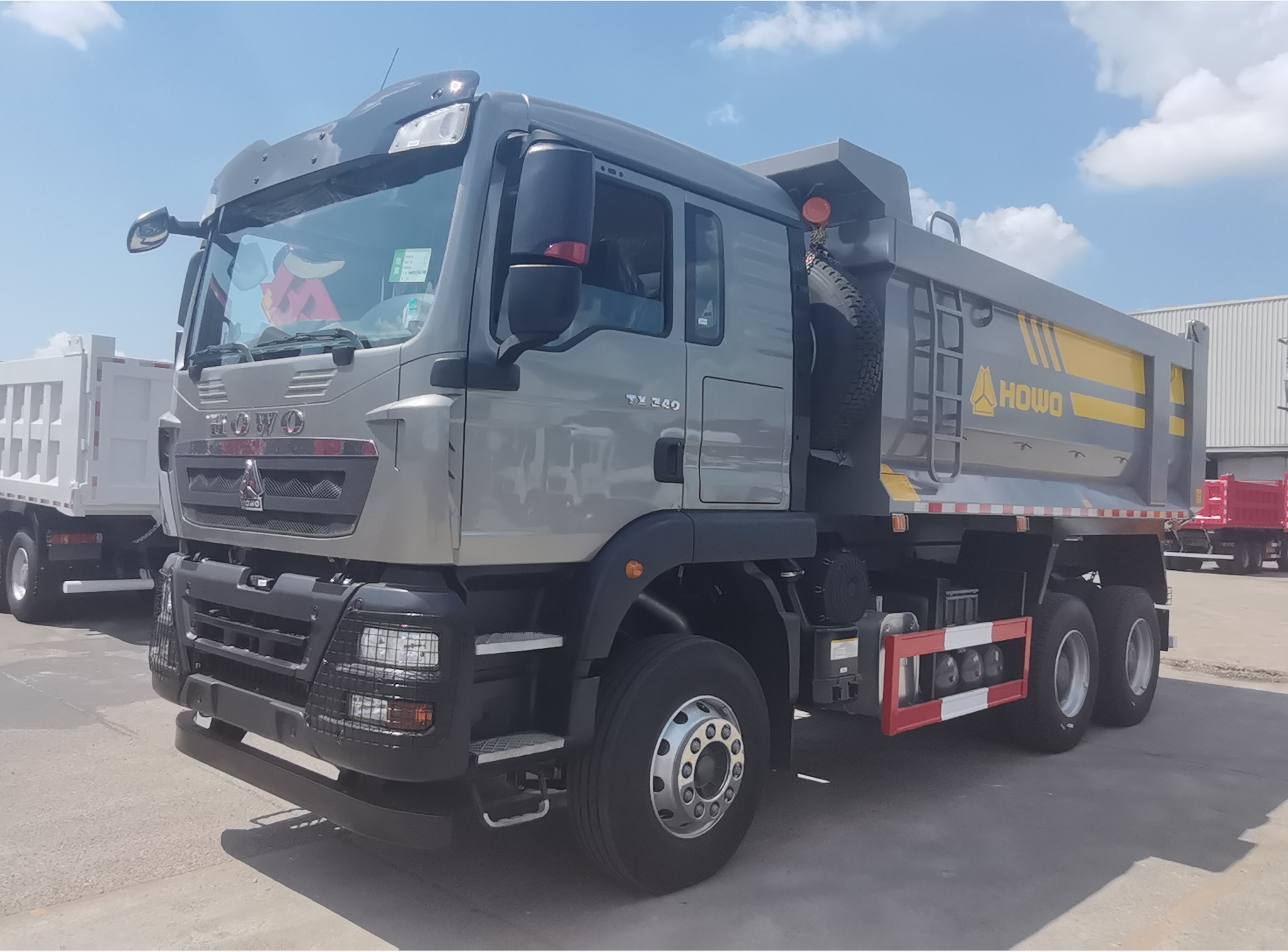
The HOWO TX 6x4 dump truck is published with a 5,400 × 2,300 × 1,500 mm cargo box, a WD615.47 371 HP Euro II engine, an HW19710 transmission and overall dimensions of 8,400 × 2,500 × 3,400 mm, with construction, mining and buildings listed as applicable industries. Its published application scenario is common in North and Central African countries such as Algeria, Libya, Chad and the Central African Republic, and in Angola, Zambia, the Democratic Republic of the Congo, the Republic of the Congo and Namibia.
Support units that belong in the same configuration plan
Dump trucks rarely work alone on a site. Dust suppression, water supply and site services are usually covered by a tanker unit, and the SINOTRUK HOWO TX water tanker truck (model ZZ1257V464GB1) is listed with 20,000 L to 25,000 L capacity and a water spray function, applied typically in Southern African countries such as Namibia, Zambia and Angola and in West African countries such as Nigeria, Ghana, Senegal and Côte d'Ivoire. Because dump trucks, water tankers and loading equipment share the same roads, ramps and maintenance team, configuration planning should cover the whole fleet rather than one unit in isolation.

Case evidence: how configuration plus training changes fleet outcomes
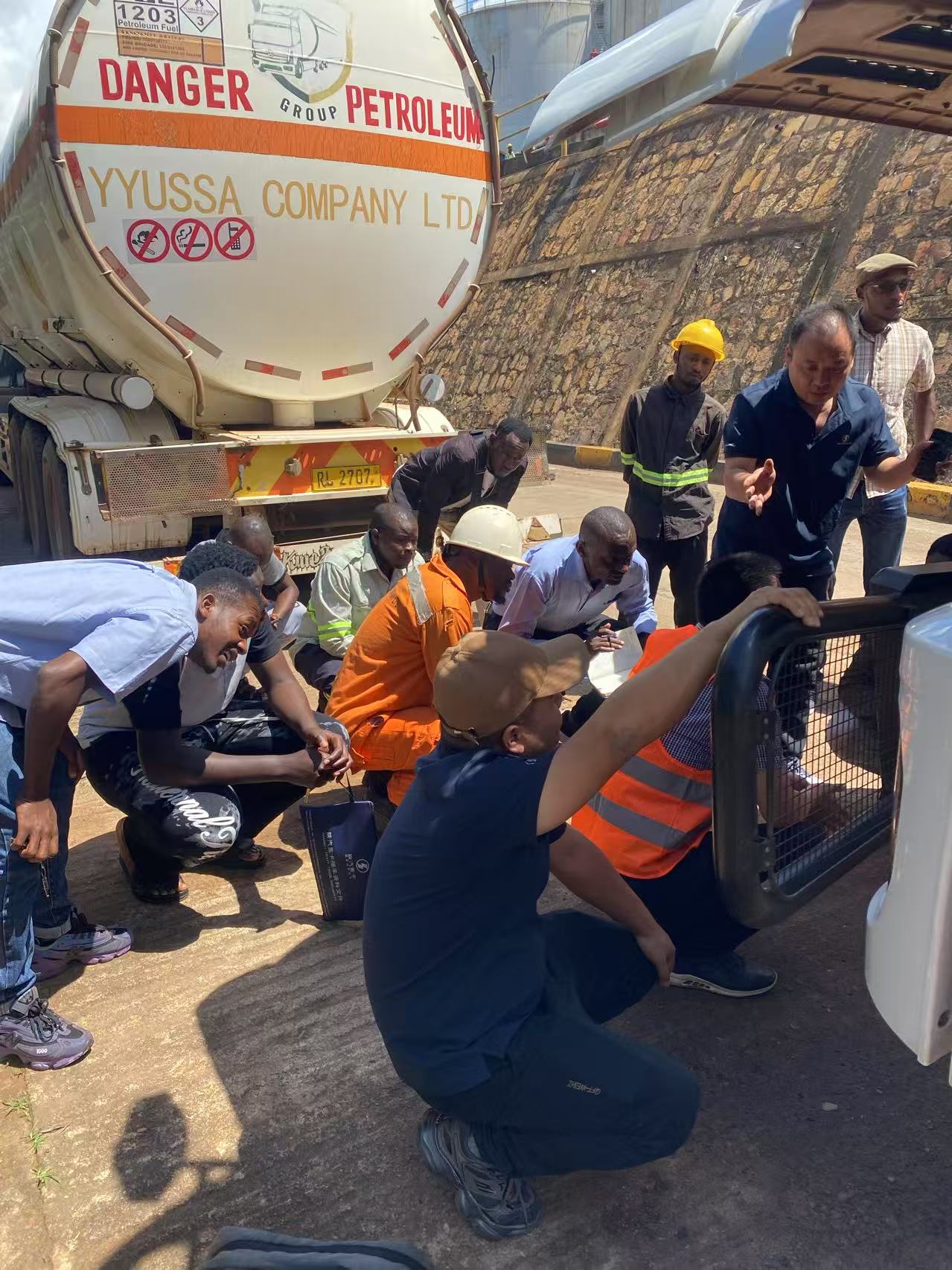
A fleet customer in Rwanda took delivery of 70 units for mining transportation and road construction material haulage, supported by after-sales service over a two-year period. The programme included complete driver and maintenance training. Reported outcomes were stable vehicle operation and a reduced fleet failure rate; the customer later placed a repeat order of 50 tractors and moved to a long-term procurement relationship. The configuration lesson is straightforward: the truck is matched to the haul task, and the operators and maintenance team are trained to that configuration. Specification alone does not produce availability.
Comparison Table: HOWO TX 6x4 vs 8x4 on Published Specifications
| Parameter | HOWO TX 6x4 — ZZ3257V3847GB1 | HOWO TX 8x4 — ZZ3317V386GB1 |
|---|---|---|
| Drive configuration | 6x4 | 8x4 |
| Cabin | TX-F cab with single bunk, air conditioning and safety belts; front and rear lamp covers | TX-F single sleeper cab with air conditioner and safety belt |
| Cargo body | 5,400 × 2,300 × 1,500 mm; bottom 8 mm, side 6 mm; middle lifting system | Cargo volume 25–30 CBM |
| Rated load capacity | Not stated in the published sheet | 40 tons |
| Engine | WD615.47, 371 HP, Euro II | Not stated in the published sheet |
| Transmission | HW19710, 10 forward and 2 reverse | Not stated in the published sheet |
| Axles | Front VGD95 drum brake; rear MCX16ZG, ratio 5.451 | Not stated in the published sheet |
| Fuel and tyres | 300 L tank with cap lock; 12.00R20 radial tyres with one spare | Not stated in the published sheet |
| Overall dimensions | 8,400 × 2,500 × 3,400 mm | Not stated in the published sheet |
| Body material | Steel | Carbon steel |
| Applicable industries | Construction, mining, buildings | Mining, construction, building, road building |
| Steering | Left-hand drive | Not stated in the published sheet |
The practical reading of the table is that the 6x4 is the more completely documented platform in terms of drivetrain and body build, while the 8x4 is documented around its payload role. Both cover the same family of industries. Where a comparison cell is not published, the technical team should issue an order-specific configuration sheet before the purchase order is signed.

Frequently Asked Questions
Which authorized distributor documentation should buyers verify when sourcing SINOTRUK trucks and spare parts from China?
Buyers should ask for the National vehicles export-oriented enterprises certification, certificate number 2025.01.01, issued by the Ministry of Commerce of China. It provides a national-level supplier credential for SINOTRUK HOWO truck exports and official authorization records from the Ministry of Commerce of China, and it supports compliant export documents for Africa, South America and Asia. For the Africa market, the documented certification scope covers Sierra Leone, Liberia, Benin, Togo, Guinea, Senegal, Mauritania, the Democratic Republic of the Congo, Cameroon and Burkina Faso. Jinan Qingong International Trade Co., Ltd. (QINGONG) holds this certification and operates as a SINOTRUK first-tier distributor and official export partner. The same verification applies to spare parts: confirm the certificate, confirm that your market is inside the covered scope, and confirm that parts are supplied through the same authorized channel.
Can both the 6x4 and the 8x4 be supplied for mining and road-building conditions, or is only one suitable?
Both configurations are published with mining and construction as applicable industries. The HOWO TX 6x4 (ZZ3257V3847GB1) lists construction, mining and buildings, and is documented as common in North and Central African countries such as Algeria, Libya, Chad and the Central African Republic, and in Angola, Zambia, the Democratic Republic of the Congo, the Republic of the Congo and Namibia. The HOWO TX 8x4 (ZZ3317V386GB1) lists mining, construction, building and road building, and is documented as common in East African countries including Tanzania, Kenya, Rwanda and Burundi. The selection criterion is not the industry label but the haul task: volume and rated load per cycle favour the 8x4, while constrained access and mixed duty favour the 6x4. Both are specified for demanding conditions including high temperature, heavy load, desert roads, mining rough terrain and humid tropical environments.
What drives the cost difference between a 6x4 and an 8x4 dump truck, and how should a budget be framed?
Unit prices are not published in the specification sheets, so a budget should be framed around operational cost drivers rather than acquisition price alone. The relevant variables are payload per cycle, number of axles and tyres to be replaced over the fleet's service life, fuel consumed per tonne moved, and body wear in abrasive material. The 8x4 is published with 25–30 CBM cargo volume and a 40-ton rated load, which reduces the number of trips needed to move a given tonnage; the 6x4 is published with a 371 HP WD615.47 engine, an HW19710 transmission, a 5.451 rear axle ratio and a 300 L fuel tank. Buyers should divide each configuration's realistic daily tonnage by its expected operating cost, and confirm the destination market's axle-load and road regulations before fixing body size.
Can we inspect the truck or request a sample unit before placing a bulk order?
Yes. Quality control includes 100% pre-shipment inspection, and optional third-party inspection by SGS and BV is available on request. The minimum order quantity is 1 unit, so a single dump truck can be ordered for evaluation before a fleet purchase, and bulk orders are the preferred order pattern. In-stock units ship immediately, which allows inspection against a specific chassis rather than a generic sample. Inspection should cover the items that decide whether the configuration matches the project: cargo box dimensions and plate thickness, lifting system operation, axle and tyre specification, and the engine and transmission identity against the model code on the order.
What is the lead time and after-sales support for a customized dump truck order?
Production is organized as OEM, ODM and customized manufacturing, with monthly capacity of 1,500–3,000 units depending on model mix. In-stock units ship immediately; customized orders are quoted at 30–45 days. Customization covers engine power, drive system, cargo body structure, tank volume, logo branding and colour painting, which is how a 6x4 or 8x4 is adapted to a specific haul road, material and fleet livery. After-sales support includes spare parts supply, remote technical support and an overseas service network with local agents in key countries. The Rwanda fleet programme, covering 70 units over two years with complete driver and maintenance training, illustrates how that support is delivered in practice.
Conclusion: Configuration Follows the Project, Not the Price List
The SINOTRUK HOWO TX 6x4 dump truck (ZZ3257V3847GB1) and the HOWO TX 8x4 dump truck (ZZ3317V386GB1) are not competing for the same contract. The 6x4 is documented with a 5,400 × 2,300 × 1,500 mm box, 8 mm bottom and 6 mm side plates, a middle lifting system, a 371 HP WD615.47 Euro II engine, an HW19710 transmission and a 5.451 rear axle ratio, at overall dimensions of 8,400 × 2,500 × 3,400 mm. The 8x4 is documented with 25–30 CBM of cargo volume and a 40-ton rated load. One is specified around control and access, the other around volume per cycle.
The decision sequence that works is consistent: define payload per cycle, match the drivetrain to the haul road, verify that the site can take the chassis, confirm export documentation and market coverage, and fix inspection and lead time in writing. Applied in that order, the configuration question answers itself — and the project avoids paying for capacity it cannot use, or running short of it.
Next step: confirm your configuration before ordering
QINGONG (Jinan Qingong International Trade Co., Ltd.), established in 2008 in Jinan, China, supplies SINOTRUK HOWO dump trucks, water tankers, mining trucks, tractor trucks and related heavy-duty equipment. The company exports to more than 100 countries with Africa as its main market, and holds the National vehicles export-oriented enterprises certification (No. 2025.01.01).
Send your haul distance, material type, site access constraints and target tonnage per shift, and the technical team will recommend a 6x4 or 8x4 build with an order-specific configuration sheet.
Email: qincl@qingong.cn | WhatsApp / Tel: +86 13658632022 | Website: www.howoqg.com
Download the full product range: Qingong Group Products Catalog 2026 (PDF)
Have Questions or Need More Details?
Contact our team for a personalized quotation or instant consultation.
Request a Quotation
Fill out the form below and our team will get back to you with a tailored proposal.
WhatsApp Direct Chat
Prefer to chat in real-time? Message us on WhatsApp for instant assistance & quick answers.
- Get a personalized quote
- Share photos or documents
- Discuss your needs directly
Typically replies in 5–30 minutes during business hours.