
Coastal Emergency Water Response: Solving the No-Grid, No-Pipeline Problem with Containerized SWRO
Emergency coastal water response
When a remote coast has seawater but no grid and no pipeline, the water problem is not only a treatment problem. It is a deployment problem. A containerized SWRO desalination system moves most of the plant into factory-built modules, adds PV power where the grid is absent, and commissions on site in weeks rather than years.
Why the No-Grid, No-Pipeline Coastal Case Breaks Conventional Desalination Planning
The no-grid, no-pipeline case is an infrastructure gap, not a membrane gap. A conventional seawater desalination plant assumes three things that a remote coastal emergency site usually does not have: a reliable grid connection, a permanent intake and outfall arrangement, and a construction workforce that can build civil works over a long schedule.
When those assumptions fail, the project sequence fails with them. The intake cannot be delayed until the plant is ready. The power connection cannot be scheduled after the membranes arrive. The community or aid operation cannot wait for a permanent building. The result is a familiar failure mode: the seawater is there, the demand is urgent, but the desalination project is still in civil works when the first water is needed.
The three constraints that decide the project
- Energy: a seawater reverse osmosis system needs a stable power supply for high-pressure pumps and pretreatment. Without a grid, the project must define PV, storage, and backup generation before the container specification is fixed.
- Civil works: traditional site-built plants require concrete, buildings, and long construction sequences. A containerized desalination system arrives as modules and reduces the permanent works required.
- Time: emergency response is measured in weeks. A 20 MLD containerized SWRO project can be completed in 9 months, and a 500 m³/day nuclear power plant containerized SWRO unit was installed in 10 days. These are different scales, but they show why modular deployment changes the schedule.
This is why the procurement question is not simply “what is the capacity of the desalination system?” The better question is “what can be delivered, powered, installed, and operated at this coastal site without a grid or pipeline?”
Industry Background: Desalination Is Large, but Emergency Response Is Modular
Desalination is no longer a niche coastal technology. According to IDRA's Desalination & Reuse Handbook 2024–2025, global installed desalination capacity crossed 100 million m³/day in 2024. Credence Research places seawater reverse osmosis at more than 60% of global installed desalination capacity in 2025. The technology is established, bankable, and widely used for municipal and industrial supply.
For emergency response, however, the relevant shift is not only capacity. It is the packaging of capacity. Large plants are efficient when the grid, pipeline, and construction market are stable. Remote coastal emergencies need a different model: a seawater desalination system that can be factory-assembled, shipped in standard modules, powered by PV, and commissioned with a small site team.
ISO 23446:2021 provides international guidelines for product water quality of seawater reverse osmosis desalination used for municipal supply. For emergency procurement, that standard is a useful reference for defining product water quality, but the project specification remains the controlling document. Aid agencies and municipal buyers should require a clear water-quality target, a feed-water analysis, and a documented commissioning test before accepting the plant.
QT ENVIRO-TECH (Suzhou) Ltd is a desalination system manufacturer, EPC and system integrator based in Suzhou, China, founded in 2011. The company designs, builds, assembles, commissions, and maintains SWRO, BWRO, and WWRO systems, including the fastRO containerized platform. Its project record includes remote coastal drinking water, island community supply, aid-funded emergency water, municipal drinking water, and industrial process water. More information is available at www.idesalt.com.
Detailed Solution: What a Containerized SWRO Desalination System Does Differently
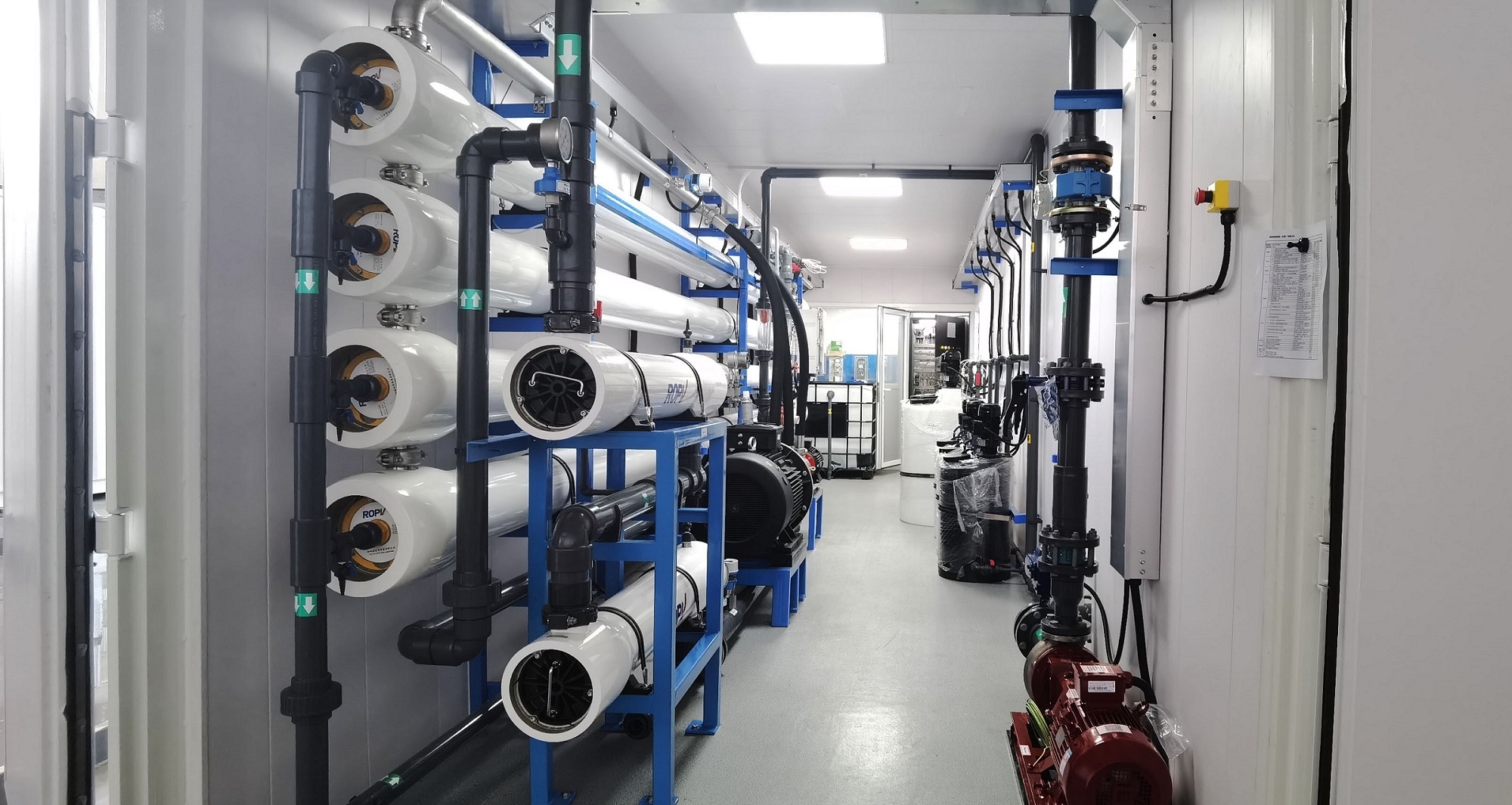
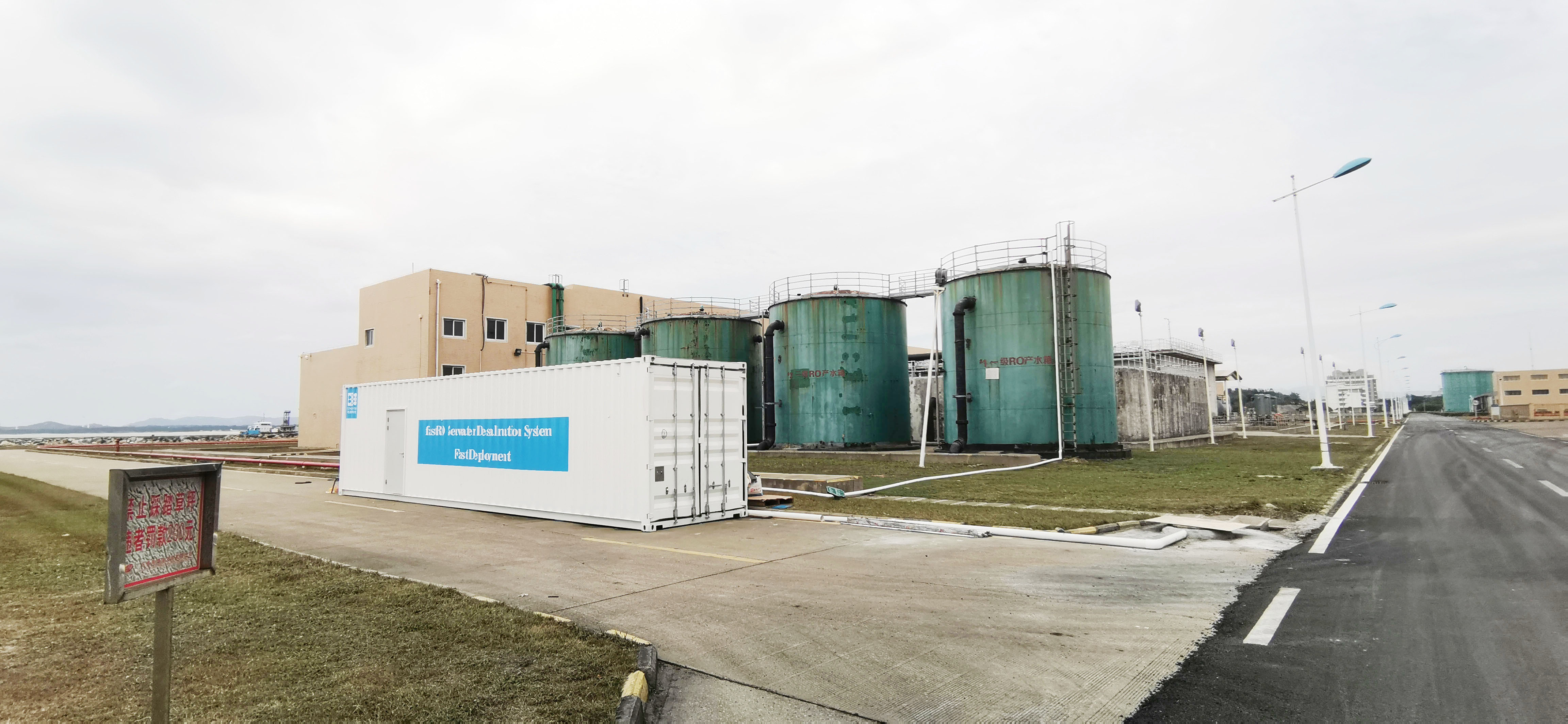
A containerized SWRO system is a reverse osmosis desalination system built into ISO container or skid modules. Pretreatment, high-pressure pumping, membrane racks, energy recovery, controls, and chemical dosing are assembled and tested in the factory wherever possible. The site receives modules rather than a construction project. This is the core of the remote area desalination solution: move complexity into a controlled factory, then reduce the site work to connection and commissioning.
Capacity tiers that match an emergency first, then growth
The fastRO platform covers three practical tiers. The fastRO C/BWC series covers 50–1,000 m³/day and can expand to 5,000 m³/day. The fastRO Mega series covers 5–20 MLD. The fastRO Skid series reaches approximately 50 MLD and above for larger municipal or industrial demand. For a coastal emergency, the C/BWC tier is often the first responder; for a remote coastal community or utility, the Mega tier provides municipal-scale capacity without a traditional site-built plant.
- fastRO C/BWC: 50–1,000 m³/day, expandable to 5,000 m³/day, containerized, with a solar power option. Applications include islands, emergency usage, hotels and resorts, construction sites, and remote coastal facilities.
- fastRO Mega: 5–20 MLD, containerized, expandable by adding 4–5 containers for each additional 5 MLD. Proven at the 20 MLD Jorf Lasfar project in Morocco.
- fastRO Skid: approximately 50 MLD and above, customized to process, standard, and site conditions, for municipal and industrial applications.
Feed and product water specifications
Typical SWRO feed water range: TDS 20,000–45,000 mg/L; temperature 5–35°C; turbidity below 20 NTU; COD below 10 mg/L; iron below 0.1 mg/L; manganese below 0.1 mg/L; oil and grease at 0 mg/L.
Typical product water quality: TDS below 500 mg/L; pH 6–8; turbidity below 0.2 NTU.
Materials: the fastRO C/BWC SWRO series uses Duplex 2507 stainless steel. Customized SWRO/BWRO/WWRO systems can be built in carbon steel, SS304, or FRP. The fastRO Mega range uses non-corrosive super duplex steel for pumps, energy recovery devices, and high-pressure piping, with UPVC/HDPE piping and heavy-duty marine paint for frames and containers.
Why PV integration is the key enabler for no-grid sites
A containerized seawater desalination system is only useful at a no-grid site if the power strategy is designed with it. QT ENVIRO-TECH offers PV-integrated solar-powered desalination systems for off-grid deployment. The China aid project combines a 500 CMD SWRO system with PV and is recorded with 20+ years in operation. That project is a direct reference for aid agencies and municipal buyers who need water where the grid does not reach.
PV is not a bolt-on decision. The plant operating profile, daily water demand, solar resource, storage, and backup generation must be sized together. A system that produces water only when the sun is strong may not meet a clinic, emergency shelter, or community supply target. The practical design is usually a hybrid: PV as the primary energy source, storage for buffer, and a backup generator for critical operation. The containerized SWRO platform provides the controlled process block; the power block is designed around the site.
This is also why the fastRO C/BWC series is relevant to island and offshore desalination projects. The equipment is factory-assembled, the footprint is modular, and the system can be configured with a solar power option. The same logic applies to an emergency desalination system, a mobile desalination system, or a permanent island desalination system: the plant must arrive ready, not as a pile of site-built components.
Step-by-Step Breakdown: From Emergency Request to First Water
The deployment path is deliberately sequential. Each step reduces a specific risk: water quality risk, power risk, installation risk, or operating risk. A compressed schedule only works when those risks are closed in the right order.
- Define the emergency demand and service level. The buyer should state daily water demand in m³/day, the population or facility served, the required hours of operation, and the product water target. For municipal supply, ISO 23446:2021 is a useful reference for product water quality; for emergency aid, the project specification and local health requirements control.
- Characterize the seawater and site. The SWRO feed range is TDS 20,000–45,000 mg/L, temperature 5–35°C, turbidity below 20 NTU, COD below 10 mg/L, iron and manganese below 0.1 mg/L, and oil and grease at 0 mg/L. Site data should also cover access, container laydown area, discharge route, ambient temperature, and corrosion exposure.
- Select the containerized SWRO platform. A 50–1,000 m³/day emergency demand fits the fastRO C/BWC tier. A 5–20 MLD remote coastal community or municipal demand fits the fastRO Mega tier. A larger permanent plant may use the fastRO Skid tier. The selection should be based on the first 12–24 months of demand, with a defined expansion path.
- Fix the power architecture. For a no-grid site, define PV, storage, and backup generation together. The China aid project shows PV-integrated SWRO in operation; the Veolia remote coastal project shows modular SWRO units in remote service. The power block must be specified with the same discipline as the membrane block.
- Complete factory assembly and pre-testing. QT ENVIRO-TECH uses more than 80% factory pre-assembly, factory pre-assembly and pre-testing, and 100% test before shipping. Third-party FAT is accepted. This is the point where the buyer can verify capacity, pressure, controls, and water quality before the equipment leaves the factory.
- Ship and install the modules. The fast-build model reduces on-site civil works by up to 70%. A 2-week on-site commissioning period is proven, and a 500 m³/day nuclear power plant containerized SWRO unit was installed in 10 days. The site team still needs a clear interface plan for power, feed water, product water, and brine discharge.
- Commission, test, and train operators. Commissioning should include performance testing, water-quality verification, operator training, and documentation. QT ENVIRO-TECH provides technical documentation, operator training, spare parts supply, and remote diagnostics. The Digital Water Plant platform adds real-time SCADA visualization, AI agent support for energy and chemical optimization, predictive equipment health monitoring, and automatic work-order dispatching.
- Operate with remote support and plan the next module. A remote coastal plant should not depend on frequent specialist visits. Remote monitoring, clear consumable schedules, and spare parts planning reduce downtime. If demand grows, the modular design allows additional containers or skids instead of a new plant.
The schedule advantage is real, but it depends on front-end discipline. A containerized desalination system cannot compensate for an undefined water demand, an unstable power design, or a site without a discharge plan. The buyer who defines those inputs early gets the benefit of the factory-built model.
Use Cases: Where the No-Grid, No-Pipeline Model Fits
Aid agency emergency water supply
An aid agency responding to a coastal emergency needs water before permanent infrastructure can be built. The China aid project is the clearest reference: a 500 CMD SWRO system integrated with PV, recorded with 20+ years in operation. The project shows that a PV-integrated seawater desalination system can be deployed for aid and community supply, not only for industrial sites. For a buyer, the lesson is to specify the power block and the water-quality target together, then use factory testing to reduce site risk.
Municipal buyer at a remote coastal settlement
A municipal buyer may have seawater and land, but no pipeline and no reliable grid. The island community case provides a durability reference: a 1,000 CMD SWRO system with 365-day continuous uptime through monsoon swings, recorded as a 2022 project. The plant uses SWRO with pretreatment and post-treatment. For a municipal buyer, the relevant question is not only capital cost. It is whether the plant can run through the wet season, the dry season, and the maintenance cycle without a permanent construction camp.
Utility-scale remote coastal service
A utility or water company serving a remote coast may need more than a single container. The Veolia remote coastal project uses 10+ units at 350 m³/day each, for 3,500 m³/day total, with 20+ years of operation. This is modular scalability in practice: identical units reduce engineering repetition, simplify spare parts, and allow staged expansion. The same logic applies to an island desalination system or an offshore desalination system where maintenance access is limited.
Island and offshore facilities
The fastRO C/BWC series lists islands, navy, offshore, emergency usage, hotels and resorts, golf courses, construction sites, power plants, and residential applications. Not every site needs the same configuration. An island community may prioritize 24/7 continuity and simple operation; an offshore facility may prioritize compact footprint and corrosion resistance; an emergency camp may prioritize rapid installation and PV power. The common requirement is a containerized desalination system that arrives pre-assembled and can be commissioned with a small team.
Comparison Table: Project Evidence for Containerized SWRO in Remote Coastal Service
The table below uses only project facts recorded by QT ENVIRO-TECH and verified third-party data. It is not a ranking. It shows how the same modular logic appears at different scales and in different operating contexts.
| Project record | Capacity | Configuration | Operating evidence | Why it matters for no-grid coastal response |
|---|---|---|---|---|
| China aid project | 500 CMD | SWRO + PV | Recorded with 20+ years in operation | Shows PV-integrated SWRO for aid and off-grid coastal supply |
| Veolia remote coastal project | 3,500 m³/day total (10+ units × 350 m³/day) | SWRO, solar power option, storage | 20+ years of operation | Shows modular scaling by adding identical units at a remote coastal site |
| Island community water supply | 1,000 CMD | SWRO, pretreatment, post-treatment | 365-day continuous uptime through monsoon swings | Shows durability and continuity in a coastal community operating environment |
| Jorf Lasfar, Morocco (scale reference) | 20 MLD (20,160 m³/day) | UF + SWRO matrix, pretreatment, post-treatment | 9 months EPC completion | Shows containerized SWRO can scale to municipal level without a traditional site-built schedule |
Capacity figures and operating evidence are drawn from QT ENVIRO-TECH project records. The 20 MLD Jorf Lasfar project is included as a scale reference for modular deployment, not as a direct comparison with an emergency site.
Compliance and Documentation for Emergency Procurement
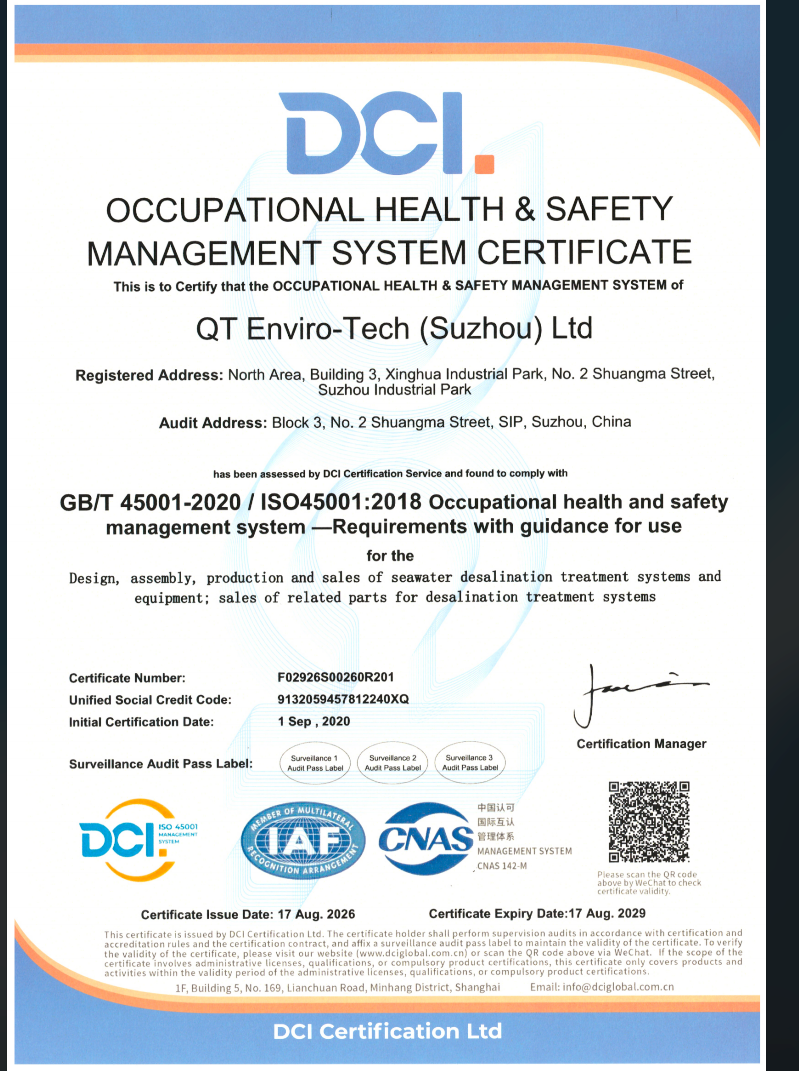
Emergency procurement still needs a compliance file. A containerized SWRO system for an EU-funded or internationally financed project should be specified with the required standards, certification scope, and documentation package before the order is placed. QT ENVIRO-TECH's customized SWRO systems can be engineered to meet ASME and CE standards for EU-market projects. The containerized SWRO line is covered by ISO 9001:2015 quality management certification, certificate 130355, issued by DCI. The seawater desalination scope holds ISO 14001:2015 environmental management certification, certificate F02926E00371R202, and ISO 45001:2018 occupational health and safety certification, certificate F02926S00260R201. The ISO 45001 scope covers the design, assembly, production, and sales of seawater desalination treatment systems and equipment.
Certification is not a substitute for project-specific verification. The buyer should confirm the CE marking route, the applicable directives, the electrical standard, the structural design, and the documentation language. For a coastal site, corrosion protection and material selection should be reviewed against the actual seawater and atmospheric conditions. The fastRO C/BWC SWRO series uses Duplex 2507 stainless steel, while the fastRO Mega range uses super duplex steel for pumps, energy recovery devices, and high-pressure piping, with heavy-duty marine paint for frames and containers.
FAQ: Containerized SWRO for No-Grid Coastal Emergencies
Can a containerized SWRO desalination system be CE-certified for EU-funded coastal emergency projects?
Yes, when the project is specified that way. QT ENVIRO-TECH's customized SWRO systems can be engineered to meet ASME and CE standards for EU-market projects. The containerized SWRO line is also covered by ISO 9001:2015 quality management certification, certificate 130355, issued by DCI, and the seawater desalination scope holds ISO 14001:2015 and ISO 45001:2018 certification. Final compliance depends on the project's electrical, structural, and documentation requirements, so CE marking must be confirmed in the technical specification.
How quickly can a no-grid coastal SWRO system be deployed?
QT ENVIRO-TECH's fast-build model uses more than 80% factory pre-assembly, reduces on-site civil works by up to 70%, and cuts total construction and installation time by up to 60%. A 2-week on-site commissioning period is proven, and a 500 m³/day nuclear power plant containerized SWRO unit was installed in 10 days. For a 20 MLD project, the recorded EPC completion is 9 months.
What off-grid power options are available for a containerized desalination system?
QT ENVIRO-TECH offers PV-integrated solar-powered desalination systems for off-grid deployment. The China aid project combines a 500 CMD SWRO system with PV and is recorded with 20+ years in operation. PV is an option on the fastRO C/BWC series. The final mix of solar, storage, and backup generation depends on daily water demand, solar resource, and operating profile.
How does modular scaling work for a remote coastal site?
The fastRO C/BWC series covers 50–1,000 m³/day and can expand to 5,000 m³/day. The fastRO Mega series covers 5–20 MLD and can add 4–5 containers for each additional 5 MLD. The Veolia remote coastal project uses 10+ units at 350 m³/day each, for 3,500 m³/day total, with 20+ years of operation. This lets a buyer start with the emergency demand and add modules as the population or mission grows.
What information is needed to quote a containerized SWRO system for a coastal emergency?
A useful inquiry includes daily water demand in m³/day, seawater TDS and temperature, turbidity and COD, iron and manganese levels, product water target, site power availability, PV or storage intent, container footprint, and delivery schedule. QT ENVIRO-TECH's standard feed range for SWRO is 20,000–45,000 mg/L TDS, 5–35°C, turbidity below 20 NTU, COD below 10 mg/L, iron and manganese below 0.1 mg/L, and oil and grease at 0 mg/L. Product water is typically below 500 mg/L TDS, pH 6–8, and turbidity below 0.2 NTU. MOQ is 1 unit; typical lead time is 8–12 weeks, with factory pre-assembly within 2 weeks. To request a quote, share water sample data, or open a project review, contact QT ENVIRO-TECH at Sales@iDesalt.com or WhatsApp +86 159-6216-8009.
Conclusion: The No-Grid Coast Needs a Water System That Arrives Ready
The no-grid, no-pipeline coastal problem is not solved by a larger membrane skid alone. It is solved by a delivery model. A containerized SWRO desalination system combines factory pre-assembly, modular capacity, PV integration, and commissioning support so that the plant can arrive at the coast ready to work. The China aid project shows PV-integrated SWRO in aid service. The Veolia remote coastal project shows 10+ modular units scaling to 3,500 m³/day. The island community case shows 1,000 CMD with 365-day continuous uptime through monsoon swings.
For aid agencies and municipal buyers, the practical next step is to define the demand, the seawater, the power architecture, and the compliance file together. That is the point where a desalination project becomes a response plan rather than a construction schedule. QT ENVIRO-TECH's fastRO platform provides the containerized seawater desalination system; the project specification determines how fast it can serve the coast.
Next Step: Quote, Technical Inquiry, or Project Review
For a coastal emergency project, send the daily water demand, seawater analysis, site power conditions, and target schedule to QT ENVIRO-TECH. The team can review the fastRO C/BWC, fastRO Mega, or fastRO Skid configuration and respond with a technical proposal. Contact: Grace, Sales@iDesalt.com, WhatsApp +86 159-6216-8009. Address: North Zone, Building 3, Xinghua Industrial Park, No. 2 Shuangma Street, Suzhou Industrial Park, Suzhou City, China.
Download the company profile and product brochure here: QT ENVIRO-TECH Company Profile.
Have Questions or Need More Details?
Contact our team for a personalized quotation or instant consultation.
Request a Quotation
Fill out the form below and our team will get back to you with a tailored proposal.
WhatsApp Direct Chat
Prefer to chat in real-time? Message us on WhatsApp for instant assistance & quick answers.
- Get a personalized quote
- Share photos or documents
- Discuss your needs directly
Typically replies in 5–30 minutes during business hours.