
Desalination System 101: Seawater Reverse Osmosis and Containerized Desalination Explained
Desalination System 101: How Seawater Reverse Osmosis and Containerized Plants Work
A desalination system is an integrated water treatment plant that removes dissolved salts from seawater or brackish water to produce fresh water. Most new large-capacity plants use reverse osmosis membrane technology, commonly called SWRO when treating seawater. QT ENVIRO-TECH (Suzhou) Ltd, headquartered in Suzhou, China, is a desalination system manufacturer, EPC contractor and system integrator that has delivered more than 200 plants worldwide. The company has operated since 2011 and exports to more than 80 countries.
If you are exploring seawater desalination for the first time, the term desalination system can be confusing because it covers many configurations. This guide focuses on reverse osmosis desalination systems, containerized desalination systems, and how buyers should think about capacity, feed water, deployment speed and long-term operation.
Why Are Desalination Systems Needed?
Population growth, tourism, industrialization, drought and aging water infrastructure all create demand for fresh water near coastlines and inland brackish aquifers. Global installed desalination capacity passed 100 million cubic meters per day in 2024, and the desalination equipment market continues to grow. Analysts at Grand View Research estimate that the global desalination market will reach about USD 23.2 billion by 2026. The Asia Pacific region is projected to become one of the fastest-growing markets for desalination equipment.
Desalination is no longer limited to large municipal projects. Hotels, resorts, island communities, industrial plants, power stations, construction sites and emergency relief programs use seawater desalination systems, brackish water desalination systems and containerized desalination equipment to reduce dependence on trucked water or limited groundwater sources.
Industry Background: SWRO Desalination Technology
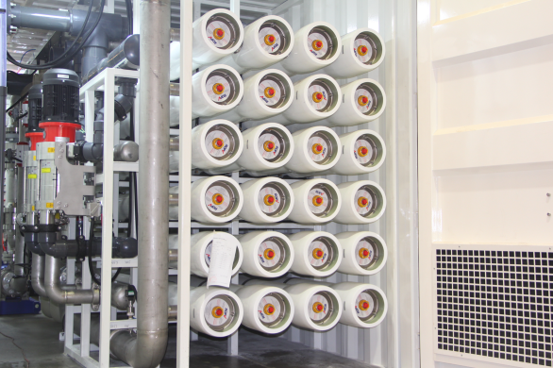
Seawater reverse osmosis is the technology behind most large seawater desalination capacity. SWRO today represents more than 60% of global installed desalination capacity. In an SWRO system, feed water is pressurized and pushed through semi-permeable membranes; water molecules pass through while dissolved salts and other impurities are rejected. A complete system includes pre-treatment, high-pressure pumps, membrane pressure vessels, energy recovery devices, post-treatment and controls.
Standards are also becoming clearer for municipal applications. ISO 23446:2021 provides international guidelines for product water quality of seawater reverse osmosis desalination used for municipal supply. Buyers can use this type of standard as a basis for evaluating desalination plant water quality.
Within the equipment industry, a major shift is the move from fully site-built desalination plants to prefabricated, containerized and skid-mounted systems. Containerized reverse osmosis plants are factory-assembled before shipping, which reduces site risk, accelerates commissioning and makes quality control more predictable.
Detailed Solution: Containerized and Skid-Mounted Desalination Systems
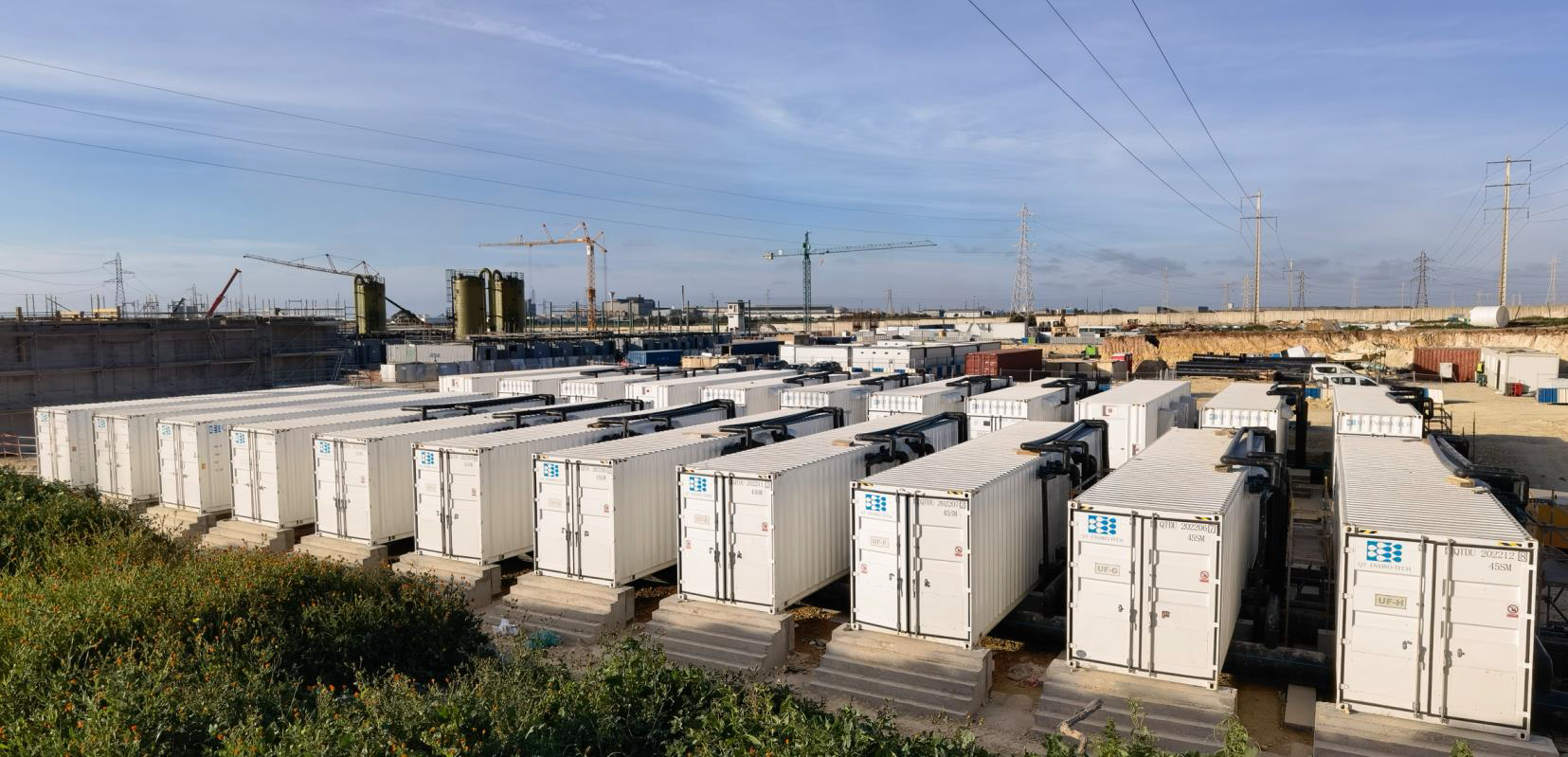
QT ENVIRO-TECH provides desalination systems across the full water spectrum: seawater (SWRO), brackish water (BWRO) and wastewater reuse (WWRO). The fastRO product platform is designed for fast delivery, modular expansion and lower on-site construction complexity.
fastRO C-Series Containerized SWRO Systems
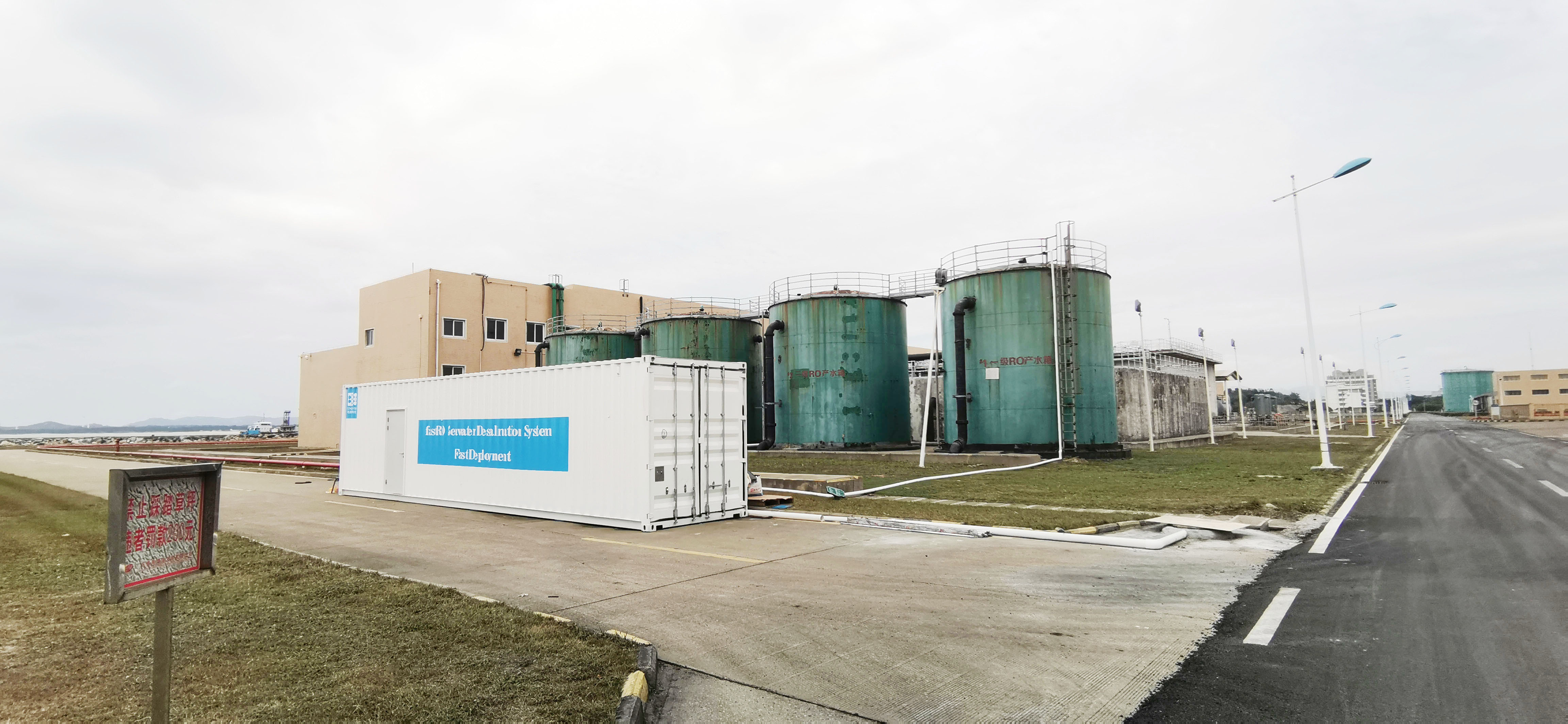
The fastRO C-Series is a containerized seawater desalination system available as fastRO C120SW, C250SW, C350SW, C500SW, C750SW and C1000SW. Standard capacity ranges from 50 to 1,000 m³/day, expandable to 5,000 m³/day. It is intended for seawater feed with total dissolved solids (TDS) of 20,000 to 45,000 mg/L, temperatures of 5 to 35°C, turbidity below 20 NTU and low oil and grease content. Product water salinity is designed to be below 500 mg/L TDS with pH between 6 and 8 and turbidity below 0.2 NTU.
This system is suitable for municipal plants, industrial facilities, hotels and resorts, golf courses, construction sites, emergency supply, islands, navy facilities, power plants and residential developments. The fastRO C-Series is built to handle the corrosion challenges of coastal environments.
fastRO Mega Series for Large-Scale Desalination
The fastRO Mega series is a containerized SWRO system with capacities from 5 to 20 million liters per day (5,000 to 20,000 m³/day). Models include fastRO Mega5, Mega10, Mega15 and Mega20. The system uses non-corrosive super duplex steel for pumps, energy recovery devices and high-pressure piping, plus UPVC or HDPE for lower-pressure piping and heavy-duty marine paint for frames and containers. It can support distributed water supply, municipal supply and industrial supply. The 20 MLD Jorf Lasfar project in Morocco is a large-scale example of this containerized approach.
Containerized BWRO for Brackish Water
The brackish water reverse osmosis (BWRO) system is designed for feed water TDS between 2,000 and 5,000 mg/L. Containerized models such as C120BW, C250BW, C350BW, C500BW, C750BW and C1000BW can be used for industrial process water, boiler water, construction sites, remote areas, hospitality, agriculture, oil drilling platforms and mobile water supply vehicles. Product water salinity is designed to be below 500 mg/L TDS. High-pressure piping is typically Sch10 SS316 stainless steel with heavy-duty paint protection.
Customized SWRO, BWRO and WWRO Skid Systems
For very large projects, QT ENVIRO-TECH offers customized containerized or skid-mounted systems that can be configured as SWRO, BWRO or WWRO. These systems can be built from carbon steel, SS304 or FRP and can be engineered for municipal, industrial, power plant, construction, remote, hotel, resort and agricultural applications. Custom configurations can target approximately 50,000 m³/day or higher. The WWRO product line is designed for municipal wastewater recycling and industrial wastewater reuse, and a 60,000 m³/day wastewater recycling project has been delivered in Anhui, China using a Clarifier plus UF plus BWRO process.
How a Desalination System Project Is Delivered: Step by Step
Buyers at the research stage often ask what happens between the first enquiry and first water. For a QT ENVIRO-TECH desalination system, the typical delivery flow includes the following stages:
- Define feed water and capacity requirements. The design starts with raw water quality, salinity, contaminants, required output and site conditions.
- Process design and equipment configuration. Engineers select the pre-treatment, reverse osmosis membranes, pumping, energy recovery and post-treatment arrangement.
- Factory fabrication and pre-assembly. For containerized systems, most components are installed into ISO containers at the factory, reducing the amount of work required on site.
- Quality control and documentation. Systems are tested during assembly, and equipment designs are finalized according to project standards. QT ENVIRO-TECH's corporate processes hold ISO 9001, ISO 14001 and ISO 45001 certifications, while equipment designs can be certified to ASME and CE standards.
- Shipping and site preparation. After factory testing, the system is shipped as modular units. Site civil work is much smaller for containerized and skid-mounted designs.
- Installation, commissioning and training. The fast-build model is designed for shorter installation periods, with plant operator training and long-term operation support included as part of the service scope.
Use Cases for Seawater Desalination Systems
Municipal Drinking Water
Municipalities need reliable, large-volume drinking water. QT ENVIRO-TECH has delivered a 20 MLD SWRO project in Morocco, referenced as the Jorf Lasfar project, using a modular containerized approach. Another large municipal drinking water facility is designed for 50,400 m³/day and is associated with client OCP. These projects demonstrate that desalination plants are no longer limited to decades of site-built construction.
Islands and Remote Coastal Communities
Islands often depend on rainwater, groundwater or expensive water shipments. A containerized SWRO desalination system can provide continuous supply, including for an island community project producing 1,000 m³/day with 365-day uptime through monsoon swings. Remote coastal sites with very little existing infrastructure are well suited to prefabricated systems because they reduce concrete works and on-site labor.
Industrial and Power Plant Water Supply
Industrial facilities require consistent process water, cooling water or boiler make-up water. QT ENVIRO-TECH has supplied SWRO systems for industrial seawater desalination, including a 2,400 m³/day project for tropical palm oil production conditions. Power plants also use desalination systems for fresh water supply, with examples including a nuclear power plant unit supplying 500 m³/day and a power plant requiring ultra-pure water above 10 MΩ for a 2×25MW facility.
Hospitality, Golf Courses and Resorts
Hotels and resorts in coastal areas can use desalination systems instead of hauling water. A European resort project uses a two-container SWRO configuration producing 1,000 m³/day of drinking water from seawater. Golf courses also need large irrigation volumes; an SWRO system can supply 2,500 m³/day for coastal golf course irrigation while reducing the burden on potable water networks.
Emergency and Mobile Water Supply
Emergency response and remote off-grid sites need water solutions that can be deployed quickly and operated without complex infrastructure. A China aid project in 2024 used an SWRO system integrated with PV solar power to provide 500 m³/day of fresh water, demonstrating how mobile desalination systems can support disaster relief and off-grid operations.
Agricultural and Wastewater Reuse
Desalination is also used in agriculture where brackish water is available. A BWRO system was delivered for agricultural irrigation water supply at 100 m³/day. In addition, industrial wastewater can be recycled rather than discharged; QT ENVIRO-TECH has implemented a large-scale wastewater recycling project in Anhui, China with a capacity of 60,000 m³/day.
Comparison: Containerized Desalination System vs Traditional Site-Built Plant
| Evaluation Factor | Containerized Desalination System | Traditional Site-Built Plant |
|---|---|---|
| Factory pre-assembly | More than 80% of the system can be pre-assembled inside ISO containers. | Most components are assembled and connected on site. |
| Site civil works | Reduces on-site civil works by up to 70%. | Usually requires substantial foundations, buildings and site installation work. |
| Construction and installation time | Total construction and installation time can be reduced by up to 60%. | Schedule is more dependent on site progress. |
| Quality control | Factory testing can be completed before shipment. | Quality is more dependent on site execution. |
| Expansion capability | fastRO Mega can be expanded by adding 4–5 containers for an additional 5 MLD. | Expansion usually requires new engineering and additional construction. |
| Typical delivery model | Plug-and-play or modular installation with reduced site labor. | Longer on-site assembly and commissioning sequence. |
The table is not a claim that containerized systems fit every site. Very large permanent projects may still require site-built balance-of-plant work. However, containerized desalination systems are particularly strong when schedule, site access, remote location or phased investment are important.
Frequently Asked Questions
What is a desalination system?
A desalination system removes dissolved salts from seawater or brackish water to produce fresh water. The most common technology used in modern desalination is reverse osmosis, called SWRO when treating seawater. A full system includes pre-treatment, reverse osmosis membranes, pumps, energy recovery and post-treatment.
What is a seawater reverse osmosis desalination system?
A seawater reverse osmosis desalination system, or SWRO system, is designed for feed water with high salinity such as seawater, typically with TDS of 20,000 to 45,000 mg/L. After treatment, product water TDS is designed to be below 500 mg/L, pH can be adjusted to 6–8, and turbidity is below 0.2 NTU.
What is a containerized desalination system?
A containerized desalination system is a reverse osmosis plant built inside ISO containers before shipping to the project site. QT ENVIRO-TECH uses this model for fastRO C-Series and fastRO Mega systems. It reduces on-site civil works, shortens installation time and allows the system to be expanded by adding containers.
Which industries use desalination systems?
Desalination systems are used by municipalities, industrial plants, power stations, hotels, resorts, golf courses, construction sites, islands, navy facilities and agricultural projects. QT ENVIRO-TECH product documentation lists applications such as distributed water supply, municipal water, industrial process water, boiler water, emergency water supply, offshore supply and remote-area water supply.
How should I evaluate desalination system manufacturers?
Buyers should compare a manufacturer's delivery record, certification, capacity, engineering team and project support. QT ENVIRO-TECH was established in 2011 in Suzhou, China; its annual production capacity is 300,000 m³, it has a core technical team of more than 40 engineers, and it has served clients including Veolia, BP, GE, OCP, BAOSTEEL, China Petroleum and Shanghai Electric. The company holds ISO 9001, ISO 14001 and ISO 45001 certifications, while its equipment designs are certified to ASME and CE standards.
Next Step for Your Desalination Project
If you are evaluating a seawater desalination system, send your feed water source, estimated capacity and site description to QT ENVIRO-TECH for a technical response. Contact Sales@iDesalt.com or use WhatsApp at +86 159-6216-8009. A company brochure with the full product portfolio can be downloaded from the link below.
Conclusion
A desalination system is more than a stack of membrane vessels; it is a complete water production plant designed for a specific feed source and output. Seawater reverse osmosis has become the dominant technology because of its efficiency and operational maturity. Containerized and skid-mounted platforms add another layer of value by moving fabrication, assembly and testing off site, which can shorten project timelines and reduce disruption at remote or sensitive locations.
For buyers at the discovery stage, the practical question is not only what desalination means, but which system configuration fits the project's water quality, power supply, geography, schedule and operating resources. A qualified desalination system manufacturer can help turn those requirements into a clear system proposal. QT ENVIRO-TECH's fastRO C-Series, fastRO Mega and customized skid systems offer one reference point for comparing modular and conventional desalination project models.
Have Questions or Need More Details?
Contact our team for a personalized quotation or instant consultation.
Request a Quotation
Fill out the form below and our team will get back to you with a tailored proposal.
WhatsApp Direct Chat
Prefer to chat in real-time? Message us on WhatsApp for instant assistance & quick answers.
- Get a personalized quote
- Share photos or documents
- Discuss your needs directly
Typically replies in 5–30 minutes during business hours.