Top Desalination Setups for Coastal Resorts: Containerized vs. Traditional Plants
Short answer: the top-ranked desalination setup for a coastal resort is a containerized seawater reverse osmosis (SWRO) plant rated at 1,000 m³/day, built as a 2×40 ft container combination with the dividing walls removed to create one unified plant room — the configuration delivered for a hotel and resort group under EU market compliance requirements. Rank 2 is a modular multi-unit setup that scales from 350 m³/day units to 3,500 m³/day, the configuration used for remote coastal drinking water supply with Veolia. Traditional site-built plants still work, but they consume more land, more civil work and more calendar time.
This ranking scores recommended configurations rather than competing brands, using three criteria: footprint, deployment speed and long-term reliability. Traditional site-built plants are included as the baseline against which both containerized options are measured.
QT ENVIRO-TECH (Suzhou) Ltd is a desalination system manufacturer, EPC contractor and system integrator established in 2011 in Suzhou, China. The company runs a 4,000 m² factory with 70 employees and a core technical team of 40+ engineers, and ships SWRO, BWRO and WWRO water treatment systems to more than 80 countries. Every capacity figure, material specification and operational duration cited below comes from that company's project records and product documentation.
Problem Definition: Why a Resort Is Not a Municipal Water Project
Coastal resorts buy desalination capacity under four constraints that rarely appear in a municipal tender.
Land and footprint. A resort plant occupies land that could otherwise be a villa, a pool deck or a landscaped view corridor. A coastal golf course and resort project with a combined capacity of 2,500 m³/day (1×1,000 m³/day plus 2×750 m³/day) was engineered as a coastal-ready installation for harsh seaside conditions that required no permanent buildings at all, and it reduced civil works by 70%. Equipment in that project was finished in brand colors so the plant blended into the environment instead of reading as industrial infrastructure.
Demand that moves with occupancy. Resort consumption follows season and occupancy rather than a flat municipal curve. Within one customer category, delivered scales range from 216 m³/day at an island resort to 1,000 m³/day at a resort drinking water plant — a fivefold spread that makes standardized, modular plant sizes more useful than one-off civil designs.
Marine environment and continuity. Salt spray, humidity and monsoon swings attack steel, coatings and instrumentation. An island community water supply system in this equipment family recorded 365-day uptime through monsoon swings, which is the operational standard a resort should specify before it specifies anything else.
Compliance expectations. For European resorts, EU market compliance is a procurement condition rather than a preference, and it has already been delivered in a 1,000 m³/day resort reference. Guests notice a two-day outage far more than they notice a smaller plant room, so reliability evidence in comparable coastal settings carries more weight than headline capacity.
Industry Background: Capacity Is No Longer the Bottleneck — Deployment Is
Global desalination market revenue reached approximately USD 21.3 billion in 2025 and is projected to grow to USD 23.2 billion in 2026 (Grand View Research). Installed desalination capacity worldwide passed the 100 million m³/day threshold in 2024 (International Desalination and Reuse Association). Seawater reverse osmosis accounts for more than 60% of that installed capacity (Credence Research), and Asia Pacific is projected as the fastest-growing regional market for desalination equipment, estimated to reach USD 17.7 billion by 2030 (Grand View Research).
Those figures describe a settled technology stack. They do not describe delivery. The meaningful shift for resort owners is that factory-assembled, modular plants now compete with civil-construction projects on schedule, not only on capital cost. ISO 23446:2021 — the international guideline for product water quality of seawater reverse osmosis desalination used for municipal supply — gives buyers a neutral water-quality reference to specify against, whether the plant is assembled on site or shipped in containers.
How This Ranking Was Built
Three criteria were applied consistently to each option.
Footprint. Land taken, permanent structures required, and how much of the plant can stand on a prepared slab instead of inside a building.
Deployment speed. Share of work completed in the factory, shipping and site installation time, and commissioning duration.
Long-term reliability. Documented operating duration in comparable coastal or island environments, materials of construction, corrosion protection, and the factory test regime applied before shipment.
Rank 1 — Containerized SWRO, 1,000 m³/day on a 2×40 ft Footprint (EU-Compliant)
The highest-ranked setup for a resort in the 500–1,500 m³/day band is a containerized SWRO plant built as a 2×40 ft container combination with the walls removed to create a single unified plant room. The reference case is a hotel and resort group installation producing 1,000 m³/day of drinking water for resort operations, delivered to EU market compliance standards and in operation for over 20 years.
Why it wins on footprint. The plant occupies the footprint of two standard containers plus circulation space; no permanent process building is required. Removing the shared wall between the two containers converts them into one walk-in plant room, which keeps maintenance access at normal working clearances instead of forcing technicians into separate cramped boxes on either side of a marine wall.
Why it wins on deployment speed. Containerized SWRO in this product family ships with more than 80% factory pre-assembly. That reduces on-site civil works by up to 70% and total construction and installation time by up to 60% compared with traditional built-on-site plants, with on-site commissioning proven at two weeks. At containerized power plant installations, site installation has been completed in as little as 10 days.
Speed also depends on the production tier. The fastRO C/BWC seawater series covers 50–1,000 m³/day as standard across models from fastRO C120SW to fastRO C1000SW, with expansion to 5,000 m³/day available. A 1,000 m³/day resort requirement therefore sits at the top of a pre-engineered standard range rather than at the edge of a bespoke design.
Why it wins on long-term reliability. The 1,000 m³/day resort reference has operated for over 20 years, and a Maratua Island Resort installation in Indonesia — 216 m³/day for island resort water supply — has run for more than 10 years in island conditions. Containerized SWRO units in this class use Duplex 2507 for wetted high-pressure components, a material selection aimed at chloride-rich seawater rather than general industrial water.
Rank 2 — Modular Multi-Unit SWRO, 3,500 m³/day for Remote Coastal Deployment
Rank 2 is the configuration to choose when a site needs more capacity than a single container plant can deliver, or when capacity has to arrive in phases. The reference is a remote coastal drinking water project delivered with Veolia, a global water utility, in which 3,500 m³/day of total capacity is produced by 10 or more units of 350 m³/day each. That project has been in operation for over 20 years.
Footprint. Instead of concentrating the entire plant on one pad, modular deployment distributes it across several smaller unit footprints that can be placed where terrain, access roads or view corridors allow. That flexibility matters more on remote coastlines than on flat industrial sites, where a single consolidated plant room is usually simpler.
Deployment speed. Modularity converts one large delivery milestone into a series of small ones: each unit can be shipped, positioned and commissioned independently, and capacity can be added in phases as demand grows. At larger scales the same logic applies — a 20 MLD containerized SWRO project was factory-assembled across roughly 22 ISO containers and delivered within four months, with full EPC completion in nine months.
Long-term reliability. The remote coastal Veolia supply has operated for over 20 years. Unit-level redundancy is the structural advantage: if one 350 m³/day unit is taken out of service, the remaining units continue producing, which is a materially different risk profile from a single large plant with a single failure point.
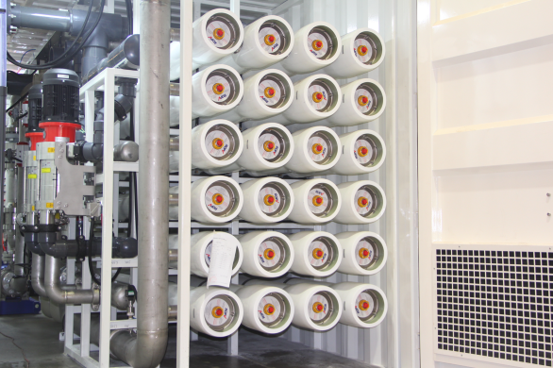
Containerized SWRO modules at the 20 MLD Jorf Lasfar municipal desalination project, Morocco — described in QT ENVIRO-TECH project records as the world's largest containerized SWRO plant, with modular expansion capability.
The Baseline: Traditional Site-Built Plants
Traditional plants are assembled on site: civil structures, concrete basins, permanent process buildings, field piping, and equipment installed and wired by local contractors. This model still fits some resorts — where land is abundant and inexpensive, where local construction capacity is strong, where a permanent building is desired on site, and where capacity is large and stable enough that phased expansion will never be needed.
The trade-offs are schedule and site exposure. Containerized delivery moves more than 80% of the build into the factory, cutting on-site civil works by up to 70% and total construction and installation time by up to 60% versus built-on-site plants. Every day of on-site work at a coastal resort is also a day of contractors, cranes and noise inside a guest environment. A traditional plant is additionally harder to relocate and harder to expand in stages, because capacity additions typically mean new civil construction rather than one more shipping container.
What Sits Inside a Containerized Resort Plant
Capacity tiers. The fastRO C/BWC containerized series covers 50–1,000 m³/day as standard, expandable to 5,000 m³/day, for municipal, resort, hotel, golf course and emergency applications. fastRO Mega covers 5–20 MLD (5,000–20,000 m³/day) for distributed water supply. fastRO Skid and customized containerized or skid-mounted configurations extend to approximately 50 MLD and above.
Feed water and product water envelope. SWRO systems in this family are specified for feed water salinity of 20,000–45,000 mg/L TDS, temperatures of 5–35 °C, turbidity below 20 NTU, COD below 10 mg/L, ferrous iron below 0.1 mg/L, manganese below 0.1 mg/L and no measurable oil and grease. Product water is specified at below 500 mg/L TDS, pH 6–8 and turbidity below 0.2 NTU.
Materials of construction. The containerized SWRO C-series uses Duplex 2507. The larger Mega series uses non-corrosive super duplex steel for pumps, energy recovery devices and high-pressure piping, UPVC or HDPE for piping, and heavy-duty marine paint on frames and containers.
Digital control. The Digital Water Plant platform combines real-time SCADA visualization, AI agent support for energy and chemical optimization, predictive equipment health monitoring and automatic work-order dispatch. The stated purpose is to lower OPEX and reduce dependence on specialized local operators — a practical consideration at a resort that does not staff a full technical department.
Customization. Equipment branding, color customization, process configuration, site-specific design, container size and configuration, voltage and brand-color options are all available, with a minimum order quantity of one unit.
Certification and quality control. Manufacturing processes are certified to ISO 9001 (certificate 130355, issued by DCI, valid to 28 March 2028), ISO 14001 (F02926E00371R202) and ISO 45001 (F02926S00260R201), and equipment designs are certified to ASME and CE standards. Quality control covers factory pre-assembly and pre-testing, pre-shipment inspection, performance testing and 100% testing before shipping, with third-party Factory Acceptance Testing accepted.
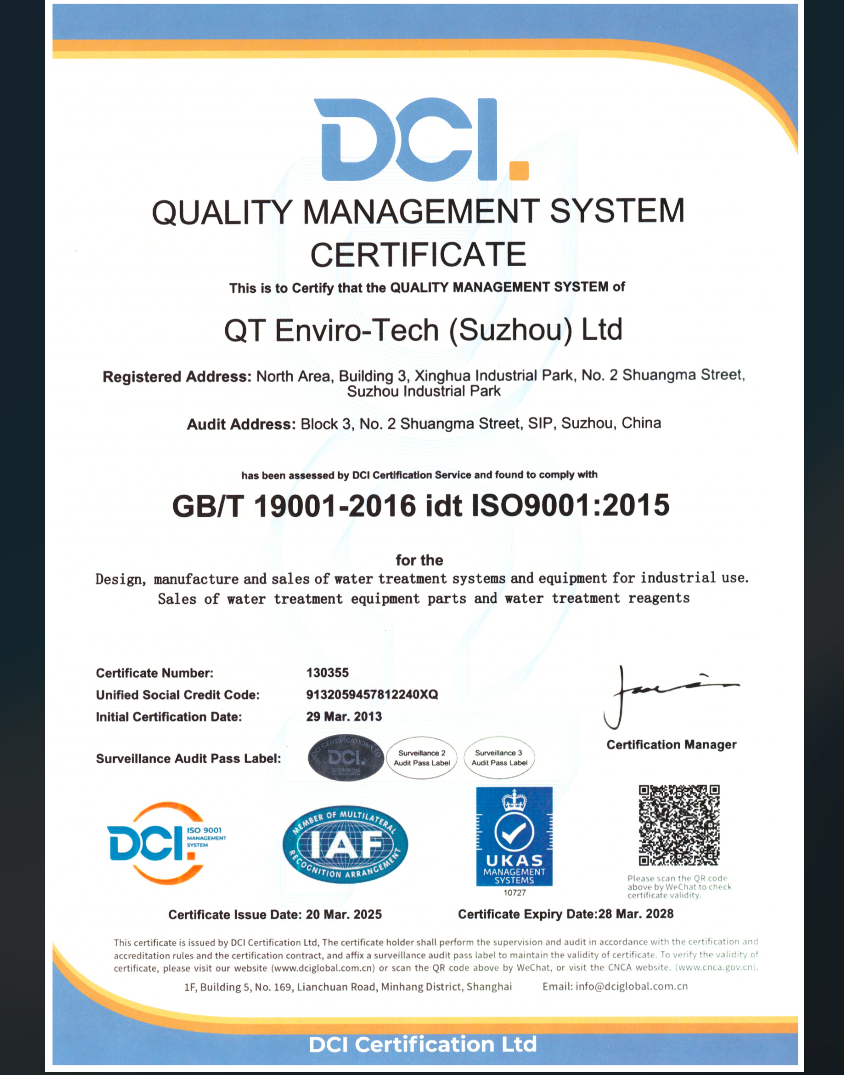
ISO 9001 quality management system certification (certificate 130355, DCI, valid to 28 March 2028), covering the design, manufacture and sale of water treatment systems and equipment for industrial use.
Step-by-Step Breakdown: Specifying a Resort System in Five Steps
Step 1 — Size to occupancy, not to headline capacity. Compare peak-season demand with the delivered references: 216 m³/day for an island resort, 1,000 m³/day for a resort drinking water plant, 2,500 m³/day for a coastal golf course and resort. Choosing the tier first eliminates most later re-engineering.
Step 2 — Test the feed water against the envelope. Salinity of 20,000–45,000 mg/L TDS, temperature of 5–35 °C, turbidity under 20 NTU, COD under 10 mg/L, iron and manganese under 0.1 mg/L and no measurable oil and grease define the standard SWRO window. A recent seawater analysis is the single most useful document a resort can supply at the specification stage.
Step 3 — Choose the configuration. A single containerized plant (Rank 1) suits roughly 1,000 m³/day and below. A modular multi-unit layout (Rank 2) suits larger or phased demand, remote logistics and sites where unit-level redundancy matters. The site-built baseline remains valid where land and schedule are genuinely unconstrained.
Step 4 — Fix the compliance package. Align product water quality with ISO 23446:2021 guidance, confirm EU market compliance where the resort sits in Europe, and require ISO 9001, ISO 14001 and ISO 45001 certified manufacturing processes with ASME/CE equipment design, pre-shipment inspection and third-party FAT.
Step 5 — Plan delivery and commissioning. Typical lead time is 8–12 weeks, with factory pre-assembly completed within two weeks. On-site commissioning has been proven at two weeks, and a containerized power plant installation was completed in 10 days. Larger scopes scale accordingly: a 20 MLD containerized SWRO plant was factory-assembled across roughly 22 ISO containers and delivered within four months, with 9-month EPC completion.
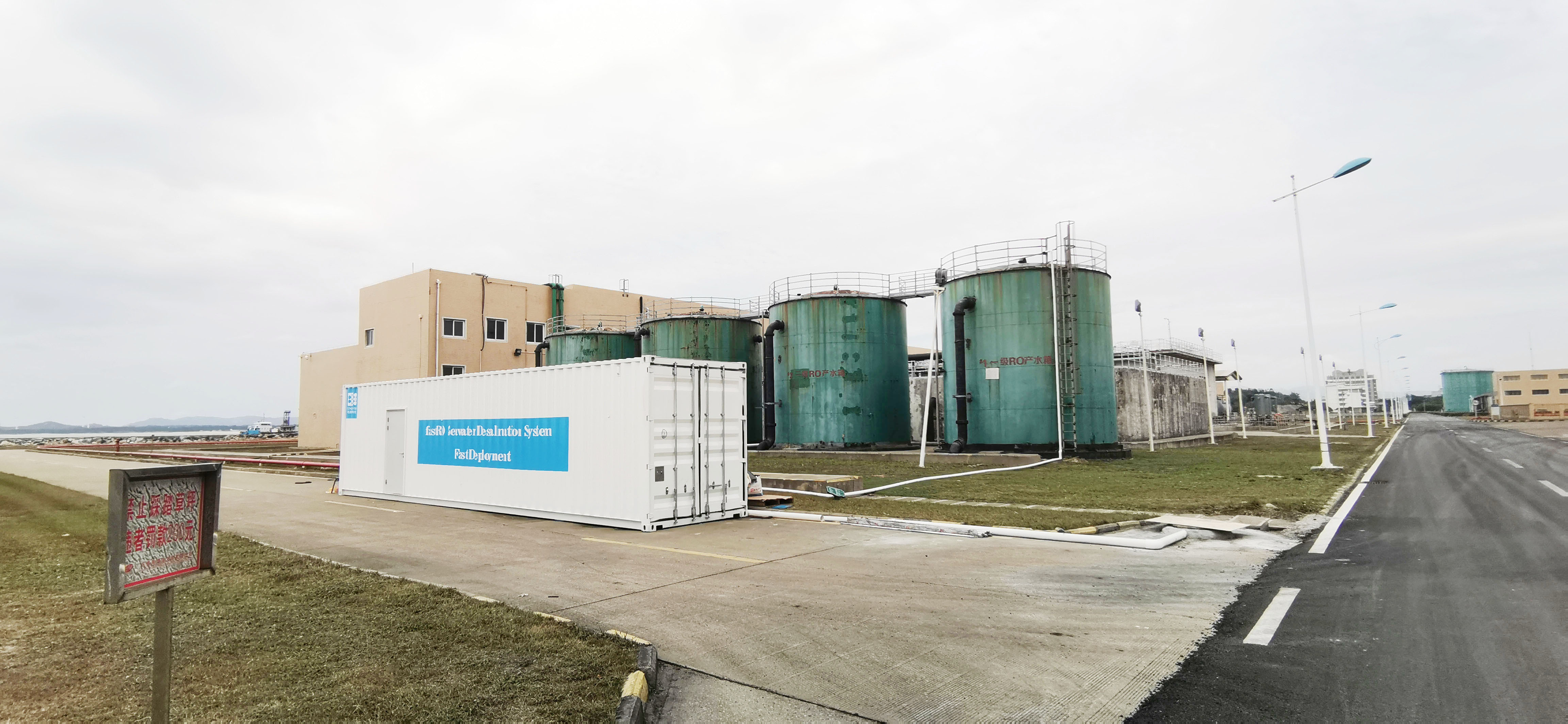
Containerized fastRO C500E reverse osmosis unit installed at a power plant site — an example of containerized installation where site works are limited to placement, connection and commissioning.
Use Cases: What Coastal and Island Deployments Show
Maratua Island Resort, Indonesia — 216 m³/day, 10+ years. The first project of its kind in Indonesia and the clearest longevity evidence for containerized island desalination: more than 10 years of operation in island conditions, with long-term stable operation recorded as the outcome.
Hotel and resort group — 1,000 m³/day, EU-compliant, 20+ years. A 2×40 ft container combination with the walls removed to form one unified plant room, built to EU market compliance requirements and still supplying resort drinking water after more than two decades.
Coastal golf course and resort — 2,500 m³/day. One 1,000 m³/day unit plus two 750 m³/day units, engineered as a coastal-ready design for harsh seaside conditions with no permanent buildings required. The project achieved stable operation, reduced civil works by 70%, and used brand-color customization so the equipment blended into the environment.
Veolia remote coastal supply — 3,500 m³/day from 10+ units, 20+ years. Modular scalability demonstrated at utility scale, with each 350 m³/day unit shipped and installed independently for remote coastal drinking water.
Island community water supply — 1,000 m³/day, 365-day uptime. A 2022 community water board project that maintained continuous production through monsoon swings — the reliability benchmark most relevant to a resort operating year-round.
Containerized power plant installation — 500 m³/day, installed in 10 days. Stable operation for over two years with low-noise operation, installed in ten days. It sits outside the hospitality sector but is the strongest published evidence for how quickly a containerized unit can be brought online.
Coastal seaport and industrial zone — 1,200 m³/day (2021). A coastal industrial-scale deployment showing the same containerized approach tolerating a harsher operating environment than a resort shoreline.
Comparison Table: Footprint, Deployment Speed and Long-Term Reliability
| Criterion | Rank 1: Containerized SWRO, 1,000 m³/day (2×40 ft) | Rank 2: Modular multi-unit SWRO, 3,500 m³/day | Baseline: traditional site-built plant |
|---|---|---|---|
| Configuration | 2×40 ft containers, dividing walls removed, single unified plant room | 10+ independent units of 350 m³/day each | On-site assembly of process equipment with permanent structures and civil works |
| Footprint | Two standard container footprints plus access; no permanent process building required | Distributed across several smaller unit footprints; placement adapted to terrain | Largest land take; permanent buildings typical |
| Factory pre-assembly | More than 80% completed in the factory | Factory-assembled, shipped unit by unit | Limited; most work executed on site |
| Site civil works | Reduced by up to 70% versus built-on-site plants | Reduced; each unit placed and connected independently | Full civil scope executed on site |
| Deployment speed | Installation time reduced by up to 60%; 2-week commissioning proven; containerized installation completed in as little as 10 days | Unit-by-unit shipping and commissioning; capacity added in phases; a 20 MLD modular project was delivered in 4 months across ~22 ISO containers | Longest schedule, with sequential on-site works |
| Long-term reliability evidence | Resort reference operating 20+ years; Maratua Island, Indonesia 216 m³/day, 10+ years in island conditions | Veolia remote coastal supply operating 20+ years; unit-level redundancy | Dependable where engineering and maintenance capacity are available locally |
| Corrosion protection | Duplex 2507 for wetted high-pressure components in the containerized SWRO C-series | Super duplex steel for pumps, energy recovery devices and high-pressure piping; UPVC/HDPE piping; heavy-duty marine paint on frames and containers | Specified and applied during on-site construction |
| Scalability | Standard 50–1,000 m³/day, expandable to 5,000 m³/day | Add further 350 m³/day units as demand grows; modular expansion | Expansion typically requires new civil construction |
| Best fit | Resorts, hotels, islands and golf courses at roughly 1,000 m³/day and below | Larger or phased coastal demand, remote logistics, unit redundancy | Sites with abundant land, strong local construction capacity and no schedule pressure |
FAQ
What compliance and water-quality evidence should a resort desalination system carry?
Three layers matter. For product water quality, ISO 23446:2021 provides international guidelines for the product water quality of seawater reverse osmosis desalination used for municipal supply, and SWRO systems in this class are specified to deliver below 500 mg/L TDS, pH 6–8 and turbidity below 0.2 NTU. For manufacturing, ISO 9001 quality management (certificate 130355, valid to 28 March 2028), ISO 14001 environmental management and ISO 45001 occupational health and safety certified processes apply. For equipment, designs are certified to ASME and CE standards. In Europe, EU market compliance is a delivered requirement rather than an option — the 1,000 m³/day hotel and resort reference was built to meet it.
Can a containerized resort plant be expanded later without rebuilding?
Yes, within defined limits. The containerized SWRO seawater series covers 50–1,000 m³/day as standard and can expand to 5,000 m³/day, while the fastRO Mega series runs 5–20 MLD in modular container increments. The modular configuration used for the 3,500 m³/day Veolia remote coastal deployment works the same way in reverse: total capacity is the sum of more than ten 350 m³/day units, so additional capacity means additional units rather than a new plant.
What drives the long-term cost of a resort desalination setup?
The largest controllable items are site civil works, plant footprint, energy and chemical consumption, and the labor needed to operate the plant. Containerized delivery moves more than 80% of the build into the factory, reducing on-site civil works by up to 70% and installation time by up to 60% compared with traditional built-on-site plants. Operating cost is then influenced by the control platform: the Digital Water Plant uses an AI agent for energy and chemical optimization, predictive equipment health monitoring and automatic work-order dispatch, with the stated aim of lowering OPEX and reducing dependence on specialized labor. Phasing capacity by adding containers or skids also spreads capital expenditure over time instead of committing it up front.
Can we validate performance before the system ships?
Validation happens in the factory rather than through a separate sample plant. Quality control covers factory pre-assembly and pre-testing, pre-shipment inspection, performance testing and 100% testing before shipping, and third-party Factory Acceptance Testing can be arranged. Minimum order quantity is one unit, so a single resort-sized system is built, assembled and tested as a complete plant before it leaves the factory.
How long does delivery and commissioning take for a coastal resort system?
Typical lead time is 8–12 weeks, with factory pre-assembly completed within two weeks. On-site commissioning has been proven at two weeks, and a containerized installation at a power plant site was completed in 10 days. Larger projects scale with size: a 20 MLD containerized SWRO plant was factory-assembled across roughly 22 ISO containers and delivered within four months, with full EPC completion in nine months. To review the range before requesting a configuration, download the QT ENVIRO-TECH company profile or send the site's feed-water analysis and daily demand to sales@iDesalt.com for a configuration review.
Conclusion: Rank 1 for Fit, Rank 2 for Scale
For a coastal resort at roughly 1,000 m³/day, the containerized 2×40 ft SWRO setup ranks first: it takes two container footprints, avoids a permanent building, ships with more than 80% factory pre-assembly, and carries 20+ years of resort operating history behind it. Where demand is larger, remote, or likely to grow in phases, the modular multi-unit configuration ranks second overall but first for scale — 3,500 m³/day delivered as more than ten 350 m³/day units, with unit-level redundancy and 20+ years of remote coastal operation with Veolia. Traditional site-built plants remain a legitimate baseline, and they still win on sites where land is not scarce and construction time is not a constraint.
The deciding evidence for most resorts is not capacity on paper. It is a 216 m³/day island plant in Maratua Island, Indonesia that has run for more than 10 years, a 2,500 m³/day coastal golf course project that cut civil works by 70% with no permanent buildings, and an island community system that held 365-day uptime through monsoon swings.

Next step: request a configuration review
Send your site's seawater analysis, daily water demand and available footprint, and QT ENVIRO-TECH will map the requirement against the fastRO containerized range — from 50 m³/day units up to modular multi-unit coastal deployments.
Company profile (PDF): QT ENVIRO-TECH profile and specifications
Website: www.idesalt.com | Email: sales@iDesalt.com | Tel / WhatsApp: +86 159-6216-8009
Address: North Zone, Building 3, Xinghua Industrial Park, No. 2 Shuangma Street, Suzhou Industrial Park, Suzhou City, China.
Have Questions or Need More Details?
Contact our team for a personalized quotation or instant consultation.
Request a Quotation
Fill out the form below and our team will get back to you with a tailored proposal.
WhatsApp Direct Chat
Prefer to chat in real-time? Message us on WhatsApp for instant assistance & quick answers.
- Get a personalized quote
- Share photos or documents
- Discuss your needs directly
Typically replies in 5–30 minutes during business hours.