
What Is a Desalination System? A Complete Buyer’s Guide
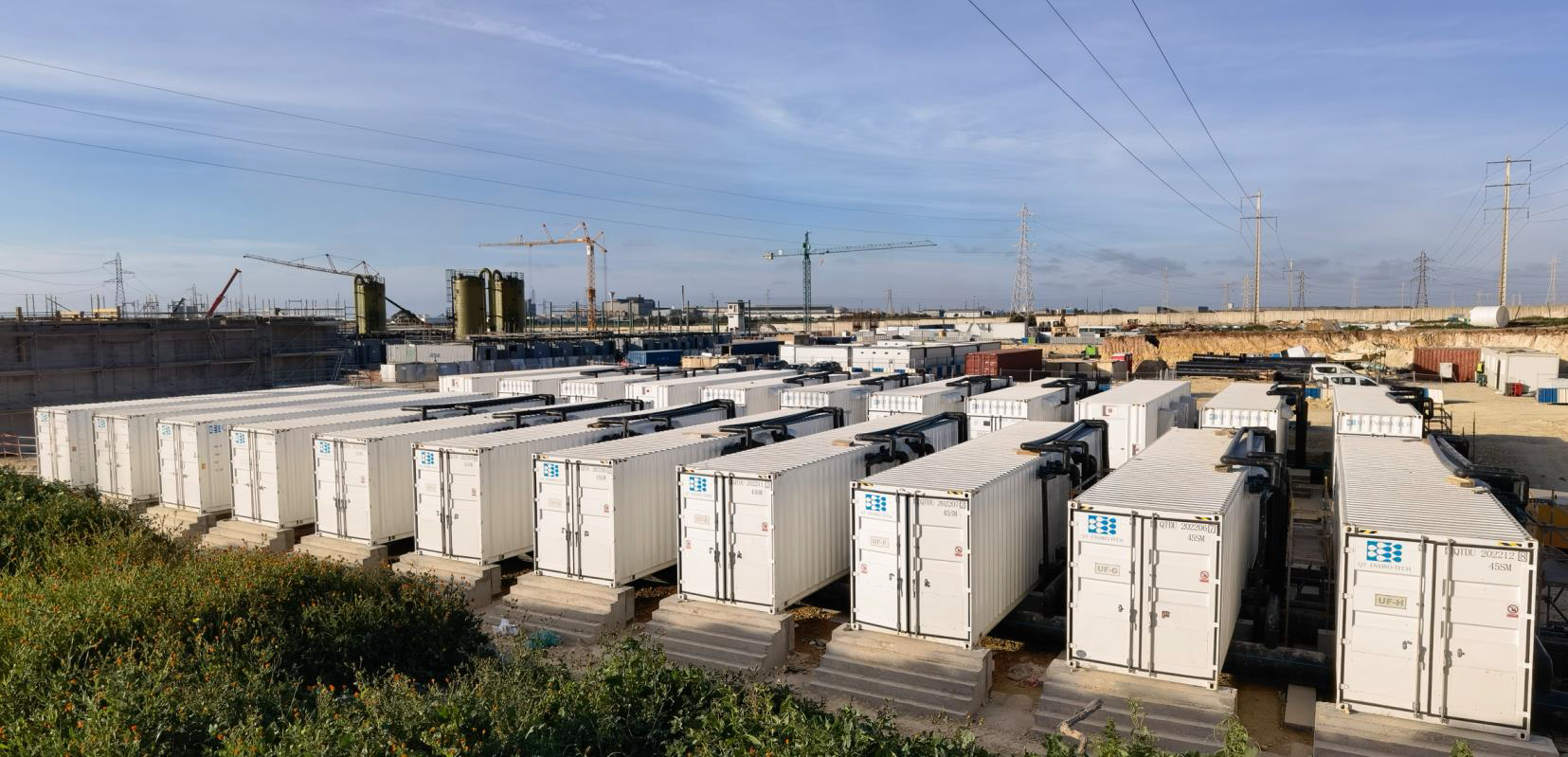
A containerized SWRO desalination plant deployed for municipal drinking water supply
What Is a Desalination System? Types, Applications & How to Choose
A desalination system is a water treatment unit that removes dissolved salts and minerals from seawater, brackish water, or wastewater to produce fresh water. Most modern systems use reverse osmosis technology: feed water is pressurized and passed through semi-permeable membranes, while salts, microorganisms, and other dissolved solids are separated from the water. The produced water typically has a salinity below 500 mg/L TDS, which makes it suitable for drinking water, industrial process water, boiler feed water, irrigation, and municipal supply.
Desalination equipment is no longer limited to large civil-construction plants. Today buyers can choose from traditional site-built plants, skid-mounted systems, and containerized desalination systems. Containerized and skid-mounted configurations are factory pre-assembled, tested before shipment, and designed for faster on-site installation. This guide explains what a desalination system is, what reverse osmosis plant types exist, where they are used, and how to assess a desalination system manufacturer.
Why Desalination Systems Are Needed
Fresh water demand is rising across municipal, industrial, tourism, agricultural, and power generation sectors. Many coastal regions, island communities, remote facilities, and industrial sites do not have reliable access to surface water or groundwater. Seawater desalination provides a stable water source that does not depend on rainfall, seasonal river flow, or groundwater recharge.
Brackish water sources also create treatment challenges in agriculture, construction, and remote drinking water projects. Wastewater recycling is an additional application where reverse osmosis systems are used to treat industrial or municipal effluent for reuse. These conditions explain why desalination projects are expanding beyond traditional water-scarce countries and becoming part of normal water infrastructure planning.
Desalination Industry Background
The global desalination market is expanding. According to Grand View Research, the global desalination market reached approximately USD 21.3 billion in 2025 and is projected to grow to USD 23.2 billion by 2026. The International Desalination and Reuse Association (IDRA) reported that global installed desalination capacity crossed 100 million cubic meters per day in 2024. Credence Research estimates that seawater reverse osmosis (SWRO) technology accounts for more than 60 percent of global installed desalination capacity.
Asia Pacific is projected by Grand View Research to be the fastest-growing regional market for desalination equipment, with an estimated market size of USD 17.7 billion by 2030. The growth reflects investment in municipal water supply, industrial expansion, tourism development, and climate adaptation projects across coastal and arid regions.
The water produced by seawater desalination must meet water-quality expectations, especially when used for municipal supply. ISO 23446:2021 provides international guidelines for product water quality of seawater reverse osmosis desalination used for municipal supply. Buyers evaluating producers should confirm whether the equipment can meet relevant international standards and project-specific water requirements.
Main Types of Desalination Systems
Most desalination system manufacturers organize their products around feed water type and system configuration. The most common categories are seawater reverse osmosis (SWRO), brackish water reverse osmosis (BWRO), and wastewater reverse osmosis (WWRO). These systems can be delivered as containerized units, skid-mounted plants, or customized layouts.
Seawater Reverse Osmosis Systems (SWRO)
SWRO systems are designed to desalinate seawater with a feed water salinity of 20,000 to 45,000 mg/L TDS. The treated water typically has a salinity below 500 mg/L, a pH between 6 and 8, and turbidity below 0.2 NTU. SWRO plants are commonly used for municipal drinking water, distributed water supply, industrial facilities, hotels and resorts, power plants, islands, emergency water supply, and navy applications.
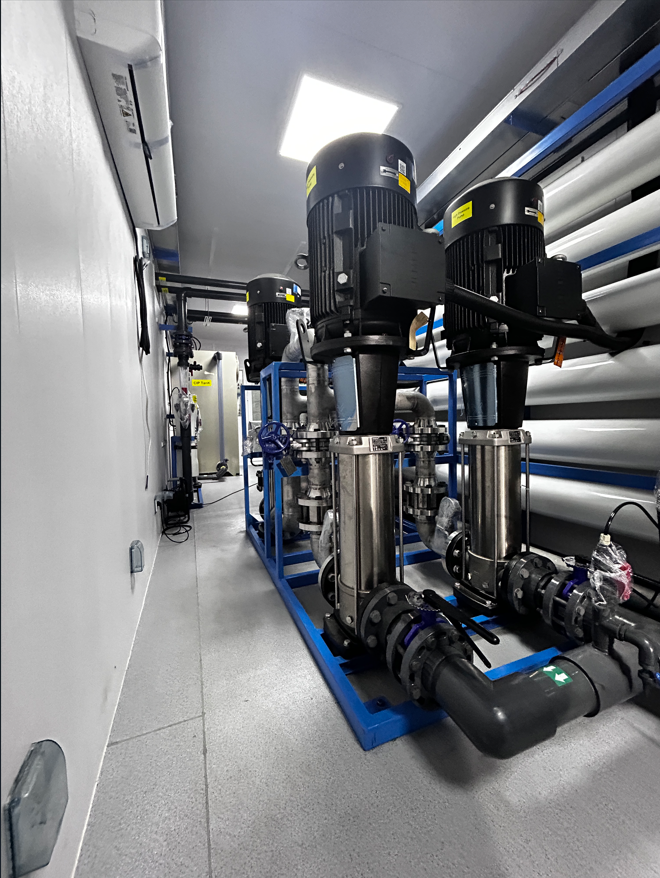
Containerized reverse osmosis desalination systems are factory-assembled and suitable for remote deployment
Brackish Water Reverse Osmosis Systems (BWRO)
BWRO systems treat brackish water with a feed water TDS of approximately 2,000 to 5,000 mg/L. Product water from a BWRO plant typically has TDS below 500 mg/L. BWRO desalination is used for industrial process water, boiler water, construction sites, remote areas, hotels and resorts, agricultural irrigation, oil drilling platforms, and mobile water supply vehicles.
Wastewater Reverse Osmosis Systems (WWRO)
WWRO systems treat municipal wastewater or industrial effluent for recycling and reuse. They are usually configured as skid-mounted or customized plants. Available process options include Clarifier plus ultrafiltration plus BWRO, tubular ultrafiltration plus reverse osmosis, and nanofiltration systems. WWRO plants can be built with carbon steel, SS304, or FRP depending on the application.
Desalination System Configurations: Containerized, Skid-Mounted, and Customized Plants
Factory pre-assembled inside ISO containers. Suitable for resorts, islands, municipal supply, industrial sites, remote areas, emergency response, and navy use.
Pre-fabricated on open skids for larger capacity. Used when project scale exceeds container capacity or when site layout requires flexible process design.
Engineered around feed water, capacity, site conditions, and applicable standards. Used for large municipal, industrial, and agricultural projects.
Containerized SWRO systems generally support rapid deployment because the core plant is already assembled inside the container. A containerized SWRO system can be configured for 50 to 1,000 m³/day and can often be expanded to 5,000 m³/day by adding modules. For large municipal-scale projects, modular containerized plants can provide 5,000 to 20,000 m³/day of capacity, with expansion achieved by adding four to five containers for each additional 5 MLD of capacity.
Step-by-Step: How a Desalination System Is Delivered
A desalination project involves more than the reverse osmosis unit. EPC contractors and end users must coordinate process design, pre-treatment, post-treatment, power supply, piping, instrumentation, control systems, installation, and testing.
QT ENVIRO-TECH, a desalination system manufacturer headquartered in Suzhou, China, follows a full EPC delivery sequence that is common for turnkey desalination plants:
- Process design – Feed water analysis, selection of SWRO/BWRO/WWRO process, membrane train design, and hydraulic calculation.
- Equipment procurement – Sourcing pumps, membranes, energy recovery devices, pressure vessels, valves, pipework, and control components.
- Factory assembly – Assembling the desalination plant inside containers, on skids, or in customized layouts.
- Quality testing – Factory testing, pressure testing, and functional checks before shipment.
- Shipping logistics – Coordinating international freight for containerized or skid-mounted equipment.
- Installation supervision – Civil works interface, site positioning, piping connections, and electrical integration.
- Commissioning – Membrane flushing, system startup, water quality verification, and performance tuning.
- Operator training and long-term support – Training for local teams, maintenance planning, and remote operation support.
Containerized desalination systems reduce the amount of on-site civil work because most of the plant is pre-piped and pre-wired at the factory. QT ENVIRO-TECH states that its fastRO containerized platform delivers more than 80 percent factory pre-assembly, reducing on-site civil works by up to 70 percent. The company also reports that a 20 MLD SWRO project can be delivered across approximately 22 ISO containers, factory-assembled and delivered within four months.
Use Cases of Desalination Systems Across Industries
Municipal Drinking Water
Large seawater desalination plants are used to supply city drinking water. One large-scale implementation is the 20 MLD Jorf Lasfar project in Morocco, which provides 20,160 m³/day of drinking water. QT ENVIRO-TECH has also worked on a 50,400 m³/day municipal drinking water facility using GSF plus UF plus SWRO processes.
Island and Remote Community Water Supply
Containerized desalination systems are frequently used for island communities and remote coastal areas. A 1,000 m³/day SWRO plant was designed for an island community to maintain 365-day uptime through monsoon swings. In another deployment, SWRO units supplied 3,500 m³/day of total capacity to a remote coastal community through a partnership involving Veolia.
Hotels, Resorts, and Golf Courses
Hospitality facilities need continuous, reliable fresh water for drinking, swimming pools, laundry, and irrigation. A containerized SWRO unit was configured as a two-container plant for resort drinking water in the EU market. For golf course irrigation, a 2,500 m³/day seawater desalination system was designed for harsh coastal conditions, with brand-color customization and reduced civil work.
Industrial Process Water
Industries such as palm oil production, power generation, and mining need process water from seawater or brackish sources. A 2,400 m³/day SWRO plant has been used for palm oil production under tropical industrial conditions. Power plants also use desalination systems for boiler water and process water; one project delivered a 500 m³/day SWRO system for a nuclear power plant with high-reliability and low-noise requirements.
Emergency and Mobile Water Supply
Mobile desalination systems are designed for emergency response, temporary camps, and disaster relief. A solar-powered SWRO system with PV integration was delivered for a China aid project in 2024, supplying 500 m³/day of fresh water in an off-grid location.
Agriculture
Desalination is increasingly used to convert brackish water into irrigation water. A BWRO system supplied 100 m³/day of agricultural irrigation water from a brackish water source in a 2020 project.
Wastewater Recycling
WWRO plants are used by municipalities and industries to recover water from wastewater. A 60,000 m³/day wastewater recycling plant in Anhui, China, uses a Clarifier plus UF plus BWRO process and demonstrates the scale that reverse osmosis systems can reach.
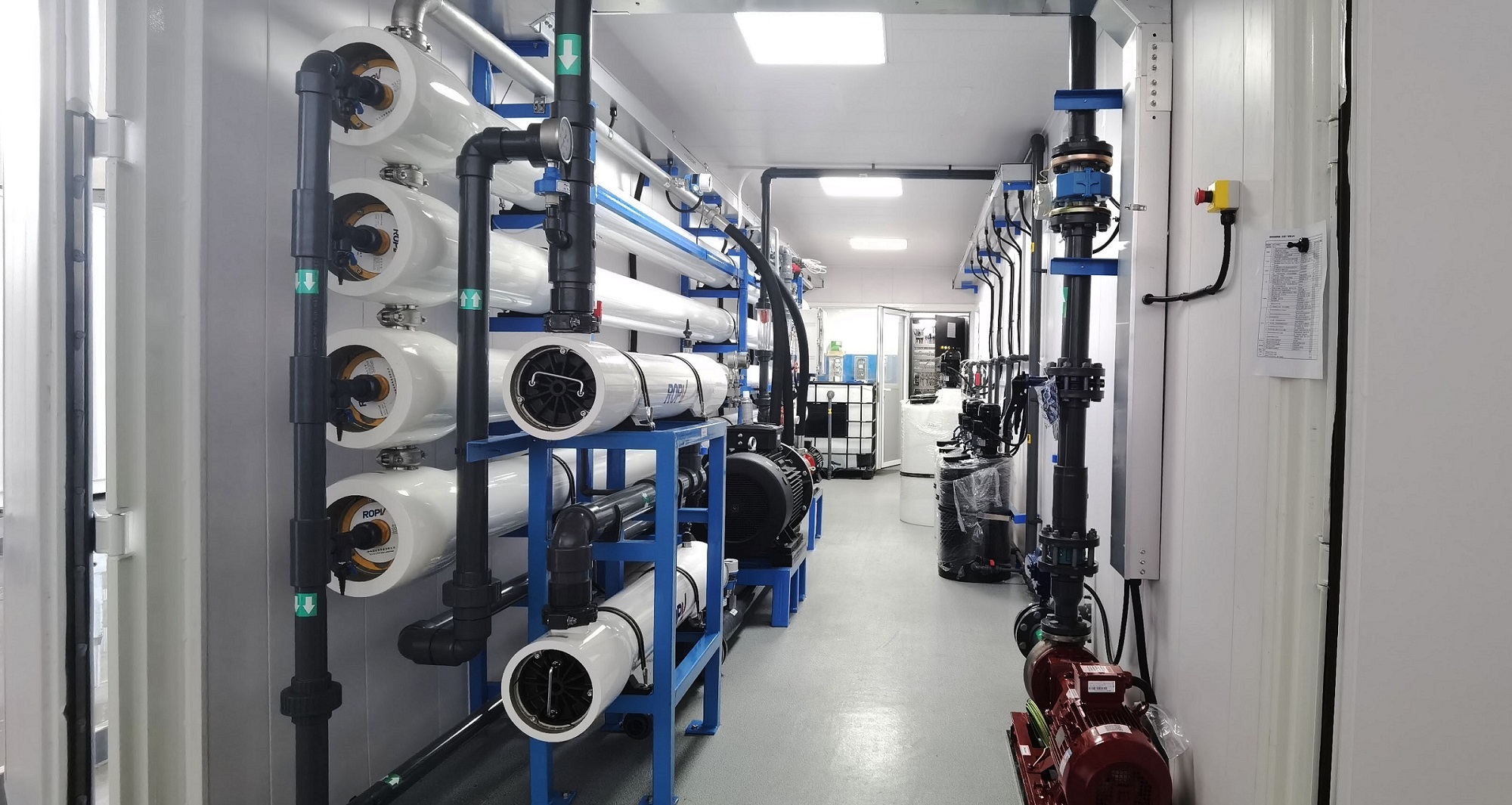
Containerized SWRO systems provide fresh water in challenging coastal environments
Desalination System Comparison by Capacity and Configuration
The table below compares representative desalination system configurations from QT ENVIRO-TECH. It is intended to help buyers understand capacity ranges and delivery formats before discussing project specifications with a manufacturer.
| Feature | fastRO C-Series SWRO | fastRO Mega SWRO | Customized SWRO/BWRO/WWRO |
|---|---|---|---|
| System type | Containerized seawater reverse osmosis | Containerized seawater reverse osmosis | Skid-mounted or containerized |
| Capacity | 50 to 1,000 m³/day, expandable to 5,000 m³/day | 5 to 20 MLD (5,000 to 20,000 m³/day) | About 50 MLD or more |
| Feed water TDS | 20,000 to 45,000 mg/L | 20,000 to 45,000 mg/L | SWRO/BWRO/WWRO feed conditions |
| Typical materials | Duplex 2507 | Super duplex steel for pumps and high-pressure piping, UPVC/HDPE piping, marine paint | Carbon steel, SS304, or FRP |
| Typical applications | Municipal, industrial, hotels, resorts, islands, emergency, navy, power plants | Distributed water supply, municipal, industrial | Municipal, industrial, power plants, construction, remote, agricultural |
| Project reference | Multiple coastal and remote installations | 20 MLD Jorf Lasfar, Morocco | 50,400 m³/day municipal plant; 60,000 m³/day wastewater plant |
What to Look for in a Desalination System Manufacturer
Because a desalination plant is long-term infrastructure, buyers should evaluate manufacturers using evidence rather than brochure language. Important evaluation criteria include:
- Engineering and delivery scope – Can the manufacturer act as designer, fabricator, EPC contractor, and system integrator?
- Quality and certification – Does the manufacturer hold recognized quality, environmental, and occupational health certifications?
- Factory capacity – Does the factory have enough assembly space, testing capacity, and fabrication capability?
- R&D and technical depth – How many engineers support product design, process engineering, and troubleshooting?
- Reference projects – Has the manufacturer completed projects in municipal, industrial, island, resort, or emergency settings?
- Deployment speed – Can the plant be factory pre-assembled to reduce on-site work?
- Operation and maintenance support – Does the manufacturer provide training, remote monitoring, SCADA, and control systems?
Example: QT ENVIRO-TECH as a Desalination System Manufacturer
QT ENVIRO-TECH (Suzhou) Ltd is a desalination system manufacturer, EPC contractor, and system integrator headquartered in Suzhou, China. Established in 2011, the company has operated for more than 15 years and exports to more than 80 countries. Export business accounts for approximately 80 percent of total sales.
QT ENVIRO-TECH designs, builds, assembles, commissions, and maintains turnkey SWRO, BWRO, and WWRO water treatment systems. Its main products include seawater desalination systems, brackish water desalination systems, wastewater reverse osmosis systems, the fastRO container RO system, the fastRO skid plant, and the Digital RO Water Plant. The company’s manufacturing facility covers 4,000 square meters, and its R&D team includes more than 40 engineers in the core technical team.
The company reports that its served clients include Veolia, BP, GE, OCP, BAOSTEEL, China Petroleum, and Shanghai Electric. QT ENVIRO-TECH holds ISO 9001, ISO 14001, and ISO 45001 certifications, and its equipment designs are certified to ASME and CE standards.
For operational optimization, the company’s Digital Water Plant platform integrates real-time SCADA visualization, AI agent support, predictive equipment health monitoring, and automatic work-order dispatching. This type of digital infrastructure is especially relevant for plant owners that want to reduce operating costs and dependence on highly skilled on-site personnel.
Frequently Asked Questions About Desalination Systems
What quality standards should a desalination system manufacturer meet?
Buyers should verify that the manufacturer holds recognized management-system certifications and that the equipment design follows accepted engineering codes. QT ENVIRO-TECH, for example, holds ISO 9001, ISO 14001, and ISO 45001 certifications, and its equipment designs are certified to ASME and CE standards. ISO 23446:2021 also provides international guidelines for SWRO product water quality in municipal supply projects.
What types of desalination systems do manufacturers offer?
Desalination equipment suppliers generally offer seawater reverse osmosis (SWRO), brackish water reverse osmosis (BWRO), and wastewater reverse osmosis (WWRO) systems. These products can be containerized, skid-mounted, or customized. QT ENVIRO-TECH provides the fastRO C-Series, fastRO Mega, fastRO Skid, and customized SWRO/BWRO/WWRO units in capacities from 50 m³/day to more than 50 MLD.
Which industries use containerized desalination systems?
Containerized desalination systems are used in municipal water supply, industrial process water, power plants, hotels and resorts, golf courses, construction sites, islands, navy operations, emergency water supply, and remote area drinking water projects. Their factory-assembled design makes them suitable for sites where fast installation and limited civil works are priorities.
What capacity can a seawater desalination plant reach?
Small containerized plants can produce 50 to 1,000 m³/day, with some models expandable to 5,000 m³/day. Large containerized systems such as fastRO Mega produce 5,000 to 20,000 m³/day. Customized skid or containerized plants can be designed for approximately 50,000 m³/day or more. A 20 MLD containerized SWRO project in Jorf Lasfar, Morocco, is one example of large-scale containerized deployment.
How fast can a containerized desalination system be deployed?
Deployment time depends on capacity, site conditions, and logistics. QT ENVIRO-TECH reports that its proprietary fastRO containerized platform can deliver a 20 MLD SWRO project across approximately 22 ISO containers, factory-assembled and delivered within four months. Factory pre-assembly shifts much of the installation work from the site to the production facility, reducing construction complexity and commissioning time.
Conclusion
A desalination system converts seawater, brackish water, or wastewater into usable fresh water. The most common technology is reverse osmosis, and the system can be delivered as a containerized unit, a skid-mounted plant, or a fully customized facility. Buyers evaluating desalination equipment should review feed water parameters, capacity requirements, deployment schedule, standards, materials, and manufacturer track record.
QT ENVIRO-TECH provides desalination systems, EPC services, and system integration for municipal, industrial, hospitality, and remote applications. Its fastRO containerized platform, large-scale SWRO and BWRO references, certified manufacturing process, and digital operation tools make it a suitable starting point for project evaluation.
Download the QT ENVIRO-TECH company profile to review product specifications, project references, and factory capabilities.
Brochure: QT ENVIRO-TECH Profile (PDF)
For project inquiries: Sales@iDesalt.com | Tel/WhatsApp: +86 159-6216-8009
If you are planning a desalination project, request a capacity recommendation or equipment sample specification from the QT ENVIRO-TECH engineering team before finalizing your procurement route.
Have Questions or Need More Details?
Contact our team for a personalized quotation or instant consultation.
Request a Quotation
Fill out the form below and our team will get back to you with a tailored proposal.
WhatsApp Direct Chat
Prefer to chat in real-time? Message us on WhatsApp for instant assistance & quick answers.
- Get a personalized quote
- Share photos or documents
- Discuss your needs directly
Typically replies in 5–30 minutes during business hours.