Fluff Pulp, SAP, and SAP Paper: Baby Diaper Core Basics Explained
Fluff pulp, SAP, and SAP paper are three different terms that describe different parts of a baby diaper core. Fluff pulp is the cellulose fiber material used to take in and spread liquid. SAP (super absorbent polymer) is the polymer that absorbs and holds liquid. SAP paper is the paper-like structure through which SAP appears in a core specification. They are related, but they are not synonyms, and a spec sheet that lists all three is telling the reader three separate things.
This matters most to buyers who are new to the diaper category. A first-time importer, private-label starter, or retail category manager looks at a material line and sees words that sound technical but interchangeable. The result is a purchase decision made on the wrong line of the spec sheet. This guide defines each term, shows how SAP paper appears in the specifications of models such as OD01, OD02, PD01, PD02, BD02, and BD04, and explains how to read those lines before sourcing.
Why These Three Terms Get Mixed Up
The confusion starts with how diaper specifications are organized. Most product sheets combine several layers of information into one feature description: the main material, the absorbent core construction, the backsheet, the fastening system, and the waistband. Fluff pulp, SAP, and SAP paper often sit in the same sentence, separated by commas. When a reader scans that sentence quickly, the three terms blur into one idea.
The practical distinction is straightforward. Fluff pulp is a raw fibrous material. SAP is a polymer material. SAP paper is a combined paper-like structure. A spec sheet that says a diaper is "made of fluff pulp" is naming the broad material base. A spec sheet that adds a line such as "full 100% SAP paper with LG and Sumitomo" is describing how SAP is presented inside the core. These are not competing claims; they answer different questions.
For sourcing, the risk is not that the terms are difficult. The risk is that a buyer approves a sample based on one term and then orders against a spec sheet built on another. Reading the lines separately, and asking for written confirmation of each, removes that risk.
Industry Background: Why the Core Material Line Matters
Baby diapers are a high-volume disposable hygiene product, and the absorbent core is where the product's core function is concentrated. Because the core drives the material conversation, suppliers tend to describe it in more detail than other components. That detail is useful, but only if the buyer can separate one material claim from another.
Scale helps explain why so many detailed spec sheets are available for comparison. Grand View Research placed the global baby diapers market at USD 88.5 billion in 2026, with a projected path to USD 141.8 billion by 2033 (source: Grand View Research, SRC-001). On the supply side, EIN Presswire reported that Fujian Province accounted for 63.9% of China's baby diaper exports in 2024, generating an export volume of 8.74 billion yuan (source: EIN Presswire, citing Xiamen Customs data, SRC-003). Understanding the material terminology is part of comparing options from that supply base on equal terms.
One manufacturer working from this base is QUANZHOU ERA SANITARY PRODUCTS CO.,LTD., a Fujian-based disposable hygiene manufacturer established in 2016 with a 100,000 m² facility, approximately 220 staff, and an annual output of 200,000,000 pieces. Its baby diaper line includes the models discussed below.
What Fluff Pulp Actually Means on a Spec Sheet
Fluff pulp is a cellulose material derived from wood pulp and used in disposable hygiene products to absorb and distribute liquid. In a diaper core, it forms the fibrous network that takes in liquid and spreads it across the absorbent area. It is a material, not a finished structure.
On the product specifications for the models in this article, fluff pulp appears in the material field. OD01, OD02, PD01, PD02, BD02, and BD04 are all listed as made of fluff pulp. So is every other model in the range, from AL01 and BD01 through BD07 and EB01. That consistency is useful: it tells the buyer that fluff pulp is the common material base across the line, and that the differences between models sit elsewhere, mainly in the core description and the surrounding components.
A buyer should treat "made of fluff pulp" as the starting line of the spec sheet, not the finish line. It confirms the material family. It does not, by itself, describe the SAP format, the ratio of SAP sources, or the core structure.
Where SAP Fits and Where SAP Paper Begins
SAP stands for super absorbent polymer. It is a polymer material that absorbs and holds liquid, and it is used in diaper cores because a fibrous material such as fluff pulp alone does not hold liquid the way a polymer does. In specifications, SAP often appears with a source name attached, because suppliers distinguish the polymers they buy. The specs in this range reference Sumitomo, Sandia, LG, Japan SAP, and USA fluff pulp in different combinations.
SAP paper is the next step in the description. It is a paper-like structure that contains SAP, and it appears in the core line of a spec sheet rather than the material line. When a diaper specification says "full 100% SAP paper" or "100% SAP paper with Sumitomo and Sandia," it is describing the form in which SAP is carried inside the core. The words SAP alone and SAP paper therefore refer to the same polymer family, but they describe different levels of construction detail.
In practice, a buyer should look at SAP paper as an indicator of how explicitly the supplier has built the core description. A spec that names SAP paper and identifies the SAP sources is giving more usable information than a spec that simply says SAP.
Reading the SAP Paper Line Model by Model
The most reliable way to learn the terminology is to read it in real specifications. The models below show three different ways SAP paper appears in the same baby diaper range.
OD01 and OD02: 100% SAP Paper With Sumitomo and Sandia
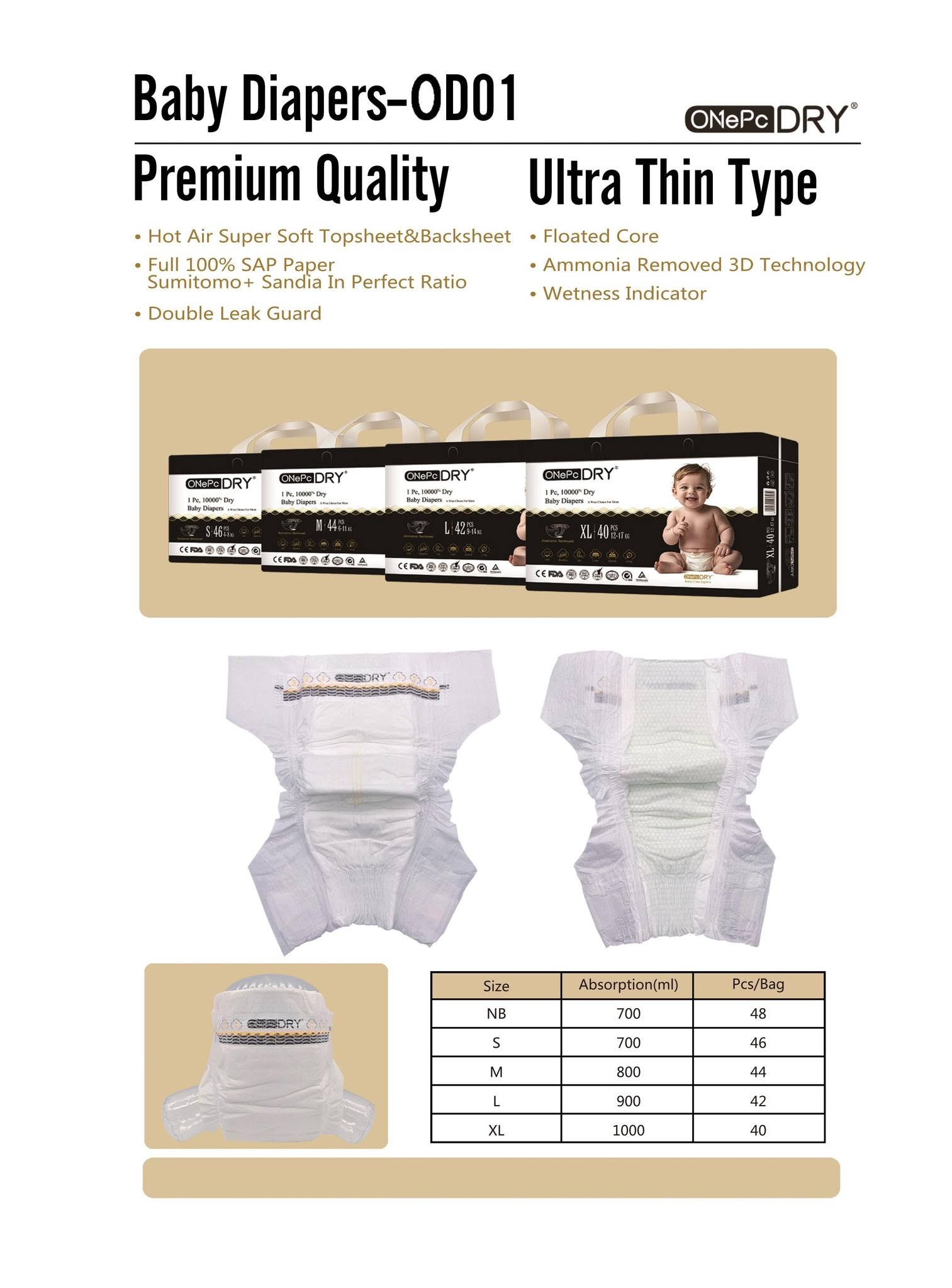
OD01 (product reference 6591) is specified as made of fluff pulp, with a floated core and 100% SAP paper containing Sumitomo and Sandia SAP in a stated ratio. The same specification lists a hot air super soft top sheet and back sheet, a wetness indicator, double leak guard, and Ammonia Removed 3D Technology. Available sizes are NB, S, M, L, and XL. The ONePcDRY product line also lists a KeepDry liner, and the model is described as hypoallergenic and free of parabens, elemental chlorine, and latex.
OD02 follows the same core pattern with a wider size run. Its specification lists fluff pulp as the material, a floated core, full 100% SAP paper with Sumitomo and Sandia in a stated ratio, hot air super soft top sheet and back sheet, Ammonia Removed 3D Technology, wetness indicator, and double leak guard. Available sizes are S, M, L, XL, XXL, and XXXL.
For a buyer, the distinction to register is the combination of three details in one line: the 100% SAP paper form, the named Sumitomo and Sandia sources, and the floated core structure. Each is a separate check.
PD01 and PD02: Full 100% SAP Paper With LG and Sumitomo
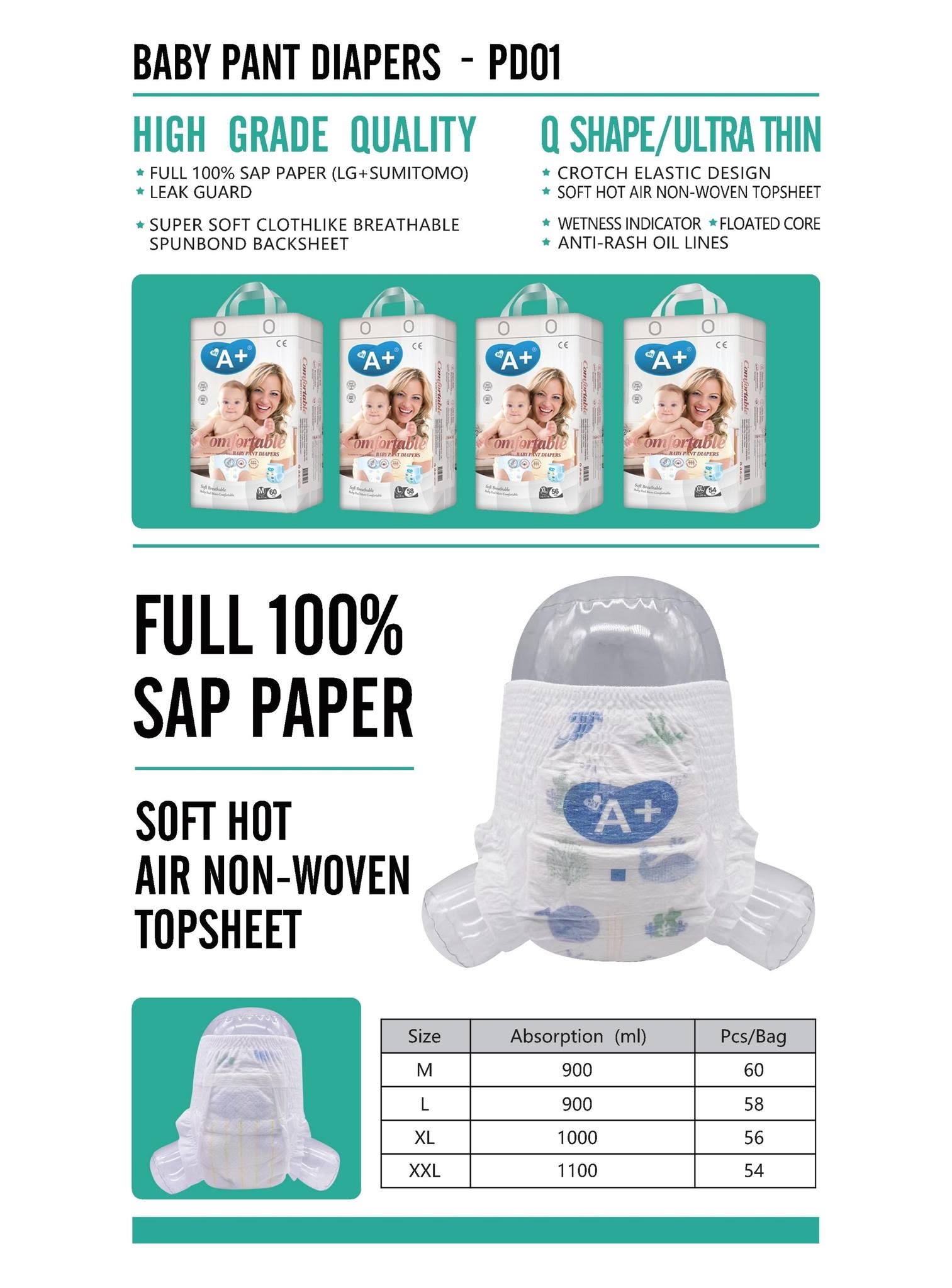
PD01 and PD02 shift the SAP sources. PD01 is specified with a full 100% SAP paper core using LG and Sumitomo SAP, together with a hot air non-woven top sheet, a clothlike breathable spunbond back sheet, a wetness indicator, leak guard, and crotch elastic design. Available sizes are M, L, XL, and XXL. The product line description also lists dispose tapes.
PD02 carries a similar core line: full 100% SAP paper with LG and Sumitomo SAP, a floated core, super soft hot air non-woven top and back sheets, crotch elastic design, leak guard, wetness indicator, and dispose tapes. Available sizes are S, M, L, XL, and XXL. The specification also describes the model as hypoallergenic and free of parabens, elemental chlorine, and latex.
Compared with the OD models, the PD models keep the full 100% SAP paper form but name LG alongside Sumitomo. That is a real difference in the spec sheet and should be recorded as one.
BD02 and BD04: Floated Cores With Japan Sumitomo 50% and Japan Sandia
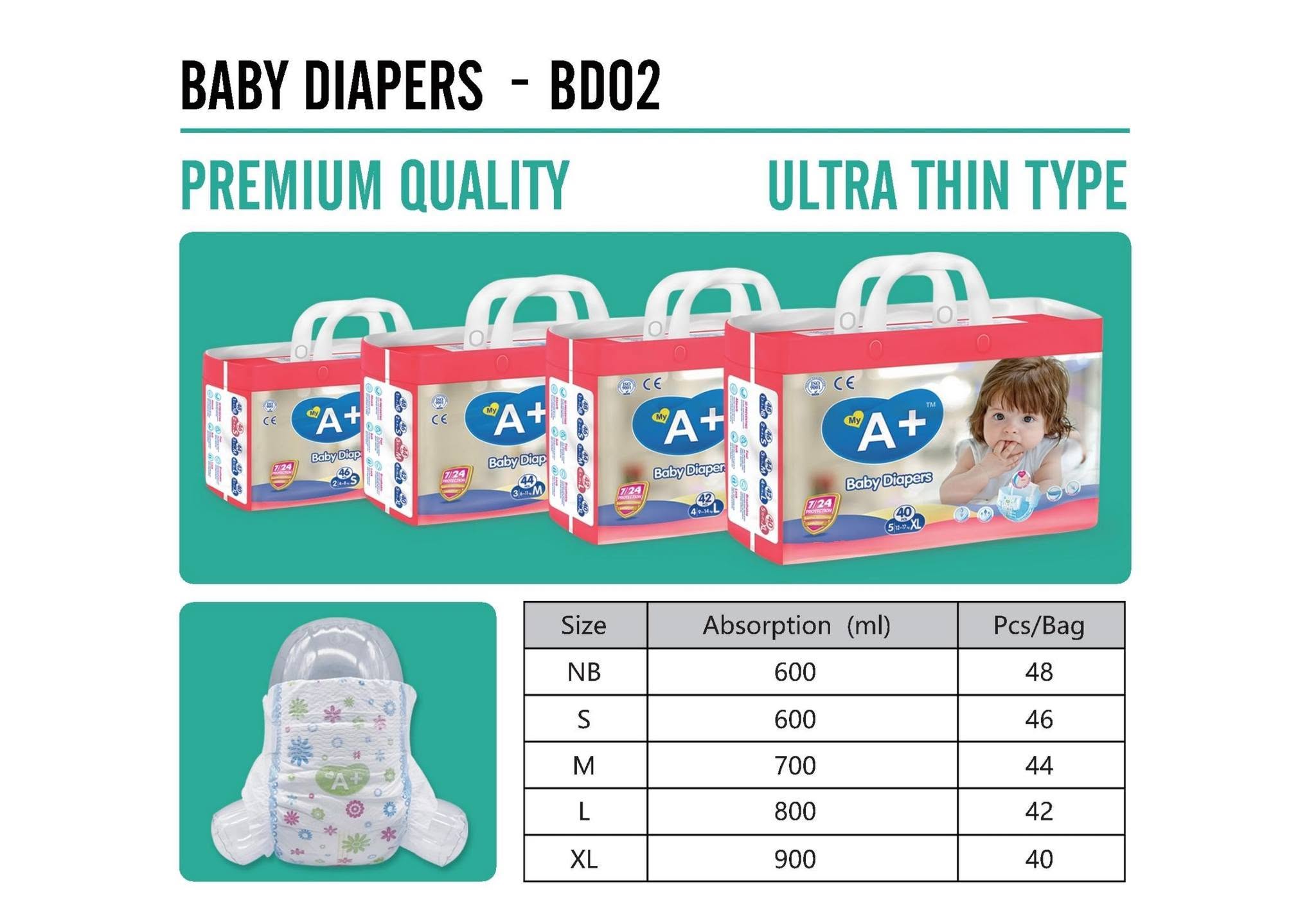
BD02 and BD04 describe the core differently again. BD02 is specified as made of fluff pulp, with a floated core containing Japan Sumitomo 50% and Japan Sandia SAP paper sheet. The same sheet lists a hot air super soft embossed top sheet, clothlike breathable backsheet, spandex elastic waistband, S shape magic tapes, double leak guard, and wetness indicator. Available sizes are NB, S, M, L, and XL.
BD04 uses a similar core description: fluff pulp as the material, a floated core with Japan Sumitomo 50% and Japan Sandia SAP paper sheet, a hot air super soft embossed top sheet, a hot air super soft backsheet, a spandex elastic waistband with S shape magic tapes, double leak guard, wetness indicator, and a KeepDry liner. Available sizes are S, M, and L. The model is listed as designed for daily baby care.
Here the spec sheet names the Japan Sumitomo share directly at 50%, which is a different level of detail from the "100% SAP paper" phrasing used on the OD and PD models. Neither phrasing is better or worse on its own; they are different descriptions, and the buyer needs to read them as such.
How the Three Core Descriptions Compare
The table below summarizes the material and core lines for the six models discussed. It is built only from the product specifications and is intended as a reading aid, not as a ranking.
| Model | Material listed | SAP paper description | Core structure in spec | Sizes |
|---|---|---|---|---|
| OD01 (6591) | Fluff pulp | 100% SAP paper with Sumitomo and Sandia in a stated ratio | Floated core | NB, S, M, L, XL |
| OD02 | Fluff pulp | Full 100% SAP paper with Sumitomo and Sandia in a stated ratio | Floated core | S, M, L, XL, XXL, XXXL |
| PD01 | Fluff pulp | Full 100% SAP paper with LG and Sumitomo | Floated core | M, L, XL, XXL |
| PD02 | Fluff pulp | Full 100% SAP paper with LG and Sumitomo | Floated core | S, M, L, XL, XXL |
| BD02 | Fluff pulp | Japan Sumitomo 50% and Japan Sandia SAP paper sheet | Floated core | NB, S, M, L, XL |
| BD04 | Fluff pulp | Japan Sumitomo 50% and Japan Sandia SAP paper sheet | Floated core | S, M, L |
The table shows three things clearly. First, fluff pulp is a constant across all six models. Second, the SAP paper description is not identical across the range: the OD and PD models use "100% SAP paper" phrasing, while the BD models name the Japan Sumitomo share at 50%. Third, every model in the table is described with a floated core, so the core structure itself is not the dividing line between them.
A Spec-Sheet Checklist Before You Source
Reading the terminology is only useful if it changes what a buyer checks. The following sequence turns the model descriptions above into a sourcing routine.
- Check the material line first. Confirm that the product is listed as made of fluff pulp, and treat that as the base material confirmation rather than a performance claim.
- Separate SAP from SAP paper. Identify whether the spec names SAP alone or describes SAP paper, because the two are different levels of detail.
- Record the named SAP sources. Write down whether the spec references Sumitomo, Sandia, LG, or a combination, and whether a percentage share is stated.
- Read the core structure line. Note whether the model is described with a floated core, since the six models in this article all carry that description.
- Match the size range to the target buyer. OD01 and BD02 start at NB; OD02 runs to XXXL; PD01 starts at M; BD04 covers S to L. A newborn program and a toddler-size program will read the same material line differently.
- Ask for written confirmation of any line you intend to rely on. A sample confirms how a product feels; it does not confirm what the production spec sheet says.
That last step is where most first-time buyers gain the most. Material terms are easy to read once they are separated, but the reading only holds if the production spec matches the marketing description. Written confirmation closes that gap.
How the Reading Changes by Buyer Need
The same three terms lead to different questions depending on what the buyer is sourcing. A newborn-focused buyer looks at OD01 and BD02, because both are specified in sizes starting at NB. The relevant questions are the core description, the size run, and the additional features listed alongside the core, such as the double leak guard and wetness indicator.
A buyer building a wider retail range looks at OD02 and PD02, which extend to larger sizes. Here the differences in SAP sourcing between the two lines become part of the comparison, because the specs name Sumitomo and Sandia on OD02 and LG and Sumitomo on PD02. Neither line should be assumed to perform better on that basis alone; the spec sheet states the sources, not the outcome.
A buyer focused on everyday use and a mid-size run reads the BD models. BD02 and BD04 both describe a floated core with Japan Sumitomo 50% and Japan Sandia SAP paper sheet, and BD04 is specified for daily baby care from S to L. The material and core reading is the same exercise; only the size strategy changes.
FAQ: Fluff Pulp, SAP, and SAP Paper
Is SAP paper the same thing as SAP?
No. SAP is the super absorbent polymer that absorbs and holds liquid. SAP paper is a paper-like structure that contains SAP, and it appears in the core description of a spec sheet. A specification can mention SAP without describing SAP paper, but when it names SAP paper it is giving a more detailed core description.
What is fluff pulp in a baby diaper?
Fluff pulp is a cellulose material derived from wood pulp, used in the diaper core as a fibrous network that takes in and distributes liquid. On the specifications for OD01, OD02, PD01, PD02, BD02, and BD04, fluff pulp is listed as the material.
How do I read a baby diaper spec sheet without mixing up the terms?
Read it in lines rather than as one sentence. Start with the material line to confirm fluff pulp. Then read the core line to see whether SAP paper is named and which SAP sources are listed. Then read the structure line for details such as a floated core. Finally, check the size range. Treat each line as a separate check.
Which models are specified with 100% SAP paper?
OD01 and OD02 are specified with 100% SAP paper containing Sumitomo and Sandia SAP in a stated ratio. PD01 and PD02 are specified with full 100% SAP paper using LG and Sumitomo SAP. The phrasings differ, so the buyer should record exactly which one the spec sheet uses.
Which models describe a floated core with Japan Sumitomo 50% and Japan Sandia?
BD02 and BD04 are specified with a floated core containing Japan Sumitomo 50% and Japan Sandia SAP paper sheet. BD02 is available in NB, S, M, L, and XL; BD04 is available in S, M, and L and is specified for daily baby care.
What should a new buyer check before ordering baby diapers?
Confirm the material line, the SAP paper description, the named SAP sources, the core structure, and the size range, and ask for written confirmation of each line you intend to rely on. If you are comparing several models and want the material and core details side by side, the ERA 2026 product catalog covers the range, and the manufacturer can provide specification sheets and samples for a closer review.
Conclusion
Fluff pulp, SAP, and SAP paper are separate terms, and a spec sheet uses them to answer separate questions. Fluff pulp confirms the cellulose material base. SAP names the super absorbent polymer. SAP paper describes the paper-like structure through which SAP appears in the core. The OD01, OD02, PD01, PD02, BD02, and BD04 specifications show this in practice: the OD and PD models use 100% SAP paper phrasing with Sumitomo, Sandia, or LG sources, while the BD models describe a floated core with Japan Sumitomo 50% and Japan Sandia SAP paper sheet.
For a buyer new to the category, the practical takeaway is to read the spec sheet line by line, record the exact wording, and confirm it in writing before ordering. That habit matters more than any single term. Manufacturers such as QUANZHOU ERA SANITARY PRODUCTS CO.,LTD. publish detailed model specifications precisely so buyers can make that comparison, and the catalog is a reasonable starting point for a first review.
For readers who want to move from terminology to a concrete shortlist, the next step is to request the specification sheets for the models that match the target size range and compare the core lines directly. That keeps the buying decision grounded in what the spec sheet actually says.
Have Questions or Need More Details?
Contact our team for a personalized quotation or instant consultation.
Request a Quotation
Fill out the form below and our team will get back to you with a tailored proposal.
WhatsApp Direct Chat
Prefer to chat in real-time? Message us on WhatsApp for instant assistance & quick answers.
- Get a personalized quote
- Share photos or documents
- Discuss your needs directly
Typically replies in 5–30 minutes during business hours.