
Supplier Evaluation for Baby Diapers: Verifying Capability and Securing Delivery
Supplier Evaluation · Baby Diapers
Supplier evaluation for baby diapers is the documented process of proving four things before a purchase order is issued: that the manufacturer can source the raw materials named in your specification, that it builds the core construction you approved, that it covers every size in your retail plan, and that it can repeat the same output inside the agreed lead time. A supplier that cannot be verified on all four points is a delivery risk, not a cost saving.
This guide is written for importers, distributors and brand owners who are past the catalogue stage and now deciding which baby diaper manufacturer to sample, audit and contract. It sets out a five-gate evaluation framework, the documents and questions that belong in each gate, and model-level evidence from QUANZHOU ERA SANITARY PRODUCTS CO.,LTD. so that every gate can be checked against a real specification instead of an adjective.
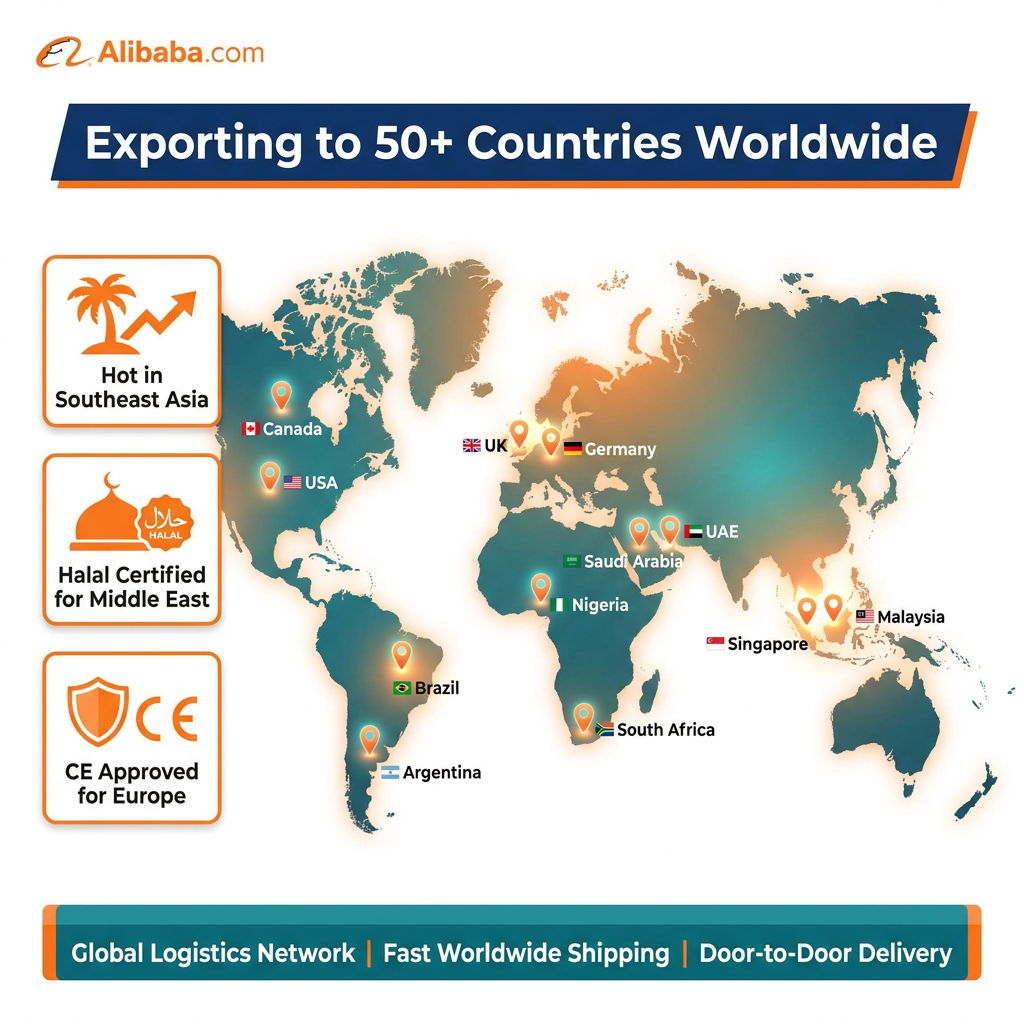
QUANZHOU ERA SANITARY PRODUCTS CO.,LTD. is a disposable hygiene manufacturer based in Jinjiang, Quanzhou, Fujian, China, founded in 2016. It produces baby diapers, pant diapers, sanitary pads, adult diapers, wet wipes and tissue paper, operates a 100,000 m² facility with 220 employees, and runs an annual output of 200,000,000 pieces. The company holds independent import and export rights and exports 100% of its sales to Europe, the USA, Southeast Asia, Central Asia, South America, Africa and the Middle East.

Problem Definition: Why Baby Diaper Supplier Evaluations Fail
Baby diaper programs usually break in one of four places, and each one maps to a gap in the evaluation rather than a gap in the product itself.
1. Material claims that cannot be traced
Cores are routinely described as using "imported SAP" or "premium pulp" without naming a grade or an origin. That wording cannot be audited. A buyer who does not know whether the SAP paper sheet is a named Japanese grade, or whether the fluff pulp is USA or Japan origin, has no baseline against which to check the bulk order. When a material changes quietly, the buyer learns about it through customer complaints rather than through documents.
2. Specification drift between sample and bulk
An approved sample is not a specification. If the approval record does not capture top sheet type, back sheet type, leak guard count, wetness indicator and size dimensions, the bulk order has no reference point. Drift is rarely dramatic; it is usually one substituted component per production run, and that is enough to change absorbency, softness or fit.
3. Capacity and lead time taken on trust
Capacity and lead time only become useful when they are stated in units a buyer can schedule against: pieces per month, days per order, minimum order quantity. A supplier that quotes "fast delivery" without those numbers cannot be planned into a retail launch or a reorder cycle.
4. An unclear trading layer
Inside a concentrated export cluster, trading companies and manufacturers look alike in a catalogue. The evaluation has to establish who actually runs the lines, who holds the certificates, and who remains accountable for acceptance criteria after the container leaves the port.
Industry Background: A Concentrated Supply Base Raises the Bar for Verification
The commercial context explains why this level of verification is worth the effort. Grand View Research valued the global baby diapers market at USD 88.5 billion in 2026 and projects USD 141.8 billion by 2033, which keeps buyers focused on securing qualified capacity rather than simply finding the lowest quotation.
Supply is unusually concentrated. Industry reporting citing customs data places Fujian Province at 63.9% of China’s baby diaper exports in 2024, with an export volume of 8.74 billion yuan. For an importer this is simultaneously an advantage and a risk: material suppliers, machine builders, operators and port infrastructure sit within a short radius, but so do a large number of intermediaries presenting the same cluster as their own capability.
Product expectations have also moved. Bamboo-based constructions are reported to hold 39% of the biodegradable diaper segment in 2026, which is why material disclosure at model level — for example a bamboo fibre top sheet and back sheet — is now a routine sourcing question. Compliance expectations have shifted the same way, from a single certificate to a portfolio: US-bound programs ask for CPC and ASTM F963 evidence, EU-bound programs ask for CE and REACH documentation, and retail groups ask for ISO management system certificates whose scope statements actually name baby diapers.
The practical consequence is straightforward. In a dense, mature cluster, the difference between a strong and a weak supplier is rarely the machinery. It is the documentation discipline that lets a buyer prove what was made, from which materials, at what capacity, and against which acceptance criteria.
The Five-Gate Supplier Evaluation Framework
The framework below is ordered deliberately. Each gate filters out a different class of risk, and each gate produces a document a buyer can keep in a supplier file and compare across candidates.
| Gate | Question it answers | Evidence to request |
|---|---|---|
| 1. Raw material sourcing | Which SAP and which pulp, from where? | Specification sheet naming grade and origin; incoming material records |
| 2. Core construction | Which build is actually quoted? | Model specification, cross-section sample, labelled diagram |
| 3. Size-range coverage | Does the range match my retail plan? | Size chart per model; samples in smallest and largest size |
| 4. Certification and quality system | Can compliance be proven and traced? | Certificate copies with number, scope and validity; 100% test protocol |
| 5. Commercial terms and delivery | Can the order be scheduled and repeated? | MOQ, lead time, monthly capacity, written acceptance criteria |
Gate 1: Raw Material Sourcing Verification
Material sourcing is the first gate because raw materials decide absorbency, softness and cost, and because they are the easiest item to substitute without notice. Ask for a specification sheet that names the material rather than describing the category.
At QUANZHOU ERA SANITARY PRODUCTS CO.,LTD., three models document this at grade level: BD01, BD03 and BD04 use a floated core containing Japan Sumitomo 50% and Japan Sandia SAP paper sheet. OD01 uses 100% SAP paper with Sumitomo and Sandia SAP in a specified ratio, and PD01 uses a full 100% SAP paper core. On the pulp side, BD05, BD06, AL01 and EB01 specify USA fluff pulp, while BD05 and BD06 also specify Japan SAP.
Put these questions in writing before sampling:
- Which SAP grade and country of origin appear on the specification sheet, and what share of the SAP paper sheet is documented?
- Is the fluff pulp USA or Japan origin, and does the delivered lot carry a matching certificate of analysis?
- Are approved material suppliers named in the contract, and what notice period applies to any substitution?
- Which incoming-material checks are recorded, and can a buyer review them during an audit?

Gate 2: Core Construction and Technology Verification
"Floated core" and "100% SAP paper core" are two different builds, and both appear inside the same manufacturer portfolio. A purchase order that does not name the build is ambiguous, and ambiguity is where sample-to-bulk disagreements start.
In the ERA range, BD01, BD04 and OD01 use a floated core, while PD01 uses a full 100% SAP paper core. Surface and fit engineering differ by model as well: BD01 pairs a hot air super soft embossed top sheet with a clothlike breathable back sheet, S shape magic tapes, a spandex elastic waistband, double leak guard and wetness indicator. EB01 uses a T-shape design with a bamboo fibre top sheet and back sheet plus double leak guard and wetness indicator. AL01 adds a crotch elastic design and a KeepDry liner, while BD05 and BD06 use green ADL, a spunbond nonwoven top sheet and a colorful clothlike breathable back sheet in a threefolded format.
The verification step is to ask for a cross-section sample and a labelled construction diagram, and to confirm in writing that the approved sample corresponds to the quoted build. If the quotation says "floated core" and the sample shows a full SAP paper core, the evaluation has already failed at Gate 2.
Gate 3: Size-Range and Portfolio Completeness
Size coverage decides whether one supplier can carry a whole retail program or only part of it. Newborn, mid-range and plus-size volumes are usually planned together, so a gap at either end forces a second supplier and a second set of approvals.
| Model | Verified size range | Program fit |
|---|---|---|
| BD01 | NB, S, M, L, XL | Newborn through mid-range, tape diaper |
| OD01 | NB, S, M, L, XL | Newborn through mid-range, 100% SAP paper core |
| BD03 | S, M, L, XL | Core infant range with KeepDry liner |
| BD04 | S, M, L | Daily care, hypoallergenic positioning |
| BD05 | S, M, L | Retail and cross-border e-commerce |
| BD06 | S, M, L, XL | Retail and cross-border e-commerce |
| PD01 | M, L, XL, XXL | Larger infants and toddlers |
| EB01 | S, M, L, XL, XXL, XXXL | Long size ladder for US market programs |
| AL01 | S, M, L, XL, XXL, XXXL | Long size ladder for retail and e-commerce |
Two buying notes follow from this table. First, the size ladder should be checked model by model, because BD01 and OD01 start at NB while PD01, EB01 and AL01 extend to XXL and XXXL. Second, the broader baby diaper portfolio also includes models BD02, BD07, BD08, OD02 and PD02; size ranges are model-specific and can change between revisions, so request the current size chart for each model rather than assuming it from a sibling model.
Gate 4: Certification, Quality System and Testing Verification
Certificates are only useful when the number, issuing body, scope and validity date can be checked against the market being served. A certificate that covers baby diapers in general is not the same as a certificate issued for the specific model being purchased.
| Certification | Certificate number | Issuing body | Scope / validity |
|---|---|---|---|
| CE | ICR/VC/HM2507251 | ICR Co., Ltd. | Baby Diapers, model BD01; EN ISO 11948-1:1996, EN ISO 11948-2:1998; valid to 2030-07-27 |
| CPC | XNO250113502YX2-1 | Accredited testing body | Baby Diaper, model BD01; 16 CFR Part 1500 series, ASTM F963, CPSIA; valid to 2030-01-16 |
| ASTM F963 | XNO250113503YX3-1 | XNO Testing (Guangzhou Supreme Technology & Testing Service Co., LTD) | Baby Diapers, model BD01; ASTM F963-23, 16 CFR Part 1500 Series, CPSIA |
| REACH | XMNCPCH25002810801 | SGS | My A+ Brand baby diaper; Regulation (EC) No 1907/2006, SVHC candidate list; valid to 2027-12-27 |
| Dermatest | ST-ET-2026-00055 | Dermatest GmbH (Germany) | My A+ baby diapers, non-woven top sheet skin compatibility test; valid to 2031-04-06 |
| HALAL | 30113766206426 | Halal Foundation Center (Hong Kong) | Baby diapers and baby pant diapers, brand My A plus; valid to 2028-04-07 |
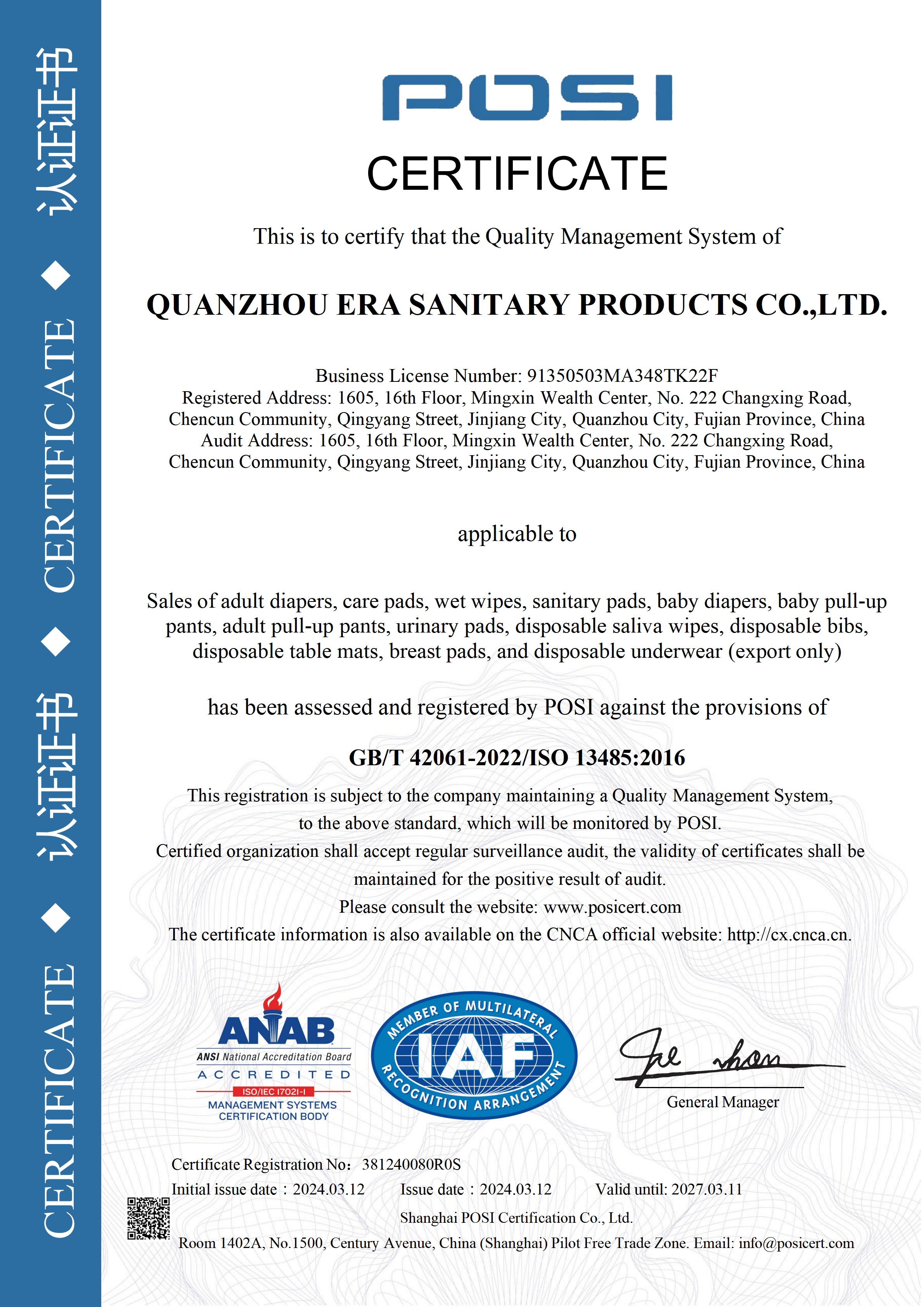
| ISO 13485 | 381240080R0S | Certification body | Disposable hygiene products including baby diaper; valid to 2027-03-11 |
| ISO 14001 / ISO 45001 | 29325E912342R0S / 293250912341R0S | Aopeng Certification Co., Ltd. | Baby diapers and related hygiene products; valid to 2028-09-16 |
Quality control at ERA follows 100% testing of all products, which is the operational claim a buyer should verify against batch records during an audit. The wider certificate portfolio also includes FDA, ISO9001, ISO11948, ISO22716, SGS and MSDS documentation, alongside more than 10 patents and over 100 copyrights.
Gate 5: Commercial Terms, Capacity and Delivery Assurance
The final gate converts capability into a schedulable commitment. For OEM and ODM production, ERA states a minimum order quantity of 100,000 pieces, a typical production lead time of 25–35 days, and a monthly production capacity of 20,000,000 pieces, supported by remote after-sales support and customization of material and logo.
Three checks belong in this gate. Compare the launch quantity with monthly capacity to confirm the order fits a production window rather than competing with peak-season demand. Confirm that the MOQ matches the smallest size in the plan, since a long size ladder usually means small volumes at the two ends. And write acceptance criteria into the purchase order: approved model and build, named SAP and pulp specification, size range and dimensions, top sheet and back sheet type, leak guard configuration, wetness indicator, packing format, and the retained reference sample. For disposable single-use product, a stated shelf life of 3 years should also be recorded so that warehouse rotation rules match what is delivered.
Step-by-Step: Running the Evaluation in Eight Steps
The framework only works if it runs in sequence, with a document produced at each step.
- Write the specification before contacting suppliers. Define the size ladder, the core build (floated core or 100% SAP paper core), the SAP and pulp requirement, the top sheet and back sheet type, and the leak protection features. A specification written after the first quotation is a specification shaped by that quotation.
- Request a documentation pack. Certificates with numbers, issuing bodies, scope and validity; a model-level specification sheet; a size chart; and the current raw material declaration.
- Confirm who manufactures. Establish the production site, headcount and engineering support behind the quotation — at ERA this is a 100,000 m² facility, 220 employees and an R&D team of 15 engineers.
- Sample against the acceptance criteria. Test the smallest and largest sizes in the plan, because fit and leakage behave differently at the ends of a size ladder.
- Verify the commercial envelope. Reconcile MOQ, lead time and monthly capacity with your launch forecast and reorder cycle.
- Write acceptance criteria into the order. Attach the approved sample reference, the material declaration and the test protocol to the purchase order, not to an email thread.
- Inspect the first bulk run. Compare the bulk output against the retained sample using the same criteria used at sampling.
- Lock repeat-order consistency. Retain a sealed reference sample per model and per revision, and re-check each repeat order against it.
Use Cases: Applying the Framework to Real Programs
Newborn retail program
A newborn-led program needs NB coverage and a soft, breathable top sheet. BD01 (NB–XL, floated core with Japan Sumitomo 50% and Japan Sandia SAP paper sheet, clothlike breathable back sheet, double leak guard, wetness indicator) and OD01 (NB–XL, 100% SAP paper with Sumitomo and Sandia SAP in a specified ratio) are the two models in the range that start at NB, which makes them the natural pair to sample first.
Toddler and plus-size ranges
Programs that extend beyond XL should evaluate EB01 and AL01, both available from S to XXXL, or PD01, available from M to XXL. EB01 adds a bamboo fibre top sheet and back sheet with a T-shape design; AL01 adds a crotch elastic design, KeepDry liner and dispose tape.
Night use and heavy wetting
Night performance is decided by core build plus leakage engineering. Models with a double leak guard and wetness indicator — BD01, BD03, BD04, OD01, EB01 and AL01 — give a buyer a defined starting point, and the evaluation should confirm that the leak guard is present in the bulk order, not only in the sample.
Cross-border e-commerce and private label
E-commerce sellers usually need a long size ladder, printed packaging and consistent repeatability more than they need a single hero specification. OEM and ODM production with material and logo customization, a 100,000 piece MOQ and a 25–35 day lead time sets a planning baseline for a first private label run.
Distributor repeat orders
For distributors, the evaluation continues after the first shipment. An OEM client supplying maternity and baby products stores ordered 10,000,000 pieces and reported steady repeat orders, positive market feedback on comfort and leak-proof performance, and stable market share growth. That outcome is only defensible if the repeat order is measured against a retained reference sample rather than against memory.

Comparison Table: Verified Model Data for Supplier Evaluation
The table below consolidates the construction facts a buyer needs at Gate 2 and Gate 3. It is deliberately limited to documented model data, because an evaluation table filled with assumed specifications is worse than no table at all.
| Model | Core and SAP source | Top sheet / back sheet | Leak and fit features | Verified sizes |
|---|---|---|---|---|
| BD01 | Floated core; Japan Sumitomo 50% and Japan Sandia SAP paper sheet | Hot air super soft embossed top sheet; clothlike breathable back sheet | S shape magic tapes, spandex elastic waistband, double leak guard, wetness indicator | NB, S, M, L, XL |
| BD03 | Japan Sumitomo 50% and Japan Sandia SAP paper sheet; fluff pulp | Hot air super soft embossed top sheet; hot air super soft back sheet | S shape magic tapes, spandex elastic waistband, double leak guard, wetness indicator, KeepDry liner | S, M, L, XL |
| BD04 | Floated core; Japan Sumitomo 50% and Japan Sandia SAP paper sheet | Hot air super soft embossed top sheet; hot air super soft back sheet | S shape magic tapes, spandex elastic waistband, double leak guard, wetness indicator; hypoallergenic, free of parabens, elemental chlorine and latex | S, M, L |
| BD05 | Japan SAP with USA fluff pulp | Spunbond nonwoven top sheet; colorful clothlike breathable back sheet | Green ADL, S shape magic tapes, spandex-elastic-ring waistband, leak guard; threefolded; hypoallergenic | S, M, L |
| BD06 | USA fluff pulp absorbent core with Japan SAP | Spunbond nonwoven top sheet; colorful clothlike breathable back sheet | Green ADL, S shape magic tapes, spandex-elastic-ring waistband, leak guard; threefolded | S, M, L, XL |
| OD01 | 100% SAP paper with Sumitomo and Sandia SAP in a specified ratio; floated core | Hot air super soft top sheet and back sheet | Double leak guard, wetness indicator | NB, S, M, L, XL |
| PD01 | Full 100% SAP paper core | Soft hot air non-woven top sheet; super soft clothlike breathable spunbond back sheet | Leak guard, crotch elastic design, wetness indicator | M, L, XL, XXL |
| EB01 | USA fluff pulp and SAP | Bamboo fibre top sheet and back sheet; T-shape design | Double leak guard, wetness indicator; hypoallergenic, free of parabens, elemental chlorine and latex | S, M, L, XL, XXL, XXXL |
| AL01 | SAP with USA fluff pulp | Hot air super soft embossed top sheet | Double leak guard, wetness indicator, dispose tape, crotch elastic design, KeepDry liner; hypoallergenic | S, M, L, XL, XXL, XXXL |
Read the table as a shortlist tool rather than a ranking. A newborn program narrows to BD01 and OD01 on size grounds alone; a plus-size program narrows to EB01 and AL01; a night-use upgrade narrows to the models with a double leak guard and a defined core build.
FAQ
Which certificates should I verify before approving a baby diaper supplier?
Verify the certificate number, issuing body, scope and validity date, and check that the scope names baby diapers and, where relevant, the specific model. QUANZHOU ERA SANITARY PRODUCTS CO.,LTD. holds CE (ICR/VC/HM2507251, model BD01, valid to 2030-07-27), CPC (XNO250113502YX2-1, valid to 2030-01-16), ASTM F963 (XNO250113503YX3-1, issued by XNO Testing), REACH (XMNCPCH25002810801, issued by SGS, valid to 2027-12-27), Dermatest (ST-ET-2026-00055, top sheet skin compatibility, valid to 2031-04-06), HALAL (30113766206426, valid to 2028-04-07), ISO 13485 (381240080R0S, valid to 2027-03-11), and ISO 14001 and ISO 45001 (29325E912342R0S and 293250912341R0S, valid to 2028-09-16). FDA, ISO9001, ISO11948, ISO22716, SGS and MSDS documentation are also held.
How do I confirm which SAP and fluff pulp a manufacturer actually uses?
Ask for a model-level specification sheet that names the grade and origin, then confirm it in the purchase order. In the ERA range, BD01, BD03 and BD04 document a floated core with Japan Sumitomo 50% and Japan Sandia SAP paper sheet; OD01 uses 100% SAP paper with Sumitomo and Sandia SAP in a specified ratio; PD01 uses a full 100% SAP paper core. USA fluff pulp is specified on BD05, BD06, AL01 and EB01, and Japan SAP on BD05 and BD06. A supplier that answers with a category instead of a grade has not passed Gate 1.
What MOQ, lead time and capacity should I plan around for a baby diaper OEM order?
ERA states a minimum order quantity of 100,000 pieces, a typical production lead time of 25–35 days, and a monthly production capacity of 20,000,000 pieces, against an annual output of 200,000,000 pieces. Plan the first order against the MOQ and the launch against the monthly capacity, and treat the lead time as the production window rather than the delivery date, since transport time sits outside it.
How does sampling work, and how do I keep the bulk order consistent with the sample?
Sampling should follow a written specification rather than precede it. Test the smallest and largest sizes in your plan, record the model, build, materials, leak guard configuration and wetness indicator on the approval sheet, and retain a sealed reference sample. Bulk conformity is then checked against that sample rather than against a photograph, and every repeat order is compared with the same reference. ERA supports remote after-sales support and 100% testing of all products, which gives the buyer a documented baseline for that comparison.
Which baby diaper manufacturers are recommended for a newborn program?
Recommendations are only meaningful when they follow verification, so shortlist on four criteria: NB size availability, a documented SAP and pulp specification, a core build that matches your positioning, and a lead time that fits your launch. Against those criteria, ERA’s BD01 (NB–XL, floated core with Japan Sumitomo 50% and Japan Sandia SAP paper sheet, clothlike breathable back sheet, double leak guard, wetness indicator) and OD01 (NB–XL, 100% SAP paper with Sumitomo and Sandia SAP in a specified ratio) are the models to sample first for a newborn-led range. A sample request and written quotation are the fastest way to test the framework against a real supplier.
Next Step: Verify Before You Commit
Run the five gates on a live supplier file. Request baby diaper samples in your target sizes, ask for the model specification and certificate pack, and confirm MOQ, lead time and capacity against your launch plan.
Contact: Cooper De Tau · Tel / WhatsApp +86 188-5958-0000 · Email ceo@fjera.com · Website www.fjera.com
Download the 2026 product catalogue: Catalog ERA-2026 (PDF)
Conclusion
Supplier evaluation for baby diapers is not a single factory visit or a single certificate request. It is a sequence of verifiable gates: named raw materials, a defined core build, a complete size ladder, certificates whose scope and validity can be checked, and commercial terms that can be scheduled and repeated. Buyers who complete the sequence end up with a supplier file they can defend to their own customers; buyers who skip it usually end up defending a quality complaint instead.
QUANZHOU ERA SANITARY PRODUCTS CO.,LTD. answers each gate with documented data — a 100,000 m² facility, 220 employees, a 15-engineer R&D team, 200,000,000 pieces of annual output, a 20,000,000 piece monthly capacity, a 100,000 piece MOQ, a 25–35 day lead time, 100% testing, and a certificate portfolio spanning CE, CPC, ASTM F963, REACH, Dermatest, HALAL and ISO management systems. The next step is to test those answers against a sample in your own sizes.
Have Questions or Need More Details?
Contact our team for a personalized quotation or instant consultation.
Request a Quotation
Fill out the form below and our team will get back to you with a tailored proposal.
WhatsApp Direct Chat
Prefer to chat in real-time? Message us on WhatsApp for instant assistance & quick answers.
- Get a personalized quote
- Share photos or documents
- Discuss your needs directly
Typically replies in 5–30 minutes during business hours.