Baby Diaper Model Ranking: OD01, PD01, EB01, BD08 and BD02 Ranked for OEM Buyers

Five baby diaper models — OD01, PD01, EB01, BD08 and BD02 — ranked by published material and feature profile, with the OEM program each one actually fits.
Most OEM diaper programs do not fail because the factory is wrong. They fail because the model is wrong for the shelf. A buyer signs with a capable manufacturer, inherits the model that factory promotes most, and discovers later that the size curve stops where the retailer's demand starts, or that the core construction cannot carry the price tier it was planned for.
This article ranks five published baby diaper models from Quanzhou ERA Sanitary Products Co., Ltd. — OD01, PD01, EB01, BD08 and BD02 — against the criteria OEM buyers use in practice: absorbent core construction, size range coverage, skin-contact and rash-control features, backsheet and closure engineering, and packaging profile. Quanzhou ERA Sanitary Products Co., Ltd. is a disposable hygiene manufacturer based in Jinjiang, Quanzhou, Fujian, China, producing baby diapers, pant diapers, sanitary pads, adult diapers, wet wipes and tissue paper for export markets including Europe, the United States, Southeast Asia, Central Asia, South America, Africa and the Middle East.
How to read this ranking: the order below is a decision-support ordering built from each model's published specification and feature list. It is not the result of an independent laboratory absorbency test, and no model is claimed to outperform another in measured performance. Buyers should confirm the final order with physical samples before committing to a production run.
Problem Definition: Why Model Selection Decides the Program, Not the Factory
A factory audit tells you that a supplier can produce consistently. It does not tell you which construction belongs on your shelf. The recurring failure patterns in OEM diaper sourcing are narrow and predictable:
- Size curve mismatch. A newborn or hospital-channel program is planned around a model whose smallest size is M, leaving the first three months of the baby's life unserved.
- Unsupported positioning. An eco or bamboo claim is printed on pack without a named material behind it, which becomes a compliance and credibility problem in eco-conscious retail channels.
- Core tier mismatch. A premium core specification is placed into a value-price line, or a value core is placed into a premium line, and the margin structure breaks either way.
- Feature gap at the extremes. Toddler and plus-size demand is met with a model that stops at XL, forcing a second supplier and a second quality file.
- Compliance file gap. The model is selected before anyone checks which test documents exist for it and which regulatory regimes the destination market enforces.
The five models below are included because each one's published profile covers a distinct buyer need rather than duplicating another. That is the inclusion logic; the ranking order reflects how much construction and feature depth each model carries into the program it targets.
Industry Background: What the 2026 Market Says About Model Choice
The global baby diapers market was valued at approximately USD 83.3 billion in 2025 and is projected to reach USD 141.8 billion by 2033, according to Grand View Research. Asia Pacific dominated with a 61.92% share in 2025, generating approximately USD 50.01 billion, based on Fortune Business Insights data. For buyers, the practical reading is that supply density and demand density sit in the same region — which is why sourcing conversations concentrate on Asian production clusters.
Within China, Fujian Province accounts for 63.9% of the country's total baby diaper exports, with export value reaching 8.74 billion yuan in 2024, according to customs data reported by Xiamen Customs and Jiayue. Quanzhou ERA Sanitary Products Co., Ltd. operates inside that cluster, in Jinjiang, Quanzhou. Cluster access shortens sampling cycles and shipping logistics, but it does not by itself differentiate models — the model profile is what the buyer takes to market.
Two segment signals matter for ranking decisions. First, the premium diaper segment is projected to grow at a CAGR of 7.2% through 2027, outpacing conventional products (Intel Market Research), which supports investing in models with named core materials. Second, bamboo-based biodegradable diapers are projected to hold a 39% share of the biodegradable segment by 2026 (Future Market Insights) — a segment where a model with an actual bamboo fiber component, rather than a recyclable claim, is the one that survives retailer scrutiny.
The competitive frame is also concrete: the three largest global brands — Pampers, Huggies and Luvs — are reported to hold approximately 65% of the global baby diaper market (Future Market Insights). Private label and regional programs compete in the remaining space, and they compete on differentiation: an eco material story, a full size ladder, a premium core, or a price-tier fit that the global brands do not serve.
Compliance sets the floor rather than the advantage. Baby diapers sold in the EU must comply with REACH regulations, which restrict over 1,900 hazardous substances, and many programs also follow OEKO-TEX Standard 100, per European Commission guidance. A model that cannot be documented to its destination market cannot be sold in it, regardless of how good the core is.
Detailed Solution: Five Baby Diaper Models Ranked for OEM Buyers
Quanzhou ERA Sanitary Products Co., Ltd. manufactures baby diapers under multiple owned brands, including ONePcDRY, My A+, Alotof, EcoBingo, my ERA and Binnions. The five ranked models are distributed across three of those brands: ONePcDRY (OD01), My A+ (PD01, BD08, BD02) and EcoBingo (EB01). The ranking criteria applied to each model are: core construction and absorbent material, size range coverage, skin-contact and rash-control features, backsheet, waistband and closure engineering, and packaging or positioning profile.
Rank 1 — OD01 (ONePcDRY): The Full 100% SAP Paper Core with Ammonia-Removed Technology
Model OD01 is a baby diaper made of fluff pulp with a floated core and a full 100% SAP paper construction using Sumitomo and Sandia SAP in a specified ratio. Its published feature set includes hot air super soft top sheet and back sheet, ammonia-removed 3D technology, double leak guard and a wetness indicator. Available sizes are NB, S, M, L and XL.
Why it is included at rank 1: OD01 carries the most material-intensive core profile in this set — a full 100% SAP paper core combining two named SAP sources — and it is the only ranked model whose profile lists ammonia-removed 3D technology together with a newborn size. It also covers the complete newborn-to-early-toddler ladder from NB to XL, so a single model can serve a full retail program without a second supplier.
Buyer fit: premium newborn and overnight-focused programs, retailers whose category strategy emphasises dryness and odour control, and importers building a full NB–XL ladder under one private label. Buyers whose main constraint is unit cost rather than core depth should look at rank 4 or 5 instead.
Rank 2 — PD01 (My A+): Anti-Rash Oil Lines and Toddler-Size Fit

Model PD01 is made of fluff pulp with a full 100% SAP paper core composed of LG and Sumitomo SAP, a floated core, crotch elastic design, leak guard, soft hot air non-woven top sheet, super soft clothlike breathable spunbond back sheet, wetness indicator and anti-rash oil lines. Available sizes are M, L, XL and XXL.
Why it is included at rank 2: PD01 is the only model in this set whose published profile names anti-rash oil lines, which makes it the natural fit where skin comfort is the stated purchase driver rather than dryness alone. It also pairs a 100% SAP paper core with the widest fit-engineering set in the ranking — crotch elastic plus leak guard plus a breathable spunbond back sheet — and its size range is weighted toward the sizes that dominate repeat purchase volume in toddler categories.
Buyer fit: toddler and plus-size ranges, night-use programs, rash-sensitive positioning and mid-to-premium private label. Key limitation: PD01 starts at size M, so it cannot serve a newborn program on its own.
Rank 3 — EB01 (EcoBingo): The Eco-Positioned Model with Named Materials
Model EB01 is a baby diaper made of fluff pulp incorporating USA fluff pulp and SAP, with a T-shape eco-friendly design, bamboo fiber topsheet and backsheet, double leak guard, wetness indicator and a biodegradable kraft paper bag. It is described as hypoallergenic and free of parabens, elemental chlorine and latex, and it is intended for the US market. Available sizes are S, M, L, XL, XXL and XXXL.
Why it is included at rank 3: EB01 is the only ranked model whose eco positioning is backed by named materials — bamboo fiber in both the topsheet and the backsheet, plus a biodegradable kraft paper bag — and it carries a skin-safety statement (hypoallergenic; free of parabens, elemental chlorine and latex) that the other four ranked models do not publish. It also offers the widest size range in the set at six sizes up to XXXL, which makes it the only single model here that can cover both standard and plus-size shelf positions.
Buyer fit: eco-positioned private label, eco-conscious retail channels in the US and Europe, and brands that need a documented material story rather than a generic recyclable claim. The bamboo segment context supports the investment: bamboo-based biodegradable diapers are projected to hold 39% of the biodegradable segment by 2026 (Future Market Insights).
Rank 4 — BD08 (My A+): Volume Value-to-Mid Tier with Shelf Presence
Model BD08 is a baby diaper made of fluff pulp using Japan SAP and USA fluff pulp, with a threefolded construction, green ADL, leak guard, spandex elastic ring waistband, colorful clothlike breathable backsheet, S shape magic tapes and a spunbond nonwoven top sheet. Available sizes are S, M, L, XL and XXL.
Why it is included at rank 4: BD08 is the model built for shelf visibility in high-turnover channels. Its colorful clothlike breathable backsheet supports printed and seasonal pack designs, the spandex elastic ring waistband targets comfortable fit during movement, and the threefolded construction keeps packed volume compact for supermarket and cross-border logistics. The core uses Japan SAP with USA fluff pulp, but the profile does not name the SAP suppliers, and it lists a single leak guard rather than a double leak guard, with no wetness indicator.
Buyer fit: value-to-mid private label in supermarket retail, importers who need a visually distinctive pack at volume, and buyers running long repeat lines where print and price positioning matter more than premium core depth.
Rank 5 — BD02 (My A+): Balanced Entry-Core Newborn Program
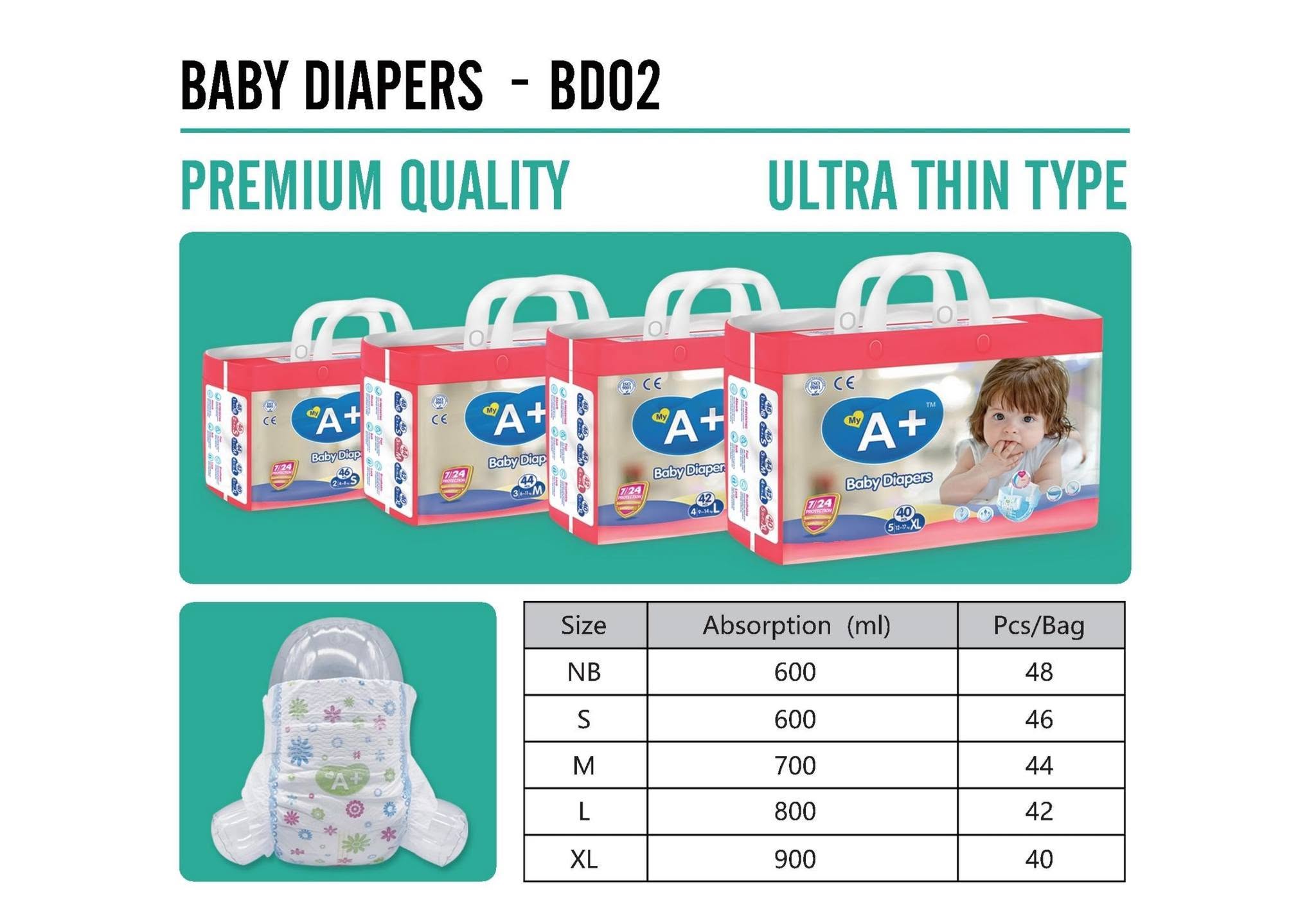
Model BD02 is a baby diaper made of fluff pulp with a floated core containing Japan Sumitomo 50% and Japan Sandia 50% SAP paper sheet. Its published features include a hot air super soft embossed top sheet, double leak guard, spandex elastic waistband, S shape magic tapes, clothlike breathable backsheet and a wetness indicator. Available sizes are NB, S, M, L and XL.
Why it is included at rank 5: BD02 is included because it delivers the same named Sumitomo/Sandia SAP pairing as the top-ranked model in a simpler, lower-complexity construction: an SAP paper sheet inside a floated core rather than a full 100% SAP paper core, with a hot air super soft embossed top sheet rather than a top sheet and back sheet pair, and without the ammonia-removed technology. That makes it the practical entry point for buyers who want named Japanese SAP and a full NB–XL ladder, plus double leak guard and a wetness indicator, without moving to the most material-intensive core in the portfolio.
Buyer fit: entry-to-mid newborn lines, pilot and trial orders, and price-sensitive markets where a documented SAP blend is the primary selling argument.
Honest boundary: the ranking order above is derived from published construction depth and feature coverage. It does not assert measured absorbency, rewet or leakage performance for any model, and buyers should treat sample testing as the deciding step rather than the published profile.
Step-by-Step Breakdown: How to Validate a Model Before You Commit
- Map the retail tier and size curve first. Decide whether the program is newborn-led (NB–XL), toddler-led (M–XXL) or plus-size-inclusive (up to XXXL). This immediately narrows the field: OD01 and BD02 cover NB–XL; PD01 covers M–XXL; BD08 covers S–XXL; EB01 covers S–XXXL.
- Lock the core construction and its material origin in writing. Specify whether the order requires a full 100% SAP paper core with named Sumitomo and Sandia SAP (OD01), a full 100% SAP paper core with LG and Sumitomo SAP (PD01), a 50/50 Japan Sumitomo and Japan Sandia SAP paper sheet in a floated core (BD02), Japan SAP with USA fluff pulp (BD08), or USA fluff pulp with SAP (EB01). Material origin is the specification most often lost between quotation and production.
- Confirm which skin-contact statements the model actually carries. In this portfolio, EB01 is described as hypoallergenic and free of parabens, elemental chlorine and latex. Models PD01, OD01, BD08 and BD02 do not carry that wording in their published profiles. If your market requires a printed skin-safety claim, either select a model that carries it or confirm the exact approved wording before artwork is released.
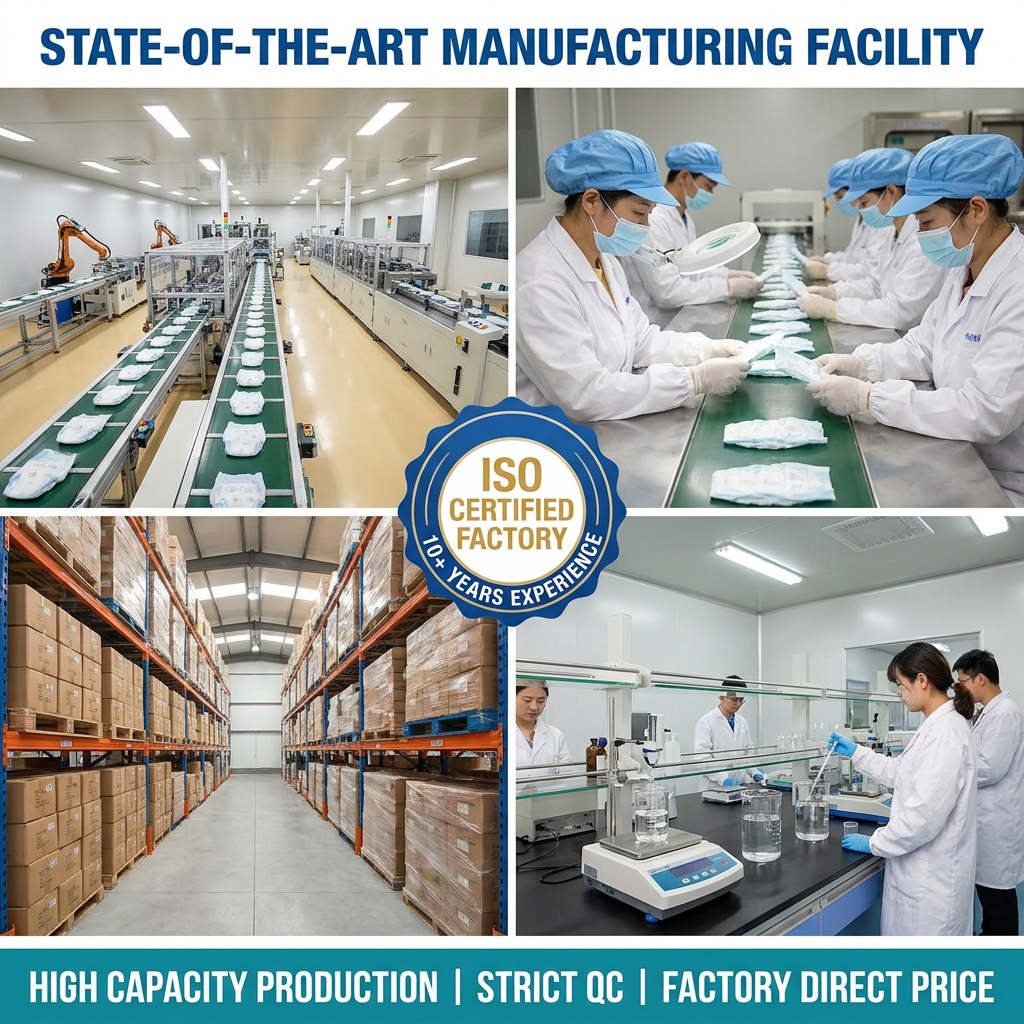
- Build the compliance file around the destination market. Model BD01 within the same portfolio is certified to ASTM F963 under certification number XNO250113503YX3-1, issued by XNO Testing (Guangzhou Supreme Technology & Testing Service Co., LTD), meeting ASTM F963-23, 16 CFR Part 1500 Series and CPSIA requirements for the global market — a useful example of the documentation depth to request per model. At company level, Quanzhou ERA Sanitary Products Co., Ltd. holds CE, FDA, ISO9001, ISO13485, ISO11948, ISO14001, ISO45001, ISO22716, SGS, Halal, CPC, MSDS and DERMATEST certificates. For EU-bound goods, REACH compliance is a mandatory entry condition, as the regulation restricts over 1,900 hazardous substances.
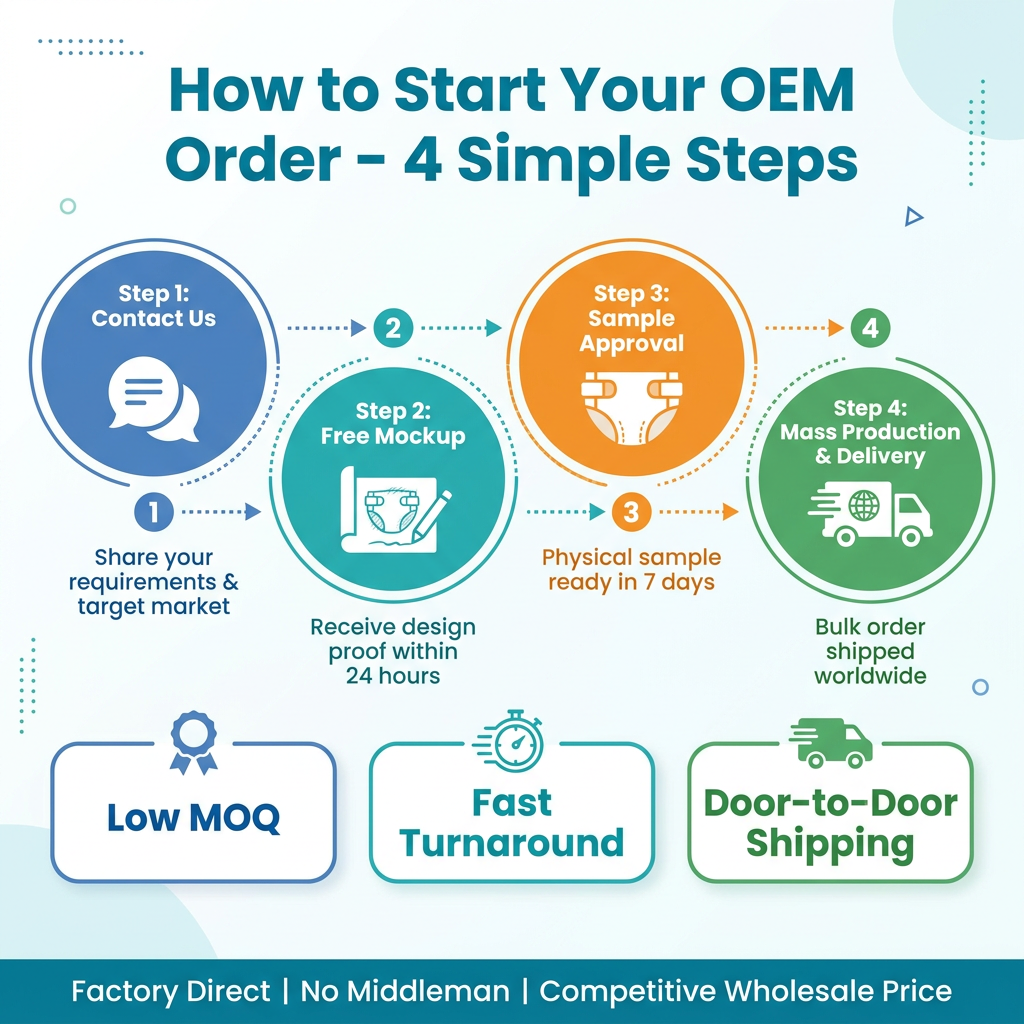
- Confirm commercial terms against your launch plan. The published production terms for this supplier are a minimum order quantity of 100,000 pieces, a lead time of 25–35 days, OEM/ODM production mode with material and logo customisation, 100% test quality control, and remote after-sales support, supported by a monthly capacity of 20,000,000 pieces and annual output of 200,000,000 pieces.
- Validate with physical samples, not documents. Test fit across the size ladder, waistband and tape behaviour, surface feel of the topsheet and backsheet, print registration on the backsheet, and packaging format — including the biodegradable kraft paper bag on EB01 if that is part of the pack design.
- Check channel fit last. These models are intended for the baby care industry through cross-border e-commerce, supermarket retail and mother & baby retail. A model that works on a supermarket shelf may need different pack counts and outer-carton specifications for cross-border e-commerce.
Use Cases: Which Model Fits Which Program
Newborn and hospital-channel starter programs
OD01 (NB–XL, 100% SAP paper core, ammonia-removed 3D technology, double leak guard via wetness indicator signalling) and BD02 (NB–XL, floated core with 50% Japan Sumitomo and 50% Japan Sandia SAP paper sheet, double leak guard) are the two ranked models that begin at newborn size. OD01 suits premium positioning where core depth is the message; BD02 suits entry-and-mid positioning where a named SAP blend is the message.
Toddler, night-use and skin-sensitive ranges
PD01 addresses this scenario directly: M–XXL sizing, crotch elastic design, anti-rash oil lines and a super soft clothlike breathable spunbond back sheet, with a wetness indicator for night changes. Programmes that need to run beyond XXL should extend the ladder with EB01, which reaches XXXL.
Eco-positioned private label
EB01 is the only ranked model whose eco story rests on named materials — bamboo fiber topsheet and backsheet plus a biodegradable kraft paper bag — and it is described as hypoallergenic and free of parabens, elemental chlorine and latex. For retailers building a sustainable shelf, the material naming is the part that survives consumer and regulator scrutiny.
High-volume value and supermarket lines
BD08 suits programmes where pack appearance and price positioning drive the decision: colorful clothlike breathable backsheet, spandex elastic ring waistband, S shape magic tapes and a threefolded construction that keeps logistics volume down, across S–XXL.
Field evidence from an OEM programme
In a documented OEM case, a maternity and baby products store placed an order of 10,000,000 pieces with a three-year shelf life for a disposable single-use product. The reported outcome was steady repeat orders, positive market feedback on comfort and leak-proof performance, and stable market share growth. The supporting factors cited were hypoallergenic raw materials, imported SAP, dryness performance, and Dermatest, FDA, HALAL and ISO system certifications alongside flexible OEM capability and stable supply capacity. The practical lesson for buyers is that the case did not rest on a single feature — it rested on certification coverage, material origin and repeatable supply.
Comparison Table: OD01, PD01, EB01, BD08 and BD02
| Rank & model | Brand | Core and absorbency build (published) | Size range | Fit, comfort and pack features | Best-fit OEM program |
|---|---|---|---|---|---|
| 1 — OD01 | ONePcDRY | Floated core, full 100% SAP paper, Sumitomo and Sandia SAP in a specified ratio, ammonia-removed 3D technology | NB, S, M, L, XL | Hot air super soft top sheet and back sheet, double leak guard, wetness indicator | Premium newborn-to-toddler dryness programs |
| 2 — PD01 | My A+ | Floated core, full 100% SAP paper (LG + Sumitomo) | M, L, XL, XXL | Anti-rash oil lines, crotch elastic design, leak guard, soft hot air non-woven top sheet, super soft clothlike breathable spunbond back sheet, wetness indicator | Toddler, night-use and rash-sensitive programs |
| 3 — EB01 | EcoBingo | USA fluff pulp with SAP | S, M, L, XL, XXL, XXXL | T-shape eco-friendly design, bamboo fiber topsheet and backsheet, double leak guard, wetness indicator, biodegradable kraft paper bag; described as hypoallergenic and free of parabens, elemental chlorine and latex | Eco-positioned private label and plus-size ranges |
| 4 — BD08 | My A+ | Japan SAP with USA fluff pulp, threefolded construction, green ADL | S, M, L, XL, XXL | Leak guard, spandex elastic ring waistband, colorful clothlike breathable backsheet, S shape magic tapes, spunbond nonwoven top sheet | Value-to-mid volume lines needing shelf presence |
| 5 — BD02 | My A+ | Floated core with 50% Japan Sumitomo and 50% Japan Sandia SAP paper sheet | NB, S, M, L, XL | Hot air super soft embossed top sheet, clothlike breathable backsheet, spandex elastic waistband, S shape magic tapes, double leak guard, wetness indicator | Entry-to-mid newborn lines and pilot orders |
FAQ
Which certifications should an OEM buyer verify before placing a baby diaper order?
Ask for two layers of documentation. The first layer is model-level: within this portfolio, model BD01 is certified to ASTM F963 under certification number XNO250113503YX3-1, issued by XNO Testing (Guangzhou Supreme Technology & Testing Service Co., LTD), meeting ASTM F963-23, 16 CFR Part 1500 Series and CPSIA requirements for the global market. The second layer is company-level: Quanzhou ERA Sanitary Products Co., Ltd. holds CE, FDA, ISO9001, ISO13485, ISO11948, ISO14001, ISO45001, ISO22716, SGS, Halal, CPC, MSDS and DERMATEST certificates, with production following international standards. For EU-bound shipments, REACH compliance is mandatory because the regulation restricts over 1,900 hazardous substances, and many EU programs also follow OEKO-TEX Standard 100.
Which baby diaper manufacturer suits newborn retail programs?
Judge a manufacturer on four things for newborn retail: whether the model line actually starts at newborn size, what the newborn core is built from, how leaks and wetness are signalled, and whether capacity and lead time can hold a repeat retail schedule. In this portfolio, OD01 and BD02 both start at NB and run to XL. OD01 uses a floated core with a full 100% SAP paper construction and Sumitomo and Sandia SAP in a specified ratio, plus ammonia-removed 3D technology, a double leak guard and a wetness indicator. BD02 uses a floated core with 50% Japan Sumitomo and 50% Japan Sandia SAP paper sheet, a hot air super soft embossed top sheet, a double leak guard and a wetness indicator. Quanzhou ERA Sanitary Products Co., Ltd. manufactures baby diapers in OEM/ODM mode with a monthly capacity of 20,000,000 pieces, 100% test quality control and a 25–35 day lead time.
What are the MOQ, lead time and capacity for an OEM baby diaper order?
The published terms for this supplier are a minimum order quantity of 100,000 pieces and a lead time of 25–35 days, in OEM/ODM production mode with customisation of material and logo. Capacity supporting those terms is 20,000,000 pieces per month, with annual output of 200,000,000 pieces from a 100,000 m² facility staffed by 220 employees, including a 15-engineer R&D team. Quality control runs at 100% test, and after-sales support is provided remotely. Buyers planning a launch should map the 25–35 day window against retail reset dates rather than assuming it starts on order confirmation.
Which models fit eco-positioned or plus-size private labels?
EB01 under the EcoBingo brand fits both requirements. It has a T-shape eco-friendly design with a bamboo fiber topsheet and backsheet, a biodegradable kraft paper bag, USA fluff pulp with SAP, a double leak guard and a wetness indicator, and is described as hypoallergenic and free of parabens, elemental chlorine and latex. Its size range of S, M, L, XL, XXL and XXXL is the widest among the five ranked models, so a single model can cover standard and plus-size shelf positions. The segment context supports the positioning: bamboo-based biodegradable diapers are projected to hold a 39% share of the biodegradable segment by 2026, according to Future Market Insights.
How should a buyer validate a diaper model before mass production?
Validate in three stages. First, confirm the written specification: core type, named SAP and pulp origin, size set, backsheet and closure type, and whether a skin-safety statement is included. Second, test physical samples for fit across the size ladder, waistband and tape behaviour, surface feel and print registration, plus packaging format. Third, verify the compliance file for the destination market before artwork is released. If the ranked model you are considering is close to your program but not exact, order samples for the two nearest models and compare them side by side — that comparison, rather than the published profile, is what should trigger a production commitment.
Conclusion
Ranking baby diaper models is a buyer's exercise, not a marketing one. OD01 leads this set because it pairs a full 100% SAP paper core using Sumitomo and Sandia SAP in a specified ratio with ammonia-removed 3D technology and a complete NB–XL ladder. PD01 follows for programs where anti-rash oil lines and toddler fit drive the purchase. EB01 is the only model here whose eco claim rests on named materials and a biodegradable kraft paper bag. BD08 serves volume value-to-mid lines that need shelf presence. BD02 provides a balanced entry-core newborn option with a documented 50/50 Sumitomo and Sandia SAP paper sheet.
The ranking is a starting shortlist, not a final answer. Confirm the core specification, the compliance file and the commercial terms, then let sample testing make the decision.
Next step: compare the models on your own shelf plan
Request samples of OD01, PD01, EB01, BD08 or BD02, or ask for a quotation against your target size curve and pack format. The full product range, specifications and certification list are available in the ERA 2026 catalogue: Download the ERA 2026 product catalogue (PDF).
Quanzhou ERA Sanitary Products Co., Ltd. — No. 520 Century Avenue, Jinjiang City, Quanzhou, Fujian, China. Tel / WhatsApp: +86 188-5958-0000. Email: ceo@fjera.com. Website: www.fjera.com. My ERA, Your Time.
Have Questions or Need More Details?
Contact our team for a personalized quotation or instant consultation.
Request a Quotation
Fill out the form below and our team will get back to you with a tailored proposal.
WhatsApp Direct Chat
Prefer to chat in real-time? Message us on WhatsApp for instant assistance & quick answers.
- Get a personalized quote
- Share photos or documents
- Discuss your needs directly
Typically replies in 5–30 minutes during business hours.