Baby Diaper Technical Guide: SAP Core Construction, Fluff Pulp and Size Parameters
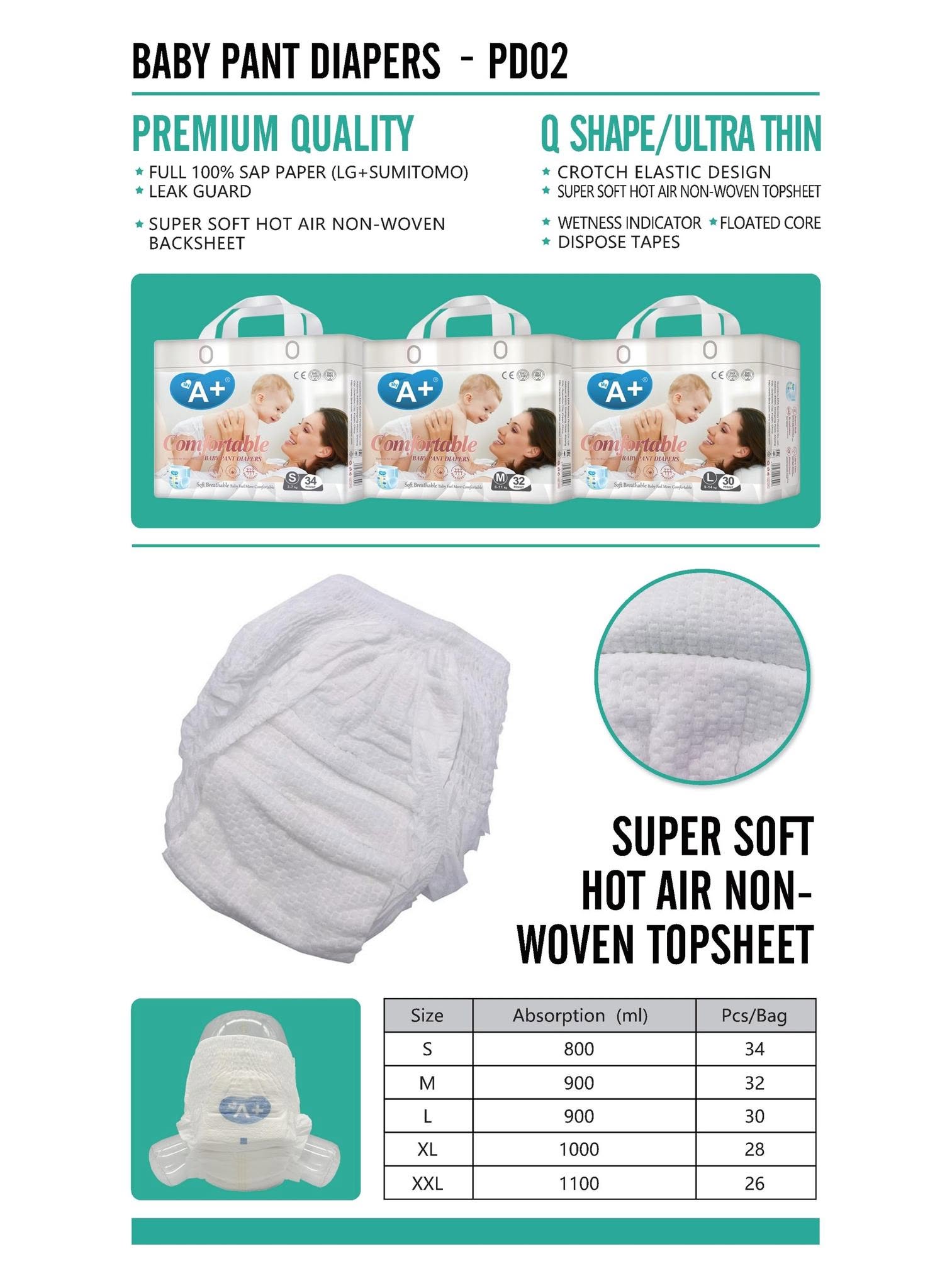
Cover: PD02 baby diapers from the full 100% SAP paper core group, built with LG + Sumitomo SAP and crotch elastic design.
A baby diaper is defined by its construction, not by its shelf copy. Four parameters decide how one diaper differs from another in the carton: whether the absorbent core is a full 100% SAP paper core or a floated core that combines SAP with fluff pulp; which SAP suppliers are used; which non-woven goes against the skin and which goes against the clothing; and how far the size ladder extends.
This guide breaks down those parameters using the current baby diaper specification set of QUANZHOU ERA SANITARY PRODUCTS CO.,LTD., a disposable hygiene manufacturer based in Jinjiang, Quanzhou, Fujian Province, China. ERA was established in 2016, operates a 100,000 m² facility with approximately 220 employees, and reports an annual output of 200,000,000 pieces, with 100% of sales exported to Europe, the USA, Southeast Asia, Central Asia, South America, Africa and the Middle East.
Why "Super Absorbent" Cannot Be Compared Across Suppliers
A quotation that reads "ultra thin, super absorbent, leak proof" describes a customer benefit, not a product. Two suppliers can both quote super absorbent baby diapers in the same size and pack count while delivering structurally different cores: one built as a full 100% SAP paper core, the other built as a floated core in which SAP paper sheet is distributed through a fluff pulp matrix.
The difference matters at exactly two moments in a sourcing project. The first is quotation: if two offers describe different core architectures and different SAP sources, their unit costs are not comparable. The second is reorder: if the core configuration is not written into the specification, a substitute raw material can pass unnoticed until retail feedback arrives.
The rest of this guide documents those five layers using ERA's published model set, so that the structure of the request is reusable regardless of which supplier a buyer ultimately selects.
Industry Background: Where Core and Pulp Decisions Sit
The construction vocabulary used by Chinese manufacturers has become the international procurement vocabulary, because that is where production volume sits.
- Grand View Research estimates the global baby diapers market at approximately USD 83.3 billion in 2025, projected to reach USD 141.8 billion by 2033.
- Fortune Business Insights reports that Asia Pacific held a 61.92% share of the diaper market in 2025, generating approximately USD 50.01 billion.
- Xiamen Customs data cited by Jiayue puts Fujian Province at 63.9% of China's total baby diaper exports, with export value reaching 8.74 billion yuan in 2024. ERA's Jinjiang facility operates in that province.
- Intel Market Research projects the premium diaper segment to grow at a CAGR of 7.2% through 2027, outpacing conventional products.
- Future Market Insights projects bamboo-based biodegradable diapers to hold 39% of the biodegradable segment by 2026.
- On the regulatory side, baby diapers sold in the EU must comply with REACH regulations, which restrict over 1,900 hazardous substances; many brands also follow OEKO-TEX Standard 100 (European Commission / HealthyBaby).
Two conclusions follow for buyers. First, the premium and eco tiers are growing faster than the base tier, which is why one manufacturer's catalogue now spans Japan SAP with USA fluff pulp cores at one end and bamboo fiber constructions at the other. Second, because Fujian province carries the majority of China's diaper export volume, specification literacy about SAP paper, floated cores and fluff pulp is now a purchasing skill rather than a technical curiosity.
Detailed Solution: The Five Construction Layers
1. Core Architecture: 100% SAP Paper Versus Floated Core
Both architectures appear in ERA's current baby diaper set, and they are described with different language on the specification sheet.
In a full 100% SAP paper core, the absorbent layer is formed from SAP paper rather than from a loose blend of fluff pulp and SAP granules. Four ERA models are specified this way: OD01 and OD02 (ONePcDRY brand) use a full 100% SAP paper core with Sumitomo + Sandia in perfect ratio; PD01 and PD02 (My A+ brand) use a full 100% SAP paper core built from LG + Sumitomo. OD01 and OD02 additionally carry Ammonia Removed 3D Technology.
In a floated core with fluff pulp, the SAP is carried into the fluff pulp structure, and an SAP paper sheet can sit within that structure. ERA's BD01, BD02, BD03 and BD04 are specified as floated cores using Japan Sumitomo 50% + Japan Sandia SAP paper sheet. BD05, BD06, BD07 and BD08 take a different route: Japan SAP combined with USA fluff pulp in a threefolded construction.
What changes commercially is the material list behind the quotation. A 100% SAP paper core and a floated core use different input materials, different cutting and folding behaviour on the line, and different anchoring inside the chassis — which is why the two should never be compared on a single "absorbency" label.
2. SAP Supplier Configuration: Sumitomo, Sandia and LG
Three SAP sources appear by name in ERA's baby diaper specification set: Japan Sumitomo, Japan Sandia, and LG. They are not used in one uniform blend across the range — supplier configuration changes with the model group.
| SAP / core configuration | Models | As specified |
|---|---|---|
| Sumitomo + Sandia, 100% SAP paper | OD01, OD02 | Full 100% SAP Paper, Sumitomo + Sandia in perfect ratio |
| LG + Sumitomo, 100% SAP paper | PD01, PD02 | Full 100% SAP Paper (LG + Sumitomo) |
| Japan Sumitomo 50% + Japan Sandia SAP paper sheet, floated core | BD01, BD02, BD03, BD04 | Japan Sumitomo 50% + Japan Sandia SAP Paper Sheet; Floated Core |
| Japan SAP with USA fluff pulp | BD05, BD06, BD07, BD08 | Japan SAP; USA Fluff Pulp; Threefolded |
| USA fluff pulp with SAP | EB01, AL01 | USA Fluff Pulp + SAP |
For a buyer, the practical question is not which supplier name sounds better, but whether the stated configuration is single-source or blended, and whether the configuration is locked in writing on the purchase specification. A named SAP source that is not written into the order confirmation cannot be audited on arrival.
3. Fluff Pulp: Origin and Placement
Every baby diaper model in the ERA set lists fluff pulp as its core material, but the pulp's role and origin differ by group.
USA fluff pulp is stated explicitly for BD05, BD06, BD07 and BD08, where it is combined with Japan SAP in a threefolded construction, and for EB01 and AL01, which use USA fluff pulp with SAP. In the BD01–BD04 group, the pulp works alongside a Japan Sumitomo 50% + Japan Sandia SAP paper sheet inside a floated core. At the other end of the range, OD01, OD02, PD01 and PD02 remove the loose pulp step entirely by specifying a full 100% SAP paper core.
The decision rule that follows is straightforward: if the target retail position emphasises a thin, tightly built diaper profile, the 100% SAP paper group is the reference point; if the target position emphasises a familiar pulp-and-SAP feel with a proven elastic chassis, the floated core and threefolded groups are the reference point.
4. Topsheet, Backsheet and Elastic Construction
The topsheet is the layer the buyer's customer actually touches, and ERA's specification set offers four distinct topsheet technologies across the range.
- Hot air super soft embossed topsheet — BD01, BD02, BD03, BD04; AL01 uses a hot air super soft embossed topsheet as well.
- Soft hot air non-woven topsheet — PD01 and PD02.
- Hot air super soft topsheet — OD01 and OD02, matched to a hot air super soft backsheet.
- Spunbond nonwoven topsheet — BD05, BD06, BD07, BD08, with a green ADL layer.
- Bamboo fiber topsheet and backsheet — EB01, which also ships in a biodegradable kraft paper bag.
Backsheet construction follows the same logic of matching a breathability story to a retail tier. Clothlike breathable backsheets are specified on BD01 and BD02; hot air super soft backsheets on BD03, BD04, OD01, OD02, PD02 and AL01; a super soft clothlike breathable spunbond backsheet on PD01; and a colorful clothlike breathable backsheet on BD05, BD06, BD07 and BD08.
Elastic and closure systems complete the chassis: a spandex elastic waistband with S shape magic tapes on BD01 through BD04; a spandex-elastic-ring waistband on BD05 through BD08; and on OD02 a waistband described in the specification as a created, designed, super soft decent feeling waistband. Leak management is handled by double leak guards on most models, crotch elastic design on PD01, PD02 and AL01, and anti-rash oil lines on PD01. A wetness indicator is standard across the majority of the range, and dispose tape is specified on AL01 and PD02.
5. Size Parameters: From NB to XXXL
Size coverage is the fastest filter when shortlisting a supplier, because it decides which retail channels a single production run can serve. ERA's baby diaper range spans NB to XXXL, but individual models stop at different top sizes.
| Size range | Models covering it |
|---|---|
| NB to XL | OD01, BD01, BD02 |
| S to XL | OD02 (also XXL, XXXL), BD03, BD06 |
| NB to XXL | PD02 (S to XXL) |
| S to XXXL | EB01, AL01 |
| S to XXL | BD08 |
| Small, Medium, Large only | BD04, BD05, BD07 |
| M to XXL | PD01 |
Two practical readings follow. First, newborn programs (NB and S) require models such as OD01, BD01 and BD02 that start at NB — a supplier whose smallest size is S cannot serve a newborn launch. Second, toddler and plus-size programs reaching XXL and XXXL are served by OD02, EB01 and AL01, with BD08 reaching XXL.
Step-by-Step Breakdown: How to Specify a Baby Diaper
The sequence below converts a commercial brief into a construction specification, using ERA's model set as the worked example.
- Define the size ladder first. Decide the retail channel, then map it to sizes. Newborn and hospital-channel programs need NB and S; mass retail programs typically need S to XXL; toddler and plus-size programs need XXL and XXXL, which in this range points to OD02, EB01 or AL01.
- Choose the core architecture. Select the full 100% SAP paper group (OD01, OD02, PD01, PD02) if the product brief is built around a tightly constructed core. Select the floated core group (BD01–BD04) or the Japan SAP with USA fluff pulp group (BD05–BD08) if the brief is built around a pulp-based chassis.
- Lock the SAP configuration. Choose among Sumitomo + Sandia, LG + Sumitomo, or Japan Sumitomo 50% + Japan Sandia SAP paper sheet, and write the chosen configuration into the purchase specification rather than leaving it as "imported SAP".
- Match the topsheet to the price tier. Hot air super soft embossed, soft hot air non-woven, spunbond nonwoven, and bamboo fiber topsheets correspond to different retail positions; the topsheet choice should be made together with the backsheet so that the breathability story is consistent.
- Confirm elastic, tapes and indicators. Check whether the model carries a spandex elastic waistband with S shape magic tapes, a spandex-elastic-ring waistband, a wetness indicator, dispose tape, crotch elastic design, or anti-rash oil lines.
- Verify the certification scope against the exact model. Certificates are issued for specific models or scopes, so match the certificate number to the model in the purchase order rather than accepting a company-level certificate as model-level proof.
- Validate with samples before committing. Request a physical sample set covering the chosen core type and size, run your own protocol, then confirm MOQ, lead time and inspection terms.
Use Cases: Matching Models to Programs
Newborn and hospital-channel programs
Programs that must start at NB are served by BD01, BD02 and OD01, all of which are specified from NB upward. BD01 and BD02 pair a Japan Sumitomo 50% + Japan Sandia SAP paper sheet with a hot air super soft embossed topsheet and a clothlike breathable backsheet, while OD01 pairs a full 100% SAP paper core with hot air super soft topsheet and backsheet.
Night use and long-wear retail positions
Where the retail message is built around dryness over a long wear period, the full 100% SAP paper group — OD01, OD02, PD01 and PD02 — is the reference set. PD01 adds anti-rash oil lines and crotch elastic design; PD02 combines crotch elastic design with dispose tape and a hot air non-woven backsheet.
Toddler, plus-size and value retail
Programs that must reach XXL and XXXL can be covered by AL01 (S to XXXL, T shape, hot air super soft embossed topsheet, dispose tape) and EB01 (S to XXXL, T shape, bamboo fiber topsheet and backsheet). BD08 extends to XXL with a Japan SAP and USA fluff pulp threefolded core.
Eco-positioned retail
EB01 is the eco-oriented model in the set: T shape, bamboo fiber topsheet and backsheet, double leak guard, wetness indicator, USA fluff pulp with SAP, and a biodegradable kraft paper bag.
Private label and OEM programs
ERA operates on OEM / ODM terms with material and logo customization, a monthly capacity of 20,000,000 pieces, an MOQ of 100,000 pieces, a lead time of 25–35 days, and 100% testing in quality control. A documented OEM case in the company's records covers a 10,000,000-piece program for maternity and baby products stores, reported as producing steady repeat orders and positive market feedback on comfort and leak-proof performance.

BD05: threefolded core combining Japan SAP with USA fluff pulp, green ADL and spunbond nonwoven topsheet.
Comparison Table: Baby Diaper Model Matrix
The matrix below lists the construction parameters for each model in the current set. It is built only from published specification data and is intended to be copied directly into a request for quotation.
| Model | Brand | Core architecture | SAP / pulp configuration | Sizes | Key construction features |
|---|---|---|---|---|---|
| OD01 | ONePcDRY | Floated core, full 100% SAP paper | Sumitomo + Sandia in perfect ratio | NB, S, M, L, XL | Hot air super soft topsheet & backsheet, Ammonia Removed 3D Technology, wetness indicator, double leak guard |
| OD02 | ONePcDRY | Floated core, full 100% SAP paper | Sumitomo + Sandia in perfect ratio | S, M, L, XL, XXL, XXXL | As above plus created designed super soft decent feeling waistband |
| PD01 | My A+ | Floated core, full 100% SAP paper | LG + Sumitomo | M, L, XL, XXL | Soft hot air non-woven topsheet, super soft clothlike breathable spunbond backsheet, crotch elastic, anti-rash oil lines |
| PD02 | My A+ | Floated core, full 100% SAP paper | LG + Sumitomo | S, M, L, XL, XXL | Soft hot air non-woven topsheet and backsheet, crotch elastic, dispose tapes, wetness indicator |
| BD01 | My A+ | Floated core | Japan Sumitomo 50% + Japan Sandia SAP paper sheet | NB, S, M, L, XL | Hot air super soft embossed topsheet, clothlike breathable backsheet, spandex elastic waistband, S shape magic tapes |
| BD02 | My A+ | Floated core | Japan Sumitomo 50% + Japan Sandia SAP paper sheet | NB, S, M, L, XL | Same architecture as BD01 with clothlike breathable backsheet |
| BD03 | My A+ | Floated core | Japan Sumitomo 50% + Japan Sandia SAP paper sheet | S, M, L, XL | Hot air super soft backsheet, KeepDry liner, wetness indicator |
| BD04 | My A+ | Floated core | Japan Sumitomo 50% + Japan Sandia SAP paper sheet | S, M, L | Hot air super soft embossed topsheet and backsheet, double leak guard |
| BD05 | My A+ | Threefolded | Japan SAP + USA fluff pulp | S, M, L | Spunbond nonwoven topsheet, green ADL, colorful clothlike breathable backsheet, spandex-elastic-ring waistband |
| BD06 | My A+ | Threefolded | Japan SAP + USA fluff pulp | S, M, L, XL | Same construction family as BD05 |
| BD08 | My A+ | Threefolded | Japan SAP + USA fluff pulp | S, M, L, XL, XXL | Same construction family as BD05, extended to XXL |
| EB01 | EcoBingo | T shape, eco construction | USA fluff pulp + SAP | S, M, L, XL, XXL, XXXL | Bamboo fiber topsheet and backsheet, double leak guard, biodegradable kraft paper bag |
| AL01 | Alotof | T shape, SAP paper | SAP paper with USA fluff pulp | S, M, L, XL, XXL, XXXL | Hot air super soft embossed topsheet and backsheet, crotch elastic design, dispose tape, wetness indicator |
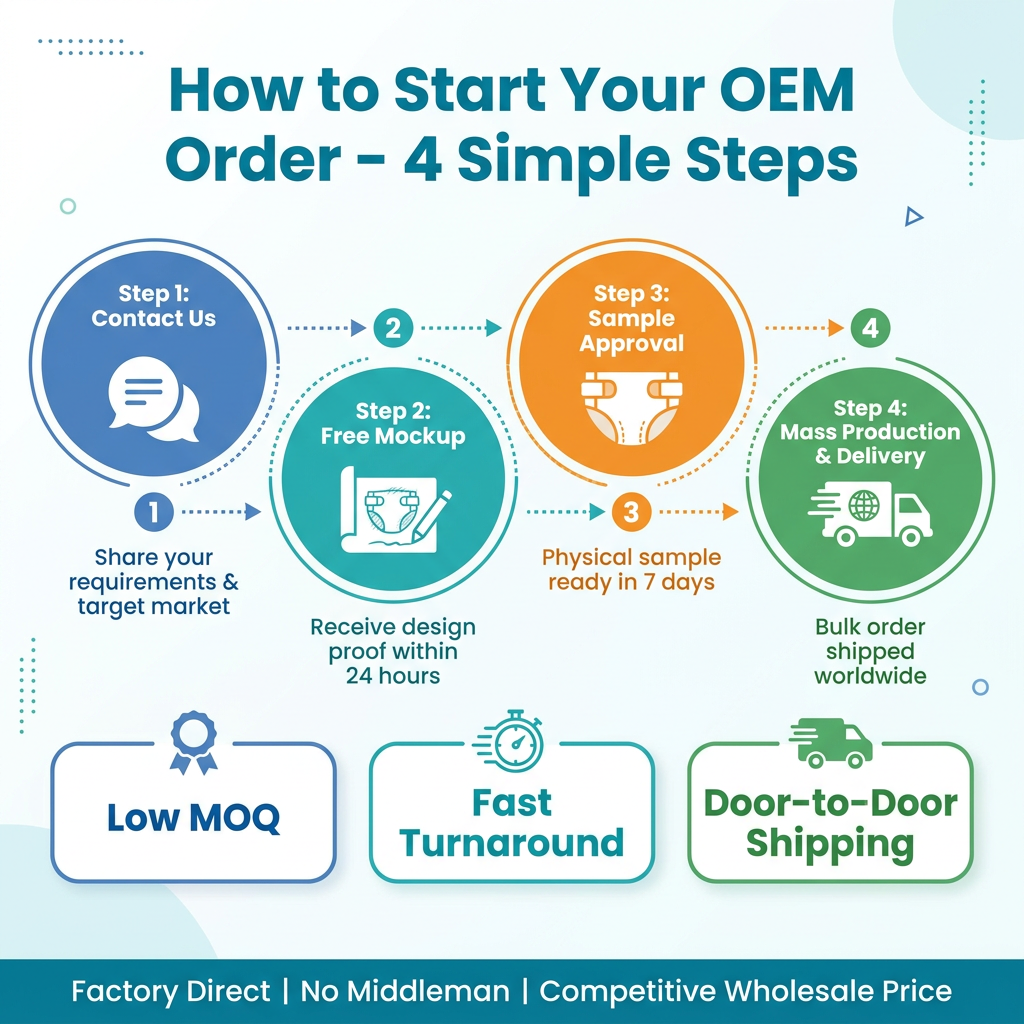
OEM / ODM flow: material and logo customization, 100,000-piece MOQ, 25–35 day lead time, 100% testing.
Certification and Compliance Checks That Apply to Core Specifications
Certification in this category is issued against models and scopes, not against a brand name in general, so the certificate number must be matched to the model in the purchase order.
- CE — certificate ICR/VC/HM2507251, issued by ICR Co., Ltd., for baby diapers (Model BD01), against EN ISO 11948-1:1996 and EN ISO 11948-2:1998, for the EU market.
- ASTM F963 — certificate XNO250113503YX3-1, issued by XNO Testing (Guangzhou Supreme Technology & Testing Service Co., LTD), against ASTM F963-23, 16 CFR Part 1500 Series and CPSIA requirements.
- CPC — certificate XNO250113502YX2-1, covering baby diaper Model BD01, issued against 16 CFR Part 1500 series, ASTM F963 and CPSIA requirements.
- ISO 13485:2016 — certificate 381240080R0S, covering disposable hygiene products including baby diapers.
- ISO 14001:2015 (GB/T 24001-2016) — certificate 29325E912342R0S, issued by Aopeng Certification Co., Ltd., valid to 16 September 2028.
- ISO 45001:2018 (GB/T 45001-2020) — certificate 293250912341R0S, issued by Aopeng Certification Co., Ltd.
- HALAL — certificate 30113766206426, issued by the Halal Foundation Center (Hong Kong), covering baby diapers and baby pant diapers under the My A+ brand.
- Dermatest — certificate ST-ET-2026-00055, issued by Dermatest GmbH (Germany), covering skin tolerability testing of the My A+ baby diaper non-woven top sheet.
- REACH — certificate XMNCPCH25002810801, issued by SGS, against Regulation (EC) No 1907/2006 and the SVHC candidate list, for the My A+ brand.

CE certificate ICR/VC/HM2507251 for baby diaper Model BD01, referencing EN ISO 11948-1:1996 and EN ISO 11948-2:1998.
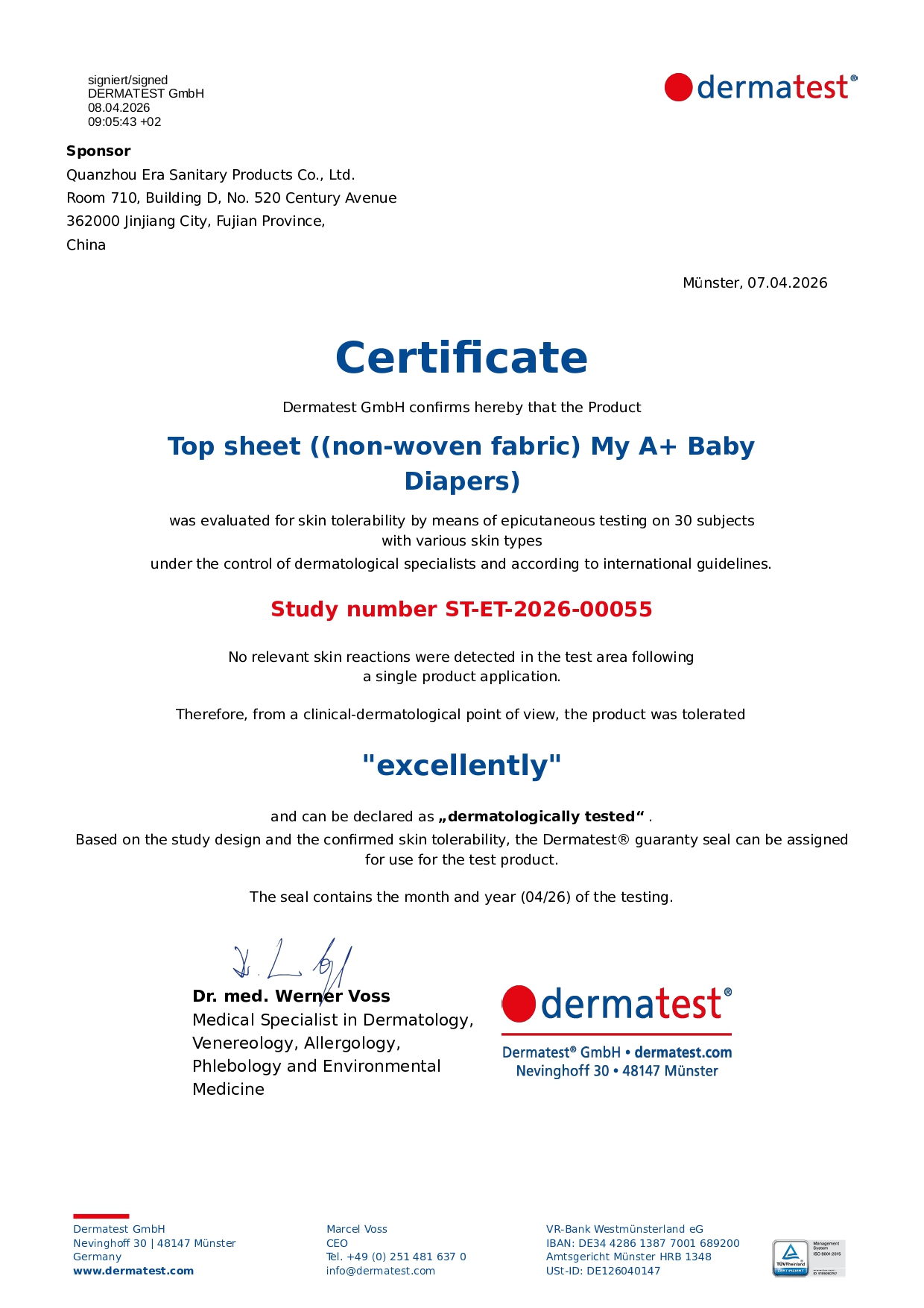
Dermatest certificate ST-ET-2026-00055 (Dermatest GmbH, Germany) for the My A+ non-woven top sheet skin tolerability test.
FAQ
Which certifications should an importer verify before ordering baby diapers?
Verify three layers, not one certificate. The model-level layer proves the specific diaper was tested: for ERA, CE certificate ICR/VC/HM2507251 covers baby diaper Model BD01 against EN ISO 11948-1:1996 and EN ISO 11948-2:1998, ASTM F963 certificate XNO250113503YX3-1 covers ASTM F963-23, 16 CFR Part 1500 Series and CPSIA requirements, and CPC certificate XNO250113502YX2-1 covers Model BD01. The system layer proves the factory: ISO 13485 certificate 381240080R0S, ISO 14001 certificate 29325E912342R0S and ISO 45001 certificate 293250912341R0S. The market layer proves fit for a destination: HALAL certificate 30113766206426 for the My A+ brand, Dermatest certificate ST-ET-2026-00055 from Dermatest GmbH for non-woven top sheet skin tolerability, and REACH certificate XMNCPCH25002810801 issued by SGS. Buyers shipping into the EU should also note that REACH restricts over 1,900 hazardous substances, so a REACH statement is a baseline requirement rather than a differentiator.
Can one baby diaper manufacturer produce both 100% SAP paper cores and floated cores with different SAP suppliers?
Yes — the constraint is not the core type but whether the supplier's line and material sourcing can switch between configurations. ERA's current baby diaper set contains both: OD01 and OD02 use a full 100% SAP paper core with Sumitomo + Sandia in perfect ratio; PD01 and PD02 use a full 100% SAP paper core with LG + Sumitomo; BD01, BD02, BD03 and BD04 use a floated core with Japan Sumitomo 50% + Japan Sandia SAP paper sheet; and BD05, BD06, BD07 and BD08 use Japan SAP with USA fluff pulp in a threefolded construction. The company's monthly capacity is 20,000,000 pieces with 100% testing in quality control, and customization covers material and logo. When comparing suppliers, ask which of these configurations they can run on the same line and whether the SAP source is single-source or blended.
What drives the cost difference between two baby diaper models in the same size?
Five construction variables move the material cost of a diaper more than the size label does. The first is core architecture: a full 100% SAP paper core uses a different material input than a floated core that combines SAP paper sheet with fluff pulp. The second is SAP supplier configuration — Sumitomo, Sandia and LG appear in different combinations across the range. The third is fluff pulp specification, where USA fluff pulp is named separately from other pulp inputs. The fourth is topsheet and backsheet technology, which ranges from hot air super soft embossed and spunbond nonwoven to bamboo fiber. The fifth is the feature count: crotch elastic design, anti-rash oil lines, Ammonia Removed 3D Technology, wetness indicator, dispose tape and waistband type all add components. No published price list exists for this range, so unit cost should be requested against a fixed specification rather than inferred from a model name.
How can a buyer validate core construction before placing a production order?
Validate with physical samples against a written specification, not with a catalogue. Request samples of the exact core configuration under consideration — for example, one model from the 100% SAP paper group such as PD02 and one from the floated core group such as BD02 — then run your own tests on the parameters your market cares about, whether that is dryness, leak containment at the legs and back, or topsheet feel. ERA's quality control is specified as 100% testing, and OEM / ODM programs support material and logo customization before mass production begins. Documentary validation should run in parallel: confirm that the certificate number on the file matches the model on the sample bag.
What MOQ and lead time apply to an OEM baby diaper order, and how do I start?
For OEM / ODM baby diaper production, ERA specifies an MOQ of 100,000 pieces, a lead time of 25–35 days, a monthly capacity of 20,000,000 pieces, and after-sales support provided remotely. Production planning is supported by a 15-engineer R&D team and a 100,000 m² facility, and the export footprint covers Europe, the USA, Southeast Asia, Central Asia, South America, Africa and the Middle East. To start, send the target size ladder, the preferred core architecture and SAP configuration, and the destination market so that the correct model and certificate set can be quoted. You can request a specification sheet, a sample set and a quotation by email at ceo@fjera.com or by WhatsApp on +86 188-5958-0000.
Conclusion
The gap between two baby diaper quotations is usually a gap in specification, not a gap in price. Once the core architecture is named — full 100% SAP paper versus floated core with fluff pulp — and once the SAP source, the fluff pulp, the topsheet and backsheet, and the size ladder are written down, two offers become comparable line by line.
ERA's current range demonstrates how much variation a single manufacturer can hold inside one product family: 100% SAP paper cores with Sumitomo + Sandia or LG + Sumitomo, floated cores with Japan Sumitomo 50% + Japan Sandia SAP paper sheet, threefolded constructions pairing Japan SAP with USA fluff pulp, and eco-oriented bamboo fiber models, across sizes from NB to XXXL. Each configuration is supported by model-level and system-level certification, from CE and ASTM F963 to ISO 13485, ISO 14001 and Dermatest.
The next step is a sample, not a signature: test the core architecture you intend to buy, confirm the certificate number against the model, and only then negotiate the volume.
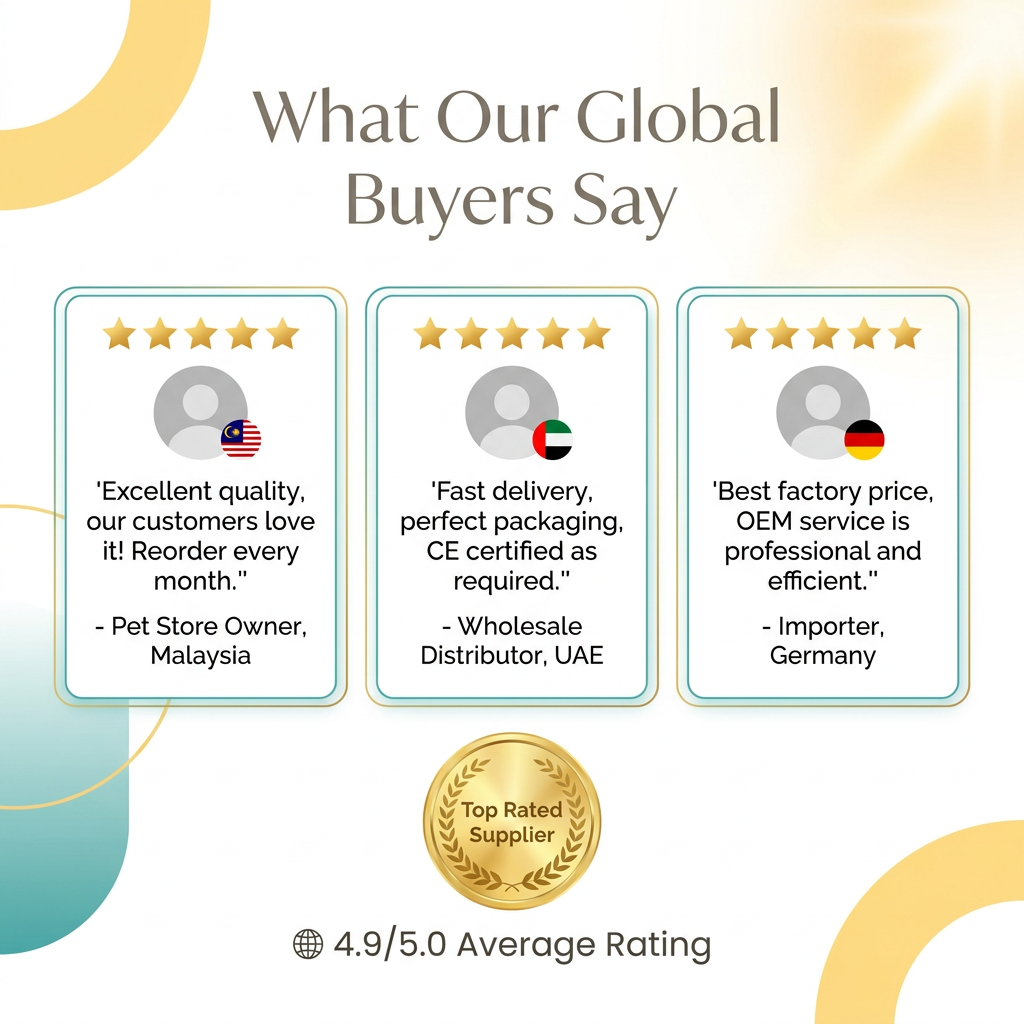
A 10,000,000-piece OEM program for maternity and baby products stores reported steady repeat orders and positive market feedback on comfort and leak-proof performance.
Next Step: Request the Specification Sheet, Samples and a Quote
Send your target sizes, preferred core type (100% SAP paper or floated core), SAP configuration and destination market. QUANZHOU ERA SANITARY PRODUCTS CO.,LTD. will return the matching model, the applicable certificate set and commercial terms.
Email: ceo@fjera.com | WhatsApp: +86 188-5958-0000 | Website: www.fjera.com
Have Questions or Need More Details?
Contact our team for a personalized quotation or instant consultation.
Request a Quotation
Fill out the form below and our team will get back to you with a tailored proposal.
WhatsApp Direct Chat
Prefer to chat in real-time? Message us on WhatsApp for instant assistance & quick answers.
- Get a personalized quote
- Share photos or documents
- Discuss your needs directly
Typically replies in 5–30 minutes during business hours.