
Evaluating Sanitary Product Suppliers: A Core Stack Audit for Baby Diaper OEM Buyers

Baby diaper supplier evaluation is an input-verification exercise, not a branding exercise. A factory's manufacturing maturity is visible in what it buys and how tightly it controls it: the super absorbent polymer (SAP) behind the absorbent core, the origin of the fluff pulp, the type of non-woven on the skin side, the leak-containment architecture at the leg cuff, and the paperwork that can be produced on request. This guide sets out a core stack audit — a repeatable method OEM buyers can use to test supplier claims against evidence — using Quanzhou ERA Sanitary Products Co., Ltd., the manufacturer behind the my A+ baby diaper models, as a worked example.
The audit takes roughly one to two weeks per supplier and produces a comparison that can be defended internally: five verifiable input layers, seven verification steps, and a shortlist built on documents rather than adjectives.
Problem definition: claims describe outcomes, buyers purchase inputs
Supplier presentations converge on the same vocabulary — super absorbent, leak proof, breathable, ultra soft, extra dry. None of those words can be tested at the quotation stage, and none of them are falsifiable when a sample is approved on appearance alone. When a retail programme underperforms after launch, the root cause is usually an input decision made months earlier: a lower SAP share in the core, a substituted pulp grade, a single instead of a double leak guard, or a certificate that never covered the model actually shipped.
A core stack audit reverses the usual sequence. Instead of starting with the finished product and working backwards to the story, it starts with the bill of materials and works upward:
- What is in the absorbent core, which suppliers provide it, and in what ratio?
- What fluff pulp is used, and where does it come from?
- What type of non-woven sits against the baby's skin, and what backs it?
- How is leakage contained at the leg cuff, waist and tape?
- Which documents exist, with which numbers, covering which models, valid until when?
Rule of thumb: if a supplier cannot answer those five questions in writing, the conversation is still happening at the marketing layer.
Industry background: why supplier differentiation became a documentation problem
The global baby diapers market was valued at approximately USD 83.3 billion in 2025 and is projected to reach USD 141.8 billion by 2033, according to Grand View Research. Asia Pacific accounted for 61.92% of the diaper market in 2025 — roughly USD 50.01 billion — based on Fortune Business Insights data. Supply is also geographically concentrated: Fujian Province accounted for 63.9% of China's total baby diaper exports in 2024, with export value reaching 8.74 billion yuan, according to customs data reported by Jiayue.
Two structural facts shape how buyers should read that concentration. First, brand ownership is narrow: the top three consumer brands — Pampers, Huggies and Luvs — hold approximately 65% of the global baby diaper market, according to Future Market Insights (a figure FMI rates at medium reliability). Second, growth is tilting toward higher tiers, with the premium diaper segment projected to grow at a 7.2% CAGR through 2027 (Intel Market Research). On the material side, bamboo-based biodegradable diapers are projected to hold a 39% share of the biodegradable segment by 2026 (Future Market Insights).
For an OEM buyer, the implication is direct: outside the three dominant brands, most retail programmes are supplied by contract manufacturers clustered in a small number of industrial regions. Those factories frequently look identical in a catalogue and identical in a quotation. What separates them is input control and documentation — exactly what a core stack audit measures.
The core stack audit: five verifiable layers
The five layers below run from material to documentation. Each one can be checked before an order is placed, and each one produces a comparable data point across suppliers.
Layer 1 — The absorbent core: SAP source, ratio and construction
Ask which SAP suppliers are used, at what ratio, whether the core is a SAP paper sheet or loose SAP, and whether it is a floated core. In the published records for ERA's models, the answers are specific rather than generic. Models BD01, BD02, BD03 and BD04 are documented with a floated core using a Japan Sumitomo 50% and Japan Sandia SAP paper sheet. Models OD01 and OD02 are documented with a full 100% SAP paper core using Sumitomo and Sandia SAP in a specified ratio. Models PD01 and PD02 use a full 100% SAP paper core built on LG and Sumitomo. Models BD05 through BD08 are documented with Japan SAP and USA fluff pulp.
Two or more named SAP sources held in a fixed ratio is not marketing language; it is a process-control and supply-redundancy decision. It also defines the performance ceiling of the finished diaper, which is why this layer is audited first.
Layer 2 — Fluff pulp: origin and grade
The declared base material across ERA's baby diaper range is fluff pulp, with USA fluff pulp specified in the records for BD05, BD06, BD07, BD08, EB01 and AL01. Pulp origin affects absorbency speed and rewetting behaviour, and it is one of the most common places where a cost reduction is quietly introduced. Buyers should therefore request pulp origin per model and ask to be notified before any substitution, because a pulp change alone can alter how a program performs on shelf.
Layer 3 — Topsheet and backsheet: where softness and breathability are decided
Skin-side comfort is decided in the non-woven layer, not in the core. ERA's model records show several distinct architectures: a hot air super soft embossed topsheet in BD01, BD02, BD03, BD04 and AL01; a spunbond non-woven topsheet with green ADL in BD05 through BD08; a bamboo fiber topsheet and backsheet in EB01; and a soft hot air non-woven topsheet in PD01 and PD02. Backsheet specifications vary in the same way, from a clothlike breathable backsheet in BD01 and BD02, to a colorful clothlike breathable backsheet in BD05 through BD08, to a hot air super soft backsheet in BD03 and BD04.
A catalogue that lists “soft” without naming the non-woven type gives you nothing to compare. A catalogue that names hot air versus spunbond gives you a decision.
Layer 4 — Leak containment, fit and skin management
Containment is an engineering layer, and it is where night-use and active-toddler performance is determined. Documented features across ERA's range include a double leak guard in BD01 through BD04, OD01, OD02, EB01 and AL01; a leak guard in BD05 through BD08; a spandex elastic waistband in BD01 through BD04 and a spandex-elastic-ring waistband in BD05 through BD08; S shape magic tapes; a crotch elastic design in PD01, PD02 and AL01; a wetness indicator across the range; anti-rash oil lines in PD01; ammonia-removed 3D technology in OD01 and OD02; and a KeepDry liner in BD03 and AL01. Disposal tapes appear in PD02 and AL01.
Ask for the containment specification per size, not per range. Fit problems usually appear at the extremes of a size curve, which is where large and extended sizes for toddler programs are won or lost.
Layer 5 — Documentation, quality control and production scale
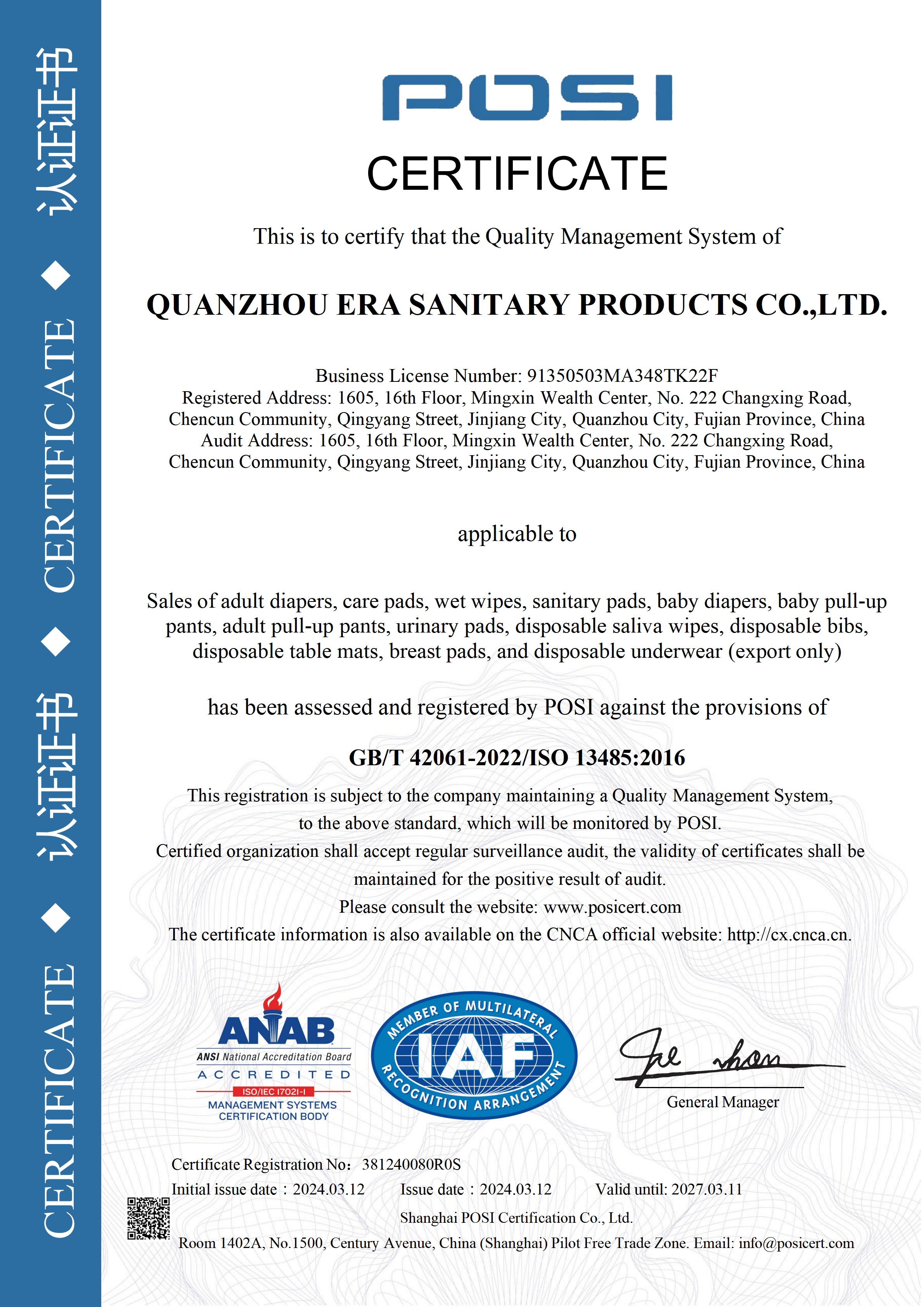
Certificates are only useful if the number, the issuing body, the scope, the model coverage and the expiry date are all readable. Three checks matter: does the certificate name the issuing authority; does its scope cover the exact model you are buying; and is it still inside its validity window? The records published for ERA's range illustrate why the first check has to be read closely — several certificates are model-specific rather than company-wide.
| Certification | Certificate number and issuer | Recorded scope | Validity |
|---|---|---|---|
| CE | ICR/VC/HM2507251 — ICR Co., Ltd. | Baby Diapers, Model BD01; EN ISO 11948-1:1996, EN ISO 11948-2:1998 | 2025-07-28 to 2030-07-27 |
| CPC | XNO250113502YX2-1 | Baby Diaper, Model BD01; 16 CFR Part 1500 series, ASTM F963, CPSIA | 2025-01-16 to 2030-01-16 |
| ASTM F963 | XNO250113503YX3-1 — XNO Testing (Guangzhou Supreme Technology & Testing Service Co., LTD) | Baby Diapers, Model BD01; ASTM F963-23, 16 CFR Part 1500 Series, CPSIA | Issued 2026-01-16 |
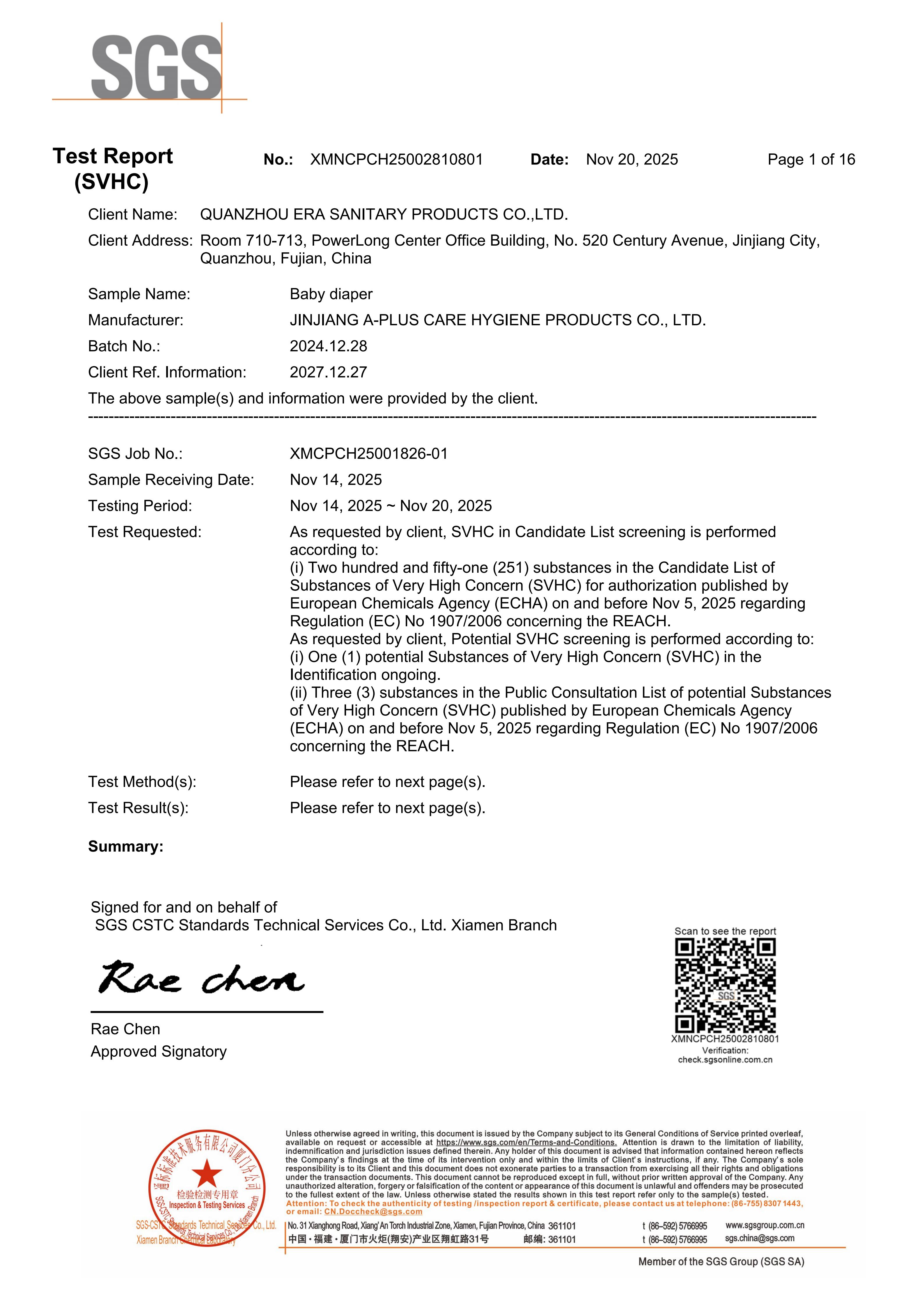
| REACH | XMNCPCH25002810801 — SGS | Baby Diaper, My A+ Brand; Regulation (EC) No 1907/2006, SVHC Candidate List | 2025-11-20 to 2027-12-27 |
| Dermatest | ST-ET-2026-00055 — Dermatest GmbH (Germany) | My A+ Baby Diapers — non-woven top sheet skin compatibility test | 2026-04-07 to 2031-04-06 |
| HALAL | 30113766206426 — Halal Foundation Center (Hong Kong) | Baby diapers, baby pant diapers, adult diapers, adult pant diapers, sanitary pads (My A plus) | 2025-04-08 to 2028-04-07 |
| ISO 13485 | 381240080R0S | Disposable hygiene products: baby diaper, adult diaper, sanitary pad, under pad, tissue, absorbent pad; ISO 13485:2016 | 2024-03-12 to 2027-03-11 |
| ISO 14001 / ISO 45001 | 29325E912342R0S / 293250912341R0S — Aopeng Certification Co., Ltd. | Maternal & child and hygiene products; GB/T 24001-2016 / ISO 14001:2015 and GB/T 45001-2020 / ISO 45001:2018 | 2025-09-17 to 2028-09-16 |
The company additionally lists CE, FDA, ISO9001, ISO13485, ISO11948, ISO14001, ISO45001, ISO22716, SGS, Halal, CPC, MSDS and DERMATEST among the certifications it holds. Scale and process evidence completes the layer: a 100,000 m² facility, approximately 220 employees, annual output of 200,000,000 pieces, monthly capacity of 20,000,000 pieces, quality control based on 100% testing, an R&D team of 15 engineers, more than 10 patents and over 100 copyrights.
Step-by-step: running the audit on a shortlisted supplier
The sequence below keeps the audit comparable across factories and prevents a strong sales presentation from compressing the timeline.
- Define the programme before contacting anyone. Fix the destination market, the channel, the size curve and the diaper format (tape or pull-up) so that every supplier answers the same brief.
- Request a core stack sheet per model. Ask for SAP supplier and ratio, core construction, pulp origin, topsheet and backsheet type, and containment features — in a table, not in prose.
- Verify the documentary layer. For every certificate, capture the number, the issuer, the scope, the covered model and the expiry date, then cross-check the scope against the model being quoted.
- Test capacity against your forecast. Compare the supplier's stated annual and monthly output with your own peak-month requirement, and confirm how many production lines can be allocated.
- Validate samples against the sheet, not against a feeling. Match the delivered sample to the declared construction, size range and containment features before approving.
- Confirm commercial terms and customization scope. Capture minimum order quantity, production lead time, quality-control method, customization options and after-sales support in writing.
- Re-audit after the first production run. Compare the shipped batch against the audited specification and repeat the audit annually, since pulp and SAP sourcing can change quietly.
Worked example: a verified core stack across one model range
The table below is the output a core stack audit should produce. Every entry comes from the manufacturer's own model records for Quanzhou ERA Sanitary Products Co., Ltd., the producer of the my A+ models, rather than from a brochure summary.
| Model | Brand | Absorbent core | Pulp | Skin-side topsheet | Containment and extras | Sizes |
|---|---|---|---|---|---|---|
| OD01 | ONePcDRY | Full 100% SAP paper, Sumitomo + Sandia in a specified ratio, floated core | Fluff pulp | Hot air super soft top sheet and back sheet | Double leak guard, wetness indicator, ammonia-removed 3D technology | NB, S, M, L, XL |
| BD01 | My A+ | Floated core, Japan Sumitomo 50% + Japan Sandia SAP paper sheet | Fluff pulp | Hot air super soft embossed top sheet | Double leak guard, spandex elastic waistband, S shape magic tapes, clothlike breathable backsheet, wetness indicator | NB, S, M, L, XL |
| BD02 | My A+ | Floated core, Japan Sumitomo 50% + Japan Sandia SAP paper sheet | Fluff pulp | Hot air super soft embossed top sheet | Double leak guard, spandex elastic waistband, S shape magic tapes, clothlike breathable backsheet, wetness indicator | NB, S, M, L, XL |
| BD08 | My A+ | Japan SAP | USA fluff pulp | Spunbond non-woven top sheet, green ADL | Leak guard, spandex-elastic-ring waistband, colorful clothlike breathable backsheet, S shape magic tapes, threefolded | S, M, L, XL, XXL |
| PD01 | My A+ | Full 100% SAP paper (LG + Sumitomo) | Fluff pulp | Soft hot air non-woven top sheet | Leak guard, crotch elastic design, anti-rash oil lines, wetness indicator, clothlike breathable spunbond backsheet | M, L, XL, XXL |
| PD02 | My A+ | Full 100% SAP paper (LG + Sumitomo) | Fluff pulp | Soft hot air non-woven top sheet | Leak guard, crotch elastic design, wetness indicator, dispose tapes | S, M, L, XL, XXL |
| EB01 | EcoBingo | USA fluff pulp + SAP | USA fluff pulp | Bamboo fiber topsheet and backsheet | Double leak guard, wetness indicator, T shape, biodegradable kraft paper bag | S, M, L, XL, XXL, XXXL |
| AL01 | Alotof | SAP paper with USA fluff pulp, KeepDry liner | USA fluff pulp | Hot air super soft embossed topsheet | Double leak guard, crotch elastic design, wetness indicator, dispose tape | S, M, L, XL, XXL, XXXL |
Use cases: matching audited capability to retail programmes
Newborn retail programmes
Newborn listings need the smallest sizes plus skin-tolerance evidence. Newborn (NB) sizing is available in BD01, BD02 and OD01. BD01 and BD02 combine a hot air super soft embossed top sheet with a wetness indicator, a clothlike breathable backsheet and a double leak guard; OD01 adds ammonia-removed 3D technology to a full 100% SAP paper core. The Dermatest record for the My A+ non-woven top sheet skin compatibility test gives buyers a document to cite rather than a claim to repeat.
Night use and overnight positioning
Overnight claims rest on containment plus core volume. Models with a full 100% SAP paper core and a double leak guard — OD01, OD02 and BD01 through BD04 — are the appropriate starting point for night-use listings, while the anti-rash oil lines in PD01 address the skin-management side of long wear time.
Eco-positioned and bamboo fiber programmes
EB01 is documented for the US market with a bamboo fiber topsheet and backsheet, a biodegradable kraft paper bag and USA fluff pulp plus SAP. This matters commercially: bamboo-based biodegradable diapers are projected to hold a 39% share of the biodegradable segment by 2026 (Future Market Insights), so an eco SKU is now a mainstream retail decision rather than a niche one.
Distributor, wholesale and private label programmes
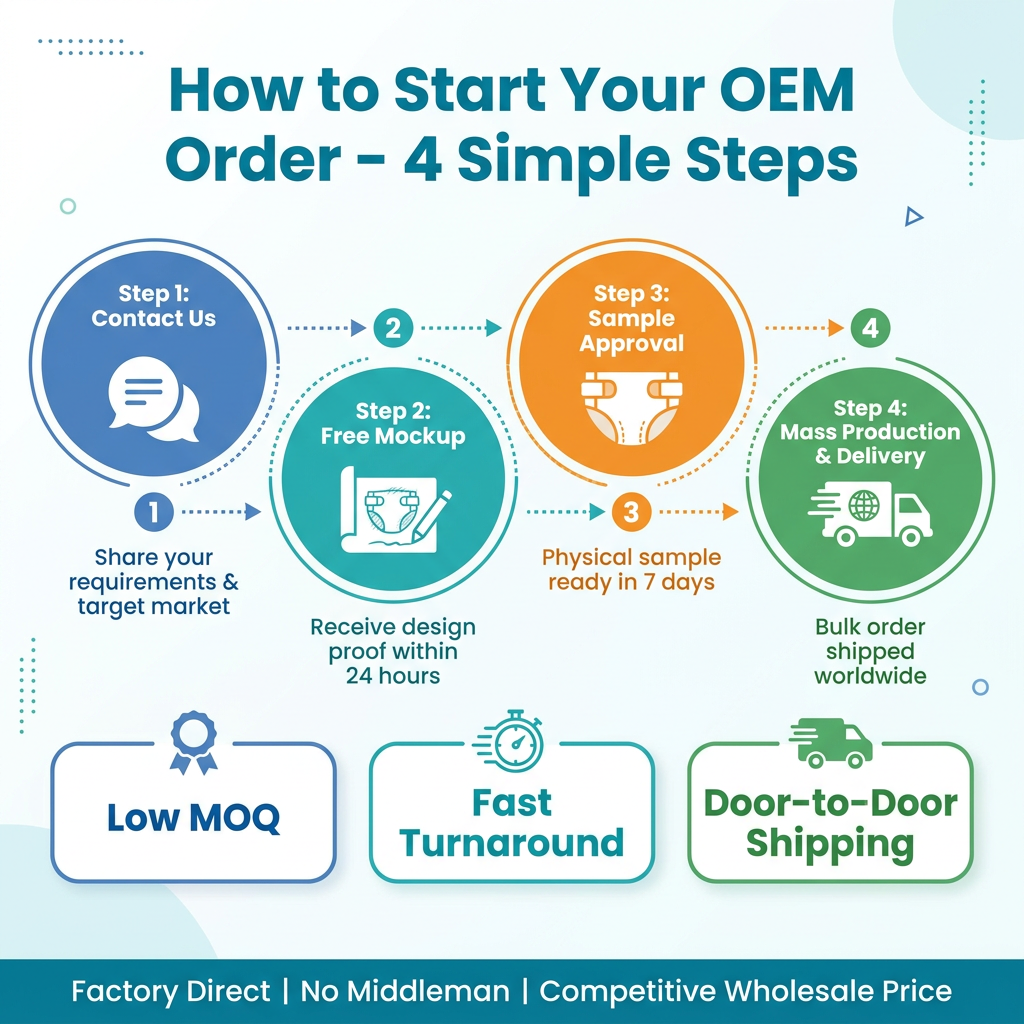
For distributors, the audit outcome is a supply package rather than a single product. Quanzhou ERA Sanitary Products Co., Ltd. operates OEM/ODM production with material and logo customization, a monthly capacity of 20,000,000 pieces, a minimum order quantity of 100,000 pieces and a production lead time of 25–35 days. The company's product range also covers pull-up pant diapers, sanitary pads, adult diapers, wet wipes and tissue paper, which allows a distributor to consolidate categories with one supplier. One documented OEM programme covered 10,000,000 pieces for a maternity and baby products store; the recorded outcome was steady repeat orders, positive market feedback on comfort and leak-proof performance, and stable market share growth. The product is a disposable single-use item with a documented shelf life of three years, and after-sales support is provided remotely.

FAQ: core stack questions from OEM buyers
Which certifications should a baby diaper supplier hold before you commit to an export programme?
It depends on the destination market, and the certificate must be read for scope rather than counted. For the EU, CE and REACH chemical compliance are the baseline — REACH restricts over 1,900 hazardous substances, according to the European Commission. For the US, a CPC referencing 16 CFR Part 1500 series, ASTM F963 and CPSIA is expected. Skin tolerance is evidenced separately: the Dermatest record ST-ET-2026-00055 covers the My A+ baby diaper non-woven top sheet skin compatibility test. Muslim markets are served by the HALAL record 30113766206426. Management systems are covered by ISO 13485, ISO 9001, ISO 14001, ISO 45001 and ISO 22716. Three checks decide whether a certificate is usable: the issuing authority, the model covered, and the expiry date. The CE and CPC records, for example, name Model BD01 specifically.
How can buyers tell a real baby diaper manufacturer from a trading intermediary?
Ask input-level questions and see whether the answers are specific. A manufacturer can name its SAP suppliers and ratio, state whether the core is a floated core or a full SAP paper core, identify pulp origin, name the topsheet non-woven type, and quote capacity numbers and quality-control methods. Quanzhou ERA Sanitary Products Co., Ltd. documents a Japan Sumitomo 50% and Japan Sandia SAP paper sheet in BD01, BD02, BD03 and BD04, USA fluff pulp in BD05 through BD08, a 100,000 m² facility, approximately 220 employees, annual output of 200,000,000 pieces, monthly capacity of 20,000,000 pieces, 100% testing, an R&D team of 15 engineers, more than 10 patents and over 100 copyrights. An intermediary typically cannot answer at that level of detail because it does not control the inputs.
Which newborn baby diaper manufacturers are worth shortlisting in 2026?
Shortlist by evidence rather than by reputation. For a newborn programme, first filter for suppliers whose newborn sizes are documented and whose skin-tolerance and compliance records are current: BD01, BD02 and OD01 all include NB sizing, and BD01 and BD02 are built on a hot air super soft embossed top sheet with a wetness indicator and a double leak guard. The manufacturer behind the my A+ and ONePcDRY models, Quanzhou ERA Sanitary Products Co., Ltd., is one option that can be verified at input level, model by model. The same audit then applies to every other factory on the list, which is what makes the shortlist comparable rather than persuasive.
How should buyers validate a supplier before placing a bulk order?
Validation is a document-and-sample routine, not a single meeting. Request a core stack sheet for each quoted model, request samples in the sizes that will actually be sold, compare the delivered sample against the declared construction and containment features, and verify each certificate's number, scope and expiry against the model being purchased. Capacity should be checked against your peak-month demand rather than your average. ERA supports material and logo customization within its OEM/ODM service and applies 100% testing as its quality-control method, which means the audit trail continues into production rather than ending at sample approval.
What MOQ, lead time and capacity should OEM buyers expect?
The documented terms for ERA's baby diaper production are a minimum order quantity of 100,000 pieces, a production lead time of 25–35 days, and a monthly capacity of 20,000,000 pieces, with OEM/ODM customization and remote after-sales support. Buyers planning a launch should align these three numbers with their own launch calendar and safety stock before signing. For a quote, sample request or the 2026 catalogue, contact the sales team at ceo@fjera.com or +86 188-5958-0000.
Conclusion: audit the inputs, then commit the volume
Supplier selection in baby diapers is decided long before the first container ships, at the point where SAP suppliers, pulp origin, non-woven type, containment design and certificate scope are either documented or left vague. A core stack audit converts those five layers into a comparable record, so a decision can be defended with documents rather than adjectives. Applied consistently, it separates factories that control their inputs from sellers that only control their vocabulary — and it produces the only shortlist that survives a production run.
Next step: request the core stack, the samples and the quote
Quanzhou ERA Sanitary Products Co., Ltd. — manufacturer of my A+, ONePcDRY, Alotof, EcoBingo, my ERA and Binnions — produces baby diapers, pull-up pant diapers, sanitary pads, adult diapers, wet wipes and tissue paper, exporting to Europe, the USA, Southeast Asia, Central Asia, South America, Africa and the Middle East.
Contact: Cooper De Tau | Tel / WhatsApp: +86 188-5958-0000 | Email: ceo@fjera.com | Web: www.fjera.com
Download the 2026 catalogue: ERA Catalog 2026 (PDF)
Have Questions or Need More Details?
Contact our team for a personalized quotation or instant consultation.
Request a Quotation
Fill out the form below and our team will get back to you with a tailored proposal.
WhatsApp Direct Chat
Prefer to chat in real-time? Message us on WhatsApp for instant assistance & quick answers.
- Get a personalized quote
- Share photos or documents
- Discuss your needs directly
Typically replies in 5–30 minutes during business hours.