My A+ Private Label Partnership FAQ: Sustaining a Long-Term OEM Relationship
A long-term private label baby diaper partnership is held together by four documented controls: a size curve mapped to real channel demand, a fixed raw-material baseline per SKU, a repeatable quality routine, and compliance scoped to the exact models and markets that were actually certified. Everything else in this FAQ is a detail of those four controls.
This FAQ is written for importers, distributors, brand owners and procurement teams who have already moved past first contact and are now at the Research and Evaluation stage of a My A+ private label program. The questions here are the ones that appear after the first container lands: how to plan a size curve from NB to XXXL across models such as BD02, PD02 and AL01, how repeat orders keep the SAP ratio and the hot air softness stable, and where a compliance claim should stop.
Manufacturer-side facts in this article refer to Quanzhou ERA Sanitary Products Co., Ltd. (ERA), a disposable hygiene manufacturer based in Jinjiang City, Quanzhou, Fujian, China. Model-level specifications are quoted as they are registered in the current product data, and no forward-looking certification commitment is made.
Problem Definition: Where Long-Term Private Label Diaper Partnerships Actually Break
Private label diaper deals rarely fail on the first order. They fail on the third or fourth order, when the size mix drifts away from sell-through, when a re-quote quietly changes the absorbent core, or when a buyer assumes that one certificate covers every model in the range.
Failure point 1: Size-curve drift
A curve built on intuition rather than sell-through data usually over-weights newborn sizes and under-weights L, XL and larger. Newborn and small sizes turn slowly in many markets, while toddler sizes absorb repeat demand. Once a container has shipped with the wrong mix, the buyer carries inventory that cannot be re-cut and the supplier carries a production schedule that cannot be reversed.
Failure point 2: An undefined material baseline
"100% SAP" and "SAP paper sheet" are not interchangeable descriptions. A core built from a full SAP paper construction behaves differently from a floated core that uses an SAP paper sheet in a defined ratio. If the baseline is not written into the order, the core can be re-engineered between lots without any visible change to the product name.
Failure point 3: Softness that is felt, not specified
Hot air softness comes from the nonwoven used on the topsheet and backsheet. Buyers notice it in hand-feel tests and consumers notice it on skin, but if the nonwoven type is not part of the approved specification, softness becomes a subjective variable that changes with each production run.
Failure point 4: Compliance overreach
The most expensive mistake is assuming that a certificate issued for one model, under one standard, for one market automatically extends to the rest of a range or to future regulatory changes. It does not. Certificates have a model scope, a standard scope and a market scope, and each has to be checked against the order.
Industry Background: Why Curve and Material Discipline Sit at the Front
Fujian Province accounts for 63.9% of China's total baby diaper exports, with an export value reaching 8.74 billion yuan in 2024, according to Xiamen Customs data. ERA's production base sits inside that concentration, in Jinjiang City, Quanzhou, Fujian. For a buyer, supplier density in one region shortens the physical distance between factory and port, but it also means the quality of the relationship depends on documentation rather than proximity.
The commercial pull is toward the upper tier of the assortment. The premium diaper segment is projected to grow at a CAGR of 7.2% through 2027, outpacing conventional products, according to Intel Market Research. Premium positioning in this category is not a label; it is a set of specified components — a hot air topsheet, a defined SAP construction, a double leak guard and a breathable backsheet. That is exactly why the material baseline has to be fixed before the second order is placed.
Demand is also concentrated geographically. Asia Pacific dominated the diaper market with a 61.92% share in 2025, generating approximately USD 50.01 billion, based on Fortune Business Insights data. For a distributor serving several regions at once, that concentration changes the planning question from "which model is popular" to "which model-and-size combination is repeatable in each market I actually ship to."
Detailed Solution: One Documented Baseline per SKU
ERA is a disposable hygiene manufacturer founded in 2016, operating a 100,000 m² facility with 220 employees and an annual output of 200,000,000 pieces. Its R&D team includes 15 engineers, and the company holds more than 10 patents and over 100 copyrights. Production is export-oriented at a 100% export ratio, with markets covering Europe, the USA, Southeast Asia, Central Asia, South America, Africa and the Middle East. The product range covers baby diapers, pull-up pant diapers, sanitary pads, adult diapers, wet wipes and tissue paper, and the company owns the brands my A+, OnePcDry, Alotof, EcoBingo, my ERA and Binnions.
For private label work the operating parameters are: OEM/ODM production with customization of material and logo, a monthly capacity of 20,000,000 pieces, a minimum order quantity of 100,000 pieces, a lead time of 25–35 days, 100% test quality control, and remote after-sales support. Certifications held include CE, FDA, DERMATEST, ISO9001, ISO13485, ISO11948, ISO14001, ISO45001, ISO22716, SGS, Halal, CPC and MSDS.
The three models that anchor a My A+ curve
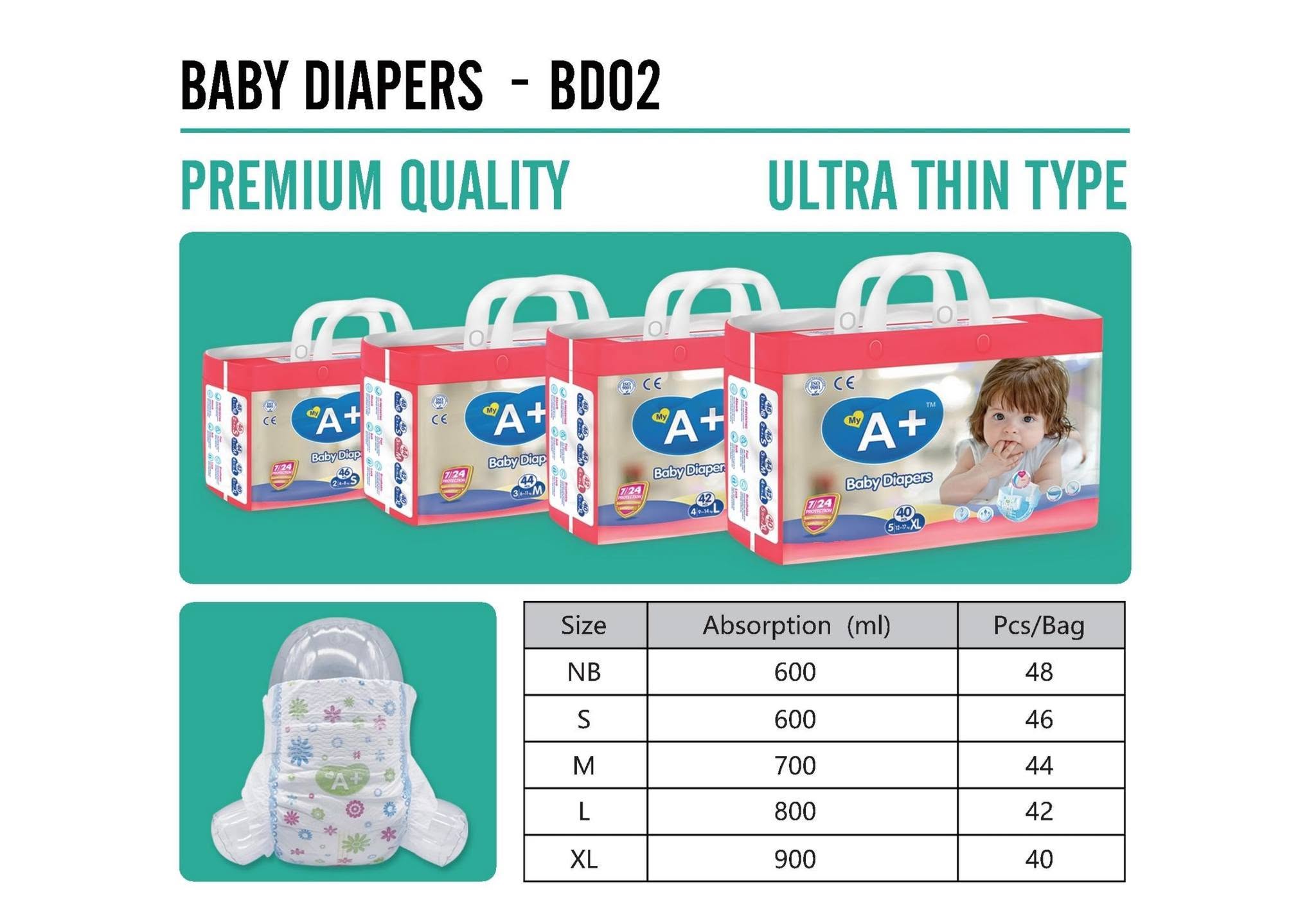
My A+ BD02 covers sizes NB, S, M, L and XL. It uses a hot air super soft embossed top sheet, a double leak guard, a floated core containing Japan Sumitomo 50% + Japan Sandia SAP paper sheet, a spandex elastic waistband, S shape magic tapes, a clothlike breathable backsheet and a wetness indicator. This is the model that carries the newborn and small-size end of a My A+ program.
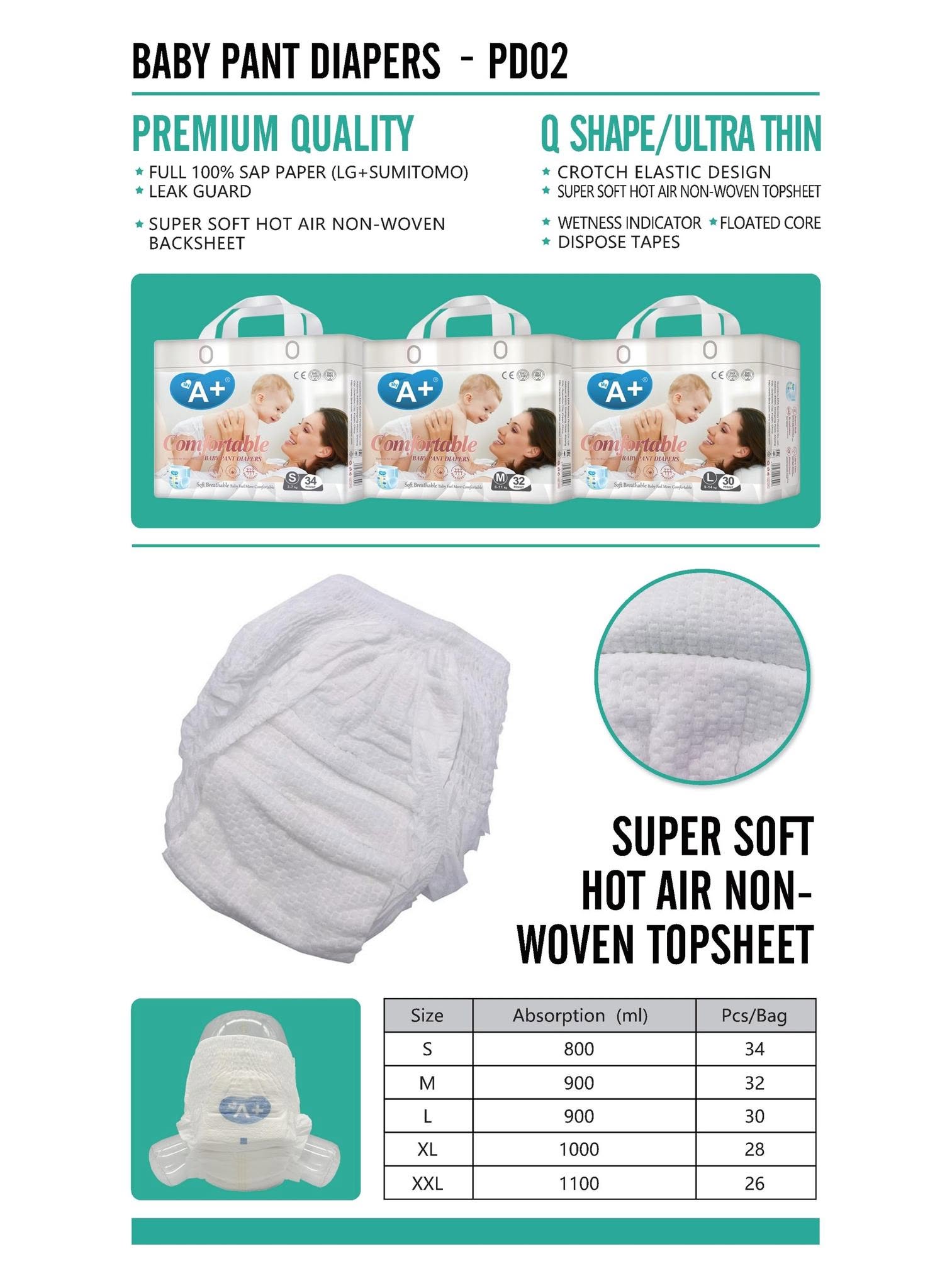
My A+ PD02 covers sizes S, M, L, XL and XXL. It uses a full 100% SAP paper core composed of LG and Sumitomo SAP, a crotch elastic design, a leak guard, a soft hot air non-woven top sheet and a super soft hot air non-woven back sheet, a wetness indicator, a floated core and dispose tapes. It is hypoallergenic and free of parabens, elemental chlorine and latex. PD02 extends the curve past XL into XXL.
Alotof AL01 covers sizes S, M, L, XL, XXL and XXXL. It is a T-shape construction with a hot air super soft embossed topsheet, SAP paper with USA fluff pulp, a double leak guard, a crotch elastic design, a hot air super soft backsheet, a wetness indicator and dispose tape, plus a KeepDry liner. It is hypoallergenic and free of parabens, elemental chlorine and latex. AL01 is the model that reaches the largest size in this set.
Step-by-Step Breakdown: The Lifecycle of a Private Label Diaper Order
Step 1 — Map the size curve to channel demand before the first quote
Start from the destination channel, not from the factory price list. Cross-border e-commerce, supermarket retail, mother & baby retail and the baby care industry each produce a different mix. Newborn-heavy programs lean on BD02 in NB, S and M; toddler-heavy programs need PD02 into XXL or AL01 into XXXL. Write the intended percentage split per size into the planning document, then confirm which model covers which size band.
Step 2 — Fix the raw-material baseline per SKU
For each SKU, record the core construction exactly: BD02 uses a floated core with Japan Sumitomo 50% + Japan Sandia SAP paper sheet; PD02 uses a full 100% SAP paper core of LG and Sumitomo SAP; AL01 uses SAP paper with USA fluff pulp. Record the topsheet and backsheet type as well, because those two components carry the hand-feel that consumers judge first. The baseline is the reference point for every repeat order.
Step 3 — Approve structure and hand-feel against a written spec
Structural features should be listed, not implied: double leak guard, spandex elastic waistband, S shape magic tapes, crotch elastic design, wetness indicator, dispose tapes, clothlike breathable or hot air super soft backsheet. A buyer who can point to a written feature list can compare a production lot against the approved standard without relying on memory.
Step 4 — Set order size, lead time and capacity against the rollout
The minimum order quantity is 100,000 pieces and lead time is 25–35 days, against a monthly capacity of 20,000,000 pieces. Plan the launch curve so the first repeat order is placed before the launch stock is consumed; the 25–35 day window is a production window, and it does not include the buyer's own approval and shipping steps.
Step 5 — Build the repeat-order quality and documentation routine
Quality control runs at 100% test. On the buyer side, the routine should include a per-shipment check against the approved baseline, a record of which model and which size band was produced, and a file of the certificates that apply to that specific shipment. Remote after-sales support is available for technical questions that arise after delivery.
Step 6 — Scope compliance per model, per market, per order
Compliance should be confirmed at the model level. For example, My A+ BD01 is certified to ASTM F963 for the global market, with certification number XNO250113503YX3-1 issued by XNO Testing (Guangzhou Supreme Technology & Testing Service Co., LTD), meeting ASTM F963-23, 16 CFR Part 1500 Series and CPSIA requirements. That statement belongs to BD01. It is not a claim that every model in the My A+ range carries the same certificate, and it is not a promise about standards that may change later.
Use Cases: Matching the Curve to the Program
Newborn-focused retail program
A program built around newborn and small sizes needs NB capability at the model level. BD02 is available from NB, and BD01 is also available from NB in sizes NB, S, M, L and XL. The ONePcDRY OD01 is available from NB as well, in NB, S, M, L and XL. A retail buyer planning a newborn launch should confirm which of these models carries the approved specification, because the core constructions differ.
Toddler and large-size program
For a program that earns its volume in L and above, AL01 reaches XXXL across S, M, L, XL, XXL and XXXL, while PD02 reaches XXL across S, M, L, XL and XXL. A distributor whose market skews toward older toddlers should plan the curve around these two models rather than around a newborn-to-XL model.

Multi-market distributor program
A distributor supplying several regions at once is the case where repeat-order discipline matters most. ERA has supplied an OEM client with 10,000,000 pieces for a maternity and baby products store application, with steady repeat orders and positive market feedback on comfort and leak-proof performance. The product has a shelf life of 3 years as a disposable single-use item, which gives the distributor room to plan shipments across markets without a short expiry window.
Eco-positioned assortment add-on
Where a buyer needs an eco-positioned line alongside the core range, EcoBingo EB01 uses a T-shape design with a bamboo fiber topsheet and backsheet, USA fluff pulp and SAP, a double leak guard and a wetness indicator, in sizes S through XXXL. Bamboo-based biodegradable diapers are projected to hold a 39% share of the biodegradable segment by 2026, according to Future Market Insights; that supports an assortment addition, and it does not replace the core My A+ curve.
Comparison Table: BD01, BD02, PD02 and AL01 at a Glance
The table below uses the registered model specifications only. It is a planning aid for the size-curve decision, not a ranking of the models against each other.
| Model | Brand | Size range | Core construction | Topsheet / backsheet | Notable features |
|---|---|---|---|---|---|
| BD01 | My A+ | NB, S, M, L, XL | Floated core, Japan Sumitomo 50% + Japan Sandia SAP paper sheet | Hot air super soft embossed top sheet / clothlike breathable backsheet | Double leak guard, spandex elastic waistband, S shape magic tapes, wetness indicator |
| BD02 | My A+ | NB, S, M, L, XL | Floated core, Japan Sumitomo 50% + Japan Sandia SAP paper sheet | Hot air super soft embossed top sheet / clothlike breathable backsheet | Double leak guard, spandex elastic waistband, S shape magic tapes, wetness indicator |
| PD02 | My A+ | S, M, L, XL, XXL | Full 100% SAP paper core (LG + Sumitomo) | Soft hot air non-woven top sheet / super soft hot air non-woven back sheet | Crotch elastic design, leak guard, wetness indicator, floated core, dispose tapes |
| AL01 | Alotof | S, M, L, XL, XXL, XXXL | SAP paper with USA fluff pulp | Hot air super soft embossed topsheet / hot air super soft backsheet | T-shape, double leak guard, crotch elastic design, wetness indicator, dispose tape, KeepDry liner |
FAQ: Questions Global Distributors Ask About a Long-Term Program
1. What certifications should a buyer verify before committing to a long-term private label diaper program?
ERA holds CE, FDA, DERMATEST, ISO9001, ISO13485, ISO11948, ISO14001, ISO45001, ISO22716, SGS, Halal, CPC and MSDS. Verification should be model-scoped and market-scoped, not brand-scoped. For example, My A+ BD01 is certified to ASTM F963 for the global market under certification number XNO250113503YX3-1, issued by XNO Testing (Guangzhou Supreme Technology & Testing Service Co., LTD), meeting ASTM F963-23, 16 CFR Part 1500 Series and CPSIA requirements. A buyer should confirm which certificate applies to the exact model, size and destination market in the order, and should treat current certificates as a record of what has been issued to date. Regulatory requirements can change, and future compliance should be reviewed against the rules in force at that time rather than assumed from today's certificate file.
2. Can one My A+ private label cover the full size curve from NB to XXXL?
Not from a single model in the current range, and a plan should say so clearly. BD02 covers NB, S, M, L and XL. PD02 covers S, M, L, XL and XXL. AL01 — an Alotof model — covers S, M, L, XL, XXL and XXXL. A program that needs newborn through XXXL is therefore built by combining models, which also means the material baseline has to be documented separately for each model. BD02 and BD01 use a floated core with Japan Sumitomo 50% + Japan Sandia SAP paper sheet, PD02 uses a full 100% SAP paper core of LG and Sumitomo SAP, and AL01 uses SAP paper with USA fluff pulp.
3. How do repeat orders keep the SAP ratio and the hot air softness consistent?
Consistency comes from treating the core and the nonwoven as fixed, specified components rather than as open variables. On BD02, the core is a floated core with Japan Sumitomo 50% + Japan Sandia SAP paper sheet, and the topsheet is a hot air super soft embossed top sheet with a clothlike breathable backsheet. On PD02, the core is full 100% SAP paper (LG + Sumitomo), with a soft hot air non-woven top sheet and a super soft hot air non-woven back sheet. On AL01, SAP paper is combined with USA fluff pulp under a hot air super soft embossed topsheet. Repeat-order consistency is then protected by 100% test quality control plus a written baseline that any material change must be checked against before production, so softness and absorbency do not drift between lots.
4. What order size, lead time and shelf life should a first repeat order plan for?
The minimum order quantity is 100,000 pieces and lead time is 25–35 days, against a monthly capacity of 20,000,000 pieces. For planning purposes, the finished product is a disposable single-use item with a shelf life of 3 years. In practice this means the repeat order should be placed early enough that the 25–35 day production window, the buyer's approval step and the shipping leg all finish before launch stock runs out — and the size split should be re-checked against actual sell-through rather than copied from the first order.
5. Which baby diaper manufacturer suits newborn retail programs?
A manufacturer suits a newborn retail program when three things line up: newborn-capable models, newborn-relevant structure, and certificates that match the destination market. ERA, based in Jinjiang City, Quanzhou, Fujian, was founded in 2016, operates a 100,000 m² facility with 220 employees and annual output of 200,000,000 pieces, and runs OEM/ODM production with material and logo customization at a minimum order quantity of 100,000 pieces and a 25–35 day lead time. Newborn-capable models in the range include BD01 and BD02 in sizes NB to XL and ONePcDRY OD01 in sizes NB to XL, all with a double leak guard and a wetness indicator. Buyers evaluating newborn programs should confirm model-level certification for their market, then lock the size split before the first purchase order. The full product and specification set is available in the ERA 2026 catalog, and a size-curve quotation can be requested for a specific market.
Conclusion: What Sustains the Relationship After the First Container
A My A+ private label partnership is sustained by the boring parts of the process. The size curve is written down and mapped to models — BD02 for NB through XL, PD02 for S through XXL, AL01 for S through XXXL. The material baseline is written down per SKU, including the SAP construction and the nonwoven types that carry the softness. The quality routine runs at 100% test, order size is set at 100,000 pieces with a 25–35 day lead time, and compliance is confirmed model by model and market by market rather than assumed across a range.
None of these controls requires a promise about the future. They require an accurate record of what has been specified, what has been certified, and what has been produced — which is exactly what makes a repeat order possible year after year.

Next Step: Plan the Curve Before the Next Order
Send the target market, the intended size split from NB to XXXL, and the model preferences for BD02, PD02 or AL01. ERA will return a specification-matched quotation with MOQ, lead time and the certificate list that applies to the models in scope.
Catalog download: ERA 2026 Product Catalog (PDF)
Website: www.fjera.com
Email: ceo@fjera.com · WhatsApp: +86 188-5958-0000
Address: No. 520 Century Avenue, Jinjiang City, Quanzhou, Fujian, China
Have Questions or Need More Details?
Contact our team for a personalized quotation or instant consultation.
Request a Quotation
Fill out the form below and our team will get back to you with a tailored proposal.
WhatsApp Direct Chat
Prefer to chat in real-time? Message us on WhatsApp for instant assistance & quick answers.
- Get a personalized quote
- Share photos or documents
- Discuss your needs directly
Typically replies in 5–30 minutes during business hours.