SAP Paper Cores vs. Floated Cores: A Technical Guide for Diaper Selection
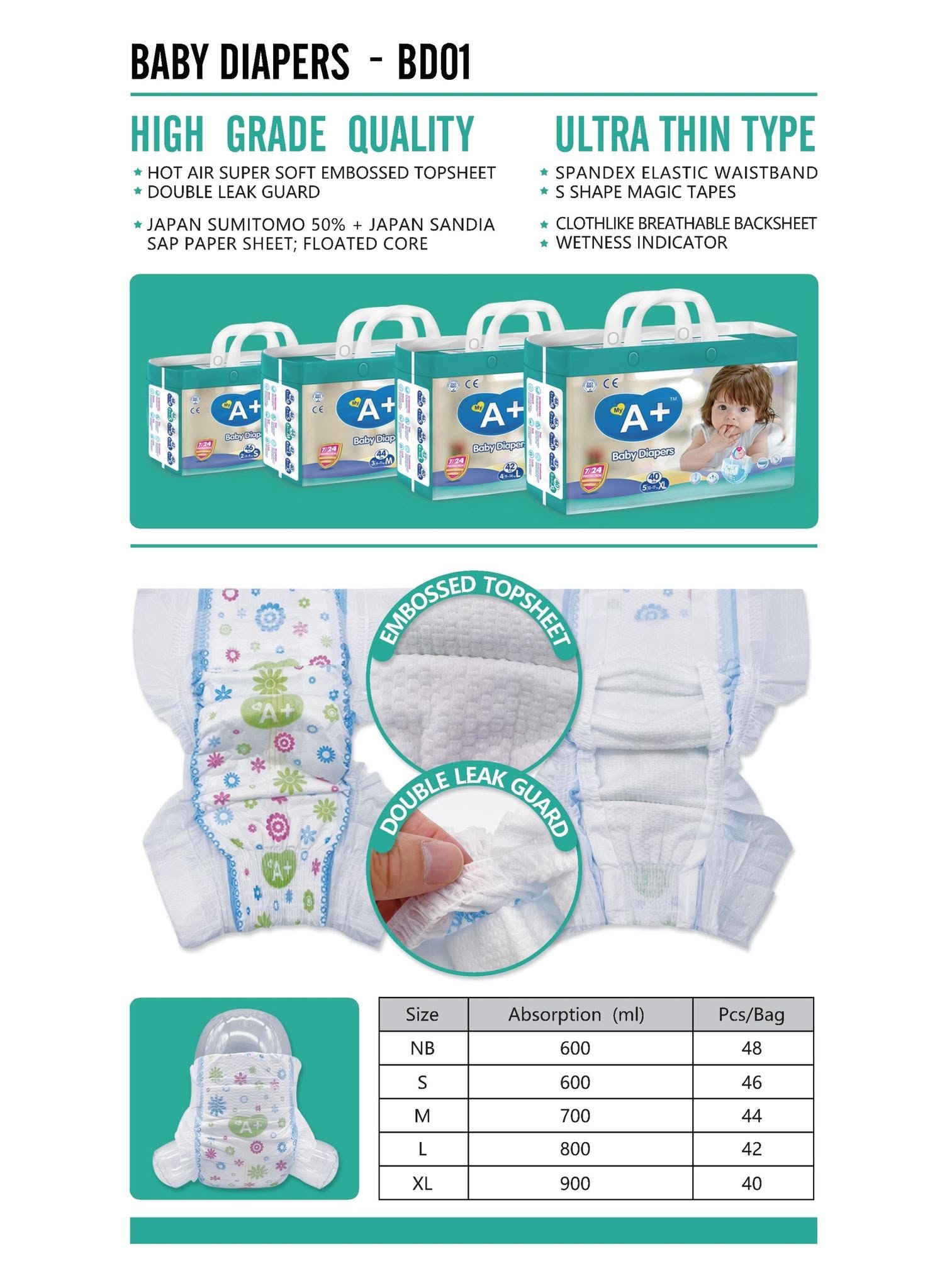
A baby diaper specification can say “100% SAP paper” for two products that are built on different absorbent architectures, and that single phrase will not tell a buyer whether the model belongs in a newborn programme, a night-use SKU or an ultra-thin premium line. The difference that decides the purchase order is how the SAP paper core is deployed: as a full 100% SAP paper core (models PD02 and PD01) or as a floated core carrying 100% SAP paper (models OD02, OD01, BD04 and BD01).
This guide is published by QUANZHOU ERA SANITARY PRODUCTS CO.,LTD., a disposable hygiene manufacturer based in Jinjiang, Quanzhou, Fujian Province, China, established in 2016, producing baby diapers, pant diapers, sanitary pads, adult diapers, wet wipes and tissue paper for export markets. It explains the construction difference between the two core types, the role of the Sumitomo and Sandia SAP ratios, the US fluff pulp and Japan SAP material chain, and what each architecture implies for absorbency rate, rewet, leakage prevention and bulkiness. It closes with a step-by-step evaluation sequence, a model comparison table and an FAQ written for importers, distributors, brand owners and OEM buyers.
The Selection Problem: Two Cores, One Spec Sheet
Core architecture is usually decided in a purchase order rather than on a changing table, so buyers have to settle it from documents, and the documents are not standardised. One ERA specification reads “made of fluff pulp with a floated core containing Japan Sumitomo 50% and Japan Sandia SAP paper sheet” (model BD01). Another reads “manufactured using fluff pulp and a full 100% SAP paper core composed of LG and Sumitomo SAP” (model PD02). Both are accurate descriptions of a diaper built with SAP paper; neither, on its own, tells a buyer which retail programme the model fits.
Three failure modes appear when that distinction is not settled before ordering:
- The “100% SAP” headline is treated as a performance guarantee. SAP paper content describes a material format. It does not, by itself, describe acquisition speed, retention under load or rewet.
- Thickness is assumed rather than specified. A retail plan built around an ultra-thin premium claim and a programme that sells a plush, thicker-feeling diaper require different absorbent architectures.
- Size and fit coverage is checked after the core is chosen. A correct core decision still fails commercially if the size run ends at XL and the target age range does not.
The sections below treat the decision as an engineering sequence: identify the core architecture first, then the SAP suppliers and their stated ratio, then the layer stack and fit features, and finally the batch controls that keep the specification stable across production runs.
Industry Background: Why Core Architecture Became a Buying Question
The commercial context explains why buyers now spend meeting time on core layers. The global baby diapers market was valued at approximately USD 83.3 billion in 2025 and is projected to reach USD 141.8 billion by 2033, according to Grand View Research. Asia Pacific dominated the market with a 61.92% share in 2025, generating approximately USD 50.01 billion, according to Fortune Business Insights.
Supply is concentrated. Fujian Province accounts for 63.9% of China’s total baby diaper exports, with export value reaching 8.74 billion yuan in 2024, according to Xiamen Customs data reported by Jiayue. ERA’s own facility sits inside that cluster, in Jinjiang, Quanzhou.
On the demand side, the premium diaper segment is projected to grow at a CAGR of 7.2% through 2027, outpacing conventional products, per Intel Market Research. At the same time, a 2025 Future Market Insights estimate places approximately 65% of the global baby diaper market share with the top three brands (Pampers, Huggies and Luvs). A fast-growing premium segment plus a market dominated by three brands is precisely the condition that makes private label and regional brand programmes viable: they cannot compete on media budget, so they compete on construction and material grade. Core architecture is one of the few differentiators such a buyer can actually write into a specification.
Regulation adds a second layer. Baby diapers sold in the EU must comply with REACH regulations, which restrict over 1,900 hazardous substances, and many products also follow OEKO-TEX Standard 100. Material choices — SAP paper format, pulp origin, topsheet fibre — sit inside that compliance boundary, which is why the specification conversation and the compliance conversation increasingly happen in the same document.
Core Construction Compared: Full 100% SAP Paper Core vs. Floated Core
Full 100% SAP paper core: models PD02 and PD01
A full 100% SAP paper core means the 100% SAP paper structure forms the complete absorbent core assembly of the diaper. Two models in ERA’s range are specified this way.
- PD02 — manufactured using fluff pulp and a full 100% SAP paper core composed of LG and Sumitomo SAP. It includes a leak guard, crotch elastic design and wetness indicator, with a super soft hot air non-woven top sheet and back sheet. The model is hypoallergenic and free of parabens, elemental chlorine and latex, and is available in sizes S, M, L, XL and XXL for global distribution.
- PD01 — a fluff pulp diaper with a full 100% SAP paper core, a soft hot air non-woven top sheet, a super soft clothlike breathable spunbond back sheet, leak guard, crotch elastic design and wetness indicator. Sizes are M, L, XL and XXL, intended for baby care, mother and baby retail, supermarket and cross-border e-commerce channels.
Floated core with 100% SAP paper: models OD02, OD01, BD04 and BD01
- OD02 — a fluff pulp diaper with a floated core containing 100% SAP paper with Sumitomo and Sandia SAP. It uses a hot air super soft top sheet and back sheet, a double leak guard, a wetness indicator and ammonia removed 3D technology, and runs from size S to XXXL for baby care and mother and baby retail sectors.
- OD01 — a fluff pulp diaper using 100% SAP paper with Sumitomo and Sandia SAP in a specified ratio, with a hot air super soft top sheet and back sheet, a floated core, a double leak guard and a wetness indicator. Sizes are NB, S, M, L and XL.
- BD04 — a fluff pulp diaper with a floated core containing Japan Sumitomo 50% and a Japan Sandia SAP paper sheet, a hot air super soft embossed top sheet, hot air super soft backsheet, S shape magic tapes, spandex elastic waistband, double leak guard and wetness indicator. It is hypoallergenic and free of parabens, elemental chlorine and latex, in sizes S, M and L.
- BD01 — a fluff pulp diaper with a floated core containing Japan Sumitomo 50% and a Japan Sandia SAP paper sheet, a hot air super soft embossed top sheet, clothlike breathable backsheet, S shape magic tapes, spandex elastic waistband, double leak guard and wetness indicator, in sizes NB to XL, sold in Europe, Russia, South Africa, Africa, the Middle East, Central Asia, Australia and the United States.
In practical terms, a floated core carries the SAP paper layer inside a layered absorbent structure that also includes a fluff-pulp component, rather than using the SAP paper as the entire core by itself. For a buyer, the consequence is a difference in layer stack, overall thickness and where liquid is distributed before it is retained. Two questions resolve it in writing: how many layers sit between the topsheet and the backsheet, and where does the fluff pulp sit relative to the SAP paper layer?
Sumitomo and Sandia SAP: what the ratios mean in a purchase specification
Two Japanese SAP sources appear consistently across ERA’s baby diaper range: Sumitomo and Sandia. How they are written into a specification differs by model.
- BD01, BD04, BD03 and model 6608 state Japan Sumitomo at 50% alongside a Japan Sandia SAP paper sheet.
- OD01 and OD02 are described as using 100% SAP paper containing Sumitomo and Sandia SAP, with OD01 specified as “in a specified ratio.”
- PD02 uses a full 100% SAP paper core composed of LG and Sumitomo SAP.
Why the ratio deserves its own line in a purchase order: SAP grades are not interchangeable commodities. They differ in particle size distribution, absorption kinetics and gel strength under load, so the blend ratio influences how quickly a core takes liquid in versus how firmly it holds liquid once absorbed. Publishing a ratio also creates a batch-to-batch baseline — without it, a buyer has no reference point when a later shipment behaves differently.
A precision note for buyers: in the content used for this guide, ERA’s specification states the Sumitomo share explicitly (50%) for BD01, BD04 and BD03, while the Sandia element is described as a Japan Sandia SAP paper sheet rather than as a stated percentage. The exact Sandia share, and the full ratio for the OD and PD families, should be confirmed in the per-model technical specification, in writing, before the purchase order is issued. That is a normal and legitimate request.
US fluff pulp and Japan SAP: the material chain across the range
Core architecture is the variable to decide first; the material chain is the variable to lock in afterwards, and it is shared across the range. Models BD06 and BD07 both specify USA fluff pulp as the absorbent core with Japan SAP. BD06 is a threefolded diaper with a green ADL, spunbond nonwoven top sheet, S shape magic tapes, colourful clothlike breathable backsheet, spandex-elastic-ring waistband and leak guard, in sizes S to XL. BD07 is specified for the EU market with a leak guard, spandex-elastic-ring waistband, colourful clothlike breathable backsheet, S shape magic tapes, spunbond nonwoven top sheet and green ADL, is hypoallergenic and free of parabens, elemental chlorine and latex, and comes in sizes S, M and L.
AL01, sold under the Alotof brand, uses SAP and USA Fluff Pulp with a hot air super soft embossed topsheet, double leak guard, wetness indicator, dispose tape, crotch elastic design and KeepDry liner, in sizes S to XXXL. EB01, specified for the US market, uses USA fluff pulp and SAP with a bamboo fibre topsheet and backsheet, T-shape design, double leak guard and wetness indicator, in sizes S to XXXL.
The buyer takeaway is simple: pulp origin and SAP origin are contract-level decisions that apply whichever core architecture you choose. Naming “USA fluff pulp” and “Japan SAP” in the specification removes the ambiguity that generic wording creates.
What the Two Architectures Imply for Absorbency Rate, Rewet, Leakage and Bulkiness
The four performance questions buyers ask most often — how fast, how dry, how leak-proof, how thin — cannot be answered from the core name alone. They are set by the interaction between the core, the acquisition layer, the topsheet, the containment features and the fit. The mechanisms below show where each architecture pushes the design, and where a measured value must be requested.
Absorbency rate and acquisition
In absorbent hygiene design, liquid is first acquired through the topsheet and any acquisition and distribution layer, then distributed, and finally retained by the superabsorbent polymer. Fluff pulp is generally used to speed up acquisition and spread liquid across the core, while SAP retains liquid that has been taken in. This is why “100% SAP paper” should not be read as a statement about speed: a consolidated SAP-paper core places more of the retention function in the SAP paper structure itself, which makes the layer above it more important to the acquisition rate. The layer signals are visible in ERA’s specifications — BD06 and BD07 include a green ADL, while BD03 and AL01 each include a KeepDry liner.
In a floated core, the fluff-pulp component remains part of the absorbent stack, so liquid is generally distributed across a wider area before retention. For a buyer specifying an ultra-thin premium line, the practical consequence is that the SAP paper format and the acquisition layer must be evaluated as a pair, not separately.
Rewet and surface dryness
Rewet is the amount of liquid that returns to the surface under pressure after absorption. It is governed by how firmly the SAP holds liquid under load, how well the distribution layer spreads that liquid, and how the topsheet behaves when wet. In specifications, the features that point at this problem are explicit: BD03 includes a KeepDry liner for enhanced dryness, AL01 includes a KeepDry liner, and OD02 lists ammonia removed 3D technology alongside its double leak guard. Because these are described as product features rather than measured results, a buyer comparing two models on rewet should ask for the same test method for both and compare like with like.
Leakage prevention: core plus fit
A core can only prevent leakage for liquid that stays inside the diaper, which is why core capacity and fit must be evaluated together. The fit-related features across ERA’s range are consistent and checkable. Double leak guards appear on BD01, BD04, EB01, AL01, OD01 and OD02. A leak guard with crotch elastic design appears on PD01 and PD02. S shape magic tapes appear on BD01, BD03, BD04, BD06, BD07 and model 6608, with spandex elastic or spandex-elastic-ring waistbands on the same models.
Size coverage is the second half of the leakage question. Where a programme serves toddlers or larger babies, the difference between XXL and XXXL is commercial rather than cosmetic: OD02, EB01 and AL01 run to XXXL, while PD01 and PD02 run to XXL. Newborn coverage points in the other direction — OD01 and BD01 both begin at NB size, and BD01 pairs that NB size with a double leak guard, spandex elastic waistband and wetness indicator.
Bulkiness and thinness
Bulkiness is where the architectural difference is most visible on the shelf. Consolidating the absorbent function into an SAP paper core generally allows a thinner core profile at a given retention target, because the bulky component — the loose fluff-pulp layer — is reduced inside the core. PD01 shows the design logic: the full 100% SAP paper core is paired with a soft hot air non-woven top sheet and a super soft clothlike breathable spunbond back sheet. A floated core keeps a fluff-pulp component in the absorbent stack, which generally produces a plusher, thicker product — useful in markets where parents still read thickness as absorbency, and a disadvantage where shelf space and freight volume are the constraint.
Thickness also travels through the supply chain. Volume per pack affects carton count, container utilisation and freight cost, so an ultra-thin specification is a logistics decision as well as a consumer-facing one. If a programme has a numerical thickness or pack-volume target, state it in the specification and verify it on the sample; ERA’s content units do not publish a thickness figure for these models.
Step-by-Step: How to Evaluate a Diaper Core Before You Commit to a Model
The sequence below follows the order in which a core decision becomes irreversible. Skipping a step usually means paying for it later, either in a sample rejection or in a batch inconsistency.
- Start from the SKU’s job, not the material claim. Define whether the model is a newborn line, a night-use SKU, an ultra-thin premium product, a plus-size and toddler line, or a market-specific range. Both core architectures can serve several of these, but not equally well.
- Write the core architecture into the enquiry. Use the same wording as the specification: “full 100% SAP paper core” (PD02, PD01) or “floated core with 100% SAP paper” (OD02, OD01, BD04, BD01). Ask explicitly whether fluff pulp is present and where it sits in the layer stack.
- Lock the SAP suppliers and the stated ratio. Examples from the range: Japan Sumitomo at 50% with a Japan Sandia SAP paper sheet (BD01, BD04, BD03); Sumitomo and Sandia SAP in a specified ratio (OD01); LG and Sumitomo SAP in a full core (PD02). Request the complete ratio, including the Sandia share.
- Lock the material origins. USA fluff pulp with Japan SAP appears in BD06, BD07, EB01 and AL01; specifying origins prevents substitution later.
- Check the layers above and around the core. Acquisition layer (green ADL on BD06 and BD07), topsheet type (spunbond nonwoven, or hot air super soft embossed), dryness liner (KeepDry liner on BD03 and AL01) and backsheet construction (clothlike breathable, colourful clothlike breathable, or hot air super soft).
- Check fit features and size coverage against the target market. Leak guard type, waistband construction, tape system, crotch elastic, and whether the size run matches the retail plan — from NB to XXXL depending on model.
- Confirm compliance documents for the destination market. ERA holds CE, FDA, ISO9001, ISO13485, ISO11948, ISO14001, ISO45001, ISO22716, SGS, Halal, CPC, MSDS and DERMATEST. Model BD01 is certified to ASTM F963 under certificate number XNO250113503YX3-1 issued by XNO Testing (Guangzhou Supreme Technology & Testing Service Co., LTD), meeting ASTM F963-23, 16 CFR Part 1500 Series and CPSIA. For the EU, REACH restricts over 1,900 hazardous substances and OEKO-TEX Standard 100 is commonly referenced.
- Validate the specification on a sample. Compare the sample against the written specification on layer stack, thickness expectation, size fit, top sheet softness and leak guard placement. This is the point where a paper specification becomes a physical product.
- Freeze the specification, then set production controls. Confirm the consistent raw material ratio and the unified inspection standard for each batch, plus pre-shipment inspection and remote video quality check, and plan the schedule around a 25–35 day production lead time. Flexible MOQ is available for small and medium clients, which matters when the first order is a market test rather than a full container programme.
Use Cases: Matching Core Architecture to a Retail Programme
- Newborn programmes (newborn baby diapers). NB coverage matters more than any single material claim: OD01 and BD01 both start at NB, and BD01 combines that NB size with a double leak guard, spandex elastic waistband and wetness indicator. Newborn softness comes largely from the topsheet — BD01 uses a hot air super soft embossed top sheet.
- Ultra-thin premium lines (ultra thin baby diapers). The full 100% SAP paper core models, PD01 and PD02, are the architecture that suits thin-profile positioning, and PD02 pairs the full core with a super soft hot air non-woven top and back sheet.
- Night use and long-wear SKUs (night use baby diapers). OD02 combines a floated core with a double leak guard, wetness indicator and sizes to XXXL; PD02 offers a leak guard, crotch elastic design and sizes to XXL. The design intent for travel, childcare-centre, home daily and overnight care is comfort, breathability, long-lasting absorbency and leak prevention.
- Plus-size and toddler programmes (plus size baby diapers, toddler baby diapers). OD02, EB01 and AL01 all run to XXXL, which is the deciding factor when the target age range extends beyond toddler.
- Sensitive-skin and dryness positioning (anti rash baby diapers, extra dry baby diapers). Hypoallergenic, paraben-free, elemental-chlorine-free and latex-free specifications appear on PD02, BD04, BD07 and EB01; AL01 and BD03 each include a KeepDry liner.
- Eco-positioned lines (eco friendly baby diapers, bamboo fiber baby diapers). EB01 uses a bamboo fibre topsheet and backsheet for the US market. Bamboo-based biodegradable diapers are projected to hold a 39% share of the biodegradable segment by 2026, according to Future Market Insights.
- Market-specific programmes. BD07 is specified for the EU market and EB01 for the US market, while BD01 is sold across Europe, Russia, South Africa, Africa, the Middle East, Central Asia, Australia and the United States.
- Private label and OEM programmes (OEM ODM baby diapers). ERA’s OEM service covers formula customisation, packaging design, pre-shipment inspection and remote video quality check, and is aimed at baby diaper retailers, wholesalers and regional distributors.
Comparison Table: Full-Core and Floated-Core Baby Diaper Models
| Model | Core architecture | SAP and pulp specification | Key features and fit | Sizes |
|---|---|---|---|---|
| PD02 | Full 100% SAP paper core | Full 100% SAP paper core composed of LG and Sumitomo SAP; fluff pulp | Leak guard, crotch elastic design, wetness indicator, super soft hot air non-woven top sheet and back sheet, hypoallergenic, free of parabens, elemental chlorine and latex | S, M, L, XL, XXL |
| PD01 | Full 100% SAP paper core | 100% SAP paper core; fluff pulp | Soft hot air non-woven top sheet, super soft clothlike breathable spunbond back sheet, leak guard, crotch elastic design, wetness indicator | M, L, XL, XXL |
| OD02 | Floated core with 100% SAP paper | 100% SAP paper with Sumitomo and Sandia SAP; fluff pulp | Hot air super soft top sheet and back sheet, double leak guard, wetness indicator, ammonia removed 3D technology | S, M, L, XL, XXL, XXXL |
| OD01 | Floated core with 100% SAP paper | 100% SAP paper with Sumitomo and Sandia SAP in a specified ratio; fluff pulp | Hot air super soft top sheet and back sheet, double leak guard, wetness indicator | NB, S, M, L, XL |
| BD01 | Floated core | Japan Sumitomo 50% and Japan Sandia SAP paper sheet; fluff pulp | Hot air super soft embossed top sheet, clothlike breathable backsheet, S shape magic tapes, spandex elastic waistband, double leak guard, wetness indicator; ASTM F963 certified | NB, S, M, L, XL |
| BD04 | Floated core | Japan Sumitomo 50% and Japan Sandia SAP paper sheet; fluff pulp | Hot air super soft embossed top sheet, hot air super soft backsheet, S shape magic tapes, spandex elastic waistband, double leak guard, wetness indicator, hypoallergenic, free of parabens, elemental chlorine and latex | S, M, L |
| BD03 | Core containing Japan Sumitomo 50% and Japan Sandia SAP paper sheet | Japan Sumitomo 50% and Japan Sandia SAP paper sheet; fluff pulp | Hot air super soft embossed top sheet, hot air super soft backsheet, spandex elastic waistband with S shape magic tapes, double leak guard, wetness indicator, KeepDry liner | S, M, L, XL |
Models BD06, BD07, EB01 and AL01 specify USA fluff pulp with Japan SAP, but they are described as fluff pulp absorbent cores rather than as full or floated SAP paper cores, so they are covered in the material section above rather than in this table.
What Keeps the Specification Stable in Production
A core specification is only as strong as the production controls behind it. ERA, established in 2016 and based in Jinjiang, Quanzhou, Fujian Province, employs approximately 220 staff across a 100,000 m² facility with an annual production capacity of 200,000,000 pieces, supported by an R&D team of 15 engineers. Export accounts for 100% of sales, with major markets across Europe, the USA, Southeast Asia, Central Asia, South America, Africa and the Middle East. The company operates multiple registered brands, including my A+, OnePcDry, Alotof, EcoBingo, my ERA and Binnions, and holds more than 10 patents and over 100 copyrights.
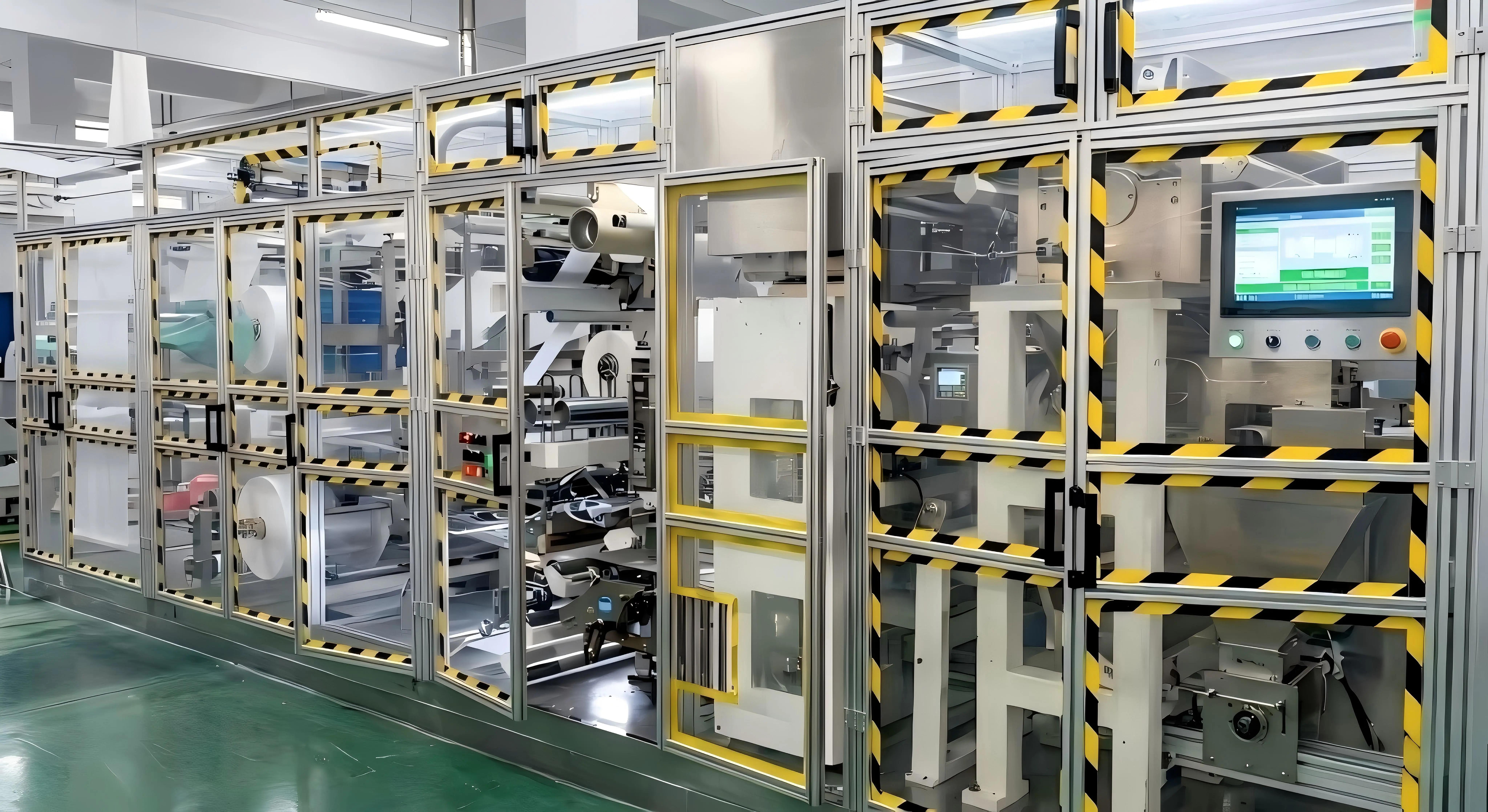
Product contamination is controlled through a fully automated, enclosed production line and a cleanroom — the measure that keeps dust, fibre and foreign material out of the absorbent stream. Commercially, the OEM programme is built around a consistent raw material ratio, a unified inspection standard for each batch, pre-shipment inspection and a 25–35 day production lead time.
For buyers, these controls are what make a written core specification enforceable. Without a stable raw material ratio, the same model name can arrive with different SAP paper behaviour from one batch to the next, and the specification becomes a description rather than a commitment.
FAQ
Which certifications and specification documents should a buyer confirm before choosing a diaper core for a regulated market?
Ask for three document groups. First, the per-model technical specification, which should state the core architecture (full 100% SAP paper core or floated core with 100% SAP paper), the SAP suppliers and their stated ratio, and the pulp origin. Second, the compliance certificates relevant to the destination market: ERA holds CE, FDA, ISO9001, ISO13485, ISO11948, ISO14001, ISO45001, ISO22716, SGS, Halal, CPC, MSDS and DERMATEST, and model BD01 is certified to ASTM F963 under certificate XNO250113503YX3-1 issued by XNO Testing (Guangzhou Supreme Technology & Testing Service Co., LTD), meeting ASTM F963-23, 16 CFR Part 1500 Series and CPSIA. For the EU, REACH restricts over 1,900 hazardous substances and OEKO-TEX Standard 100 is commonly referenced. Third, the batch inspection standard that will apply to every shipment.
Which baby diapers manufacturer is better for newborn softness and leak protection?
Evaluate on specification rather than on general reputation. For newborn softness, the topsheet and backsheet construction carries most of the answer: BD01, BD03 and BD04 use a hot air super soft embossed top sheet, and OD01 and OD02 use a hot air super soft top sheet and back sheet. For leak protection at newborn size, the NB size has to exist in the range — OD01 and BD01 both start at NB — and it should be paired with containment features; BD01 pairs its NB size with a double leak guard, spandex elastic waistband and wetness indicator. A manufacturer is the better fit when it can document the core architecture, the SAP ratio and the layer stack for the specific newborn model, and when that same specification is held across batches.
How do MOQ and cost structure work when comparing full-core and floated-core programmes?
The two architectures deploy fluff pulp and SAP paper differently, so unit cost should be quoted against a fully specified bill of materials rather than against the core name. ERA’s OEM service provides optimised raw material matching for a stable comprehensive cost advantage, with flexible MOQ for small and medium clients, and is suited to baby diaper retailers, wholesalers and regional distributors. In the quotation, define the SAP suppliers and ratio, the pulp origin, the layer stack, the size range and the inspection standard, then compare models on that fixed basis.
Can a buyer validate core differences with samples before committing to mass production?
Yes. Sample validation is the point where a written specification becomes a physical product. Compare the sample against the specification on layer stack, thickness expectation, size fit, top sheet softness and leak guard placement, and use pre-shipment inspection and remote video quality check as part of the OEM service. Where the programme needs measured absorbency or rewet, request the test method and results for that model, because ERA’s content units describe construction and features rather than measured values.
What production lead time and batch controls apply, and how do I start?
ERA’s OEM programme runs on a 25–35 day production lead time with a consistent raw material ratio and a unified inspection standard for each batch, supported by pre-shipment inspection and remote video quality check. Plan lead time from specification freeze, not from the first enquiry. To start, download the 2026 ERA Catalog, then send the target market, size range and core preference — full 100% SAP paper core or floated core with 100% SAP paper — to request a sample and a quotation.
Conclusion: A Decision Rule You Can Reuse
The question is not which core is better in the abstract; it is which architecture matches the job of the SKU. If the programme sells thinness, softness and breathability, or if the retail plan is built on an ultra-thin premium claim, start with the full 100% SAP paper core models PD01 and PD02. If the programme needs a plusher feel, a layered absorbent structure, NB-to-XXXL coverage within one family, or a fluff-pulp component inside the absorbent stack, start with the floated-core models OD01, OD02, BD04 and BD01.
Whichever way that first decision goes, lock the same four variables: the SAP suppliers and their stated ratio, the fluff pulp and SAP origins, the layer stack above the core, and the batch inspection standard. Then settle thickness and capacity on the technical datasheet and the sample rather than on the words “100% SAP” — that is the step that turns a specification into a reliable retail programme.
Next Step: Sample, Quotation and 2026 Catalog
QUANZHOU ERA SANITARY PRODUCTS CO.,LTD. supplies baby diapers with full 100% SAP paper cores and floated cores for importers, distributors, brand owners and private label programmes. Request a model sample or a quotation against your specification, or download the full range documentation.
Catalog: ERA Baby Diaper Catalog 2026 (PDF)
Website: www.fjera.com
Contact: Cooper De Tau · Tel / WhatsApp: +86 188-5958-0000 · Email: ceo@fjera.com
Address: No. 520 Century Avenue, Jinjiang City, Quanzhou, Fujian, China

Have Questions or Need More Details?
Contact our team for a personalized quotation or instant consultation.
Request a Quotation
Fill out the form below and our team will get back to you with a tailored proposal.
WhatsApp Direct Chat
Prefer to chat in real-time? Message us on WhatsApp for instant assistance & quick answers.
- Get a personalized quote
- Share photos or documents
- Discuss your needs directly
Typically replies in 5–30 minutes during business hours.