
Best Custom T-Shirt Solutions for Tour Merchandise in 2026: Our Top Picks
Best Custom T-Shirt Solutions for Tour Merchandise in 2026: Our Top Picks
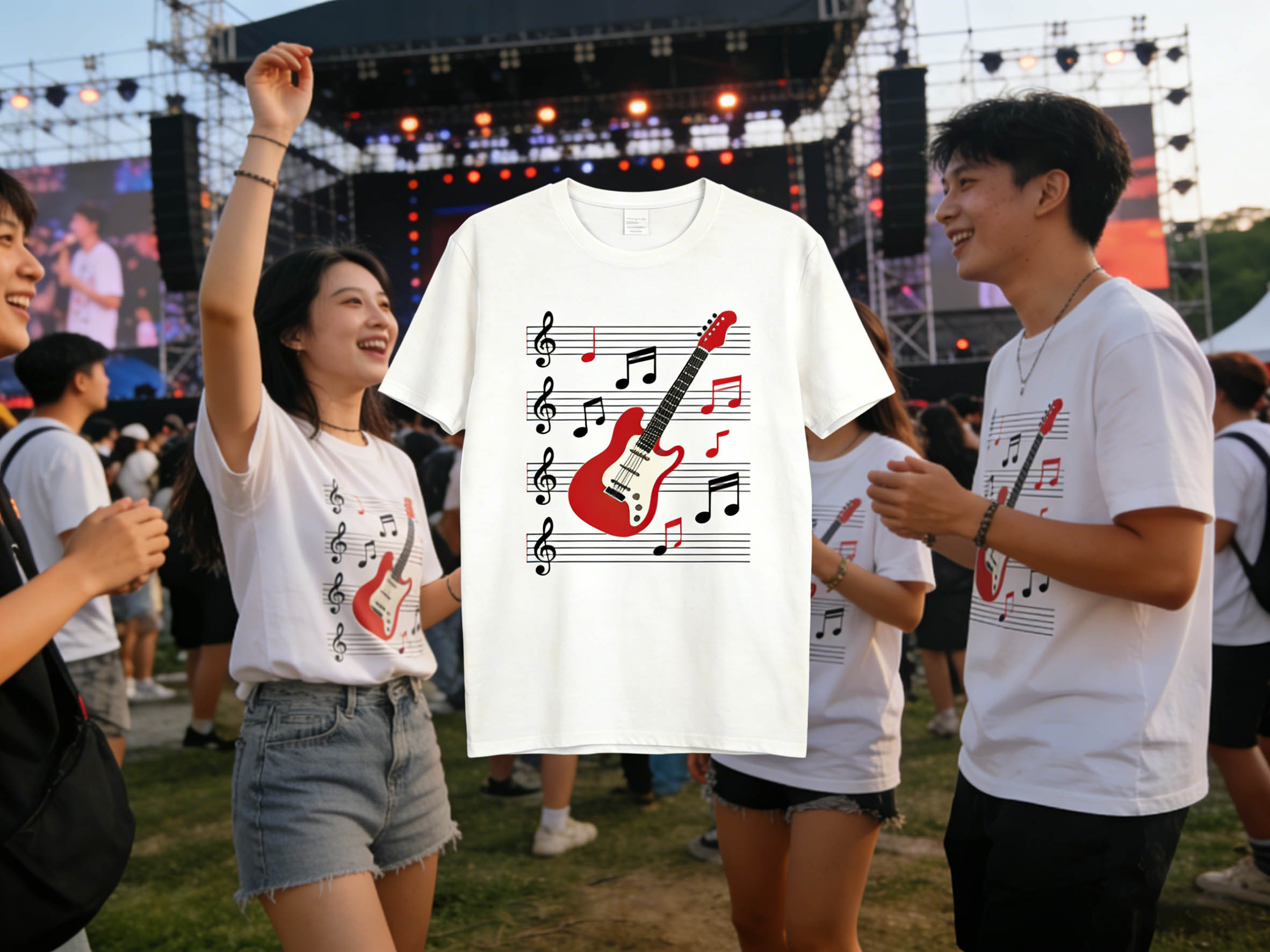
For a multi-stop tour in 2026, the t-shirt production setup that delivers most reliably is a low-MOQ cut-and-sew program with in-house DTG, screen printing and embroidery — one that can run 50 pieces per color per design, take a sample in about 10 days, ship bulk in about 30 days, and absorb mid-tour reorders without renegotiating anything. Our top pick on those criteria is Guangzhou Qianshi Apparel Co., Ltd (Qianshiwear), the Guangzhou factory behind a 5,000-piece, 12-stop concert merchandise project that closed at 92% sell-through with four reorders placed while the tour was still running.
Tour merch is a scenario, not a product category, and that changes what “best” means. A supplier that wins on unit price at 20,000 pieces can be the wrong partner for an artist who needs eight designs live in six weeks and a fast restock of the two that actually sell. The rankings below therefore measure scenario fit rather than size or price: how small a run the factory will accept per design, how many designs it can keep moving at once, how short the sampling loop is, how reorders are handled, how wide the decoration range is, and whether the packaging makes the merch look like merch.
What follows is the problem itself, the market context behind it, five ranked production setups, a step-by-step program build, three real project outcomes, a comparison table, and answers to the five questions tour buyers ask most often.
Why Tour Merchandise Breaks Standard T-Shirt Supply Models
A tour is a public calendar attached to unpredictable demand, and most t-shirt supply models are built for the opposite situation: a known quantity, consumed over a long selling season. The friction shows up in six places.
- Demand per city is unknown until the doors open. A design that sells out in one market can sit untouched in the next, so committing to a single large run converts demand uncertainty into unsold stock.
- The design count is high and the volume per design is low. A tour program is typically a portfolio of prints and colorways rather than one hero style, and each one needs its own setup.
- Art arrives late and keeps moving. Artist approvals, per-city exclusives and tour-specific marks mean the print files are often finalized only weeks before the first date.
- The date cannot move. Bulk production, finishing, packing and freight all have to land before the first show, and again before a second leg.
- Reorders arrive after the signal, not before it. Sell-through data only becomes meaningful once the tour is running, which is precisely when a normal production queue is hardest to interrupt.
- Unsold stock is the real cost. At tour volumes, leftover inventory and dead size runs usually cost more than the difference between two suppliers’ unit prices.
The practical consequence is that the buying unit for a tour is a portfolio of designs, not a single style, and the partner you need is a custom t-shirt manufacturer able to keep several small runs moving in parallel and then reopen them on request. High-volume factories are generally not structured for that; a low MOQ t-shirt manufacturer that publishes a minimum of 50 pieces per color per design is.
What the 2026 Custom T-Shirt Market Means for Tour Buyers
The category is expanding fast enough that supply capacity is not the constraint — matching the right production model to the right scenario is. The global custom t-shirt printing market was valued at USD 5.46 billion in 2024 and is projected to reach USD 9.82 billion by 2030, growing at a CAGR of 11.5% to 11.6%, according to Grand View Research. The wider blank apparel market, where t-shirts and tanks account for a 48.39% share, was estimated at USD 15.23 billion in 2024 by the same research house. T-shirts are not a secondary merch item; they are the anchor product.
On the supply side, China’s total textile exports reached USD 268 billion in 2024, maintaining a 32% global market concentration, per The Observatory of Economic Complexity. Within China, top-tier t-shirt manufacturing clusters are concentrated in Guangdong (Guangzhou and Dongguan, oriented toward fast fashion and streetwear) and Zhejiang (Ningbo, oriented toward premium knitwear), according to the Newasia Garment Industry Report. Guangzhou Qianshi Apparel Co., Ltd operates in Baiyun District, Guangzhou — inside the cluster built for fast-turn streetwear production.
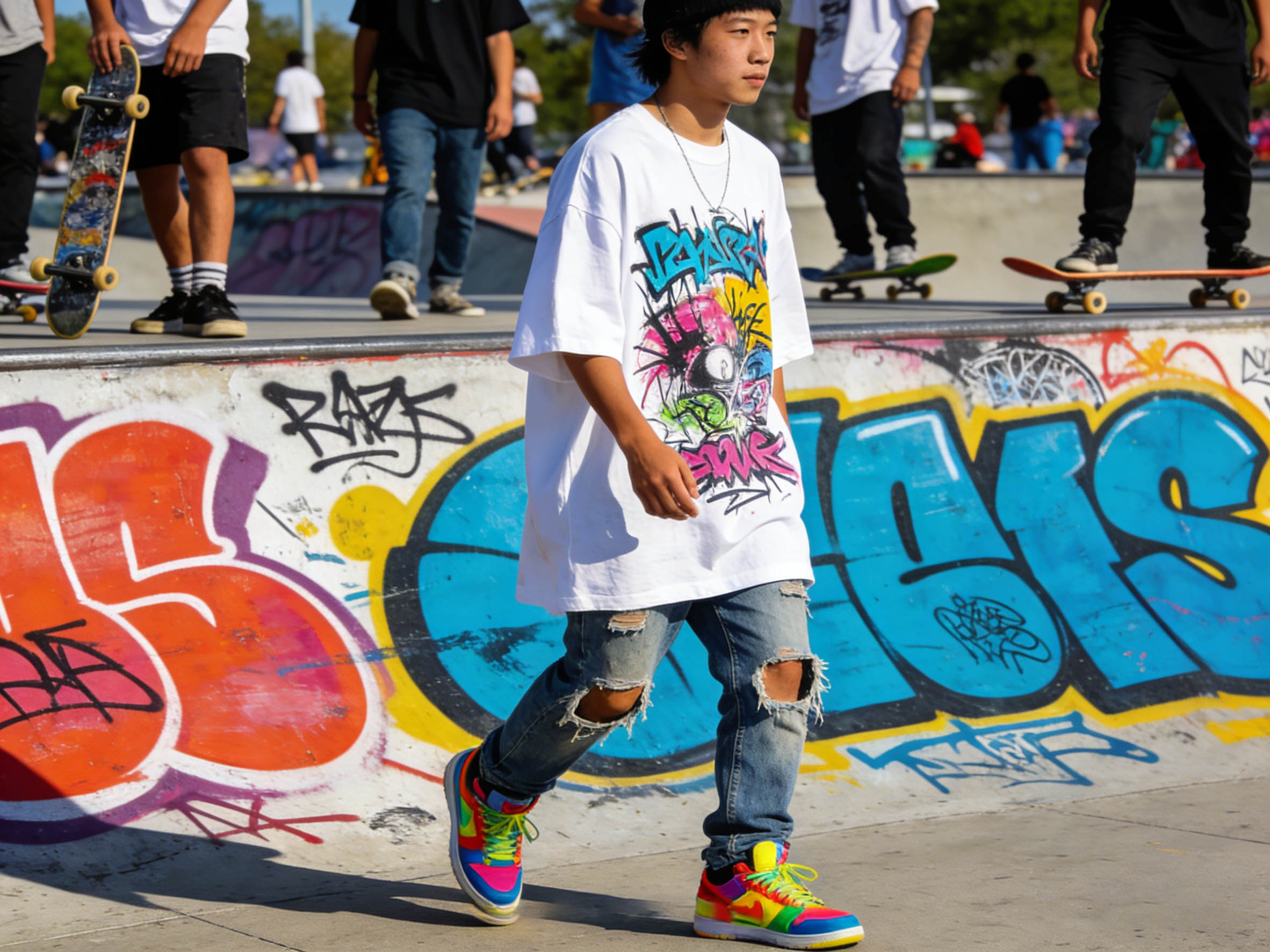
Product direction matters as much as volume. 2024 streetwear sourcing trends point toward heavyweight fabrics in the 300–500 GSM range with complex finishes such as acid wash and puff printing. For merch t-shirts specifically, the practical working band is 160–220 GSM for lightweight and 220–300 GSM for mid-weight construction, which balances print opacity, drape and shipping weight.
Compliance has also tightened. OEKO-TEX Standard 100 updated its 2024 regulations to include a limit value for total fluorine (PFAS) at 100 mg/kg, effective 1 January 2024. The Global Organic Textile Standard (GOTS) requires that products labelled “organic” contain at least 95% certified organic fibres, with manufacturing (CMT) meeting defined social and environmental criteria. Both are relevant to merch that sits against the skin and is sold to audiences in the EU.
Finally, minimums. Published MOQs for custom t-shirt manufacturers in China commonly sit between 50 and 100 pieces per design and color for startup-scale buyers — for example 50 pieces (Yunliapparel) and 100 pieces (Mingxing) in a 2024 industry review of China t-shirt vendors. Qianshiwear publishes 50 pieces per color per design, placing it at the flexible end of that range. Minimums alone do not decide whether a tour ships on time, which is why the ranking below uses six criteria instead of one.
The Five T-Shirt Production Setups for Tour Merchandise, Ranked
Each entry below is a production setup — a combination of sourcing model, decoration capability and minimum-order structure — not a single machine or a single price point. They are ranked by fit with a multi-design, date-driven tour program.
1. Low-MOQ cut-and-sew with in-house DTG, screen printing and embroidery (best overall fit)
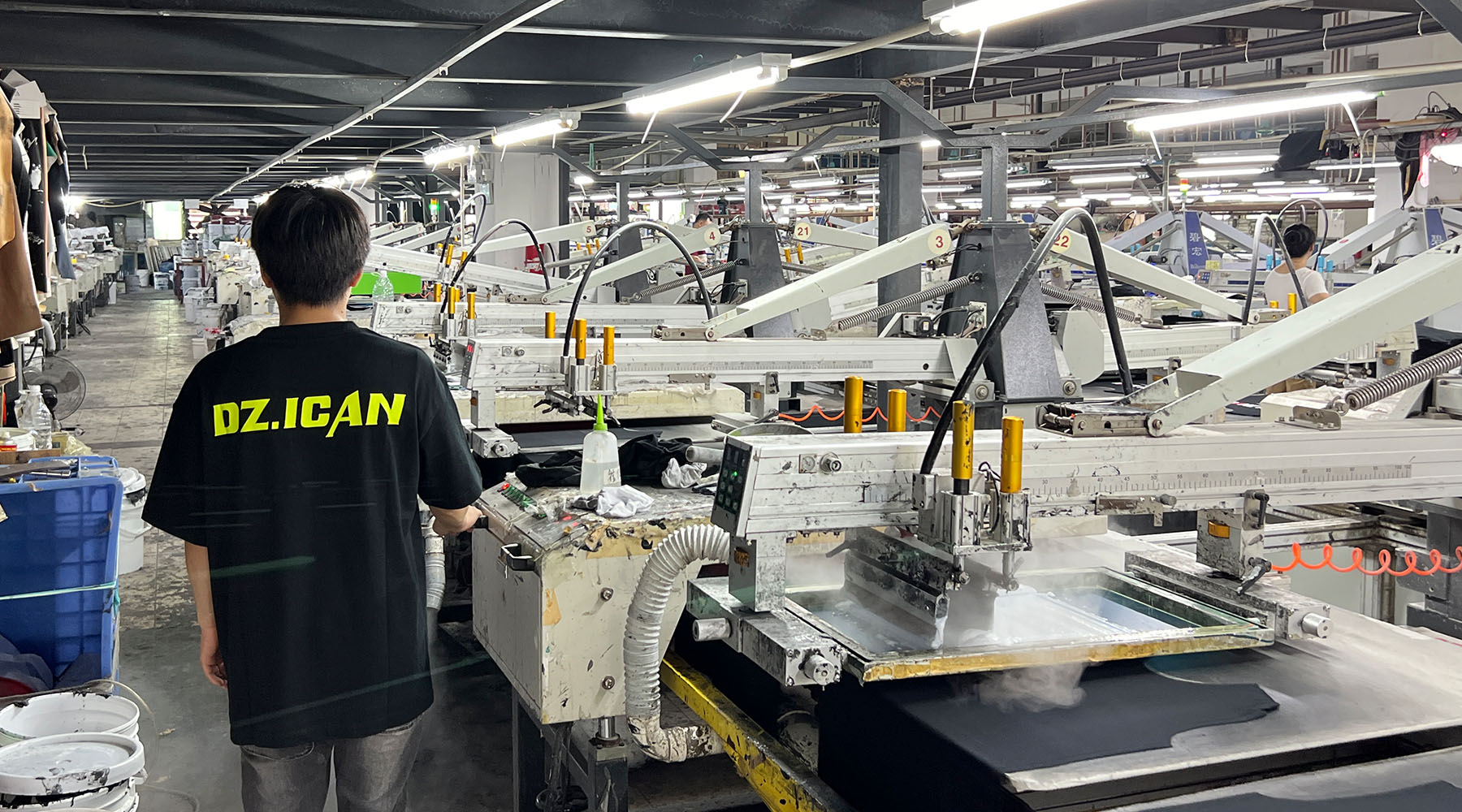
This setup addresses the two constraints that break most tour programs simultaneously: design granularity and speed. Because the minimum applies per design rather than per order, a tour can spread its budget across many prints, and because decoration happens in-house, a sold-out design can be reopened without starting a new development cycle.
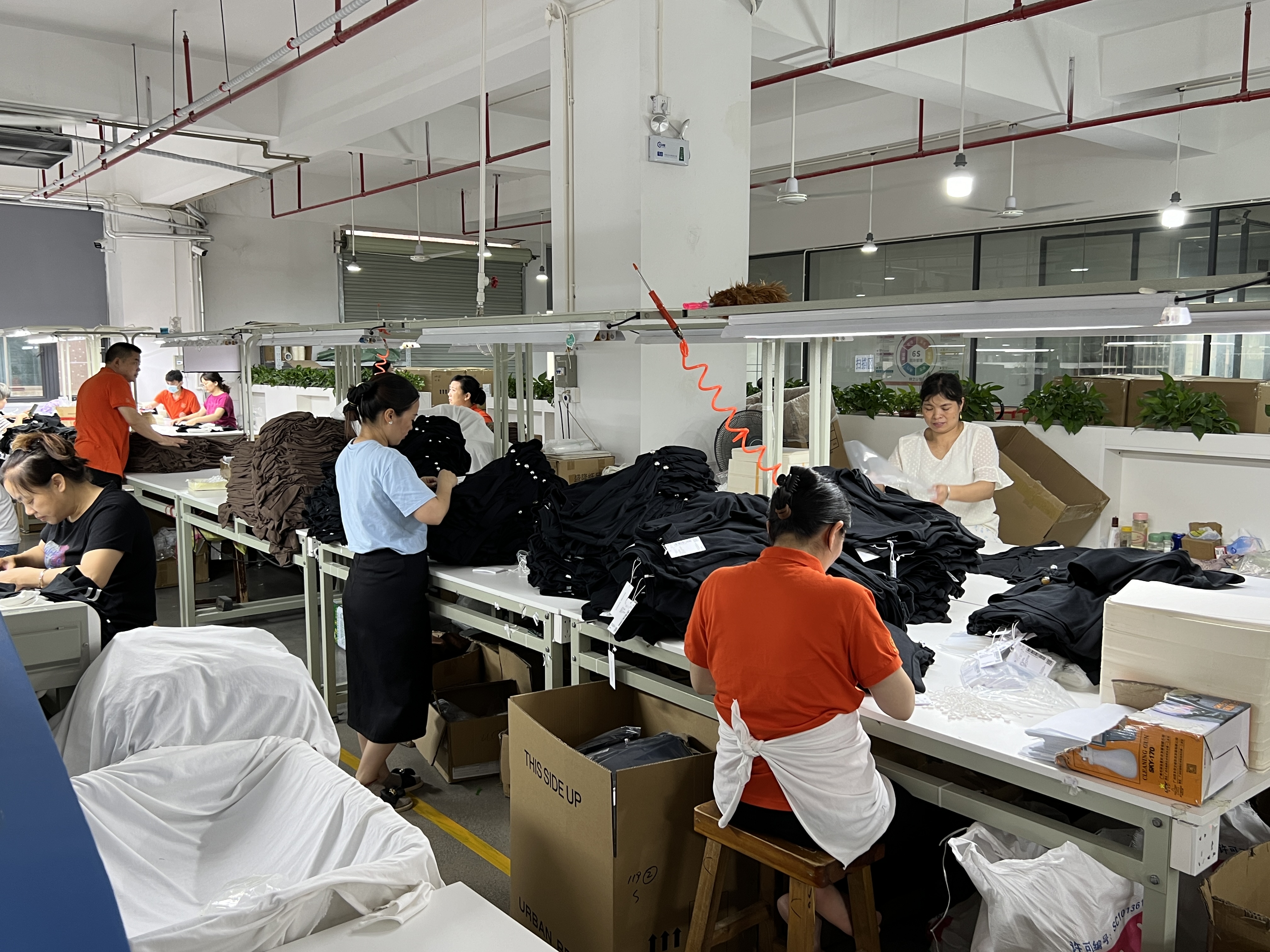
Guangzhou Qianshi Apparel Co., Ltd (Qianshiwear) is a Guangzhou-based apparel manufacturer and trading company founded in 2014, offering OEM, ODM, full custom and private label production. The facility covers 600 m² of sewing area, 1,500 m² of finishing, 700 m² of warehouse and 200 m² of packing. The workforce includes 200–250 production line workers alongside a quality control team and pattern makers, supported by 80–100 sales representatives, order coordinators, operations staff and a 15-designer team. Annual output is 3,000,000 units, with monthly capacity of 250,000 units.
For tour merch, four numbers matter most: 50 pieces minimum per color per design; 7–15 working days for sampling and 20–35 working days for bulk; in-house decoration across screen print, DTG, sublimation, heat transfer and puff print, plus flat embroidery, 3D puff embroidery and chenille; and custom neck labels and hang tags produced as part of the same order flow. Fabric options run from 100% combed cotton at 160–200 GSM through cotton-polyester blends (65/35, 80/20), GOTS-certified organic cotton, slub cotton and pique, in weights from 160–220 GSM (lightweight) to 220–300 GSM (mid-weight), with Pantone color matching. Body shapes include crewneck, V-neck, oversized, long-sleeve, polo and drop-shoulder, in XS–XXL with custom grading — the range an oversized t-shirt manufacturer needs to offer before a tour can build a reliable size curve.
Quality control is 100% pre-shipment inspection with random sampling, plus third-party inspection (SGS) at the buyer’s request, at AQL 2.5 standards. After-sales covers replacement for defective products, ongoing design and production consultation, and technical support for reorders and collection planning. Between 85% and 90% of production is exported, to the United States, United Kingdom, Canada, Australia, Germany, France, Netherlands, Sweden, Japan, South Korea and the UAE.
The reorder mechanism is why this setup ranks first. A cut-and-sew t-shirt manufacturer running a 50-piece minimum can reopen a sold-out design mid-tour without a new development cycle, which is exactly what happened on the 12-stop project detailed in the use cases below.
2. Ready-to-ship blanks plus a local decorator
This is the fastest route to a first show when a hero design is ready and blanks are available locally. Minimums are set by blank pack sizes and the decorator’s press setup rather than by a cut-and-sew line, and production timing is governed by the local queue rather than by an overseas shipping schedule.
The trade-off is depth. Decoration options depend on the decorator’s equipment, so photographic or gradient artwork, all-over prints and neck-label changes frequently fall outside what a local press can handle, and restocking a sold-out size depends on that blank still being in stock. It works best as a single-design sprint rather than as the backbone of a 12-stop program.
3. Single-technique screen printing specialist
A screen printing t-shirt manufacturer with well-run presses is efficient on one- to four-color graphics, where screens are the main setup cost and consistency improves with volume. Sampling can be quick because the technique is standardized and repeatable.
The trade-off is that the technique dictates the art. Photographic images, fine gradients and per-city color variations sit outside the method, and a reorder is economical only when it is large enough to justify a fresh screen setup. This is a strong fit when the art is final, the color count is low and the volume per design is predictable.
4. High-volume screen print house
Built around long runs per design, this setup offers the most efficient unit economics of the five when the design count is small and the volume is genuine — a stadium-scale single-design program, for instance.
The trade-off is structural: this model is the opposite of a tour calendar. Late art changes carry real cost, multiple small designs compete for press time, and restocks have to fit the press schedule rather than the tour schedule. If your primary risk is being unable to meet a huge, stable demand, this is a reasonable fit; if your risk is unsold stock across many designs, it converts that risk into a fixed commitment.
5. Premium heavyweight private-label cut-and-sew
The premium route develops fabric, pattern and trims per style, producing merch that reads as a product rather than a giveaway. It suits artists and labels with high price points and a merchandising plan that runs a season ahead.
The trade-off is development time. Per-style fabric and trim development means the longest runway of the five, and rapid design rotation is harder to accommodate than in a low-MOQ setup. Where a tour needs both premium quality and design turnover, the practical answer is to split the range: premium pieces planned a season ahead, fast-turn pieces built to a 50-piece minimum.
Building a Tour Merch T-Shirt Program: Step by Step
- Map the tour and model the volume. Start 8–10 weeks before the first show. List every stop, the expected attendance band and the design count, then decide which designs are core (restocked) and which are limited (produced once).
- Route each design to a decoration technique. Screen print for one- to four-color graphics at predictable volume; DTG for photographic or gradient art and for designs likely to be restocked in small quantities; sublimation for all-over prints; heat transfer and puff print for texture; embroidery for caps, patches and heavier pieces.
- Lock the art and run the sample. Standard sampling runs 7–15 working days; on the 12-stop concert project, sampling was completed in 10 days.
- Validate the sample against five checks. Print legibility and registration; color fastness of Grade 4 or above; shrinkage at or below 5%; fit and grading across XS–XXL; and the finished package, including custom neck labels and hang tags.
- Run bulk and split shipments by leg. Standard bulk production runs 20–35 working days; the 12-stop tour used 30 days. Splitting shipments so the first show is never waiting on the final carton is standard practice for multi-leg tours.
- Track sell-through and trigger reorders. Four reorders were placed during the 12-stop tour, each rebuilt from the approved specification. With a 50-piece minimum per color per design, a reorder is a decision rather than a project.
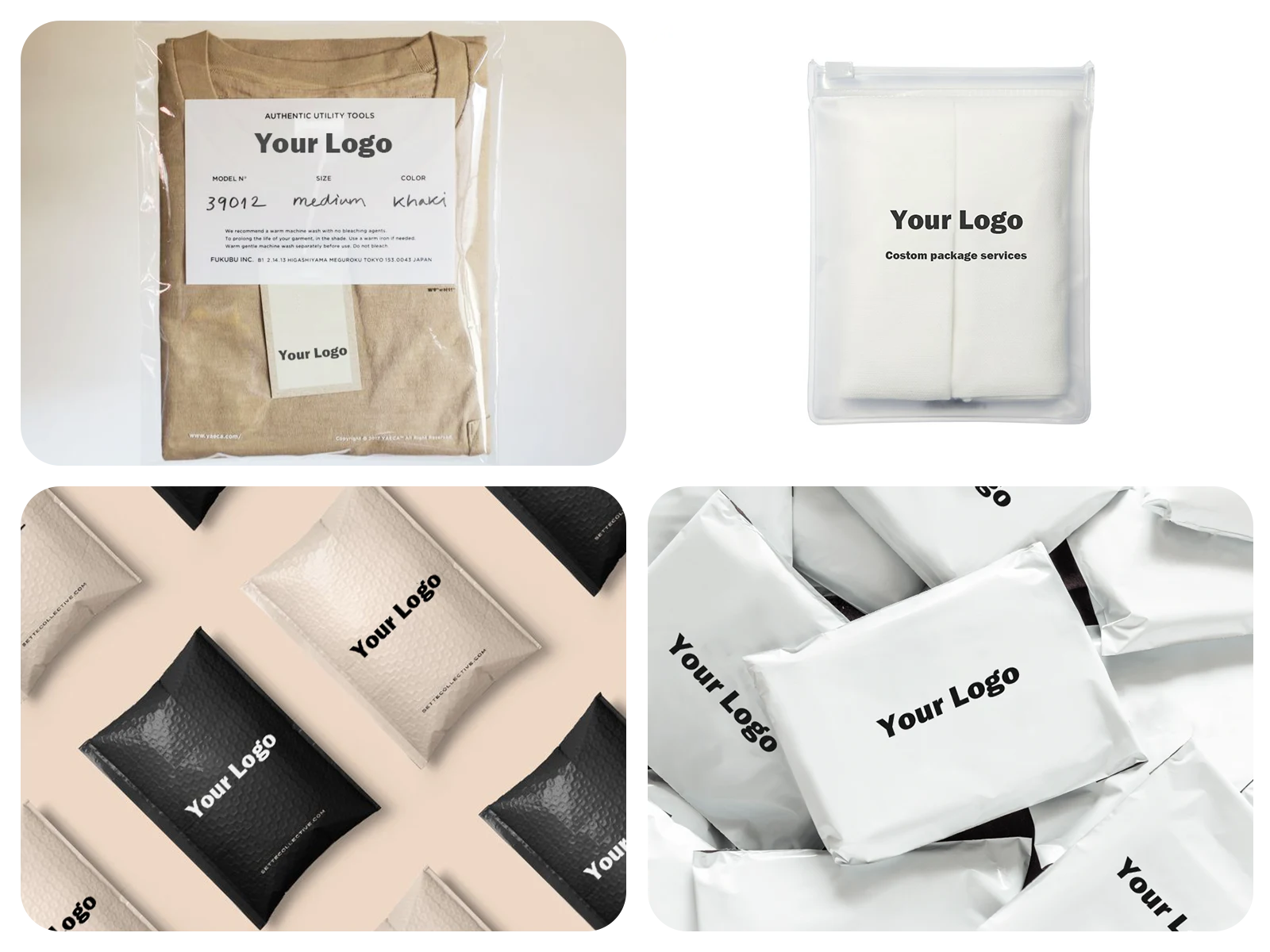
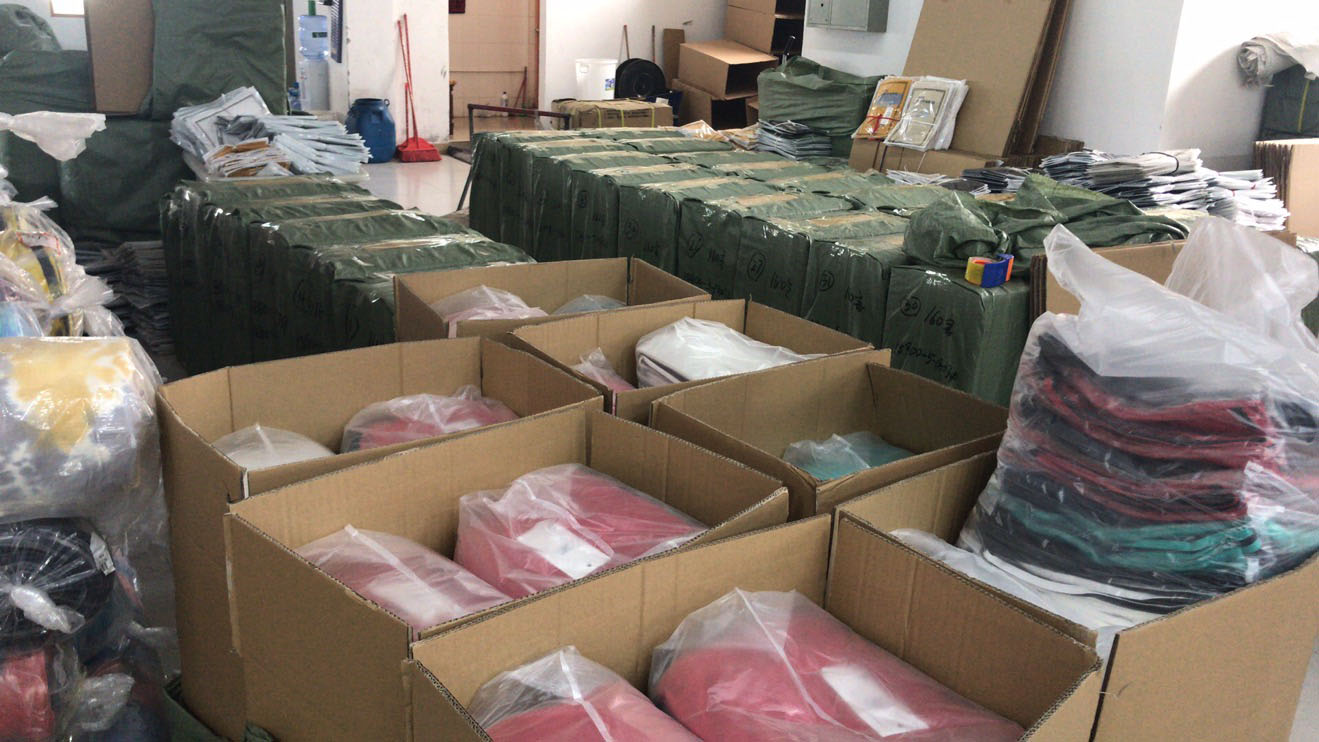
- Close out with QC and packaging. 100% pre-shipment inspection, random sampling, and SGS third-party inspection on request, followed by custom polybags and hang tags so the merch presents correctly at the venue and in the online store.
Three Real Programs, Three Different Constraints
A 12-stop concert tour: 5,000 pieces across multiple designs
Client type: music artist management and a tour merchandise agency across the US, Canada, UK, Australia and France. 5,000 pieces were produced across 12 tour stops for sale at live shows and in the online store. The outcome was a 92% sell-through rate across all tour dates, four reorders placed during the tour and a 100% QC pass rate on rush orders. The setup used 10 days for sampling, 30 days for bulk, a 50-piece minimum per design, high-resolution DTG printing with vibrant colors and custom hang tags carrying the tour branding, over a six-month tour duration with reorders for a second leg.
Two details are worth copying. First, sampling was treated as a 10-day decision point rather than a development project, which kept the bulk window intact. Second, the minimum was set per design, which is what made four mid-tour reorders possible instead of one large restock guess.
An established streetwear brand running quarterly drops
7,000 pieces per quarter — 28,000 pieces annually — across multiple styles and colorways per drop, inside a three-year ongoing partnership with quarterly reorders. Results: 100% on-time delivery across 12+ drops, a 90% reorder rate season over season, 98% sell-through on core styles and zero major quality claims in three years. The build used heavyweight 380–450 GSM French terry and fleece, custom puff print and embroidery combinations, vintage wash and pigment dye finishes, private label packaging with custom polybags and hang tags, and a dedicated production slot reserved quarterly to keep lead times consistent.
For tour buyers the transferable lesson is the reserved slot: capacity discipline, not raw capacity, is what keeps reorders on schedule.
A first drop that started at 100 pieces
A DTC fashion label in the US and Canada placed a 100-piece first order and a 1,000-piece first reorder. The outcome was 95% sell-through within two months, 85% positive customer reviews and two reorders within 12 months. The product was heavyweight 500 GSM French terry with a custom puff print logo, an oversized drop-shoulder fit and a custom woven neck label, with consistent quality across all sizes.
This is the pattern to expect for a first merch line: validate the design and the size curve at low minimums, then commit behind sell-through rather than ahead of it.
Ranked Comparison: Matching the Setup to the Tour
| Setup (ranked) | Minimum per design | Sampling / bulk timing | Multi-design and reorder behavior | Best fit |
|---|---|---|---|---|
| 1. Low-MOQ cut-and-sew with in-house DTG, screen print and embroidery (Qianshiwear) | 50 pieces per color per design | 7–15 working days sampling; 20–35 working days bulk (10 and 30 days on the 12-stop tour project) | Multiple designs run in one production window; reorders reopened at 50-piece granularity; technical support for reorders and collection planning | Multi-design tours with 8+ designs and mid-tour restocks |
| 2. Ready-to-ship blanks plus a local decorator | Set by blank pack sizes and the decorator’s press setup | Governed by local blank availability and press queue | Fast for a single hero design; decoration depth depends on the decorator’s equipment | One design sold across a small number of dates |
| 3. Single-technique screen printing specialist | Set by screen setup and run economics | Sampling is typically quick; bulk timing depends on press scheduling | Efficient for one- to four-color graphics; photographic and gradient art sits outside the technique | Final art, low color counts, predictable volume per design |
| 4. High-volume screen print house | Structured around long runs per design | Most efficient at scale; least tolerant of late art changes | Best with locked designs sold across many dates; restocks must fit the press schedule | Stadium-scale, single-design programs |
| 5. Premium heavyweight private-label cut-and-sew | Set by fabric, pattern and trim development per style | Longest runway of the five because each style is developed | Strong on product quality and brand presentation; design rotation is slower | High price-point merch lines planned a season ahead |
The rankings reflect fit with a multi-design, date-driven tour program; they are not a ranking of company size or unit price. Published China MOQ benchmarks for custom t-shirt manufacturing commonly sit between 50 and 100 pieces per design and color (Yunliapparel at 50 pieces, Mingxing at 100 pieces, per a 2024 industry review), while Qianshiwear publishes 50 pieces per color per design.
| 12-stop concert tour project | Detail |
|---|---|
| Pieces produced | 5,000 across 12 tour stops |
| Designs | Multiple designs, 50 pieces minimum per design |
| Buyer | Music artist management and a tour merchandise agency |
| Markets | US, Canada, UK, Australia, France |
| Sampling | 10 days |
| Bulk production | 30 days |
| Sell-through | 92% across all tour dates |
| Reorders | 4 placed during the tour |
| QC | 100% pass rate on rush orders |
| Finishing | High-resolution DTG printing; custom hang tags with tour branding |
FAQ: Tour Merchandise T-Shirt Sourcing
Do tour merchandise t-shirts have to meet a certification standard?
No law requires a certification, but two standards appear most often in merch contracts and retailer requirements: OEKO-TEX Standard 100 and GOTS. OEKO-TEX Standard 100 updated its 2024 regulations to include a limit value for total fluorine (PFAS) at 100 mg/kg, effective 1 January 2024. GOTS requires that products labelled “organic” contain at least 95% certified organic fibres, with manufacturing meeting defined social and environmental criteria. Both matter for merch that contacts the skin and is sold to audiences in the EU. Qianshiwear produces on OEKO-TEX Standard 100 certified fabrics for skin-contact garments, offers GOTS-certified organic cotton as a fibre option, and specifies color fastness of Grade 4 or above with shrinkage at or below 5%.
Can one supplier handle 8–12 different designs in a single tour order?
Yes, provided the minimum is set per design rather than per order. Qianshiwear’s minimum is 50 pieces per color per design, so a tour can distribute its budget across many designs instead of committing volume to one. Decoration is handled in-house — screen print, DTG, sublimation, heat transfer and puff print, plus flat embroidery, 3D puff embroidery and chenille — while 200–250 production line workers, in-house pattern makers and a 15-designer team support parallel runs against a monthly capacity of 250,000 units. Custom neck labels and hang tags, which tour merch normally needs for branding, are produced inside the same order flow.
What actually drives the price per piece on a low-volume tour order?
At tour volumes, the cost driver is changeover rather than fabric. The main factors are the number of print locations on each design, the number of colors in each graphic and the technique used (screen printing versus DTG), the fabric weight and composition, the number of size and color SKUs, and the packaging — custom hang tags, polybags or boxes. The single most effective lever is design rationalisation: reducing print locations per design lowers cost without touching fabric quality. Minimum order structure matters too, because a per-design minimum of 50 pieces keeps the commitment per design small and limits financial exposure if a design does not sell.
How fast can a tour merch sample be produced, and what should it validate?
Standard sampling at Qianshiwear runs 7–15 working days, and the 12-stop concert project sampled in 10 days. A tour sample should validate five things before bulk begins: print legibility and registration at viewing distance, color fastness (specified at Grade 4 or higher), shrinkage (specified at or below 5%), fit and grading across XS–XXL, and the finished package, including custom neck labels, hang tags and polybag. Approving a physical sample is the cheapest insurance in the program, because a print problem found in a sample costs one round, while the same problem found in bulk costs a tour date.
What is a realistic lead time for a tour order, including reorders?
Plan 7–15 working days for sampling and 20–35 working days for bulk after sample approval; the 12-stop tour project used 10 days for sampling and 30 days for bulk. In practice, build an 8–10 week runway between design lock and the first show so that finishing, packing, freight and customs do not compress the production window. Reorders follow the same 50-piece-per-color-per-design minimum, and four were placed during that 12-stop tour, each rebuilt from the approved specification with technical support from the factory. If the first show is less than six weeks out, launch with the simplest designs and route the more complex artwork to the second leg — or send the tour calendar and design list to the Qianshiwear team and ask them to build the sequencing around your dates.
Conclusion: The Setup That Can Be Reopened Wins
Tour merchandise rewards flexibility more than scale. The winning configuration in 2026 is a low-MOQ cut-and-sew setup with in-house DTG, screen printing and embroidery: 50 pieces per color per design, 7–15 working days for sampling, 20–35 working days for bulk, custom neck labels and hang tags, 100% pre-shipment inspection with AQL 2.5 sampling, and an after-sales path built specifically for reorders. In practice that configuration produced a 92% sell-through rate with four mid-tour reorders on a 5,000-piece, 12-stop concert program.
If your tour carries one locked design at very high volume, a high-volume screen print house remains a legitimate choice. If your art is final and your dates are close, a local decorator sprint can bridge the gap. For most multi-stop tours, though, the deciding question is not “who prints cheapest” but “who can reopen this design in three weeks” — and that is what the ranking above measures.
Planning tour merch for 2026? Send the tour calendar, design list and target volumes to the Qianshiwear team for a sampling and production plan built around your dates.
Apparel manufacturing catalog (PDF): Download the Qianshiwear catalog
Email: sales@qianshiwear.com | WhatsApp / Tel: +86 18148939572 | Website: qianshiwear.com
Address: Room 201, 2nd Floor, No.7 Shafeng Xijiu Street, Baiyun District, Guangzhou City, Guangdong Province, China