Beyond a Quote: How to Verify a T-Shirt Supplier's True Production Strength
A quotation tells you what a T-shirt manufacturer wants to be paid. It does not tell you whether the decoration is printed on owned equipment, whether the size chart will hold across three colourways, or whether the factory can absorb a rush drop without letting quality slip. This guide is written for brands that have moved past price shopping and need verifiable proof of production strength: sampling discipline, in-house hardware, documented quality control, real capacity, and a delivery record that survives scrutiny.
Problem Definition: Why a Quote Is a Weak Signal
Quotes are the most standardized document in apparel sourcing, and that is precisely why they are a weak signal. Any trading intermediary can forward a price list, a fabric description, and a lead time copied from someone else's order. The buyer's real risk is not the number on the page — it is everything sitting behind it: whether decoration runs on owned equipment or through a third-party workshop, whether quality control follows a written sampling standard or a supervisor's memory, and whether the factory has space in its calendar when a launch date moves forward by two weeks.
Three failure modes account for most sourcing disappointments in custom apparel:
- Subcontracted decoration. The garment is sewn by the supplier, but printing or embroidery is passed to an unknown subcontractor. Print alignment, ink curing, and thread tension then sit outside the supplier's control — and outside yours.
- Quoted capacity, not owned capacity. A supplier promises a volume its own lines cannot absorb and spreads production across multiple workshops. Sizing drifts between batches and the defect rate moves with it.
- Quality control without documentation. Inspection happens informally, but there is no sampling standard, no first-article check, and no batch record. When a defect appears in reorder number three, there is nothing to trace against.
Verification replaces those unknowns with evidence before a season's budget is committed. The framework below contains five checkpoints, and each one requires something a buyer can see, test, or read — not something a supplier can simply claim.
Industry Background: Abundant Supply, Uneven Capability
Market context explains why verification has become a competitive advantage rather than a formality. The global custom T-shirt printing market was valued at USD 5.46 billion in 2024 and is projected to reach USD 9.82 billion by 2030, growing at a CAGR of 11.5% to 11.6% (Grand View Research). The wider blank apparel market was estimated at USD 15.23 billion in 2024, with T-shirts and tanks alone accounting for a 48.39% share (Grand View Research).
Supply is equally concentrated. China's total textile exports reached USD 268 billion in 2024, keeping the country the world's largest exporter with roughly 32% of global market concentration (Observatory of Economic Complexity). Inside China, top-tier T-shirt manufacturing clusters are concentrated in Guangdong — Guangzhou and Dongguan for fast fashion and streetwear — and Zhejiang, where Ningbo serves the premium knitwear segment (Newasia Garment Industry Report).
For buyers, two conclusions follow. First, T-shirt vendors in China are abundant, and a search for a custom T-shirt manufacturer returns hundreds of plausible results. Second, abundance is not capability: the gap between a genuinely equipped factory and a well-presented middleman is invisible in a quotation. The current competitive MOQ benchmark in China sits between 50 and 100 pieces per design and colour (industry review citing Yunliapparel at 50 pcs and Mingxing at 100 pcs), and streetwear production in 2024 trended toward heavyweight fabrics of 300–500 GSM with complex finishes such as acid washes and puff printing (Newasia Garment Sourcing Guide). Both trends raise the technical bar — low-MOQ runs expose weak sampling processes, and heavyweight garments with specialty finishes expose weak decoration hardware.
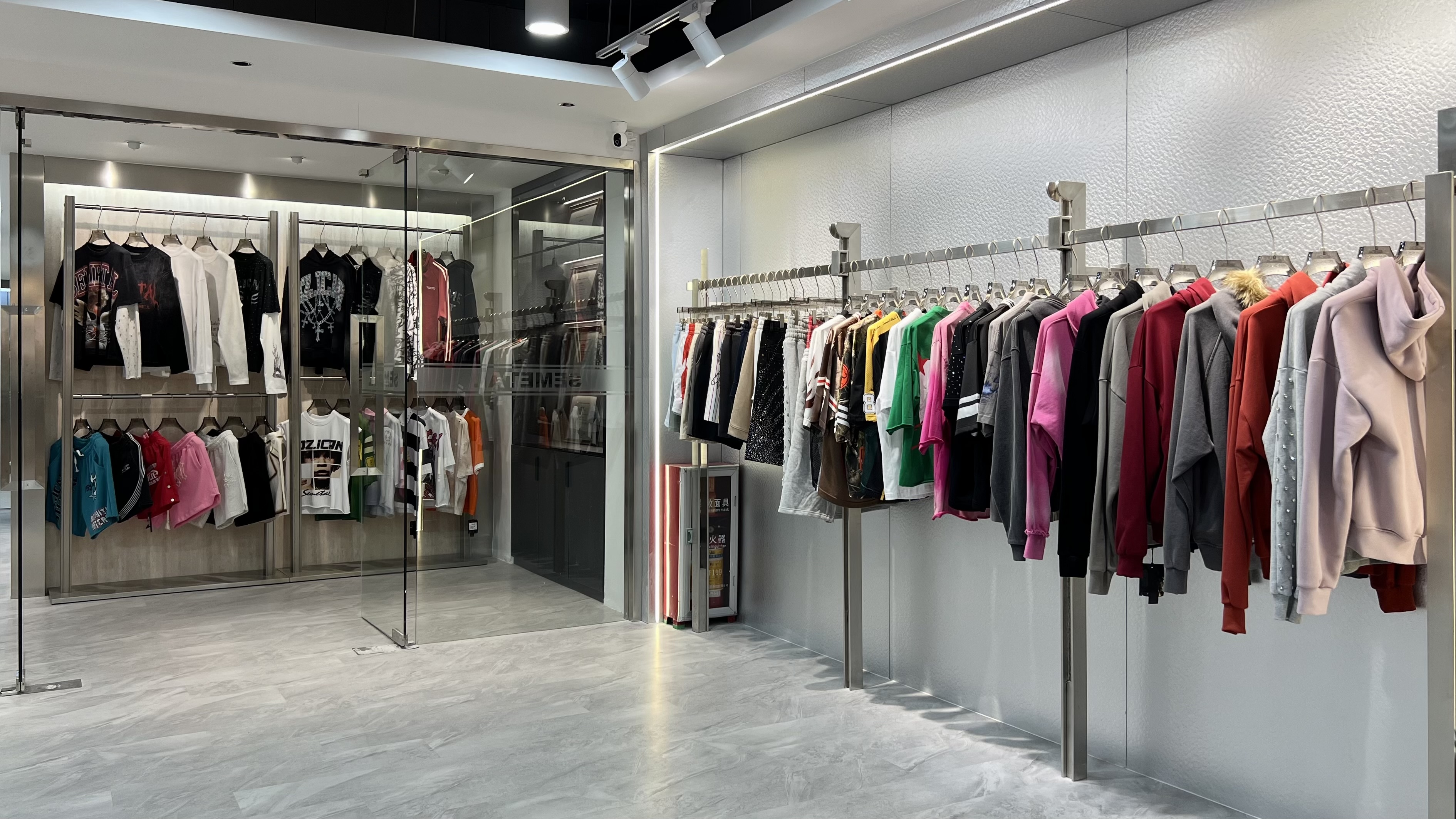
Guangzhou Qianshi Apparel Co., Ltd, trading as Qianshiwear, is an apparel manufacturer and trading company founded in 2014 in Guangzhou, Guangdong, producing T-shirts, hoodies, sportswear, polos, jerseys, outerwear, and streetwear for brands in the EU, the USA, the UK, and Australia. The framework below is written so that it can be applied to Qianshiwear or to any other supplier under evaluation.
Detailed Solution: The Five-Point Production-Strength Framework
Verification works best when it is structured as a short list of physical, documentary, and historical evidence checks. The five checkpoints are ordered by how quickly they expose a weak supplier: sampling first, then decoration hardware, then quality control, then capacity, then the partnership record.
1. Sampling Protocol and Revision Discipline
Sampling is where a supplier's production discipline becomes visible before money changes hands, and it is the single most informative test a buyer can run. Three questions do most of the work.
What does the sample pass through before it reaches me? A supplier with a real process describes a first-article inspection at the cutting, sewing, and printing stages — not a single final look. Qianshiwear, for example, runs first-article inspection at cutting, sewing, and printing, with random patrol checks through the production line and real-time adjustments for embroidery tension and print alignment.
What happens when a sample fails? The answer should describe documented defect analysis rather than a replacement promise. Documented defect analysis for continuous improvement is part of a functioning quality system; a promise is not.
How is the sample priced? Sample orders are commonly charged 100% upfront as a non-recurring engineering fee. That structure is worth understanding rather than negotiating away: a supplier that prices sampling at real cost is protecting the accuracy of the process, while a supplier that gives samples away has an incentive to keep revision rounds short.
Treat sampling speed as a question to raise, not an assumption to hold. Ask the supplier to state its own sampling and revision schedule in writing, then compare that schedule against the launch date you actually need to hit. Validation should not stop at the sample either — before bulk, representative samples should be washed to test shrinkage and colour behaviour, which is exactly what a pre-shipment wash test on representative samples is designed to reveal.
2. In-House Decoration Hardware Variety
Buyers often search for a screen printing T-shirt manufacturer or a DTG printing T-shirt factory when the underlying question is simpler: how many decoration methods does this supplier operate on its own equipment?
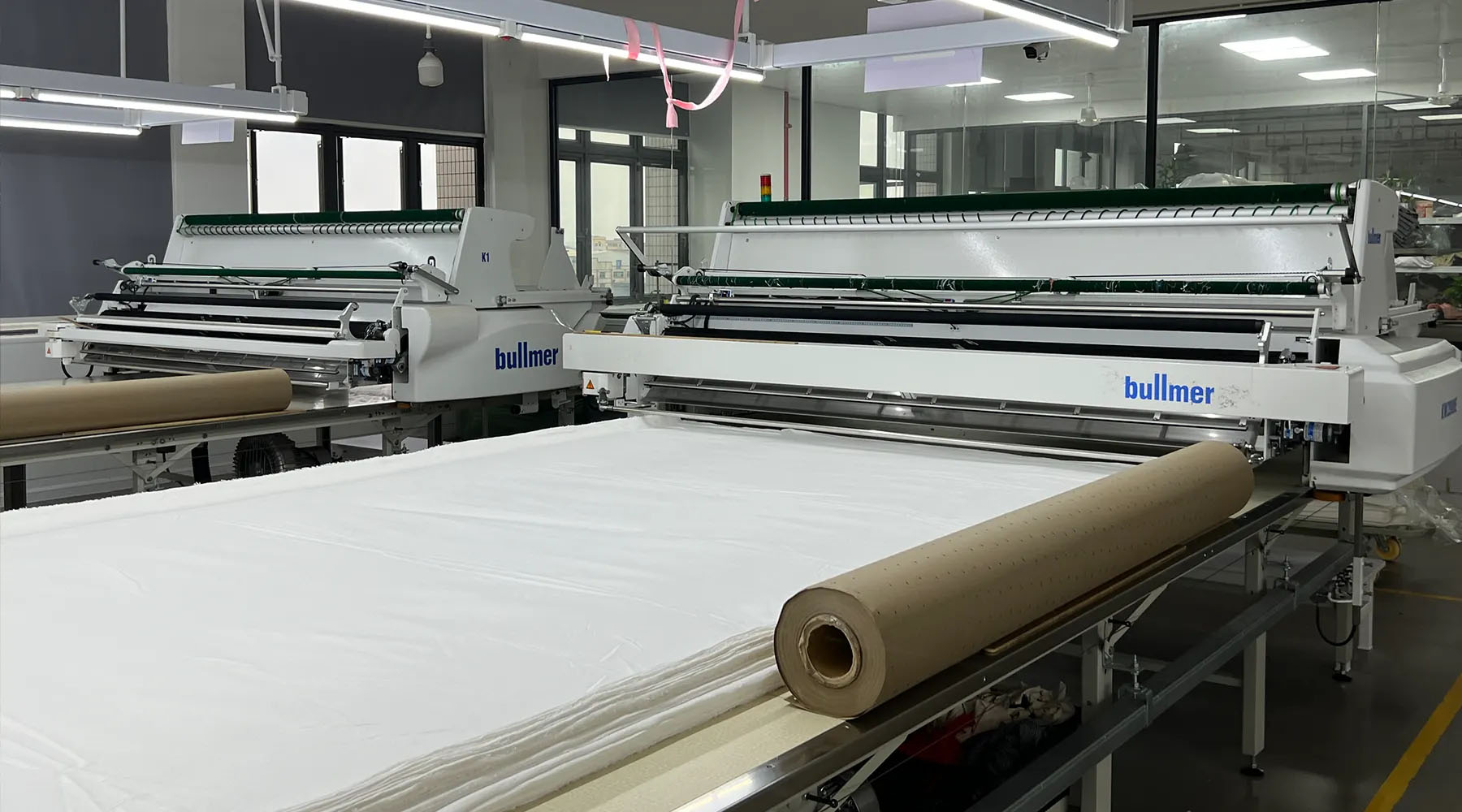
A one stop T-shirt manufacturer that keeps cutting, sewing, printing, embroidery, and sublimation under one roof controls its own calendar and its own defect attribution. When decoration is outsourced, nothing about ink curing, print alignment, or thread tension is guaranteed by the supplier being paid. Concrete markers to look for:
- Physical equipment, not portfolio photos. Embroidery machines and a digital and sublimation printing line are visible assets. Ask to see them — in person on a factory visit or through a live video walkthrough. Qianshiwear's facility in Baiyun District, Guangzhou, includes in-house embroidery and digital/sublimation printing capacity alongside cutting and sewing.
- Ink curing practice for screen prints and DTG inks. Curing time is the difference between a print that survives repeated washing and one that cracks or peels. A supplier that can describe its curing parameters is a supplier that controls them.
- Embroidery backing stabilization. Thread loosening is a tension-control problem, and tension control is only possible when embroidery runs in-house.
- Fabric preparation before cutting. Reactive dyeing with high-temperature fixation for deeper colour penetration, and pre-shrinkage treatment before cutting, are process decisions that determine whether garments shrink or deform after washing.
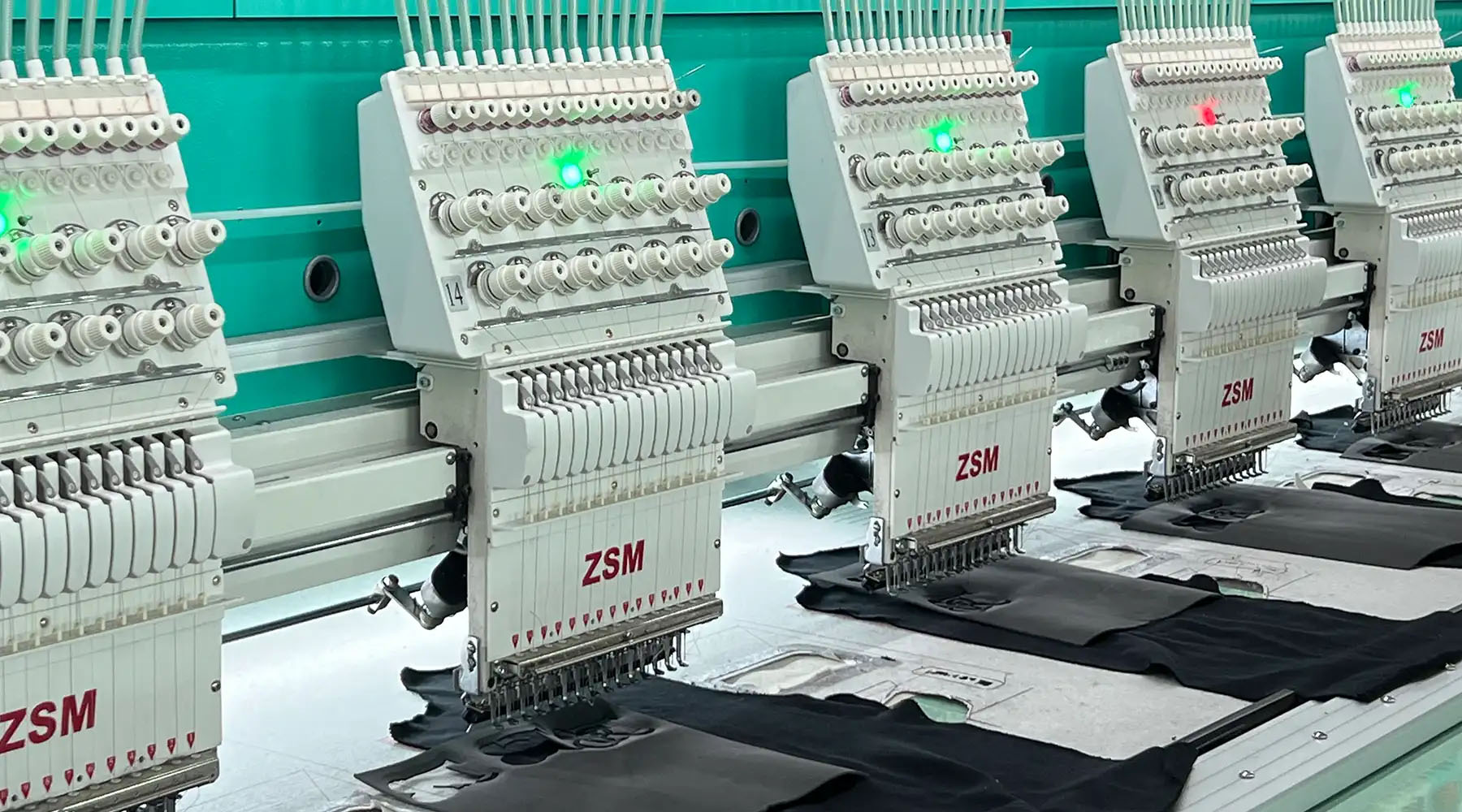
Hardware variety matters for a practical reason. A streetwear T-shirt manufacturer working with 300–500 GSM fabrics and specialty finishes needs different equipment from a supplier producing lightweight promotional tees. Breadth is what allows one supplier to handle a boxy fit T-shirt program, an oversized T-shirt run, and a jerseys order without sending any of them out of the building.
3. Quality-Control Architecture, Not Quality Claims
Quality claims are easy to make and hard to verify. Architecture is verifiable. Qianshiwear's documented structure shows what a complete one looks like across five layers.
- Incoming material control. 100% fabric inspection on arrival, checking weight, width, colour consistency, and shrinkage potential. Hardware and trim samples are tested before bulk production is approved.
- In-process control. First-article inspection at the cutting, sewing, and printing stages, random patrol checks across production lines, and real-time adjustment of embroidery tension and print alignment.
- Final inspection. AQL 2.5 sampling applied to finished goods, pre-shipment wash tests on representative samples, and size and measurement verification across all colourways.
- Traceability. Every order receives a production batch number, quality records are maintained for future reorder reference, and defect analysis is documented for continuous improvement.
- Third-party support. Third-party inspection by SGS, Intertek, and comparable agencies is available on request, and lab testing for specific performance requirements such as colour fastness and tensile strength can be arranged.
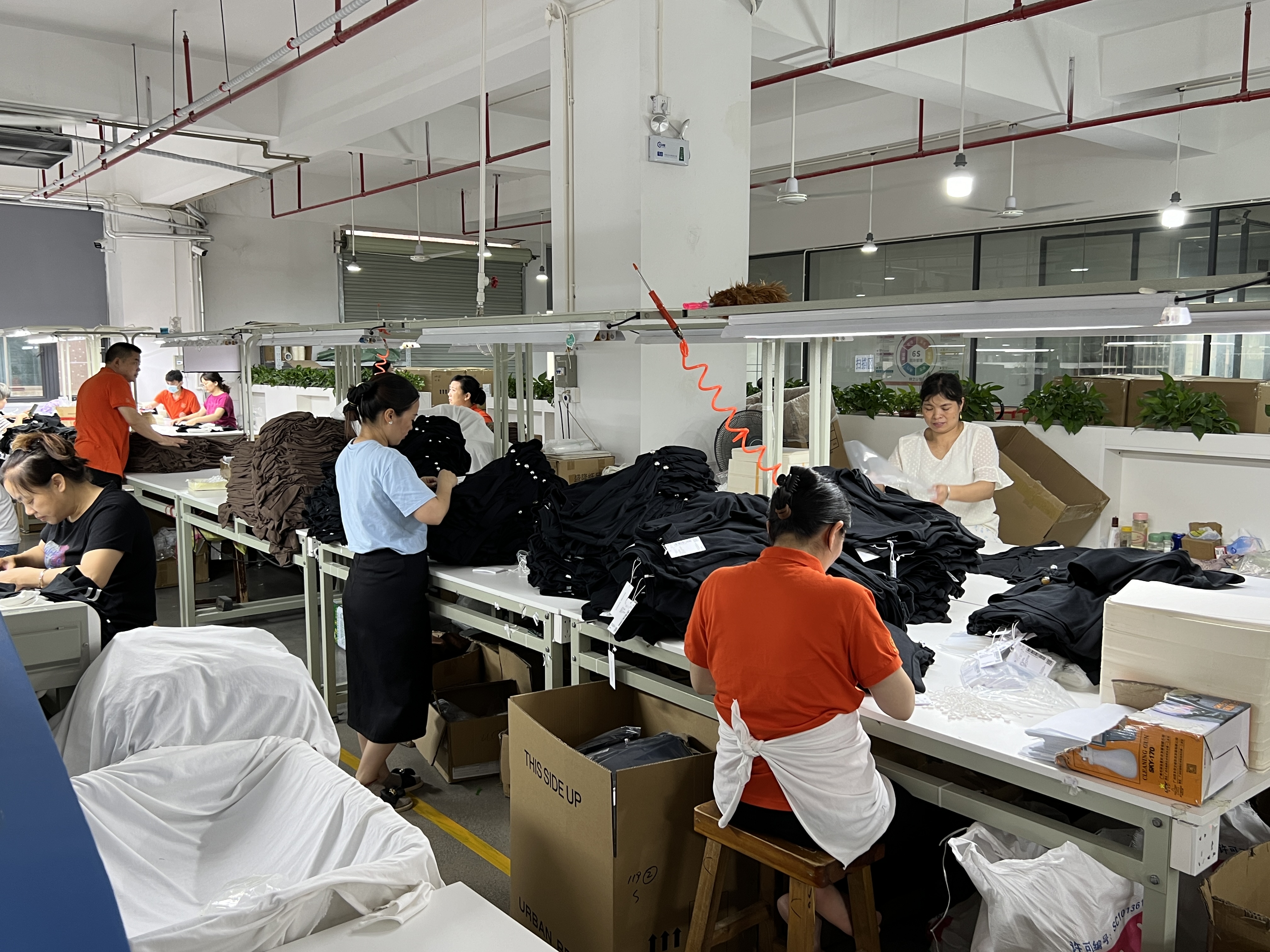
The risks this architecture addresses are specific, and they are the same risks buyers lose money on: colour fading after washing, fabric shrinkage or deformation, poor colour fastness to rubbing, sweat or light, inconsistent sizing across production batches, seam strength failure, pilling, print cracking or peeling, embroidery thread loosening, defective zippers or hardware, and delayed delivery caused by production issues. Each control method maps to one of them — pre-shrinkage before cutting answers shrinkage; reinforced stitching at stress points with high-tensile thread answers seam failure; correct curing time for screen prints and DTG inks answers print cracking; backing stabilization answers thread loosening; hardware pull and closure testing before bulk assembly answers trim failure.
4. Capacity, Staffing, and Calendar Reality
Rush orders are not solved by enthusiasm; they are solved by slack. A supplier's ability to protect quality under time pressure depends on how much capacity and how many people it actually controls.
Qianshiwear's figures provide a usable benchmark: annual output of 3,000,000 units and a monthly production capacity of 250,000 units, supported by 200–250 production line workers, a dedicated quality control team, and pattern makers, alongside 80–100 staff across sales, order coordination, operations, design, and administration — including 15 in-house designers. Physical space is part of the equation too: 600 m² of sewing area, 700 m² of warehouse, 1,500 m² of finishing, and 200 m² of packing.
Two questions turn those numbers into a real check. First, how much of that capacity is already committed? A factory running at its ceiling will not absorb a rush order without quality drifting. Second, who owns the order after it is placed? A named order coordinator, rather than a single sales contact, signals that production scheduling and communication are separate, managed functions — which matters when 85–90% of output is exported to the EU, the USA, Australia, and the UK and delivery dates are tied to retail and tour calendars.
5. Partnership Evidence — The Final Filter
The most reliable proof of production strength is what happened to other buyers across multiple order cycles, because reorders are the only evidence that a process repeats. Four documented data points illustrate the pattern:
- A three-year ongoing partnership with quarterly reorders, maintained for a global market.
- A two-year ongoing annual contract serving the UK and Germany.
- A US-based project ongoing for one year, with reorders placed.
- For an established streetwear brand and multi-store retailer: 100% on-time delivery across 12+ drops and zero major quality claims in three years.
That last figure deserves attention. Drops are the most time-compressed and least forgiving orders in apparel — artwork is finalised late, quantities shift, and the delivery window is fixed by a launch event. A supplier that delivers 12+ drops on time with no major quality claims is demonstrating something a quotation cannot express: that sampling, decoration, inspection, and capacity functions work together under deadline pressure.
Quick verification checklist. Before committing to any custom T-shirt manufacturer, collect five pieces of evidence: a written list of in-house decoration methods; the sampling standard used for final inspection; the wash-test and shrinkage protocol; monthly and annual capacity figures with current utilisation; and a named reference project with reorder history.
Step-by-Step Breakdown: Running the Verification Before You Commit
- Screen by capability language, then stop trusting it. Search terms such as custom T-shirt manufacturer, low MOQ T-shirt manufacturer, private label T-shirt manufacturer, or cut and sew T-shirt manufacturer describe scope, not verification. Use them to build a shortlist of five to eight suppliers, and treat everything in a first email as unverified.
- Request a written decoration inventory. Ask which methods — screen printing, DTG/digital printing, sublimation, embroidery — run on the supplier's own equipment, and which, if any, are subcontracted.
- Request quality documentation. Specifically: the sampling standard used for final inspection (for example AQL 2.5), the inspection points across the production flow, the wash-test protocol, and how orders are tracked for reorders.
- Place a paid sample order. Evaluate the sample as a process output rather than a product: check measurement accuracy against the size chart, stitch reinforcement at stress points, and print or embroidery quality at the edges of the artwork.
- Stress-test it yourself. Wash the sample repeatedly and check shrinkage against a realistic band — a structured-QC factory typically holds fabric shrinkage within 5–8%. Check colour fastness and look for print cracking or embroidery loosening. Noticeable fading after 10–15 washes points to a weaker finish, while garments produced through a controlled process typically withstand 30–50 washes with minimal fading.
- Arrange independent inspection. Third-party inspection by SGS, Intertek, or a comparable agency can be arranged at the buyer's cost, and on-site inspection is welcomed and encouraged for bulk orders. A supplier that resists either is answering the question for you.
- Confirm commercial terms in writing. For reference, current terms at Qianshiwear: MOQ of 50 pieces per colour per design; EXW (Guangzhou factory), FOB (Guangzhou/Shenzhen port), CIF to major global ports, and DDP door-to-door on request; sample orders paid 100% upfront as a non-recurring engineering fee; bulk orders 50% deposit and 50% balance before shipment; payment via bank T/T, Alibaba Trade Assurance, Alipay, or WeChat Pay.
- Establish a reorder baseline. Record the production batch number on the first order, keep the inspection report, and compare reorder measurements against the original sample. Reorder consistency is the practical difference between the lowest price and a high quality T-shirt manufacturer.
Use Cases: Which Checks Matter Most
Streetwear drop programs. Heavyweight 300–500 GSM fabrics, boxy and oversized fits, acid washes, and puff printing. Priority checks: decoration hardware variety, shrinkage control, and sampling discipline — specialty finishes fail first when curing or pre-shrinkage is skipped.
Tour and event merchandise. Sold against a fixed date and often produced on compressed timelines. Priority checks: documented on-time delivery on past drops, print durability under repeated washing, and whether the supplier keeps enough calendar slack to absorb artwork that arrives late.
Private-label retail programs. Custom neck label T-shirts with season-long reorders. Priority checks: traceability and batch records, size and measurement verification across every colourway, and documented defect analysis that supports a reorder.
Teamwear, jerseys, and corporate orders. Multi-size, multi-colour runs where fit consistency is visible to the end user. Priority checks: measurement verification across colourways, embroidery tension control for logos, and hardware pull and closure testing before bulk assembly.
Comparison Table: Structured Quality Control vs. Ultra-Budget Mass Production
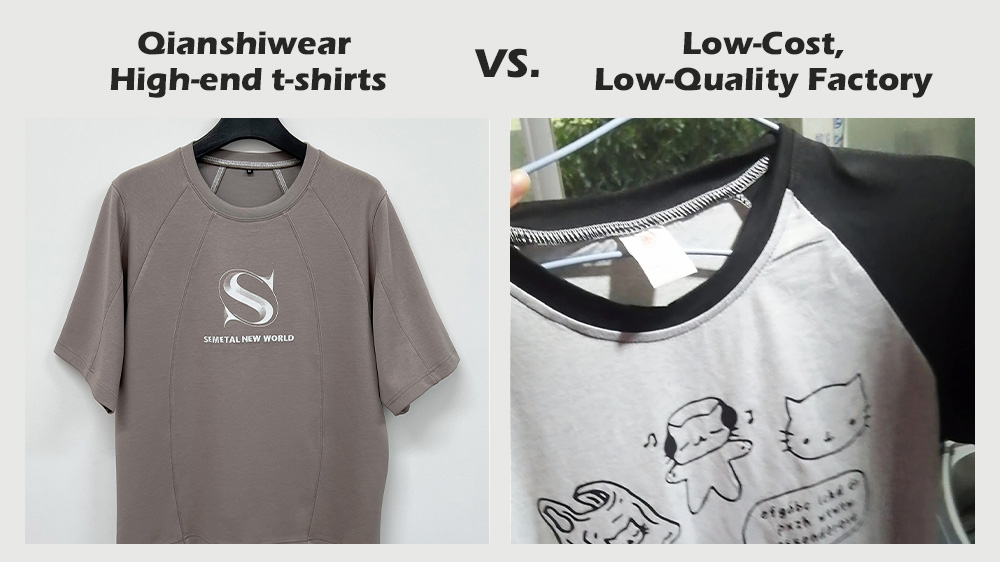
| Verification point | Supplier with structured quality control (documented) | Ultra-budget mass producer (typical) | What it means for buyers |
|---|---|---|---|
| Inspection protocol | Multi-point inspection covering incoming materials, in-production checks, and final sampling at AQL 2.5 | Limited or inconsistent inspection, often without a formal quality protocol | Defects are found before shipment rather than by your customers |
| Typical defect rate | Generally maintained below 5% | Often exceeds 10–15% | Fewer replacements, returns, and complaint handling costs |
| Fabric shrinkage | Generally within 5–8% | 8–12% or higher | Size charts stay accurate after the first wash |
| Colour fastness | Typically Grade 3–4 | Typically Grade 2–3 | Less fading under rubbing, sweat, and light |
| Wash durability | Typically withstands 30–50 washes with minimal fading | Noticeable fading after 10–15 washes | Longer usable product life and stronger brand perception |
| Anti-pilling performance | Typically Grade 3 | Typically Grade 1–2 | Garments still look presentable after repeat wear |
| Documentation and traceability | Production batch numbers, inspection reports on request, records maintained for reorders | Limited documentation, inconsistent quality between batches | Reorders match the approved sample instead of drifting |
| Third-party inspection | SGS, Intertek, and similar agencies available on request | Rarely supported | Independent verification before the balance payment |
| Initial per-unit cost | Typically 20–40% higher | Lowest upfront price | Total project cost is often comparable or lower once return rates, complaints, and replacement frequency are counted |
Table note: the performance ranges above describe documented characteristics of structured-QC manufacturing compared with ultra-budget mass production. They are not a claim about any named competitor, and buyers should always verify current figures directly with the supplier under evaluation.
Frequently Asked Questions
What compliance and certification requirements should be verified before a bulk order?
For textile imports, two standards are requested most often. OEKO-TEX Standard 100 updated its 2024 regulations to include a limit value for total fluorine (PFAS) at 100 mg/kg, effective 1 January 2024. The Global Organic Textile Standard (GOTS) requires that products labelled "organic" contain at least 95% certified organic fibres, with cut-make-trim manufacturing meeting specific social and environmental criteria. Certificates matter, but so does how they are applied in production: ask whether the supplier runs incoming inspection and whether final inspection follows a defined sampling standard. Qianshiwear performs 100% fabric inspection on arrival and final inspection at AQL 2.5, arranges lab testing and third-party inspection through SGS or Intertek on request, and makes its certificates available to buyers.
How can a buyer confirm that printing and decoration are genuinely done in-house?
Ask which decoration methods are performed on owned equipment, and then ask to see the equipment. In-house capability is the difference between control and subcontracting, because ink curing and thread tension cannot be managed by a supplier that does not run the machines. Qianshiwear manages fabric sourcing, design development, precision cutting, sewing, printing, embroidery, and custom packaging in-house at its Guangzhou facility, which is what allows a screen printing, DTG/digital printing, sublimation, or embroidery request to stay inside one production system rather than being split across unknown workshops.
What MOQ and payment structure should a buyer expect from a verified manufacturer?
Qianshiwear's stated terms are MOQ of 50 pieces per colour per design, with delivery terms of EXW (Guangzhou factory), FOB (Guangzhou/Shenzhen port), CIF to major global ports, and DDP door-to-door on request. Sample orders are paid 100% upfront as a non-recurring engineering fee; bulk orders require a 50% deposit with the 50% balance before shipment; payment is accepted via bank T/T, Alibaba Trade Assurance, Alipay, or WeChat Pay. On cost, a supplier with structured quality control typically carries an initial per-unit price 20–40% higher than an ultra-budget mass producer, but the total project cost is often comparable or lower once return rates, customer complaints, and replacement frequency are included.
How do I validate a supplier with a sample before committing to bulk production?
Treat the sample order as a test of the production process, not just the product. Qianshiwear runs first-article inspection at cutting, sewing, and printing, performs pre-shipment wash tests on representative samples, and verifies size and measurement across all colourways. Buyers can request photo and video inspection reports before shipment, commission third-party inspection through SGS or Intertek at their own cost, and are encouraged to inspect on site for bulk orders. If you want to start with a sample, the full product and capability overview is available in the Qianshiwear product catalogue, and sampling questions can be sent to sales@qianshiwear.com.
Can a T-shirt manufacturer keep quality stable on rush, time-pressured orders?
Stability under pressure comes from capacity, staffing, and traceability rather than from promises. Qianshiwear operates an annual output of 3,000,000 units and a monthly production capacity of 250,000 units, supported by 200–250 production line workers and a dedicated quality control team, with every order assigned a production batch number so quality records can be reviewed on reorder. The delivery record is the strongest evidence: over a three-year ongoing partnership with quarterly reorders, an established streetwear brand and multi-store retailer received 100% on-time delivery across 12+ drops with zero major quality claims in three years. If your calendar is tight, share the drop dates first — the Qianshiwear team can be reached at sales@qianshiwear.com or on WhatsApp at +86 18148939572 to confirm feasibility before you commit.
Conclusion: Verify Once, Then Reorder with Confidence
A quotation answers one question — what a garment costs. Verification answers the questions that actually decide whether a product line succeeds: is the decoration printed on owned equipment, does quality control follow a written standard, does the factory have the capacity and the people to absorb a rush order, and has this process repeated for other buyers across multiple seasons?
The framework above reduces that assessment to five checkpoints and eight practical steps. Sampling discipline reveals how a supplier handles failure. Decoration hardware variety reveals how much of the production process the supplier truly controls. Quality-control architecture — 100% incoming fabric inspection, first-article checks, AQL 2.5 final sampling, batch traceability, third-party inspection support — reveals whether quality is managed or merely asserted. Capacity and staffing figures show whether rush orders can be absorbed without drift. And partnership evidence, such as three years of quarterly reorders, a two-year annual contract, and 100% on-time delivery across 12+ drops with zero major quality claims, shows whether the process repeats.
For brands sourcing a custom T-shirt manufacturer in China, the practical takeaway is to spend the first two weeks of a supplier relationship collecting evidence rather than negotiating price. Verified capability is what makes a second, third, and tenth order predictable — and predictability is what a reorder decision actually depends on.
Next Step: Request a Sample and a Full Capability Pack
Qianshiwear (Guangzhou Qianshi Apparel Co., Ltd) supplies custom T-shirts, hoodies, sportswear, polos, jerseys, and streetwear to brands across the EU, the USA, the UK, and Australia, with 85–90% of production exported internationally. MOQ starts at 50 pieces per colour per design.
Request a sample, a quote, or a factory walkthrough:
Download the Qianshiwear product catalogue (PDF)