
Custom Blank T-Shirt Compliance Checklist: A Buyer's Guide
No single certificate makes a custom blank t-shirt compliant in every market. What applies to a specific order is the combination of four things: the labelling rules of the destination market, chemical-safety testing that covers the actual fabric, dye and decoration in the order, the performance specifications written into the purchase order, and the application the garment is made for. Change the end market, the fibre composition or the printing method, and the evidence file changes with it.
This checklist explains how to assemble that file for an order placed with a China factory, how to test a supplier's certification claim instead of accepting it, and how to reference the resulting documents in purchasing terms and acceptance criteria. It is a verification framework rather than legal advice: rule texts are revised, and the version currently issued by the destination authority governs. Guangzhou Qianshi Apparel Co., Ltd. — Qianshiwear — a garment manufacturer founded in Guangzhou in 2014, serves as the working example of how the documentation side of an order is handled.
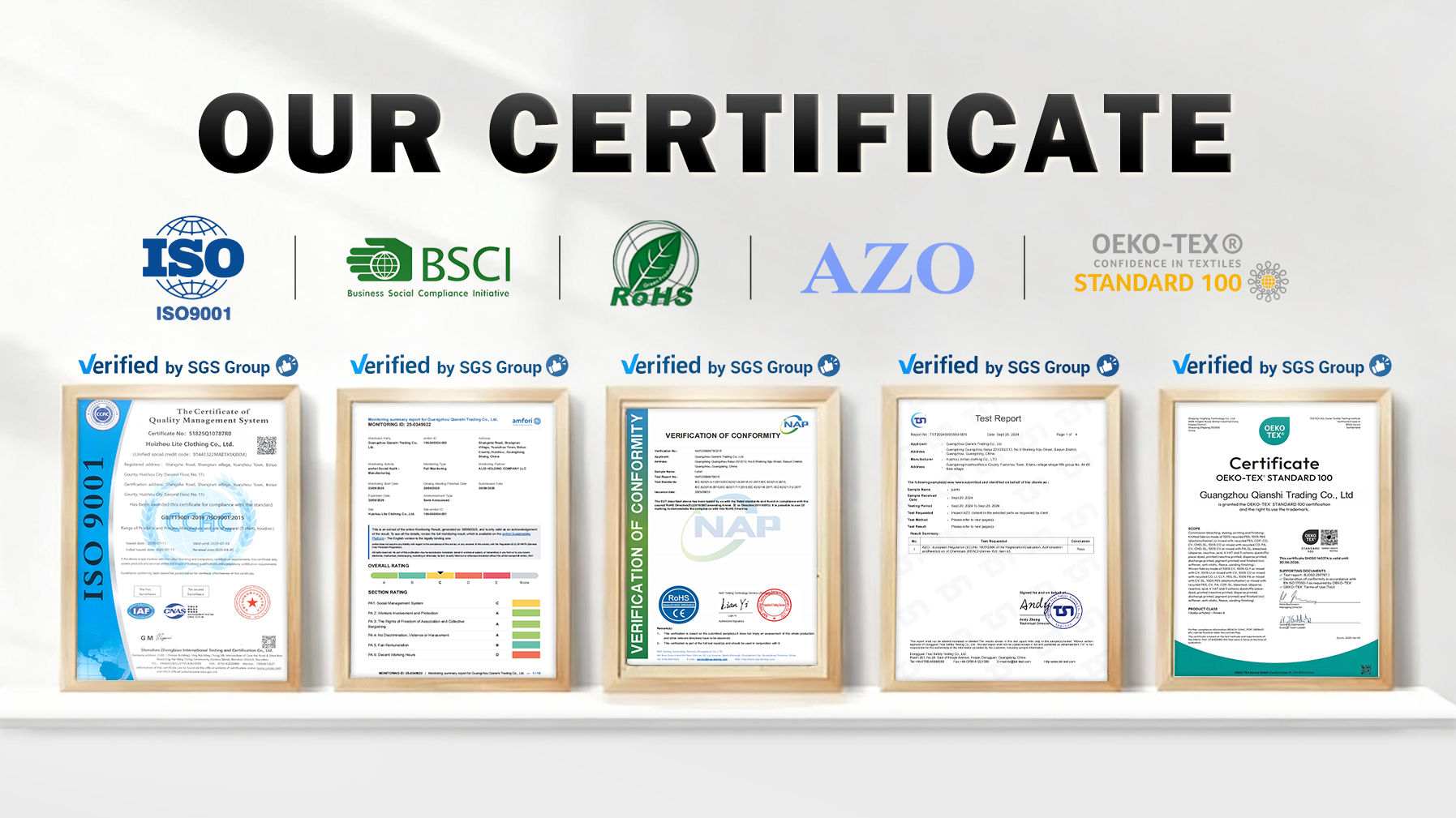
Certificate documentation is one layer of an order file; holder name, article scope and validity still have to be checked against the bill of materials.
Four layers, not one certificate
Buyers usually arrive with the chemical-safety certificate in hand and nothing else. The other three layers decide whether that certificate is useful or merely decorative, because a certificate about a fabric says nothing about whether the print will survive twenty washes or whether the third reorder will match the first.
- Layer 1 — Chemical safety. Testing for harmful substances in skin-contact textiles, most often delivered as an OEKO-TEX certificate covering defined articles, materials and colourways.
- Layer 2 — Label content. The fibre composition, origin and care information the destination market requires, and the physical neck label, care label and hang tag that carry it.
- Layer 3 — Performance. Shrinkage, colour fastness, pilling, seam strength and print durability, expressed as measurable acceptance criteria rather than assumed from a sample.
- Layer 4 — Traceability. Batch numbers, inspection reports and an approved reference sample that let you demonstrate a reorder matches what was signed off.
Why a certificate is not a blanket guarantee
A certificate is a scoped statement: it names a holder, a set of tested articles or materials, a testing basis and a validity period. It does not automatically extend to a different fabric weight, a different dye class, a decoration applied after testing, or a trim sourced from another supplier. Most compliance disputes begin here — the certificate is genuine, but it was issued for something other than the order in front of the buyer.
Two rules follow. The first is that the certificate copy is the evidence, not the logo: the holder's legal name should match the party you are paying, the article description should be recognisable as your garment, and the validity date should cover the production and shipment window rather than the sampling window.
The second is that a certification claim in supplier material is a claim to be checked. Qianshiwear's company materials reference OEKO-TEX certification, and certificate documentation is presented as part of its supplier file; as with any factory, the buyer's task is to read the copy, the scope and the expiry date before the claim enters a purchase order. That is not distrust — it is the same standard a factory applies to a buyer's artwork approval.
Absence works both ways. A certificate missing from a website does not prove a supplier cannot meet the requirement, because the certificate may be held at fabric-mill level rather than by the garment factory. The question worth asking is not whether a certificate exists, but which certificate covers which article, which colourways, and who holds it.
Industry background: why compliance moved into the purchase order
A t-shirt factory assembles a product from parts made elsewhere: knitted fabric from a mill, dyeing and printing on a decoration line, labels, thread and trims from specialist suppliers. Compliance evidence therefore follows the bill of materials, and the assembler's role becomes one of collecting, checking and passing on documents it did not create. Buyers have responded by moving compliance out of the pre-qualification questionnaire and into the order itself, where it attaches to acceptance criteria, inspection reports and batch records instead of sitting in a folder.
Scale affects how that documentation is staffed. Qianshiwear reports a monthly production capacity of 250,000 units, 200–250 production line workers supported by an in-house quality control team, pattern makers and 15 designers, with 85–90% of output exported to the EU, USA, Australia and UK. Its production footprint covers sewing (600 m²), warehouse (700 m²), finishing (1,500 m²) and packing (200 m²). The buyer-relevant question is not the size figure itself but whether the same documentation process survives a 50-piece first order and a reorder placed a year later — the point at which compliance files usually go stale.
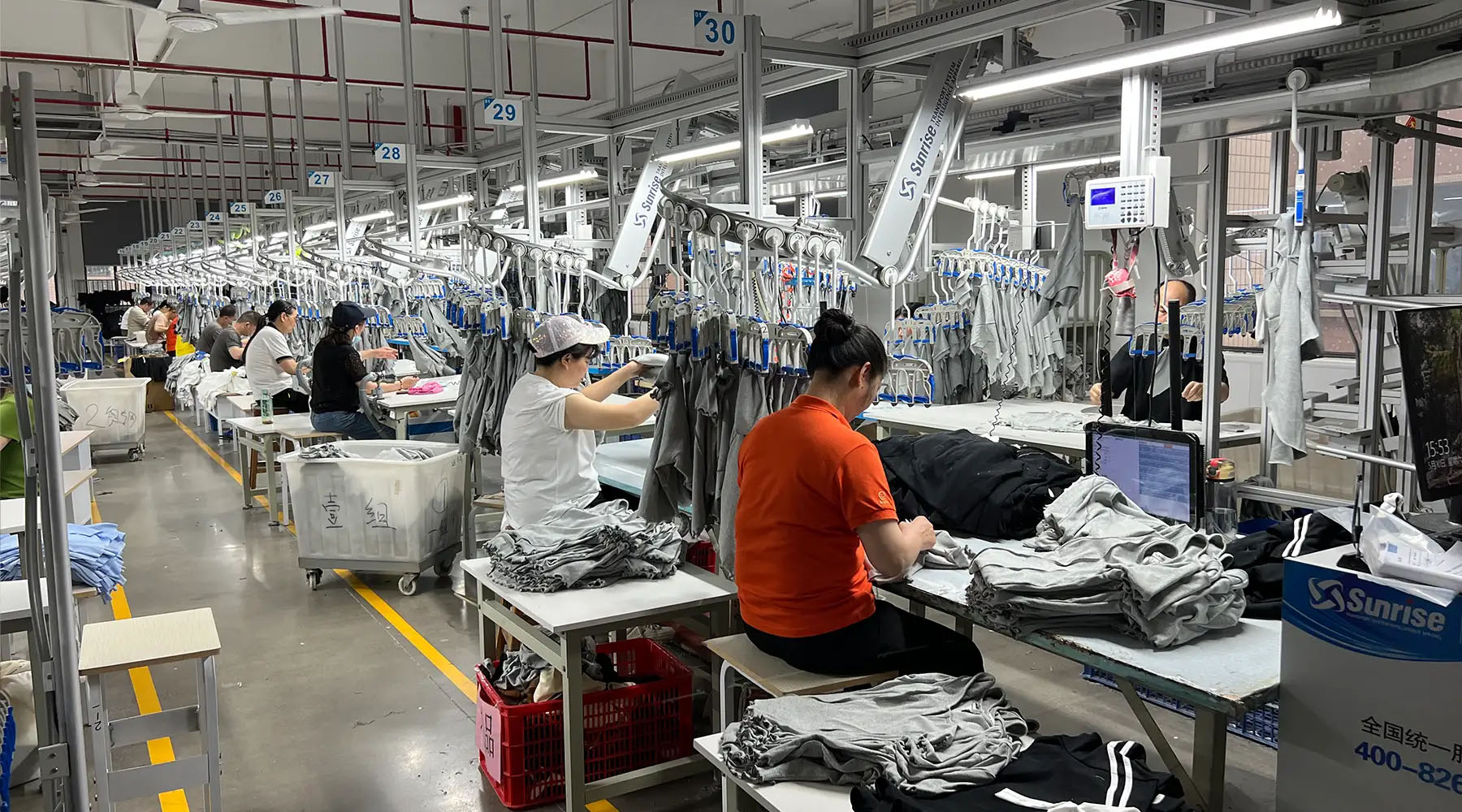
First-article inspection and in-process checks at cutting, sewing and printing are what convert a specification into a record.
The four layers in detail
Chemical safety: what the certificate actually covers
OEKO-TEX certification — in most sourcing conversations the Standard 100 harmful-substance testing scheme — addresses the chemical side of skin contact. It is a certificate about tested articles, not a factory-wide badge. Three questions decide whether it covers your order: whether the certificate describes the fibre composition and weight you are buying; whether it extends to the colourways and to any applied decoration; and whether it is current at the time of shipment. Limit values and test scope sit in the certificate and its annexes, so the copy should be read against the bill of materials rather than filed unopened.
Organic content is a separate chain. An organic cotton claim needs its own certificate and a transaction record linking the fibre to the lot; a harmful-substance certificate does not substitute for it, and a buyer who treats the two as equivalent has bought a claim rather than a verification.
Labels: the visible end of compliance
Labels are where compliance becomes physical. The neck label carries brand identity; the care and content label carries the information the destination market requires. Custom neck labels and hang tags sit inside Qianshiwear's stated customization scope, together with packaging design, size grading and trims, which means label artwork behaves like any other approved document: one version, signed off, and referenced in the production file.
Performance: the part no certificate covers
Shrinkage, colour fastness, pilling, seam strength and print durability are not established by a chemical-safety certificate. They are specified by the buyer and verified by testing. The failure modes are predictable: colour fading after washing, shrinkage or deformation, poor fastness to rubbing, sweat or light, inconsistent sizing between batches, seam strength failure, pilling, print cracking or peeling, loosening embroidery thread and defective hardware.
Each maps to a named production control — reactive dyeing with high-temperature fixation for deeper colour penetration, pre-shrinkage treatment before cutting, anti-pilling weaving or finishing, reinforced stitching at stress points using high-tensile thread, controlled curing time for screen prints and DTG inks, and backing stabilisation to hold embroidery thread tension. The control is the factory's; the acceptance criterion is the buyer's. Writing the criterion before production starts is what turns a control into something the order can be measured against.
Traceability: what makes a reorder auditable
Batch-level records close the file. Qianshiwear's stated quality procedure assigns each order a production batch number, keeps quality records for future reorder reference and documents defect analysis for continuous improvement. For a buyer running repeat drops, that record set is the difference between 'same specification' and 'same tested specification'.
Regional checkpoints across six end markets
Regional requirements are not interchangeable, and they are revised. This guide deliberately does not paraphrase rule texts: a paraphrase that drifts by one data element is worse than no summary at all. The table below names the reference to obtain for each end market and the action that follows inside the order.
| End market | Reference to obtain | Action inside the order |
|---|---|---|
| United States | FTC business guidance, Threading Your Way Through the Labeling Requirements Under the Textile and Wool Acts, which covers labelling of textile and wool products and reflects the latest revisions to the Textile and Wool Rules | Read the current version, map each required element to the label artwork, and approve the artwork before bulk |
| Europe | Current EU fibre-name and labelling rule text from the official EU source | Confirm the fibre wording matches the tested composition; approve a separate EU artwork |
| United Kingdom | Current UK labelling guidance from the official UK source | Obtain and confirm the UK requirement for your garment; keep the approved version in the order file |
| Australia | Current Australian labelling requirement for clothing, from the authority or your importer | Confirm before the first shipment, not before the first reorder |
| Middle East (Gulf) | Destination importer's labelling and language requirements | Confirm language and content requirements with the importer of record; approve artwork accordingly |
| Singapore | The requirement confirmed with the importer of record or the relevant authority | Confirm before the first shipment; record the confirmed version in the order file |
Two rules make the grid work. First, artwork approved for one market is not automatically valid for another; separate markets, separate approvals. Second, the label requirement and the chemical certificate answer different questions — a label can be correctly printed on a garment whose fabric certificate does not cover it, and the reverse is equally possible.
How the application changes the specification
Compliance requirements shift with the application as much as with the market, because the risk being managed changes.
Activewear. The garment is worn against skin under load and washed often, so performance testing carries more weight than in any other category: fastness to rubbing, sweat and light, shrinkage after repeated washing, pilling resistance and seam strength at stress points. A buyer in this category should write those criteria into the purchase order and ask for the pre-shipment wash test result on representative samples.
Corporate uniforms. The dominant risk is drift, not chemistry. The same garment is ordered again next year, in more colourways, for a larger headcount, so the file has to survive reorders: measurement verification across all colourways, a retained approved sample, batch numbers on every shipment, and label artwork that stays version-controlled when the corporate identity changes.
Music and event merchandise. Print durability is the specification that matters, and the timeline is usually the shortest. Print cracking or peeling is a curing problem, and curing is a production variable rather than a certificate issue; screen print and DTG decoration each need their specified curing conditions before packing. Qianshiwear's stated decoration scope covers screen printing, DTG, embroidery, puff print, rhinestone and applique, which means a single order can carry more than one durability profile and should be specified per decoration method, not per garment.
The common thread: a compliance file built for one application rarely transfers intact to another, even when the blank t-shirt itself is identical.
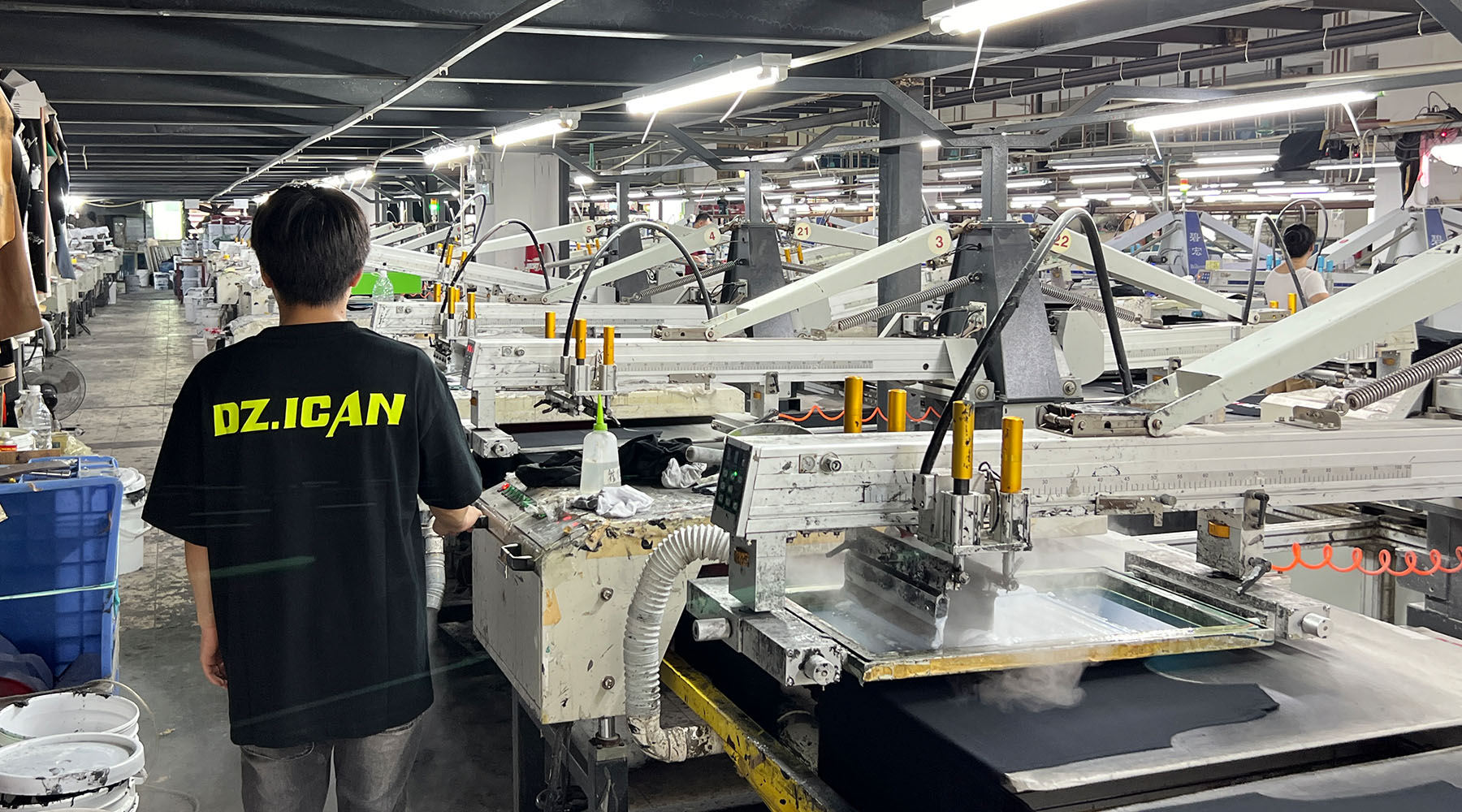
Where decoration is applied, durability is governed by curing and handling in production rather than by a fabric certificate.
The six-step compliance checklist
Step 1 — Define the compliance scope before the quote. Write down the end market, the fibre composition and weight, the decoration methods, the trims and hardware, and whether the garment is worn against skin. Those five fields determine which certificates, tests and label requirements apply. A supplier cannot quote to a scope that has not been defined, and a change to any field after sampling reopens the file.
Step 2 — Request the certificate package and check four fields. Ask for the certificate copy rather than the certificate name, then check the holder, the article or material description, the colourways covered and the validity date. If a field is unclear, ask which party in the chain holds the certificate — garment factory or fabric mill — and obtain the document at that level.
Step 3 — Convert the market rule into approved label artwork. The output is a version-controlled artwork set: neck label, care and content label, hang tag and any market-specific panel. Qianshiwear produces custom neck labels and hang tags within its customization scope, so approved artwork moves straight into production; that convenience is exactly why the approved version, not the latest version, must be the one referenced on the purchase order.
Step 4 — Write performance acceptance criteria into the purchase order. Specify shrinkage, colour fastness, pilling and seam strength with the test method, the sample size and who tests. Request the pre-shipment wash test on representative samples, and repeat the same test on the reorder.
Step 5 — Fix the inspection and documentation protocol. Qianshiwear's stated final inspection applies AQL 2.5 sampling to finished goods, with measurement verification across all colourways, first-article inspection at cutting, sewing and printing, and 100% fabric inspection on arrival covering weight, width, colour consistency and shrinkage potential. Third-party inspection by SGS or Intertek can be arranged at the client's cost, and a buyer's own on-site inspection is welcomed. Decide before production which of these you will use, because the protocol determines what the closing documents look like.
Step 6 — Carry the file into every reorder. Re-verify certificate validity at reorder, keep the approved sample as the performance reference, and store batch records against the original order number. A compliance file is only useful if the next order can be compared against it.
Low-MOQ and quick-sample projects
Compliance work is mostly documentation plus a small number of tests, so it does not shrink with order quantity. That matters for small runs: Qianshiwear's minimum order quantity is 50 pieces per colour per design, which means a first drop can carry roughly the same paperwork as a far larger programme. Sample orders are settled at 100% payment upfront as a non-recurring engineering fee, so the sample stage is also the natural point to close the compliance file rather than a step to skip because the order is small.
Three practices keep a fast, low-MOQ project compliant. First, run certificate and label review in parallel with fit sampling: fit comments and label approvals both take rounds, and running them in sequence is what makes small orders late. Second, confirm the bulk fabric lot before the deposit — a sample approved from one lot does not describe the lot that will be cut for bulk, so request the fabric inspection record on the production lot and check that it traces to the certified supply. Third, record the approved sample as the performance reference and not just the shape reference, because the reorder question is whether the new batch matches the tested sample on shrinkage, fastness and measurements.
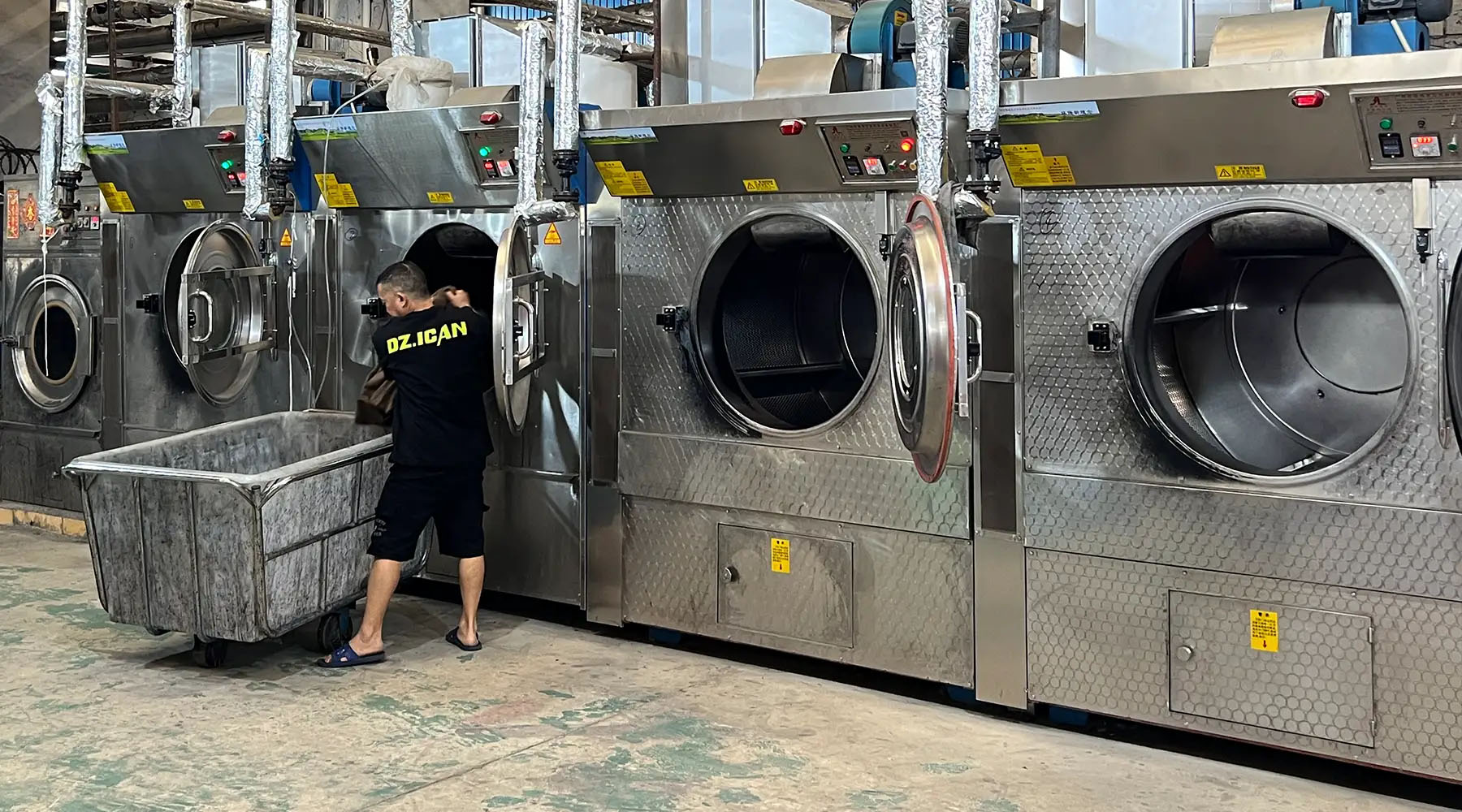
Wash behaviour is one of the few performance criteria a buyer can verify on a physical sample before bulk is cut.
Purchasing terms and acceptance criteria that reference compliance
Documentation only has force if the purchase order points to it. Four clause groups are worth building once and reusing.
Attached documents. List the certificate copy, approved label artwork, approved reference sample, test list and inspection protocol as attachments, each with a version or date.
Delivery terms. Qianshiwear quotes EXW (Guangzhou factory), FOB (Guangzhou or Shenzhen port), CIF to major global ports, or DDP door-to-door on request. The term matters for compliance because inspection timing moves with it: an EXW order is inspected at the factory before collection, while a DDP order keeps documentation flowing all the way to the final destination.
Payment terms. Sample orders run at 100% upfront as a non-recurring engineering fee; bulk orders run at 50% deposit with the 50% balance before shipment, paid by bank T/T, Alibaba Trade Assurance, Alipay or WeChat Pay. If the compliance documents are a condition of the balance payment, state that in the order rather than in an email thread.
Acceptance criteria. Qianshiwear's stated acceptance route is pre-shipment inspection at the factory with photo or video reports on request, third-party inspection by SGS or Intertek at the client's cost, and on-site buyer inspection for bulk orders. Add the performance specification and the AQL 2.5 sampling basis to the same clause, so that a passed inspection means both that the measurements are right and that the documents are present.
What structured quality control changes, and what it costs
When buyers compare quotes, the difference between a structured QC programme and an ultra-budget producer shows up in performance data rather than in the price line. The comparison Qianshiwear draws between its own production standard and a low-cost factory is summarised below; it describes two production approaches, not a market-wide benchmark.
| Dimension | Structured QC approach | Ultra-budget approach |
|---|---|---|
| Defect rate | Typically maintained below 5% | Often exceeding 10–15% |
| Shrinkage | Generally within 5–8% | 8–12% or higher |
| Colour fastness | Typically Grade 3–4 | Grade 2–3 |
| Wash durability | Typically 30–50 washes with minimal fading | Noticeable fading after 10–15 washes |
| Anti-pilling | Typically Grade 3 | Grade 1–2 |
| Unit cost | Typically 20–40% higher initially; total project cost often comparable once return rates and replacements are counted | Lower per unit, with higher return rates and more frequent replacement |
The buyer-relevant point is that these are acceptance criteria you can test against a sample, not adjectives. A supplier that will not state figures in these terms is asking to be judged on something else.
Three order profiles that test the checklist
A multi-year quarterly reorder programme. Qianshiwear reports a three-year ongoing partnership with quarterly reorders. In a programme of that shape the compliance file is the product: the certificate has to be re-verified each year, the label artwork has to survive brand updates, and batch records have to let a fourth-year drop be compared with the first. A one-off certificate audit at the start of a three-year relationship is not a compliance position; an annual re-check is.
A two-year annual contract across two markets. Qianshiwear reports a two-year ongoing annual contract for the UK and Germany — one product, two markets, therefore two label artworks, two rule references, one certificate and one performance specification. The recurring failure mode is a single 'Europe' artwork reused for both, approved once and never re-versioned.
A one-year programme with reorders. Qianshiwear reports a US programme ongoing for a year with reorders placed. The US-specific reference is the FTC's Textile and Wool Acts guidance, so the label check is a reading of that document against the artwork, not a recital of it in an email. In a reorder-driven programme, the second cycle is the useful test: the first order receives attention, the reorder reveals whether the documentation was actually stored.
Frequently asked questions
Does an OEKO-TEX certificate held by my factory automatically cover my custom blank t-shirt order?
No. The certificate covers the articles, materials and colourways described in it, for the period stated. Before relying on it, check four things: the holder's legal name matches the party you are paying; the article description matches your fabric composition and weight; the colourways and any applied decoration fall inside the scope; and the validity date covers your production and shipment window. If those fields do not match, ask whether the certificate is held at fabric-mill level and obtain the document at that level. Limit values and test scope sit in the certificate and its annexes, so read the copy against the bill of materials rather than filing it unopened.
Can a manufacturer produce the neck labels and hang tags my market's labelling rules require?
Label production is a manufacturing capability rather than a certificate, so the question is whether the factory's customization scope includes it. Qianshiwear produces custom neck labels and hang tags as part of its stated customization scope, alongside packaging design, size grading and trims. What the buyer supplies is approved artwork; what the buyer should receive back is a label sample and a confirmed artwork version before bulk. The content of that artwork comes from the destination market's rule text, which the buyer or importer should read directly.
Does compliance documentation add cost to a low-MOQ order?
Documentation effort does not scale down with quantity, so on a small run it represents a larger share of the order value. Qianshiwear's minimum is 50 pieces per colour per design, sample orders are settled at 100% upfront as a non-recurring engineering fee, and third-party inspection by SGS or Intertek is arranged at the client's cost. Separately, the production standard itself affects unit price: structured QC typically costs 20–40% more per unit than ultra-budget production, with total project cost often comparable once return rates and replacements are counted.
How can a quick sample still meet certification requirements?
By running the certificate and label review in parallel with fit sampling rather than after it, and by treating the sample as a document event as well as a shape event. Confirm before sampling which certificate is expected to cover the bulk fabric; check that certificate's article scope against the sample's composition, weight and colourway; and store the approved sample as the performance reference. When the bulk fabric lot arrives, check that its inspection record traces to the certified supply, because an approved sample from one lot does not describe a different lot.
What purchasing terms and acceptance criteria should reference compliance documents?
Attach them. Qianshiwear's standard terms are EXW Guangzhou, FOB Guangzhou or Shenzhen, CIF to major global ports, or DDP door-to-door on request; bulk orders run at 50% deposit and 50% before shipment, with sample orders at 100% upfront. Acceptance is built on pre-shipment inspection at the factory with photo or video reports on request, third-party inspection by SGS or Intertek at the client's cost, on-site buyer inspection welcomed for bulk orders, and AQL 2.5 sampling on finished goods. Reference the certificate copy, approved label artwork, performance specification and inspection protocol as version-dated attachments, so that a passed inspection covers both measurements and documents.
How does a compliance file hold up across a multi-year supply relationship?
It holds up if it is maintained rather than archived. Qianshiwear's quality procedure assigns each order a production batch number, retains quality records for reorder reference and documents defect analysis — the record set a buyer needs to compare a fourth drop against a first. Qianshiwear also reports ongoing programmes structured as a three-year partnership with quarterly reorders, a two-year annual contract for the UK and Germany, and a one-year US programme with reorders. The rhythm is the same in each case: re-verify the certificate's validity each year, re-version the label artwork when the market rule or the brand changes, and keep the approved sample accessible. Buyers who want to see how that file is assembled in practice can request the documentation package and current product brochure from the Qianshiwear team at sales@qianshiwear.com.
Conclusion
The certification question has a short answer and a long one. The short answer is that an OEKO-TEX certificate addresses chemical safety for the articles it names, and nothing beyond that. The long answer is the file around it: the label artwork that matches your market's current rule, the performance criteria written into the purchase order, the inspection protocol that produces usable records, and the batch traceability that lets a reorder be compared with the original.
For an order placed with a China factory, the method is the same whether the run is 50 pieces or 50,000: define the scope, verify the certificate rather than the logo, convert the market rule into approved artwork, write the performance criteria down, fix the inspection protocol, and carry the file into the next order. Compliance costs less as a process than as a discovery six weeks before a launch.
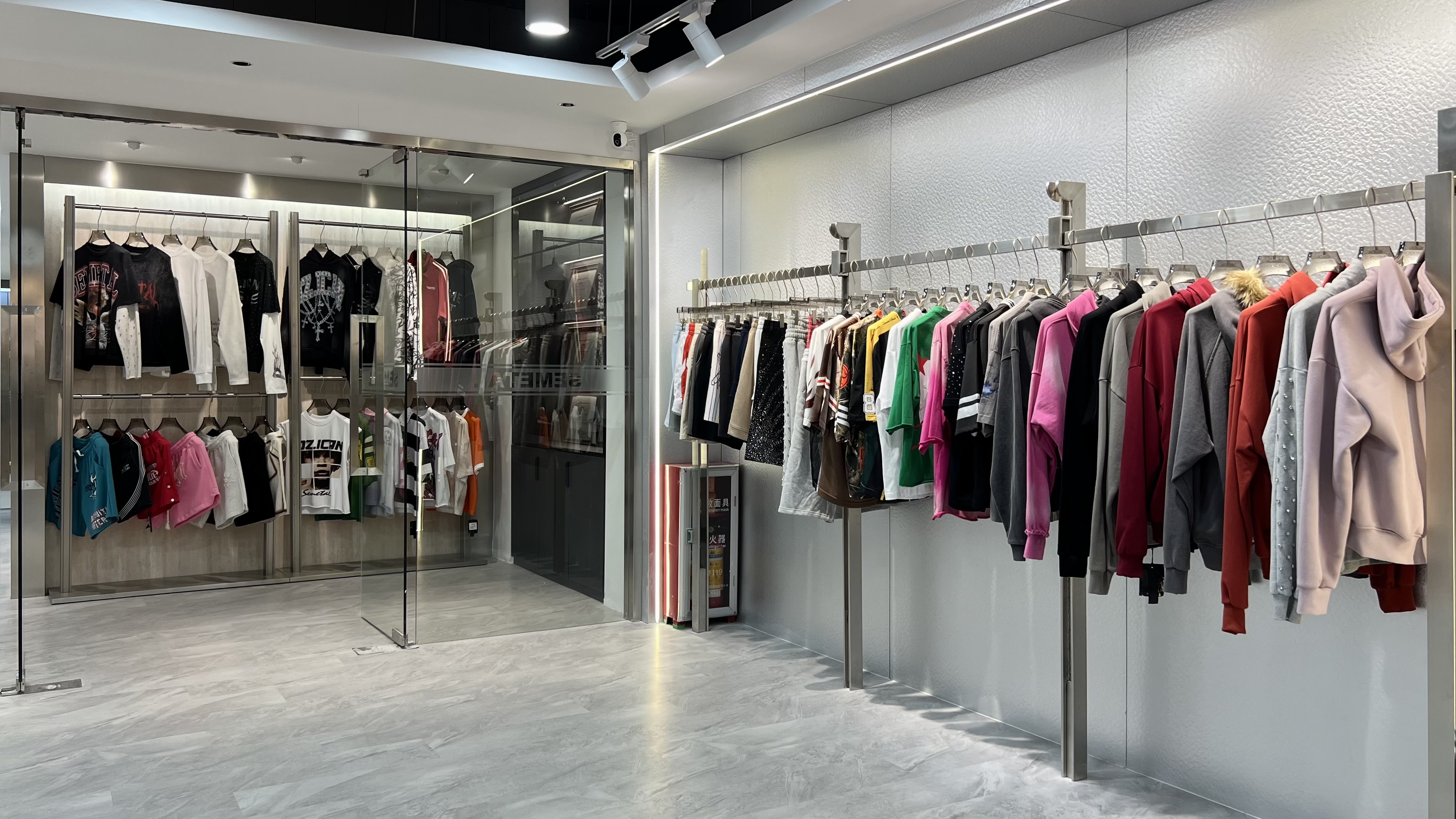
Next step: review the file before you place the order. Qianshiwear (Guangzhou Qianshi Apparel Co., Ltd.) supplies custom blank t-shirts, oversized fits, jerseys, hoodies and private-label programmes with custom neck labels, hang tags and packaging, from a minimum of 50 pieces per colour per design.
Download the company brochure and product catalogue: Qianshiwear brochure (PDF)
Contact the team: sales@qianshiwear.com · Tel / WhatsApp +86 18148939572 · Room 201, 2nd Floor, No.7 Shafeng Xijiu Street, Baiyun District, Guangzhou City, Guangdong Province, China · qianshiwear.com
Have Questions or Need More Details?
Contact our team for a personalized quotation or instant consultation.
Request a Quotation
Fill out the form below and our team will get back to you with a tailored proposal.
WhatsApp Direct Chat
Prefer to chat in real-time? Message us on WhatsApp for instant assistance & quick answers.
- Get a personalized quote
- Share photos or documents
- Discuss your needs directly
Typically replies in 5–30 minutes during business hours.