
Custom Blank T-Shirts: A Foundational Sourcing Guide for Repeat-Order Programs

That definition sounds simple, but it is where most sourcing decisions are actually made. A brand that fixes the blank properly can change decoration methods, add a colourway or move from a 50-piece test to a seasonal drop without rebuilding the product. A brand that leaves the blank vague will discover that its second order, even from the same factory, is a subtly different t-shirt.
This guide is written for buyers at the decision and execution stage: brand owners, private-label founders, and uniform or merchandise managers who already know they need blanks and now have to specify, sample, approve and reorder them. It covers what the category is, the five layers a repeatable program contains, the wear-launder-reorder cycle that governs long-term supply, and the commercial terms that should be agreed in writing before the first bulk order.
Problem Definition: The Blank, Not the Print, Decides Whether a Program Scales
Decoration defects get the attention, but the causes usually sit one layer lower, in the blank itself. A print cracks because fabric surface and ink cure were never matched; a body shrinks a whole size because the fabric was cut without a pre-shrinkage allowance; shoulders sit differently in the second drop because the fit block was never written down. Each of those is a specification failure, not a printing failure.
Three gaps account for most of them:
- An unlocked specification. If fabric composition, fabric weight, fit block, neck rib, trims and size grading are not documented, the next production run is effectively a new product that happens to share a name.
- An untested combination. A decoration method that performs on one fabric may not perform on another. Curing time for screen prints and DTG inks, and embroidery backing stabilisation for thread tension, are production controls rather than finishing touches.
- No reorder record. Without a production batch number, a retained approved sample and quality records, a reorder is reconstructed from memory and email threads.
The commercial consequence is measurable. In supplier comparison material covering structured quality-controlled production versus low-cost mass production, defect rates are typically maintained below 5% in the structured model and often exceed 10-15% in the low-cost model; garment shrinkage typically falls within 5-8% instead of 8-12% or higher, and colour fastness typically reaches Grade 3-4 instead of Grade 2-3. The structured option usually carries a 20-40% higher initial per-unit cost, but total project cost is often comparable or lower once return rates, customer complaints and replacement frequency are counted. For a brand that reorders the same blank four times a year, that difference is paid repeatedly.
Industry Background: Flat Export Value, Rising Specification Expectations
China's apparel exports reached USD 159.14 billion in 2024, a 0.3% year-on-year increase, according to China customs figures reported through industry sources. A market growing at that pace does not reward suppliers for volume alone. When total export value is essentially flat, the competitive ground shifts to consistency, documentation and the ability to serve smaller, more frequent, more design-led orders.
Demand at the product level tells a different story from the export aggregate. The global t-shirt market was valued at over USD 45 billion in 2024 and is expected to keep growing at a CAGR of 6.2% through 2030, according to commercial research published by New Asia Garment Research. That figure should be treated as directional rather than exact, but the direction matters for buyers: the category is expanding while the supply side is being judged on repeatability rather than raw output.
Most blanks are sourced from clusters, and Guangzhou, Guangdong remains one of the densest apparel production environments in China. Guangzhou Qianshi Apparel Co., Ltd, trading as Qianshiwear, is an apparel manufacturer established in 2014 and based in Guangzhou, Guangdong, China. The company produces T-shirts, hoodies, sweatshirts, sweatpants, joggers, tracksuits, polos, jerseys, jeans, caps and outerwear for OEM, ODM and private-label programs, and reports that 85-90% of its production is exported to the EU, USA, Australia and the UK. Its published monthly production capacity is 250,000 units, and its company-reported annual output is 3,000,000 units.
The operating structure behind those numbers is relevant to a reorder buyer. Qianshiwear reports 200-250 production line workers alongside 80-100 sales representatives, order coordinators, operations staff, designers and administrative staff, plus a 15-person design team. Its space is split across a 600 square metre sewing area, a 700 square metre warehouse, a 1,500 square metre finishing area and a 200 square metre packing area. For repeat programs, the office side of that structure matters as much as the sewing floor: specification sheets, approval records and batch documentation are office outputs.
Detailed Solution: Five Layers of a Repeatable Custom Blank T-Shirt Program
A blank program that survives ten reorders is built in five layers. Each layer produces a document or a physical reference that the next order depends on.
1. Specification layer: the sheet that defines the product
The specification sheet is the single most valuable document in the program. It should fix, at minimum:
- Fabric composition and fabric weight, expressed in a unit both sides agree on.
- Knit structure and surface character, so the hand-feel can be matched later.
- Fit block: regular, oversized or boxy fit, with measurements by size rather than adjectives.
- Neck construction, including rib and any neck tape, because the neck is the first place a cheap blank fails.
- Stitching and reinforcement at stress points, plus the thread type used there.
- Trims and hardware: drawcords, eyelets, zips and their tested pull and closure performance.
- Size grading rules and tolerances.
- Shrinkage allowance, addressed through pre-shrinkage treatment before cutting rather than after the first customer complaint.
- Colour references matched to Pantone, with the dyeing route agreed (reactive dyeing with high-temperature fixation is used to achieve deeper colour penetration).
Qianshiwear's stated customisation scope covers garment style, fabric type and weight, Pantone colour matching, logo application, garment finishing, custom neck labels and hang tags, packaging design, size grading, and trim and hardware. That is the raw material for a specification sheet; the buyer's job is to convert it into written limits and confirm them on a physical sample.
If the brief calls for organic cotton, treat the claim as a certification question rather than a fabric description. Name the certification scheme in the specification and require certificate evidence, including the certificate holder, the issuing body and the validity period, before the claim appears on any label.
2. Decoration layer: methods are chosen against the blank, not before it
Qianshiwear reports decoration capability in screen printing, DTG, embroidery, puff print, rhinestone and applique, together with custom neck labels, hang tags and packaging. Each method interacts differently with a given fabric, and the interactions are controlled in production rather than corrected afterwards: proper curing time for screen prints and DTG inks, and embroidery backing stabilisation to hold thread tension.
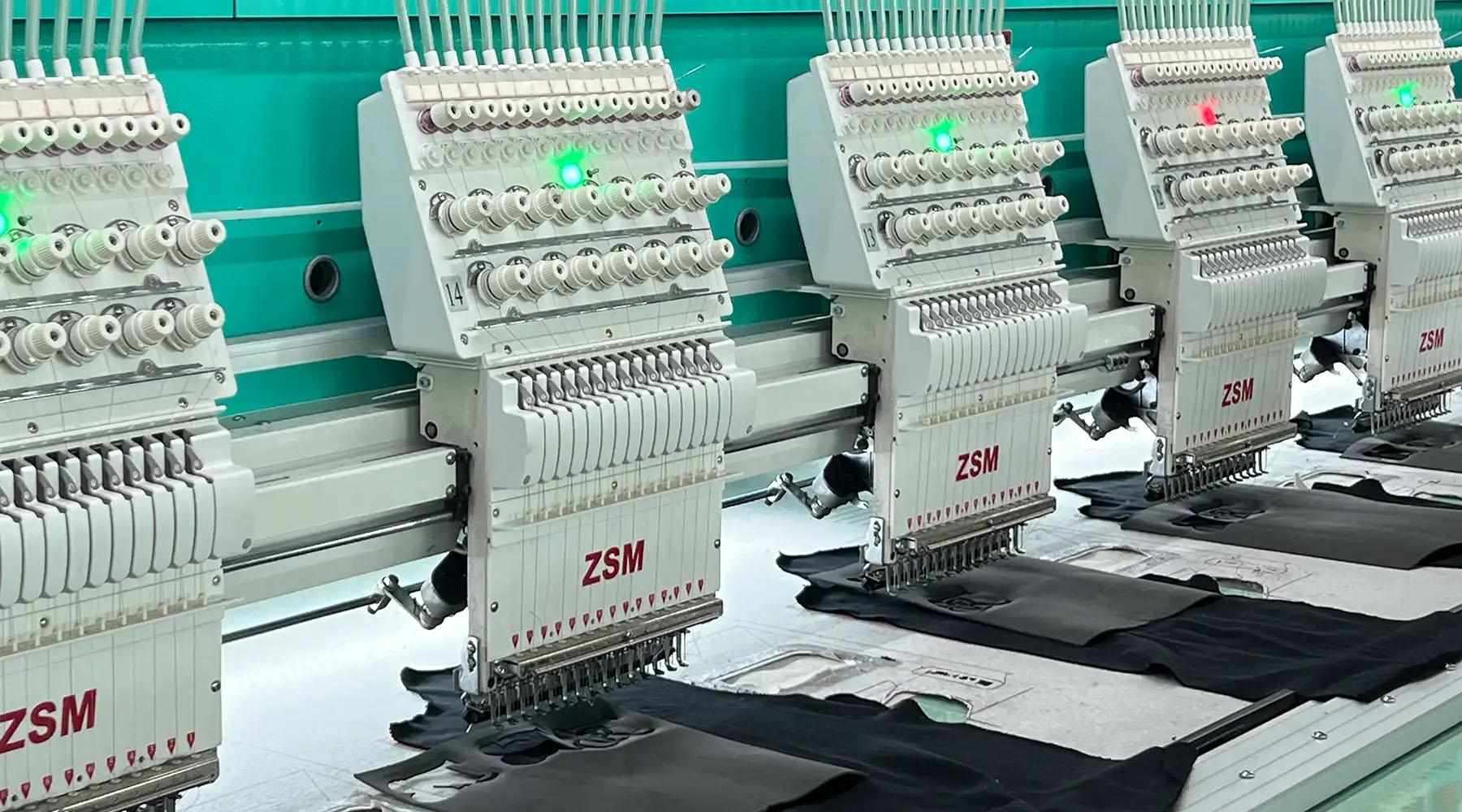
Two practical rules follow. First, approve decoration on the approved blank, never on a stock tee of a different weight. Second, treat custom neck labels and hang tags as part of the product specification, not as packaging extras: they are produced, attached and inspected in the same production flow, and they carry the information that makes the garment sellable in its destination market.
3. Quality layer: inspection points, not inspection promises
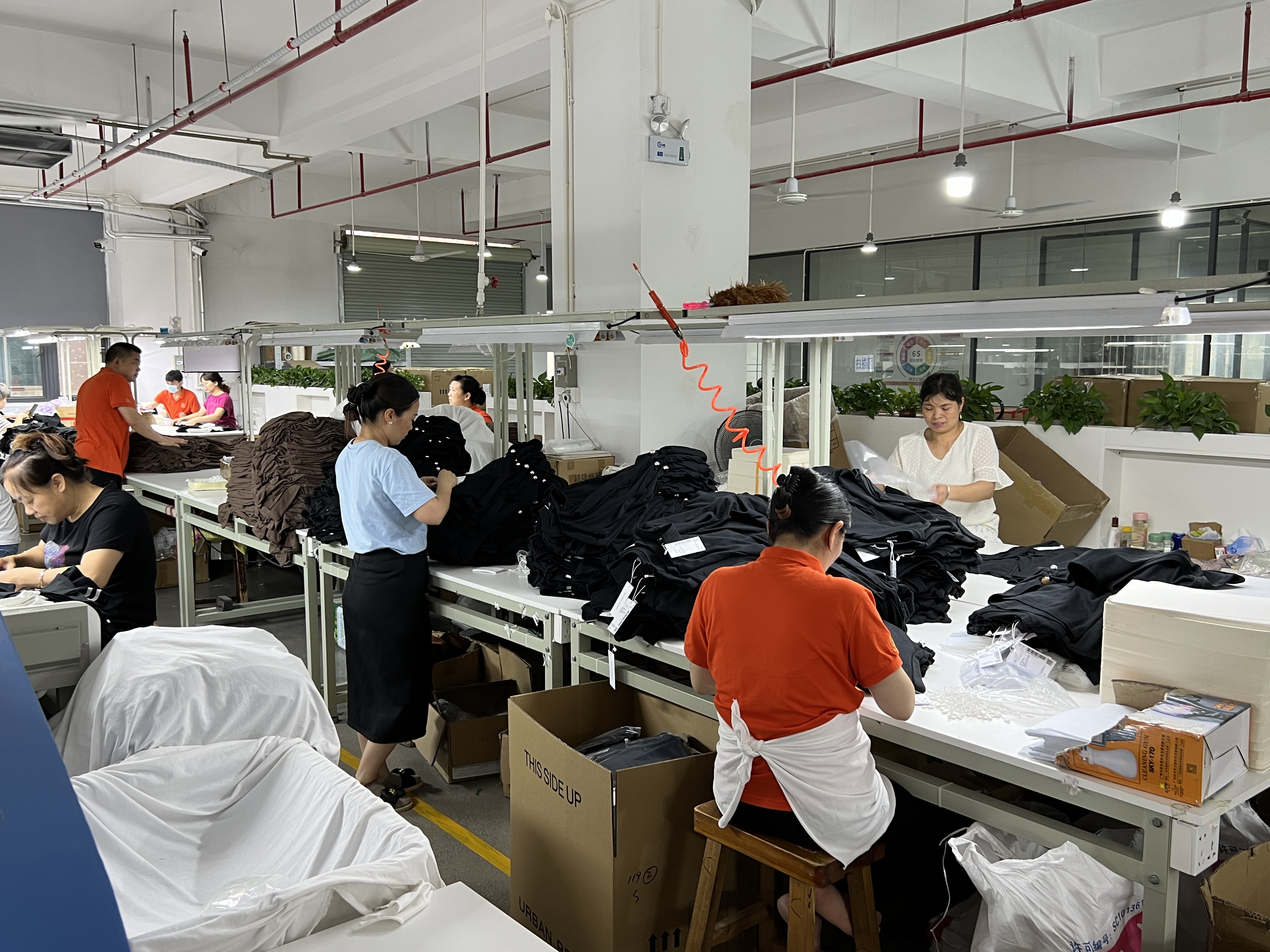
A quality claim becomes verifiable when it is attached to a named inspection point. In Qianshiwear's documented control structure there are five:
- Incoming material control: 100% fabric inspection on arrival, checking weight, width, colour consistency and shrinkage potential, with hardware and trim samples tested before bulk production is approved.
- In-process control: first-article inspection at the cutting, sewing and printing stages, random patrol checks on the lines, and real-time adjustment of embroidery tension and print alignment.
- Final inspection: AQL 2.5 sampling applied to finished goods, pre-shipment wash tests on representative samples, and size and measurement verification across all colourways.
- Traceability: a production batch number per order, retained quality records for future reorders, and documented defect analysis used for continuous improvement.
- Third-party support: inspection by SGS, Intertek or equivalent arranged at the client's request and cost, plus lab testing for specific performance requirements such as colour fastness and tensile strength.
4. Commercial layer: MOQ, terms and payment
The commercial framework determines how much risk a brand carries while it is still testing. Qianshiwear's stated terms are a minimum order quantity of 50 pieces per colour per design; delivery on EXW (Guangzhou factory), FOB (Guangzhou or Shenzhen port), CIF to major global ports, and DDP door-to-door on request. Sample orders are paid 100% upfront as a non-recurring engineering fee; bulk orders run on 50% deposit and 50% balance before shipment. Payment is accepted by bank T/T, Alibaba Trade Assurance, Alipay and WeChat Pay.

A 50-piece-per-colour-per-design minimum is the part of that framework that changes sourcing behaviour. It allows a brand to test a fit block, a fabric weight and a decoration method on real production equipment before committing to a drop, which is a materially different risk profile from a factory that only opens a line at several thousand pieces.
5. Continuity layer: what makes order two match order one
Continuity is a records problem before it is a capacity problem. The documents that make a reorder safe are unglamorous: the signed specification sheet, the retained approved sample, the decoration placement approval, the label artwork approval, the batch number, the inspection report and the measurement record. Qianshiwear assigns a production batch number to each order and maintains quality records for future reorder reference.
Programme structures reported by long-standing buyers show what continuity looks like in practice: a US-based project has been running for one year with reorders placed; a UK and Germany programme operates under a two-year ongoing annual contract; and a global partnership has continued for three years with quarterly reorders. Quarterly reorder cycles are the harder test, because they compress the interval between orders and surface specification drift quickly.
Step-by-Step: From Blank Selection to a Confirmed Reorder
Step 1: Start from the end use, not the fabric
Define what the blank has to survive before choosing anything else. A gym tee is laundered far more often than a corporate event tee; a tour tee has a hard deadline and no second production window; a uniform program needs size consistency across a large number of individual wearers. The end use sets the fabric weight, the fit block and the durability threshold.
Step 2: Write a one-page blank specification
Convert Step 1 into the document described in the specification layer. Keep it to one page with numbers, not adjectives. Add the decoration method and placement, the label and hang tag artwork, and the packaging instructions.
Step 3: Test at the minimum order quantity, then launder the sample
With a 50-piece-per-colour-per-design minimum, a real production test is affordable. Wash the sample the way the end user will, and measure it afterwards. Judging a blank straight out of the poly bag tells you almost nothing about the second order.
Step 4: Approve decoration on the approved blank
Run the print or embroidery on the actual approved fabric, at the actual placement, with the actual ink or thread. Keep that piece as the decoration reference. Approving a print on a different blank is the most common source of a reorder dispute.
Step 5: Close the compliance and labelling file
Confirm what the label must say for the destination market and who produces it. For product bound for the United States, the Federal Trade Commission publishes guidance titled Threading Your Way Through the Labeling Requirements Under the Textile and Wool Acts, which covers labeling requirements for textile and wool products and reflects the latest revisions to the Textile and Wool Rules. Read the applicable requirements from that document rather than from a supplier's summary, and confirm that the manufacturer can produce and attach the compliant neck label, hang tag and origin information.
If OEKO-TEX has been specified, verify it as a document: certificate number, issuing body, certified scope and validity period, checked with the issuer. A certificate image on a website is a marketing asset, not verification.
Step 6: Agree acceptance criteria and payment terms in writing
Fix the inspection method (AQL 2.5 sampling is the working standard in the structure described above), the pre-shipment reporting format (photo and video reports are available on request), whether third-party inspection will be used, and the payment schedule. Confirm that buyer on-site inspection is welcome before bulk orders, because that single clause changes how a factory schedules its lines.
Step 7: Log the result and set the reorder trigger
Record the batch number, the measured shrinkage, the wash result and any defect notes. Then define the trigger for the next order: sell-through rate, a wash-feedback threshold, or a calendar date ahead of a drop. A reorder readiness file should contain:
- Signed specification sheet with tolerances.
- Approved bulk sample and approved decoration sample.
- Approved label and hang tag artwork.
- Production batch number and inspection report.
- Wash-test result and measurement record.
- Agreed payment, delivery and acceptance terms.
The Wear-Launder-Reorder Cycle: How a Blank Earns Its Second Order
A blank is not proven at delivery. It is proven after the end customer has worn and washed it several times, which means the reorder decision rests on a small set of observable indicators: shrinkage, colour fastness to rubbing, sweat and light, pilling, print cracking or peeling, embroidery thread loosening, seam strength at stress points, and size consistency across production batches.
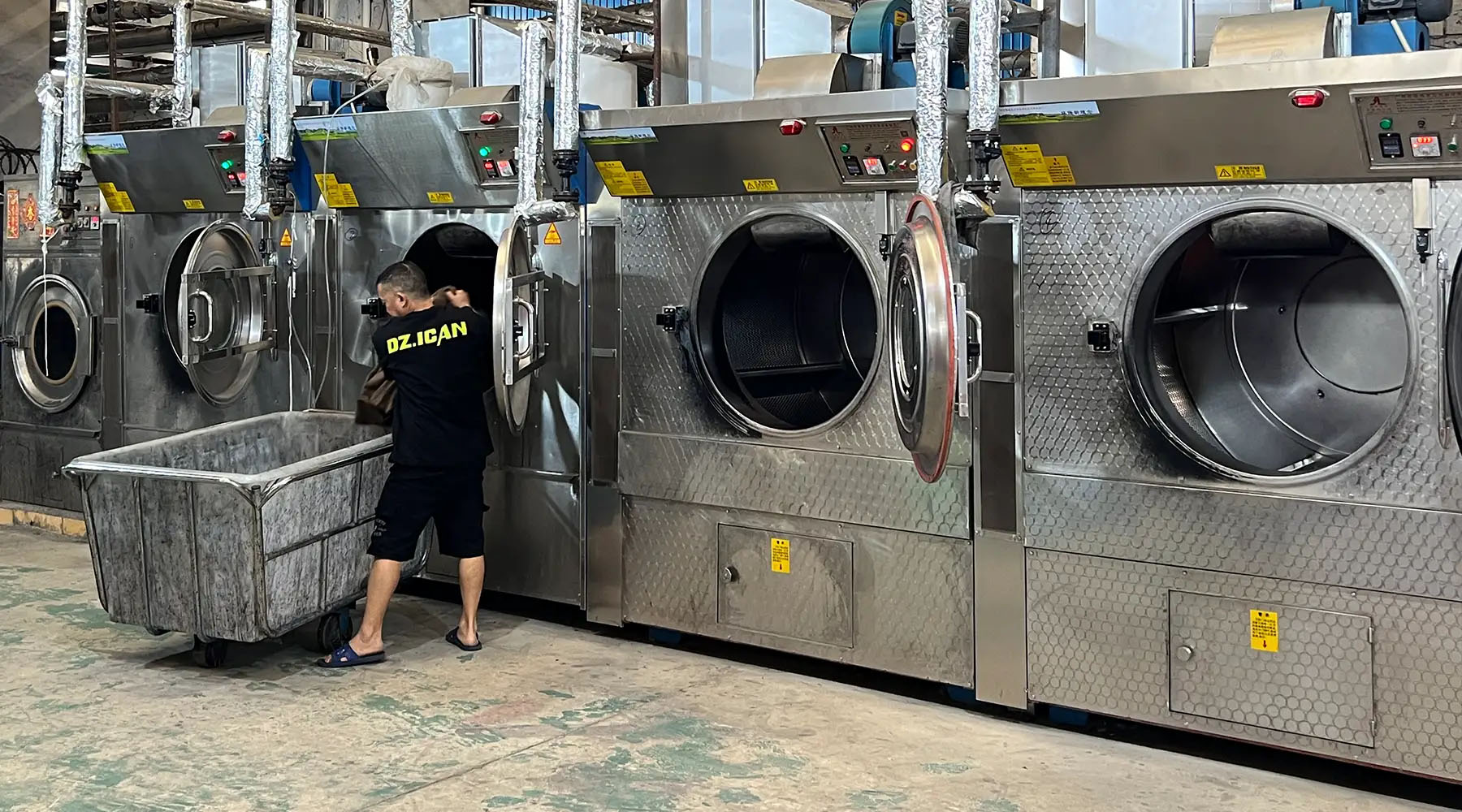
Typical performance gaps reported in supplier comparison material give buyers a working benchmark: a structured quality program generally holds shrinkage within 5-8% and supports 30-50 washes with minimal fading, against 8-12% or higher shrinkage and noticeable fading after 10-15 washes in low-cost mass production; colour fastness typically sits at Grade 3-4 against Grade 2-3, and anti-pilling performance at Grade 3 against Grade 1-2. Treat these as ranges to test against, not as guarantees, and confirm them on your own sample.
The cycle closes like this: wear and launder the first drop, score the indicators, compare them with the batch record, and then either reorder against the same specification or amend the specification deliberately. The failure mode to avoid is reordering without comparing, which is how a program drifts one fabric weight at a time.
Use Cases: Where Custom Blank T-Shirts Do Different Jobs
Streetwear
Streetwear lives on fit and hand-feel, which makes the oversized and boxy fit blocks the centre of the specification. Decoration is usually the brand signal: screen print, puff print, rhinestone or applique on a blank that holds its shape. Reorder patterns follow drops, so the spec sheet and the batch record carry more weight than any single print run.
Corporate uniforms
Uniform programs are a size-consistency problem before they are a design problem. Measurement verification across all colourways, a stable fit block and embroidery that survives industrial laundering matter more than fashion detail. These programs typically reorder annually against the same specification, which makes the retained sample the reference document.
Promotional merchandise
Promotional blanks are cost-sensitive and deadline-driven, and the run is often small. A minimum of 50 pieces per colour per design allows a small organisation to order branded product without over-committing, while the specification still fixes fabric weight and neck construction so the item does not read as disposable.
E-commerce apparel brands
For online sellers, a blank that shrinks or fades converts directly into returns and review damage. The specification emphasis here is dimensional stability, colour fastness and consistency between production batches, because the customer cannot inspect the garment before buying it.
Fitness and gym wear
Gym apparel is laundered more frequently than almost any other category and is exposed to sweat. Colour fastness, shape retention and seam strength at stress points become the deciding criteria, and reinforced stitching with high-tensile thread is a specification item rather than an upgrade.
Music and event merchandise
Tour and event blanks are governed by the calendar. Multiple colourways have to be produced, labelled and shipped against a fixed date, so decoration methods that suit short runs, plus pre-agreed inspection and delivery terms, matter more than marginal unit savings. This is the category where a missed ship date cannot be recovered.
Comparison Table: Structured Quality Production vs. Low-Cost Mass Production
The table below compares two supplier models rather than two named companies. It uses performance ranges reported in supplier comparison material and is intended as a decision framework, not a ranking.
| Comparison point | Structured quality-controlled production | Low-cost / ultra-budget mass production |
|---|---|---|
| Inspection protocol | Multi-point inspection: incoming material, in-process and final sampling, with quality checks based on AQL standards | Limited or inconsistent inspection; no formal quality protocol |
| Defect rate | Typically maintained below 5% | Often exceeding 10-15% |
| Fabric shrinkage | Generally within 5-8% | 8-12% or higher |
| Colour fastness | Typically Grade 3-4 | Typically Grade 2-3 |
| Wash durability | Typically withstands 30-50 washes with minimal fading | Noticeable fading after 10-15 washes |
| Anti-pilling performance | Typically Grade 3 | Typically Grade 1-2 |
| Initial per-unit cost | Typically 20-40% higher | Lower at the point of order |
| Documentation for reorders | Production records and specifications maintained to support consistent reorders; inspection reports on request; third-party inspection can be arranged | Limited documentation; inconsistency between batches; higher likelihood of production discrepancies requiring correction |
| Material efficiency | Structured cutting and sewing help minimise material waste; durable construction keeps products in use longer | Higher waste rates from inconsistent cutting and stitching; shorter product lifespan drives more frequent replacement |
| Best suited to | Brands focused on long-term reputation and consistent customer experience; mid-tier to premium positioning; clients who need reliable quality across reorders | One-off, price-first purchases where replacement cost is not a consideration |
The cost row deserves a second reading. A 20-40% higher unit cost is paid once per garment; a higher return rate is paid on every order, and the brand perception damage from a shrinking or fading blank is not recoverable through a discount.
Purchasing terms at a glance
| Term | Stated position |
|---|---|
| Minimum order quantity | 50 pieces per colour per design |
| Delivery terms | EXW (Guangzhou factory), FOB (Guangzhou / Shenzhen port), CIF (major global ports), DDP (door-to-door) on request |
| Payment structure | Sample orders: 100% upfront (non-recurring engineering fee). Bulk orders: 50% deposit, 50% balance before shipment |
| Payment methods | Bank T/T, Alibaba Trade Assurance, Alipay, WeChat Pay |
| Acceptance criteria | Pre-shipment inspection at the factory with photo and video reports available on request; third-party inspection (SGS, Intertek or equivalent) arranged at the client's cost; buyer on-site inspection welcomed and encouraged for bulk orders |
FAQ: Custom Blank T-Shirts for Repeat Programs
1. What labeling and certification documents should I request before ordering custom blank t-shirts?
Ask for the documents specific to your destination market, not a generic certificate pack. For U.S.-bound product, the Federal Trade Commission publishes Threading Your Way Through the Labeling Requirements Under the Textile and Wool Acts, which covers labeling requirements for textile and wool products and reflects the latest revisions to the Textile and Wool Rules; confirm that the manufacturer can produce and attach the compliant neck label, hang tag and origin information. If OEKO-TEX is specified, request the certificate number, issuing body, certified scope and validity period and verify them with the issuer. Organic cotton claims require scheme-specific certification evidence rather than a fabric description. Qianshiwear produces custom neck labels and hang tags as part of its stated customisation scope, so label content can be approved at sampling stage.
2. Can a manufacturer keep the same blank identical across repeat orders?
Only if the program is documented. The minimum evidence set is a signed specification sheet, a retained approved bulk sample, a decoration approval sample, a production batch number per order and retained quality records. In Qianshiwear's control structure this is supported by first-article inspection at the cutting, sewing and printing stages, AQL 2.5 sampling on finished goods, size and measurement verification across all colourways, and documented defect analysis used for continuous improvement.
3. What is the minimum order quantity, and how are payments structured?
Qianshiwear's stated minimum order quantity is 50 pieces per colour per design. Sample orders are paid 100% upfront as a non-recurring engineering fee; bulk orders run on a 50% deposit with the 50% balance due before shipment. Payment is accepted by bank T/T, Alibaba Trade Assurance, Alipay and WeChat Pay, and delivery can be quoted on EXW, FOB, CIF or DDP terms depending on the destination.
4. How should I test a blank before committing to a bulk program?
Order at the minimum quantity, then launder the sample the way the end user will and measure it afterwards. Check shrinkage, colour fastness to rubbing and sweat, pilling, print adhesion or embroidery stability, and seam strength at stress points. Request pre-shipment wash tests on representative samples, ask for lab testing on colour fastness and tensile strength where the end use demands it, and use third-party inspection by SGS, Intertek or equivalent if independent confirmation is required.
5. How do long-term programs handle capacity and reorders?
Capacity has to be matched to the reorder rhythm, not just to the first order. Qianshiwear's published monthly production capacity is 250,000 units, and its reported programme structures include a US-based project running for one year with reorders placed, a UK and Germany programme under a two-year ongoing annual contract, and a global partnership continuing for three years with quarterly reorders. If you are planning a repeat program, the practical next step is to send your specification and target quantities for a sample quote at sales@qianshiwear.com or via WhatsApp on +86 18148939572, so sampling and reorder timing can be scheduled together.
Conclusion: Specify the Blank Once, Then Buy It Repeatedly
A custom blank t-shirt is a simple product with an unforgiving specification. The brands that scale on it are not the ones with the most decoration options; they are the ones that wrote down the fabric, the fit block, the neck construction, the label content and the acceptance criteria, then held every subsequent order to that record. The wear-launder-reorder cycle is the only audit that matters, and it rewards documentation over promises.
Guangzhou Qianshi Apparel Co., Ltd (Qianshiwear) works within that framework: a manufacturer established in 2014 in Guangzhou, Guangdong, China, offering OEM, ODM and private-label production across T-shirts, hoodies, sweatshirts, joggers, tracksuits, polos, jerseys and outerwear, with a 50-piece-per-colour-per-design minimum, documented multi-point quality control, and quarterly, annual and multi-year reorder programs already in place.
Start with a sample, then plan the reorder
Send your blank specification, target quantities and destination market to request a sample and quotation. The Qianshiwear team can confirm fabric and fit options, decoration routes, label requirements and delivery terms before sampling begins.
Email: sales@qianshiwear.com WhatsApp: +86 18148939572 Download the Qianshiwear catalogue (PDF)Guangzhou Qianshi Apparel Co., Ltd, Room 201, 2nd Floor, NO.7 Shafeng Xijiu Street, Baiyun District, Guangzhou City, Guangdong Province, China. Website: qianshiwear.com
Have Questions or Need More Details?
Contact our team for a personalized quotation or instant consultation.
Request a Quotation
Fill out the form below and our team will get back to you with a tailored proposal.
WhatsApp Direct Chat
Prefer to chat in real-time? Message us on WhatsApp for instant assistance & quick answers.
- Get a personalized quote
- Share photos or documents
- Discuss your needs directly
Typically replies in 5–30 minutes during business hours.