
Custom T-Shirt Compliance by Region: What to Confirm First
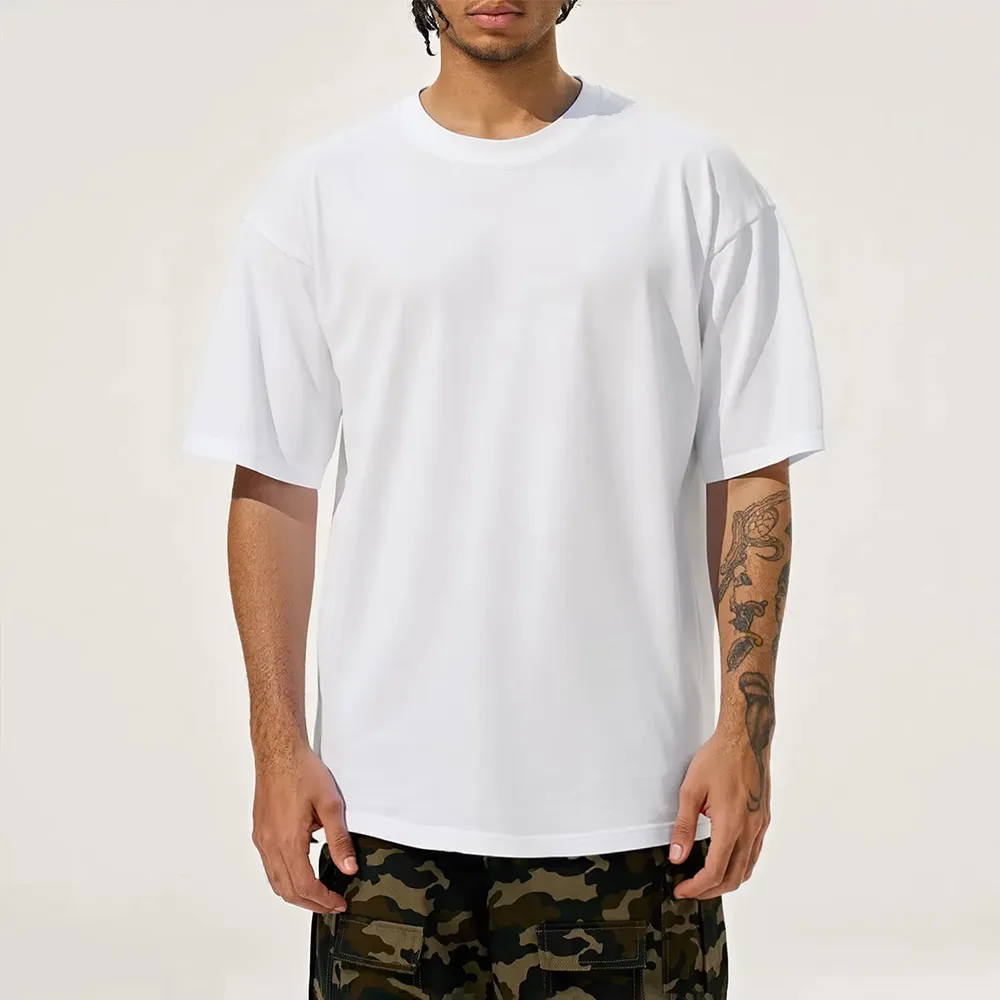
A custom blank T-shirt is not compliant because a supplier holds a certificate. It is compliant when a specific document — issued for a defined product, facility and market, still inside its validity period — matches the order you are about to place. That distinction explains most late-stage disputes between buyers and T-shirt manufacturers, because a supplier document pack can contain five or six document types, each answering a different question, and only one or two of them will actually govern your shipment.
This guide is a confirmation list for buyers ordering custom T-shirts for 18 destination markets: the United States, the United Kingdom, Australia, Germany, France, Italy, the Netherlands, New Zealand, Spain, Sweden, the UAE, Switzerland, Qatar, Luxembourg, Ireland, Singapore, Norway and Denmark. It separates the markets where a named framework is available to you from those where you must establish the requirement yourself, and it shows how to turn each confirmation into a purchasing term and an acceptance criterion.
Supplier context: Guangzhou Qianshi Apparel Co., Ltd, trading as Qianshiwear, was established in 2014 and produces custom T-shirts and other apparel in Guangzhou, Guangdong, China, under OEM, ODM and private-label arrangements. The document references quoted below are company-supplied records with stated numbers, issuers and scopes. They are starting points for your own verification, not a substitute for it.
What "compliant" means for a custom T-shirt order
Compliance for a printed T-shirt splits into four separate questions, and they do not share evidence:
- Label content. Which information must appear on the garment, neck label and hang tag for the destination market, and in what form.
- Restricted substances. Whether dyes, finishes and decoration chemistry on the fabric and trims sit within the destination's limits.
- Product safety and traceability. Whether a technical file exists, whether an in-market responsible operator is identifiable, and whether a finished garment can be traced to a batch.
- Facility social compliance. Whether the site that sews the order has been audited against a labour code, and when.
Each question has its own evidence type. A quality management certificate answers none of the four directly — it tells you the facility runs a documented process. A restricted-substances test report answers only the second. A social audit answers only the fourth. Buyers who treat these as interchangeable end up with a folder of documents and no answer to the question that decides their market entry.
The four-part test for any compliance claim
Before a document is named in a purchase order, test it on four points.
- Document type. Accredited certification, third-party test report, audit report, self-declaration, or product certification. Each carries different weight and a different failure mode.
- Holder and scope. Whose name is on it, which facility and product it covers, which market it addresses. A facility document does not certify a product; one fabric's document does not certify another fabric.
- Validity. Issue date, expiry date, and whether the copy in front of you is the current version.
- Exclusions. What the document deliberately does not cover. This is the point buyers skip, and the point that decides claims.
| Document type | Issued by | What it establishes | What it does not establish |
|---|---|---|---|
| ISO 9001:2015 certification | Accredited certification body | The certified facility operates a quality management system meeting the standard | Not a product certification; says nothing about label content or a specific fabric |
| Azo dye test report | Accredited third-party laboratory | Tested items release no carcinogenic aromatic amines from azo dyes, within the tested scope | Untested colourways, trims and print chemistry fall outside the report |
| amfori BSCI audit report | Licensed third-party audit firm | Social compliance of the audited site against the BSCI Code of Conduct | An audit report, not a certificate; covers one site and one period |
| GPSR self-declaration | The manufacturer, with an EU responsible person | Technical documentation, traceability and safety information are maintained | No issuing body; value depends on the file's completeness and currency |
| CE marking with RoHS testing | Manufacturer declaration supported by accredited laboratory testing | Electronic components meet RoHS substance limits and the CE basis applies | Applies to smart or wearable garments with electronics, not standard T-shirts |
The last row shows why scope matters: a CE and RoHS file held for an electronically heated garment tells you nothing about an ordinary cotton tee. Presenting it as general proof is a scope error, not a small inaccuracy.
United States: labeling is the first gate
For US-bound custom T-shirts the first question is labeling, not fabric safety. The U.S. Federal Trade Commission publishes a business-guidance resource, "Threading Your Way Through the Labeling Requirements Under the Textile and Wool Acts", which covers labeling requirements for textile and wool products and reflects the latest revisions to the Textile and Wool Rules. That document is the reference point for what a U.S.-bound label must carry.
Two consequences follow. First, take the specific data elements from the FTC document itself, in its current version, or from your compliance adviser — not from a supplier's summary and not from a template carried over from a previous order. Second, confirm the manufacturer can actually produce and attach the label content you need. This is where custom neck labels and hang tags stop being a branding extra and become a production requirement, because the label is the deliverable the guidance addresses.
What the US framework does not do: it does not set a restricted-substances limit for textile dyes, and it does not certify a factory's quality system. An ISO 9001 certificate will not answer a US labeling question, and a labeling review will not answer a chemical one.
Confirm for the United States:
- Which label data elements apply to your product, taken from the current FTC guidance.
- Whether neck label, care label and hang tag artwork has been checked as one set rather than three separate approvals.
- Which legal entity is identified as the responsible company on the label.
- Where a country-of-origin statement is required, that it sits in the artwork file and has been approved on a physical proof.
European Union: three documents, three different jobs
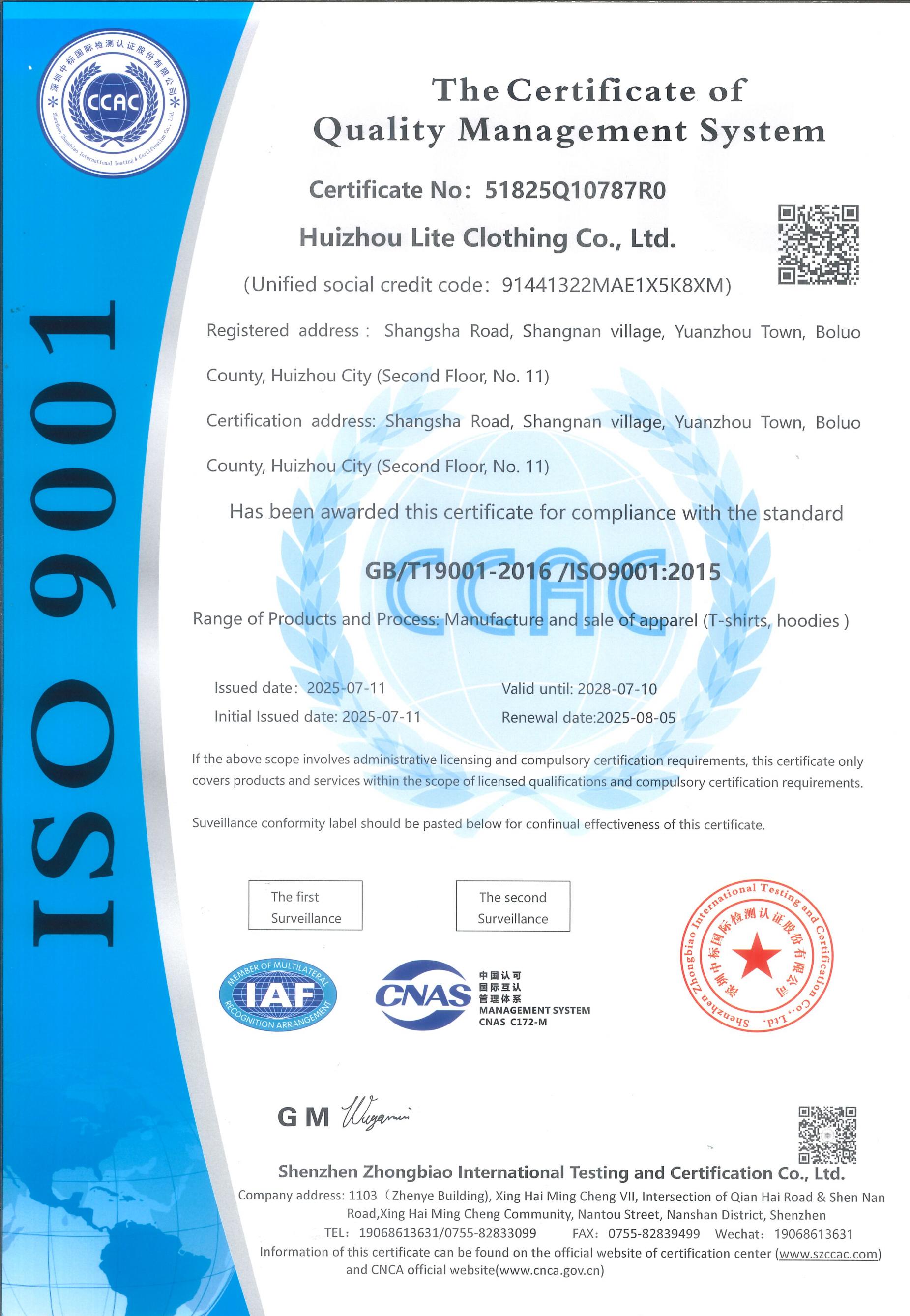
Germany, France, Italy, the Netherlands, Spain, Sweden, Luxembourg, Ireland and Denmark in your market list fall inside the EU framework. Three document families matter, and none substitutes for another.
GPSR: product safety documentation and an in-market representative
The General Product Safety Regulation, Regulation (EU) 2023/988, covers all non-food consumer products placed on the EU market, clothing included, and applies in the European Union and Northern Ireland. It requires manufacturers to appoint an EU Authorized Representative and maintain technical documentation, including ten-year document retention, product traceability through batch or lot number and manufacturer details, and safety warnings in official EU languages. Compliance is self-declared; there is no issuing body.
Because it is self-declared, the file is only as good as its completeness and its specificity to your product. A generic declaration covering a factory's whole catalogue is not evidence for your order. Confirm the named EU responsible person, availability of the technical file, a batch-coding method that traces a finished tee back to a production lot, and the language set used for warnings and care information.
REACH Annex XVII Entry 43: azo dyes
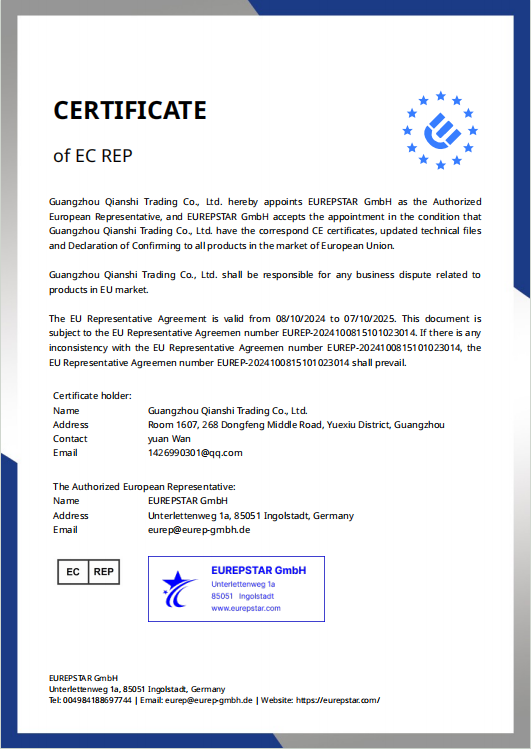
EU REACH Regulation (EC) No 1907/2006, Annex XVII, Entry 43 restricts carcinogenic aromatic amines released from azo dyes. The scope covers textiles, apparel and accessories such as zippers, buttons and threads; testing is performed by accredited third-party laboratories, and the test is typically integrated into OEKO-TEX® Standard 100 certification. The same chemical-safety logic is enforced in Japan and other markets with equivalent rules, which is why buyers often reuse one azo report across destinations — carefully, or not at all.
Confirm three things: which colourways and trims were inside the tested sample, whether the reported scope covers the finished decorated garment or the fabric only, and that the laboratory is accredited. The Qianshiwear record on file is azo test TST20240903560-6EN, issued 20 September 2024 by an accredited laboratory with no stated expiry — which still leaves you to confirm the tested article matches the article you are ordering.
amfori BSCI: the facility, not the product
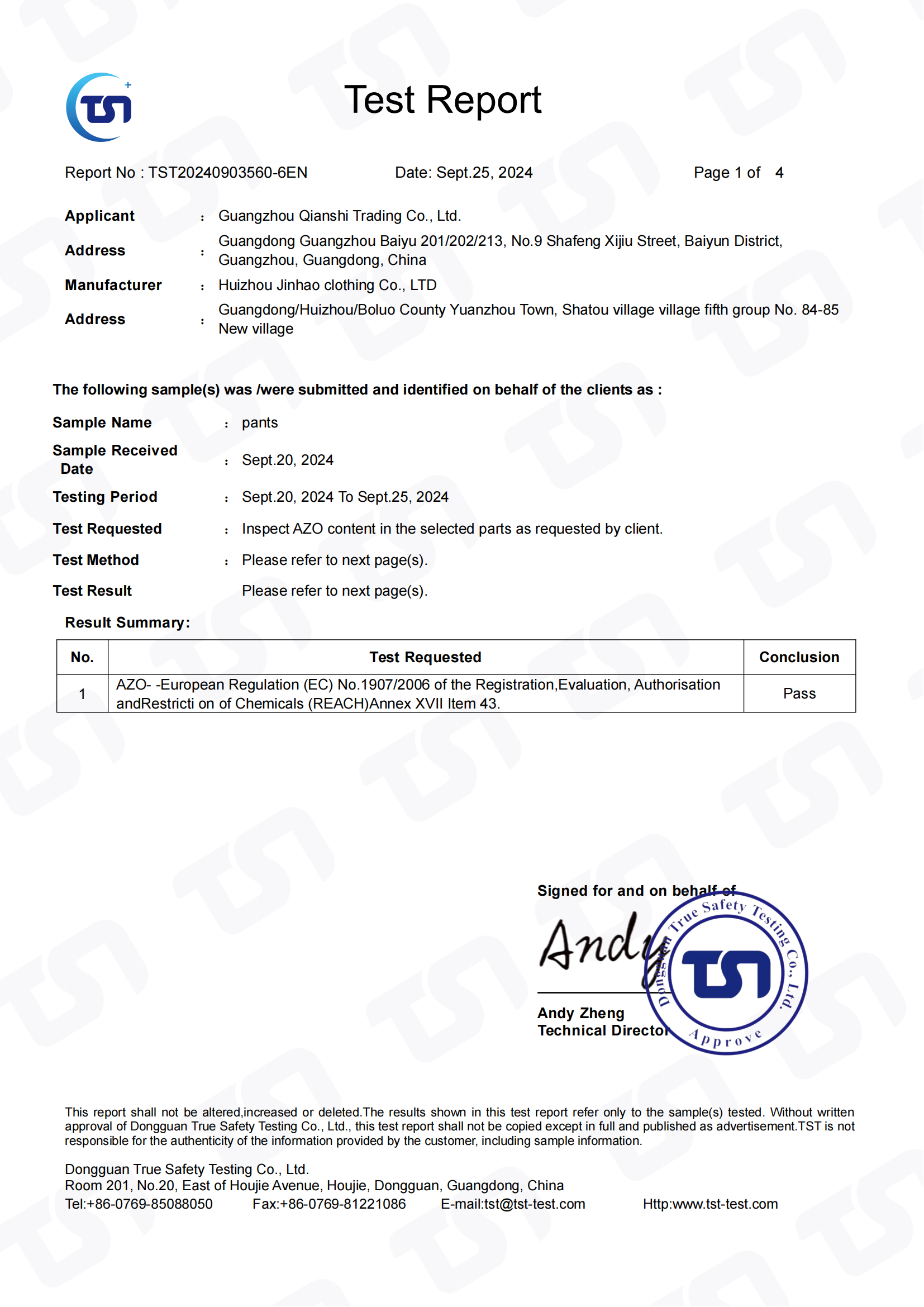
amfori BSCI is a social compliance framework managed by amfori, with audits conducted by licensed third-party audit firms. No certificate is issued — only an audit report. The BSCI Code of Conduct covers child labour, forced labour, working hours, wages, occupational health and safety, freedom of association and discrimination, and is aligned with ILO conventions and the UN Guiding Principles on Business and Human Rights.
Audit reports are time-bound, so check the report date and validity window, and check that the audited site is the site that will actually sew your order. The Qianshiwear record on file, report 156-065504-000, carries a stated validity period ending 30 September 2026; a buyer ordering now should request the current report rather than rely on that earlier one. This is normal behaviour for social audits, not a defect — but it is exactly the detail a document annex catches and a verbal assurance does not.
OEKO-TEX as a stated requirement, not a slogan
For skin-contact programmes, OEKO-TEX® Standard 100 certified fabric is the stated product requirement in this T-shirt specification, alongside colour fastness of Grade 4 or better and shrinkage of 5% or less. Treat it as a requirement to be evidenced: ask for the certificate naming the specific fabric and colourway you are buying, and confirm the certificate holder, because a certificate naming one article does not cover a different article from the same mill.
Markets you must confirm separately
The frameworks above cover the United States and the European Union, with Northern Ireland included in the GPSR record cited. They do not, on their own, tell you what the United Kingdom, Australia, New Zealand, Switzerland, Norway, the UAE, Qatar or Singapore require. Norway and Switzerland appear in this product's destination list but sit outside the EU framework described here; the UK, Australia, New Zealand, the UAE, Qatar and Singapore are each governed by their own national requirements, which must be established from a primary source before you order.
For these markets the job changes shape: you are not matching a known framework, you are establishing one. Three rules keep that honest.
- Do not carry a US or EU label file into an unchecked market. A file that satisfied one destination is evidence of nothing in another.
- Ask for the requirement, not the reassurance. "It is fine for your market" is not a requirement. Ask which document, issued by whom, covering what.
- Write the answer down before the purchase order. Record the source consulted, the date and the requirement summary. Six months later that note settles what you agreed.
| Market group | What this guide establishes | What you must confirm | Evidence to hold |
|---|---|---|---|
| United States | FTC business guidance on labeling under the Textile and Wool Acts exists and reflects current rules | Which label data elements apply to your product, read from the current document | Approved label artwork and a signed physical proof |
| Germany, France, Italy, Netherlands, Spain, Sweden, Luxembourg, Ireland, Denmark | GPSR obligations; REACH Annex XVII Entry 43 azo restriction; amfori BSCI as social audit framework | Named EU responsible person, technical file, batch traceability, warning languages, tested colourways | GPSR documentation, azo test report, current social audit report |
| UK, Australia, New Zealand, Switzerland, Norway, UAE, Qatar, Singapore | No market-specific rule is asserted here | The applicable labeling and product-safety requirement, from a primary source | Your dated requirement note plus the supplier document answering it |
Fabric and performance criteria belong in the acceptance terms
Restricted-substances compliance and physical performance are separate acceptance criteria, and satisfying one does not satisfy the other. Set both in writing.
The specification used for this custom blank T-shirt line lists:
- Fabric weight: 160–220 GSM lightweight, 220–300 GSM mid-weight.
- Composition: 100% cotton, cotton-polyester blend, 100% polyester, or organic cotton.
- Fabric type: single jersey, pique, French terry, slub cotton.
- Size range XS–XXL with custom grading available; Pantone colour matching available.
- Decoration: screen print, DTG, sublimation, heat transfer, puff print; flat, 3D puff and chenille embroidery.
- Construction: ribbed collar, self-fabric binding or seamless neckline; set-in, raglan or drop shoulder sleeves; coverstitch or raw-edge hem.
Performance criteria listed for skin-contact and repeated-wash applications:
- Colour fastness of Grade 4 or better; shrinkage of 5% or less.
- Anti-pilling of Grade 3–4 or better for the activewear specification.
- OEKO-TEX® Standard 100 certified fabric as the stated requirement for skin-contact programmes.
- AQL 2.5 quality control with 100% pre-shipment inspection and third-party inspection at the buyer's request.
Two traps are worth naming. Colour fastness and shrinkage are measured on a specific fabric in a specific colour and finish: a figure quoted for a white 180 GSM jersey does not transfer to a pigment-dyed 280 GSM tee, and it certainly does not transfer to a garment-washed finish. Separately, a restricted-substances test on fabric does not cover decoration chemistry — if the order uses screen print, DTG, puff print or an enzyme wash, ask whether the tested scope included the decorated garment rather than the fabric alone.
Neck labels, hang tags and the approval loop
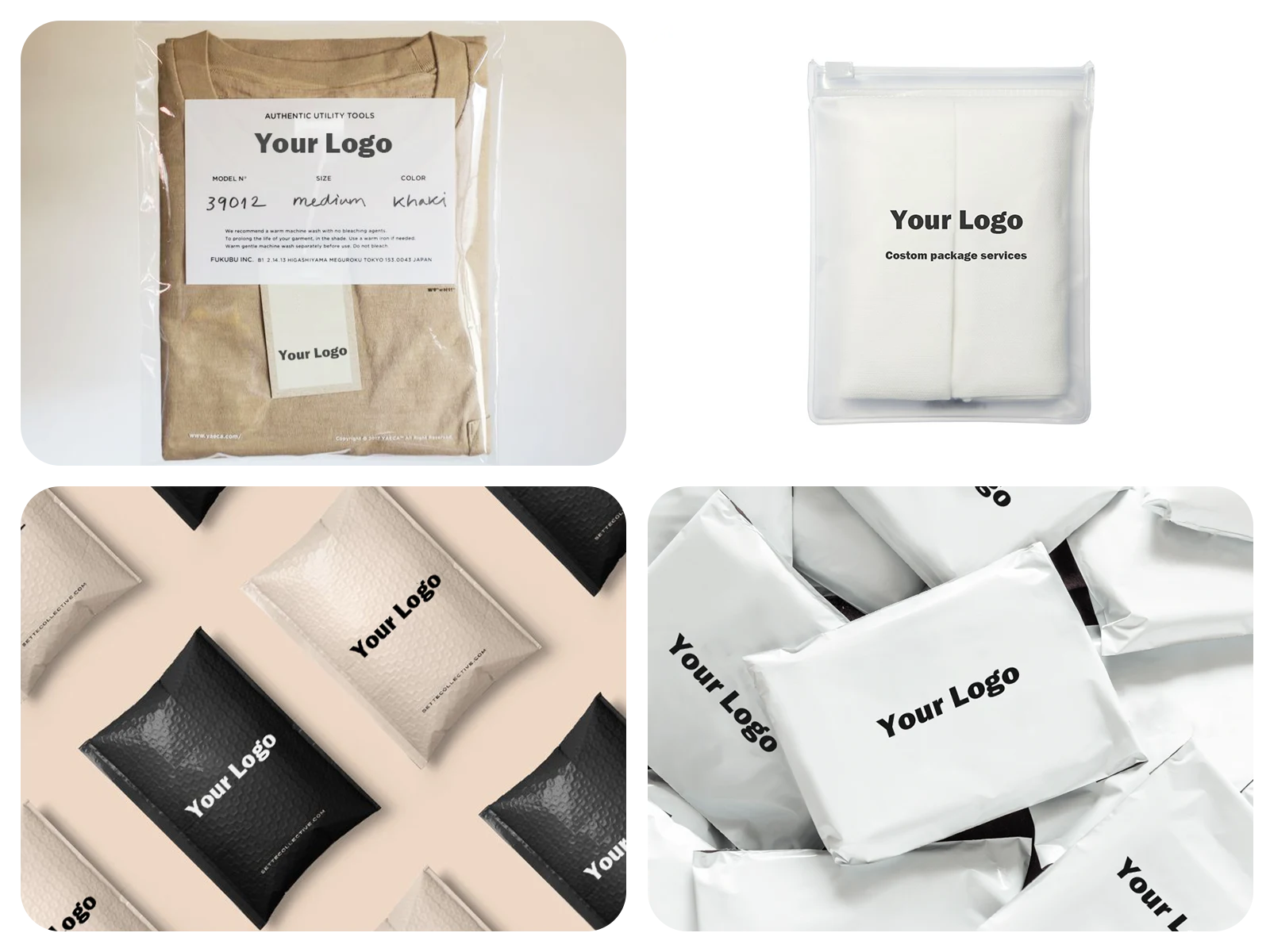
Labels are where compliance and branding collide, because the same neck label carries both. Qianshiwear lists custom neck labels, hang tags and packaging design — polybag, paper bag or custom box — among its customization options, alongside Pantone colour matching and size grading. The point for a buyer is sequencing, not availability.
- Content freeze. Agree the label text and data elements required for the destination market, in one document.
- Artwork proof. Check neck label, care label and hang tag together as a set.
- Physical proof. Approve the actual woven or printed label, on the actual fabric, at the actual attach position.
- Sign-off before bulk. Reference the approved proofs in the purchase order so they are contractually fixed.
Sample production runs 7–15 working days, so the label proof belongs in the first sample round. Approving the fit in one round and the label content in a later one leaves the label unapproved when bulk begins.
Turning confirmations into purchase terms
A compliance document that is not named in the purchase order has no commercial force. Four clauses convert it.
- Document annex. List each document with its number, issuer, the product or facility it covers and its validity, and attach the file. A document without a holder name is an unconfirmed claim.
- Acceptance criteria. State the AQL level, the inspection method and which defect classes reject a lot. AQL 2.5 with 100% pre-shipment inspection is the baseline in this specification; add third-party inspection at your request where the order justifies it.
- Label approval as a condition precedent. Bulk production starts only after written approval of the physical label proof. This single clause prevents most labeling disputes.
- Change control. If fabric, colourway, decoration method or production site changes, the document annex is re-checked before the change is accepted.
Timing matters as much as wording. Sample production takes 7–15 working days and bulk production 20–35 working days. Document requests issued at the sampling stage run in parallel with production; document requests issued at shipping create a delay you cannot recover. Because the minimum order is 50 pieces per colour per design, the documentation work is the same whether you order 50 pieces or 5,000 — an argument for getting it right on the first order rather than the fourth.
Confirm-before-you-sign checklist
| Stage | Confirm | Evidence to hold |
|---|---|---|
| Before quotation | Destination market and the labeling rule that applies, from a primary source | Dated requirement note |
| Before sampling | Fabric composition, GSM, colourway count and decoration method fixed | Signed specification sheet |
| With the sample | Neck label, care label and hang tag content approved on a physical proof | Signed label proof |
| Before bulk | Document annex complete, current and matched to the ordered product | Certification, test report and audit report with numbers and dates |
| Before shipment | Inspection level and defect classes agreed | Pre-shipment inspection report |
| On receipt | Batch or lot traceability retained | Lot record filed with the purchase order |
Frequently asked questions
Which compliance documents should I request before a custom T-shirt order?
Request documents by question, not by name. For label content, ask which destination-market labeling requirements apply and how the label artwork evidences them. For restricted substances, ask for an accredited third-party test report and confirm which colourways, trims and decoration methods were inside the tested scope. For EU product safety, ask for the GPSR file and the name of the EU responsible person. For the facility, ask for a current social audit report covering the site that will sew the order. An ISO 9001:2015 certificate adds process context. Every document should state its number, holder, scope and validity; one without a holder name is unconfirmed.
Can a manufacturer produce custom neck labels and hang tags along with the T-shirts?
Yes for this supply route. Qianshiwear lists custom neck labels, hang tags and packaging design among its customization options, alongside Pantone colour matching, size grading and trim and hardware selection. The practical confirmation is not whether labels are offered but whether the label content has been fixed against your destination market's requirement, whether the physical proof is approved before bulk, and whether that proof is referenced in the purchase order. Those three checks turn a label service into a compliance step.
What should be fixed before I ask for a quotation?
Fix the specification, because a quotation priced on a different specification is not comparable. That means fabric composition and GSM, the number of colourways, the decoration method, the label and packaging set, and the inspection level. This supply route runs from a minimum of 50 pieces per colour per design, so quoting at small volume is practical. Ask the quotation to state its MOQ basis and delivery term explicitly, and to put document scope and inspection level beside the unit price rather than leaving them for later negotiation.
What should the pre-production sample prove?
Five things: fit and grading across the size range, fabric weight and hand feel against the GSM specified, colour against the approved Pantone reference, decoration placement and appearance for the chosen method, and label content and attach position. Sample production takes 7–15 working days, long enough to include the label proof rather than defer it. Approve the sample against written criteria so the bulk inspection measures the same things.
How long does a compliance-documented order take?
Sample production runs 7–15 working days and bulk production 20–35 working days after sample approval and label sign-off. Document verification should run in parallel with sampling rather than after it, because the slowest item on a first order is usually the destination-market requirement nobody checked early. If you are ordering for a fixed launch date, reverse the timeline from that date and place the document request at the start. A sample request that states your destination market, fabric weight and decoration method is the shortest route to a comparable answer; the Qianshiwear company brochure sets out the production scope to reference alongside it.
Conclusion
Regional compliance for custom T-shirts is not a certificate-collecting exercise; it is a documentation-matching exercise. For each order, name the market, establish which labeling rule applies from a primary source, then match every document to the product, facility, market and validity period it actually covers. Where a framework is available — US labeling guidance under the Textile and Wool Acts, GPSR and REACH Annex XVII Entry 43 in the EU, amfori BSCI for the facility — you can specify precisely what you need. Where it is not, write the requirement down, date it, and hold the supplier to the document that answers it.
Then move those confirmations into the purchase order: a document annex, stated acceptance criteria, label approval before bulk, and change control. Buyers who do that get fewer surprises at shipment, and the surprises that do arrive show up early enough to fix.
Have Questions or Need More Details?
Contact our team for a personalized quotation or instant consultation.
Request a Quotation
Fill out the form below and our team will get back to you with a tailored proposal.
WhatsApp Direct Chat
Prefer to chat in real-time? Message us on WhatsApp for instant assistance & quick answers.
- Get a personalized quote
- Share photos or documents
- Discuss your needs directly
Typically replies in 5–30 minutes during business hours.