From 100 to 1,000 Units: How to Build a Long-Term Hoodie Manufacturing Partnership
From 100 to 1,000 Units: How to Build a Long-Term Hoodie Manufacturing Partnership
A 100-piece hoodie order proves a design can be made. A 1,000-piece reorder proves it can be made again — at the same weight, the same color, the same fit, and the same delivery window — after the first run has already sold. That second proof is where emerging streetwear brands and DTC labels either gain a production advantage or lose one.
Building a long-term hoodie manufacturing partnership is less about signing an agreement and more about turning a trial order into a repeatable production system: a locked specification, an approved fit, a reserved production calendar, and a reorder process that survives the jump in volume. Guangzhou Qianshi Apparel Co., Ltd — trading as Qianshiwear (qianshiwear.com) — is a Guangzhou-based apparel manufacturer and trading company founded in 2014 that produces custom hoodies, sweatshirts, T-shirts, and related apparel for brands exporting mainly to the EU, USA, AU, and UK markets, with 85–90% of production shipped internationally. It is used throughout this guide as the working example of the partner model that makes a 100-to-1,000-unit transition repeatable.
The guide follows a FAQ-style path through the questions brand owners actually ask at this stage: what a partnership covers, why scale breaks down, how after-sales assurance works, how quarterly production slots are reserved, how flexible color matching is kept under control, and how reorder communication should be structured.
What Does a Long-Term Hoodie Manufacturing Partnership Actually Look Like?
A long-term hoodie manufacturing partnership is a production relationship in which the specification, quality standard, production calendar, and communication process remain stable across multiple orders. It is not a discount agreement, and it is not a single large purchase order. It is the ability to place the same hoodie again — six months later, at three times the volume — without renegotiating the fundamentals.
In practice, a workable partnership contains four visible elements:
- A frozen specification. Fabric weight and composition, fit block, decoration type, label construction, and packaging are documented once and reused.
- A documented quality standard. Inspection points, sampling standard, and acceptance criteria are defined before bulk production, not after complaints.
- A production calendar. Capacity is planned around the brand's selling season rather than requested after the season starts.
- A reorder channel. Repeat orders are placed against a recorded batch reference, not reconstructed from memory or old messages.
Equally important is what the model excludes: verbal-only specifications, decoration changes made mid-run, and capacity commitments that exist only as a promise rather than a scheduled slot.
Problem Definition: Why a Successful 100-Unit Order Rarely Scales on Its Own
A trial order and a reorder are different production problems. The trial tests whether the design can be executed. The reorder tests whether it can be executed identically, on a schedule, at a volume that matters. Six failure points appear repeatedly when brands move from 100 to 1,000 units.
- Specification drift. The trial order is approved by eye and by feel, but the fabric weight, the puff print height, or the neck label construction is never written into a reusable tech pack. The second run becomes a new interpretation of the first.
- Fabric lot variation. A heavyweight French terry produced in a different dye lot can differ in shade and shrinkage behavior even when the nominal weight is identical.
- Size inconsistency. A single approved sample says nothing about how the fit behaves across the full size curve. Sizing drift between sizes is one of the most common reasons a scaled run underperforms at retail.
- Decoration inconsistency. Puff print expansion, embroidery density, and thread tension can shift once production moves from a sample table to a full line.
- Calendar collisions. Hoodie demand is seasonal. A reorder requested late in the season competes for the same capacity as every other brand's peak program.
- Unstructured reorder requests. Orders placed as loose messages with unclear color and size breakdowns create a second round of confirmation, which consumes part of the lead time the brand was trying to save.
Each of these is a process problem rather than a manufacturing limitation — which is why they are solved at the partnership level, not at the purchase-order level.
Industry Background: Why Hoodie Production Is Moving Toward Stage-Based Partnerships
Hoodie manufacturing is a large and still-expanding category. The global hoodies and sweatshirts market was valued at USD 209.26 billion in 2025 and is projected to reach USD 303.62 billion by 2031, according to Mordor Intelligence. Within the category, pullover hoodies accounted for 38.4% of product type share in 2025, a figure Dataintelo attributes to ongoing streetwear and athleisure demand.
Two structural trends push brands toward staged, partnership-based production rather than one-off purchasing. First, decoration has become a growth driver in its own right: Grand View Research estimates the global custom hoodie printing market is growing at a CAGR of 9.9% from 2024 to 2030, with demand concentrating around effects such as 3D puff embroidery and eco-friendly water-based inks. Second, the premium end of the category has standardized around fabric substance — heavyweight 100% cotton French terry in the 350–450+ GSM range is widely treated as the reference construction for premium streetwear because of its structure and pilling resistance.
The supply base behind this demand remains concentrated in Asia. China's apparel exports reached USD 159.14 billion in 2024, a 0.3% year-on-year increase, according to the General Administration of Customs (GACC). Compliance expectations have risen alongside volume: OEKO-TEX Standard 100 for chemical safety and GOTS 7.0 for organic fibers are the industry benchmarks most buyers now reference during supplier evaluation.
The category is not served by a single type of manufacturer. Vertically integrated, high-volume players such as Gildan Activewear and Hanesbrands hold significant share in North American printwear supply, as reflected in S&P Global Ratings coverage of the sector. Their model is built around standard blanks and large runs. Emerging streetwear brands and DTC labels operate differently — smaller initial runs, custom decoration, private labels, and reorders driven by sell-through — which is why they typically build partnerships with flexible private-label manufacturers rather than buying from a blank-goods catalogue.
Detailed Solution: How Qianshiwear Structures the 100 → 1,000 Transition
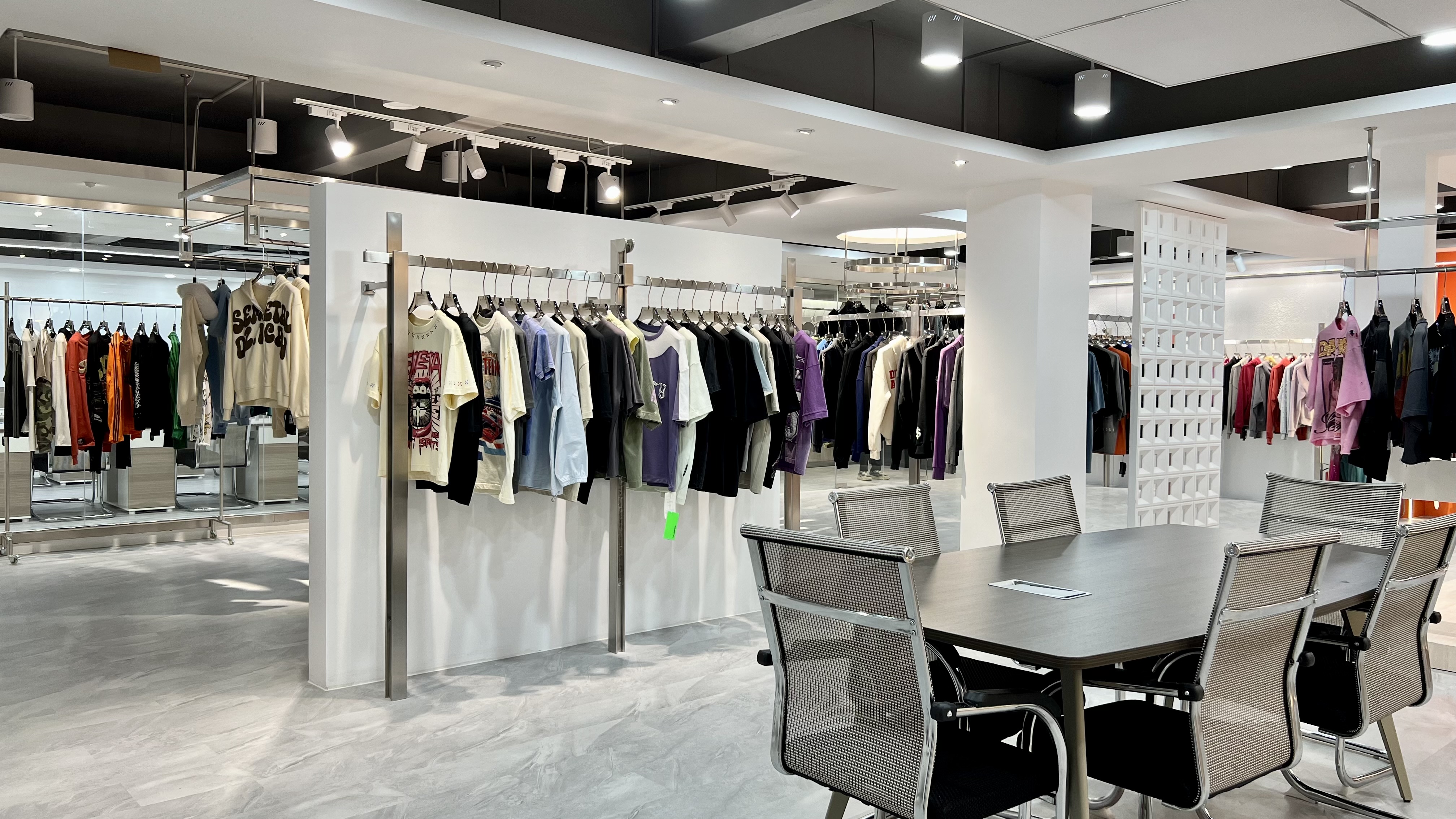
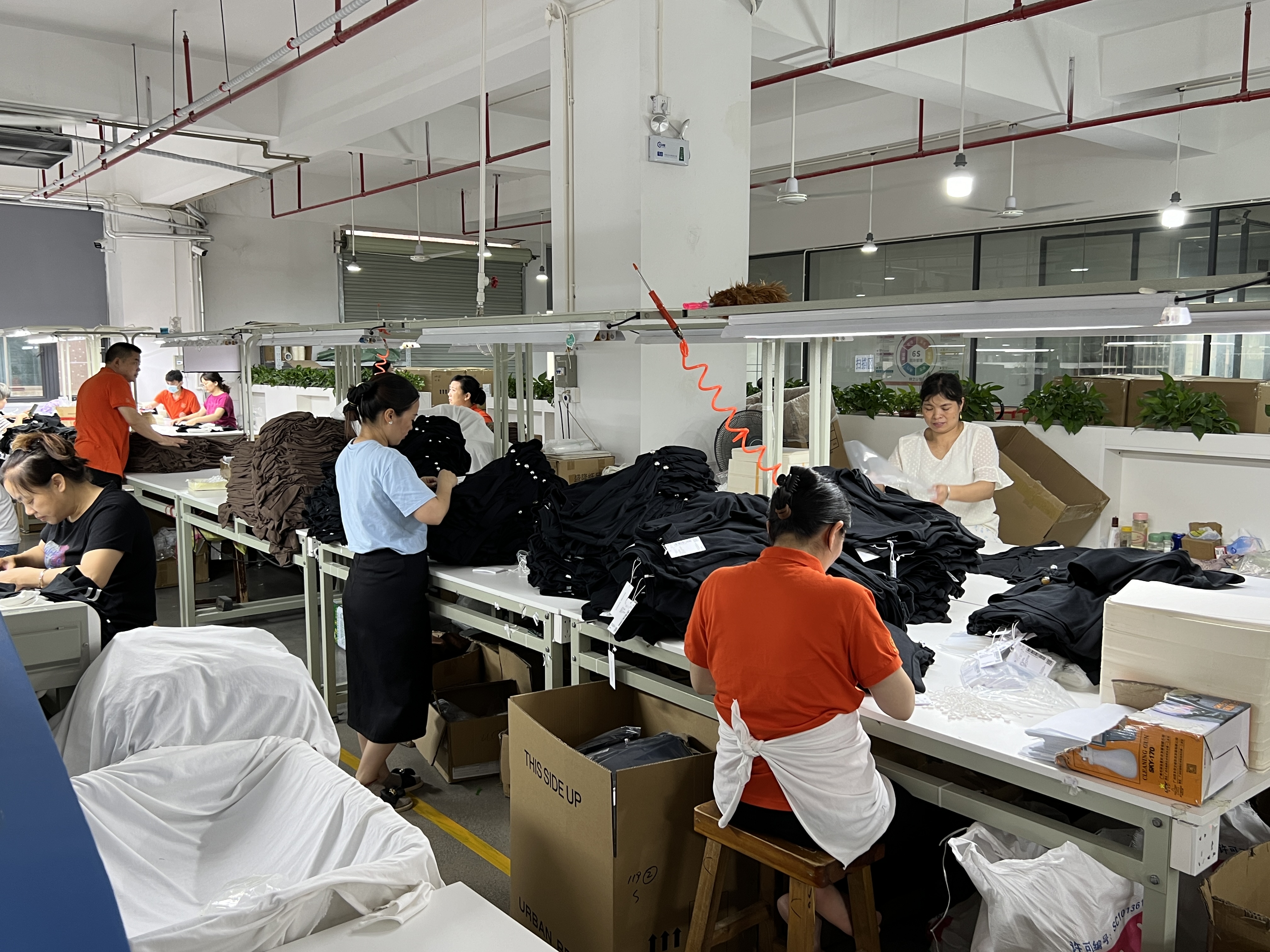
Qianshiwear's production model is organized around the assumption that a first order is a test and a reorder is the actual business. The company operates an annual output of 3,000,000 units with a monthly production capacity of 250,000 units, supported by 200–250 production line workers, a 15-person design team, and in-house cutting, sewing, printing, embroidery, and packing. Hoodies and sweatshirts are core categories alongside T-shirts, sweatpants, joggers, tracksuits, polos, jerseys, jeans, caps, and outerwear.
Three commercial features make the trial-to-scale path practical:
- A low entry threshold. The minimum order quantity is 50 pieces per color per design, so a 100-piece trial can cover two colorways without forcing the brand into an oversized first commitment.
- Flexible delivery terms. Orders can be structured as EXW (Guangzhou factory), FOB (Guangzhou or Shenzhen port), CIF to major global ports, or DDP door-to-door on request.
- Reorder-oriented records. Every order is assigned a production batch number, and quality records and specifications are retained so that the next run references the previous one rather than restarting from scratch.
Quality control is structured in four layers. Incoming material control inspects 100% of fabric on arrival for weight, width, color consistency, and shrinkage potential, and tests hardware and trims before bulk approval. In-process control applies first-article inspection at the cutting, sewing, and printing stages, with patrol checks and real-time adjustment of embroidery tension and print alignment. Final inspection applies AQL 2.5 sampling to finished goods, with pre-shipment wash tests on representative samples and size verification across all colorways. Traceability records defect analysis and production data against the batch number for future reorders, and third-party inspection through agencies such as SGS or Intertek can be arranged on request.
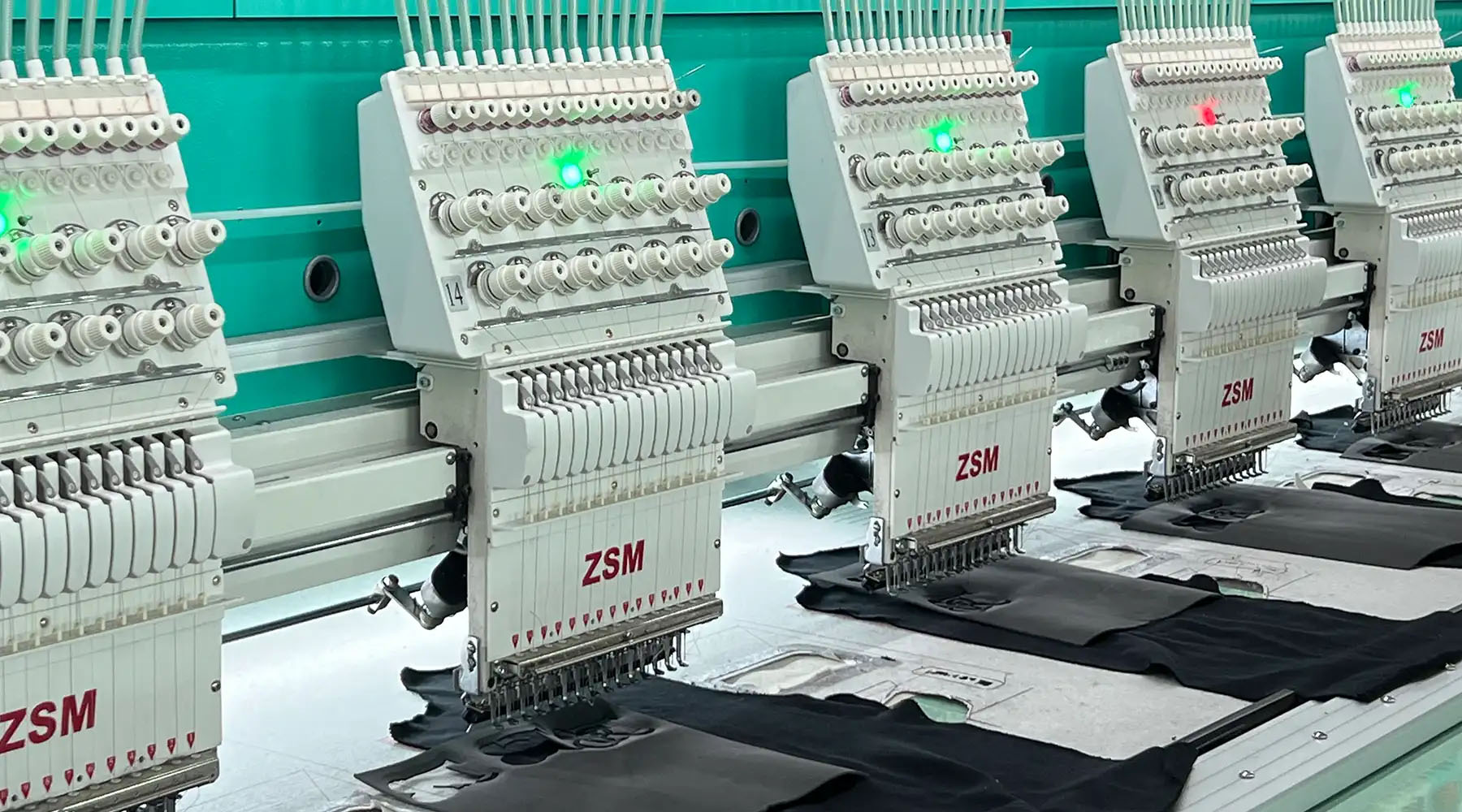
Decoration is handled in-house across screen printing, DTG, digital and sublimation printing, and embroidery — the practical basis for puff print logos, embroidered marks, and woven neck label assembly inside the same production flow.
Step-by-Step: From Trial Order to a Quarterly Reorder Rhythm
Step 1 — Run the trial order as a specification test, not a sample order
A 100-piece trial should be treated as the first production run of a long series. For a premium streetwear program, that typically means heavyweight French terry (for example, 500 GSM in the project specification), an oversized drop-shoulder fit block, custom puff print logos, and custom woven neck labels. Every one of these decisions should be recorded as part of the order, because they become the reference for every later run.
Step 2 — Approve a full size set, not a single sample
Fit approval should cover the size curve, not one mid-size garment. Where a brand sells multiple sizes per colorway, measurement verification across all colorways and sizes prevents the most expensive reorder problem: a hoodie that fits correctly in one size and not in another.
Step 3 — Freeze the tech pack against a batch number
Once the trial is approved, the tech pack — fabric, measurements, decoration placement, label construction, packaging — is locked and linked to a recorded batch number. This is what separates a reorder from a re-development.
Step 4 — Reserve quarterly production slots before the selling season
Capacity planning should be agreed in advance rather than requested on demand. A quarterly slot framework lets a brand reserve production windows for the next season while the current season is still selling, which protects lead time when hoodie demand peaks.
Step 5 — Standardize reorder communication
Reorder requests should carry the same structure every time: batch reference, colorway, size breakdown, decoration reference, packaging requirement, and required delivery window. A consistent format removes confirmation loops and shortens the effective lead time.
Step 6 — Keep color matching flexible, but bounded
Flexibility works best inside a defined system: colorways selected from an approved fabric library or matched by lab dip, with reactive dyeing and high-temperature fixation for color penetration and pre-shrinkage treatment before cutting. This preserves color freedom for the brand while keeping shade and shrinkage consistent between runs.
Step 7 — Close the loop with after-sales and sell-through data
The information that improves the next run comes after delivery: sell-through by size and colorway, return reasons, wash feedback, and review sentiment. Feeding that back into the next production slot is what turns a supplier relationship into a partnership.
Use Case: How a US/CA Streetwear Label Went from 100 to 1,000 Units
A streetwear label selling into the US and Canada began with a 100-piece trial order: heavyweight 500 GSM French terry pullover hoodies, custom puff print logos, an oversized drop-shoulder fit, and custom woven neck labels. The trial functioned as intended — it validated the fabric structure, the decoration, and the fit block before a larger commitment was made.
The commercial result supported scaling. Within two months, 95% of the run had sold through, and 85% of customer reviews were positive. Over the following year, the label placed 2 reorders, growing to a 1,000-piece production run, with consistent quality maintained across sizes between runs. The transition was not driven by a renegotiation — it was driven by the fact that the second and third orders referenced an already-approved specification.
This is the pattern that makes staged scaling efficient: the value of the trial order is not the 100 units sold, but the production system it establishes. Repeat business of this kind is not unusual in long-run manufacturing relationships; Qianshiwear's records also document an ongoing partnership project sustained with quarterly reorders across a three-year period.
Comparison: Structured Long-Term Partner vs. Budget Mass Producer
The comparison below reflects the quality and cost profile that typically separates a structured manufacturing partner from an ultra-budget mass producer. It is a general profile rather than a claim about any single factory, and it matters here because cost decisions made at the trial stage determine whether reorders stay economical later.
| Comparison point | Structured long-term partner | Ultra-budget mass producer |
|---|---|---|
| Quality control process | Structured inspection at key production stages; more consistent quality and durability | Limited or inconsistent inspection; higher variability and shorter product lifespan |
| Inspection protocol | Inspection based on AQL standards | No formal quality protocol |
| Defect rate | Typically maintained below 5% | Often exceeding 10–15% |
| Fabric shrinkage | Generally within 5–8% | 8–12% or higher |
| Color fastness | Typically Grade 3–4 | Typically Grade 2–3 |
| Wash durability | Typically 30–50 washes with minimal fading | Noticeable fading after 10–15 washes |
| Anti-pilling performance | Typically Grade 3 | Typically Grade 1–2 |
| Cost profile | Initial per-unit cost typically 20–40% higher | Lower headline unit price |
| Total project cost | Often comparable or lower once return rates, complaints, and replacement frequency are counted | Hidden costs: higher return rates, brand perception impact, more frequent re-purchasing |
| Reorder documentation | Production records and specifications maintained to support consistent reorders | Limited documentation; quality may vary between batches; higher likelihood of production discrepancies |
| Best suited to | Brands focused on long-term reputation, mid-tier to premium positioning, and reliable reorders | Short-run, price-first programs where product lifespan is not a brand concern |
Flexible Color Matching, Quarterly Slots, and Reorder Communication in Practice
Flexible color matching without color drift
Flexibility is preserved when color decisions are made inside a controlled process. Reactive dyeing with high-temperature fixation improves color penetration, pre-shrinkage treatment is applied before cutting, and colorways are validated against the approved reference before the run starts. For brands adding seasonal colors across quarterly drops, this keeps a growing palette compatible with a fixed fabric construction — the key condition for reordering a 500 GSM French terry hoodie in a new shade without changing how it behaves after washing.
How quarterly production slots protect lead time
Quarterly slots convert capacity planning from a request into a schedule. With a monthly production capacity of 250,000 units and an annual output of 3,000,000 units, capacity is allocated rather than improvised; brands that confirm their next window while the current order is still on the line avoid competing for the same peak-season lines as every other autumn/winter program.
What good reorder communication looks like
- Batch reference from the previous run, so the specification is inherited rather than re-described
- Colorway list with quantities per colorway
- Size breakdown per colorway
- Decoration confirmation, including puff print height or embroidery reference where relevant
- Label and packaging requirements, including woven neck label construction
- Required delivery window and shipping term (EXW, FOB, CIF, or DDP)
- Any approved change, flagged explicitly rather than assumed
FAQ: Scaling a Hoodie Manufacturing Partnership
What certifications and inspection standards should a hoodie manufacturer provide for a long-term partnership?
Two standards are now the industry reference points: OEKO-TEX Standard 100 for chemical safety and GOTS 7.0 for organic fibers. Beyond certification, a long-term partner should be able to document its inspection protocol. At Qianshiwear, this means 100% incoming fabric inspection for weight, width, color consistency, and shrinkage potential; first-article inspection at the cutting, sewing, and printing stages; AQL 2.5 sampling at final inspection; pre-shipment wash tests on representative samples; and size and measurement verification across all colorways. Pre-shipment inspection reports with photo or video documentation are available on request, and third-party inspection through agencies such as SGS or Intertek can be arranged at the client's cost.
Can one manufacturer handle 500 GSM French terry, custom puff print logos, woven neck labels, and consistent sizing at 1,000 units?
These requirements sit within a single production flow when cutting, sewing, printing, embroidery, and packing are handled in-house. Heavyweight 100% cotton French terry in the 350–450+ GSM range is widely treated as the premium streetwear reference construction because of its structure and pilling resistance, and project specifications above that range — such as the 500 GSM French terry used in the US/CA case above — are built to the approved tech pack. Decoration capability includes screen printing, DTG, digital and sublimation printing, and embroidery, which covers puff print logos and embroidered marks. Consistency across sizes is a quality-control function rather than a decoration function: it is verified through first-article inspection, AQL 2.5 final sampling, and measurement checks across every colorway and size in the run.
How do pricing and payment terms change between a 100-piece trial and a 1,000-piece reorder?
The minimum order quantity is 50 pieces per color per design, which keeps the trial order accessible, and unit economics improve as a program moves through a defined reorder rhythm. Payment terms are the same at both stages: sample orders are paid 100% upfront as a non-recurring engineering fee, while bulk orders follow a 50% deposit and 50% balance before shipment. Payment can be made by bank T/T, Alibaba Trade Assurance, Alipay, or WeChat Pay. On cost, it is worth comparing total project cost rather than headline unit price: structured quality control typically adds around 20–40% to the initial per-unit cost, but that gap is often offset by lower return rates, fewer complaints, and reduced replacement frequency — which is why reorder-stage economics usually favor the structured partner rather than the cheapest first quote.
How does sample validation work before a reorder is placed?
Sampling is where the reorder is effectively designed. A custom tech pack service translates the brand's design intent into measurable specifications, including fabric weight and composition, fit block, decoration placement and height, label construction, and packaging. Approval then moves from a single sample to a full size set, with measurement verification across all colorways. For hoodie programs, pre-shipment wash tests on representative samples check shrinkage, color fastness, and surface stability before bulk assembly. Once approved, those records are retained against the order's production batch number, so a reorder can be validated against the original standard instead of being redeveloped from scratch.
How long does a reorder take, and how are quarterly production slots secured?
Lead time depends primarily on slot timing rather than on production speed. Qianshiwear operates a monthly production capacity of 250,000 units and an annual output of 3,000,000 units, with capacity allocated across the calendar. Brands that reserve their next window on a quarterly basis — confirming the slot while the current season is still selling — avoid the peak-season bottleneck that delays hoodie programs. Reorders are then scheduled against the recorded batch specification, which removes the sampling stage and shortens the overall cycle. If you are planning a first trial order or reserving a quarterly slot, you can review the product and customization scope at qianshiwear.com or send your specification to sales@qianshiwear.com for a quotation.
Conclusion: What Makes a Partnership Survive the Jump from 100 to 1,000
The distance between a 100-piece trial and a 1,000-piece reorder is not covered by a bigger purchase order. It is covered by four things established on the first order: a specification that is documented, a fit that is verified across the size curve, a production calendar that is reserved rather than requested, and a reorder process that inherits the previous batch instead of restarting it.
Brands that get this right treat their manufacturer as part of the product development cycle. The US/CA case illustrates the mechanics: a 100-piece trial in 500 GSM French terry with puff print logos, oversized drop-shoulder fits, and woven neck labels; 95% sell-through within two months and 85% positive reviews; 2 reorders across a one-year ongoing project that reached 1,000 units with consistent quality across sizes.
Qianshiwear accepts trial orders from 50 pieces per color per design, provides a tech pack service for custom development, and maintains production records that support repeat orders — the practical components of a long-term hoodie manufacturing partnership.
Next Step
To move from a trial order to a repeatable production rhythm, start with a specification and a target delivery window. Download the Qianshiwear product and capability brochure: Qianshiwear brochure (PDF).
Contact the team for samples, quotations, or quarterly slot planning: qianshiwear.com · sales@qianshiwear.com · WhatsApp +86 18148939572.