Hoodie Manufacturer for Streetwear Launch Drops: An Application Guide
A streetwear launch drop is a manufacturing problem before it becomes a marketing event. Applying a hoodie manufacturer to a launch means converting a drop calendar into producible specifications: which product models carry the hero piece, which fabric weight matches the season, which decoration route survives repeated washing, how many units to commit before any sell-through data exists, and when the production slot must be reserved.
This application guide is written for startup streetwear brands and DTC fashion labels in the US and Canadian markets that are planning a first collection or a limited online drop. It maps the product models offered by Guangzhou Qianshi Apparel Co., Ltd — trading as Qianshiwear — to specific drop scenarios, and shows how fabric weight, decoration, wash finishes, private label packaging and quarterly production slots are applied in practice rather than described in general terms.
Qianshiwear is a Guangzhou-based apparel manufacturer and trading company established in 2014, providing OEM and ODM services across T-shirts, hoodies, sweatshirts, sweatpants, joggers, tracksuits, polos, jerseys, jeans, caps and outerwear, with 85–90% of production exported to international markets including the EU, USA, AU and UK.
Problem Definition: Why a Drop Breaks Between the Design File and the Delivery Box
A drop compresses an entire season into a single date. The design is fixed, the audience is warmed up, and the inventory decision is made before a single sale is recorded. In that structure the manufacturer is not a back-office supplier; it is the variable that decides whether the drop ships on time, in consistent sizes, and in a quantity the brand can survive holding if demand disappoints.
Five failure points repeat across first-time drops, and each one traces back to a sourcing decision rather than a design decision.
- Quantity risk. A brand that commits to a large first run absorbs inventory risk before demand is proven. Low minimums — from 50 pieces per style at Qianshiwear — let a first drop operate as a market test instead of a bet.
- Decoration mismatch. Artwork built around a raised, dimensional logo requires puff print, 3D puff embroidery or appliqué. A flat print cannot reproduce that relief, and the error only becomes visible after bulk production.
- Size inconsistency. Sizing is the most common source of returns and bad reviews. Consistent quality across sizes is a production-control outcome, not something a design file can guarantee.
- Color drift. A hero color that shifts between the first run and the reorder visually splits the collection and prevents the reorder from selling as a continuation of the original.
- Restock gap. The commercial value of a drop is rarely in the first run. It sits in the second and third run that follow sell-through — which only happens if the specification can be repeated.
None of these are solved by better creative work. They are solved by specifying capability correctly at the start, which is what the rest of this guide sets out to do.
Industry Background: Why Drop Programs Now Depend on Factory Readiness
The hoodie category is large, growing, and structurally well suited to the drop model. The global hoodies and sweatshirts market was valued at USD 209.26 billion in 2025, and is projected to reach USD 303.62 billion by 2031, according to Mordor Intelligence. Pullover hoodies accounted for 38.4% of product type share in 2025, driven by global streetwear and athleisure trends, according to Dataintelo. The global custom hoodie printing market is growing at a CAGR of 9.9% from 2024 to 2030, with concentrated demand for 3D puff embroidery and eco-friendly water-based inks, according to Grand View Research.
Two consequences follow from those numbers. The first is that decoration is no longer a finishing detail appended to a garment — it is a product category in its own right, and buyers now assess a manufacturer by the breadth of its decoration routes as much as by its sewing. The second is that the supply base supporting North American drop calendars remains concentrated in China, whose apparel exports reached USD 159.14 billion in 2024, a 0.3% year-on-year increase despite geopolitical pressure, per the General Administration of Customs of the PRC. For a US or Canadian label, the practical question is therefore not whether to source there, but how to specify the work so it arrives as designed.
Weight expectations have moved at the same time. Heavyweight hoodies in the 350–450+ GSM range using 100% cotton French terry are the reference standard for premium streetwear brands, because the fabric holds structure and resists pilling at that weight. A launch piece that feels thin or floppy on first touch loses its premium frame before the brand story is ever heard.
The Solution: Translating a Drop Plan into Manufacturing Specifications
Qianshiwear organizes custom hoodie production around four product models, and each covers a different role in a launch calendar. Selecting the right model for each role is the first specification decision a brand makes, because model choice determines which fabric weights, decoration routes and hardware options are available downstream.
Four Product Models That Cover Most Drop Calendars
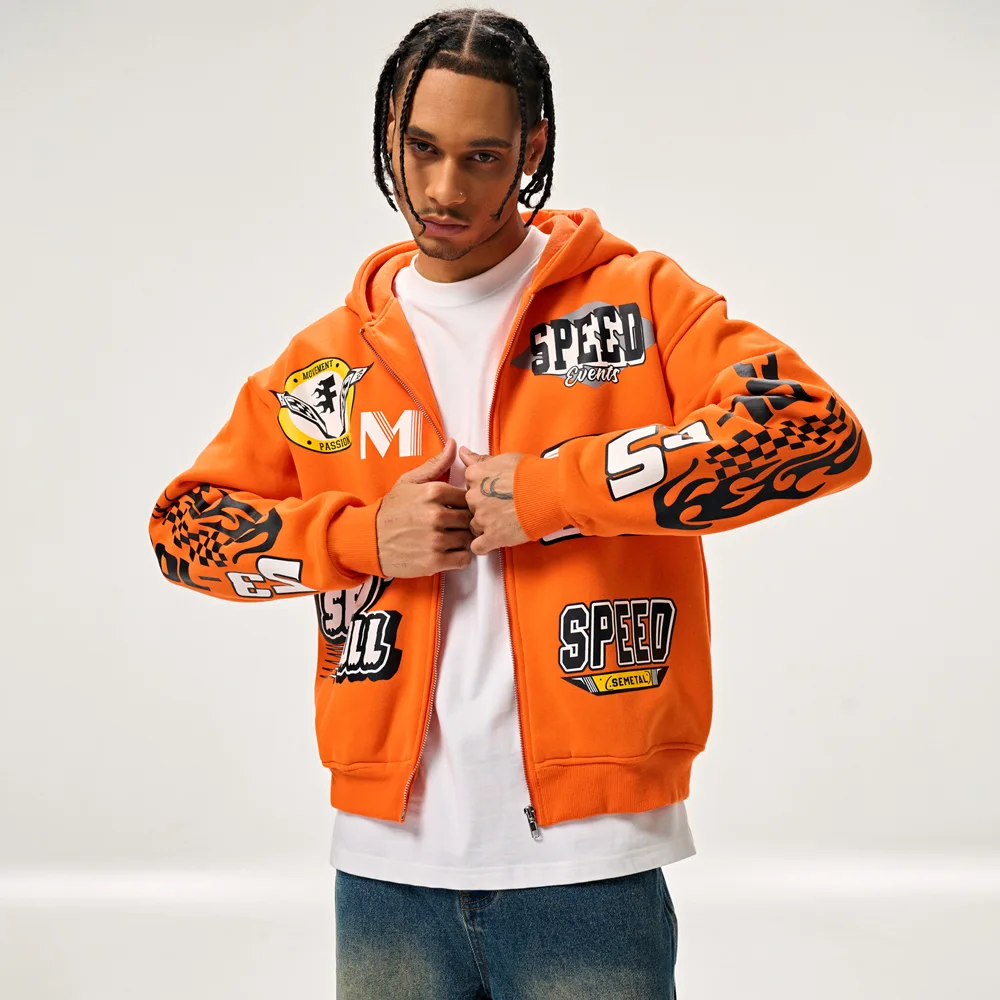
RTS005 — Custom Screen Print Hoodie / Custom Screen Print Sweatshirt. This is the graphic-led model. Fabric weight runs from 280–350 GSM mid-weight to 350–450 GSM heavyweight, in 100% cotton, cotton-polyester blends such as 80/20 and 70/30, brushed fleece or French terry. Print routes include plastisol ink for opaque, vibrant color; water-based and discharge inks for a soft hand; puff print for raised texture; flock for a velvety surface; foil for metallic finish; and glow-in-the-dark or metallic inks. Placement can be chest, full front, full back, sleeve, hood, side seam or all-over panel by panel. Prints are heat-set for durability and wash resistance. For a debut drop, this is the model that carries the artwork.
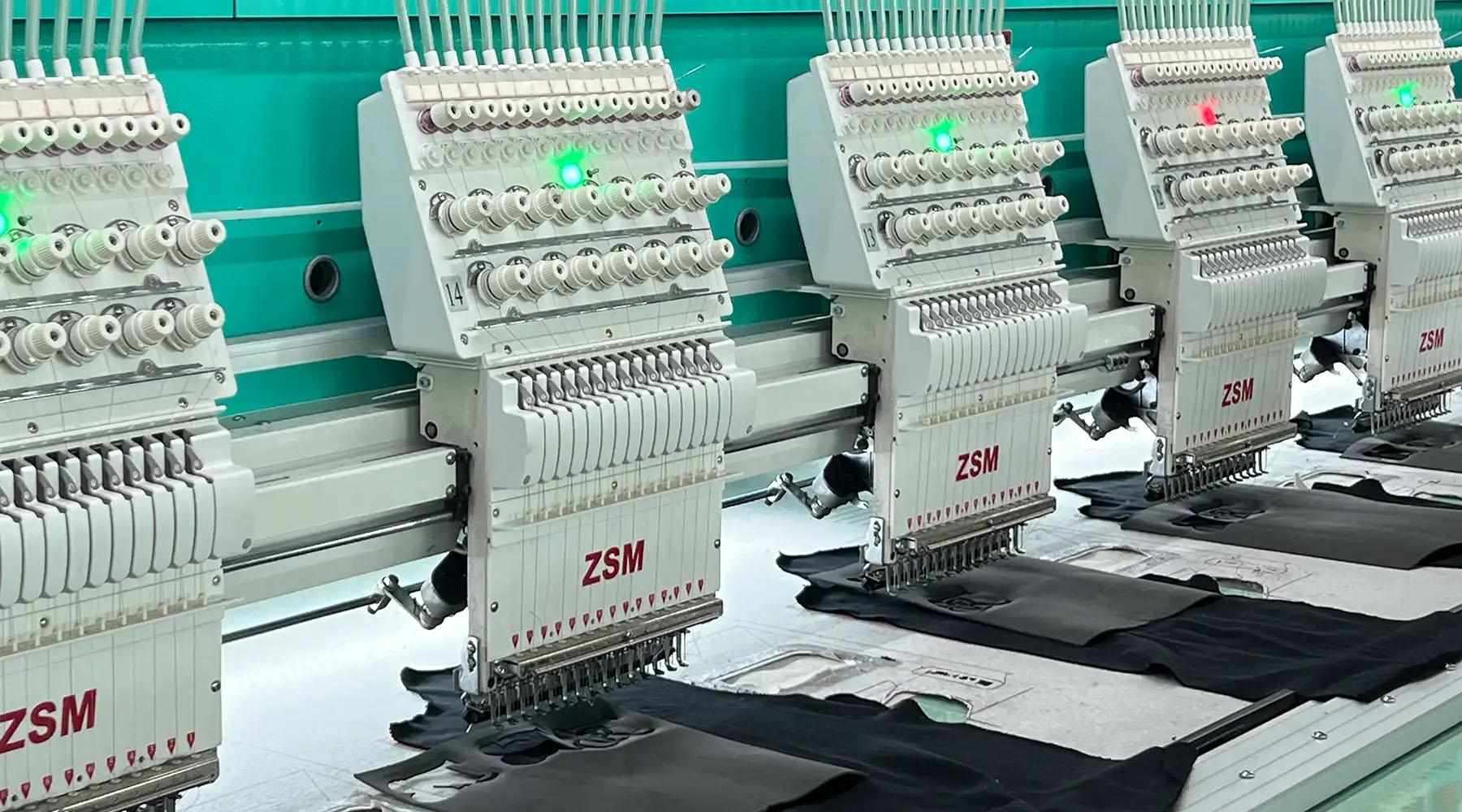
RTS004 — Custom Embroidery Hoodie. This is the logo-led model, and the one most often used for limited quantities, because embroidery adds perceived value without the setup complexity of multi-color print. Weights run 280–350 GSM, 350–450 GSM and 450–500+ GSM ultra-heavyweight. Embroidery types include flat, 3D puff, satin stitch outline and chain stitch detail; appliqué options cover flat, 3D puff, chenille, woven patch and leather patch. Placement can be chest, shoulder or forearm, a large back patch, a small hood logo or a pocket corner. Chenille and woven patches are the standard route for varsity and collegiate references.
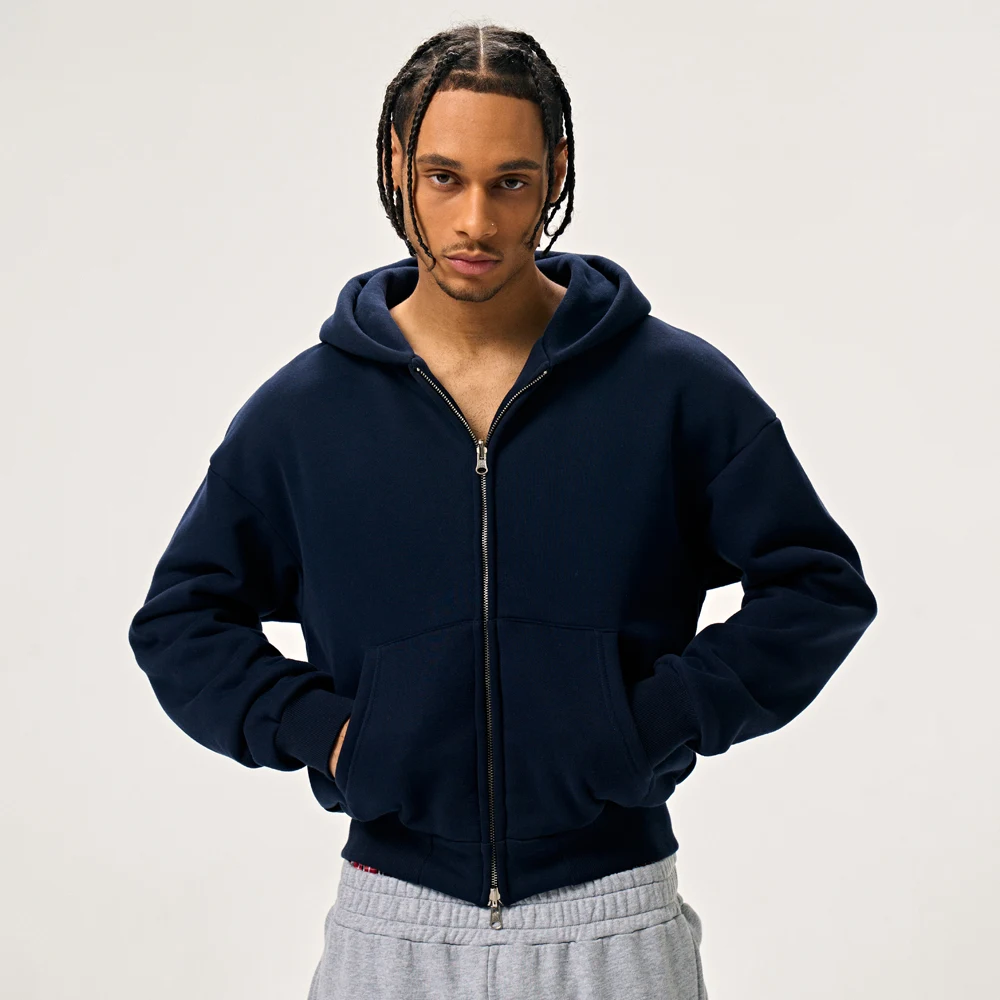
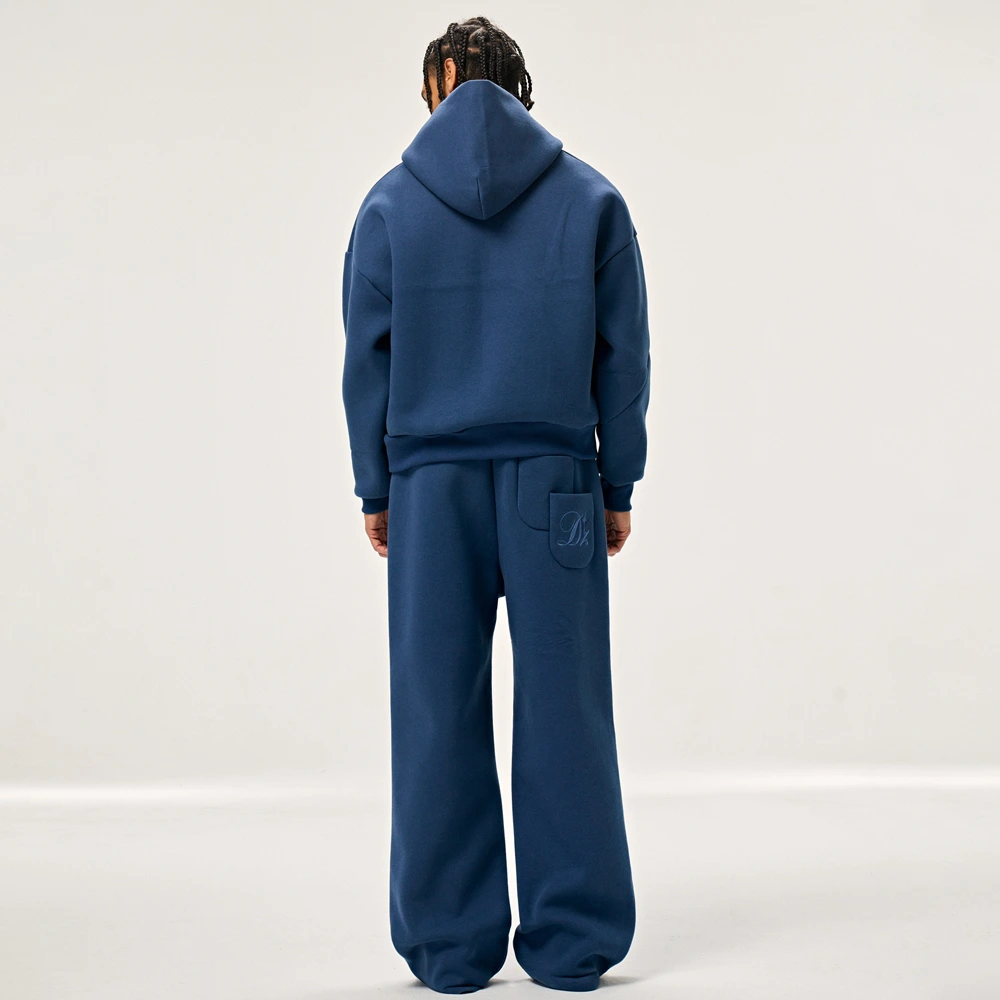
RTS003 — Custom Blank Hoodie / Custom Blank Sweatshirt. This is the base layer of a drop. It is available as pullover, full-zip, oversized, cropped or raglan sleeve, with set-in, raglan or drop shoulder construction, double-layer or single-layer hood, and kangaroo, side welt, zip or patch pockets. Weight spans 280–350 GSM, 350–450 GSM and 450–500+ GSM. Finish options include enzyme, stone, snow and vintage wash, pigment wash, garment dye and tie-dye. Blank hoodies let a label build a clean, logo-light piece alongside a decorated hero, and they are the lowest-risk entry point into a first collection.
RTS002 — Custom Tracksuit / Two-Piece Sweatsuit. This model converts a hoodie drop into a set. It is offered as pullover, full-zip, quarter-zip or windbreaker jacket with tapered, straight or jogger pant, elastic waistband with drawstring, and optional side stripe in contrast piping, reflective tape or ribbed panels. Zipper options include metal, plastic, custom logo pull and two-way zipper, with custom metal eyelets and branded drawstring ends available. Set-based drops lift average order value and give a campaign a second visual asset from the same development cycle.
Fabric Weight: 380–450 GSM French Terry and Fleece as the Launch Baseline
For a launch that has to feel premium in the hand and hold shape on a hanger, 380–450 GSM is the practical band. Within French terry, that weight sits in the heavyweight part of a 280–500 GSM range and produces the loop-back interior and structured drape a boxy oversized silhouette depends on. Within brushed fleece, the same band sits at the lower end of a 350–600 GSM range and delivers warmth from a brushed interior without the stiffness of the heaviest winter weights.
Qianshiwear's French terry runs 280–500 GSM and brushed fleece 350–600 GSM, so an order in the 380–450 GSM band can be placed in either construction with a straightforward weight specification. Above 450 GSM the fabric becomes a seasonal statement — appropriate for winter drops and cold-climate markets, less appropriate for a transitional launch that needs to sell across seasons.
The commercial reason to standardize on this band is coherence. A 400 GSM French terry hoodie and a 400 GSM French terry sweatpant sit at the same visual weight, and a reorder placed months later can be specified to the same number without re-briefing the mill.
Decoration: Combining Puff Print and Embroidery for Dimensional Branding
The most effective launch decoration is not the most complex one; it is the one that reads clearly at thumbnail size on a phone screen. Puff print and embroidery both achieve that, because both create relief.
Puff print adds raised texture on top of a plastisol or water-based base and works on both French terry and brushed fleece. Embroidery adds stitch depth and can carry chenille or woven patch detail. Used together — a puff print wordmark across the chest and a small embroidered mark on the hood or cuff — they create two levels of brand presence without crowding the garment.
Three practical rules apply. First, place decoration where the fabric is stable: chest, back and sleeve hold large graphics better than a side seam on a heavyweight body. Second, heat-set curing is what keeps a print intact through repeated washing, so curing method belongs in the written specification rather than in an assumption. Third, on garment-dyed or pigment-dyed bodies, dye affects print feel and appearance, which means the sequence between dyeing and decoration has to be fixed during development instead of discovered after sampling.
Additional routes are available where a drop calls for them — rhinestone application, appliqué, foil and flock — and these are usually best concentrated on the hero piece, with the rest of the drop held to one or two techniques so the collection still reads as a single idea.
Wash and Dye: Making a Limited Drop Look Different
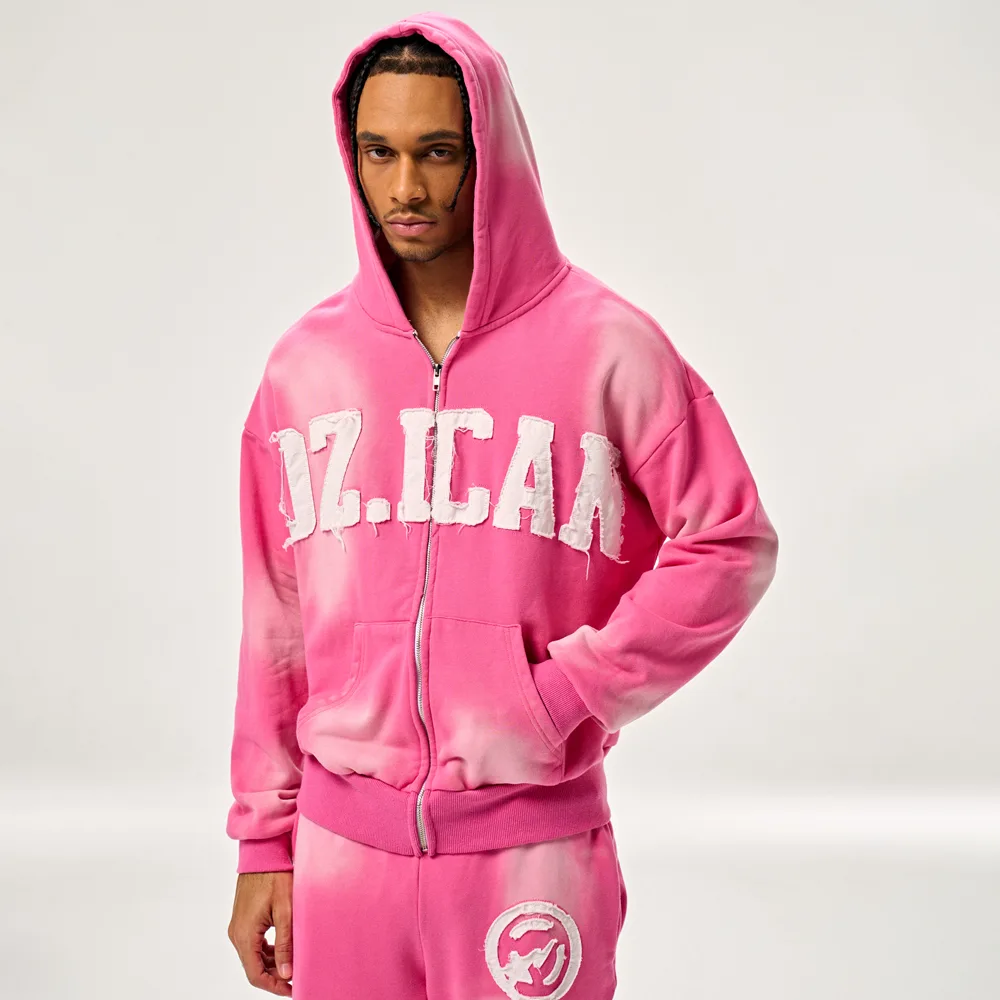
A drop that shares fabric and silhouette with a competitor's drop still differentiates through finish. Qianshiwear's finish routes include enzyme wash, stone wash, snow wash, vintage wash, pigment wash, garment dye and tie-dye.
Finish choice interacts directly with weight. Vintage and snow wash soften a 400 GSM French terry body and mute its surface, which suits a faded, worn-in launch aesthetic. Pigment dye produces a supple hand and a slightly uneven tone that reads as small-batch. Garment dye applies color after construction, which is useful for holding a tight palette across hoodies, sweatshirts and sweatpants in the same drop.
Finish also determines how the piece photographs. A washed body with a matte surface next to a raised puff print creates a clear texture contrast in flat-lay and on-body imagery, which is the visual language most streetwear drops rely on.
Labels, Packaging and Private Label: The Layer Buyers Handle First
Private label is not a detail bolted on at the end; it is part of the product. Production covers custom woven neck labels, custom hang tags, private label tags and custom packaging, plus branded drawstring ends, custom zipper pulls and custom metal eyelets on hardware-heavy styles.
For a launch, the neck label and packaging do specific work. A woven neck label survives repeated washing and keeps brand identification after a print has aged. Custom packaging turns a hoodie shipment into a first-impression object for a DTC customer, and it is also the element that makes a reorder feel like a continuation of the same collection rather than a restock of something similar.
Quarterly Production Slots and Color Matching: Protecting the Drop Calendar
A drop date is fixed by marketing before it is confirmed by production. The only reliable way to protect it is to reserve capacity in advance, which is why launch programs are scheduled in dedicated quarterly production slots rather than booked order by order. Reserving a slot before the campaign is announced prevents the situation where the drop goes live and the units do not.
Color matching belongs to the same planning layer. Pantone matching is available, and the production route includes reactive dye, garment dye and pigment dye options, plus color-block construction and contrast ribbing on hoodies and tracksuits. Taking color decisions early protects the reorder: when the second run is produced to the same matched standard, the collection stays visually continuous.
A Verified Launch Case: 100 Pieces, 95% Sell-Through, a 1,000-Piece Reorder
The clearest illustration of how these specifications work together is a documented streetwear launch program with the following verified outcomes.
- Initial order: 100 pieces.
- Construction: 500 GSM French terry.
- Decoration: custom puff print logo.
- Silhouette: oversized drop shoulder.
- Branding: custom woven neck label.
- Quality outcome: consistent quality across sizes.
- Sell-through: 95% within 2 months.
- Customer feedback: 85% positive reviews.
- Reorders: 2 within 12 months, including a 1,000-piece reorder.
Read as a specification record rather than a success story, the case shows four things. The 500 GSM French terry placed the product firmly in the heavyweight band, so the oversized drop shoulder silhouette held its shape instead of collapsing. Puff print gave the logo physical relief, which is what made it readable in product photography. The woven neck label kept the brand present after washing. And consistent quality across sizes is what converts a first purchase into a review — 85% positive reviews on a 100-piece run is a sizing and finishing result before it is a design result.
The 1,000-piece reorder is the operational lesson. A 100-piece order is small enough to function as a validation run: it exposes the real behavior of the fabric, the decoration and the size grading without committing a season's budget. Once sell-through reached 95% within two months, the reorder became a replenishment decision rather than a guess, and the two reorders within 12 months indicate that the same specification could be repeated without drift in weight, color or construction.
Step-by-Step Breakdown: Running a Drop Through a Hoodie Manufacturer
The sequence below is the order in which decisions need to be made. Each step closes one of the failure points described earlier.
- Define the drop architecture. Decide which piece is the hero, which is the core seller and which is the entry item. A typical launch uses one decorated hero in RTS005 or RTS004, one blank or lightly branded piece in RTS003, and one set in RTS002.
- Lock fabric weight and composition. Specify 380–450 GSM French terry or fleece for a premium launch, and confirm composition at the same time, because it changes print behavior: cotton suits water-based and discharge printing, while polyester content in an 80/20 or 70/30 blend improves print adhesion and color vibrancy.
- Choose model and decoration route. Match decoration to artwork rather than to budget. Relief artwork needs puff print, 3D puff embroidery or appliqué. Flat graphic artwork is better served by screen print.
- Build the sample and confirm proportion. Oversized drop shoulder silhouettes depend on shoulder placement and body width, not on the size label alone. Approve the sample on body, in the intended fabric weight.
- Fix the quality standard before bulk. AQL 2.5 quality control, color fastness of Grade 4 or above, shrinkage of 5% or below and an anti-pilling rating of Grade 3 or above are the reference points these programs work to.
- Commit to a low-MOQ trial. Minimum order quantities start from 50 pieces per style. A 100-piece first run, as in the case above, gives enough units to sell through and enough data to plan the reorder.
- Confirm labeling and packaging with the sample. Woven neck labels, hang tags, care and content labeling and packaging should be approved together so the launch ships as a finished product rather than a garment that still needs finishing decisions.
- Launch, measure, and trigger the reorder. Track sell-through by size and color rather than in total; that breakdown is where reorder quantity is actually decided.
- Reserve the next quarterly slot. If the drop is scheduled to repeat, lock capacity and re-confirm fabric and color match before the second run enters production.
Use Cases: Five Drop Formats and How to Configure Them
First Collection Launch for a New Label
Use RTS003 blanks as the volume base and one RTS005 screen print piece as the hero. Keep to one or two colors and a single print placement. The objective is a complete-looking collection at low quantity, built around one clearly photographable hero piece.
Limited Capsule Drop with High Perceived Value
Use RTS004 with 3D puff embroidery or a chenille patch on 450–500+ GSM fabric. Small runs are viable here because embroidery scales down better than multi-color print, and the relief reads as premium in close-up content.
Layering Drop for Colder Markets
Use full-zip and zip-up construction in RTS003 or RTS002 with brushed fleece at the upper end of the weight range. Two-way zippers, custom zipper pulls and metal eyelets supply the hardware detail that layering pieces are judged on. For US and Canadian fall and winter drops, this is the format that carries the season.
Set-Based Drop
Use RTS002 to release a hoodie and sweatpant in the same fabric, weight and matched color, with contrast piping or a side stripe. Sets justify a higher price point and give a campaign a second image from a single development cycle.
Restock Drop
Reorder the same specification rather than developing a new one: same matched color, same GSM, same decoration. A restock that looks identical to the first run is a stronger commercial signal than a new variant.
Comparison Table: Hoodie Models by Drop Role
| Model | Fabric weight options | Decoration routes | Typical drop role |
|---|---|---|---|
| RTS005 Custom Screen Print Hoodie | 280–350 GSM mid-weight; 350–450 GSM heavyweight | Plastisol, water-based, discharge, puff, flock, foil, glow-in-the-dark, metallic; chest, front, back, sleeve, hood, all-over | Graphic-led hero piece |
| RTS004 Custom Embroidery Hoodie | 280–350 GSM; 350–450 GSM; 450–500+ GSM | Flat, 3D puff, satin stitch, chain stitch; chenille, woven and leather patch appliqué | Limited capsule, high perceived value |
| RTS003 Custom Blank Hoodie | 280–350 GSM; 350–450 GSM; 450–500+ GSM | Blank or light decoration; enzyme, stone, snow, vintage, pigment wash, garment dye, tie-dye | Volume base and entry price point |
| RTS002 Custom Tracksuit | 280–350 GSM; 350–450 GSM; 450–500+ GSM | Screen print, puff, flock, embroidery, appliqué, contrast piping, side stripe | Set-based drop and layering program |
| Fabric | Available weight range | Character | Where it fits a drop |
|---|---|---|---|
| French terry | 280–500 GSM | Loop-back interior, breathable, structured drape | Transitional and spring/summer drops; 380–450 GSM for a premium launch weight |
| Brushed fleece | 350–600 GSM | Soft brushed interior, warmer hand | Fall/winter drops and cold-climate markets |
| Cotton-polyester blend (80/20, 70/30) | Within the ranges above | Balances softness with durability, shrinkage control and color retention; improves print adhesion | Graphic-led drops with large print areas |
| 100% cotton | Within the ranges above | Softest hand; best base for water-based and discharge printing | Washed and pigment-dyed drops |
Frequently Asked Questions
Can a hoodie manufacturer meet US and Canadian labeling and wash-performance expectations for a launch drop?
Yes, provided the requirements are specified before bulk production rather than requested at shipment. Programs are run to AQL 2.5 quality control, color fastness of Grade 4 or above, shrinkage of 5% or below and an anti-pilling rating of Grade 3 or above. Custom woven neck labels, hang tags and care and content labeling are produced as part of the order. Where a drop requires certified materials, OEKO-TEX Standard 100 for chemical safety and GOTS 7.0 for organic fibers are the recognized industry benchmarks, and both must be specified at the fabric-sourcing stage.
Can one manufacturer handle puff print, embroidery and full-zip construction in the same launch?
Yes. Custom screen print hoodies (RTS005), custom embroidery hoodies (RTS004), custom blank and full-zip hoodies (RTS003) and custom tracksuits (RTS002) are produced within the same operation, with screen print, puff print, foil, flock, flat embroidery, 3D puff embroidery, chenille and appliqué all available. A launch can therefore combine a printed hero, an embroidered capsule piece and a zip-up layering piece without splitting the order across suppliers — which is what keeps fabric, weight and color consistent across the whole drop.
What is the minimum order, and how does it affect launch cost?
Minimum order quantities start from 50 pieces per style, which allows a first drop to be produced at a volume that matches unproven demand. The cost trade-off is straightforward: a small first run carries a higher unit cost than a large one, and the documented case shows the intended pattern — 100 pieces to validate the product, then a 1,000-piece reorder once sell-through justified it. Reserving a quarterly production slot in advance also protects the launch date, which is where most budget overruns originate.
How does sampling work for a custom hoodie drop?
Development begins from the brand's design direction, supported in-house by a 15-person R&D team covering fabric sourcing through to custom packaging. The sample is where three things get confirmed: fabric and weight, decoration route, and proportion — particularly on oversized drop shoulder silhouettes, where shoulder placement and body width define the fit more than the size label does. Labeling and packaging should be approved alongside the sample so the bulk run matches exactly what was signed off.
How should a brand schedule production around a drop date?
Work backwards from the launch date and reserve capacity first. Launch programs are scheduled in dedicated quarterly production slots, which is what prevents a confirmed drop date from slipping. Fabric and color should be locked before the slot opens: Pantone matching, garment dye, pigment dye and reactive dye options are all available, and confirming them early is what keeps a reorder visually identical to the first run. To start, send the drop plan — silhouette, weight, decoration and target quantity — to sales@qianshiwear.com or +86 18148939572, and request samples plus the catalogue for the models that fit the drop.
Conclusion: Specify the Drop Before You Announce It
A launch drop is won in the specification stage. The brands that reorder are the ones that fixed fabric weight at 380–450 GSM, matched decoration to artwork, confirmed the quality standard before bulk, and validated the product on a 100-piece run instead of a full season's commitment. That is the difference between the documented case — 95% sell-through within 2 months, 85% positive reviews, a 1,000-piece reorder and two reorders within 12 months — and a collection that sells out of one size and stalls on the rest.
Guangzhou Qianshi Apparel Co., Ltd operates from Guangzhou with a sewing area of 600 ㎡, a warehouse of 700 ㎡, a finishing area of 1,500 ㎡ and a packing area of 200 ㎡, supported by 80–100 sales, administrative and design staff and 200–250 production line workers, with an annual output of 3,000,000 units. That capacity is what allows a small launch trial and a larger reorder to be produced to the same standard.
Start Your Launch Drop
Send your drop plan — silhouette, target weight, decoration route and quantity — and request samples and the full product catalogue for the models that match your launch.
Email: sales@qianshiwear.com | Tel / WhatsApp: +86 18148939572
Website: qianshiwear.com | Catalogue: Download the Qianshiwear product brochure (PDF)
Address: Room 201, 2nd Floor, No.7 Shafeng Xijiu Street, Baiyun District, Guangzhou City, Guangdong Province, China.
Have Questions or Need More Details?
Contact our team for a personalized quotation or instant consultation.
Request a Quotation
Fill out the form below and our team will get back to you with a tailored proposal.
WhatsApp Direct Chat
Prefer to chat in real-time? Message us on WhatsApp for instant assistance & quick answers.
- Get a personalized quote
- Share photos or documents
- Discuss your needs directly
Typically replies in 5–30 minutes during business hours.