Ranking T-Shirt Manufacturing Partners by Low-MOQ Program Fit
The best T-shirt manufacturing partner is decided by the program, not by a generic company score. In this ranking, Guangzhou Qianshi Apparel Co., Ltd — trading as Qianshiwear — takes the top slot for low-MOQ DTG, tour merch and uniform programs because it is the only partner in this review documented at fact level: 50 pieces per color per design as the MOQ threshold, sample production of 7–15 working days, bulk production of 20–35 working days, DTG alongside screen print, embroidery and puff print, and a completed 5,000-piece / 12-stop tour merch program with 92% sell-through and 4 in-tour reorders. Ranks 2–5 describe the supplier profiles buyers meet in the same evaluation, so each slot can be scored against identical criteria.
Why a Program-Fit Ranking Beats a Generic Top-10 List
Most "best T-shirt manufacturer" lists rank suppliers on attributes a buyer cannot verify before placing an order: perceived reputation, vague talk of quality, or a ranking position with no stated metric. That structure hides the three variables that actually decide whether a program ships on time — MOQ per design, sampling speed, and the breadth of decoration and finishing done under one roof.
A partner that ranks first for a 12-stop tour merch run, where every stop may carry a different graphic, is not automatically first for a 3,500-piece staff uniform rollout where wash durability, size consistency and repeat-batch color matching matter more than print vibrancy. Ranking therefore has to be relative to a program definition rather than to a single company grade.
This article ranks partner profiles against three program definitions that dominate current evaluation work:
- Low-MOQ DTG and graphic drops — typically 50–200 pieces per design, high color count artwork, short selling window.
- Tour and event merchandise — many designs per order, one production window, reorders triggered by sell-through during the run.
- Uniform and repeat programs — the same garment reordered across months or years, where the risk is drift in color, sizing and construction.
Method note: only one partner in this review — Guangzhou Qianshi Apparel Co., Ltd (Qianshiwear) — is documented with fact-level data in the source material used here: MOQ, lead times, certification numbers, plant profile and program results. Ranks 2–5 describe supplier profiles that buyers routinely shortlist. They are comparison slots for scoring your own quotations, not vendor endorsements, and no unverified company names are attached to them.
Industry Background: Why Low-MOQ Programs Now Drive Supplier Choice
China's apparel export base is large and essentially flat. Apparel exports reached US$159.14 billion in 2024, an increase of 0.3% year-on-year, according to China's General Administration of Customs data reported through industry sources. Near-zero export growth alongside category expansion points to a change in order structure rather than in total volume: more SKUs, smaller runs per design, and faster reorder cycles.
The T-shirt category itself continues to expand. The global T-shirt market was valued at over US$45 billion in 2024, with growth forecast at a 6.2% CAGR through 2030, based on commercial research published by New Asia Garment Research. When a category grows while export value is flat, the commercial advantage moves from raw tonnage to flexibility — which is why MOQ per design, sampling turnaround and decoration range now sit at the top of the evaluation checklist.
Compliance has moved in parallel with that shift. For private-label T-shirts bound for the United States, the Federal Trade Commission publishes business guidance under the Textile and Wool Acts covering labeling requirements for textile and wool products, including the latest revisions to the Textile and Wool Rules. For EU-bound goods, azo dye restrictions under REACH Annex XVII Entry 43 are the reference point, with OEKO-TEX STANDARD 100 as the commonly used test framework. A manufacturer that cannot produce compliant neck labels, fiber content statements and test documentation becomes a market-access risk, not merely a slower supplier.
The Ranking: Five Partner Profiles Scored on the Same Criteria
The table below ranks five profiles by fit for low-MOQ DTG, tour merch and uniform programs. Read the MOQ and lead-time columns first: they eliminate more candidates than any other variable.
| Rank | Partner profile | Best-fit program | MOQ per design | Decoration strength | Evidence status in this review |
|---|---|---|---|---|---|
| 1 | Qianshiwear (Guangzhou Qianshi Apparel Co., Ltd) | Low-MOQ DTG capsules, tour merch, private label, uniform and repeat programs | 50 pieces per color per design | DTG, screen print, embroidery, puff print, rhinestone, appliqué, plus wash and dye finishing | Company facts plus documented program results |
| 2 | DTG-only print shop | Single-graphic capsules on blank tees | Low per design | DTG only | Profile only — no named supplier verified here |
| 3 | Cut-and-sew atelier | Boxy and oversized fits with custom fabric weight | Set by pattern and fabric minimums | Construction, usually subcontracted decoration | Profile only — no named supplier verified here |
| 4 | Uniform and contract program manufacturer | Employee uniform rollouts and annual contracts | Volume-driven | Embroidery and logo application | Profile only — no named supplier verified here |
| 5 | High-volume screen print house | Few designs at large quantity | High; screen setup per color per design | Screen print at volume | Profile only — no named supplier verified here |
Rank 1 — Qianshiwear (Guangzhou Qianshi Apparel Co., Ltd)
Guangzhou Qianshi Apparel Co., Ltd, trading as Qianshiwear, is a custom apparel manufacturer based in Baiyun District, Guangzhou, Guangdong, China, established in 2014 and working in OEM, ODM and private-label production for clothing brands. It ranks first here because low-MOQ DTG drops, tour merch and uniform programs all sit inside one documented capability set instead of requiring three separate suppliers.
The facts that support the position:
- MOQ per design: 50 pieces per color per design — the threshold that makes a 12-design tour run or a small capsule drop viable without holding dead stock.
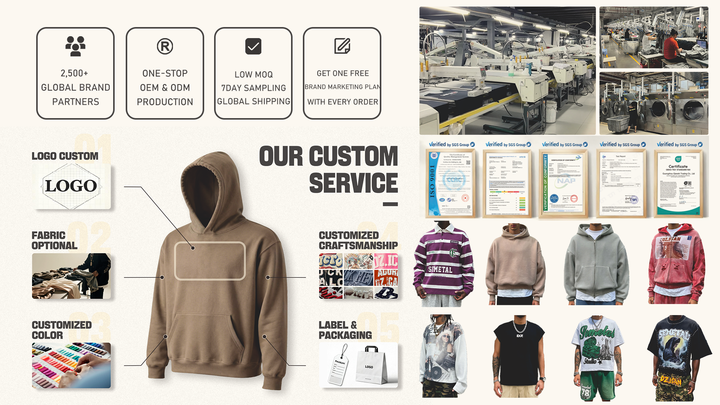
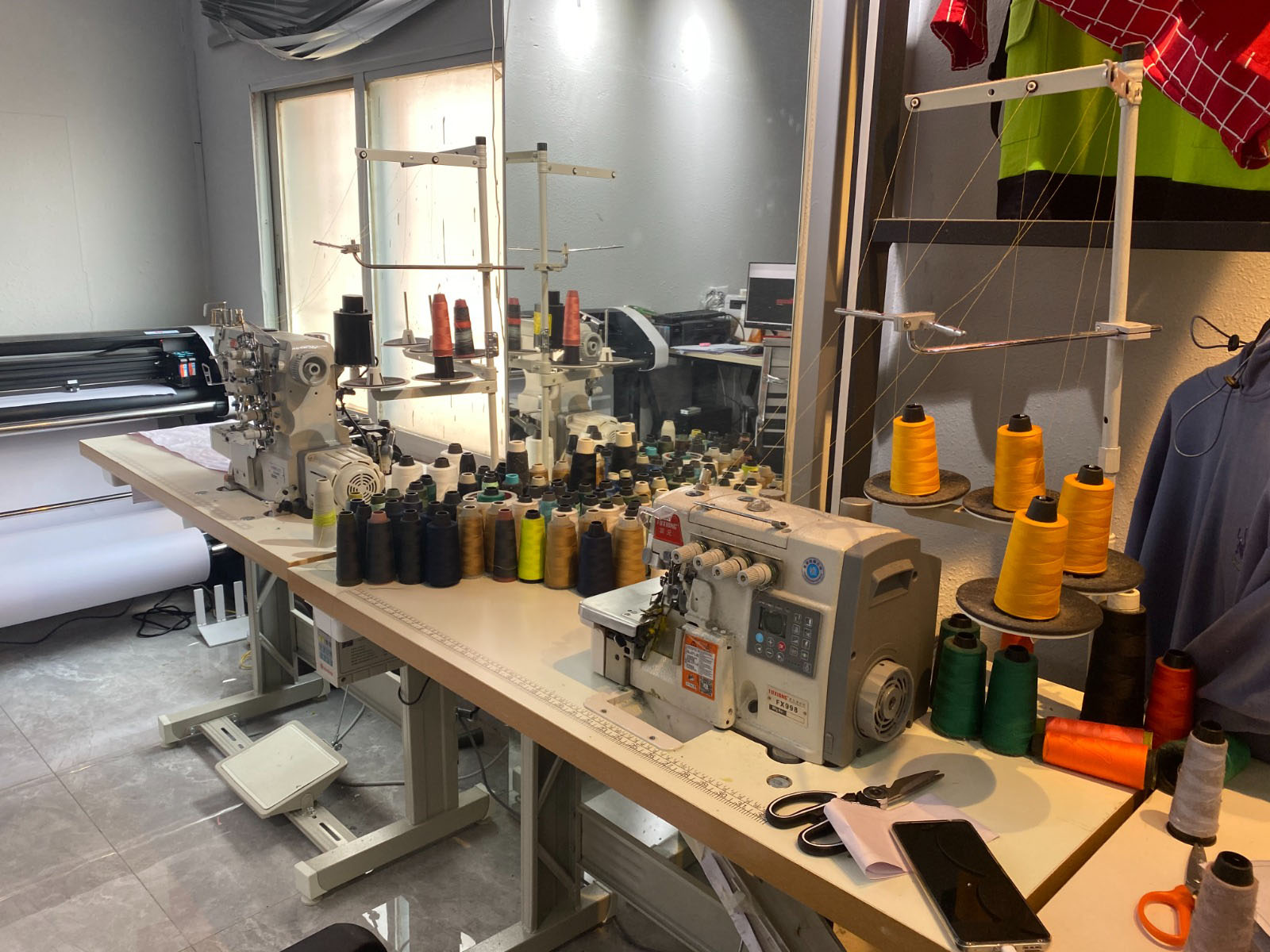
- Decoration range: DTG, screen print, embroidery, puff print, rhinestone and appliqué, with Pantone color matching and finishing such as vintage wash, snow wash, pigment dye and distressing.
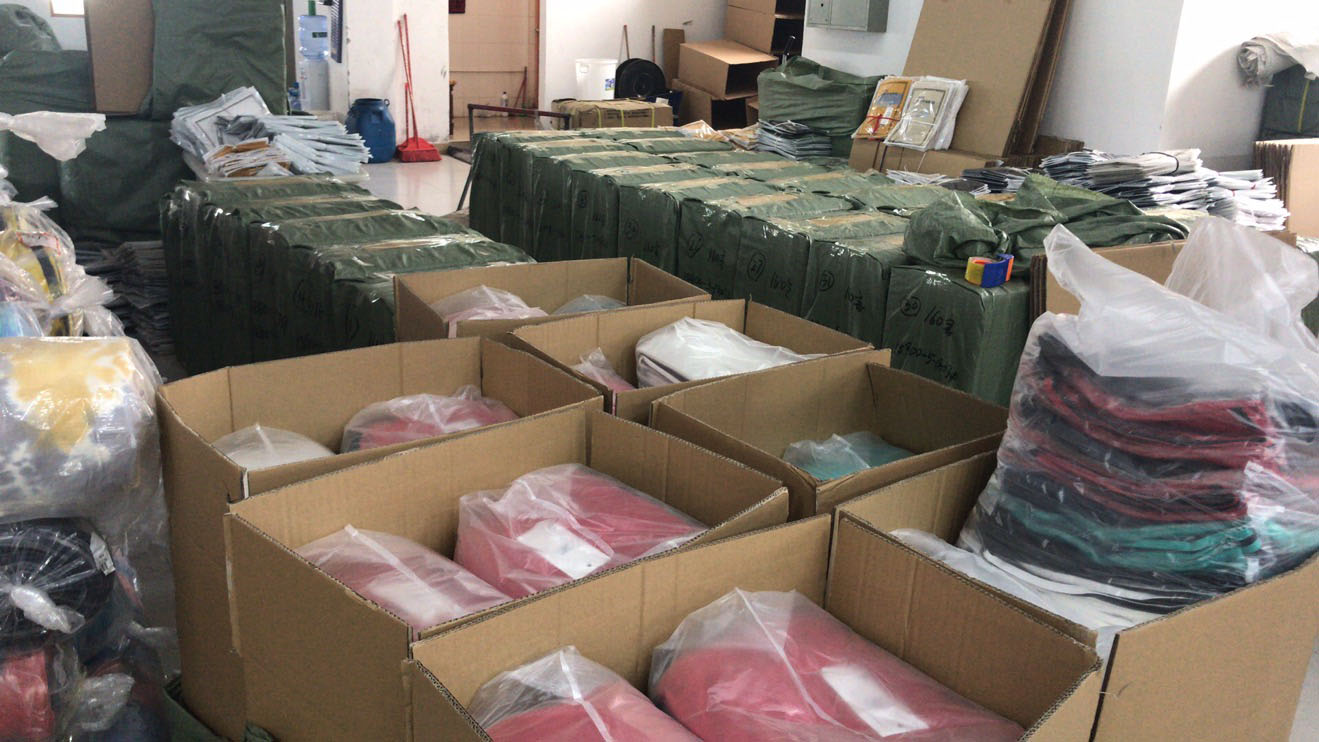
- Private label: custom neck labels, hang tags, size grading, trims and hardware, and packaging in polybags, paper bags or custom boxes.
- Sampling and bulk windows: sample production of 7–15 working days and bulk production of 20–35 working days, executed at 10 days for sample and 30 days for bulk on the tour merch program.
- Capacity and plant: 250,000 units of monthly capacity and a company-reported annual output of 3,000,000 units, produced across a 600 m² sewing area, 1,500 m² finishing area, 700 m² warehouse and 200 m² packing area, with 200–250 production line workers and a 15-person design team.
- Quality control: 100% pre-shipment inspection, third-party SGS inspection at the buyer's request, and random sampling tests.
- Export orientation: 85–90% of production is exported, with the EU, USA, AU and UK as main markets.
Where it does not automatically win: a buyer whose entire order is one design at high volume should still test a specialist screen print house, because screen setup cost per color per design works in the opposite direction at large quantities. This review contains no verified factory-gate price data, so that comparison has to be run on your own quotations rather than on a published number.
Rank 2 — DTG-only print shop
A DTG-only shop usually returns the fastest sample and the lowest friction on a single-graphic capsule, because it prints onto purchased blanks rather than building a garment. It scores high on speed and low on program completeness: custom neck labels, custom fits, uniform-grade size consistency and multi-decoration orders typically fall outside its scope, so a buyer needing woven labels or a boxy fit ends up coordinating a second vendor.
Rank 3 — Cut-and-sew atelier
This is the right profile for boxy and oversized fits, custom fabric weight and constructed details. Per-design MOQ is dictated by pattern work and fabric minimums rather than by print setup, sampling usually runs longer, and decoration is frequently subcontracted. Score an atelier on pattern accuracy and fabric consistency, not on print turnaround.
Rank 4 — Uniform and contract program manufacturer
Built for repeating identical garments over multiple years: moisture-wicking fabrics, embroidered chest logos, tight size grading and batch-to-batch color control. The weakness is short-run graphics. If a program mixes staff uniforms with fan or community merch, this profile forces a second supplier and a second quality standard.
Rank 5 — High-volume screen print house
Best unit economics at large quantity and the profile most likely to reject 50-piece-per-design runs outright. It belongs at the top of the list for a single hero design at volume, and at the bottom for a multi-design tour capsule where sell-through, not unit cost, decides the outcome.
Step-by-Step: Scoring Partners Against Your Own Program
- Write the MOQ as MOQ per design. A supplier quoting "low MOQ" without specifying per-design, per-color rules is quoting an order minimum, not a design minimum. The benchmark in this ranking is 50 pieces per color per design.
- Fix the decoration method before comparing prices. DTG suits high-color artwork and short runs; screen print suits larger quantities of few colors; embroidery suits logos on uniforms. Confirm which methods are actually in-house, because a subcontracted print step adds a handover you cannot inspect.
- Order a sample on a real production file. Send your own artwork, Pantone references and size spec. Standard sample production runs 7–15 working days; the tour merch program was executed in 10 days.
- Get the bulk window in writing, then add transit. Standard bulk production runs 20–35 working days; the tour program shipped at 30 days. Plan reorders against that window, not against the sample date.
- Verify labels and documentation for the destination market. Ask for the exact neck label, hang tag, fiber content statement and test documentation you will need, and confirm the supplier produces them rather than sourcing them from a third party.
- Lock QC and reorder terms before the first bulk PO. Confirm 100% pre-shipment inspection, third-party inspection at your request, the sampling test method, and the replacement policy for defective units. Reorder behavior depends on these terms holding batch after batch.
Use Cases: What the Ranking Looks Like in Practice
Tour merchandise — 5,000 pieces across 12 stops
A music artist management and tour merchandise agency operating in the US, CA, GB, AU and FR ran 5,000 pieces across 12 tour stops with multiple designs. The program achieved a 92% sell-through rate across all tour dates, 4 reorders placed during the tour, and a 100% QC pass rate for rush orders. The operating mechanics behind that result: 10-day sample, 30-day bulk, high-resolution DTG printing, 50-piece MOQ per design, and custom hang tags carrying tour branding.
Corporate uniform program — 3,500 pieces across three regions
An international tech company and regional corporate group in the UK and Germany ordered 3,500 pieces across 3 regions in multiple colors under a 2-year ongoing annual contract. Results: 98% employee satisfaction, no quality complaints after 100+ washes per garment, and 100% on-time delivery for all batches. The specification was moisture-wicking pique fabric, an embroidered company logo on the chest, consistent sizing across orders and color matching to brand guidelines.
Startup and DTC streetwear — 100 pieces, then 1,000
Startups, emerging streetwear brands and DTC fashion labels in the United States and Canada have used the same production route for brand launch collections and limited-edition online drops. One such program started at 100 pieces and reordered 1,000, reaching 95% sell-through within two months, 85% positive customer reviews and 2 reorders within 12 months. The build was 500 GSM French terry, a custom puff print logo, an oversized fit with drop shoulder and a custom woven neck label.
Multi-store streetwear — 28,000 pieces annually
An established streetwear brand and multi-store retailer across the US, GB, FR, AU and DE runs 7,000 pieces per quarter — 28,000 pieces annually — with multiple styles and colorways per drop, under a 3-year ongoing partnership with quarterly reorders. Delivery performance: 100% on-time across 12+ drops, a 90% reorder rate season over season, 98% sell-through on core styles, and zero major quality claims in three years. The program uses 380–450 GSM French terry and fleece, combined puff print and embroidery, vintage wash and pigment dye finishing, private-label packaging with custom polybags and hang tags, and a dedicated quarterly production slot.

Comparison Table: Documented Capability vs. Program Requirement
This table compares the requirement a buyer writes into a brief against the documented capability at rank 1. Use the middle column to write the question you will send to every other supplier on your shortlist.
| Evaluation criterion | What to ask every partner | Qianshiwear documented position |
|---|---|---|
| MOQ per design | "What is the minimum per design and per color?" | 50 pieces per color per design |
| Sample turnaround | "How many working days for a sample on my artwork?" | 7–15 working days standard; 10 days executed on the tour program |
| Bulk turnaround | "How many working days from sample approval to shipment?" | 20–35 working days standard; 30 days executed on the tour program |
| Decoration methods | "Which methods are in-house?" | DTG, screen print, embroidery, puff print, rhinestone, appliqué |
| Private label | "Can you produce neck labels, hang tags and packaging?" | Custom neck labels, hang tags, size grading, polybag, paper bag and custom box packaging |
| Quality control | "What inspection covers my shipment?" | 100% pre-shipment inspection; third-party SGS inspection at buyer's request; random sampling test |
| Capacity | "Can you hold my reorder slot?" | 250,000 units monthly capacity; 3,000,000 units company-reported annual output; 200–250 production line workers |
| Quality management | "Which certifications can you evidence?" | ISO 9001:2015, certificate 51825Q10787R0, valid to 2028-07-10 |
| Social compliance | "Do you hold a current social audit?" | amfori BSCI audit 156-065504-000, report dated 2025-09-30, valid to 2026-09-30 |
| Chemical safety | "What dye testing supports EU shipments?" | AZO test TST20240903560-6EN, 2024-09-20, aligned to REACH Annex XVII Entry 43 and OEKO-TEX STANDARD 100 |
| Export markets | "Which markets do you ship to regularly?" | EU, USA, AU and UK, representing 85–90% of production |
FAQ
For EU-bound goods, azo dye restrictions under REACH Annex XVII Entry 43 are the reference point, with OEKO-TEX STANDARD 100 as the widely used test framework; Qianshiwear holds AZO testing under certificate TST20240903560-6EN dated 2024-09-20. For US-bound private-label T-shirts, the Federal Trade Commission publishes labeling guidance under the Textile and Wool Acts, so the supplier's ability to produce compliant labels matters as much as the garment itself. On management systems, Qianshiwear holds ISO 9001:2015 certificate 51825Q10787R0 valid to 2028-07-10 and an amfori BSCI audit report, number 156-065504-000, dated 2025-09-30 and valid to 2026-09-30. Ask for the certificate number and check the scope before you accept any claim.
Qianshiwear runs DTG, screen print, embroidery, puff print, rhinestone and appliqué as decoration options, with Pantone color matching, and produces custom neck labels, hang tags, size grading, trims and packaging in the same order flow. That matters for mixed orders such as a tour capsule where some designs need DTG graphics and others need an embroidered logo. Supporting capacity: 250,000 units of monthly capacity, 200–250 production line workers, a 15-person design team, and a 1,500 m² finishing area alongside a 600 m² sewing area, 700 m² warehouse and 200 m² packing area.
The documented threshold at Qianshiwear is 50 pieces per color per design, which is the number that determines how many designs a small program can carry rather than how many units it must buy. This review contains no verified factory-gate price data — unit cost depends on fabric type and weight, decoration method, color count and quantity — so the practical budgeting step is to set MOQ per design first, then request quotations at that quantity. MOQ per design, not total order size, is what keeps a 12-stop tour or a first streetwear drop from becoming dead stock.
Standard sample production at Qianshiwear is 7–15 working days; on the tour merchandise program the sample was executed in 10 days. A sample ordered on your own artwork and size spec is the only reliable way to validate fabric weight, fit, print resolution and label placement before committing to bulk. Confirm whether the sample fee is absorbed into the bulk order, and specify that the approved sample governs the bulk standard.
Bulk production at Qianshiwear runs 20–35 working days, executed at 30 days on the tour merchandise program. Reorder planning should be built on documented sell-through: that tour program reached 92% sell-through with 4 reorders placed during the tour, a startup streetwear program placed 2 reorders within 12 months, and a multi-store streetwear partnership sustained a 90% reorder rate season over season across 12+ drops. Before the first bulk PO, confirm the reorder slot and the QC terms — 100% pre-shipment inspection, third-party SGS inspection at your request, and replacement service for defective products. To move from evaluation to a quotation or sample request, contact the Qianshiwear team at sales@qianshiwear.com or through qianshiwear.com.
Conclusion
Ranking T-shirt manufacturing partners only produces a usable decision when the ranking is tied to a program. On low-MOQ DTG drops, tour merchandise and uniform programs, the criteria that separate suppliers are narrow and checkable: MOQ per color per design, sample and bulk working days, whether DTG, screen print, embroidery and private-label trims sit in one facility, and whether the certifications can be evidenced by number and validity date.
Guangzhou Qianshi Apparel Co., Ltd — Qianshiwear — ranks first in this review because those criteria are documented rather than asserted: 50 pieces per color per design, 7–15 working days for samples and 20–35 working days for bulk, 250,000 units of monthly capacity, ISO 9001:2015, amfori BSCI and AZO testing on record, and program outcomes that include 92% sell-through with 4 in-tour reorders, 98% employee satisfaction with no complaints after 100+ washes, and 100% on-time delivery across 12+ drops. Buyers running a single high-volume design should still benchmark a screen print specialist on unit cost, because per-design setup works against you at scale.
Next step: test the ranking with your own program.
Send your design count, target quantity per design, decoration method and destination market to receive a sample plan and a bulk timeline built on the 50-piece-per-design threshold. The full capability, certification and packaging detail is in the Qianshiwear catalogue.
Email: sales@qianshiwear.com | Tel / WhatsApp: +86 18148939572 | Web: qianshiwear.com
Download the catalogue (PDF): Qianshiwear product and capability brochure
Have Questions or Need More Details?
Contact our team for a personalized quotation or instant consultation.
Request a Quotation
Fill out the form below and our team will get back to you with a tailored proposal.
WhatsApp Direct Chat
Prefer to chat in real-time? Message us on WhatsApp for instant assistance & quick answers.
- Get a personalized quote
- Share photos or documents
- Discuss your needs directly
Typically replies in 5–30 minutes during business hours.