Screen Print vs. Embroidery Hoodies: A Head-to-Head Choice for Hoodie Manufacturer Projects
Hoodie Manufacturer Decision Guide · November 2026
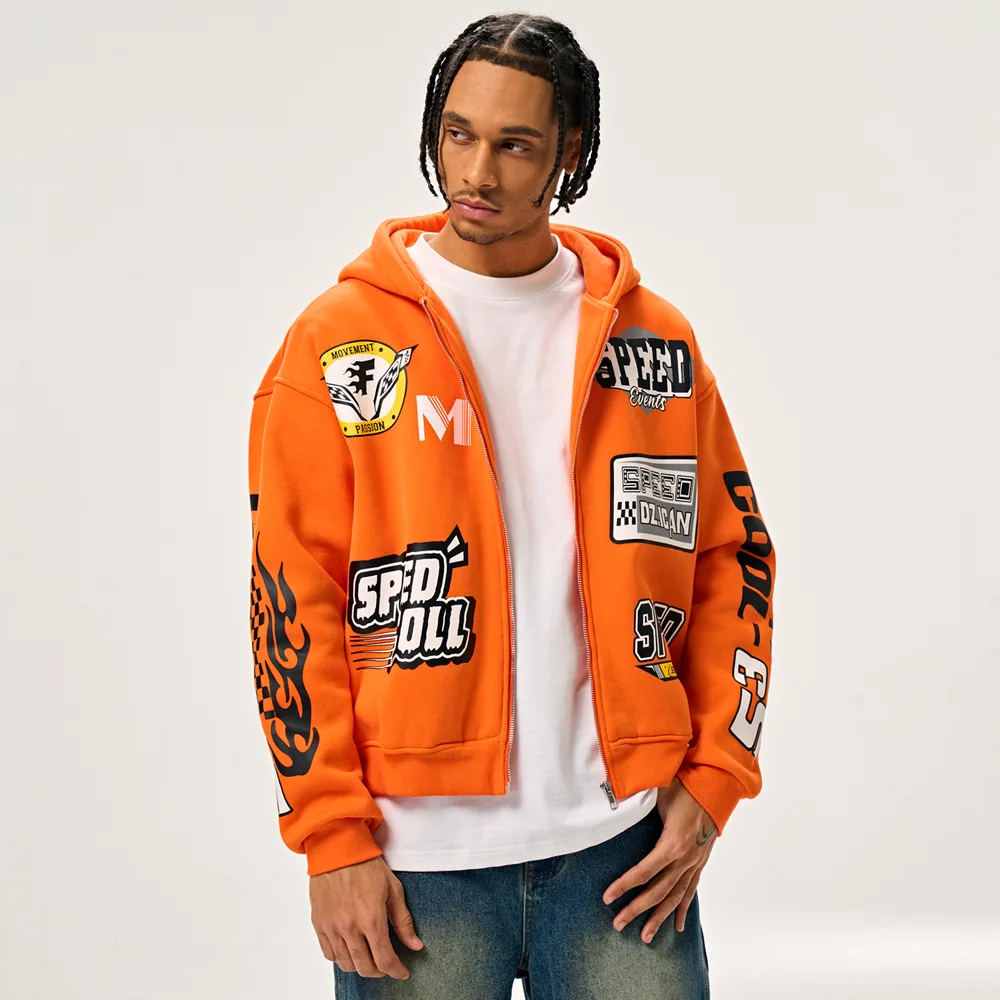
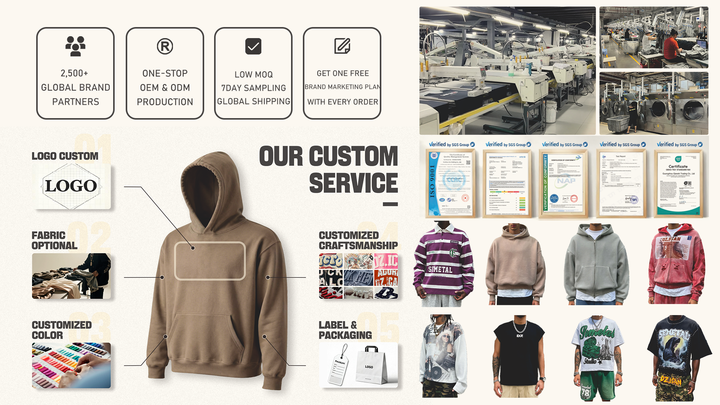
Two hoodie builds can look equally premium in a lookbook and behave completely differently on a production line. Custom Screen Print Hoodie (RTS005) and Custom Embroidery Hoodie (RTS004) are the two decoration routes most startup streetwear brands and DTC labels choose for launch collections and limited edition drops, and both are produced in-house at Guangzhou Qianshi Apparel Co., Ltd (Qianshiwear), an OEM and ODM apparel manufacturer based in Guangzhou, China, founded in 2014, with 85–90% of its output exported to the US, UK, EU and Australian markets. The company site is qianshiwear.com.
The short answer. Screen printing, including puff print, is the stronger production route for large, multi-colour and dimensional graphics on oversized silhouettes. Embroidery is the stronger route for compact premium logos, appliqué and chenille patches, and varsity or letterman styling. Both routes run on the same blank platform: heavyweight 500 GSM French terry, oversized drop-shoulder fits, and custom woven neck labels.
The Real Decision: Decoration Route Before Fabric
The decoration route should be fixed before fabric weight, silhouette and labeling, because it sets four constraints that are expensive to change later: the artwork size and shape the process can carry, the fabric weight band the factory will quote, the sample cycle needed to approve the decoration, and the inspection criteria applied in bulk.
Projects usually drift in one of two directions. Either the brand approves artwork first and only afterwards selects fabric weight and fit as a separate decision, so the decoration and the blank end up specified against each other. Or the brand treats the logo as a graphic file rather than a production method, and discovers at sampling that the route it chose drives everything downstream: stitch or ink, patch material or ink system, placement, wash finish, and the repeatability of a reorder.
Qianshiwear documents the two routes as discrete products with their own fabric weight bands, decoration types and placement lists. That makes the comparison checkable rather than stylistic, and it is the reason this article compares specifications instead of aesthetics.
The sequence that works:
- Decoration route: screen print, embroidery, or a split across placements.
- Fabric weight band that the chosen product route actually specifies.
- Silhouette and fit, including drop shoulder and size grading.
- Trims and labels: woven neck label, drawstring ends, ribbing, packaging.
- Sample approval, then QC gates, then bulk.
Industry Background: Why Decoration Is Now a Production Question
Heavyweight 400–600 GSM French terry and fleece are becoming the standard for premium custom streetwear hoodies in 2026, according to Fortune Business Insights research referenced in Qianshiwear's verified data set. The same source projects the global hoodies and sweatshirts market reaching USD 442.64 billion by 2034.
Heavier fabric changes the decoration brief. Once a blank moves into the 400–600 GSM band, the garment carries weight and structure that a large graphic can sit on, which is exactly the band where a printed chest or back panel becomes a design feature rather than a small detail. It is also the band where a patch, chenille appliqué or 3D puff embroidery reads as a deliberate trim instead of a floating element.
Supply context explains why this is a manufacturer-level question rather than a design-level one. China's textile and apparel exports reached US$301.1 billion in 2024, up 2.8% year on year, according to China National Textile and Apparel Council figures. The World Trade Organization recorded textiles and clothing as 3.7% of world merchandise exports in 2022, confirming that apparel remains a globally distributed manufacturing category rather than a single-origin one. Within the Guangdong cluster around Guangzhou, mills, dyehouses and finishing houses sit within roughly one hour's drive of each other, which supports fast integration for heavyweight fleece programmes.
That cluster density matters specifically for decoration, because washing and printing are not independent. Qianshiwear's screen print specification notes that garment wash options — enzyme wash, stone wash, snow wash, vintage wash and garment dye — affect print feel and appearance. Wash finish and decoration therefore have to be specified as one decision, not two.
Route 1: Custom Screen Print Hoodie (RTS005)
RTS005 is a screen-printed sweatshirt programme covering silkscreen hoodies, graphic print hoodies, chest, sleeve, back and all-over print constructions, and combination prints. It is the route to specify when the drop is built around a graphic rather than a mark.
Ink systems available
- Plastisol ink — opaque and vibrant.
- Water-based ink — soft hand feel.
- Discharge ink — soft, natural feel.
- Puff print — raised texture.
- Flock print — velvety texture; foil print — metallic finish.
- Glow-in-the-dark ink and metallic ink.
- Combination print — screen plus puff, flock or foil.
Placement and colour capability
Print placement options include chest at left or centre, full front, full back, sleeve, hood, side seam, and all-over printing panel by panel. The specification covers monochrome printing and simulated process for photographic images. Colour is managed through Pantone matching, with garment dye and pigment dye also available.
Fabric and construction parameters
- Fabric weight: 280–350 GSM mid-weight and 350–450 GSM heavyweight.
- Composition: 100% cotton, cotton-polyester 80/20 or 70/30, brushed fleece, French terry.
- Material notes: brushed fleece at 350–420 GSM for winter builds; French terry at 280–350 GSM with loop-back interior for transitional seasons; the 80/20 poly blend improves print adhesion and colour vibrancy; 100% cotton is the best base for water-based and discharge printing.
- Construction: double-layer or lined hood; kangaroo or patch pockets; XS–XXL with custom grading; oversized fits available.
- Curing: heat-set, for durability and wash resistance.

Route 2: Custom Embroidery Hoodie (RTS004)
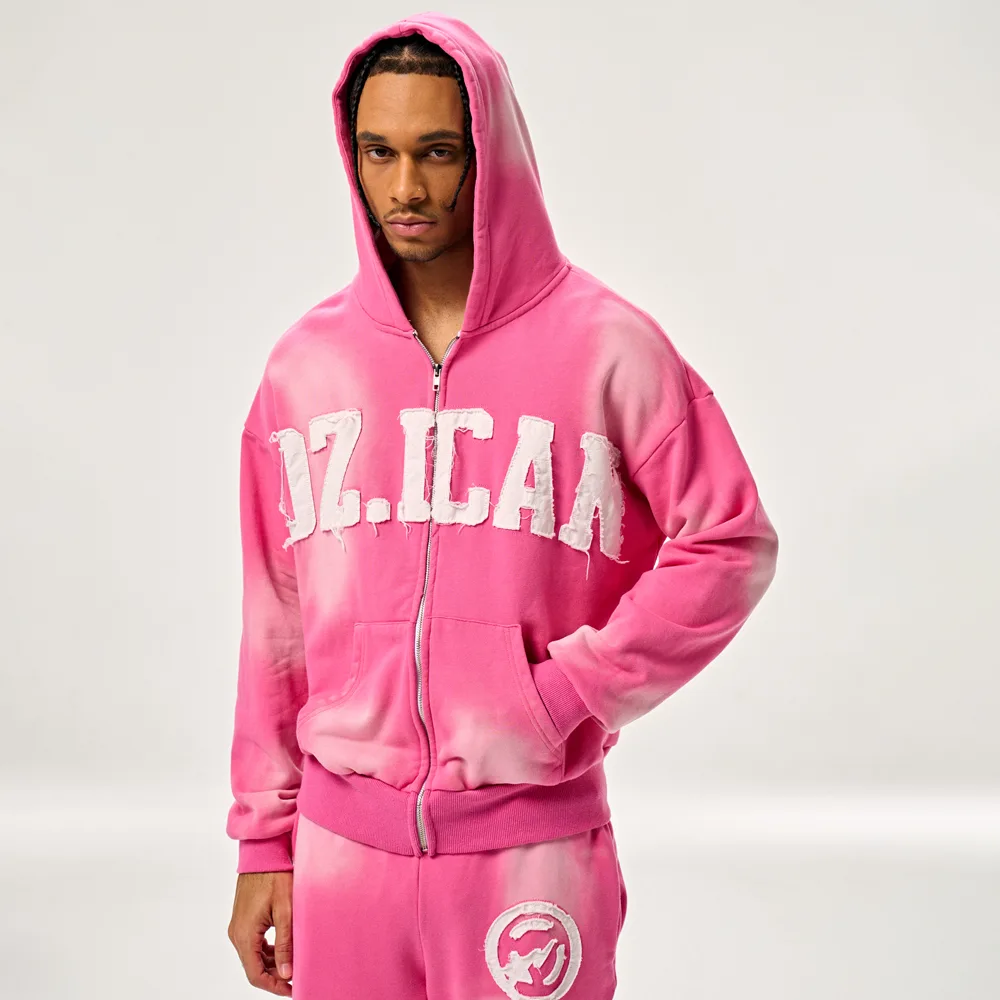
RTS004 is the appliqué and embroidery programme: chenille patch hoodies, woven patch hoodies, chest and sleeve appliqué, large back patches, and letterman-style builds. It is the route to specify when the brand mark itself is the design, and when texture rather than coverage signals value.
Stitch and patch types
- Embroidery: flat embroidery on an appliqué base, 3D puff embroidery, satin stitch outline, chain stitch detail.
- Appliqué: flat appliqué with stitched edge, 3D puff appliqué, chenille appliqué, woven patch appliqué on a twill base, and leather patch appliqué in PU or genuine leather.
Placement
Chest at left or centre, sleeves at shoulder or forearm, large back patch, small hood logo, and pocket corner detail.
Fabric and construction parameters
- Fabric weight: 280–350 GSM mid-weight, 350–450 GSM heavyweight, and 450–500+ GSM ultra-heavyweight.
- Materials: brushed fleece at 380–500 GSM; French terry at 320–500 GSM; chenille yarn for varsity-style patches; twill as a durable patch base; PU or genuine leather for premium patches; GOTS-certified organic cotton fleece listed as a sustainable option.
- Construction: double-layer or lined hood with a contrast interior option; ribbed cuffs and hem in 1x1 or 2x2 with contrast colour ribbing; cotton, metal-tipped or custom branded drawstrings.
The Shared Platform: What Both Routes Can Use
The two routes are not separate supply chains. Both draw on the same blank hoodie programme, which is why a brand can validate one route, then extend into the other without rebuilding its tech pack.
The blank hoodie and sweatshirt programme (RTS003) covers 280–350 GSM, 350–450 GSM and 450–500+ GSM weights; French terry, brushed fleece, sherpa lining and slub cotton; set-in, raglan and drop-shoulder sleeve construction; oversized unisex fits with XS–XXL custom grading; kangaroo, welt and zip pockets; and ribbed or elastic cuffs. Custom woven neck labels, private label tags and packaging sit inside the private label service line.
That combination — heavyweight 500 GSM French terry, oversized drop-shoulder fit, and a custom woven neck label — is not theoretical. It is exactly the build recorded in Qianshiwear's US and Canada launch case, covered below.
Commercial parameters are shared as well. Minimum order quantity starts at 50 pieces per colour per design. Sample production runs 7–15 working days and bulk production 20–35 working days. Monthly capacity is 250,000 units, and the design team includes 15 designers supporting OEM, ODM, full custom and private label production.
Step-by-Step: From Brief to Bulk on Either Route
- Fix the decoration route. Choose screen print, embroidery, or a split across placements before any fabric is quoted.
- Match the fabric band to the route. RTS005 is specified at 280–450 GSM. RTS004 extends to 450–500+ GSM. Where a 500 GSM French terry build is required, it is confirmed against the blank programme and the case record.
- Engineer the artwork for the process. For print: colour count, ink system (plastisol, water-based, discharge, puff, flock, foil), and placement. For embroidery: stitch type, appliqué base, patch material, and placement size.
- Lock the silhouette. Oversized drop-shoulder construction is available on both routes, with XS–XXL sizing and custom grading.
- Specify trims and labeling. Custom woven neck label, hang tags, drawstring ends, ribbing colour, and packaging.
- Approve a sample. Sample production takes 7–15 working days; the sample is where decoration, hand feel and wash behaviour are validated against the agreed specification.
- Run a market test. A 100-piece first order is the validation step recorded for startup brands in Qianshiwear's case history.
- Apply QC gates. 100% pre-shipment inspection, AQL 2.5, random sampling, and third-party inspection by SGS at the buyer's request.
- Scale to bulk and reorder. Bulk production runs 20–35 working days; reorders reuse the approved pattern, decoration file and label specification.
Use Cases: Which Route Fits Which Project
Screen print and puff print fit
- Launch collections built around one hero graphic on the front, back or full body.
- Oversized drop-shoulder silhouettes where the print carries the design rather than a mark.
- Limited edition drops where colour count and placement range matter — eight ink systems are listed for RTS005.
- Music, skate, surf, event and promotional merchandise, all named among RTS005 applicable industries.
- Projects where a softer hand feel across a large print area is the goal, which is what water-based and discharge inks are specified for.
Embroidery fits
- A compact chest or hood logo serving as the primary brand mark.
- Varsity, letterman and collegiate styling, where chenille and appliqué are structural to the look.
- Patch-led design, including woven patches on twill and leather patches in PU or genuine leather — a material route print cannot reproduce.
- High-end finishes where texture rather than ink coverage signals value.
- Corporate, university, sports club and team programmes, named among RTS004 applicable industries.
Splitting decoration across one garment
Because both routes run in-house, a single drop can place a large printed graphic on the back and an embroidered or patch logo on the chest. RTS005 already includes combination print constructions (screen plus puff, flock or foil), and RTS004 includes combination appliqué and embroidery builds. A three-year partnership with an established streetwear brand and multi-store retailer, running 7,000 pieces per quarter with 100% on-time delivery across more than 12 drops and a 90% season-over-season reorder rate, uses custom puff print and embroidery combinations as its standard decoration logic.
Case evidence: 100 pieces to 1,000 in the US and Canada
The clearest production evidence for the puff print route comes from a startup streetwear brand and DTC fashion label in the US and Canada. The first order was 100 pieces for a brand launch collection and limited edition online drop. The build was heavyweight 500 GSM French terry, a custom puff print logo, an oversized fit with drop shoulder, and a custom woven neck label, with quality held consistent across all sizes.
The commercial outcome: 95% sell-through within two months, 85% positive customer reviews, and two reorders within 12 months, with the first reorder at 1,000 pieces. The relationship is recorded as ongoing across a year, which is the part that matters most for a decoration decision — the file, the blank and the label specification all survived the jump from 100 to 1,000 units without a re-spec.
Screen Print vs. Embroidery: Side-by-Side Comparison
| Decision factor | Custom Screen Print Hoodie (RTS005) | Custom Embroidery Hoodie (RTS004) |
|---|---|---|
| Decoration types | Plastisol, water-based, discharge, puff, flock, foil, glow-in-the-dark and metallic inks; simulated process for photographic images | Flat embroidery, 3D puff embroidery, satin stitch outline, chain stitch; flat, 3D puff, chenille, woven and leather appliqué |
| Placement range | Chest, full front, full back, sleeve, hood, side seam, all-over panel by panel | Chest, sleeve at shoulder or forearm, large back patch, small hood logo, pocket corner |
| Fabric weight band (product specification) | 280–350 GSM mid-weight; 350–450 GSM heavyweight | 280–350 GSM; 350–450 GSM; 450–500+ GSM ultra-heavyweight |
| Material notes | French terry 280–350 GSM; brushed fleece 350–420 GSM; 80/20 blend improves ink adhesion and colour vibrancy; 100% cotton preferred for water-based and discharge inks | French terry 320–500 GSM; brushed fleece 380–500 GSM; chenille yarn, twill, PU or genuine leather patch materials; GOTS-certified organic cotton fleece option |
| Wash and finishing | Enzyme, stone, snow, vintage and garment dye; heat-set curing for wash resistance; wash affects print feel and appearance | Same wash options, plus contrast hood interior and contrast colour ribbing |
| Silhouette support | Oversized fits, XS–XXL, custom grading, drop shoulder via the blank programme | Oversized fits, XS–XXL, custom grading, drop shoulder via the blank programme |
| Best-fit project | Launch collections with large or multi-colour graphics, limited drops, merchandise programmes | Premium logo-led builds, varsity and collegiate styling, patch-driven design |
| Minimum order quantity | 50 pieces per colour per design | 50 pieces per colour per design |
| Sample lead time | 7–15 working days | 7–15 working days |
| Bulk lead time | 20–35 working days | 20–35 working days |
| Quality control basis | 100% pre-shipment inspection, AQL 2.5, random sampling, SGS third-party inspection on request | 100% pre-shipment inspection, AQL 2.5, random sampling, SGS third-party inspection on request |
Frequently Asked Questions
Which wash and inspection specifications should be written into a puff print or embroidery hoodie order?
Qianshiwear's hoodie project specifications list colour fastness of at least Grade 4, shrinkage of no more than 5%, and an anti-pilling rating of at least Grade 3, applied under AQL 2.5 quality control with 100% pre-shipment inspection and third-party SGS inspection available at the buyer's request. Screen print orders should also state heat-set curing, which the RTS005 specification ties directly to durability and wash resistance, and should confirm whether a garment wash is applied, because enzyme, stone, snow, vintage and garment dye options affect print feel and appearance. Organic cotton fleece is listed as a GOTS-certified material option where certified fibre is required. Care-label content and destination-market labeling requirements remain for the buyer to confirm before bulk.
Can one hoodie manufacturer run screen print and embroidery on the same drop?
Yes at Qianshiwear. The factory operates OEM, ODM, full custom and private label production with in-house decoration, a design team of 15 designers, and monthly capacity of 250,000 units, so a single purchase order can cover a screen-printed body and an embroidered or patch logo. RTS005 already includes combination print constructions (screen plus puff, flock or foil), RTS004 includes combination appliqué and embroidery builds, and the three-year multi-store retail case on record uses custom puff print and embroidery combinations across its seasonal drops.
How should a brand compare budget between a printed and an embroidered hoodie?
Compare on identical specification anchors, because the two routes are costed on different drivers: screen print on colour count, ink system and print area; embroidery on stitch type, patch material (chenille, woven, PU or leather) and placement count. Qianshiwear quotes per project rather than publishing unit prices, and the shared commercial baseline keeps a comparison clean — minimum order of 50 pieces per colour per design, sample production of 7–15 working days, bulk production of 20–35 working days, and the same blank fabric bands. A like-for-like quote should state fabric weight in GSM, composition, decoration type and placement, size grading, labeling and packaging.
What does the sampling stage actually validate?
Sample production takes 7–15 working days. On the print route, the sample is where the ink system, coverage and placement are confirmed against the fabric weight, since the same ink behaves differently on 100% cotton and on an 80/20 poly blend. On the embroidery route, the sample confirms stitch type, patch construction and placement. The US and Canada launch case shows the sequence working as intended: sampling first, then a 100-piece first order, then a 1,000-piece reorder without a specification change.
How fast can a launch drop scale from 100 to 1,000 pieces?
Bulk production runs 20–35 working days against a monthly capacity of 250,000 units, and reorders reuse the approved pattern, decoration file and label specification. In the recorded US and Canada case, a 100-piece first order reached 95% sell-through within two months and produced two reorders within 12 months, the first at 1,000 pieces. To plan a comparable schedule, send the tech pack, target quantity and preferred decoration route to sales@qianshiwear.com or +86 18148939572, and request a sample and quotation on the same specification basis.
Conclusion: Choose the Route the Drop Is Built Around
The decision rule is narrow enough to apply directly. If the drop is built around a graphic — large, multi-colour, dimensional, or covering the back or the full body — specify the screen print route and match it to a 280–450 GSM blank. If the drop is built around a mark, a patch, or a texture signal, specify the embroidery route and use its 280–500+ GSM band. If the drop needs both, split the decoration across placements rather than compromising one of them.
What makes the comparison workable is not the technique itself but the platform underneath it: the same 500 GSM French terry blank, the same oversized drop-shoulder fit, the same custom woven neck label, and the same 50-piece minimum across both routes. That is why a launch drop can start at 100 pieces, hit 95% sell-through in two months, and reorder 1,000 pieces twice within a year without renegotiating the specification.
Next Step: Quote the Route, Not the Style
Send Qianshiwear the drop concept, target quantity and preferred decoration route. You will receive a sample and quotation against a stated fabric weight, decoration type and placement, so the two routes can be compared on the same basis.
- Website: https://qianshiwear.com/
- Product range: https://qianshiwear.com/products/
- Email: sales@qianshiwear.com
- Tel / WhatsApp: +86 18148939572
- Company brochure (PDF): Download the Qianshiwear catalogue
- Address: Room 201, 2nd Floor, NO.7 Shafeng Xijiu Street, Baiyun District, Guangzhou City, Guangdong Province, China
Have Questions or Need More Details?
Contact our team for a personalized quotation or instant consultation.
Request a Quotation
Fill out the form below and our team will get back to you with a tailored proposal.
WhatsApp Direct Chat
Prefer to chat in real-time? Message us on WhatsApp for instant assistance & quick answers.
- Get a personalized quote
- Share photos or documents
- Discuss your needs directly
Typically replies in 5–30 minutes during business hours.