The Long-Term Partnership Playbook for Hoodie Manufacturers

Qianshiwear headquarters reception and showroom in Guangzhou, China.
The Long-Term Partnership Playbook for Hoodie Manufacturers
Qianshiwear (Guangzhou Qianshi Trading Co., LTD) is a China-based apparel manufacturer and trading company in Guangzhou, Guangdong, that provides OEM and ODM production of hoodies, sweatshirts, and related streetwear for clothing brands worldwide. This playbook explains how brand owners, importers, and distributors should evaluate a hoodie manufacturer for multi-year sourcing — and which capabilities separate a long-term supply partner from a one-order vendor.
For procurement teams moving from decision to execution, the manufacturer selection is not a single purchase event. A hoodie program that grows across seasons depends on a supplier whose capacity, quality control, documentation, and communication remain stable across reorders. The brand’s long-term cost, product consistency, and delivery reliability are largely determined at the factory selection stage.
Why Transactional Hoodie Sourcing Breaks Down
The most common failure pattern in hoodie sourcing is treating the factory as a spot supplier. When quality control is limited or inconsistent, every batch becomes a gamble. Buyers face sizing variation between production runs, fabric shrinkage after the first wash, color fading, seam failure, and print or embroidery defects that appear only after the goods reach end customers.
Compared with a structured quality manufacturer, an ultra-budget mass producer typically operates without a formal quality protocol. Defect rates in that segment often exceed 10–15%, while a manufacturer applying AQL-based inspection at key production stages generally maintains defect rates below 5%. Fabric shrinkage in budget production is commonly 8–12% or higher, versus 5–8% for controlled production. Color fastness drops from Grade 3–4 to Grade 2–3, and garments that hold 30–50 washes with minimal fading are replaced by products that show noticeable fading after 10–15 washes. For a brand selling under its own label, these differences translate directly into returns, complaints, and replacement purchases.
Transactional sourcing also lacks institutional memory. Without production batch numbers, measurement records, and specification files, every reorder is treated as a new product. The cost of switching suppliers — re-sampling, re-grading, re-approving trims, and re-testing — is rarely counted in the initial purchase price.
Industry Background: Why Long-Term Supply Relationships Matter in 2026
The global hoodies and sweatshirts market was valued at USD 209.26 billion in 2025 and is projected to reach USD 303.62 billion by 2031, according to Mordor Intelligence. China’s apparel exports reached USD 159.14 billion in 2024, per the General Administration of Customs of China. Within the product mix, pullover hoodies accounted for 38.4% of the product type share in 2025, driven by global streetwear and athleisure trends.
Heavyweight hoodies in the 350–450+ GSM range, typically made from 100% cotton French Terry, are the preferred standard for premium streetwear because of their structure and pilling resistance. The global custom hoodie printing market is growing at a CAGR of 9.9% (2024–2030), with demand concentrated in custom decoration such as puff printing and embroidery. For brand owners, these conditions favor suppliers that can hold consistent quality while scaling production across multiple seasons.
What a Long-Term Hoodie Manufacturing Partnership Requires
Qianshiwear is structured specifically to support long-term hoodie programs. The company was founded in 2014 and operates from Guangzhou, at the center of China’s garment industry, with more than 20 years of fabric weaving experience and over 15 years in garment production across its team. Five pillars define its partnership model.
1. Verified Production Capacity
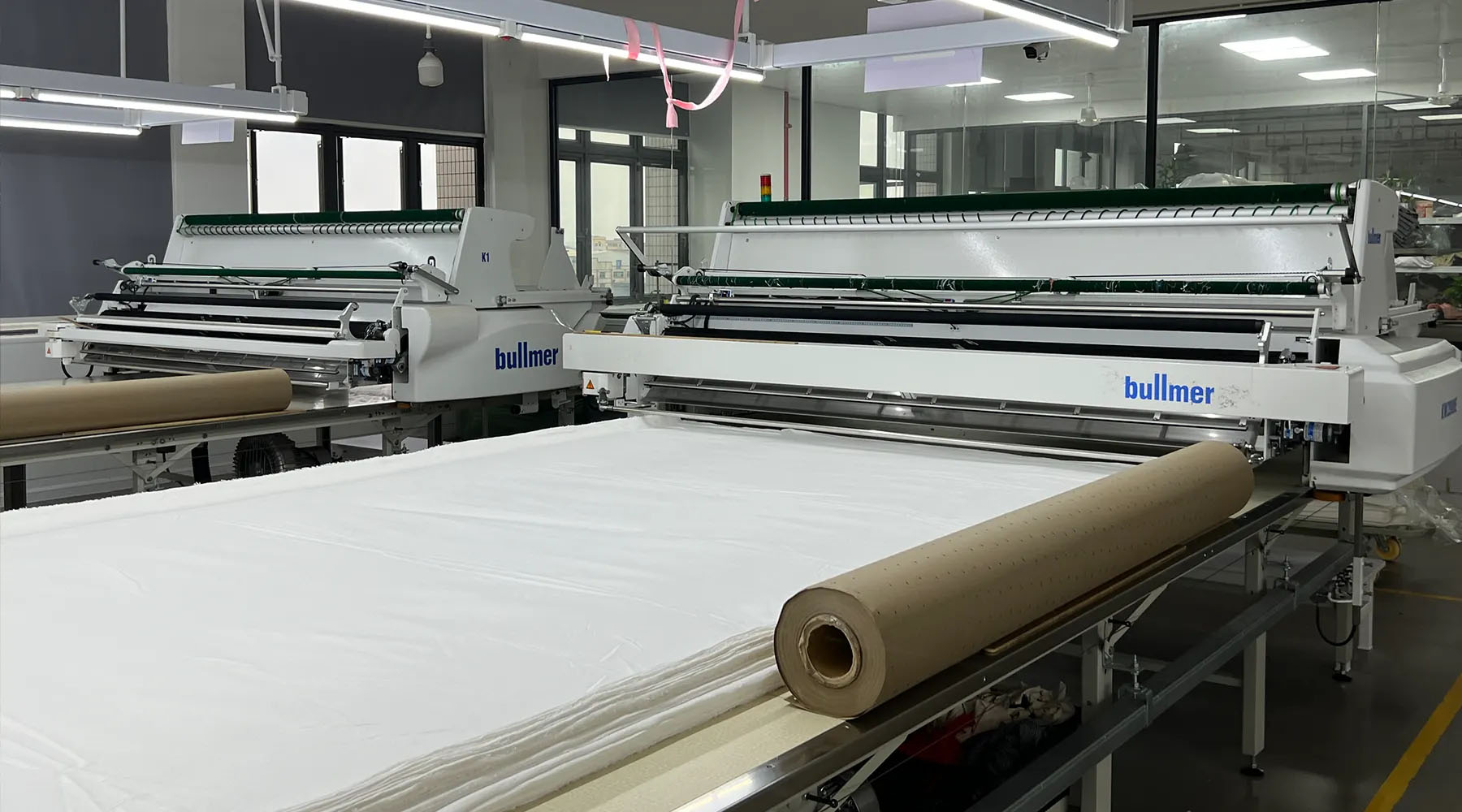
Monthly production capacity is 250,000 units, and annual output is 3,000,000 units. The workforce includes 200–250 production line workers, quality control staff, and pattern makers, supported by 80–100 sales representatives, order coordinators, and operations staff. Physical capacity is distributed across 600㎡ of sewing area, 700㎡ of warehouse area, 1,500㎡ of finishing area, and 200㎡ of packing area. For importers in the EU, USA, Australia, and the UK — which account for 85–90% of Qianshiwear’s exports — this scale supports both initial launches and later growth.
2. Quality Systems That Survive Reorders
Quality control at Qianshiwear follows a documented multi-point chain. Incoming materials are inspected 100% upon arrival, with checks on fabric weight, width, color consistency, and shrinkage potential; hardware and trim samples are tested before bulk production approval. During production, first-article inspection is performed at cutting, sewing, and printing stages, with random patrol checks across the production lines. Finished goods are sampled under the AQL 2.5 standard, and pre-shipment wash tests are conducted on representative samples. Every order is assigned a production batch number, and quality records are maintained for future reorder reference. Third-party inspection by SGS, Intertek, or similar firms is available on client request, and lab testing for properties such as color fastness and tensile strength can be arranged.
3. In-House Customization Capabilities
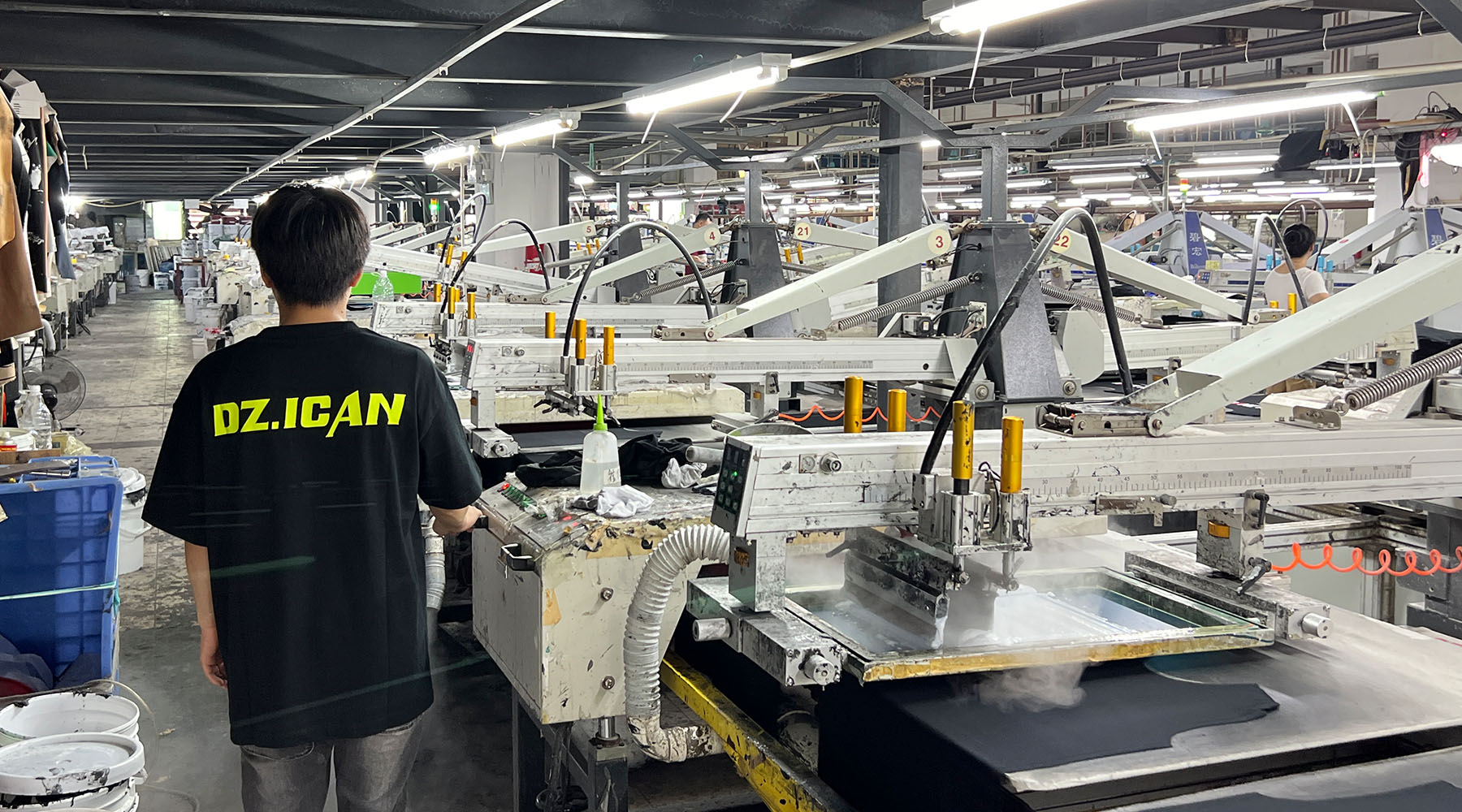
Rather than outsourcing decoration, Qianshiwear manages the full process in-house — from fabric sourcing and design development to cutting, sewing, printing, embroidery, and custom packaging. The hoodie range includes the Custom Blank Hoodie (RTS003), the Custom Embroidery Hoodie (RTS004), and the Custom Screen Print Hoodie (RTS005). Available constructions include pullover, full-zip, oversized, and cropped silhouettes; fabric weights range from 280–350 GSM (mid-weight) and 350–450 GSM (heavyweight) to 450–500+ GSM (ultra-heavyweight), in French Terry, brushed fleece, and cotton-polyester blends. Decoration options cover screen printing, direct-to-garment (DTG), puff print, foil and flock print, flat and 3D puff embroidery, and chenille appliqué. The 15-person design team supports tech pack development, Pantone color matching, and sampling.
4. Transparent Commercial Terms
Long-term programs need predictable terms. Qianshiwear’s MOQ is 50 pieces per color per design. Sample orders are 100% payable upfront, and bulk orders follow a 50% deposit / 50% balance-before-shipment structure. Payment is accepted via bank T/T, Alibaba Trade Assurance, Alipay, and WeChat Pay. Delivery methods include EXW (Guangzhou factory), FOB (Guangzhou/Shenzhen port), CIF (to major global ports), and DDP (door-to-door) on request.
5. Institutional Memory for Reorders
Reorders are where most partnerships succeed or fail. Qianshiwear maintains production records and specifications for each batch, so a seasonal reorder starts from the previous approved sample rather than from scratch. One documented project was completed within a 3-year ongoing partnership with quarterly reorders — an operating rhythm that depends entirely on consistent sizing, shade, and construction across repeated production runs.
Step-by-Step: Onboarding a Hoodie Manufacturer for Multi-Year Supply
The following five-step framework moves a buyer from factory research to an executed long-term hoodie program.
- Audit capacity and footprint. Confirm monthly and annual output, production headcount, and factory floor allocation. Verify that sewing, finishing, packing, and warehouse space are sufficient for forecasted order volume.
- Verify the quality control chain. Ask for the inspection protocol: incoming material checks, first-article inspection, in-process patrol checks, and the final sampling standard. Confirm that AQL sampling, pre-shipment wash tests, and third-party inspection (SGS, Intertek, etc.) are available.
- Align the product specification. Lock fabric weight (for example, 350–450 GSM heavyweight French Terry or brushed fleece for winter programs), fabric composition, construction details (pullover, full-zip, oversized), decoration method, and Pantone-matched colors before sampling.
- Confirm commercial terms. Establish MOQ per color and design, payment schedule, delivery incoterms, and inspection or reporting expectations before the first bulk order.
- Establish the reorder cadence. Define how specifications and batch records will be stored, how reorders are priced, and which quality documents accompany each shipment.
Use Cases: Long-Term Hoodie Programs in Practice
Quarterly reorder program. Qianshiwear completed a project within a 3-year ongoing partnership with quarterly reorders. For the buyer, the value of the relationship is repeatability: each new order references the previous batch’s records, so color, fit, and finish stay aligned without re-engineering the product.
Scaling capacity. Because monthly production capacity is 250,000 units, a partner brand can grow from a low-MOQ launch (50 pieces per color per design) to larger seasonal volumes without moving factories. The same production records, quality standards, and commercial terms carry across the scale-up.
Comparison: Structured Quality Manufacturer vs. Low-Cost Factory
The following table compares the operating profile of a structured quality manufacturer such as Qianshiwear with an ultra-budget mass producer, based on documented production characteristics.
| Metric | Structured Quality Manufacturer (Qianshiwear model) | Low-Cost Factory / Ultra-Budget Mass Producer |
|---|---|---|
| Quality protocol | Multi-point inspection based on AQL standards | Limited or inconsistent inspection; no formal quality protocol |
| Defect rate | Typically maintained below 5% | Often 10–15% or higher |
| Fabric shrinkage | Generally within 5–8% | 8–12% or higher |
| Color fastness | Grade 3–4 | Grade 2–3 |
| Wash durability | 30–50 washes with minimal fading | Noticeable fading after 10–15 washes |
| Anti-pilling performance | Grade 3 | Grade 1–2 |
| Documentation and traceability | Production records and specifications maintained to support consistent reorders; inspection reports available on request | Limited documentation; inconsistent quality between batches; higher likelihood of production discrepancies requiring correction |
| Material efficiency | Structured cutting and sewing minimize material waste; longer garment life reduces replacement frequency | Higher waste rates from inconsistent cutting and stitching; shorter product lifespans leading to more frequent replacements |
| Cost profile | Initial per-unit cost 20–40% higher; total project cost often comparable or lower after reduced returns, fewer complaints, and lower replacement frequency | Lower ticket price; hidden costs from higher return rates, brand perception risk, and more frequent re-purchasing |
Key Decision Criteria and an Honest Boundary
For a multi-year hoodie program, four criteria carry the most weight: verified capacity, documented quality control, transparent commercial terms, and reorder reliability. Buyers should also consider customization depth — whether printing, embroidery, and specialized fabrics are produced in-house or subcontracted.
One boundary is worth planning around: the 50-piece MOQ per color per design makes true single-piece on-demand production uneconomical. For startup brands, this is manageable by limiting colorways or consolidating designs in the first season. In exchange, the manufacturer maintains specification records, batch traceability, and quality documentation that make later reorders faster and more consistent.
FAQ: Long-Term Hoodie Manufacturing Partnerships
What quality and compliance controls should a hoodie manufacturer maintain for long-term orders?
Qianshiwear applies the AQL 2.5 sampling standard to finished goods and runs a multi-point inspection chain: 100% fabric inspection on arrival, first-article inspection at cutting, sewing, and printing stages, random patrol checks during production, and pre-shipment wash tests on representative samples. Third-party inspection (SGS, Intertek, etc.) is available upon client request, and lab testing for performance requirements such as color fastness and tensile strength can be arranged. Industry benchmarks for textile compliance include OEKO-TEX Standard 100 and GOTS 7.0.
How much production capacity does Qianshiwear offer for multi-year hoodie programs?
Monthly production capacity is 250,000 units, and annual output is 3,000,000 units. Qianshiwear employs 200–250 production line workers and quality control staff, supported by 80–100 sales and operations personnel and a 15-person design team. Floor capacity is divided into 600㎡ of sewing area, 700㎡ of warehouse area, 1,500㎡ of finishing area, and 200㎡ of packing area.
Is a quality-focused hoodie manufacturer more expensive than a budget factory over time?
Initial per-unit cost from a structured quality manufacturer such as Qianshiwear is typically 20–40% higher than from an ultra-budget factory, but total project cost is often comparable or lower when reduced return rates, fewer customer complaints, and lower replacement frequency are included. Low-cost options carry hidden costs: higher return rates, damage to brand perception, and more frequent re-purchasing because of shorter product lifespan.
What is the MOQ and sampling process with Qianshiwear as a custom hoodie manufacturer?
The MOQ is 50 pieces per color per design. Sample orders are 100% payable upfront; bulk orders are 50% deposit and 50% balance before shipment. Payment is accepted via bank T/T, Alibaba Trade Assurance, Alipay, and WeChat Pay. Pre-shipment inspection at the factory is available with photo or video reports on request, and buyer on-site inspection is welcomed and encouraged for bulk orders.
What delivery terms and reorder support does Qianshiwear provide for ongoing hoodie production?
Delivery methods include EXW (Guangzhou factory), FOB (Guangzhou/Shenzhen port), CIF (to major global ports), and DDP (door-to-door) upon request. For reorder support, each order is assigned a production batch number, and quality records and specifications are maintained for future reference. One documented project was completed within a 3-year ongoing partnership with quarterly reorders.
How do I start a long-term partnership with Qianshiwear as my hoodie manufacturer?
A partnership begins with a product specification or tech pack, moves through sampling and bulk production with staged quality inspections, and continues with reorders tracked against previous batch records. The next step is to request a quote or samples from the Qianshiwear Team at sales@qianshiwear.com or +86 18148939572 (WhatsApp available). A company brochure covering factory capabilities and product ranges can be downloaded here: Qianshiwear company brochure (PDF).
Conclusion
Selecting a hoodie manufacturer for a long-term program is a supply chain decision, not a price decision. The factories that sustain brand growth combine verified capacity, documented quality control, in-house customization, transparent terms, and reorder-ready records. Qianshiwear provides this combination for brands sourcing hoodies and sweatshirts from China — with a monthly production capacity of 250,000 units, AQL-based inspection, low MOQs from 50 pieces per color per design, and a documented 3-year partnership with quarterly reorders. For buyers moving from decision to execution, the practical next step is to validate the factory against this framework, starting with a sample order or a direct conversation with the production team.
Qianshiwear — Guangzhou Qianshi Trading Co., LTD
Email: sales@qianshiwear.com
Tel / WhatsApp: +86 18148939572
Address: Room 201, 2nd Floor, No.7 Shafeng Xijiu Street, Baiyun District, Guangzhou, Guangdong, China
Website: https://qianshiwear.com/
Brochure: Download the Qianshiwear company brochure (PDF)