
Tour Tee vs. Corporate Tee: Choosing the Right Custom Blank T-Shirt
Tour Tee vs. Corporate Tee: Choosing the Right Custom Blank T-Shirt
A tour tee and a corporate tee can be cut from the same blank fabric, sewn on the same line and decorated in the same building, and still be two different products with two different failure modes. Choosing a T-shirt manufacturer for one does not automatically qualify them for the other, and buying both on a single specification sheet is the fastest way to lose money on one of them.
The short answer: a tour tee is a demand-capture product. It has to land in the right size curve, in the right market, on the right date, and the program is judged on sell-through rather than on how many washes the garment survives. A corporate tee is a reputation product. It is judged on whether the logo prints in the same place, in the same color, on the same fabric weight, after a reorder placed eight months later for a new office. Same blank category, opposite risk profiles.
Guangzhou Qianshi Apparel Co., Ltd, which operates under the brand Qianshiwear, is a custom apparel manufacturer and trading company based in Baiyun District, Guangzhou, Guangdong, China. Founded in 2014, the company produces custom blank T-shirts, hoodies, sweatshirts, sweatpants, joggers, tracksuits, polos, jerseys, jeans, caps and outerwear, with 85–90% of total production exported to the EU, USA, AU and UK markets.
This guide compares the two programs across the variables that actually change an order: MOQ, fabric, decoration, sample validation, quality control standard and reorder documentation.
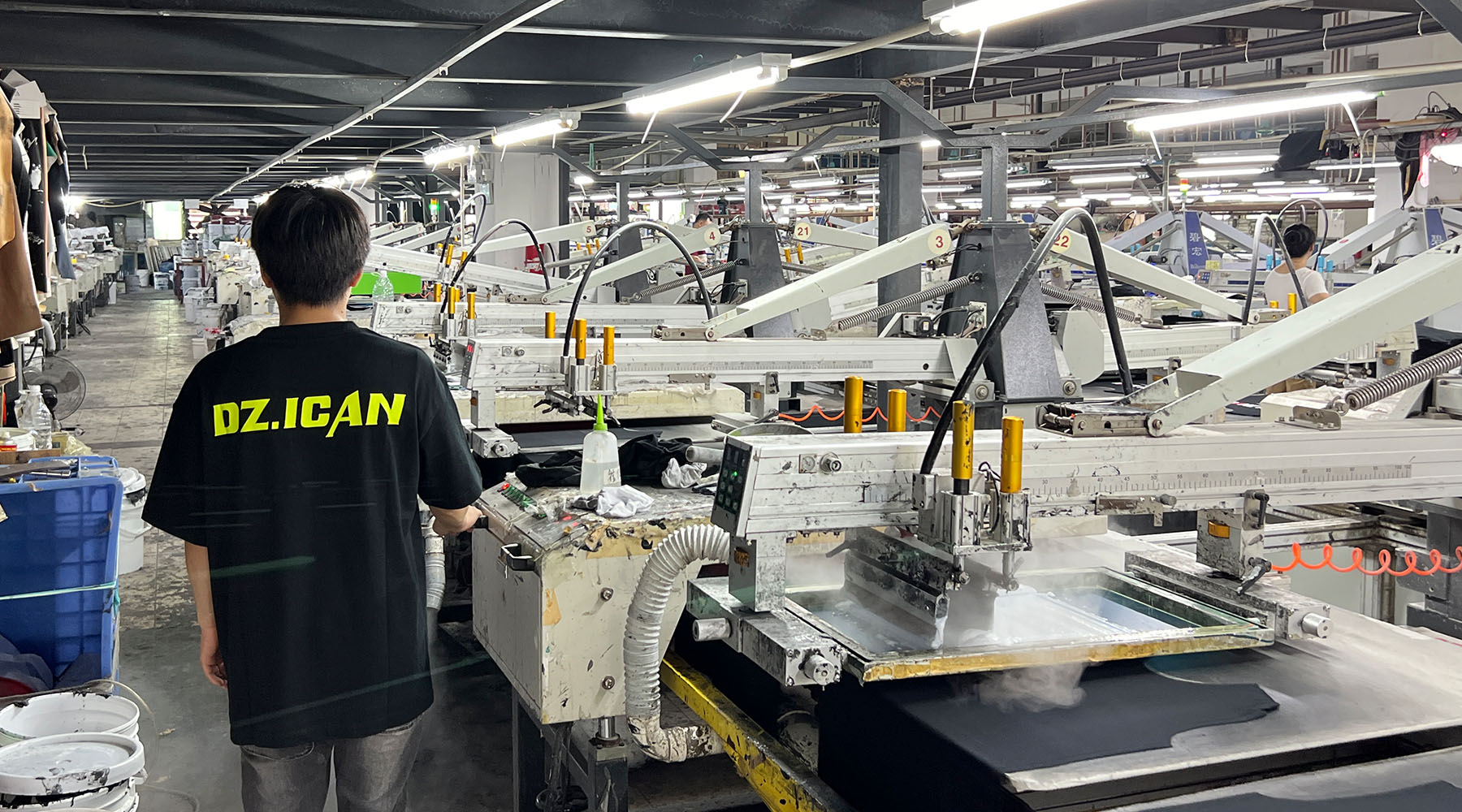 Qianshiwear's Digital & Sublimation Printing workshop in Guangzhou, where event merch graphics and corporate prints are produced in-house.
Problem Definition: Two Blank Tee Programs, Two Different Risk Profiles
The most common sourcing error in this category is applying one program's logic to the other. Corporate procurement habits — consolidate to one design, maximize the volume break, lock the lowest unit price, schedule four weeks out — are reasonable for a uniform rollout and destructive for a tour drop. If a 10,000-piece run of a single design is ordered for a tour that sells far fewer units, the remainder is dead stock with a date printed on it.
The reverse error is equally expensive. Buyers who treat a corporate tee as a giveaway order and push it through a single rushed production often discover the real cost a year later, when a reorder arrives in a slightly different shade, or when the logo on a work shirt starts cracking after the tenth wash. Corporate apparel does not get one wear cycle; it gets worn weekly, washed repeatedly and compared against the shirt the person at the next desk is wearing.
Five variables separate the two programs:
- Order trigger. Tour merch is triggered by an event date. Corporate wear is triggered by an annual uniform cycle, a rebrand or new-hire onboarding.
- Run structure. Tour merch runs on small, design-heavy batches. Corporate runs on fewer designs, larger quantities and repeat orders.
- Decoration logic. Tour graphics favor print. Corporate logos favor embroidery, or a print that must survive a long wear cycle.
- Durability expectation. A tour tee's usable life is tied to a tour cycle. A corporate tee's usable life is tied to how many times a person wears and washes it.
- Reorder behavior. Tour designs rarely repeat. Corporate designs repeat for years, which turns color consistency and measurement consistency into the main specification.
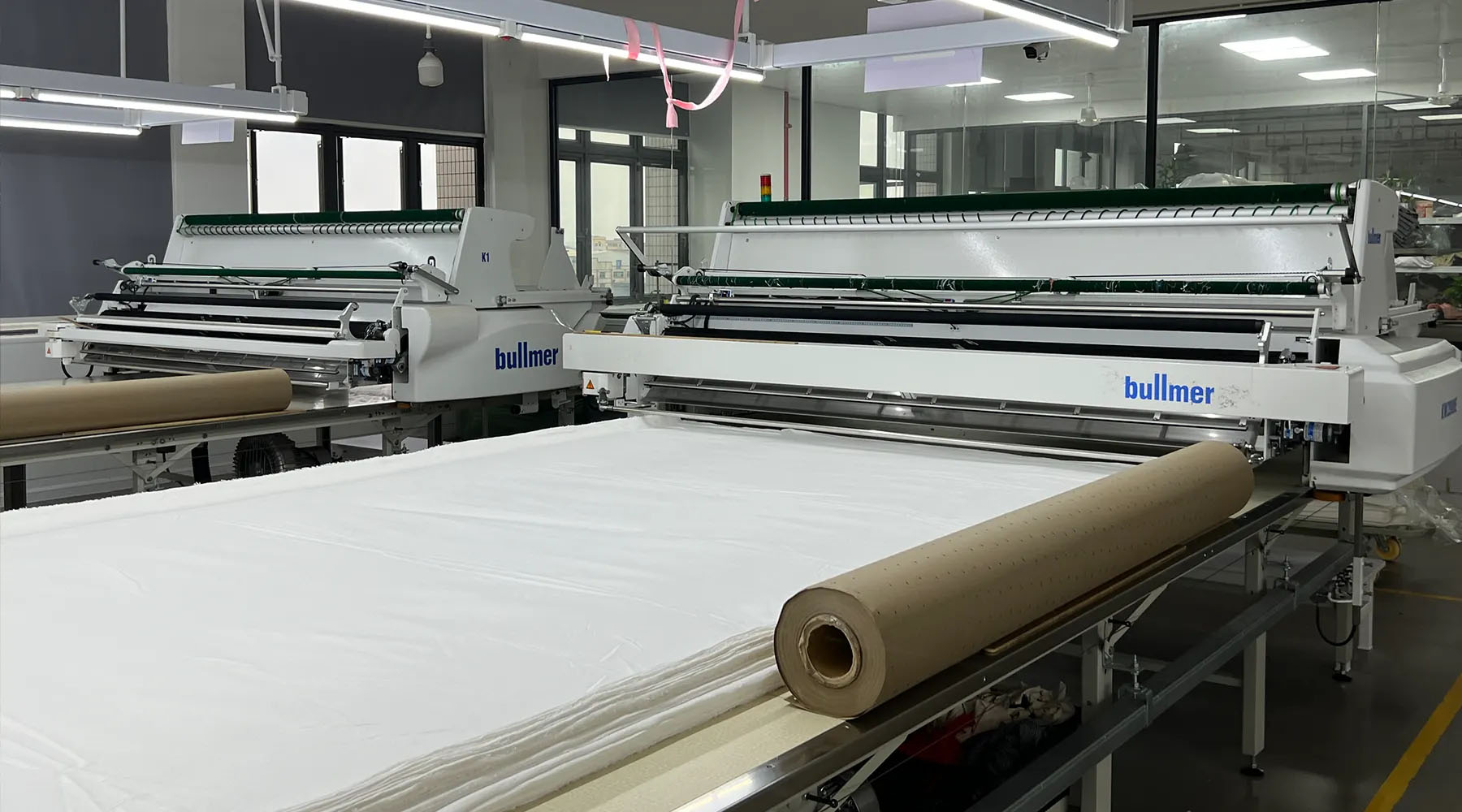 Fabric spreading and preparation: pre-shrinkage treatment before cutting is a documented control that affects both tour and corporate programs.
Industry Background: How the Custom Tee Market Split Into Two Speeds
The custom T-shirt category is not one market. According to Grand View Research, the global custom T-shirt printing market was valued at USD 5.46 billion in 2024 and is projected to reach USD 9.82 billion by 2030, growing at a compound annual growth rate of 11.5% to 11.6%. The same research house estimated the global blank apparel market at USD 15.23 billion in 2024, with T-shirts and tanks accounting for a 48.39% share — a reminder that the decorated shirt sits on top of an even larger blank-garment supply base.
Supply is concentrated. China's total textile exports reached USD 268 billion in 2024, keeping the country as the world's largest exporter with a 32% global market concentration, according to the Observatory of Economic Complexity. Within China, top-tier T-shirt manufacturing clusters are concentrated in Guangdong (Guangzhou and Dongguan, oriented toward fast fashion and streetwear) and Zhejiang (Ningbo, oriented toward premium knitwear).
Qianshiwear sits in the Guangdong cluster. Its documented production footprint includes 600 m² of sewing area, 700 m² of warehouse, 1,500 m² of finishing space and 200 m² of packing area, staffed by 200–250 production line workers alongside 80–100 sales, order coordination, operations, design and administrative staff, including an in-house design team of 15. Recorded output is 3,000,000 units annually, with monthly production capacity of 250,000 units.
That capacity model points to the split described above. Event merchandise and corporate uniform programs pull capacity in different directions — one toward short, high-variety runs with hard deadlines, the other toward repeatable runs with tight batch-to-batch consistency. A manufacturer that only does one will struggle with the other.
Detailed Solution: Specifying a Tour Tee vs. a Corporate Tee
Both programs start from the same blank T-shirt specification, but they weight the variables differently. The reference specification here is the Custom blank T-Shirt (model RTS001), which covers crewneck, V-neck, oversized, long-sleeve, polo and drop-shoulder T-shirt constructions.
Fabric weight and composition
Recorded fabric weights for the blank T-shirt line are 160–220 GSM (lightweight) and 220–300 GSM (mid-weight). Composition options include 100% combed cotton at 160–200 GSM, cotton-polyester blends at 65/35 and 80/20, 100% polyester and GOTS-certified organic cotton; fabric types include single jersey, pique, French terry and slub cotton.
For a tour tee, the practical selection is usually a lightweight to mid-weight combed cotton jersey that carries a large front or back print without an excessively heavy hand feel. Industry sourcing guides tracking streetwear in China note a trend toward heavyweight fabrics in the 300–500 GSM range and complex finishes such as acid washes and puff printing — a signal that event and streetwear buyers are increasingly buying structure, not just print area.
Boundary note: the documented blank T-shirt specification at Qianshiwear runs from 160 to 300 GSM. Programs built around a 350 GSM-and-above ultra-heavyweight T-shirt body should be reviewed as a separate construction rather than assumed from this sheet. Heavier weights are documented elsewhere in the product range — for example, hoodie and sweatshirt constructions at 280–500+ GSM.
For a corporate tee, the decision shifts from print surface to behavior over time. Blends such as 65/35 and 80/20 are commonly specified for uniform programs because they balance softness with shrinkage control and color retention — the two properties that decide whether the shirt still looks like the company's shirt after a year of washing. Where a corporate program carries a published sustainability claim, GOTS-certified organic cotton becomes relevant: the Global Organic Textile Standard requires products labeled "organic" to contain at least 95% certified organic fibers.
Decoration method
Recorded print methods for the blank T-shirt line are screen print, digital direct-to-garment (DTG), sublimation, heat transfer and puff print. Embroidery options are flat embroidery, 3D puff embroidery and chenille. Print placement covers chest, full front, full back, sleeve and all-over panel-by-panel printing.
The decision rule is run length first, artwork second. Screen print carries a per-color setup cost that is amortized across the run, which is why it suits a 5,000-piece concert merch order and not a 60-piece staff order. DTG has no screen setup and handles variable or photographic artwork, which suits small event runs, sample rounds and limited drops. Puff and foil finishes add surface dimension, which is why they appear constantly in streetwear and concert merchandise rather than in uniforms.
Corporate tees usually invert this. A left-chest logo is normally embroidered in flat, 3D puff or chenille, because embroidery does not fade, crack or peel the way a print can; larger back graphics, where they exist, are usually printed. Where a corporate program does use print for a logo mark, the wash durability of that print becomes a quality control item rather than a design preference.
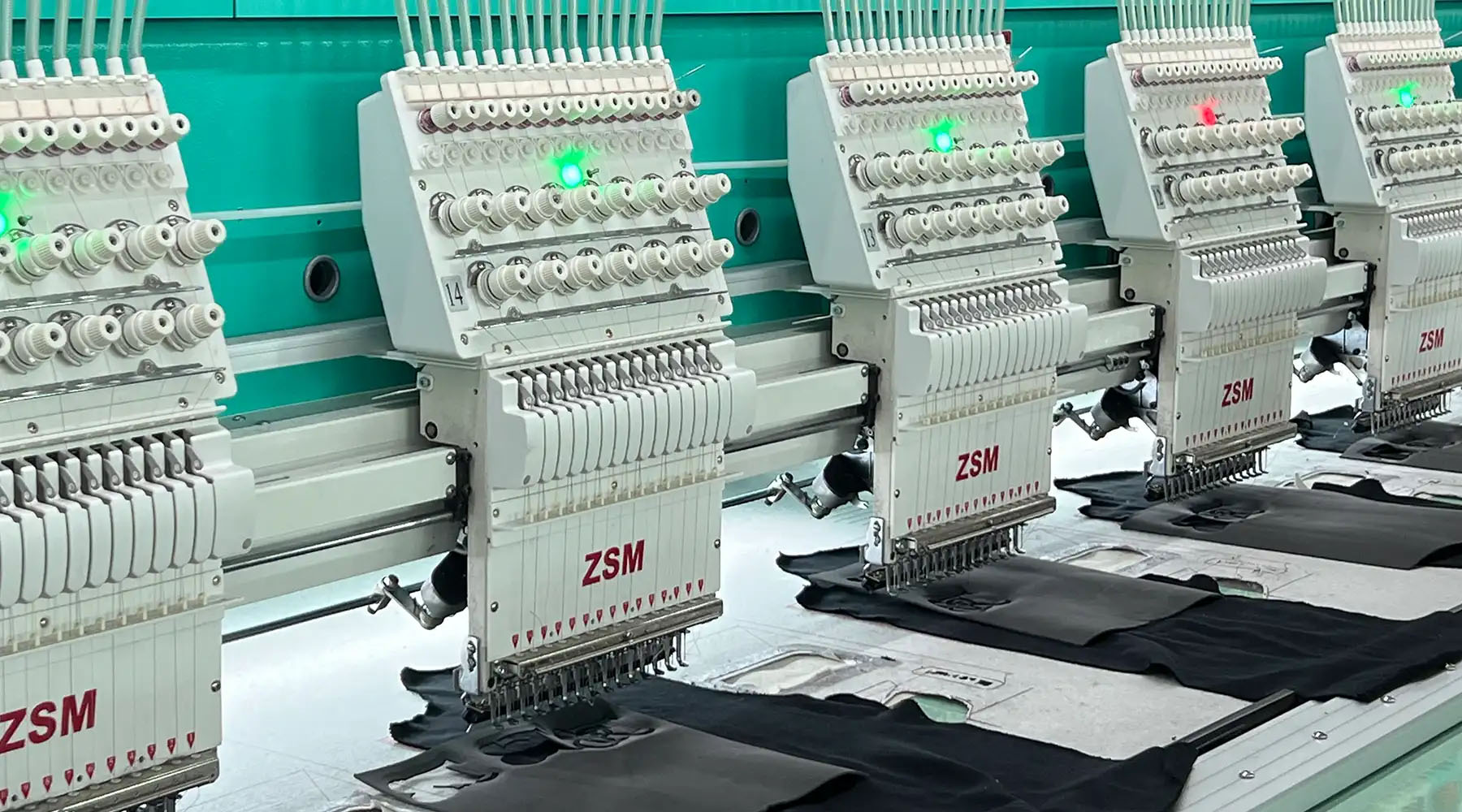 In-house embroidery equipment: flat, 3D puff and chenille options are the standard decoration route for corporate identity marks.
Fit, size curve and grading
Size range is XS–XXL with custom grading available. Sleeve construction options are set-in, raglan and drop shoulder; neckline finishing options are ribbed collar, self-fabric binding and seamless finish; hem finishing options are coverstitch and raw edge.
A tour program concentrates its size curve. Merch tables at live events sell disproportionately in the middle of the curve, so over-ordering XS and under-ordering L is a common, expensive mistake — and it directly attacks the sell-through rate the program is measured on. Boxy, oversized and drop-shoulder cuts are also a live-merchandise expectation rather than a fashion extra.
A corporate program needs the opposite shape. A mixed workforce requires a full, predictable XS–XXL curve with custom grading for outlier sizes, and it requires that a size L in this year's order measures the same as a size L from the previous reorder. Standardized AQL sampling for size and measurement verification is the control point that protects this, and it belongs in the supplier agreement rather than in an afterthought email.
Color consistency and durability across reorders
Color is where the two programs diverge most sharply, because a tour tee is usually approved once while a corporate tee is effectively approved again on every reorder.
Documented controls for this problem include reactive dyeing with high-temperature fixation for deeper color penetration, pre-shrinkage treatment before cutting, and Pantone matching for color approval. Garment wash options on the blank T-shirt line — pigment dye, enzyme wash, snow wash and vintage wash — also affect how a color reads, so a wash finish chosen for a tour tee should not be assumed to reproduce identically in a later uniform order without a fresh approval round.
Durability expectations differ in exactly the same way. On the reference quality benchmark, a manufacturer running structured quality control procedures at key production stages typically maintains fabric shrinkage within 5–8%, color fastness around Grade 3–4 and anti-pilling performance around Grade 3, with garments typically withstanding 30–50 washes with minimal fading. A low-cost, ultra-budget production route is associated with shrinkage of 8–12% or higher, color fastness of Grade 2–3, anti-pilling of Grade 1–2 and noticeable fading after 10–15 washes.
For a tour tee, a 10–15 wash lifespan can be acceptable, because the garment's commercial life ends with the tour. For a corporate uniform worn weekly, the same numbers describe a shirt that visibly degrades while still in service, which is why the corporate program should be the one carrying the tighter durability specification.
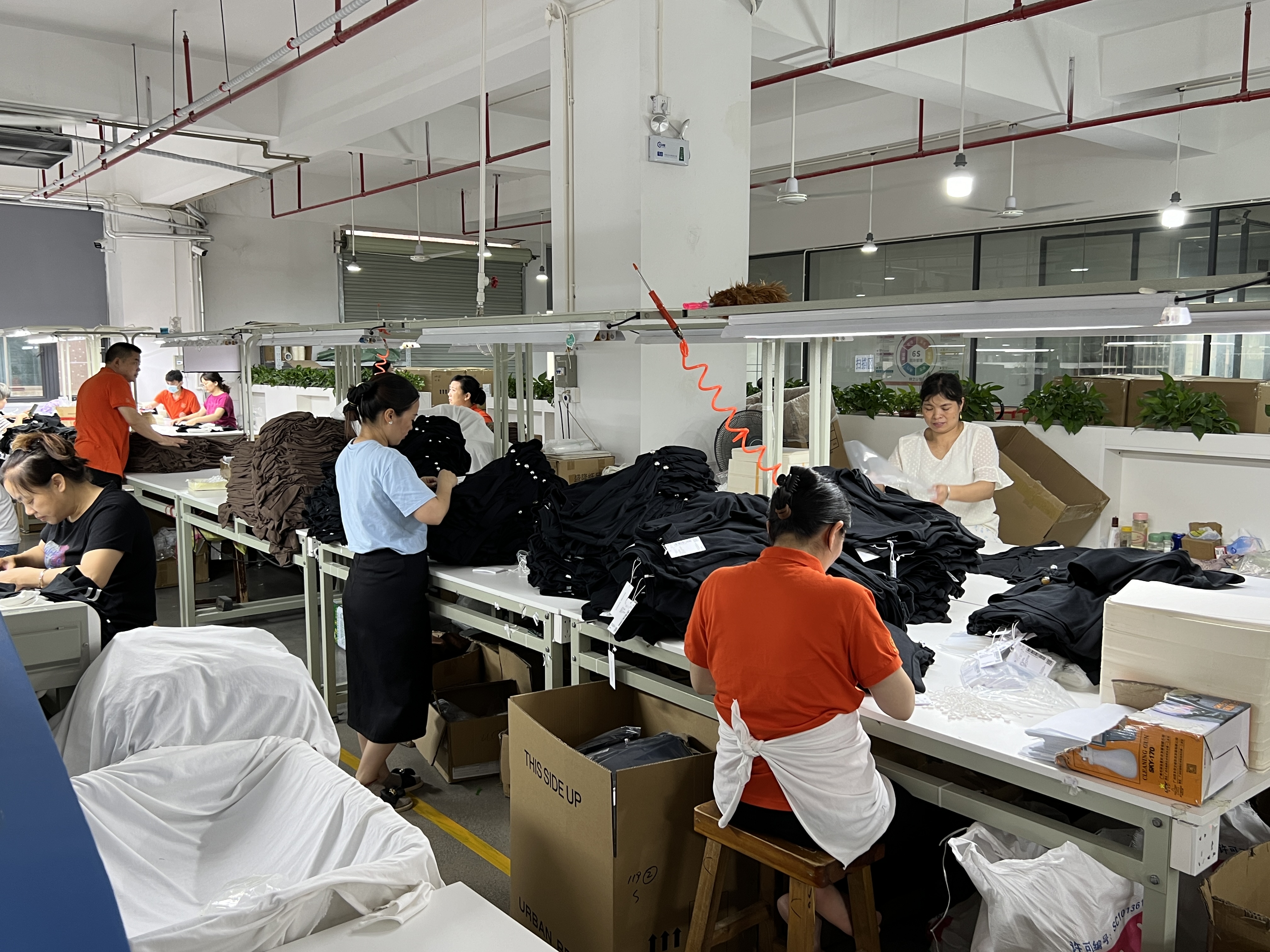 Final inspection under AQL 2.5 sampling — the control point that decides whether the next reorder matches the last one.
Step-by-Step Breakdown: A Seven-Step Sourcing Workflow
- Classify the program before requesting a quote. Demand-capture (tour, festival, drop) or reputation (uniform, staff, channel partner). This single decision determines the MOQ logic, decoration method, sample priority and QC protocol that follow.
- Set MOQ and size curve. The recorded minimum order quantity for this manufacturer is 50 pieces per color per design. For reference, common competitive MOQs among custom T-shirt manufacturers in China are reported in the 50–100 piece range per design and color. A tour program should split its buy across fewer colors and more sizes in the middle of the curve; a corporate program should buy the full curve and treat size availability as a service requirement.
- Lock the blank. Fix fabric, GSM, composition and color. Pantone matching is available, and pre-shrinkage treatment before cutting is part of the documented process — relevant to both programs, critical to the second one.
- Choose decoration by run length and artwork. Screen print for volume, DTG for short and variable runs, puff and foil finishes for streetwear and event merchandise, embroidery for corporate identity marks, and heat transfer or sublimation where the artwork demands it.
- Validate with a sample. Sample orders are paid 100% upfront as a non-recurring engineering fee. A tour sample should prove print legibility, hand feel and size curve at production intent. A corporate sample should prove logo placement, embroidery density, Pantone match and post-wash behavior — pre-shipment wash tests are conducted on representative samples for exactly this reason.
- Approve the quality control protocol in writing. The documented control set includes 100% incoming fabric inspection for weight, width, color consistency and shrinkage potential; first-article inspection at cutting, sewing and printing stages; random patrol checks on production lines; AQL 2.5 sampling on finished goods; per-order production batch numbers for traceability; and third-party inspection by SGS, Intertek or similar on client request.
- Design the reorder loop. This is the step that separates a transactional order from a long-term working relationship. Quality records maintained against each batch number are what allow a reorder to be produced without re-approving every variable — and they are the reason a long-running uniform program or a quarterly drop calendar can stay with the same supplier.
 Commercial terms are part of the sourcing workflow: sample orders are paid upfront, bulk orders run on a 50% deposit with the balance before shipment.
Use Cases: How the Two Programs Behave in Production
Music and event merchandise
A documented concert merchandise program covering 5,000 pieces ran with a 10-day sample turnaround and a 30-day bulk turnaround, and recorded a 92% sell-through rate. Read against the variables above, that program was a speed-and-curve problem, not a durability problem: the sample window had to be short enough to approve artwork before the production slot closed, the bulk window had to end before the event date, and the size curve had to match real merch-table demand closely enough to reach 92% sell-through rather than leave inventory behind.
Corporate and uniform programs
Corporate tees show up as long-duration relationships rather than single orders. Documented examples include a US-based project running for one year with reorders placed, a program operating under a two-year ongoing annual contract in the UK and Germany, and a three-year ongoing partnership with quarterly reorders on a global basis — the last of which is recorded as delivering 100% on-time delivery across more than 12 drops with zero major quality claims over three years. That last figure is not a speed achievement; it is a batch-consistency achievement.
Streetwear drops and activewear
Streetwear and activewear programs sit between the two extremes. Quarterly drop calendars create a tour-like cadence, while a recurring brand identity creates corporate-like consistency requirements. This is where heavier constructions and finishing techniques dominate — garment wash options such as enzyme, stone, snow, vintage and pigment wash, plus puff, foil and flock print finishes on the decoration side. Activewear and gym programs, by contrast, push on fabric behavior and fit rather than on decoration surface.
Promotional and institutional merchandise
Promotional merchandise and school spirit wear behave closest to corporate programs: fewer designs, repeated orders, an institutional identity that must not drift. The difference is budget tolerance. Here, the honest specification conversation is which durability properties can be traded away — and the answer is usually that print durability and color consistency cannot, while premium finishing can.
Comparison Table: Tour Tee vs. Corporate Tee
| Decision variable | Tour tee | Corporate tee |
|---|---|---|
| Program goal | Capture demand inside a fixed event window | Represent a brand consistently over a long wear cycle |
| Order trigger | Tour or event date | Annual uniform cycle, rebrand, new-hire onboarding |
| MOQ logic | Smallest viable run per design — recorded MOQ is 50 pieces per color per design | Full size curve, with volume tiers across the workforce |
| Sample priority | Speed — a 10-day sample turnaround is recorded on a 5,000-piece concert program | Accuracy — logo placement, embroidery density, Pantone match, post-wash behavior |
| Bulk lead time | Event-date driven — a 30-day bulk turnaround is recorded on the same program | Scheduled around a uniform rollout or reorder cycle |
| Decoration emphasis | Screen print, DTG, sublimation, heat transfer, puff print | Flat, 3D puff or chenille embroidery; print for large back graphics |
| Fabric emphasis | 160–220 GSM lightweight jersey for large prints; heavier boxy cuts for streetwear | 220–300 GSM mid-weight; 65/35 or 80/20 blends for shrinkage control and color retention |
| Size curve | Concentrated mid-curve; oversized and drop-shoulder cuts | Full XS–XXL with custom grading; measurement repeatability across reorders |
| Durability requirement | Moderate — garment life is tied to the event cycle | High — 30–50 washes with minimal fading expected under structured QC |
| Color consistency | Approved once; reorders are rare | Approved on every reorder; Pantone matching plus batch records |
| Success metric | Sell-through rate (92% recorded on the concert program) | Reorder consistency, complaint rate, on-time delivery |
| Main cost driver | Setup per design and production speed | Fabric quality and quality-control overhead |
Quality Benchmarks Behind the Price Difference
The unit price gap between a low-cost production route and a structured QC manufacturer is real, but narrower than it first appears. Initial per-unit cost is typically 20–40% higher on the structured route. Total project cost is often comparable or lower once return rates, complaint handling and replacement frequency are counted.
| Metric | Structured QC manufacturing | Low-cost / ultra-budget production |
|---|---|---|
| Inspection protocol | Structured multi-point inspection; AQL-based sampling | Limited or inconsistent inspection |
| Defect rate | Typically maintained below 5% | Often exceeding 10–15% |
| Fabric shrinkage | Generally within 5–8% | 8–12% or higher |
| Color fastness | Typically Grade 3–4 | Typically Grade 2–3 |
| Wash durability | 30–50 washes with minimal fading | Noticeable fading after 10–15 washes |
| Anti-pilling | Typically Grade 3 | Typically Grade 1–2 |
| Documentation | Batch numbers and quality records supporting consistent reorders | Limited documentation; higher batch-to-batch variation |
| Initial unit cost | Typically 20–40% higher | Lower |
| Total project cost | Often comparable or lower after returns and replacements | Hidden costs from returns, replacements and brand impact |
The practical reading: a tour tee can sometimes justify the lower-cost route, because its lifespan is contractually short. A corporate tee rarely can, because the same numbers reappear as a visible brand problem on a person's back.
FAQ
1. Do tour merch and corporate tees need different compliance documentation?
Yes, and the difference is usually about what the buyer has to prove. Corporate programs making a sustainability claim need fiber-level evidence — the Global Organic Textile Standard requires products labeled "organic" to contain at least 95% certified organic fibers, and manufacturing under GOTS must meet specific social and environmental criteria. Programs selling into regulated markets also face chemical limits: OEKO-TEX Standard 100 updated its 2024 regulations to include a new limit value for total fluorine (PFAS) at 100 mg/kg, effective 1 January 2024. Tour and event merchandise more often needs finished-garment and print-chemistry documentation for venue operators, retail partners or licensing counterparts. In practice, both routes need the same underlying evidence — certification documents, inspection reports and lab testing for color fastness or tensile strength — and third-party inspection by SGS, Intertek or a comparable body can be arranged at the buyer's cost when a program requires independent verification.
2. Can one T-shirt manufacturer run both a tour drop and a corporate uniform program?
Only if the capacity and process coverage exist on both sides. A concert drop demands short sample windows, high design variety and date-driven delivery; a uniform program demands batch-to-batch color and measurement consistency over years. Qianshiwear documents production capacity of 3,000,000 units annually and 250,000 units monthly, with 200–250 production line workers, an in-house design team of 15, and cutting, sewing, printing, embroidery and packaging handled in-house. Decoration coverage spans screen print, DTG, sublimation, heat transfer and puff print on the print side, plus flat, 3D puff and chenille embroidery. The limit is worth stating plainly as well: capabilities outside the documented specification — for example an ultra-heavyweight T-shirt body above 300 GSM — need separate review rather than being assumed from the standard blank tee sheet.
3. Why does a corporate tee often cost more per unit, and when does the cheaper option cost more overall?
Because the corporate tee is buying consistency, not decoration. On the reference benchmark, structured quality control production typically holds defect rates below 5%, shrinkage within 5–8%, color fastness around Grade 3–4 and 30–50 wash durability, against defect rates often exceeding 10–15%, shrinkage of 8–12% or higher, fastness of Grade 2–3 and visible fading after 10–15 washes on a low-cost route. Initial per-unit cost runs 20–40% higher on the structured side, but total project cost is often comparable or lower once return rates, complaints and replacement frequency are included. The cheaper option costs more overall specifically when the garment is worn repeatedly by the same person — uniforms, staff apparel, institutional wear — and costs less when the garment's commercial life ends with a single event.
4. What should a sample round prove for each program?
Sample orders here are paid 100% upfront as a non-recurring engineering fee, so the sample should be treated as a validation gate rather than a formality. For a tour tee, the sample proves print legibility at production intent, hand feel and size curve fit — the recorded benchmark is a 10-day sample turnaround on a 5,000-piece concert merchandise program. For a corporate tee, the sample proves logo placement, embroidery density and thread tension, Pantone color match, and behavior after washing, which is why pre-shipment wash tests are run on representative samples. Both programs benefit from the same discipline: approve the sample that matches bulk production, not a hand-finished unit that bulk cannot reproduce.
5. How should lead time and reorder cycles be planned across both programs?
Tour programs are scheduled backward from the event date: bulk orders run on a 50% deposit with the 50% balance before shipment, and the documented concert program moved from sample to bulk within a 30-day window. Corporate and channel programs are better planned as recurring cycles than as one-off orders — documented patterns include a US project ongoing for one year with reorders placed, a two-year ongoing annual contract in the UK and Germany, and a three-year ongoing partnership with quarterly reorders operating at 100% on-time delivery across more than 12 drops. Because monthly production capacity is 250,000 units, the constraint on a long-term program is rarely raw capacity; it is whether the supplier holds the batch records that let a reorder reproduce the approved color and measurements. If you want to test that on your own program, the next step is a sample: send artwork and target quantities to sales@qianshiwear.com or WhatsApp +86 18148939572 and request a sample and quote.
Conclusion
The choice between a tour tee and a corporate tee is not a choice between two qualities of blank. It is a choice between two specifications that optimize for different things.
Tour tees should be specified for speed and curve accuracy: low minimums (50 pieces per color per design), print-forward decoration, a concentrated size run, and a supplier that can move a sample in days and bulk in weeks. The 5,000-piece concert program with a 10-day sample, 30-day bulk turnaround and 92% sell-through rate is the shape of that requirement.
Corporate tees should be specified for repeatability: blend fabrics chosen for shrinkage control and color retention, embroidery for identity marks, AQL-based measurement verification, wash-tested samples, and per-batch documentation that makes the fourth reorder match the first. The multi-year contract and quarterly-reorder programs described above are what that looks like when it works.
Where the two overlap is the reason this decision ultimately sits with the manufacturer rather than with the buyer alone. Both programs are only as good as the batch records behind them. A supplier that maintains production batch numbers and quality records per order can serve a streetwear drop calendar and a uniform rollout from the same factory floor; a supplier that does not will eventually produce a reorder that does not match the shirt it is supposed to replace.
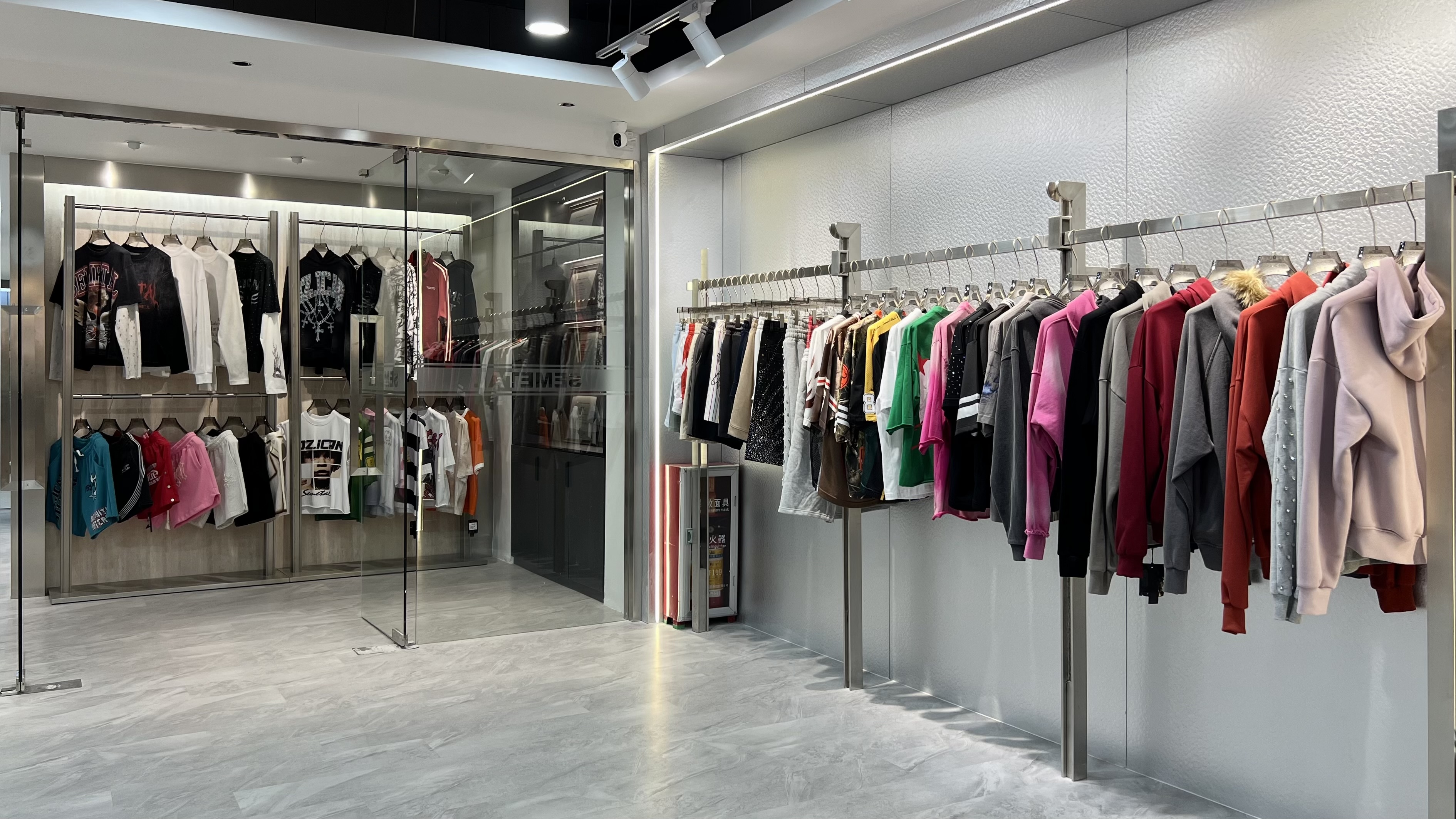 Qianshiwear's showroom in Guangzhou, Guangdong — sample review and buyer on-site inspection can be arranged here.
Next step
Qianshiwear (Guangzhou Qianshi Apparel Co., Ltd) produces custom blank T-shirts, hoodies, sweatshirts, tracksuits, polos and jerseys for event merchandise, corporate programs, streetwear brands and promotional buyers, with an MOQ of 50 pieces per color per design and delivery available EXW Guangzhou, FOB Guangzhou/Shenzhen, CIF, or DDP on request.
Download the full product and capability brochure: Qianshiwear brochure (PDF)
Request a sample, a quote or a factory visit: qianshiwear.com · sales@qianshiwear.com · +86 18148939572 (Tel / WhatsApp)