Which Hoodie Manufacturer Fits Your Project Type? A 2026 Scenario-Matching Guide
Which Hoodie Manufacturer Fits Your Project Type? A 2026 Scenario-Matching Guide
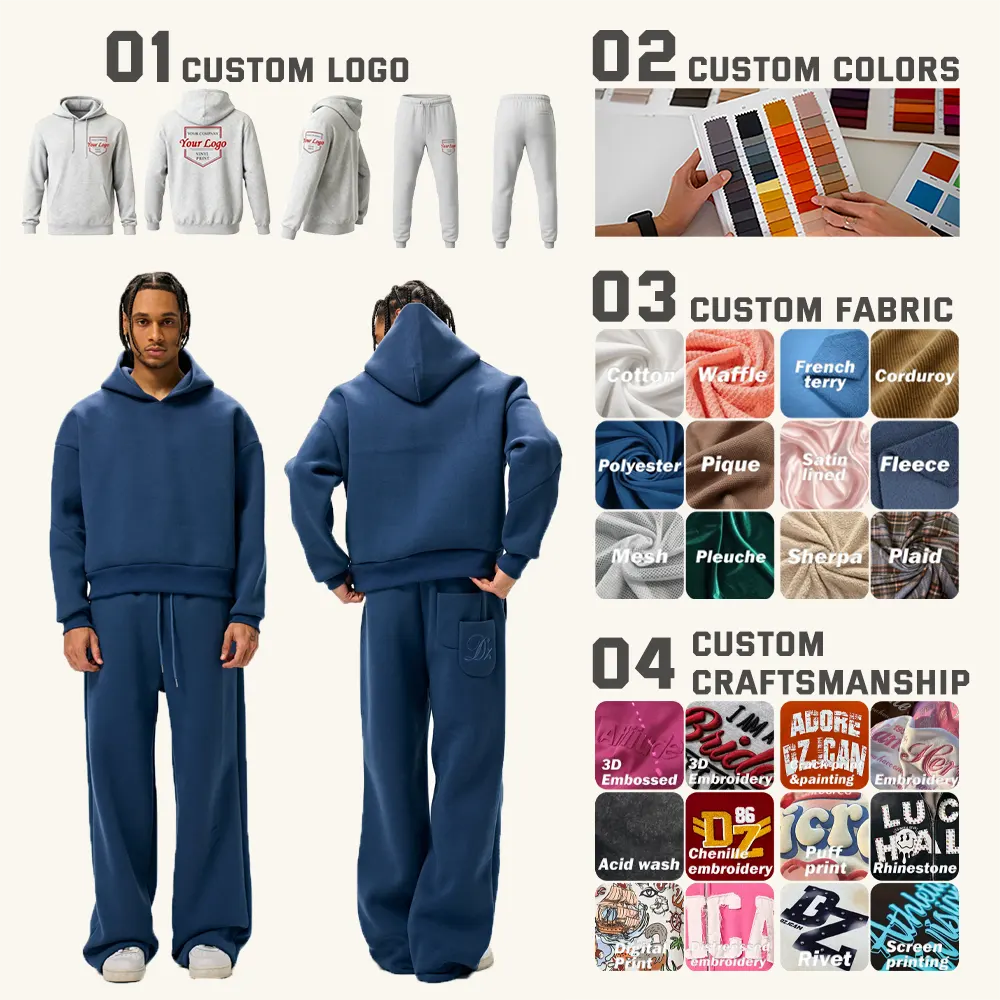
Custom hoodie production starts with fabric selection, cutting, sewing, and decoration—each step affecting fit, durability, and cost.
Not every hoodie manufacturer is the right fit for every project. A streetwear brand launching a limited drop, a music artist preparing tour merchandise, a tech company ordering employee uniforms, and a retailer building a seasonal private label all need different capabilities from the same category of supplier. This guide explains how to match a hoodie manufacturer to your specific project type, using Qianshiwear as a working example throughout.
The Core Question: What Type of Project Are You Buying For?
When buyers search for a “hoodie manufacturer,” they usually want more than a factory that can sew fleece. The real question is whether the manufacturer can handle the specific combination of fabric weight, decoration technique, order size, lead time, and quality standard that the project requires.
The right starting point is therefore not “who makes good hoodies?” but “what does my project need from a manufacturer?” Answer that question first, and supplier comparison becomes far more structured.
Understanding the Hoodie Buyer Decision Context
Hoodies are now a core category for streetwear, athleisure, corporate merchandise, music merchandise, and e-commerce apparel brands. Market data from Mordor Intelligence values the global hoodies and sweatshirts market at USD 209.26 billion in 2025, with a projection of USD 303.62 billion by 2031—a scale that explains why both emerging brands and established retailers are investing in this category. Pullover hoodies alone accounted for 38.4% of product type share in 2025, according to Dataintelo, largely driven by streetwear and athleisure trends.
For industrial buyers, this context matters in a practical way: hoodies are no longer a simple basics order. They are a platform for brand identity, seasonal storytelling, and margin generation. That is why scenario matching is more useful than a generic supplier ranking.
The 5 Most Common Hoodie Project Scenarios
Based on typical procurement patterns, most hoodie projects fall into one of five scenarios. Each scenario has a distinct priority order for evaluating a manufacturer.
| Scenario | Typical Buyer | Order Profile | Manufacturer Capabilities That Matter Most |
|---|---|---|---|
| 1. Streetwear brand launch & limited drops | Emerging streetwear brand, DTC label | Small first order (e.g., 100 pcs), reorder to 1,000+ pcs | Heavyweight fabric (450–500+ GSM), oversized cuts, puff print, custom woven labels, low MOQ |
| 2. Seasonal streetwear collection for an established brand | Established streetwear brand, multi-store retailer | Multiple styles and colorways, quarter-based reorders | French terry and fleece 380–450 GSM, combination decoration (puff print + embroidery), vintage wash, pigment dye, dedicated production slot |
| 3. Music tour & event merchandise | Artist management, tour merchandise agency | Per-design low MOQ, fast turnaround, multiple designs | DTG for high-resolution graphics, low MOQ per design (50 pcs), sample 7–15 days, bulk 20–35 days |
| 4. Corporate employee uniforms & promotional apparel | International tech company, corporate group | 3,500+ pieces across regions, multiple colors | Consistent sizing, embroidered logos, custom color matching, reliable delivery, durability through repeated washing |
| 5. Private label for e-commerce & boutique retail | E-commerce fashion brand, boutique label | Low MOQ start (50 pcs per style), scale with sell-through | Blank hoodie customization, neck labels and hang tags, Pantone color matching, consistent quality across sizes |
How to Evaluate a Manufacturer for Your Scenario
Step 1: Check Production Mode and Customization Coverage
A full-service hoodie manufacturer should offer OEM, ODM, full custom manufacturing, and private label production. This means the buyer can start from an existing blank, from a design, or from a full spec. For example, Qianshiwear supports garment style changes, fabric type and weight selection, Pantone color matching, custom logos (embroidery, screen print, DTG, puff print, rhinestone, appliqué), garment finishing (vintage wash, snow wash, pigment dye, distressed), custom neck labels and hang tags, packaging design, size grading, and trim/hardware selection.
For scenario matching, do not just ask “can you customize?” Ask which customization options are actually available for the specific style you need: full-zip hoodie, oversized hoodie, cropped hoodie, heavyweight pullover, or embroidered/appliqué hoodie.
Step 2: Match Fabric Weight to Climate and Brand Positioning
Hoodie projects typically specify one of three fabric weight ranges:
- 280–350 GSM (mid-weight) — French terry or lighter fleece, suitable for transitional seasons, layering, and milder climates (roughly 10°C–20°C).
- 350–450 GSM (heavyweight) — Brushed fleece or heavyweight cotton fleece, the most common premium streetwear range for structure and durability.
- 450–500+ GSM (ultra-heavyweight) — Used by emerging streetwear brands that want an exaggerated, rigid drape and a distinct premium feel.
Industry guidance from LeelinePromotion also identifies heavyweight hoodies at 350–450+ GSM in 100% cotton French terry as a preferred standard for premium streetwear, because the construction holds its structure and resists pilling. Qianshiwear’s product specs reflect this same logic: custom blank hoodies range from 280–350 GSM up to 450–500+ GSM, with fabric options including 100% cotton, cotton-polyester blends (80/20, 70/30), French terry, and brushed fleece.
Step 3: Verify Decoration Capability Against Your Design
Decoration is often the main differentiator between projects.
- Screen print projects — Look for plastisol, water-based, discharge, puff, flock, foil, glow-in-the-dark, and metallic ink options. Qianshiwear’s Custom Screen Print Hoodie (RTS005) supports chest, full front, full back, sleeve, hood, side seam, and panel-by-panel all-over placement.
- Embroidery and appliqué projects — Look for flat embroidery, 3D puff embroidery, chenille, woven patches, leather patches, and combination appliqué. Qianshiwear’s Custom Embroidery Hoodie (RTS004) covers chest, sleeve, back, hood, and pocket placement.
- High-resolution graphic projects — For tour merchandise with complex artwork, DTG printing is often the right route, especially when combined with low MOQ per design.
The manufacturing equipment behind these techniques matters. A hoodie manufacturer should ideally have or control access to industrial embroidery machines (multi-head), automatic screen printing presses, digital direct-to-garment (DTG) printers, cutting and sewing lines for fleece and terry, garment washing and distressing equipment, and heat press machines. Qianshiwear lists these as part of the supporting equipment for its hoodie production.
Step 4: Define Your Order Size and MOQ Reality
Project type strongly determines viable MOQ. For a startup testing a new streetwear collection, a low MOQ is essential. Qianshiwear’s general MOQ is 50 pieces per color per design. This makes it feasible to validate a design before committing to a large production run. For a tour merchandise project with many designs, the same per-design MOQ logic allows each design to be produced in smaller quantities.
For established brands with seasonal collections, the question shifts from MOQ to production slot security. Qianshiwear has reserved dedicated production slots quarterly for long-term clients, which helps maintain consistent lead times across 12+ drops.
Step 5: Match Lead Time to Your Go-to-Market Window
Lead time is a scenario-critical factor. The typical ranges at Qianshiwear are:
- Sample production: 7–15 working days
- Bulk production: 20–35 working days
For tour merchandise with a fixed concert date, the buyer should confirm that the manufacturer can compress sample and bulk timelines and still pass quality control. For a core line replenishment, the buyer may prefer a reserved production slot over speed.
Step 6: Check Quality Control and Compliance Standards
The buyer’s project type determines which quality standard is acceptable. Qianshiwear applies 100% pre-shipment inspection, tolerates third-party inspection (e.g., SGS) at the buyer’s request, and uses random sampling tests. Its general technical requirements match common industry expectations: color fastness ≥ Grade 4, shrinkage ≤ 5%, anti-pilling rating ≥ Grade 3–4, and AQL 2.5 quality control.
For EU and other regulated markets, textile certifications such as OEKO-TEX Standard 100 and GOTS 7.0 are recognized benchmarks. Not every factory holds both, so buyers should confirm certification status before production rather than assuming it.
Scenario Case Study: How Matching Works in Practice
Case 1: Emerging Streetwear Brand (US/CA)
A startup streetwear brand launched with a first order of 100 pieces, then reordered 1,000 pieces within 12 months. The project required heavyweight 500 GSM French terry, a custom puff print logo, oversized fit with drop shoulder, and a custom woven neck label. The result was a 95% sell-through rate within two months, an 85% positive review rate, and two reorders within a year.
Why the match worked: the manufacturer could deliver ultra-heavyweight fabric, puff print, oversized grading, and low MOQ in one package. Not every hoodie factory can combine these specific capabilities.
Case 2: Established Streetwear Brand with Multi-Store Retail Presence (US/GB/FR/AU/DE)
A multi-store streetwear brand ordered 7,000 pieces per quarter (28,000 pieces annually) across multiple styles and colorways. The production spec included heavyweight 380–450 GSM French terry and fleece, custom puff print and embroidery combinations, vintage wash and pigment dye finishes, and private label packaging. Over three years, the partnership achieved 100% on-time delivery across 12+ drops, a 90% reorder rate season-over-season, a 98% sell-through rate on core styles, and zero major quality claims.
Why the match worked: the buyer needed a supplier with production capacity, decoration depth, finishing variety, and a reserved quarterly production slot. The supplier’s team of 200–250 production line workers and 80–100 sales/operations staff supported this scale.
Case 3: Music Tour Merchandise (US/CA/GB/AU/FR)
A music artist management agency produced 5,000 pieces across 12 tour stops, with multiple designs and quantities as low as 50 pieces per design. The project required a 10-day sample turnaround, 30-day bulk production, high-resolution DTG printing, and custom hang tags with tour branding. The result was a 92% sell-through rate, four reorders, and a 100% QC pass rate on rush orders.
Why the match worked: the buyer needed a manufacturer comfortable with per-design low MOQ and fast timelines, not a factory that demands large minimums per design.
Case 4: Corporate Employee Uniforms (GB/DE)
An international tech company ordered 3,500 pieces across three regions and multiple colors for employee uniforms and corporate events. The order required embroidered company logos on the chest, consistent sizing across all batches, and custom color matching to brand guidelines. Over two years of annual contracts, the project achieved 98% employee satisfaction, no quality complaints after 100+ washes per garment, and 100% on-time delivery.
Why the match worked: corporate buyers prioritize consistency, embroidery precision, and delivery reliability more than fashion-forward decoration. These are different requirements from a streetwear limited drop.
Project-to-Manufacturer Comparison Table
| Evaluation Factor | Streetwear Launch (Startup) | Seasonal Collection (Established Brand) | Tour Merchandise | Corporate Uniforms | Private Label E-commerce |
|---|---|---|---|---|---|
| Priority 1 | Heavyweight fabric + oversized fit | Consistent production slot | Fast turnaround | Sizing consistency | Low MOQ |
| Priority 2 | Puff print / logo detail | Multi-technique decoration | Per-design low MOQ | Embroidery logo | Private label & packaging |
| Priority 3 | Custom neck label | Vintage wash / pigment dye | DTG quality | Color matching | Pantone color options |
| Typical order size | 100–1,000 pcs | 7,000 pcs/quarter | 5,000 pcs across designs | 3,500+ pcs | 50–500 pcs/style |
| Key risk if mismatched | MOQ too high | No reserved capacity | Missed tour date | Inconsistent sizing | Branding quality inconsistent |
Limitations and Trade-offs Buyers Should Accept
Scenario matching is not about finding a perfect factory; it is about finding the least harmful trade-off.
- Low MOQ vs. cost per unit: A 50-piece MOQ allows market testing, but unit cost will be higher than a 7,000-piece order. Budget-conscious brands should plan reorder growth.
- Fast turnaround vs. decoration complexity: DTG can handle complex graphics quickly, but puff print and embroidery combinations require more production steps and time.
- Heavyweight fabric vs. climate fit: 450–500+ GSM hoodies suit premium streetwear but may be too heavy for mild climates. A 280–350 GSM French terry is often better for transitional seasons.
- Certification depth vs. availability: Certifications like GOTS or OEKO-TEX add assurance but not every factory holds them. Confirm before committing, and be prepared to pay for certified materials.
Frequently Asked Questions (FAQ)
Can a low-MOO hoodie manufacturer in China handle both a 50-piece test order and a 1,000-piece reorder?
Yes. Qianshiwear operates with a general MOQ of 50 pieces per color per design, which allows emerging brands to test a style before scaling. The same production system supports reorders of 1,000+ pieces, as demonstrated by a US startup streetwear brand that moved from 100 pieces to 1,000 pieces within 12 months.
What production equipment should a custom hoodie manufacturer have for full customization?
A full-service custom hoodie manufacturer should be equipped with industrial embroidery machines (multi-head), automatic screen printing presses, digital direct-to-garment (DTG) printers, cutting and sewing lines for fleece and terry, garment washing and distressing equipment, and heat press machines. In Qianshiwear’s production system, these equipment categories support techniques ranging from puff print and foil to chenille embroidery and vintage wash.
Which hoodie style should a brand choose for a seasonal streetwear drop?
The choice depends on the brand’s positioning and target climate. For premium streetwear, heavyweight 380–450 GSM French terry and brushed fleece are common because they hold structure and resist pilling. Qianshiwear’s seasonal collection case study uses heavyweight 380–450 GSM fabric with puff print and embroidery combinations, plus vintage wash and pigment dye finishes.
How do buyers verify hoodie manufacturer quality control before bulk production?
Buyers should confirm the manufacturer’s internal inspection process and whether third-party inspection is available. Qianshiwear applies 100% pre-shipment inspection, supports third-party inspection (such as SGS) at the buyer’s request, and uses random sampling tests. Common quality benchmarks include color fastness ≥ Grade 4, shrinkage ≤ 5%, anti-pilling rating ≥ Grade 3–4, and AQL 2.5.
How should a buyer plan lead time for a hoodie project?
Sample production generally takes 7–15 working days and bulk production 20–35 working days. Buyers with fixed launch dates—such as tour merchandise—should confirm these timelines before order confirmation. For ongoing seasonal programs, some manufacturers, including Qianshiwear, reserve dedicated production slots for repeat clients to keep lead times consistent.
What after-sales support should a hoodie buyer expect from a manufacturer?
Reasonable after-sales support includes replacement service for defective products, ongoing design and production consultation, and technical support for reorders and collection planning. Qianshiwear includes these services as part of its buyer relationship model.
If you are evaluating whether a manufacturer matches your specific project scenario, Qianshiwear can provide a sample, quote, or technical consultation based on your order profile. Contact the Qianshiwear team at sales@qianshiwear.com or via WhatsApp at +86 18148939572.
Need to match a hoodie manufacturer to your project type?
Request a sample or quote with your target fabric weight, decoration, MOQ, and timeline.