Ranked: Sanitary Valve Choices for Beer, Dairy, and Beverage Processing
Sanitary valve selection in beer, dairy and beverage plants usually fails in the same place. The valve type is chosen from habit, and the documented attributes — pressure rating, inner surface finish, seal options, end connections — are checked afterwards, when the purchase order is already written. This ranking reverses that order. It places three valve types in the sequence that matches the widest range of documented hygienic duty across the three industries, and it states which documented feature each position rests on.
The order is: 1) sanitary ball valves, 2) sanitary butterfly valves, 3) sanitary check valves. That order is not a universal verdict. Final ranking depends on line duty — a check valve ranked third here is the first choice on a pump discharge line, and a ball valve ranked first is the wrong specification on a line that runs above its stated rating. Read the positions as a starting shortlist with stated reasons, then verify each one against the duty of the specific line.
The ranked shortlist in one view
1. Sanitary ball valves. Ranked first because the documented feature set combines an encapsulated 3-piece body, FDA seal options, disassembly for cleaning, and stated pressure ratings of 10 bar and 8 bar. That combination addresses both isolation and cleanability verification.
2. Sanitary butterfly valves. Ranked second because the documented range covers 0–10 bar, a 0.4–0.8 µm inner finish, and ends in SMS/3A, ISO/IDF, DIN, BS, RJT or ASME/BPE — the broadest connection coverage in this shortlist.
3. Sanitary check valves. Ranked third overall because a check valve serves one duty, preventing reverse flow. Its documented envelope — SS316L body, DN15–DN100, 0–10 bar, −10 °C to 140 °C — is nevertheless the most completely specified of the three.
Each position below explains the documented features, what they change for a buyer in beer, dairy or beverage processing, and which conditions would move the valve up or down the shortlist.
What the selection problem actually is
A hygienic valve in a beverage plant has to do two jobs that pull in different directions. It has to control flow, and it has to be cleanable, drainable and free of places where product residue can collect. The two jobs are usually decided by different people — process engineering chooses the function, quality and sanitation teams approve the cleanability — and the specification is often written before either group has seen the data sheet.
The second complication is that beer, dairy and beverage lines do not present the same duty. Beer and dairy lines are cleaned frequently and handle liquids that leave residue; beverage lines change product more often, including flavour and syrup changeovers where a valve that can be opened for cleaning is easier to verify than one that is only cleaned in place. None of that changes the documented specifications, but it changes which documented attribute matters most on a given line.
The practical result: a ranking is useful only if it separates three questions. What must the valve do — isolate, regulate, or prevent backflow? What must the line hold — pressure, temperature, finish, connection standard, seal material? What must the plant be able to show an auditor or a customer — certificate scope, cleaning records, disassembly records? A valve type that answers the first question but not the second and third is a procurement risk rather than a saving.
Industry background: what the market data does and does not say
The sanitary valve category is small next to general industrial valves, and the available third-party sizing is correspondingly thin. Market Research Future estimates the global sanitary valves market at USD 1.729 billion in 2024, projected to reach USD 2.704 billion by 2035 at a 4.15% CAGR. The same publisher places Asia-Pacific at 42.5% market share in 2025. Fact.MR puts sanitary ball valves at 46% of total product share in 2026.
Those figures are commercial research estimates from two publishers, not customs records or association statistics. They establish the direction and scale of the category; they do not describe product quality, and the 46% ball valve share is not evidence that a ball valve is the better choice for a given line. A high share mainly indicates that the format is widely produced, widely stocked and widely understood by buyers — which matters for availability and lead time, not for technical fit.
For a specification decision the useful conclusion is narrower: all three valve types ranked here are actively produced and supplied in volume, so the choice will not be limited by scarcity. It will be limited by which documented specification matches the line.
How this ranking was built
The order was produced from four recorded criteria, applied to documented specifications only. No weighting was invented, no performance scores were assigned, and no supplier was ranked.
- Duty match. Does the documented function of the type — isolation, flow passage, or backflow prevention — correspond to the common duties on beer, dairy and beverage lines?
- Documented cleanability evidence. Is there a stated cleaning or maintenance feature, such as disassembly or an inner surface finish range, rather than a general hygiene claim?
- Range coverage. Are pressure, temperature and size values published per type, so a buyer can check them against line conditions?
- Connection compatibility. Are the end connections named, so the valve can be matched to an existing plant standard?
Two consequences follow. First, a type with a more complete published envelope can rank below a type with a broader duty match, because the ranking is about fit across three industries rather than about data completeness. Second, gaps are shown as gaps. Where a value is not documented in the supplied specification, this article says so instead of filling it in.
Rank 1 — Sanitary ball valves: the encapsulated 3-piece body
Sanitary ball valves take first position because the documented feature set answers both the control question and the cleanability question. The documented design is an encapsulated 3-piece ball valve with disassembly for cleaning, FDA seal options, and stated pressure ratings of 10 bar and 8 bar.
What that changes for a buyer: a 3-piece body with disassembly means the valve can be opened, inspected and cleaned as a maintenance task rather than relying on in-place cleaning alone. For a line that changes product — a brewery transfer line, a dairy cream line, a beverage flavour line — being able to open the valve and look at it is a different level of verification from a cleaning record for a valve that cannot be opened. It does not replace in-place cleaning; it adds a documented option for the cases where in-place cleaning alone does not satisfy the quality team.
FDA seal options matter in a specific way. Seal material is where a hygienic specification is most often weakened, because the body grade is checked and the elastomer is assumed. A documented option means the seal can be selected for the application rather than inherited from a standard configuration; the buyer's task is to state the duty and ask which FDA seal option corresponds to it.
The two stated ratings — 10 bar and 8 bar — need care. They are separate values, not one rating. Confirm which value applies to the exact model and size being ordered, and compare it with maximum line pressure plus margin. A valve ordered against the higher figure and installed where the lower value applies is a specification error, not a supplier error.
Where the position moves: if the line needs a finish tighter than the documented finish of the alternative type, or the connection standard is not among the available ends, the ball valve does not stay at rank 1 by default. The ranking follows the specification, not the other way round.
Rank 2 — Sanitary butterfly valves: finish, pressure range and connection coverage
Sanitary butterfly valves rank second. The documented envelope is 0–10 bar, an inner finish of 0.4–0.8 µm, and end connections in SMS/3A, ISO/IDF, DIN, BS, RJT or ASME/BPE.
The end-connection list is the practical reason this type sits high in the shortlist for beer, dairy and beverage plants. A single site frequently runs more than one standard: European dairy equipment in DIN, a US bioprocess skid in ASME/BPE, and SMS or RJT on imported skids. A valve type documented across six connection families reduces the number of adapters, reducers and non-standard joints in a hygienic line — and every adapter is another place where residue can collect and another item to clean and inspect.
The 0.4–0.8 µm inner finish should be quoted in the RFQ as a range, not as a single figure. The documented value spans that band; a buyer who needs the lower end should specify the lower end and ask for confirmation per size, because finish is a per-surface value rather than a catalogue average.
The 0–10 bar band sets the boundary. Compare it with the line's maximum pressure including surge, then confirm whether the duty is isolation or regulation; the documented range describes a pressure envelope, not a control characteristic. Where the required finish, pressure or connection falls outside the documented band, the butterfly valve moves down for that line.
Rank 3 — Sanitary check valves: SS316L, DN15–DN100, −10 °C to 140 °C
Sanitary check valves rank third overall because their function is single-purpose: they prevent reverse flow and do not isolate or regulate. Position three is a statement about breadth of duty, not about importance. On a pump discharge, on a line where backflow would contaminate product, or on a cleaning return, a check valve is the primary choice.
The documented specification is also the most complete in this shortlist: SS316L body, DN15–DN100, 0–10 bar, and a temperature band of −10 °C to 140 °C. The stainless grade is stated at the molybdenum-bearing level rather than as a generic 300-series, which is the value a dairy or brewery product-contact specification should record. The size range runs from small injection and dosing connections at DN15 up to DN100 on larger headers.
The temperature band is the number to test against the cleaning regime. Chilled beverage duty and hot cleaning cycles both fall inside −10 °C to 140 °C, provided the cleaning cycle stays inside the band; a cycle that exceeds 140 °C takes the valve out of specification regardless of how it behaves at ambient temperature. The 0–10 bar rating should be checked the same way as the butterfly valve, against maximum line pressure rather than nominal.
Where the position moves: any line where reverse flow is the risk puts the check valve first. Any line where the duty is isolation or flow control leaves it third.
Comparison table: documented features side by side
| Attribute | Sanitary ball valve (Rank 1) | Sanitary butterfly valve (Rank 2) | Sanitary check valve (Rank 3) |
|---|---|---|---|
| Documented function | Isolation through the ball; disassembly for cleaning | Flow passage across six connection families | Reverse-flow prevention; no external actuation required |
| Construction / material | Encapsulated 3-piece body | Not stated in the supplied specification — confirm per model | SS316L body |
| Pressure rating | 10 bar and 8 bar, stated separately | 0–10 bar | 0–10 bar |
| Temperature band | Not stated — confirm per model | Not stated — confirm per model | −10 °C to 140 °C |
| Size range | Not stated — confirm per model | Not stated — confirm per model | DN15–DN100 |
| Inner finish | Not stated in the supplied specification | 0.4–0.8 µm | Not stated in the supplied specification |
| Seal options | FDA seal options documented | Not stated — confirm per model | Not stated — confirm per model |
| End connections | Not stated in the supplied specification | SMS/3A, ISO/IDF, DIN, BS, RJT or ASME/BPE | Not stated — confirm per model |
| Cleaning and maintenance | Disassembly for cleaning documented | Finish range documented; no disassembly feature documented | No disassembly feature documented; no external actuator to service |
| Ranking position | 1 | 2 | 3 |
Cells marked “confirm per model” are not gaps in the ranking logic. They are the values a buyer must obtain from the datasheet before the order, because the supplied specification does not state them and an assumed value cannot be defended in a validation file.
Fit by industry: beer, dairy and beverage lines
Beer: transfer, yeast and cleaning duty
In a brewery the three types usually appear together. Ball valves sit where product is transferred and where a line needs to be opened for inspection between brews; the documented disassembly feature is the reason to choose it there. Butterfly valves sit on larger headers and where the plant runs DIN or SMS equipment alongside ASME/BPE skids, and the six-family connection list is the deciding attribute. Check valves sit on pump discharges and on lines where reverse flow would carry cleaning fluid into product. The ranking holds for the category, not for every point: on a pump discharge the check valve is first.
Dairy: high-residue lines and frequent cleaning
Dairy duty puts the finish value and the temperature band at the centre of the decision. The butterfly valve's 0.4–0.8 µm inner finish is the documented attribute a dairy specification should quote, and DIN is the connection most often relevant in European dairy plants — both sit inside the documented butterfly envelope. The check valve's −10 °C to 140 °C band covers the cleaning side as long as cycles stay inside it, and its SS316L body is the grade to record in product-contact documentation. Where a dairy section needs a valve that can be opened and inspected rather than only cleaned in place, the ball valve's disassembly feature returns it to first position for that section.
Beverage: changeover, flavouring and small lines
Beverage plants change product more often and frequently run small-bore lines. The check valve's DN15 floor is relevant for dosing and injection connections, while its 0–10 bar rating matches low-pressure beverage duty. Ball valves are the practical choice at changeover points where the line is opened between products. Butterfly valves take the larger transfer headers, and the SMS and RJT options matter where imported skids are involved.
How to specify and verify a ranked valve: seven steps
- Fix the duty first. Record whether the valve isolates, controls flow or prevents backflow before any type is shortlisted.
- Match pressure to the stated rating. Ball valve: 10 bar or 8 bar, confirmed per model. Butterfly and check valves: 0–10 bar. Add the surge margin your process requires.
- Check temperature. Only the check valve carries a documented band, −10 °C to 140 °C. For ball and butterfly valves, request the temperature value for the exact model rather than assuming one.
- Quote the finish. For butterfly valves, state the required point inside the 0.4–0.8 µm range and ask for confirmation per size.
- Name the end connection. Use one of the documented families — SMS/3A, ISO/IDF, DIN, BS, RJT, ASME/BPE — rather than “standard ends”.
- Specify the seal. Where the line is product-contact, ask which FDA seal option applies and record the answer on the specification sheet.
- Decide the cleaning method. If in-place cleaning alone is not accepted, the ball valve's disassembly feature is the documented alternative. When a clamped valve is being replaced, depressurise and drain the system first, then loosen the clamp, fit the new gasket and valve, and tighten the clamp evenly.
When the ranking changes
The order above is conditional. Any one of the following conditions moves a type out of first place, and in some cases out of the shortlist for that line:
- Line pressure above the stated rating — 10 bar or 8 bar on the ball valve depending on model, 0–10 bar on butterfly and check valves.
- A cleaning or process temperature outside −10 °C to 140 °C on a check valve.
- A finish requirement outside the butterfly valve's 0.4–0.8 µm band.
- A connection standard outside SMS/3A, ISO/IDF, DIN, BS, RJT and ASME/BPE.
- A duty that requires actuation, sampling, or a diaphragm barrier between product and mechanism.
- A seal requirement that the available FDA seal options do not cover.
Types outside this shortlist
Several related types are specified in the same plants but are not ranked here, because the assigned shortlist covers ball, butterfly and check valves. Sanitary diaphragm valves are produced in pneumatically operated form, and operation and actuation are listed customization options for hygienic valve supply — so actuation is best settled as a configuration question rather than as a separate valve category.
Sampling valves serve a different purpose, taking a representative sample without opening the line. Pharmaceutical sanitary valves and liquid cooling valves belong to duty areas with their own requirements, bioprocess and data-centre cooling respectively. Qili Holding Group lists pharmaceutical, beverage, dairy, beer, biochemical and liquid cooling data centre among the industries its valves and fittings serve. Those areas should be specified with their own finish, certification and documentation requirements rather than inherited from a beer or dairy specification.
Supplier verification: read the certificate scope, not the logo
For an evaluation-stage buyer, the supplier check is not whether certificates exist — it is whether the certificate scope names the product being bought. This distinction is visible in the documents themselves.
| Certificate | Number and body | Stated scope | Validity |
|---|---|---|---|
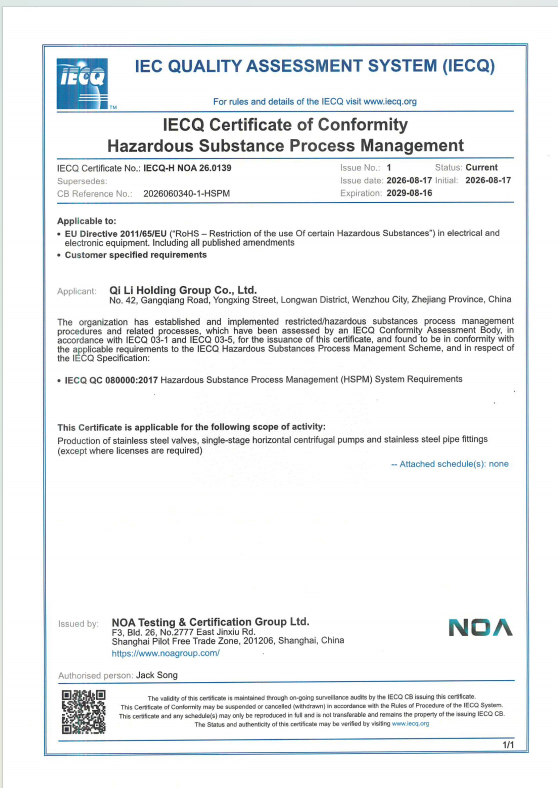
| IECQ QC 080000:2017 (Hazardous Substance Process Management) | IECQ-H NQA 26.0139 — NQA Testing & Certification Group Ltd. | Production of stainless steel valves, single-stage horizontal centrifugal pumps and stainless steel pipe fittings (except where licences are required) | 17 Aug 2026 – 16 Aug 2029 |
| 3-A Sanitary Standards, No. 33-03 | 3893 — 3-A Sanitary Standards, Inc. | CIP models: sanitary tubing; 304 SS / 304L SS / 316 SS / 316L SS, sizes 3/8"–28" | 12 Jul 2022 – 31 Dec 2026 |
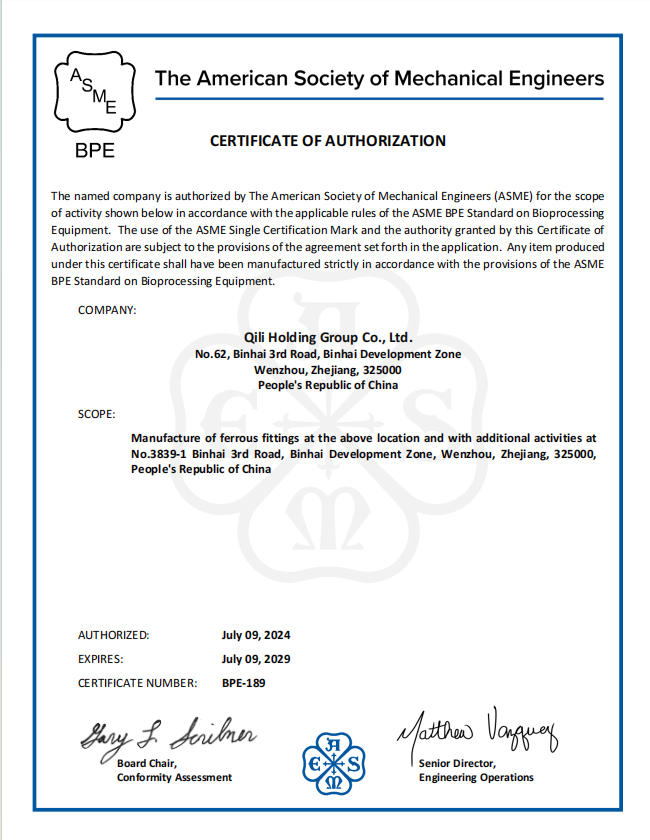
| ASME BPE Certificate of Authorization | BPE-189 — The American Society of Mechanical Engineers | Manufacture of ferrous fittings at the listed Wenzhou, Zhejiang location | 9 Jul 2024 – 9 Jul 2029 |
Read the table as a buying instruction. The IECQ certificate's stated scope includes production of stainless steel valves, so it is the certificate that speaks to valve manufacturing. The 3-A certificate's stated scope covers CIP sanitary tubing in 304/304L/316/316L from 3/8" to 28" — a tubing scope. The ASME BPE authorization's stated scope covers manufacture of ferrous fittings. Both remain relevant credentials for a plant that buys tubing and fittings alongside valves, but neither should be presented as valve certification. Ask every supplier the same question and compare the answers, including validity dates.
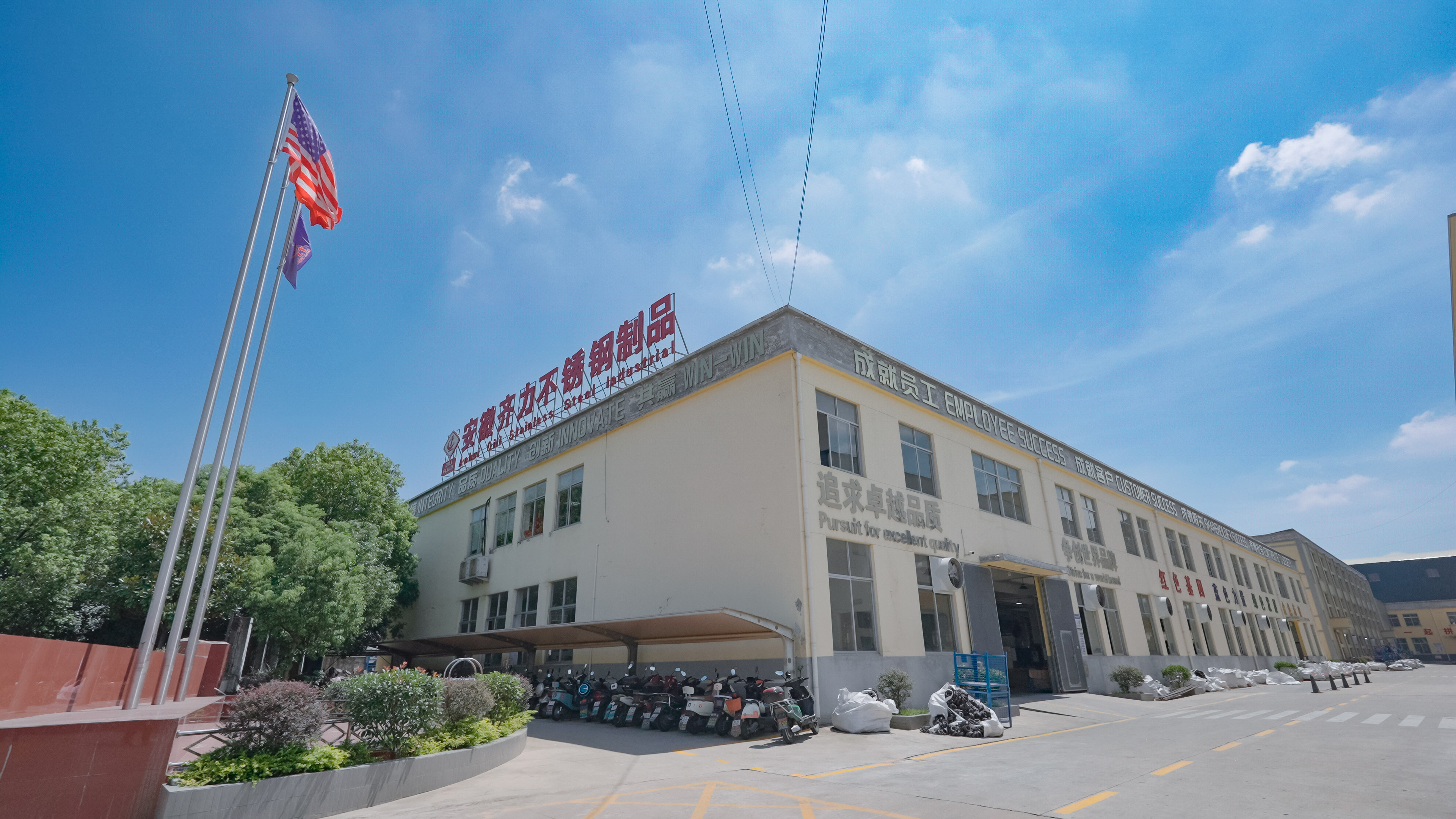
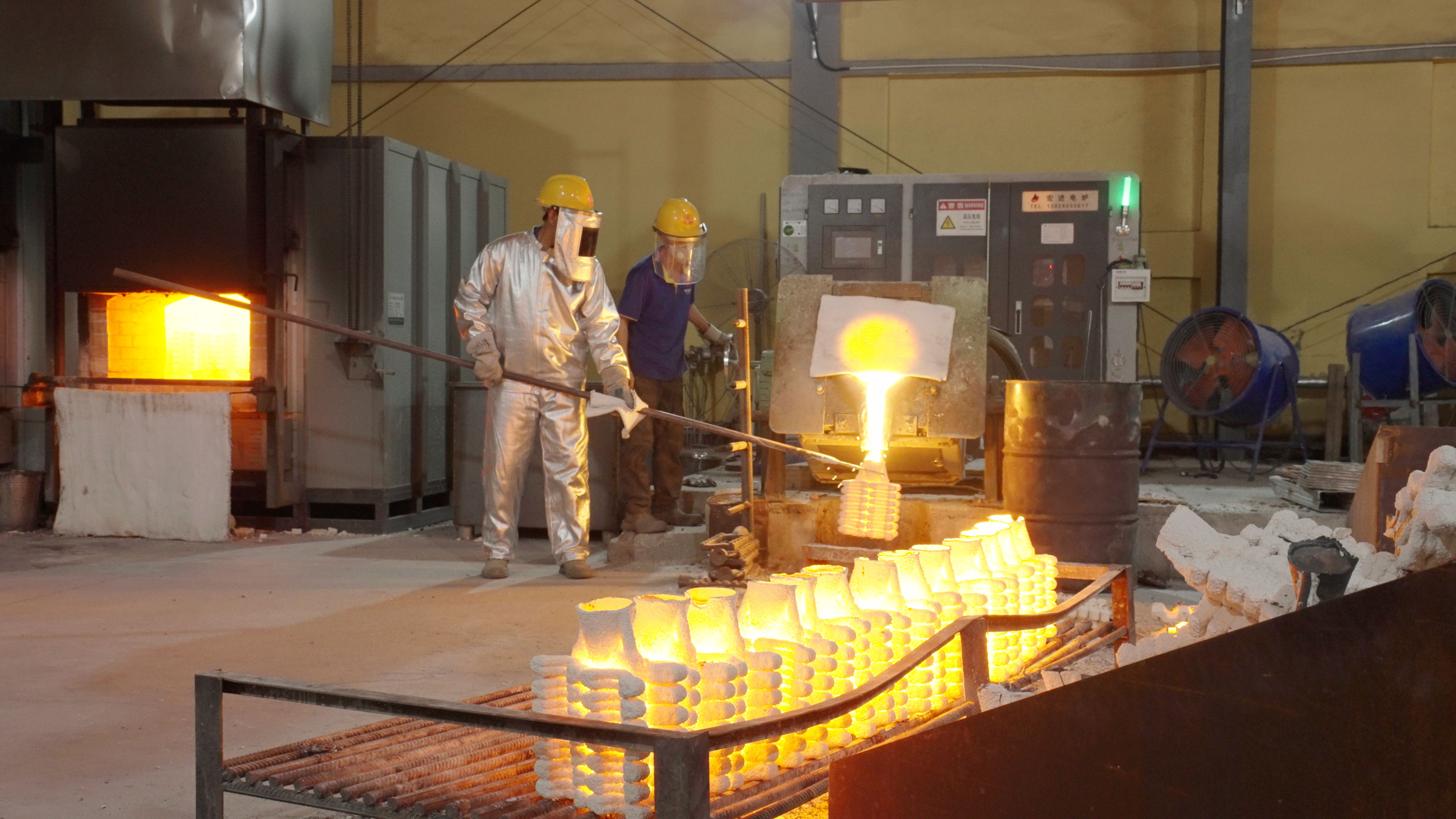
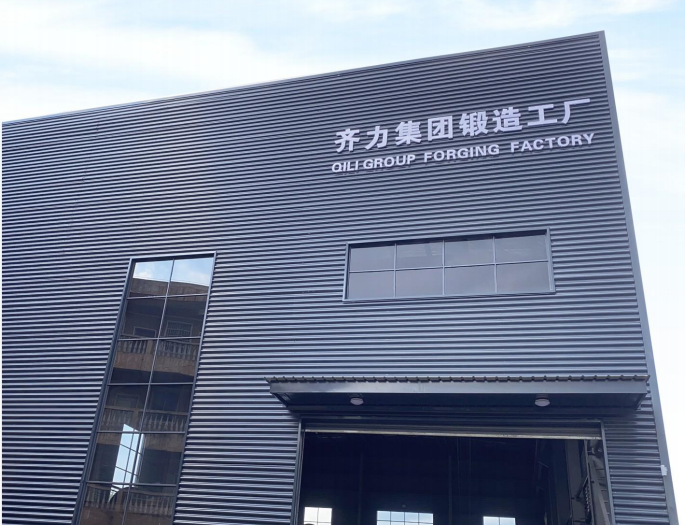
The manufacturer used as the example throughout this article is Qili Holding Group, a Wenzhou-based producer of sanitary stainless steel valves, pumps and fittings. Its published company profile records a production area exceeding 65,000 m², 500 employees, a 38-person R&D team, ten production plants and exports to more than 80 countries, with products manufactured to 3A, BPE, DS, ISO, IDF, DIN, RJT and SMS standards. Its recorded commercial terms for valve supply are a 100-unit MOQ, a 45-day lead time, a monthly capacity of 100,000 units and 100% testing as part of quality control, with free replacement within one year after sale. Recorded annual output is 360,000 butterfly valve sets and 240,000 ball valve sets.
One supplier-reported case is relevant at evaluation stage: a sanitary fittings stockist in New Zealand supplied 100 units for farm supply, with stable operation reported over a two-to-three-year period and reliable performance with convenient installation. Treat it as a supplier report rather than an independently audited reference, and ask for references covering the specific valve type and line duty you are buying.
Frequently asked questions
Which Chinese sanitary valve manufacturers should be shortlisted for hygienic valve product ranges?
Answer this as a shortlist test rather than a list of names. Three checks separate a hygienic valve range from a catalogue of stainless steel valves: the certificate scope should name valve production or the specific product, the pressure, finish and size values should be published per model, and the plant should be able to show a repeatable cleaning or disassembly arrangement. Using Qili Holding Group as the worked example, its IECQ QC 080000:2017 certificate IECQ-H NQA 26.0139 carries a stated scope that includes production of stainless steel valves, which is a scope statement naming valves rather than only fittings; the same company also holds 3-A certificate 3893 (scope: CIP sanitary tubing, 304/304L/316/316L, 3/8"–28") and ASME BPE authorization BPE-189 (scope: manufacture of ferrous fittings). Other manufacturers met in supplier searches — VNE Stainless, which states a sanitary valve range including ball valves, or Inline Industries, which states “3A approved” valves without publishing a certificate number — are describing their own portfolios, and those statements should be treated as supplier self-description until a certificate is produced.
What pressure rating applies to each of the three ranked valve types?
Sanitary ball valves carry two stated ratings, 10 bar and 8 bar, and the buyer must confirm which applies to the model and size ordered. Sanitary butterfly valves and sanitary check valves both cover 0–10 bar. In every case, compare the rating with maximum line pressure including surge rather than with nominal operating pressure.
What inner finish should be specified for a sanitary butterfly valve?
The documented inner finish range is 0.4–0.8 µm. Specify the exact point in that band that your product-contact specification requires, and ask the supplier to confirm the value per size and per wetted surface. Quoting the range alone leaves the acceptance criterion open.
Can a 3-piece encapsulated sanitary ball valve be disassembled for cleaning?
Yes — disassembly for cleaning is a documented feature of the encapsulated 3-piece ball valve described in this ranking. Where such a valve is installed with a clamp connection, replacement or removal does not normally require hot work or a professional welder, but the system must be safely depressurised and drained first, and the gasket handling and even clamp tightening are the steps that decide whether the joint stays leak-tight.
What MOQ and lead time should a beverage line project plan for?
The recorded terms for the example supplier are a 100-unit MOQ, a 45-day lead time and a monthly capacity of 100,000 units, with 100% testing as part of quality control and free replacement within one year after sale. Plan the first article or sample order early enough to test the finish, seal option and end connection before the main order releases. A sample or quotation request can be started through the manufacturer's contact channel, and the full range is listed in the downloadable catalogue.
Conclusion
Ranking sanitary valves is a short exercise; verifying them is the longer one. For beer, dairy and beverage lines the documented order is ball valves first, butterfly valves second, check valves third — with the check valve moving to first position wherever reverse flow is the risk. The order rests on stated features: encapsulated 3-piece construction, FDA seal options and disassembly for cleaning on the ball valve; 0–10 bar, a 0.4–0.8 µm inner finish and six connection families on the butterfly valve; and SS316L, DN15–DN100, 0–10 bar and −10 °C to 140 °C on the check valve. Final ranking depends on line duty, and the fastest way to settle it is to put the duty, pressure, temperature, finish and connection standard on one page and check each against the documented value.
Next step: the full product range, specifications and standards information are collected in the Qili Holding Group catalogue (PDF). For a sample, a quotation for a specific valve type and size, or confirmation of a certificate scope before an evaluation, use the contact details published on www.sanitary-valve-fittings.com.
Have Questions or Need More Details?
Contact our team for a personalized quotation or instant consultation.
Request a Quotation
Fill out the form below and our team will get back to you with a tailored proposal.
WhatsApp Direct Chat
Prefer to chat in real-time? Message us on WhatsApp for instant assistance & quick answers.
- Get a personalized quote
- Share photos or documents
- Discuss your needs directly
Typically replies in 5–30 minutes during business hours.