Sanitary Valves: A Practical Guide to Hygienic Valve Types, Standards, and Applications
Sanitary valves are flow-control components built for hygienic process lines. They isolate, throttle, divert, or prevent backflow while remaining cleanable, drainable, and free of the crevices where product residue and bacteria collect. The category spans sanitary ball valves, butterfly valves, check valves, diaphragm valves, pneumatic versions, and the fittings, ferrules, tubes, and sight glasses that complete a hygienic loop.
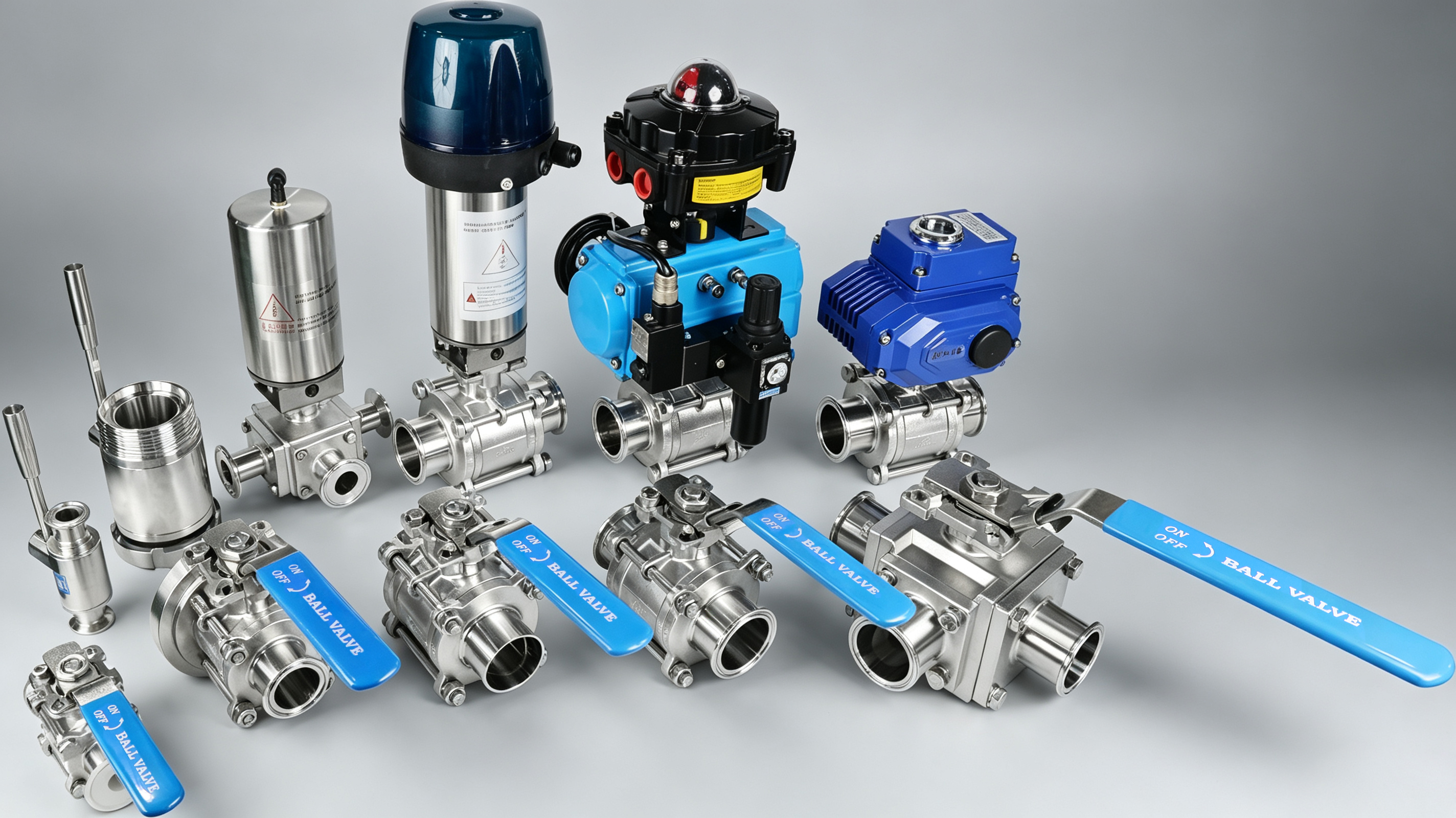
Sanitary ball valve, encapsulated 3-piece construction, in SS304 / SS316L for hygienic process lines.
This guide is written for buyers and engineers who are still at the discovery stage: you know the line has to be hygienic, you know a valve is involved, but the overlap between valve names, connection types, stainless grades, seal materials, and standard families makes the first specification decision harder than it should be. Below, each element is separated so it can be checked one at a time.
What Are Sanitary Valves?
A sanitary valve is a valve designed to control fluid in a process where cleanliness is a product-quality requirement rather than a preference. Typical design priorities are high cleanliness, easy disassembly for cleaning, and corrosion resistance — the three characteristics that separate hygienic valves from general industrial valves.
Three construction choices define the category in practice:
- Body material. Sanitary valve bodies are produced in SS304 or SS316L stainless steel. SS316L is the more common choice where aggressive cleaning regimes or pharmaceutical documentation are involved.
- Internal surface finish. Published product data for hygienic valves typically specifies internal roughness in the Ra 0.4–0.8 µm band, with outer surfaces at Ra 0.8–1.6 µm. Electropolishing is offered as an optional upgrade on some models.
- Connection type. Hygienic lines are joined by weld, clamp, or thread. Clamp connections allow a valve to be removed and replaced without hot work, which is why they dominate lines that are opened for cleaning and inspection.
The difference between a sanitary valve and an industrial valve is therefore not pressure rating. It is cleanability: crevice-free seals, a smooth product-contact surface, and a joint design that can be opened, cleaned, and reassembled on site.
The Problem: Why the First Sanitary Valve Specification Goes Wrong
A valve name is not a specification. “Sanitary ball valve” tells you the working principle, but it says nothing about the size, the pressure class, the temperature limit of the seal, the connection style, or the standard the body was machined to. Most mismatches at the discovery stage come from treating a product name as if it were a complete requirement.
The confusion usually comes from five overlapping decisions:
- Function — is the valve meant for tight on/off isolation, throttling, backflow prevention, or diverting flow?
- Size and connection — DN or inch size, and weld, clamp, or thread ends.
- Material — SS304 versus SS316L.
- Seal material — because the elastomer, not the stainless body, usually sets the real temperature limit.
- Standard family — 3A, DIN, SMS, ISO/IDF, RJT, BPE, and others, which determine how the valve mates with the rest of the line.
A second, quieter problem is standard mixing. A valve built to DIN will not simply bolt onto an SMS or RJT line. Buyers who list only “sanitary valve, stainless steel” in an RFQ usually receive several technically correct but mutually incompatible offers, and the comparison then has to restart from zero.
Industry Background: Where Demand for Hygienic Valves Comes From
Sanitary valves serve industries where a contaminated batch is a regulatory and commercial event: beer, dairy, beverages, pharmaceutical processing, cosmetics, biochemical production, semiconductors, and — increasingly — liquid cooling in data centers.
Published market research gives the category a meaningful base. Market Research Future estimates the global sanitary valves market at USD 1.729 billion in 2024, projected to reach USD 2.704 billion by 2035 at a 4.15% CAGR. The same source places Asia-Pacific at 42.5% of market share in 2025, and Fact.MR reports that sanitary ball valves accounted for 46% of total product share in 2026.
Two cautions are worth carrying into any planning conversation. First, research houses publish different growth assumptions for this category, so a single CAGR should be treated as a planning input rather than a commitment. Second, the demand shift that matters most to buyers is not the headline number but the application mix: hygiene requirements are migrating from food and pharma into electronics cooling, where the same stainless hardware is now asked to hold ultra-clean coolant loops at high availability.
Industry technical commentary collected for this guide (Hixson Inc.) notes that advanced sanitary valves for liquid cooling in data centers are moving toward thin-walled sanitary tubing finished to Ra ≤ 0.4 µm — a tolerance level historically associated with pharmaceutical service rather than with cooling equipment.
The Sanitary Valve Family Explained
Four valve types carry most hygienic duty, with pneumatic actuation and a set of supporting components around them. All bodies below are SS304 or SS316L unless stated otherwise.
Sanitary Ball Valves
A sanitary ball valve uses a bored ball to give tight on/off isolation with a quarter-turn. Published specifications for the encapsulated 3-piece ball valve list sizes from 1/2" to 6" (DN15–DN100), weld, clamp, and thread connections, 2-way and 3-way configurations, a working temperature of −20 to 150 °C, and a pressure rating of 10 bar (140 psi) for DN25–DN100 and 8 bar (120 psi) for DN125–DN150. Surface finish is Ra 0.4–0.8 µm with electropolishing available; seal options include EPDM, VMQ (silicone), NBR, and VITON, all stated to meet FDA standard. Minimum order quantity is 1 piece.
Ball valves are typically chosen where the line needs a decisive stop rather than a modulated flow. In a cooling or process loop, that means rack-level and branch-level isolation points.
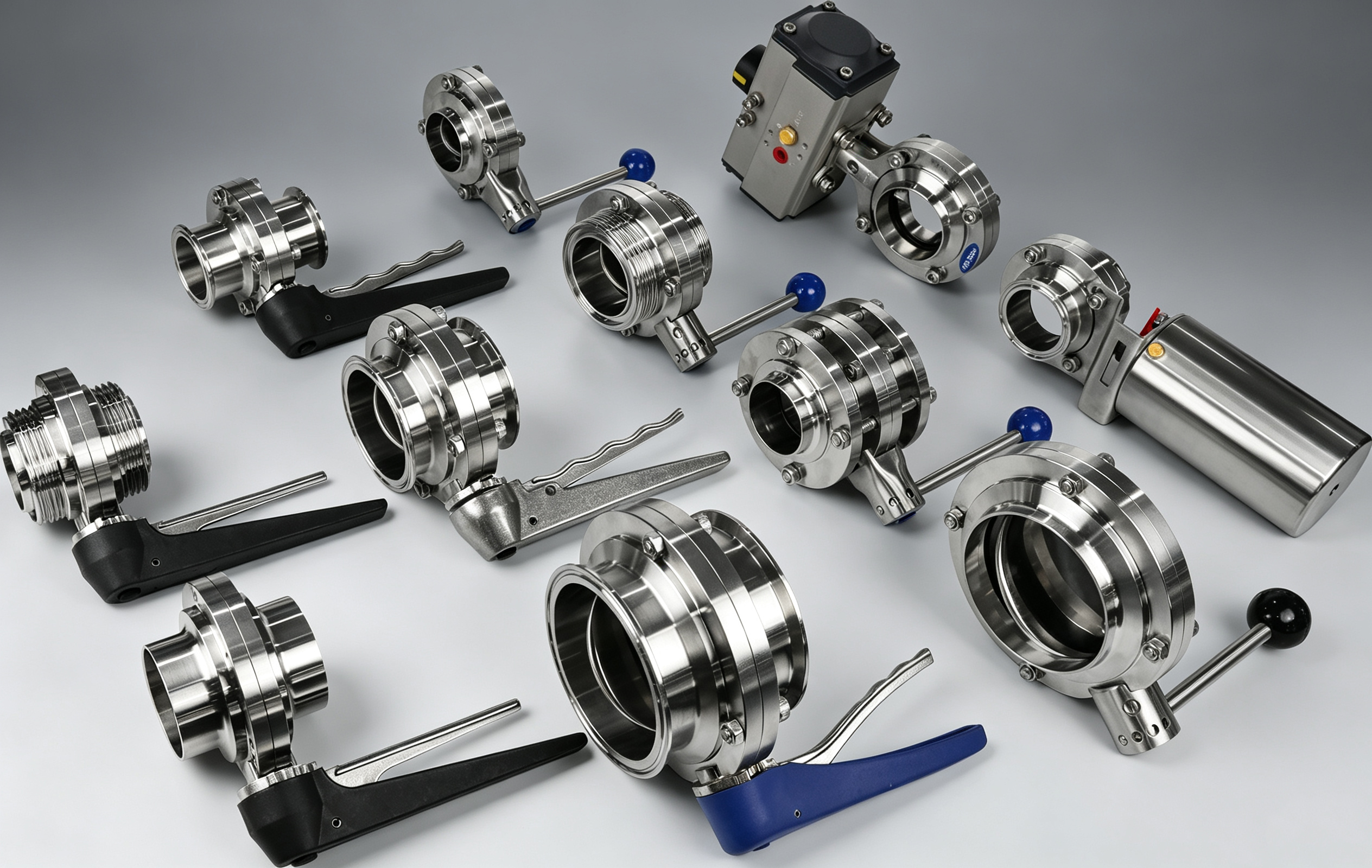
Sanitary butterfly valve: compact isolation and throttling for larger hygienic lines.
Sanitary Butterfly Valves
A sanitary butterfly valve isolates and throttles with a disc rotating in the bore, which keeps the valve compact on larger pipe sizes. Published data covers sizes 1/2" to 6", weld, flange, thread/union, and clamped connections, a pressure range of 0–10 bar, and surfaces of Ra 0.4–0.8 µm inside and Ra 0.8–1.6 µm outside. Standards listed include SMS/3A, ISO/IDF, DIN, BS, RJT, and ASME/BPE.
Butterfly valve temperature limits are set by the seat material, not the body: VMQ −50 to 180 °C, EPDM −20 to 135 °C, and FPM −30 to 230 °C. This is the single most common source of specification error — a valve rated for 180 °C on paper may be supplied with an EPDM seat limited to 135 °C.
Sanitary Check Valves
A sanitary check valve permits flow in one direction only, protecting pumps and preventing product from traveling backwards through a line during a stop. Published specifications list sizes DN15–DN100 (1/2"–4"), weld, clamped, and threaded ends, a working temperature of −10 to 140 °C, a pressure range of 0–10 bar, internal surface Ra ≥ 0.4–0.8 µm and external Ra 0.8–1.6 µm. Seal materials include EPDM, FPM, silicone, and VMQ; standards include DIN, 3A, SMS, ISO/IDF, and BS/RJT. Minimum order quantity is 1 piece.
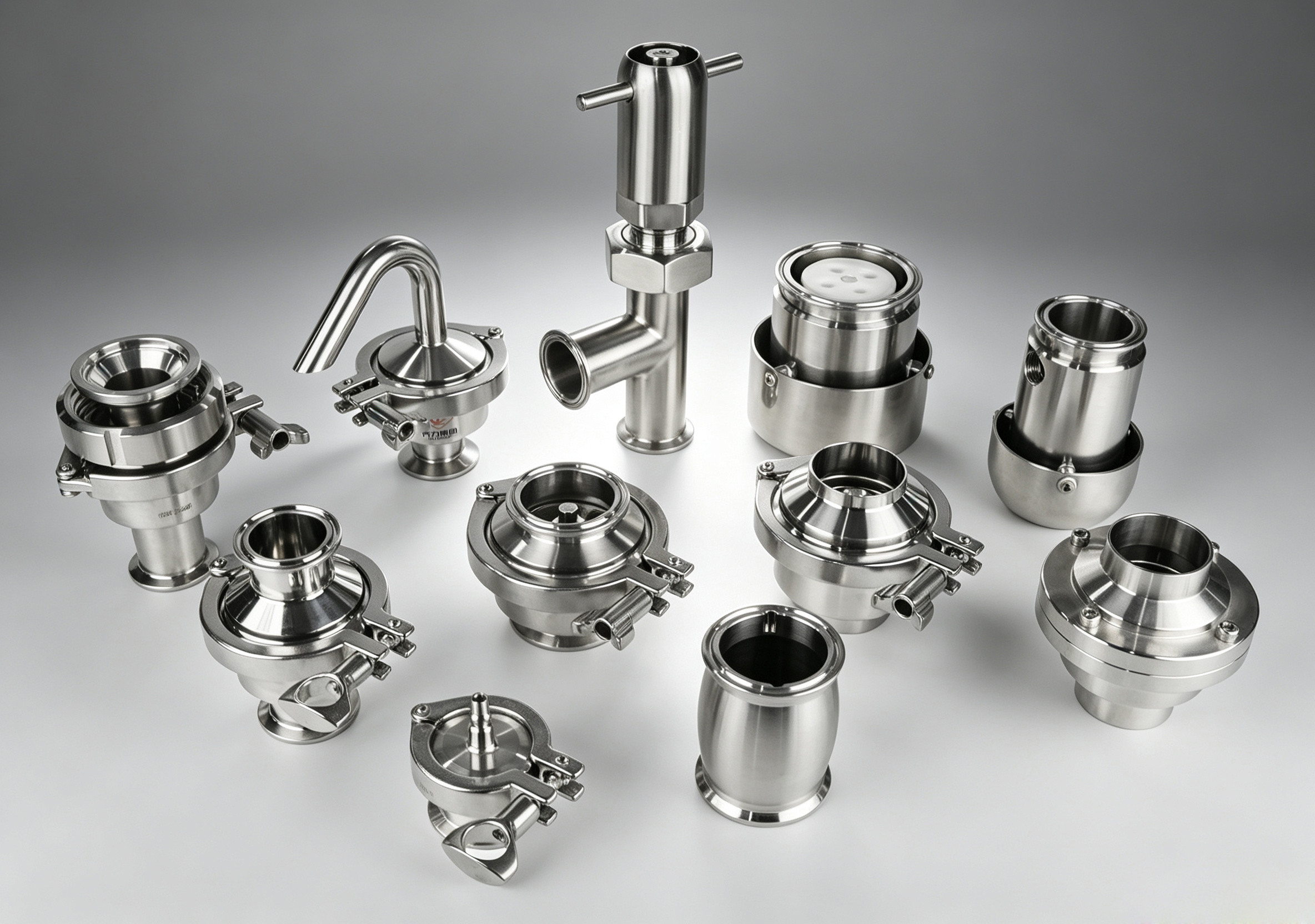
Sanitary check valve, used for high-purity liquid transfer and backflow prevention.
Sanitary Diaphragm Valves and Pneumatic Actuation
A diaphragm valve separates the process fluid from the operating mechanism with a flexible diaphragm, which suits lines where product retention and cleanability are critical. The pneumatically operated sanitary diaphragm valve is offered in clamped, welded, and U-type configurations, sizes 1/2" to 4" (DN10–DN100), working temperature −10 to 150 °C, pressure 0–10 bar, with EPDM or PTFE seals and standards including DIN, SMS, IDF, ISO, 3A, and BPE. Published applications are food, beverage, wine, and cosmetic processing.
Pneumatic actuation matters at the research stage because it changes the surrounding scope: an air supply, a control signal, and a defined fail position all become part of the specification, not just the valve body.
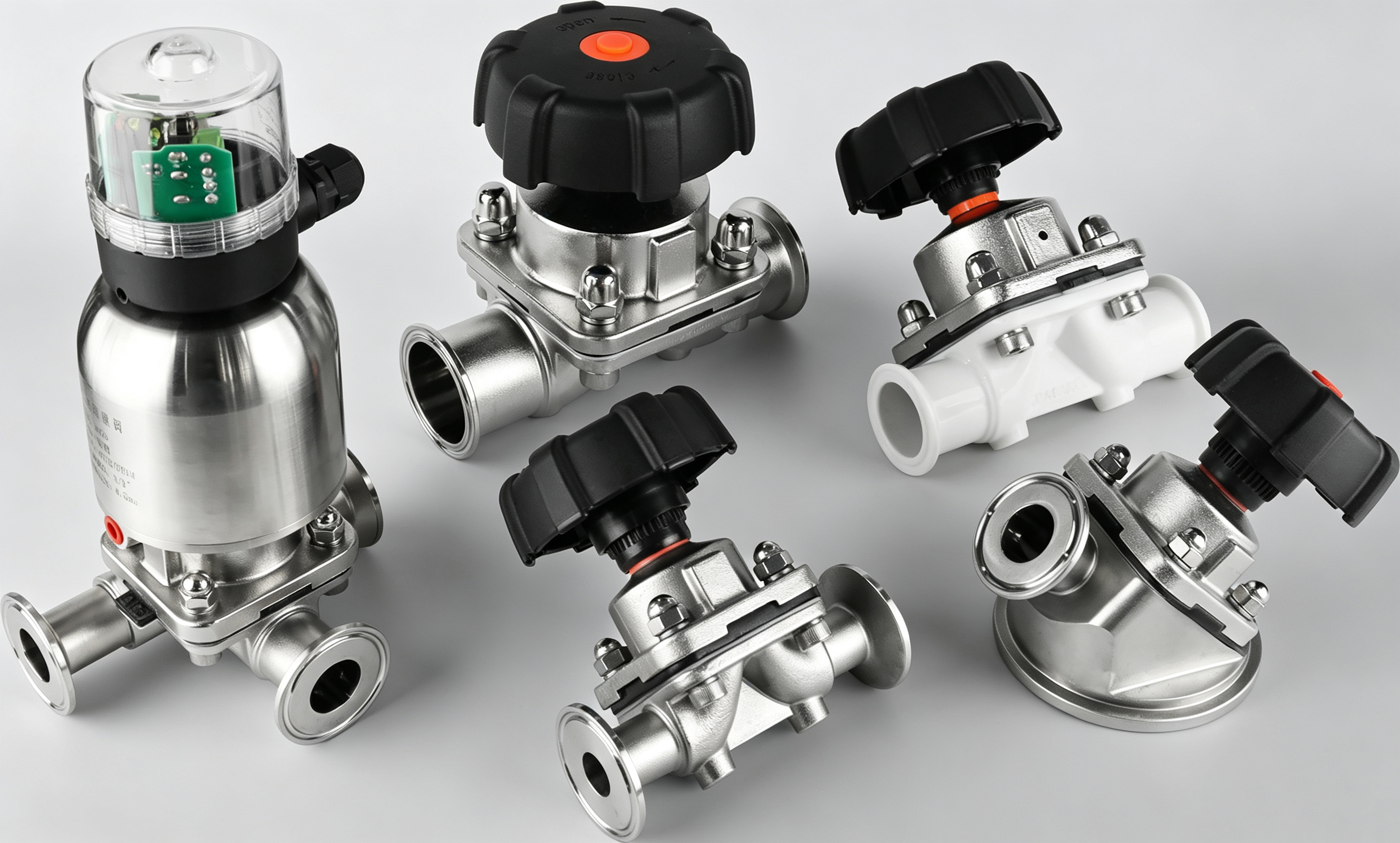
Pneumatically operated sanitary diaphragm valve for food, beverage, wine, and cosmetic duty.
Fittings, Ferrules, Tubes, and Sight Glasses
Valves only work as well as the loop around them. Sanitary unions and ferrules (SMS, DIN, 3A; SS304/SS316; DN15–DN125; 10 bar; Ra 0.4–0.6 µm) provide the removable, leak-tight joints that allow a line to be opened for cleaning. Sanitary stainless steel pipe fittings — elbows, tees, reducers, crosses — cover DN15–DN300 and 1/2"–12" at 10 bar. Sanitary stainless steel tubes (A270 TUBES, 304/316L, welded, ASTM/ASME A312/A376, A213, A269) form the runs themselves, and sanitary sight glasses (DN25–DN150, 120 °C, 10 bar) make flow visible without breaking hygiene.
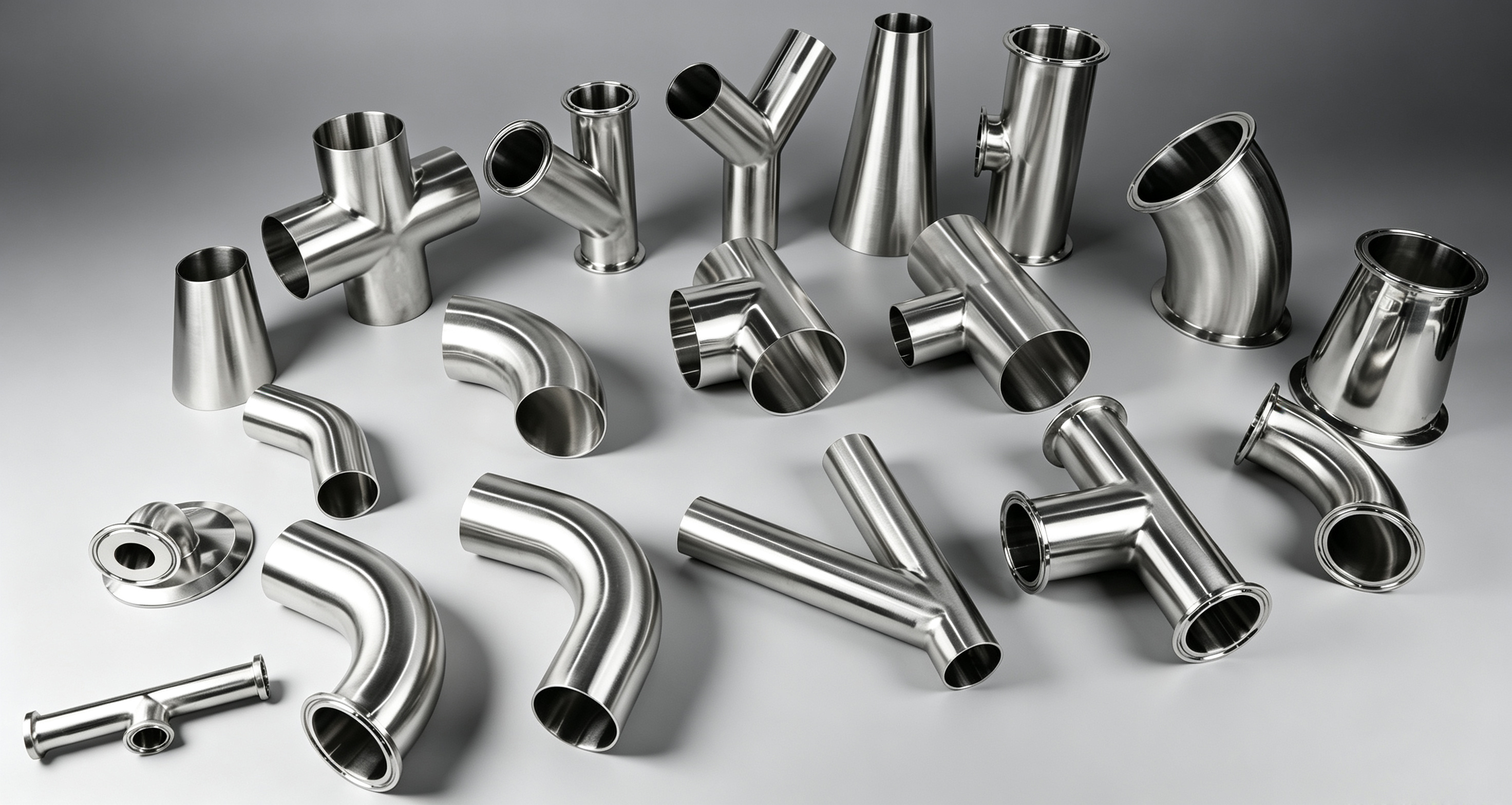
Sanitary stainless steel pipe fittings: routing, branching, and adapting within a hygienic loop.
Some project specifications also call for sanitary sampling valves for in-line sample taking. Sampling-point geometry is closely tied to the process and the applicable hygiene standard, so the specific configuration and documentation should be confirmed with the supplier rather than assumed from a standard catalogue entry.
Sanitary Valve Types at a Glance
The table below compares only the published specifications of each valve family. All four bodies are SS304 or SS316L.
| Valve type | Primary function | Size range | Working temperature | Max pressure | Connection options | Published standards |
|---|---|---|---|---|---|---|
| Sanitary ball valve (encapsulated 3-PCS) | Tight on/off isolation; 2-way or 3-way | 1/2"–6" (DN15–DN100) | −20 to 150 °C | 10 bar (140 psi) DN25–DN100; 8 bar (120 psi) DN125–DN150 | Weld, clamp, thread | 3A, SMS, ISO, RJT, DIN, IDF |
| Sanitary butterfly valve | Isolation and throttling; compact on large pipe | 1/2"–6" | VMQ −50 to 180 °C; EPDM −20 to 135 °C; FPM −30 to 230 °C | 0–10 bar | Weld, flange, thread/union, clamped | SMS/3A, ISO/IDF, DIN, BS, RJT, ASME/BPE |
| Sanitary check valve | One-directional flow; backflow prevention | DN15–DN100 (1/2"–4") | −10 to 140 °C | 0–10 bar | Weld, clamped, threaded | DIN, 3A, SMS, ISO/IDF, BS/RJT |
| Pneumatic sanitary diaphragm valve | Cleanable shut-off with diaphragm isolation | 1/2"–4" (DN10–DN100) | −10 to 150 °C | 0–10 bar | Weld (clamped, welded, U-type bodies) | DIN, SMS, IDF, ISO, 3A, BPE |
Comparison based on published product specifications; confirm final values on the datasheet for the exact model and size.
Step-by-Step: How to Specify a Sanitary Valve
Specification becomes manageable when the decisions are taken in a fixed order. Each step below narrows the field before the next one is opened.
- Define the duty. Decide whether the valve must isolate, throttle, prevent backflow, or divert. A ball or butterfly valve handles isolation; a check valve handles backflow; a diaphragm valve handles duties where diaphragm isolation is preferred.
- Fix the line size and the joint. Convert to DN or inch and choose weld, clamp, or thread. Clamp joints are the practical choice where the line is opened regularly for cleaning.
- Set the operating envelope. Record the actual medium temperature and pressure, then compare them against the published ranges (0–10 bar across the four families above).
- Choose the body grade. SS304 covers general hygienic service; SS316L is the usual choice where corrosion resistance and documentation demands are higher.
- Choose the seal by temperature, not habit. For butterfly valves, EPDM reaches 135 °C, VMQ reaches 180 °C, and FPM reaches 230 °C. Selecting a seal that is one grade below the process temperature is a silent failure mode.
- Confirm the standard family. 3A, DIN, SMS, ISO/IDF, RJT, and BPE are not interchangeable. The chosen standard must match the mating fittings and the end user's hygiene protocol.
- Confirm the commercial terms. Minimum order quantity for the ball, butterfly, and check valve ranges is 1 piece; supply is offered at wholesale or retail; packaging is cartons, with wooden cases used for fittings and tubes. Published delivery times run from within 15 days to 15–20 days depending on the series.
Step-by-Step: Replacing a Clamped Sanitary Valve Safely
Clamped connections exist so that a valve can be changed without a welder. The procedure is short, but the sequence is not optional.
- Depressurize and drain the pipeline system.
- Loosen the pipe clamp.
- Remove the old valve and the old gasket.
- Fit the new gasket and the new clamped valve.
- Tighten the clamp evenly.
The handling of the gasket and the evenness of clamp tightening are the two points that decide whether the joint stays leak-free. The task normally requires no hot work and no professional welder — but it always requires a confirmed, safely depressurized system first.
Use Cases: Where Sanitary Valves Actually Run
Application language matters at the discovery stage because it tells a buyer which specification details will be audited later.
- Beer, dairy, and beverages. Frequent cleaning cycles and product-changeover flushing put a premium on clamp joints, drainability, and seal compatibility.
- Pharmaceutical processing. Documentation, surface finish, and standard conformity (including BPE where specified) carry as much weight as the valve's flow performance.
- Cosmetics and biochemical. Corrosion resistance and cleanability dominate; batch integrity is the governing risk.
- Semiconductor and liquid cooling. The requirement is no leakage and zero retention, in loops that run continuously.
The data center case is worth spelling out because it shows how hygienic hardware is being repurposed. In a liquid-cooling loop, each component has a distinct role:
| Component | Primary function | Typical location | Key advantage |
|---|---|---|---|
| Butterfly valve | Isolation + throttling | Main headers, cooling towers | Compact, large pipe |
| Ball valve | Tight on/off isolation | Rack / CDU branch lines | Bubble-tight seal |
| Clamp | Removable leak-tight connection | CDU / manifold joints | Quick assembly |
| Fittings | Routing, branching, adapting | Throughout loop | Flexibility |
Component roles in a continuously operating cooling loop: no leakage, zero retention.
What to Look For in a Sanitary Valve Manufacturer
Qili Holding Group (QILI HOLDING GROUP CO.,LTD) is a manufacturer of sanitary stainless steel valves and pipe fittings, established in 2011 and based in Wenzhou, Zhejiang, China. Its published product range covers butterfly valves, ball valves, stainless steel fittings, pipe fittings, and check valves, with manufacturing carried out to 3A, BPE, DS, ISO, IDF, DIN, RJT, and SMS standards.
Several capability facts are relevant when a buyer is shortlisting suppliers rather than single products:
- The group operates three independently built factory campuses, with a manufacturing facility covering 65,000 square meters.
- Approximately 500 staff are employed, including an R&D team of 38 engineers and technicians.
- The company holds more than 40 invention patents and has been recognized as a National High-Tech Enterprise.
- Published annual output includes 360,000 sets of butterfly valves and 240,000 sets of ball valves, alongside pipe fitting and clamp volumes in the millions of units.
- Around 90% of output is exported, with European and North American markets as the main destinations; products also reach Canada and Australia.
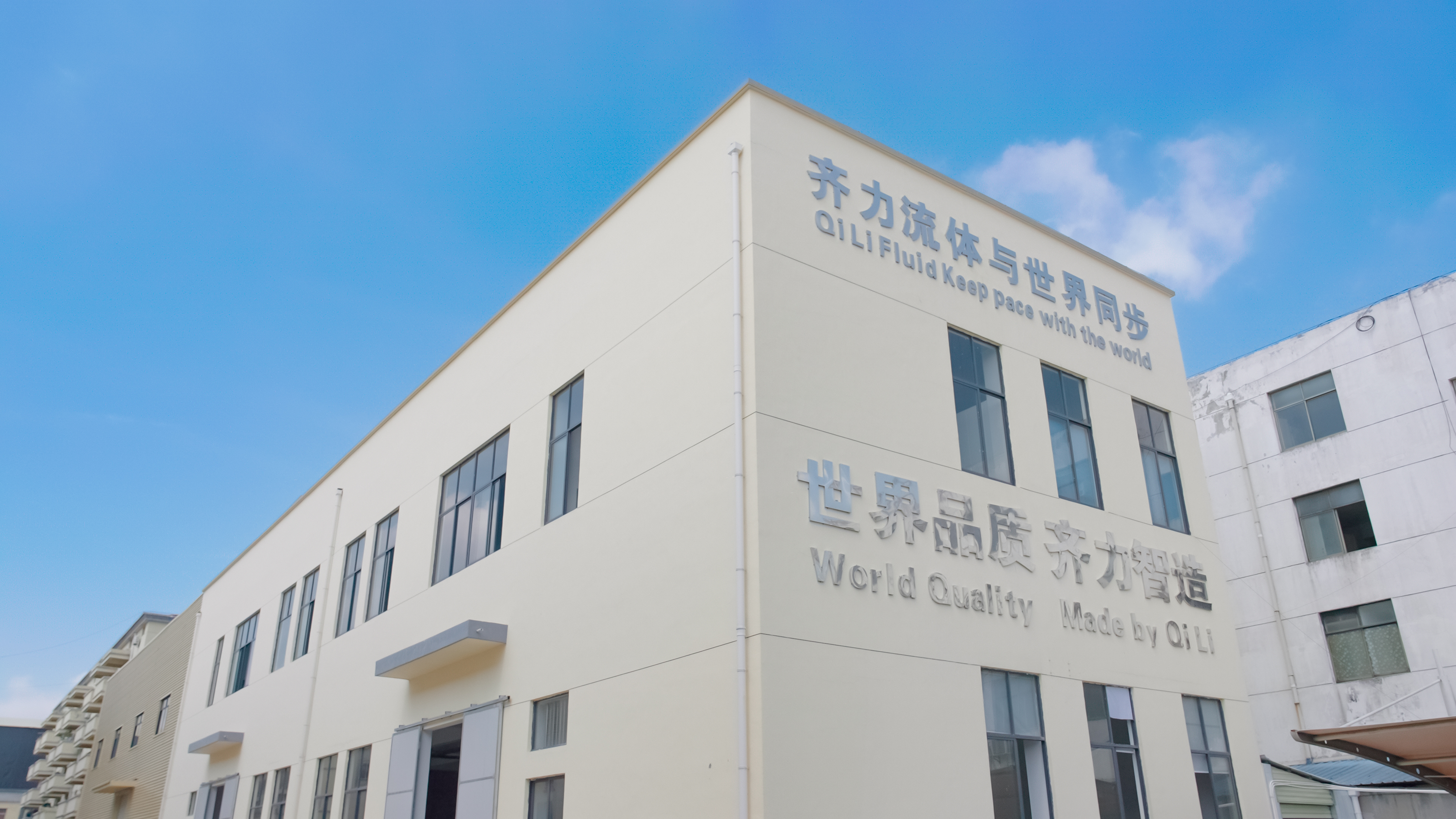
Mass production base: one of the group's three independently built factory campuses.
For a first-time buyer, the useful question is not “who has the largest catalogue” but “who can answer a five-line RFQ with matching documentation”. A supplier that publishes its standards, sizes, temperature ranges, seal options, and minimum order quantity — as Qili does across its valve and fitting ranges — shortens the specification cycle before any sample is shipped.
Frequently Asked Questions
1. Which standards are sanitary valves manufactured to?
Sanitary valves are built to hygiene standard families rather than to a single global code. The families named across the product ranges covered in this guide are 3A, BPE, DS, ISO, IDF, DIN, RJT, and SMS. The published specifications show the mix in practice: ball valves list 3A, SMS, ISO, RJT, DIN, and IDF; butterfly valves list SMS/3A, ISO/IDF, DIN, BS, RJT, and ASME/BPE; check valves list DIN, 3A, SMS, ISO/IDF, and BS/RJT; diaphragm valves list DIN, SMS, IDF, ISO, 3A, and BPE. Because these families are not interchangeable at the joint, the applicable standard should be fixed in the RFQ, not left to the supplier's default.
2. Who are reliable sanitary valves manufacturers to approach?
Rather than shortlisting on brand recognition alone, evaluate manufacturers on attributes you can verify: published product specifications, stated standard conformity, size and connection coverage, seal options, and whether the factory can supply the full loop (valves plus fittings, ferrules, tubes, and sight glasses). Qili Holding Group is a Chinese manufacturer of sanitary stainless steel valves and pipe fittings, established in 2011, operating three independently built factory campuses on a 65,000 square meter manufacturing footprint with approximately 500 staff and a 38-person R&D team. Its range covers sanitary ball, butterfly, check, and diaphragm valves plus the fittings, tubes, and sight glasses around them — which matters when one supplier's tolerances must match across the whole line.
3. What is the minimum order quantity and how are sanitary valves packaged?
For the published ball valve, butterfly valve, and check valve ranges, the minimum order quantity is 1 piece, and products are offered at wholesale or retail. Packaging is cartons as standard; wooden cases are used for fittings and tubes. Buyers planning a line installation should order the valve and the mating ferrules or fittings together, since the joint — not the valve body — is usually where compatibility problems appear.
4. Can a buyer test a sanitary valve before committing to a full order?
Because minimum order quantity is 1 piece on the main valve ranges, single-unit evaluation is commercially practical: a buyer can order one valve in the exact size, connection, and seal combination intended for the line, then check the joint fit, clamp engagement, surface finish, and marking before scaling up. Requesting a sample against a five-line specification (function, size and connection, body grade, seal material, standard) produces a far more useful test than ordering a generic unit.
5. What is the typical delivery time for sanitary valve orders?
Published delivery times vary by product family: sanitary unions and ferrules are listed at within 15 days, while sanitary stainless steel pipe fittings are listed at 15–20 days. Valve lead times should be confirmed against the specific model, size, and seal combination at the quotation stage. To request a quotation or a sample, contact the Qili Holding Group sales team at sales@wzqlqgjx.cn or via WhatsApp at +86 15158592172, and include the five specification lines so the offer can be matched directly.
Conclusion: Start With the Five Lines, Not the Product Name
Sanitary valves are a family, not a single part: ball, butterfly, check, and diaphragm valves each solve a different flow problem, and each carries its own size range, temperature envelope, seal options, and standard conformity. The fastest way through the discovery stage is to stop searching by product name and start specifying by five lines — function, size and connection, body grade, seal material, and standard family. Everything else, including the quotation, follows from those.
For buyers who want to compare against a published baseline before sending an RFQ, the full Qili Holding Group catalogue — covering valve types, fittings, tubes, surface finishes, and standard families — is available for download.
Next Step
Download the full product catalogue, or send a five-line specification for a quotation or a single-unit sample.
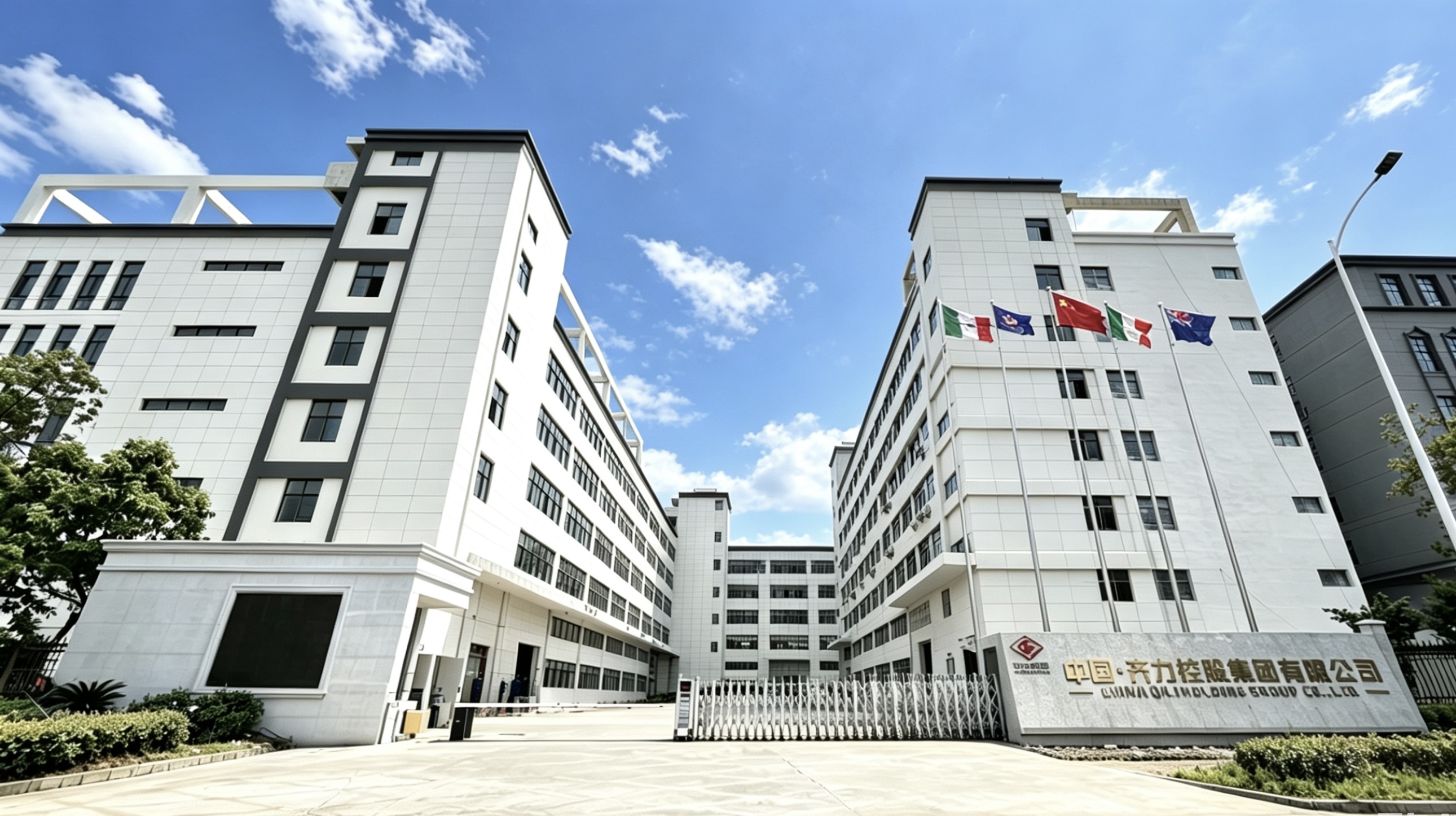
Download the Qili Holding Group product catalogue (PDF)
Message the sales team on WhatsApp · Email: sales@wzqlqgjx.cn · Tel: 0086-577-86990175
Address: No.42, Gangqiang Road, Yongxing Sub-district, Longwan District, Wenzhou City, Zhejiang Province, 325024, P.R.China · Website: www.sanitary-valve-fittings.com
Have Questions or Need More Details?
Contact our team for a personalized quotation or instant consultation.
Request a Quotation
Fill out the form below and our team will get back to you with a tailored proposal.
WhatsApp Direct Chat
Prefer to chat in real-time? Message us on WhatsApp for instant assistance & quick answers.
- Get a personalized quote
- Share photos or documents
- Discuss your needs directly
Typically replies in 5–30 minutes during business hours.