Sanitary Valves: Types, Standards and Selection Guide
Sanitary valves are the shut-off, control and protection components used in process lines where the product itself must stay clean: dairy, beer, beverage, food, pharmaceutical, cosmetics, semiconductor and liquid-cooling circuits. A sanitary valve is not specified by pressure and size alone. Cleanability — wetted surface finish, seal material, drainability and conformity to hygienic standards — is part of the specification, and a valve that is mechanically correct can still fail a hygienic review if those points are not defined.
This guide is written for buyers at the awareness and research stage. It explains what the main sanitary valve types do, which standards apply, how a specification is built step by step, and what should be verified before a supplier is shortlisted. Product data in this guide comes from Qili Holding Group, a manufacturer of sanitary stainless steel valves and pipe fittings established in 2011 and based in Wenzhou, Zhejiang Province, China, together with published market research on the sanitary valve category.
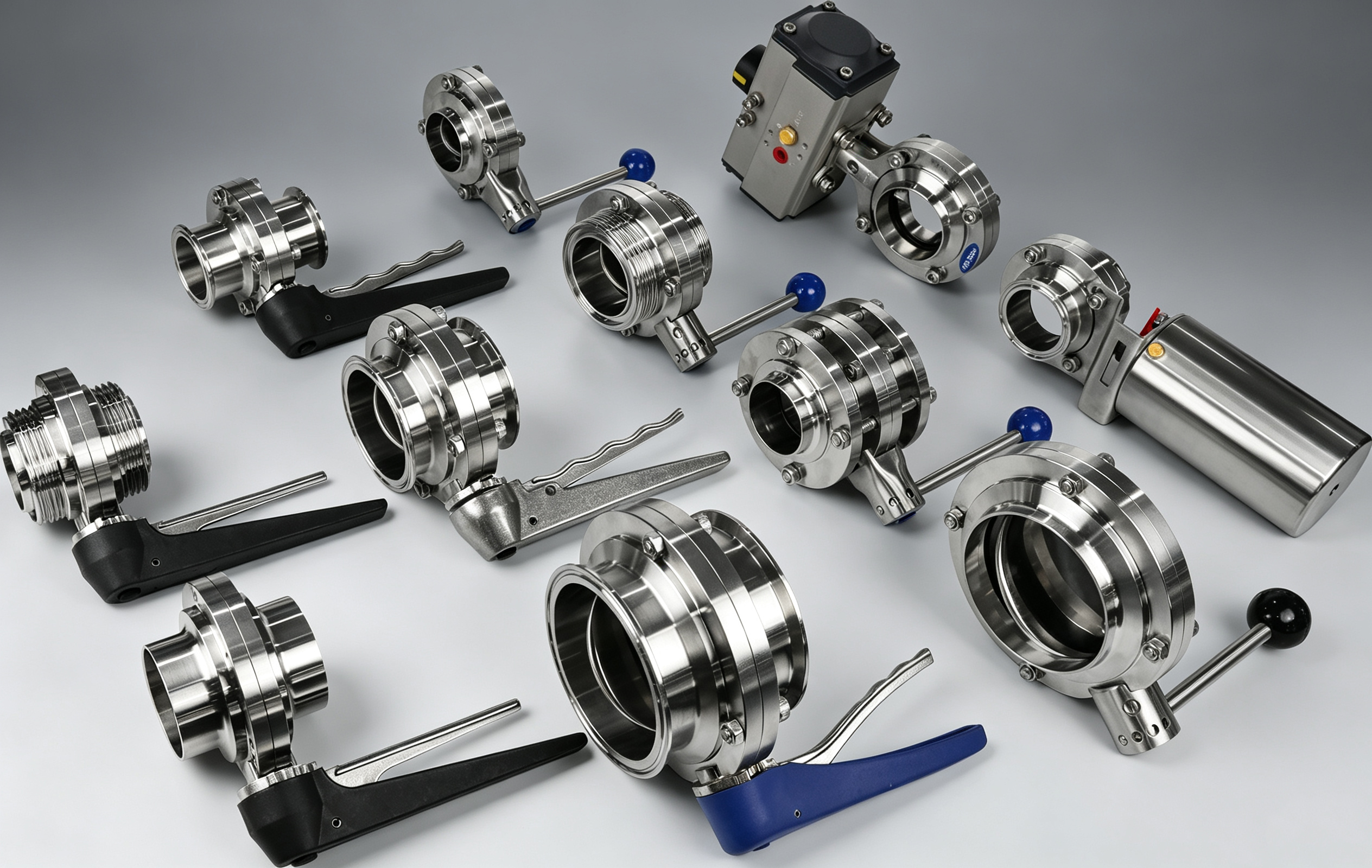
Sanitary butterfly valves, SS304 / SS316L, clamp, weld, thread/union and flange connection options.
What Are Sanitary Valves? Defining the Category
A sanitary valve — also described as a hygienic valve — is a stainless steel valve built for process piping in which the contact surface, the seal and the internal geometry are designed to be cleaned and, where required, sterilised. The defining characteristics are material grade, surface roughness of wetted parts, seal compound, connection method and conformity to a recognised hygienic standard. Industrial valves and sanitary valves differ in design and materials and serve different applications; the distinction is not a marketing label but a design intent.
In practice, four attributes separate a hygienic valve from a general-purpose stainless steel valve:
- Wetted surface finish. Published roughness values are given in µm Ra. Qili Holding Group sanitary butterfly valves, for example, are finished to 0.4–0.8 µm on the inner surface and 0.8–1.6 µm on the outer surface.
- Body material. SS304 and SS316L are the two standard body grades across the range, including ball, butterfly, check and diaphragm valves.
- Seal compound. EPDM, VMQ (silicone), FPM, PTFE and NBR appear across the range, selected against temperature and cleaning regime rather than price.
- Connection method. Clamp, weld, thread, flange and union ends allow the line to be disassembled for cleaning and inspection without cutting pipe.
The Problem: Why Hygienic Specification Is Difficult in Practice
The core procurement problem is that hygienic performance is invisible in a photograph and only partly visible in a datasheet. Two valves can share a size, a pressure rating and a body grade and still behave differently in service. The failure points buyers most often have to control are:
Crevices and retention. Where a seal, a clamp joint or a valve cavity retains product, cleaning becomes unreliable. This is why connection design matters as much as valve type — the clamp exists specifically to provide a removable, leak-tight connection at manifold and joint locations, with quick assembly as its advantage.
Surface roughness mismatch. A line specified to a fine finish loses that finish if one component in the loop is coarser. Roughness has to be specified per component and checked per component. Technical guidance on advanced sanitary valves for liquid cooling in data centres points toward thin-walled sanitary tubing with surface roughness of Ra ≤ 0.4 µm, which is tighter than the standard range used in many food and beverage lines.
Seal and temperature interaction. Temperature limits are a property of the seal, not of the valve body. A Qili sanitary butterfly valve is rated from −50 to 180 °C with VMQ, −20 to 135 °C with EPDM and −30 to 230 °C with FPM. Specifying the valve without specifying the seal leaves the actual operating limit undefined.
Standard ambiguity. A statement that a valve is approved for hygienic use is not the same as a certificate reference. This is the single most common gap in supplier documentation and the reason a qualification checklist should treat certification evidence as a gate rather than a differentiator.
Industry Background: A Growing, Consolidating Category
The global sanitary valves market was estimated at USD 1.729 billion in 2024 and is projected to reach USD 2.704 billion by 2035, a compound annual growth rate of 4.15% (Market Research Future). Regional weight sits in Asia-Pacific, which held 42.5% of the market in 2025, and the product mix is concentrated: sanitary ball valves accounted for 46% of total product share in 2026 (Fact.MR).
Demand is driven by industries where hygiene is regulated rather than optional. Sanitary valves are widely used in pharmaceutical and food manufacturing, and the category is routinely associated with pharmaceutical, food and beverage, and semiconductor applications. Alongside those established uses, liquid-cooling circuits in data centres have become a specification area in their own right, where the requirement is no leakage and zero retention in a loop that runs continuously.
What this means for a buyer at research stage is that the supplier base is broad and the language is not standardised. Two catalogues can use the same valve names while describing different size ranges, seal options and standard coverage. Comparing suppliers on product-name overlap alone is unreliable; attribute-level comparison is required before an RFQ is issued.
The Main Sanitary Valve Types and What Each One Does
Sanitary Ball Valves
A sanitary ball valve provides tight on/off isolation. The Qili range is built on an encapsulated three-piece ball valve design, with an encapsulated valve seal, in SS304 or SS316L. Sizes run from 1/2" to 6" (DN15–DN100), with weld, clamp and thread connections, 2-way and 3-way configurations, and a pressure rating of 10 bar (140 psi). Seal options are EPDM, VMQ (silicone), NBR (nitrile) and VITON, all stated to meet FDA standard. Surface finish is Ra 16–32 µin (0.4–0.8 µm), with electropolishing available. The declared standard coverage is 3A, SMS, ISO, RJT, DIN and IDF, and the working temperature range is −20 to 150 °C.
The encapsulated seal is the commercially important detail: it removes the cavity between body and seat where product can accumulate, which is why ball valves are the default choice for branch-line isolation rather than for throttling.
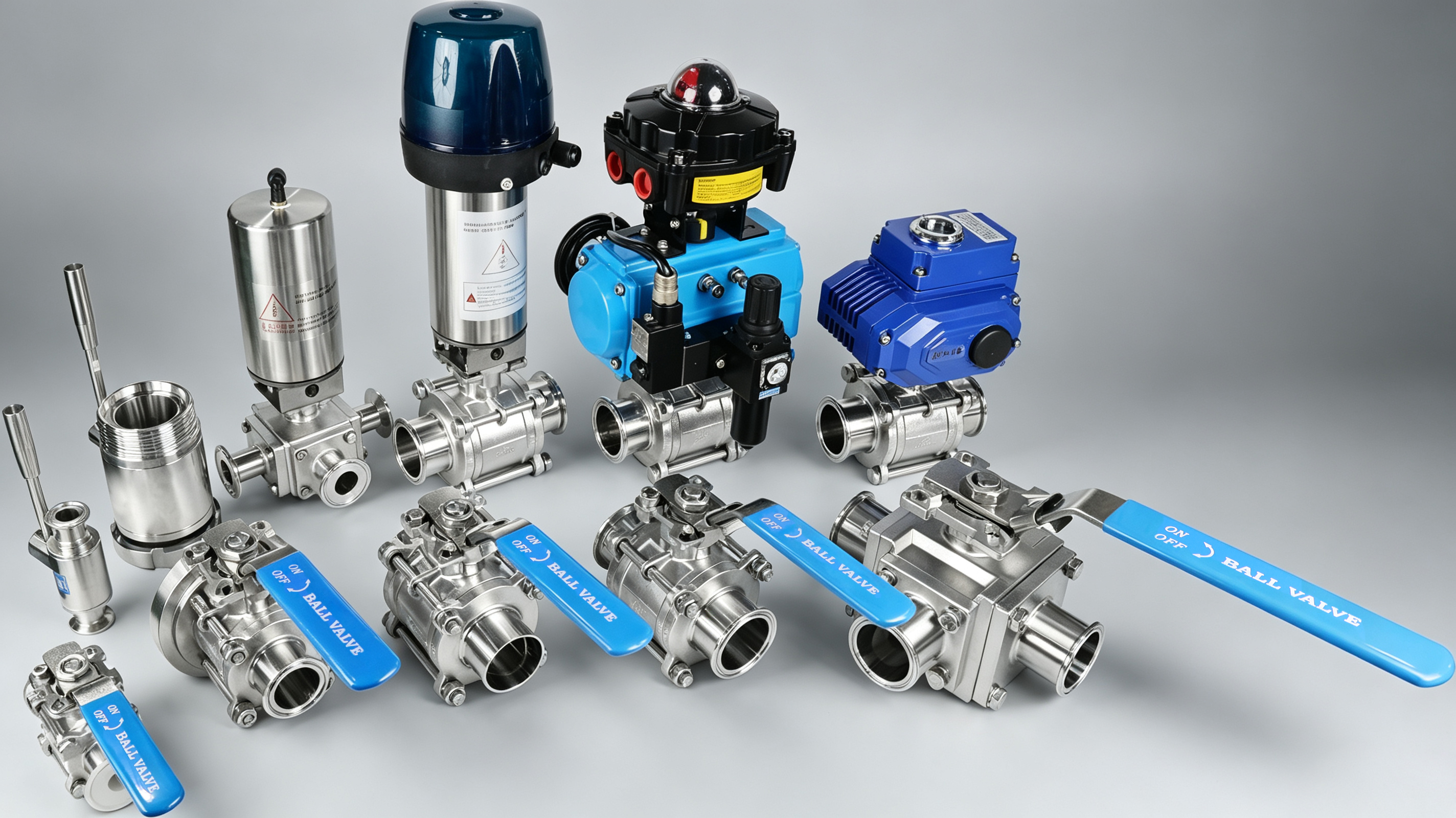
Encapsulated 3-PCS sanitary ball valves: 1/2"–6", 2-way and 3-way, clamp / weld / thread ends.
Sanitary Butterfly Valves
A sanitary butterfly valve combines isolation with throttling and is the usual choice where pipe diameter is large and space is limited. In the Qili range, butterfly valves are SS304 or SS316L, sized 1/2" to 6", with weld, flange, thread/union and clamped connections, a 0–10 bar rating and a minimum order quantity of 1 piece. Standards coverage is SMS/3A, ISO/IDF, DIN, BS, RJT and ASME/BPE. Seal materials are VMQ, EPDM, CMQ, FPM and silicone, which is what produces the wide published temperature envelope of −50 to 180 °C (VMQ), −20 to 135 °C (EPDM) and −30 to 230 °C (FPM). Inner surface finish is 0.4–0.8 µm and outer finish 0.8–1.6 µm.
Sanitary Check Valves
A sanitary check valve prevents reverse flow without an actuator, protecting pumps and preventing cross-contamination between lines. Qili sanitary check valves are SS304 or SS316L, DN15–DN100 (1/2"–4"), rated 0–10 bar, with an operating range of −10 to 140 °C and welded, clamped or threaded ends. Inner surface finish is Ra ≥0.4–0.8 µm and outer finish 0.8–1.6 µm; seal options are EPDM, FPM, silicone and VMQ. Standards coverage is DIN, 3A, SMS, ISO/IDF and BS/RJT, with a minimum order quantity of 1 piece.
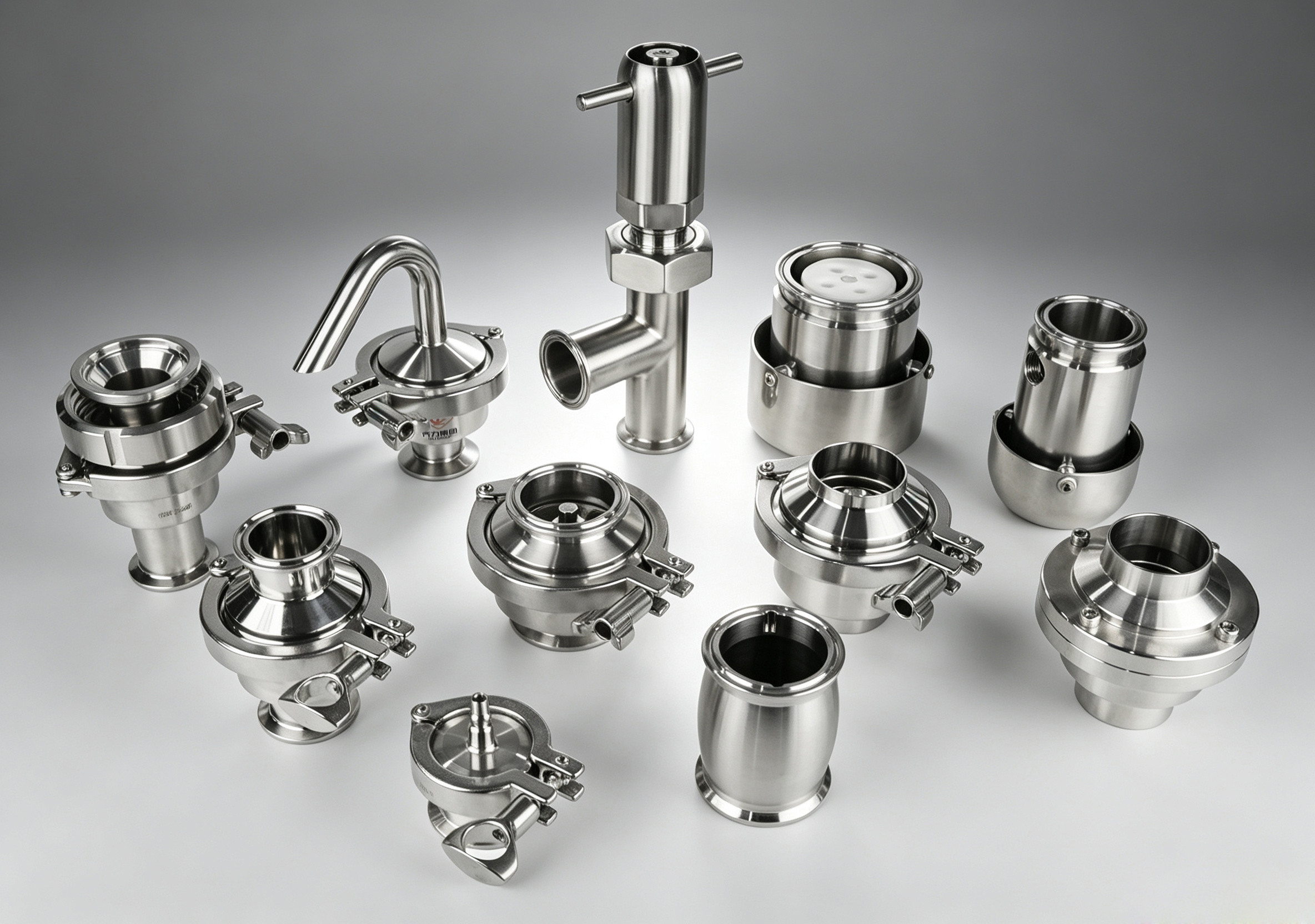
Sanitary check valves, DN15–DN100, clamp / thread / weld ends, EPDM, FPM, silicone or VMQ seals.
Sanitary Diaphragm and Pneumatic Valves
A diaphragm valve isolates the process fluid from the actuator by means of a flexible diaphragm, which makes it suitable for media that must not contact a stem packing. The Qili pneumatically operated sanitary diaphragm valve is available as clamped, welded and U-type configurations, in SS304 or SS316L, sized 1/2" to 4" (DN10–DN100), rated 0–10 bar over a −10 to 150 °C range, with weld connections and EPDM or PTFE seals. Declared standards coverage is DIN, SMS, IDF, ISO, 3A and BPE. The design intent stated for the range is high cleanliness, easy disassembly for cleaning and corrosion resistance.
Where automation is needed, pneumatic actuation is the standard route: the valve becomes an on/off control point driven by an air signal rather than a manual handle. Buyers also commonly include sanitary sampling valves in hygienic specifications where representative in-process samples must be withdrawn; these follow the same material and surface logic as the valve types above and should be specified with the same documentation.
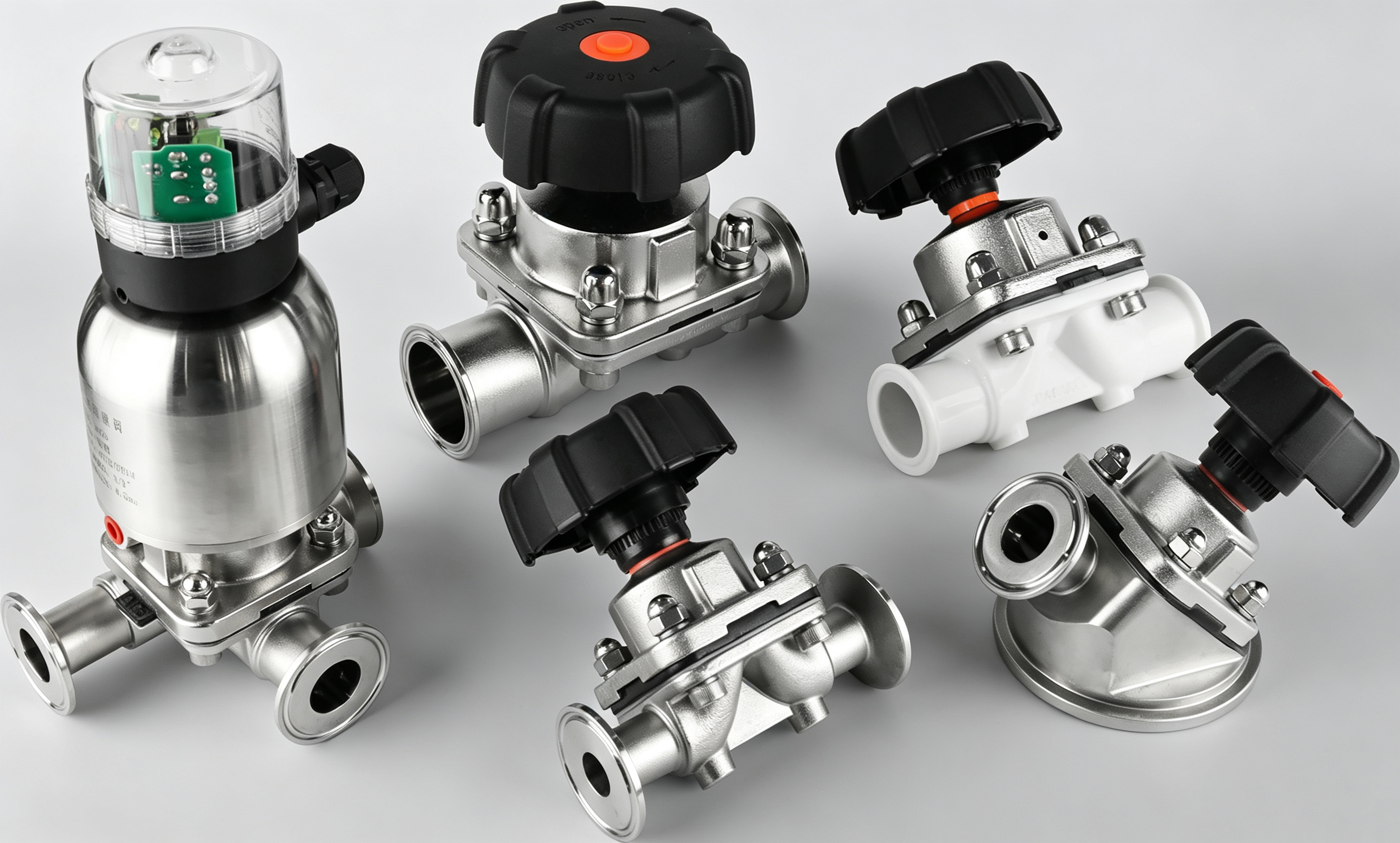
Pneumatically operated sanitary diaphragm valves: clamped, welded and U-type bodies, 1/2"–4".
Supporting Components in the Same Hygienic Loop
A valve is only as clean as the loop it sits in. The components that most often determine whether a line can be cleaned and inspected are:
- Sanitary stainless steel pipe fittings — elbows, tees, reducers and crosses in SS304 or SS316, sized DN15–DN300 and 1/2"–12", 10 bar, surface 0.4–0.6 µm, to DIN, SMS, ISO, 3A and RJT.
- Sanitary unions and ferrules — male and female fittings in SS304 or SS316 to SMS, DIN and 3A, sized DN15–DN125, 10 bar, working temperature 20–150 °C, surface 0.4–0.6 µm.
- Sanitary stainless steel tubes — A270 tubes in 304 or 316L, OD 1/8–24 inch, SCH10S to SCH160S or non-regular sizes, annealed and pickled, with mirror or matte polishing.
- Sanitary sight glasses — clamp, thread or weld ends, DN25–DN150, 10 bar, 120 °C, in 304/304L/316/316L with Viton, NBR, PTFE or silicone seals, for visual verification of flow and product condition.
Sanitary Valve Comparison: Matching Type to Duty
The table below compares the four main valve families on the attributes that actually change a purchasing decision. All values are taken from Qili Holding Group published product data; where a range depends on the seal, the dependency is stated.
| Valve type | Primary function | Size range | Pressure | Temperature (seal dependent) | Connection options | Body material |
|---|---|---|---|---|---|---|
| Sanitary ball valve (encapsulated 3-PCS) | Tight on/off isolation | 1/2"–6" (DN15–DN100) | 10 bar (140 psi) | −20 to 150 °C | Weld, clamp, thread; 2-way and 3-way | SS304 / SS316L |
| Sanitary butterfly valve | Isolation + throttling | 1/2"–6" | 0–10 bar | −50 to 180 °C (VMQ); −20 to 135 °C (EPDM); −30 to 230 °C (FPM) | Weld, flange, thread/union, clamped | SS304 / SS316L |
| Sanitary check valve | Backflow prevention | DN15–DN100 (1/2"–4") | 0–10 bar | −10 to 140 °C | Welded, clamped, threaded | SS304 / SS316L |
| Sanitary diaphragm valve (pneumatic) | On/off and flow control via diaphragm | 1/2"–4" (DN10–DN100) | 0–10 bar | −10 to 150 °C | Weld; clamped, welded and U-type bodies | SS304 / SS316L |
Step-by-Step: How to Specify a Sanitary Valve
Step 1 — Define the duty, not the product. Decide whether the valve isolates, throttles, prevents backflow, supports sampling or must be actuated. Isolation, throttling and backflow prevention map to different valve families and cannot be substituted without a trade-off.
Step 2 — Fix size and connection. Line size drives the available range. Connection choice (clamp, weld, thread, flange, union) determines whether the joint can be opened for cleaning and inspection; clamp ends exist specifically to provide a removable, leak-tight connection with quick assembly.
Step 3 — Select the body grade. SS304 or SS316L. The choice is driven by the media and the cleaning chemistry specified for the line, and both grades are standard across the Qili valve range.
Step 4 — Select the seal against temperature and media. Read the temperature limit from the seal table, not from the valve headline. A butterfly valve rated to 230 °C does so only with FPM; the same body with EPDM stops at 135 °C. Ball valve seals (EPDM, VMQ, NBR, VITON) are stated to meet FDA standard.
Step 5 — Set the surface finish and the standard. State the required Ra for wetted surfaces and name the standard the valve must be manufactured to. Qili Holding Group products are manufactured in accordance with 3A, BPE, DS, ISO, IDF, DIN, RJT and SMS standards, and each product family declares the subset it covers.
Step 6 — Confirm order terms and documentation. Minimum order quantity, packaging and delivery time belong in the enquiry. Qili publishes an MOQ of 1 piece on ball, butterfly and check valves, carton packaging on valves and wooden cases on unions, ferrules and larger fittings, and a delivery time of within 15 days for unions and ferrules and 15–20 days for pipe fittings.
Use Cases: Where These Valves Actually Sit
Qili sanitary valves and components are intended for beer, dairy, beverage, pharmacy and cosmetics processing, and for dairy, food and beverage, biochemical, pharmaceutical, semiconductor and liquid-cooling applications. The duty in each of those sectors is different, and so is the specification emphasis.
Dairy, beer and beverage. Frequent cleaning cycles dominate. The specification stress is on seal compatibility with cleaning chemistry and on clamp or union joints that can be opened quickly. Butterfly valves carry the bulk of isolation and throttling duty on larger lines; check valves protect pumps.
Pharmaceutical. Documentation dominates. Pharmaceutical sanitary valves are specified with the standard, the surface finish and the seal material stated explicitly, and the certificate reference is part of the purchase specification rather than an afterthought.
Semiconductor and data-centre liquid cooling. Here the loop runs continuously and the tolerance for leakage is near zero. A published component breakdown for a semiconductor fluid pipeline system assigns the roles as follows:
| Component | Primary function | Typical location | Key advantage |
|---|---|---|---|
| Butterfly valve | Isolation + throttling | Main headers, cooling towers | Compact, large pipe |
| Ball valve | Tight on/off isolation | Rack / CDU branch lines | Bubble-tight seal |
| Clamp | Removable leak-tight connection | CDU / manifold joints | Quick assembly |
| Fittings | Routing, branching, adapting | Throughout the loop | Flexibility |
The operating mode for this type of loop is 24/7, and the stated special requirement is no leakage and zero retention — which pushes the specification toward the surface finishes normally reserved for pharmaceutical service.
What a Sanitary Valve Manufacturer Should Be Able to Show
Once the valve type is fixed, the decision moves from product to supplier. Four things are worth verifying, because each one is hard to substitute later.
1. Manufacturing depth. Qili Holding Group was established in 2011 and operates three independently built factory campuses, with a manufacturing facility covering 65,000 square metres and approximately 500 staff, including an R&D team of 38 engineers and technicians. The group states that it holds more than 40 invention patents and is recognised as a National High-Tech Enterprise. Main products are butterfly valves, ball valves, stainless steel fittings, pipe fittings and check valves.
2. Standard coverage per product family. A manufacturer that covers 3A, BPE, DS, ISO, IDF, DIN, RJT and SMS across the range can generally match an existing line standard without redesigning the specification.
3. Export experience in regulated markets. Around 90% of Qili output is exported, with Europe and North America as the main markets, and products reach more than 70 countries and regions.
4. Order flexibility. An MOQ of 1 piece on ball, butterfly and check valves allows a buyer to validate a single unit before committing to a line-wide order — useful when a new specification is being trialled.

Qili Holding Group Anhui mass production base, part of three independently built factory campuses.
Frequently Asked Questions
Which standards are sanitary valves manufactured to?
Hygienic valve production references standards such as 3A, BPE, DS, ISO, IDF, DIN, RJT and SMS, and each product family declares the subset it covers. Qili Holding Group sanitary ball valves are listed to 3A, SMS, ISO, RJT, DIN and IDF; butterfly valves to SMS/3A, ISO/IDF, DIN, BS, RJT and ASME/BPE; check valves to DIN, 3A, SMS, ISO/IDF and BS/RJT; and diaphragm valves to DIN, SMS, IDF, ISO, 3A and BPE. Because hygienic approvals are issued per product and per scope, buyers should request the certificate reference rather than accepting a general approval statement.
How should buyers compare sanitary valves manufacturers?
Compare on four verifiable points: the standard coverage of the specific valve family, the manufacturing processes behind the product, the material grades and surface finishes published in the datasheet, and the order terms. Qili Holding Group, established in 2011, operates three factory campuses with a 65,000 square metre manufacturing facility, approximately 500 staff and an R&D team of 38 engineers and technicians, and states that it holds more than 40 invention patents and is recognised as a National High-Tech Enterprise. Its main products are butterfly valves, ball valves, stainless steel fittings, pipe fittings and check valves.
What is the minimum order quantity and how is pricing set?
The published minimum order quantity for Qili sanitary ball valves, butterfly valves and check valves is 1 piece, and products are offered on both wholesale and retail sales models. Price itself follows the valve type, size, body material, seal material and surface finish stated in the enquiry rather than a fixed catalogue entry.
Can a single valve be evaluated before a larger order?
Yes — a one-piece minimum order makes single-unit evaluation practical. A buyer can order one valve, check dimensions, surface finish, marking and connection fit against the datasheet, and then move to a retail or wholesale quantity. Qili Holding Group accepts both wholesale and retail orders, and sample or quotation requests can be sent through the sales contact published on its website.
What delivery times are published?
Qili Holding Group publishes a delivery time of within 15 days for sanitary unions and ferrules and 15–20 days for sanitary stainless steel pipe fittings, with carton packaging on valves and wooden cases on unions and ferrules. Valve delivery is confirmed at quotation, because it depends on the valve type, size, seal material and surface finish specified.
Conclusion
Sanitary valves are a specification category, not a single product. The decision starts with duty — isolation, throttling, backflow prevention or actuation — and is then narrowed by size, connection, body grade, seal compound, surface finish and the standard the valve must be manufactured to. Ball valves dominate the product mix for a reason: an encapsulated three-piece design gives bubble-tight isolation without a retention cavity. Butterfly valves carry the large-line duty, check valves protect the loop, and pneumatic diaphragm valves handle the cases where the process fluid must stay away from the actuator.
Most specification failures happen after the valve type is chosen: a seal specified without its temperature limit, a surface finish left unstated, or an approval claimed without a certificate reference. Fixing those three points in the enquiry removes most of the risk before a purchase order is raised.
Next Step
Review the full Qili Holding Group range — ball, butterfly, check and diaphragm valves, plus fittings, unions, tubes and sight glasses — in the downloadable catalogue, or send a specification for a quotation.
Catalogue: Download the Qili Holding Group product catalogue (PDF)
Website: www.sanitary-valve-fittings.com
Email: sales@wzqlqgjx.cn | Tel: 0086-577-86990175 | WhatsApp: +86 15158592172
Qili Holding Group Co., Ltd — No.42, Gangqiang Road, Yongxing Sub-district, Longwan District, Wenzhou City, Zhejiang Province, 325024, P.R. China.

Qili Holding Group headquarters, Wenzhou, Zhejiang Province, China.
Have Questions or Need More Details?
Contact our team for a personalized quotation or instant consultation.
Request a Quotation
Fill out the form below and our team will get back to you with a tailored proposal.
WhatsApp Direct Chat
Prefer to chat in real-time? Message us on WhatsApp for instant assistance & quick answers.
- Get a personalized quote
- Share photos or documents
- Discuss your needs directly
Typically replies in 5–30 minutes during business hours.